
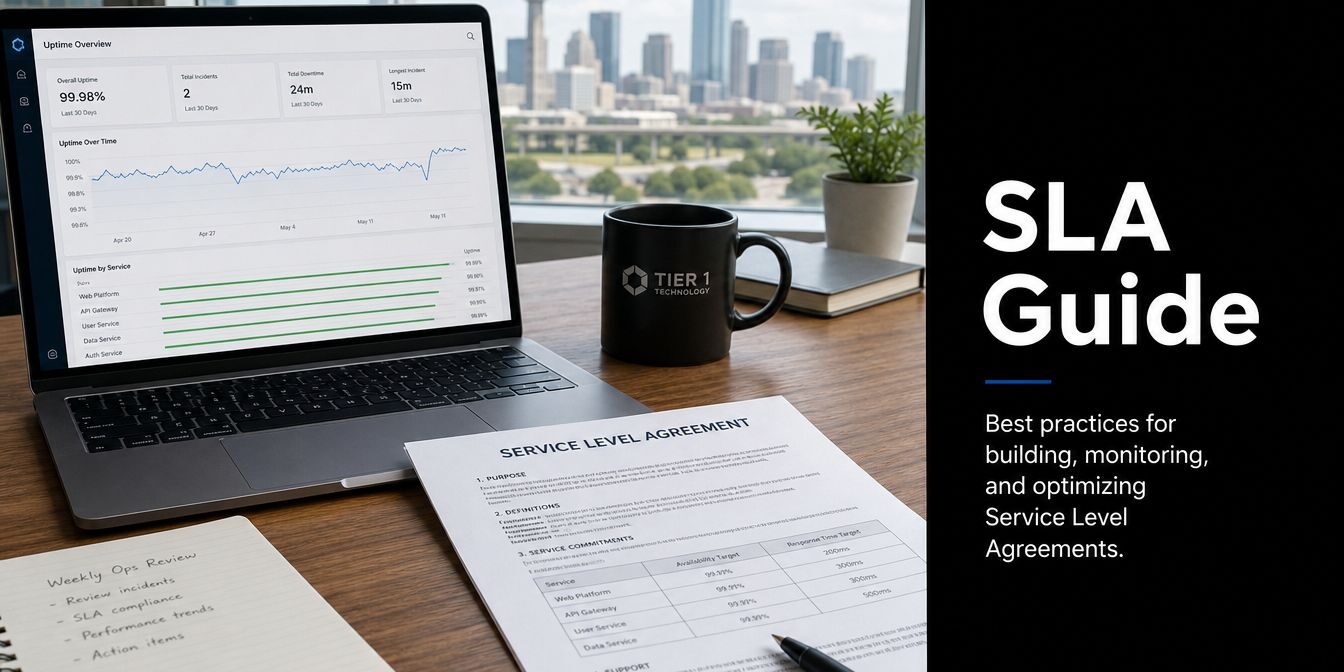
A Dallas-Fort Worth business owner usually notices the need for service level agreements at the worst possible moment. The phones are active, staff can't reach a critical system, and the IT provider says someone will “take a look soon.” That answer might have worked when the company was smaller. It doesn't work when patient schedules, client files, accounting deadlines, or project drawings depend on reliable systems.
For many SMBs, the problem isn't the absence of support. It's the absence of clear expectations. If the contract doesn't spell out what's covered, how quickly the provider responds, how performance is measured, and what happens when service slips, the business is relying on assumptions. In healthcare, finance, and legal environments, assumptions create operational and compliance risk.
Table of Contents
- Beyond a Handshake Why Your DFW Business Needs an SLA
- Deconstructing Your SLA The Core Components Explained
- Key SLA Metrics That Actually Matter for Your Business
- Penalties and Reporting How to Ensure Accountability
- Negotiating Your SLA A Guide for DFWs Regulated Industries
- SLA Evaluation Checklist for Dallas Fort Worth Businesses
- Your Path to a Stronger IT Partnership
Beyond a Handshake Why Your DFW Business Needs an SLA
A familiar scenario plays out across North Texas. A clinic loses access to a line-of-business application on a busy Tuesday morning. The office manager calls support and gets a polite answer, but no real commitment. No one can say whether the issue is covered, how fast a technician should respond, or when leadership should be updated. The business isn't just dealing with a technical problem. It's dealing with uncertainty.
That's what a solid service level agreement is supposed to remove. It turns “we'll help when we can” into a documented operating agreement between the business and its IT partner. It gives both sides the same definition of success.
A strong SLA prevents arguments by settling expectations before the outage happens.
The structure matters because not every business needs the same type of agreement. There are three primary categories of SLAs: customer-based, service-level, and multilevel agreements, as outlined in this explanation of SLA categories. Customer-based SLAs fit organizations that need one agreement across a broad portfolio. Service-level SLAs apply the same terms to a standard service for all clients. Multilevel SLAs layer general terms with group-specific and customer-specific obligations.
For a DFW accounting firm, a service-level arrangement may work for standardized help desk support, but not for sensitive tax systems or retention requirements. A medical practice may need a multilevel structure because one part of the business depends on standard device support while another depends on tighter handling for regulated data and after-hours escalation.
A handshake is fine for trust. It's not enough for operations.
Businesses that outsource support often get the most value when expectations are written at the same level of detail as the services themselves. That's one reason many owners reviewing the benefits of outsourced IT support end up focusing less on price and more on accountability. Cheap support that arrives vaguely is often expensive in practice.
Deconstructing Your SLA The Core Components Explained
Most service level agreements look more complicated than they really are. Once broken apart, they read like a blueprint. Each section answers a basic business question: what's covered, how performance is measured, who owns which tasks, and what happens if something goes wrong.
What belongs in the service definition
The first thing to inspect is the scope of services. If a document says “managed IT support” without listing systems, support channels, service hours, covered locations, and excluded work, the agreement is still too loose.
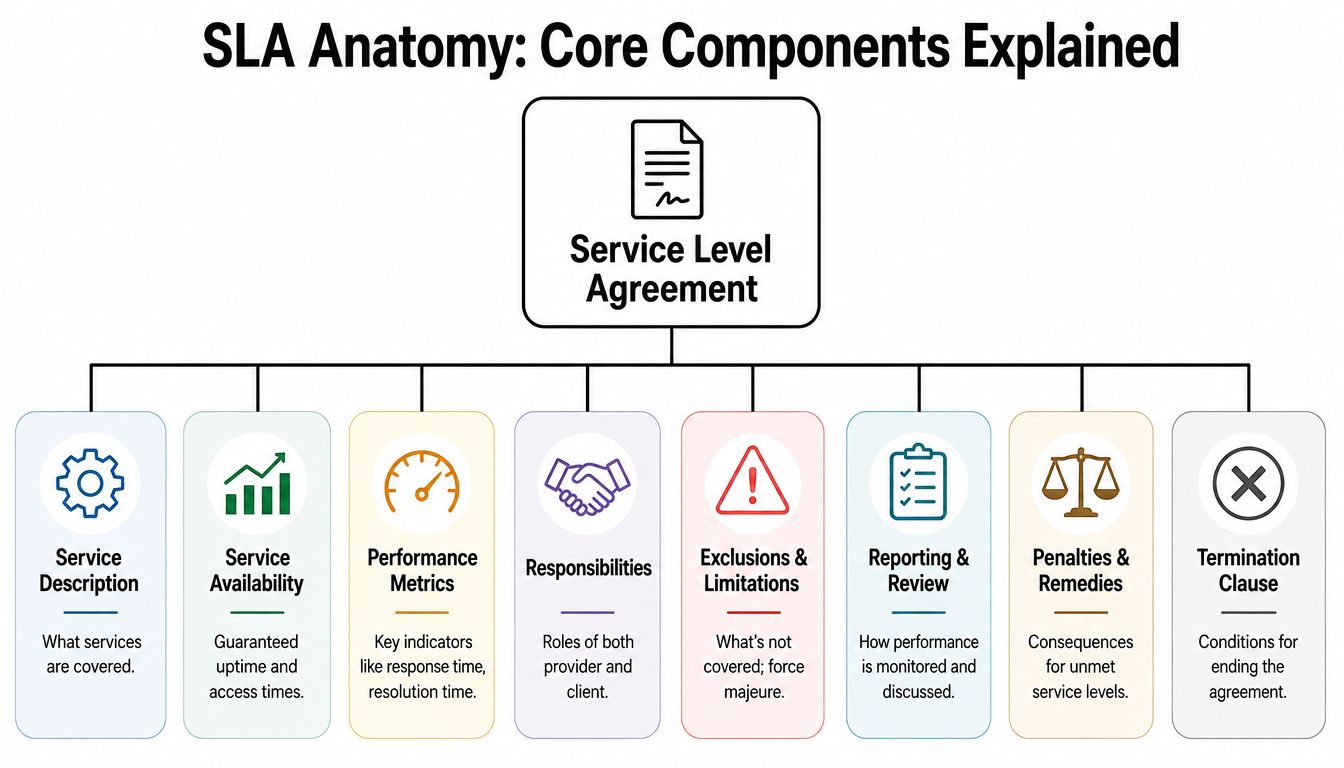
A workable SLA usually includes these parts:
- Service description. Which devices, users, cloud systems, networks, and security functions are included.
- Availability commitment. What the provider is promising the business can count on.
- Response and resolution targets. How quickly the provider acknowledges and addresses different issue severities.
- Roles and responsibilities. What the provider owns, and what the client must supply.
- Exclusions and limitations. Projects, third-party software issues, onsite work, force majeure events, and after-hours requests.
- Review and reporting terms. How performance is measured, reported, and discussed.
- Remedies and termination language. What recourse exists if service repeatedly misses target.
Technology SLAs often define uptime using standard benchmarks of 99.5% or 99.9% monthly uptime, and they commonly specify response targets such as acknowledging severe issues within 1 hour and resolving them within 4 hours, according to this overview of common SLA metrics.
For businesses that depend on continuity planning, the SLA should also connect to backup and recovery duties. A practical companion resource is this guide to cloud-native disaster recovery, which helps frame the difference between “the system is backed up” and “the business can recover in an acceptable way.”
Where accountability usually breaks down
The weak point in many agreements isn't the legal language. It's the missing operational detail.
A provider may promise strong support, but if the SLA doesn't define severity levels, service windows, approval dependencies, and escalation steps, every major issue becomes a debate. Consequently, business owners should ask whether the support model matches the actual need. A company trying to compare basic triage, deeper engineering, and strategic oversight can use this breakdown of tiers of IT support to pressure test whether the SLA aligns with the support stack being sold.
Practical rule: If a provider can't explain how an incident moves from ticket intake to escalation to closure, the SLA probably won't protect the business under pressure.
Key SLA Metrics That Actually Matter for Your Business
Some SLA metrics look impressive and still fail to protect the business. The test is simple. If a metric can't be tied to user productivity, client service, compliance exposure, or recovery speed, it's probably not the right metric to focus on.
Translate technical metrics into business impact
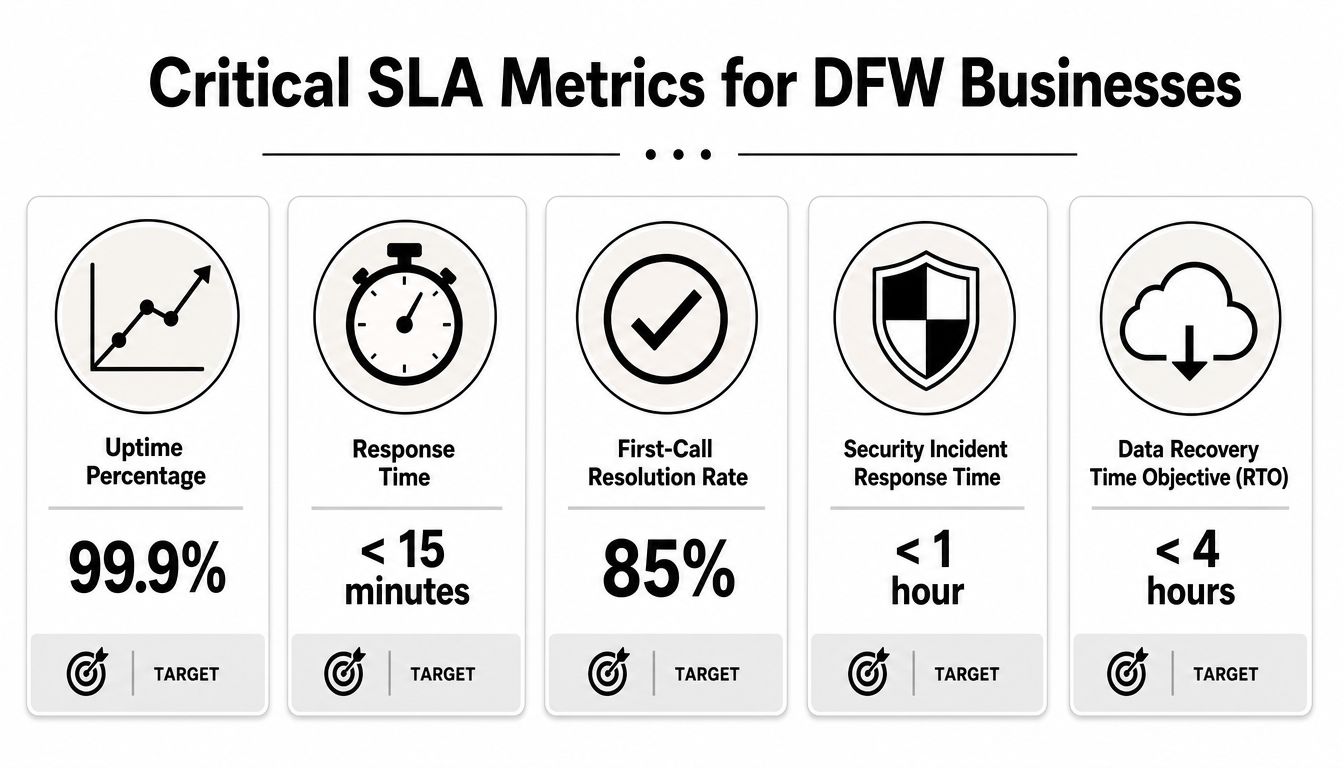
The first metric most owners notice is uptime. That matters, but only when the business understands what the number means in real terms. A technically rigorous SLA can define targets such as 99.9% uptime and a 15-minute response time for critical incidents, and those targets should be based on historical performance and realistic benchmarks, according to this discussion of measurable SLOs.
The same source notes an important trade-off. A 99.99% availability target implies roughly 52 minutes of annual downtime, while 99.9% uptime implies around 8.76 hours annually. That gap isn't just a technical nuance. It changes architecture, staffing expectations, failover planning, and budget.
For a small legal office, that may mean deciding whether a document platform can be briefly unavailable outside trial prep windows. For a healthcare group, even a short interruption during active patient scheduling or chart access may be unacceptable. The right number depends on the business process, not on marketing language.
A useful way to evaluate metrics is to ask what each one protects:
| Metric | What it actually protects |
|---|---|
| Uptime | Access to systems |
| Response time | Speed of acknowledgement |
| Resolution time | Business restoration |
| Recovery target | Continuity after failure |
| Security response | Containment of active risk |
What good SLOs look like
The strongest SLAs separate response from resolution. Fast acknowledgement with slow restoration won't keep operations running. A provider can meet a response target and still leave users blocked for too long.
Business owners should look for measurable objectives that answer these questions:
- How fast is a critical incident acknowledged? This defines whether the issue is being actively managed.
- How fast is service restored? This is what users directly experience.
- How are priorities assigned? Critical outages, degraded performance, and routine requests shouldn't share the same clock.
- What hours apply? A target tied to business hours works differently from one tied to continuous support.
- What data supports the target? The provider should be able to explain why the commitment is credible.
Good SLOs are disciplined, not ambitious. They should fit the provider's delivery model and the client's risk profile.
If a target sounds aggressive but the provider can't explain the staffing, monitoring, and escalation behind it, the business is buying language, not reliability.
Penalties and Reporting How to Ensure Accountability
A promise without evidence doesn't create accountability. It creates a sales talking point. Enforcement of service level agreements stems from two places: remedies when service misses target, and transparent reporting that shows what happened.
Why service credits matter less than most people think
An SLA should include an explicit remedy when performance drops below the minimum standard. One common mechanism is the service credit. Effective SLAs may provide pricing discounts of 5% to 10% of monthly fees when minimum service levels are missed, as described in this summary of SLA remedies and reporting practices.
That sounds useful, and it has value. A provider should feel a financial consequence when it fails to deliver. But service credits are usually a secondary protection, not the main one. A discount on the monthly bill doesn't restore lost operating time, repair a damaged client relationship, or unwind a compliance problem.
The better view is this: remedies matter because they prove the SLA has teeth. They don't replace the need for operational discipline.
What reporting should look like
The same source explains that a rigorous SLA should also define measurement methodology, reporting frequency, and a dispute window, such as monthly automated reporting and a 7-day dispute period for discrepancies. That language matters because performance data has to be auditable, not improvised after a disagreement starts.
A useful reporting package should show more than a green summary line. It should reveal whether the provider is consistently meeting commitments or just barely avoiding breach.
A business owner should expect reporting that includes:
- Ticket performance by priority. Critical issues should be separated from routine support.
- Availability summaries tied to covered systems. Broad averages can hide failure in a key application.
- Root cause notes for major incidents. Not legal theater. Actual explanation.
- Escalation history. When the issue moved, who took ownership, and whether delays were customer-side or provider-side.
- Review cadence. Someone from each side should discuss trends, not just archive a PDF.
This is also where ongoing visibility matters. If the provider offers little insight into active performance, the agreement is weak even if the language looks polished. Businesses evaluating whether that visibility exists often benefit from understanding what network monitoring should include before they sign.
Reporting should answer a hard question quickly: did the provider meet the agreement, and if not, why not?
Negotiating Your SLA A Guide for DFWs Regulated Industries
Generic SLAs create the most risk in businesses with legal, financial, or privacy obligations. A Dallas medical clinic, wealth advisory office, or law firm doesn't just need “good support.” It needs contract terms that reflect how data is handled, how incidents are escalated, and how service interruptions affect regulated work.

Turn compliance duties into contract language
The strongest negotiation move is to stop talking about the SLA as a support document and start treating it as a business risk document. That changes the questions.
Instead of asking only, “What uptime do you guarantee?” regulated businesses should ask:
- How is protected or confidential data accessed and handled during support?
- What are the incident notification steps if a security event affects regulated information?
- Which systems require tighter recovery expectations because they support regulated workflows?
- What records are retained to prove service delivery and issue handling?
- Where do contractual privacy duties sit if a third party touches sensitive data?
A useful supporting reference for contract review is this overview of a data protection clause. It helps frame how privacy language should interact with operational support obligations rather than sit in a separate legal silo.
For regulated SMBs, it also helps to separate routine inconvenience from business-critical harm. A printer outage is disruptive. Loss of access to patient scheduling, trust accounting support systems, or financial reporting workflows can trigger bigger consequences. The SLA should identify those systems and assign more serious handling standards.
Move beyond credit based thinking
One of the biggest blind spots in SLA negotiation is overreliance on service credits. Research highlighted in this analysis of SLA disputes and XLA trends notes that 78% of SLA disputes arise because service credits don't compensate for the actual operational downtime or compliance exposure experienced by clients. The same source points to a projected shift in 2025 to 2026 toward Experience-Level Agreements, with 63% of forward-looking MSPs embedding XLA frameworks into their SLAs.
That trend matters because regulated businesses often care less about raw uptime than about whether users can do regulated work without friction or delay. A server can be technically “up” while staff still can't process claims, retrieve client records, or complete financial workflows.
That doesn't mean every SMB needs a formal XLA program. It does mean the negotiation should include outcome-based questions such as:
- Can staff access critical systems during business peaks?
- Are security incidents handled in a way that limits business interruption?
- Does reporting show user impact, not just system status?
- Do remedies include escalation, corrective action, and review, not just credits?
A better SLA for a regulated DFW business is one that ties service promises to continuity, not just to infrastructure percentages.
SLA Evaluation Checklist for Dallas Fort Worth Businesses
A business owner reviewing service level agreements shouldn't have to read like a lawyer to spot a weak contract. A practical checklist helps separate clear agreements from vague ones.
Use this checklist before signing
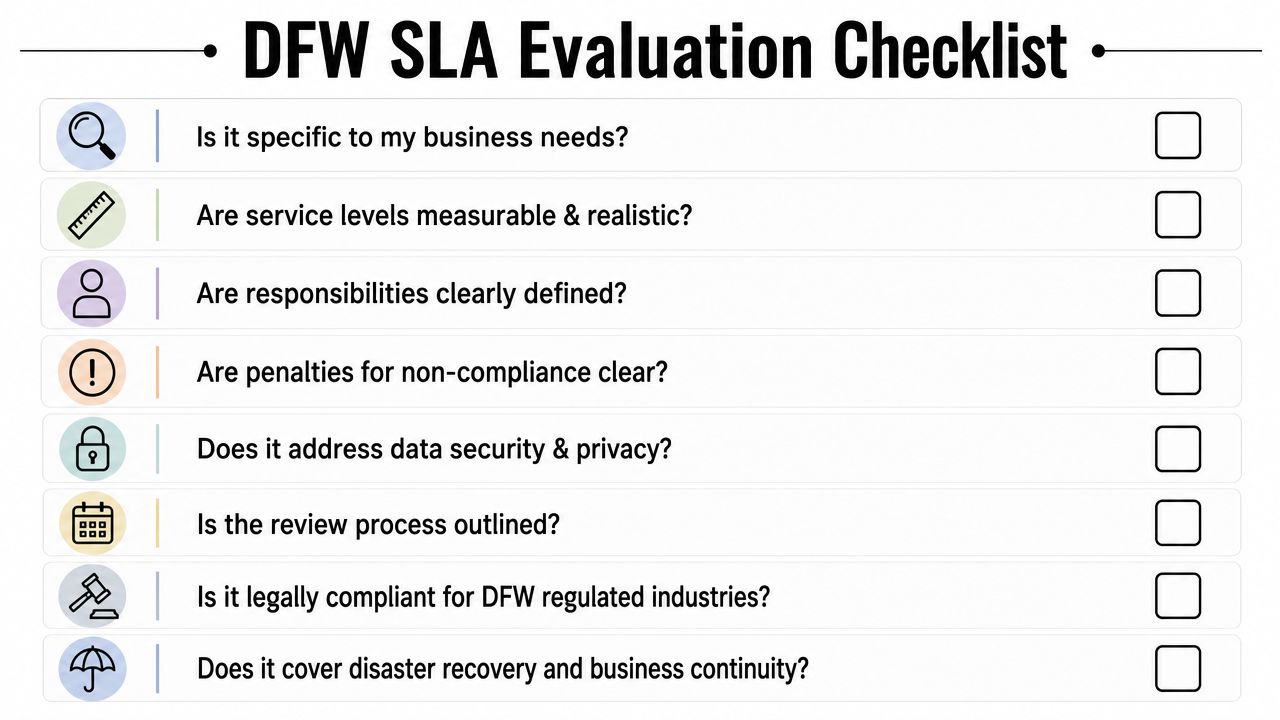
Run through these questions before approving any SLA:
- Is the service scope specific? Covered systems, locations, user groups, support hours, and excluded work should all be named.
- Are service levels measurable and realistic? If the target can't be tracked, it can't be enforced.
- Are severity levels clearly defined? A critical outage should not be left open to interpretation.
- Are customer responsibilities stated? Approval delays, access requirements, and required contacts should be documented.
- Does the agreement address security and privacy duties? For regulated businesses, this can't be left to generic terms.
- Is the reporting process explained? The provider should say what gets reported, how often, and how disputes are handled.
- Are business continuity expectations included? Backup, restoration, and escalation should connect to operations.
- Can the contract be reviewed and updated? An SLA should change when the business changes.
A business that already uses operational checklists in other areas may find it useful to compare how it reviews vendors with broader audit habits. For example, WebAbility.io's ultimate checklist is about website audits, but the discipline behind it applies here too. Good evaluation means asking direct questions before something breaks.
Common red flags in SMB agreements
Some warning signs show up repeatedly:
“Unlimited support” means very little if the contract never defines what support includes.
Other red flags include:
- Bundled language with no exclusions. That often leads to billing disputes later.
- One response target for everything. Password resets and business outages need different treatment.
- No measurement method. If the provider is the sole judge of performance, the client has little power.
- Credits with no corrective action process. The provider needs a path to fix repeated failure, not just compensate for it.
- Compliance language separated from operations. In regulated businesses, that gap creates avoidable risk.
The best checklist question is simple: if a serious issue happens next week, will the agreement tell both sides exactly what to do?
Your Path to a Stronger IT Partnership
The best service level agreements don't exist to punish an IT provider. They exist to make the relationship work under pressure. When expectations are precise, the business knows what it's buying, the provider knows what it must deliver, and both sides have a shared process for handling disruption.
That's especially important in DFW industries where downtime affects more than convenience. Healthcare, finance, legal services, and security-conscious businesses need support agreements that reflect continuity, privacy, and operational reality. A clean SLA won't eliminate every incident, but it does remove confusion, shorten disputes, and improve decision-making when time matters.
Leaders who want a stronger governance mindset around service delivery can also review this perspective on governing security services effectively. The same principle applies here. Clear governance creates better outcomes than vague expectations.
A business that wants more from its IT relationship should expect more from the contract behind it. That means measurable commitments, transparent reporting, practical remedies, and language that fits the actual risk environment.
Technovation LLC helps Dallas-Fort Worth businesses turn vague IT expectations into clear, enforceable service agreements that support compliance, continuity, and day-to-day operations. For organizations that want a second opinion on an existing SLA, or a stronger framework before signing a new managed services contract, Technovation LLC can review the agreement and help align it with real business needs.