An agency owner in Dallas-Fort Worth often lives in two worlds at once. One world is sales, renewals, carrier relationships, and staff management. The other is quieter but far riskier: shared inboxes full of policy documents, employee laptops connecting from home, scanned IDs sitting in folders, and a line-of-business system that has to stay available every business day.
That second world usually gets attention only when something breaks. That's the mistake.
Insurance agencies hold sensitive client information by default. They also depend on consistent system access, documented controls, and reliable communication. A locked account, failed backup, exposed mailbox, or unsupported remote device doesn't just create inconvenience. It threatens service continuity, client trust, and in some cases insurability itself.
The right conversation isn't “Who fixes computers fastest?” A more pertinent question is whether the agency's technology stack can support resilience, compliance, and growth without constant friction. That's where specialized insurance IT support earns its place. It doesn't sit on the sidelines as overhead. It protects operations, supports underwriting readiness, and gives leadership a clearer path to scale without gambling on fragile systems.
Table of Contents
- Introduction The Hidden Risk in Every Insurance Agency
- What Is Specialized Insurance IT Support
- The Core Services Your Agency Needs to Thrive
- From Expense to Asset The Business Case for Specialized IT
- Your Checklist for Choosing an IT Partner in DFW
- The Partnership Roadmap to IT Resilience
- Secure Your Agency's Future Today
Introduction The Hidden Risk in Every Insurance Agency
A typical agency morning doesn't look dangerous. A producer needs access to a policy file. A CSR resets a password for a client portal. Someone forwards a certificate request from a phone while driving between appointments. A new hire starts and needs system access before lunch. Nothing about that feels dramatic.
But stack those moments together and the pattern becomes obvious. The agency is moving private data through email, browsers, mobile devices, scanners, shared folders, and cloud apps all day long. That creates a business environment where one weak process can ripple through the entire office.
A lot of owners know this in the abstract. They just haven't had time to deal with it in a structured way. Revenue-generating work always wins the day. Technology gets pushed into a reactive lane, where support means fixing printers, restarting workstations, and hoping the backup ran.
Practical rule: If an agency only talks about IT after an outage, that agency doesn't have an IT strategy. It has a repair habit.
That's why insurance IT support has to be treated differently from generic office tech help. The issue isn't whether the internet works. The issue is whether the agency can protect sensitive records, keep systems available, support staff securely from any location, and show enough operational maturity to satisfy clients, carriers, and insurance requirements.
Resilience matters more than perfection. Agencies don't need a flashy stack. They need stable systems, clear controls, documented processes, and support that understands how insurance work gets done.
What Is Specialized Insurance IT Support

Specialized insurance IT support is the difference between a general doctor and a heart surgeon. Both work in medicine. Only one is built for high-stakes complexity.
Generic IT support usually handles everyday issues well enough. Password resets, device setup, software installs, mailbox problems, and basic troubleshooting all fit that model. That's useful, but it's not enough for an insurance agency that depends on secure workflows, continuous access to core platforms, and documented safeguards around sensitive information.
Generic support handles devices. Specialized support protects operations.
Insurance agencies don't just need functioning hardware. They need support aligned to how the business operates.
That means the support team has to understand:
- Line-of-business dependence: Agency staff can't lose access to management systems, shared records, or communications during business hours.
- Regulated data handling: Agencies routinely process financial, personal, and in some cases health-related information.
- Escalation discipline: Not every issue belongs at the help desk. Some problems involve integrations, permissions, backend settings, or application behavior that require deeper expertise.
A properly structured support organization matters. Industry guidance on tiered support explains that L1 handles basic user issues, L2 addresses more complex technical problems, and L3 manages critical system-level issues involving advanced troubleshooting and engineering coordination. It also notes that well-defined support tiers with automated routing can improve issue resolution speed by up to 35% and reduce repeat tickets by 25% according to this overview of L1, L2, and L3 support models. Agencies that want fewer recurring problems should care about that.
Insurance workflows require a deeper support model
Insurance operations are becoming more technology-driven, not less. In 2025, 81 percent of insurers globally reported using AI for operational cost reduction, and 44 percent applied AI to underwriting processes, according to global insurance industry data. That shift matters even for smaller agencies because AI-enabled workflows, automation, and reporting all depend on cleaner systems, stronger data handling, and support that can scale beyond break-fix work.
An agency owner should expect insurance IT support to include strategy, not just response. It should address access controls, documentation, backup integrity, remote work standards, application performance, and structured escalation. It should also map support tasks to actual business risk, which is why a clear tiered support structure matters so much.
Agencies don't outgrow generic IT because they get bigger. They outgrow it because the consequences of weak support get more expensive.
That's the definition. Specialized insurance IT support protects the agency's ability to operate, comply, and qualify for the business opportunities that weaker systems block.
The Core Services Your Agency Needs to Thrive
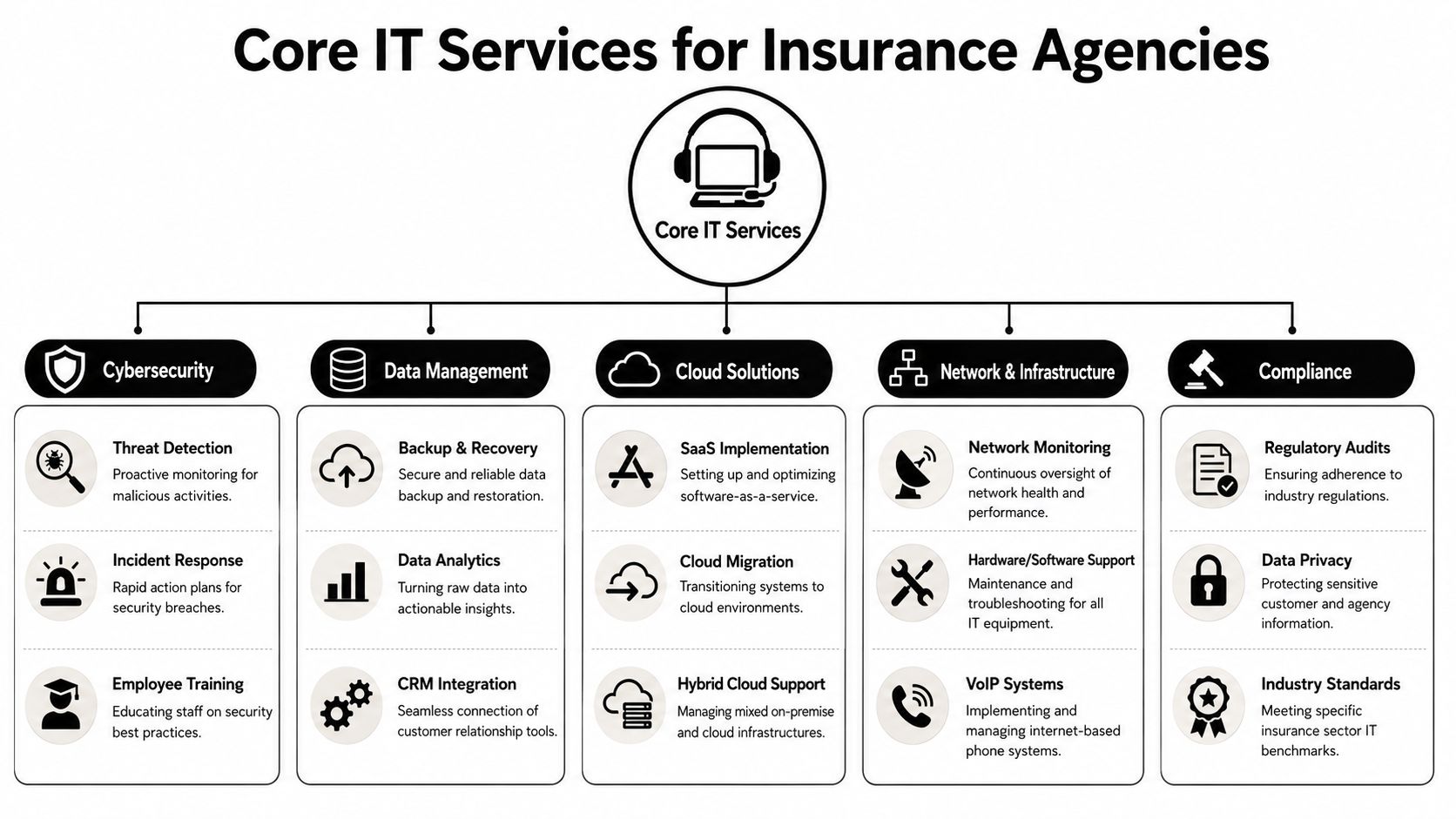
The fastest way to evaluate an agency's IT posture is simple. Look at whether the environment is protected, recoverable, documented, and usable from anywhere without inviting chaos. If one of those pillars is weak, the agency is carrying unnecessary risk.
This visual captures the service stack that matters most.
Proactive cybersecurity
Reactive security is a losing model. Waiting for suspicious activity to become a visible problem is how agencies end up dealing with compromised accounts, wire fraud attempts, or encrypted files.
Insurance IT support should put layered defenses in place before staff notice anything is wrong. Core measures include multi-layered firewalls, endpoint protection, email security, regular vulnerability assessments, and automated daily backups following the 3-2-1 rule according to managed IT guidance for insurance agencies. That same source reports 99.8% average network uptime and critical issue response times under 15 minutes from providers using proactive monitoring and patch automation.
For an agency owner, that translates into fewer emergencies and far less operational drift.
Regulatory compliance readiness
Compliance readiness isn't a binder on a shelf. It's a living operating discipline.
Agencies need systems that can track policy-related documentation, preserve audit trails, control access to sensitive records, and show that security practices are applied consistently. If leadership can't answer who has access to what, where key records live, and how changes are tracked, the agency has a compliance problem even if no regulator has called yet.
A serious provider also helps the agency tighten account governance and user permissions. That's where stronger identity management services become part of risk control, not just account administration.
Automated data backup and recovery
Backup failures often go unnoticed. That's why agencies shouldn't ask whether they “have backups.” They should ask whether data can be restored quickly and cleanly.
A recovery plan should cover:
- Daily protected copies: Backups should run automatically and be checked, not assumed.
- Multiple storage paths: The 3-2-1 structure exists for a reason. One copy isn't a recovery plan.
- Recovery testing: Restore capability matters more than backup completion notices.
A backup that hasn't been tested is just a hopeful file copy.
Agencies often discover this too late, after deletion, ransomware, sync corruption, or a failed workstation replacement. Recovery planning belongs in normal operations, not crisis mode.
Secure remote access
Remote access is now standard operating reality. Producers travel. Staff work from home. Owners approve requests after hours. The problem isn't remote work itself. The problem is sloppy remote work.
Secure access should separate business activity from unmanaged exposure. That means approved devices, controlled sign-ins, defined permission levels, and practical rules for file access outside the office. Agencies that still rely on ad hoc remote methods usually create blind spots around who accessed what and from where.
The right insurance IT support model treats remote access like a governed business process. It doesn't leave it to employee improvisation.
Endpoint protection
Every laptop, desktop, and mobile endpoint is a possible entry point. That sounds technical, but the business meaning is simple. If a device touches agency systems, it can create agency risk.
Endpoint protection should include policy-based controls, malware defense, patching discipline, and visibility into device health. It should also support quick isolation if a device starts behaving suspiciously.
Agencies don't need every machine treated the same way. A workstation used by accounting, agency leadership, or anyone accessing especially sensitive records deserves tighter control than a generic kiosk or conference room device. Good support reflects that difference instead of applying one flat rule to every endpoint.
From Expense to Asset The Business Case for Specialized IT
A lot of agency owners still treat IT like rent. Necessary, annoying, and hard to connect directly to growth. That mindset is outdated.
Specialized insurance IT support creates a business advantage. It affects whether the agency can satisfy underwriting expectations, maintain service continuity, support client trust, and compete for better opportunities without operational drag. That's not overhead. That's infrastructure for revenue protection and controlled growth.
Eligibility now follows operational discipline
Cyber insurance has moved from niche product to mainstream business requirement. The global cyber insurance market reached approximately $16.6 billion in 2024, and analysts project it will reach about $19 billion by 2026, according to cyber insurance market data. That growth doesn't just signal demand. It signals scrutiny.
Insurers want evidence of resilience. Agencies and the businesses they serve increasingly face underwriting questions about backups, endpoint controls, account security, and incident response readiness. Weak answers can lead to tougher terms, exclusions, delays, or failed applications.
That changes the role of IT completely. Support is no longer just there to keep machines running. It helps the business qualify.
Downtime costs more than the monthly invoice
When an agency management system slows down or access breaks, the damage doesn't stay in the IT lane. Producers lose time. Service teams delay client responses. Billing tasks stack up. Internal confidence drops. Small interruptions become workflow friction, and friction always shows up somewhere in margins, service quality, or staff burnout.
The better way to think about insurance IT support is as business continuity engineering. It protects the systems that let the agency quote, renew, document, communicate, and collect. Every hour of preventable disruption taxes the entire office.
Consider the difference between these two operating models:
- Reactive model: Staff report issues after work stops, support responds when available, and root causes often linger.
- Managed model: Systems are monitored, risks are addressed early, and recurring issues are documented and corrected before they spread.
One approach purchases interruption. The other purchases stability.
The real return on IT isn't flashy technology. It's a calmer office, fewer disruptions, and a business that can keep moving when something goes wrong.
Stronger IT creates room to grow
Growth adds complexity faster than many owners expect. More employees mean more devices, accounts, permissions, workflows, and client records. More partners mean more contractual requirements. More remote work means more attack surface and more support demands.
That's where specialized support starts paying off beyond protection. It gives leadership cleaner onboarding, better process consistency, stronger visibility, and a more credible operating posture when larger clients or partners ask hard questions.
For DFW agencies that want to move upmarket, expand into more regulated niches, or support hybrid teams without constant headaches, insurance IT support isn't a side function. It's part of the business model.
Your Checklist for Choosing an IT Partner in DFW
Most agencies don't need another smooth sales presentation. They need a filter that exposes weak providers before a contract gets signed.
A qualified partner should be able to answer practical questions without dodging specifics. If answers stay vague, the agency should keep looking.
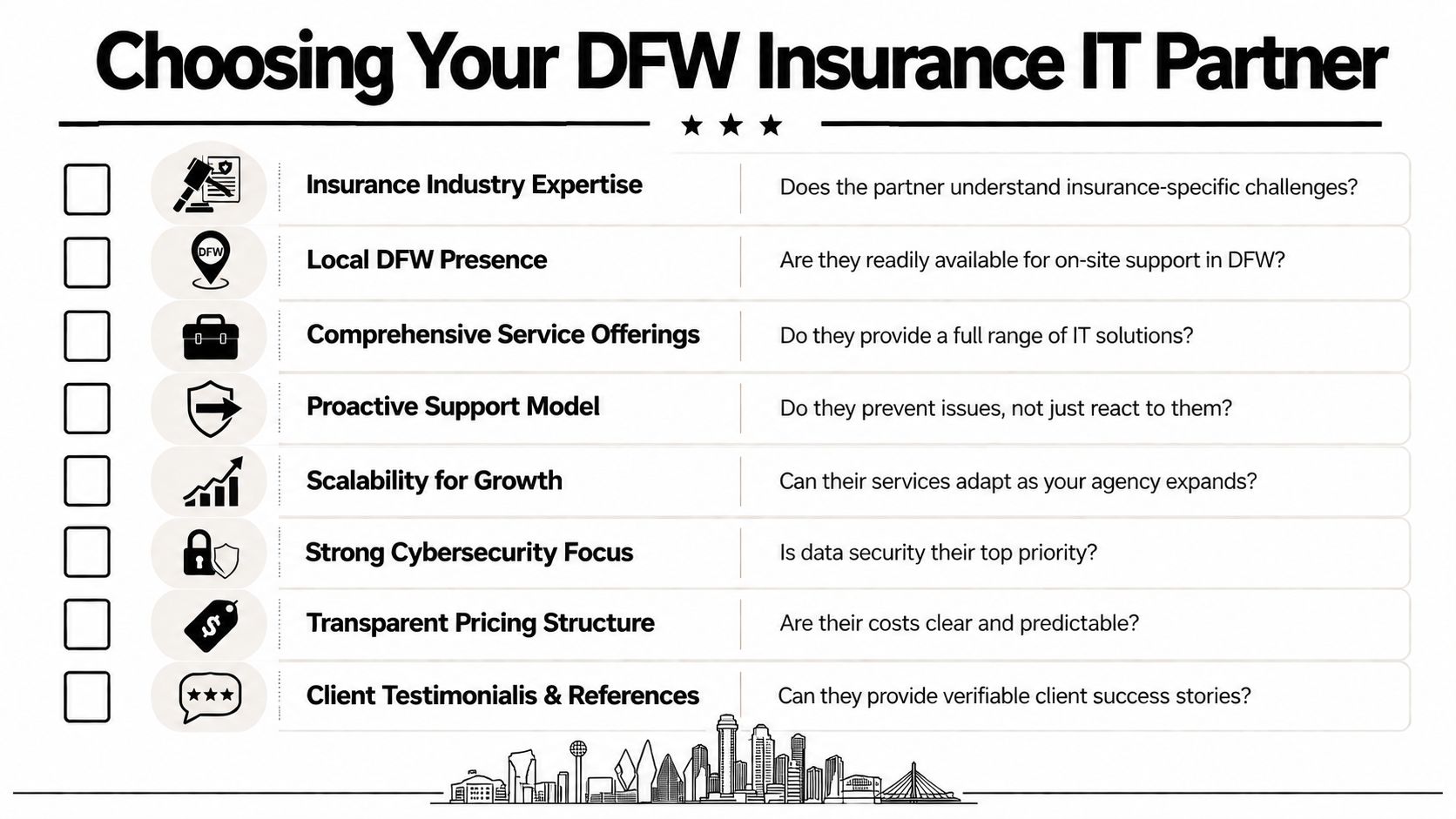
Questions that expose weak providers fast
An agency owner should ask:
- How do support escalations work: If every issue goes through one general queue, complex problems will sit too long.
- How do you handle access governance: Password resets are easy. Permission discipline is harder and more important.
- How do you support compliance documentation: Security work that isn't documented becomes difficult to prove.
- How do you secure remote staff and personally used devices: A provider should have a clear answer, not a shrug.
- How do you help clients prepare for insurance or partner requirements: This is a business issue, not just a technical one.
Contractual requirements deserve special attention. Enterprise agreements often require technology service providers, including IT consultants, to carry specific Technology Errors & Omissions and cyber insurance with defined liability limits, as explained in this analysis of business insurance requirements. Providers that understand that environment tend to think more clearly about risk transfer, documentation, and accountability.
For agencies that want a stronger evaluation framework, this guide on how to choose a managed service provider is worth reviewing before signing anything.
Generic IT vs. Specialized Insurance IT Support
| Feature | Generic IT Provider | Specialized Partner (like Technovation) |
|---|---|---|
| Support model | Broad help desk with general troubleshooting | Structured support aligned to business-critical insurance workflows |
| Security posture | Basic reactive controls | Layered protections tied to operational risk |
| Compliance support | Limited documentation help | Ongoing readiness, audit support, and process discipline |
| Remote work support | Convenience-focused access | Secure, policy-driven access with tighter control |
| Business alignment | Device and ticket focus | Eligibility, resilience, continuity, and growth focus |
| Strategic planning | Often ad hoc | Regular planning tied to agency goals and risk profile |
Why local context matters in DFW
DFW agencies benefit from a local partner for practical reasons. On-site support is easier to arrange. Leadership meetings happen faster. Infrastructure decisions can be made with direct knowledge of the local business environment, staffing realities, and growth patterns common to the region.
That local factor shouldn't replace technical depth, but it should strengthen it. A provider that can show up, understand the office, and translate technical risks into business decisions usually delivers a far better working relationship than one operating at a distance.
The Partnership Roadmap to IT Resilience
Owners often delay action because they assume fixing IT will turn into a giant disruptive project. It doesn't have to. A disciplined partnership should feel controlled, staged, and understandable from day one.
This is what a sensible roadmap looks like.
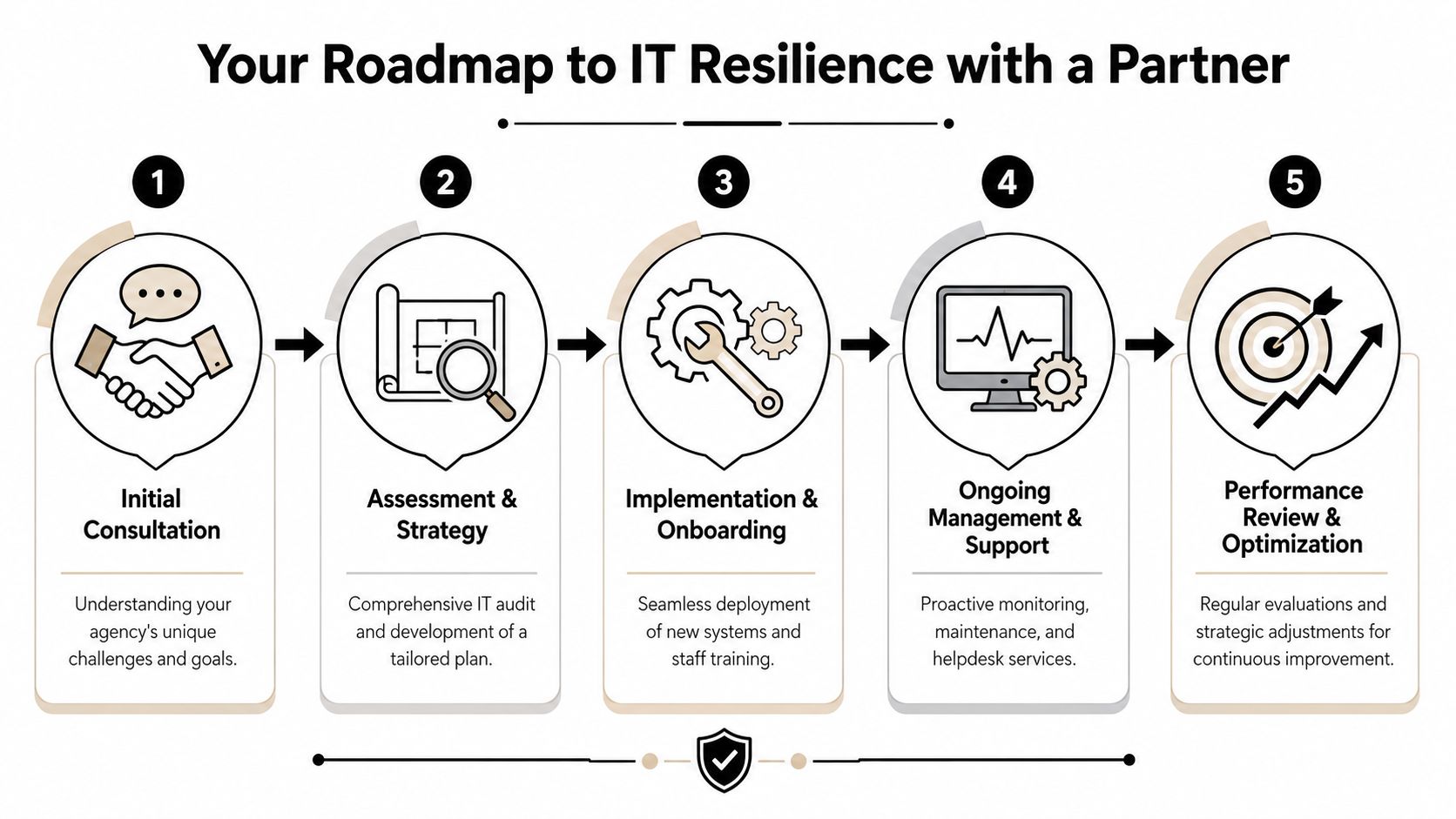
Phase 1 and Phase 2 clarity before change
The first phase should be discovery, not disruption. That means a security audit or health check that identifies exposure, workflow gaps, aging systems, account risks, and recovery concerns without forcing immediate change.
The second phase is strategy. A real plan should prioritize what gets fixed first, what can wait, what affects compliance, and what supports growth. It should also account for service failure risk. That matters because Technology Errors & Omissions insurance protects against financial loss when a service fails, a risk distinct from data breach exposure, as described in this explanation of technology insurance coverage.
That distinction is useful for agencies choosing support partners. A serious provider thinks beyond cyberattacks. It also plans around operational failure, process reliability, and service accountability.
Phase 3 through Phase 5 controlled execution
Implementation should be boring in the best possible way. Staff should know what changes are coming, what training they need, and what support exists during the transition. Devices, accounts, backups, monitoring, and remote access controls should be moved into a cleaner operating model without forcing the agency into unnecessary downtime.
Ongoing management is where insurance IT support proves its value. Monitoring, patching, alerting, escalation, and user support all need to run quietly in the background. Agencies that want around-the-clock visibility should look closely at structured 24/7 cybersecurity monitoring as part of that operating model.
The final phase is review and optimization. Systems change. Staff changes. Business goals change. The IT plan has to change with them.
Good support doesn't create dependence. It creates confidence, because leadership knows what is protected, what is improving, and what still needs attention.
That's what resilience looks like in practice. Not perfection. Not complexity. Just an agency that can operate with fewer surprises and stronger control.
Secure Your Agency's Future Today
An insurance agency doesn't need more noise. It needs fewer blind spots.
Specialized insurance IT support helps an agency protect sensitive data, maintain operational continuity, support secure remote work, and meet the expectations that now shape coverage eligibility and business credibility. That's why the old break-fix mindset no longer works. It solves yesterday's inconvenience while ignoring tomorrow's exposure.
Owners who want a stronger governance foundation should also review these essential compliance strategies to see how regulatory discipline and practical operations fit together. The agencies that perform best usually aren't the ones chasing the newest tool. They're the ones that run clean, documented, resilient systems.
The next smart move is simple. Get a clear view of the current environment, identify the gaps that matter, and make decisions from facts instead of assumptions.
Technovation LLC helps DFW agencies turn IT from a recurring headache into a stable business asset. A complimentary security audit or IT health check gives leadership a practical view of current risks, compliance gaps, backup readiness, remote access exposure, and support weaknesses without pressure or guesswork. For agencies that want peace of mind, stronger resilience, and a clearer path to growth, Technovation is the conversation to start now.