

A clinic manager in Dallas approves a new scheduling app because the front desk needs help now. A partner at a small law firm buys a file-sharing tool after a client asks for faster document access. A finance team replaces aging laptops one by one as they fail. None of those choices seems reckless in the moment.
Then the problems show up. The new app doesn't sync with the existing systems. The file-sharing tool raises questions during a compliance review. The laptops all age differently, warranties expire at different times, and nobody can tell which devices should be replaced next. Budgeting turns into guesswork. Security reviews happen late. Contracts pile up in separate inboxes.
That's where structured IT procurement services matter. They turn reactive buying into a repeatable business process. For regulated small and mid-sized businesses in DFW, that shift protects more than the budget. It protects uptime, documentation, vendor accountability, and compliance posture.
Table of Contents
- Introduction to IT Procurement Services
- Understanding IT Procurement Services
- End-to-End Procurement Process
- Key Benefits and Risks for SMBs in Regulated Industries
- Vendor Selection Criteria and Practical Checklist
- Cost Models and Contracting Considerations
- How to Hire a Managed IT Procurement Partner in DFW
- Conclusion with Next Steps
Introduction to IT Procurement Services
For many regulated SMBs, technology buying starts as a series of reasonable shortcuts. One department needs a faster tool. Another team needs replacement hardware. A manager renews software because nobody wants disruption. Over time, those decisions create a patchwork environment with overlapping subscriptions, inconsistent security terms, and equipment that's hard to support.
A DFW medical practice offers a familiar example. The office manager buys a cloud service for patient communication. The billing team signs up for a separate reporting add-on. The physicians ask for tablets that differ from the rest of the fleet. Every purchase solved a local problem, but the business ended up with scattered contracts, uncertain data handling, and no shared view of lifecycle cost.
That's the core reason IT procurement services exist. They give a business a controlled way to decide what to buy, who to buy it from, how to review risk, and how to manage the purchase after deployment.
Structured procurement doesn't slow a business down. It prevents expensive rework after the contract is already signed.
A mature process also helps leaders answer practical questions that often get missed until too late:
- Will this tool fit the current environment: Compatibility matters as much as features.
- Who approved the risk: Security and compliance review need a clear owner.
- What happens at renewal: A cheap first year can become a messy long-term commitment.
- Who tracks replacement timing: Hardware planning affects budgets long after the initial purchase.
For regulated firms, procurement isn't just an administrative task. It's part of operational governance.
Understanding IT Procurement Services
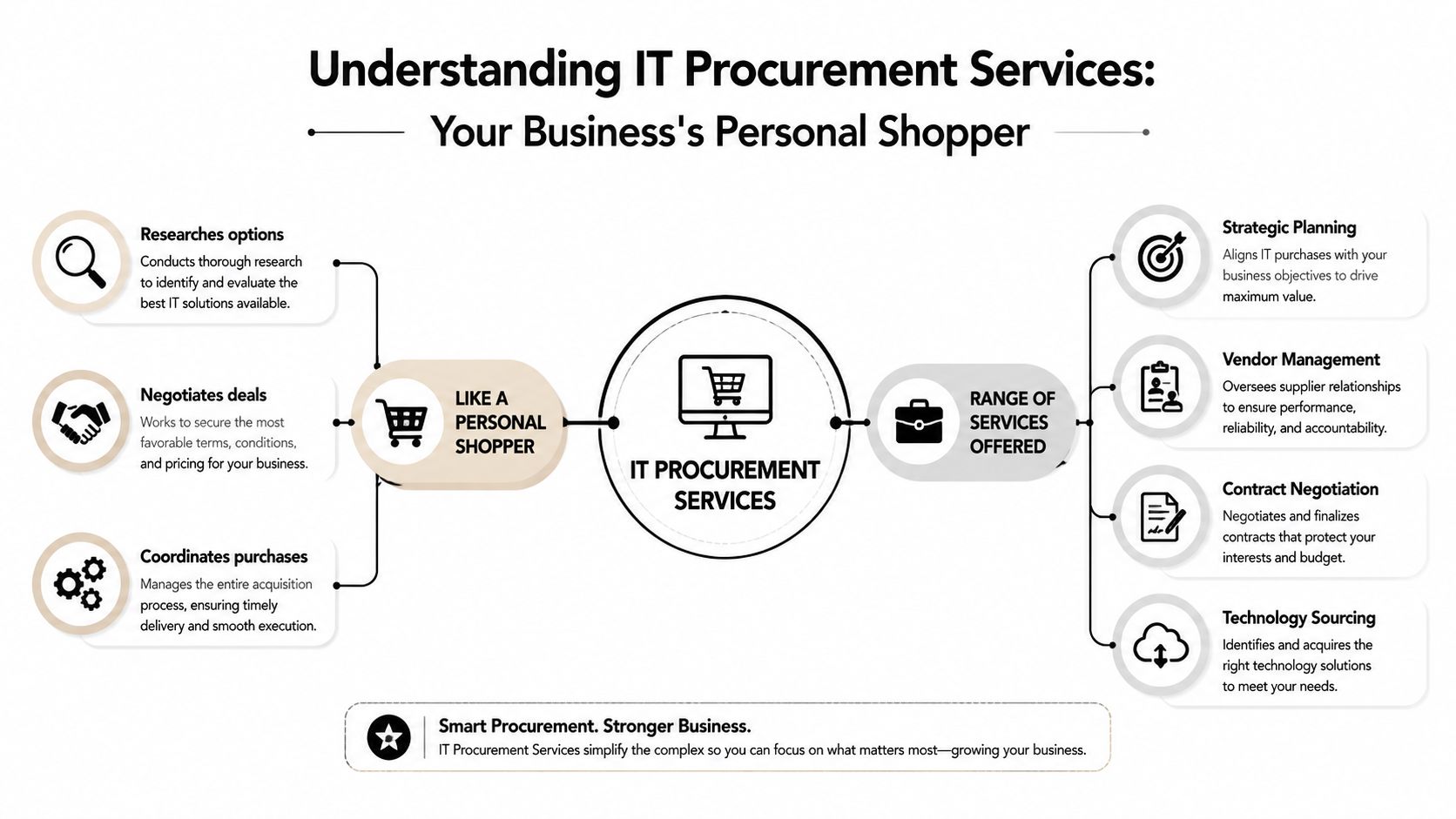
IT procurement services are best understood as a business's technology buying function, organized and managed with discipline. A simple analogy helps. They work like a personal shopper, but for business technology. Instead of grabbing the first option that looks good, the procurement function researches alternatives, compares terms, checks fit, and coordinates the purchase from request through rollout.
That approach has become more important as technology stacks have grown more complicated. The global IT Procurement Service Market was valued at 22.3 USD Billion in 2024 and is projected to reach 45.0 USD Billion by 2035, growing at a CAGR of 6.6%. That growth reflects a wider shift toward cost control and digitalization.
What the service actually includes
Some business owners hear “procurement” and think only of purchasing. In practice, the service is broader.
A solid procurement function usually covers:
- Planning and requirements definition: Clarifying what problem the business is solving before anyone talks pricing.
- Vendor research: Narrowing options based on fit, support model, and operational needs.
- Negotiation and contract review: Looking at terms, service commitments, renewal language, and risk allocation.
- Order coordination: Managing approvals, purchase orders, delivery timing, and deployment sequencing.
- Lifecycle oversight: Tracking renewals, asset age, support status, and replacement planning.
In plain terms, procurement sits between “we need something” and “this is running correctly and documented.”
Three common operating models
Not every SMB needs the same structure. Most fall into one of three models.
| Model | How it works | Best fit |
|---|---|---|
| In-house | Internal staff handle requests, reviews, and buying | Firms with mature IT, finance, and compliance teams |
| Advisory support | Internal staff lead, outside specialists guide complex purchases | Businesses with occasional high-risk or high-value projects |
| Managed procurement | A partner runs the process with defined controls and reporting | SMBs that need consistency without building a full internal function |
The confusion usually starts when a business assumes buying and procurement are the same thing. They aren't. Buying is the transaction. Procurement is the control system around the transaction.
Practical rule: If leadership can't quickly identify the owner, risk review, contract terms, and renewal date for a technology purchase, procurement hasn't been formalized yet.
End-to-End Procurement Process
The safest technology purchases follow a sequence. Not because process is fashionable, but because each stage catches a different kind of mistake. A regulated SMB doesn't need bureaucracy. It needs checkpoints.
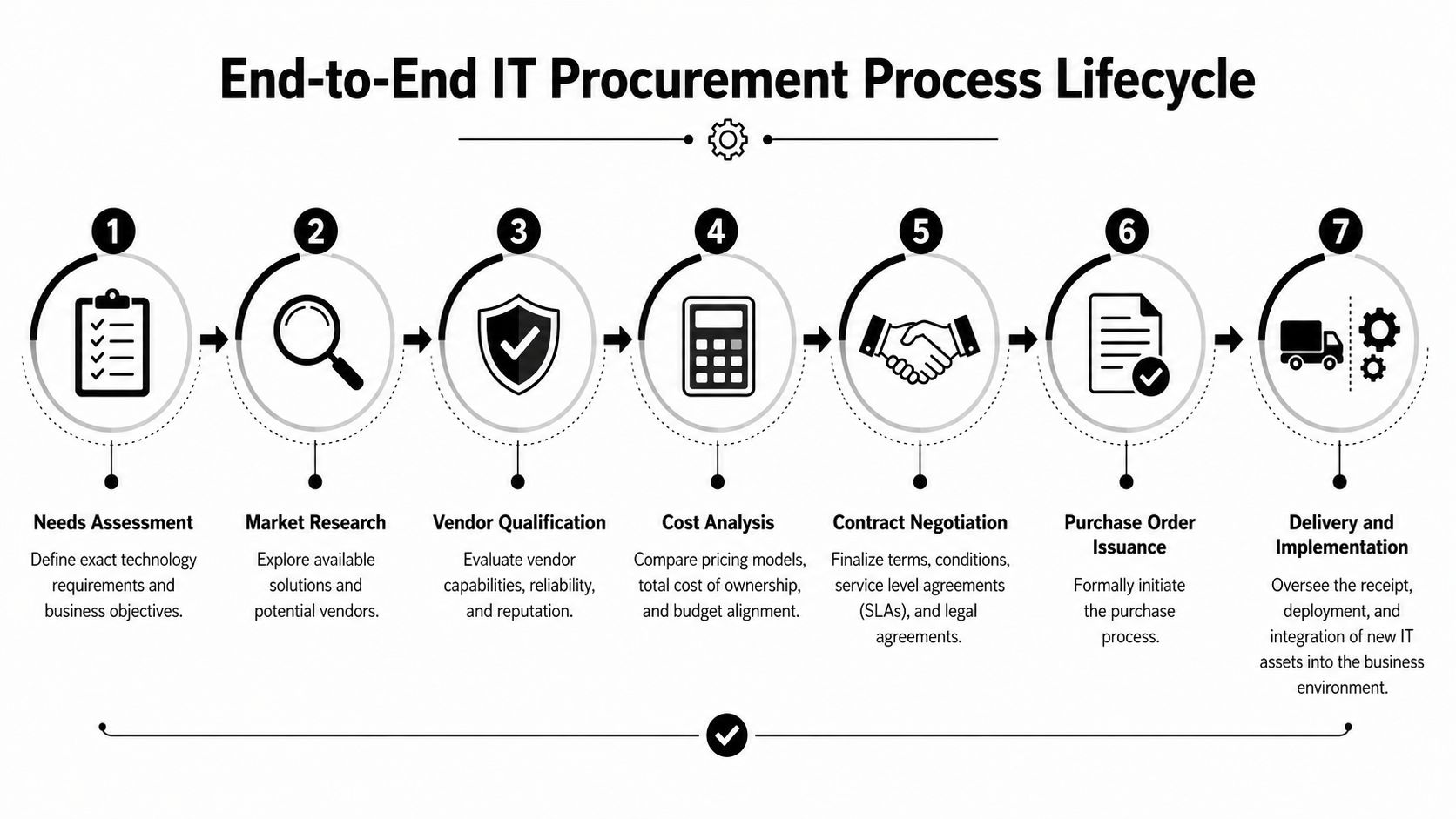
A useful control point is spend level. Any IT purchase exceeding 5,000 USD per year should trigger a full seven-step procurement process including needs assessment, vendor qualification, and contract negotiation. That threshold helps separate routine buys from decisions that deserve structured review.
When the formal process should start
A common mistake is waiting until a vendor quote arrives. By then, the conversation is already biased toward one option. The formal process should begin when the business identifies a need, not when someone is ready to buy.
That early start matters for risk review, budget alignment, and timing. It also helps teams avoid duplicate purchasing, especially when departments solve similar problems independently.
A business that wants a clearer baseline before buying can start with an IT infrastructure assessment. That kind of review often reveals whether the need is a new product, a configuration change, or better use of existing systems.
The full lifecycle in practice
Needs assessment
The business defines the operational problem, required outcomes, users, and constraints. A clinic may need secure mobile access for staff. A law office may need better document retention controls. A finance firm may need stronger audit trails.
Common pitfall: teams describe the product they want before they describe the business need.
Market research
Staff gather options that appear to fit the requirement. This stage should compare deployment model, support expectations, implementation complexity, and likely fit with current systems.
Common pitfall: choosing based on the feature list alone.
Vendor qualification
The vendor itself is reviewed. The business checks capability, support maturity, compliance posture, and operating fit. Regulated firms should ask whether the vendor can support documentation requests, audits, and contractual security obligations.
Cost analysis
Purchase price is only one part of the picture. Teams should review setup effort, internal training time, integration work, ongoing administration, and eventual replacement implications.
Common pitfall: approving a low sticker price that creates higher support burden later.
Contract negotiation
Legal, finance, and IT should all be involved here. Contract language should address service levels, support response, security obligations, renewal terms, termination rights, and data handling requirements.
Contract review is where many procurement risks become visible for the first time. It shouldn't be treated as a last-minute signature step.
Purchase order issuance
The formal order should match the negotiated scope and terms. This sounds basic, yet many SMBs discover discrepancies only after invoicing begins.
Delivery and implementation
Hardware has to arrive, be tracked, and be deployed. Software has to be configured, tested, and documented. Ownership for onboarding should be assigned before purchase.
Ongoing vendor management
The lifecycle doesn't end at delivery. Someone should track performance, support quality, renewal dates, and any drift between promised and actual service.
A good procurement process feels less like a gate and more like a guided route. It keeps purchases moving, but it makes sure nobody skips the turns that protect the business.
Key Benefits and Risks for SMBs in Regulated Industries
Regulated SMBs often feel pulled in two directions. They need to move quickly enough to support staff and clients, but they also need evidence that purchases were reviewed responsibly. Structured procurement helps balance those goals.
Where structured procurement helps most
In healthcare, structured procurement helps a practice evaluate whether a vendor can support privacy obligations, user access controls, and documented service expectations. In legal settings, it improves consistency around client data handling, retention requirements, and secure collaboration. In finance and accounting firms, it helps leadership connect technology purchases to auditability, access governance, and documented vendor responsibility.
Those benefits show up in a few practical ways:
- Better cost control: Teams are less likely to buy duplicate tools for similar functions.
- Stronger compatibility: New systems are reviewed against current workflows and infrastructure.
- Cleaner accountability: Finance, IT, and leadership know who approved what.
- More predictable scaling: Growth planning improves when hardware, software, and service contracts are tracked together.
For firms dealing with regional or industry-specific data obligations, procurement decisions also intersect with infrastructure and storage design. Questions about hosting location, access boundaries, and record handling often belong in the buying process, not after deployment. Businesses that need to think through those issues can review data residency requirements as part of procurement planning.
Where unmanaged buying creates hidden exposure
The biggest risks often don't come from one terrible purchase. They come from many small, isolated decisions.
One of the most overlooked issues is shadow procurement. The total cost of shadow procurement for SMBs often includes duplicate purchases and compliance gaps that formal audits miss until they become legal exposures. That's especially relevant in firms where department heads can approve low-friction software or services without full review.
Consider three common examples:
| Industry | Unmanaged purchase | Hidden consequence |
|---|---|---|
| Healthcare | A department adds a niche communications tool | Sensitive workflows may sit outside the approved compliance process |
| Legal | A team adopts a separate file-sharing service | Matter data handling becomes inconsistent across attorneys |
| Financial | Staff buy analytics or reporting add-ons directly | Reporting logic fragments and audit support becomes harder |
Hardware creates another blind spot. A business may buy devices over time without a replacement policy, then shift toward managed services or cloud-first operations later. Suddenly leadership has to answer an awkward question. Who carries the risk of underused hardware, obsolete devices, or assets that no longer fit the environment? That's not only an IT issue. It's a finance and contract issue.
The most expensive technology purchase is often the one that looked harmless because nobody evaluated the downstream obligations.
Vendor Selection Criteria and Practical Checklist
Vendor selection gets confusing when teams focus on demos before they define standards. A good vendor may still be the wrong fit if the contract, support model, or security evidence doesn't hold up under scrutiny.
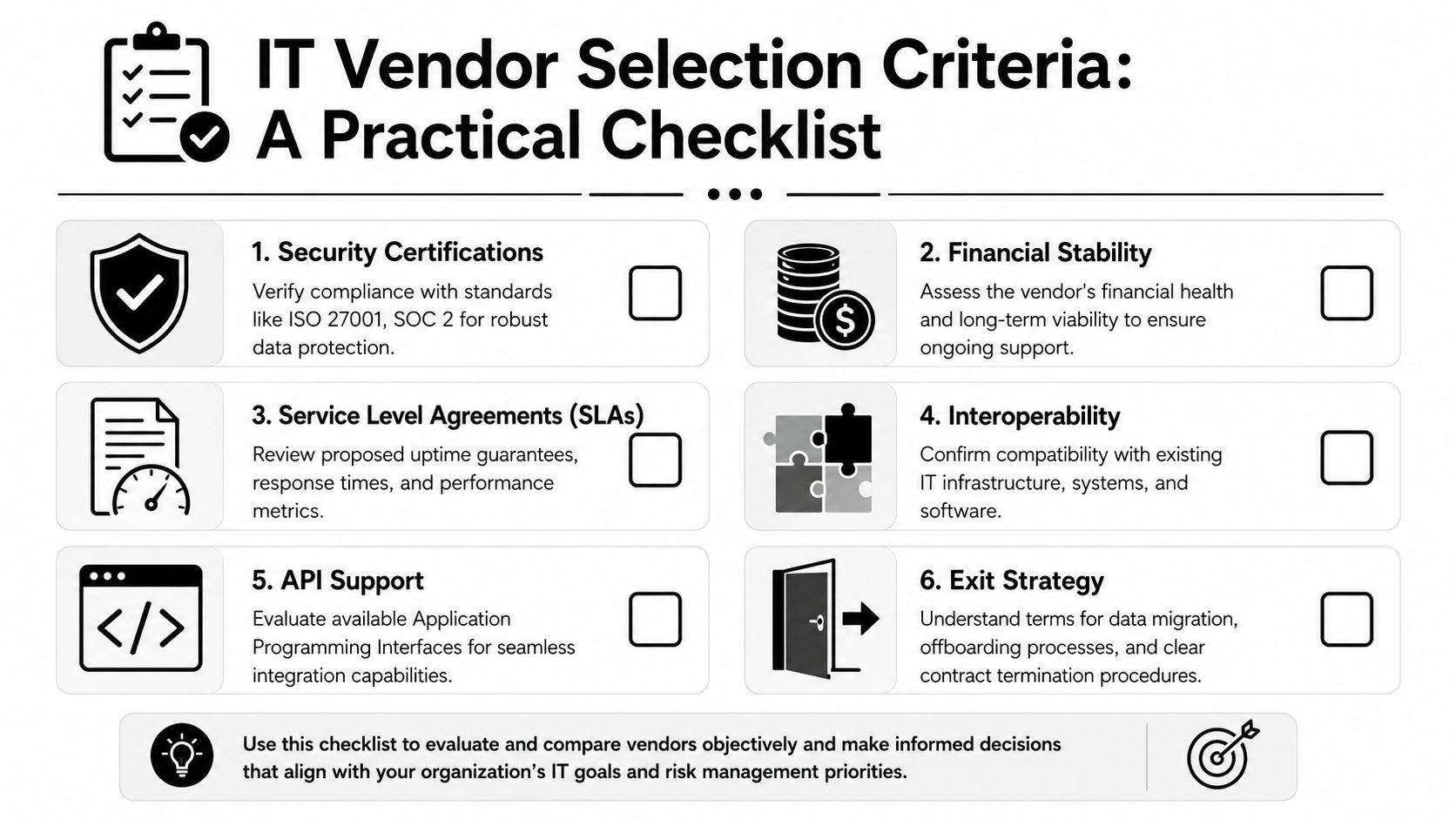
One principle matters early. Effective IT procurement mandates embedding security compliance checks into vendor selection workflows, requiring ISO 27001, SOC 2, or NIST adherence before deployment to prevent regulatory violations. For regulated SMBs, that review belongs in the shortlist stage, not after final approval.
The criteria that deserve real scrutiny
Some criteria are obvious, like price and functionality. Others are easier to miss and often matter more after go-live.
Security evidence: Ask whether the vendor can provide current certification or audit evidence, not just marketing language. A regulated firm should also ask how incident response, access control, and data handling are documented.
Financial stability: A vendor relationship only works if the provider can continue delivering support and updates over time. This doesn't require detective work. It requires reasonable diligence on business maturity and continuity.
Service level agreements: SLAs should spell out uptime expectations, support response, escalation paths, and accountability when service fails.
Interoperability: A product that works alone may still create friction if it doesn't fit the rest of the environment.
API support: Integration matters because SMBs rarely run one isolated system. Data movement, automation, and reporting often depend on clean interfaces.
Exit terms: Businesses should know how they would leave before they sign. Offboarding, data export, transition support, and termination language all matter.
Businesses that want a stronger review process can adapt ideas from broader best practices for vendor management, especially for recurring service relationships.
A practical scorecard for decision meetings
The easiest way to avoid subjective debates is to turn criteria into questions. A short scorecard keeps decision meetings grounded.
| Criterion | Questions to ask | Red flag |
|---|---|---|
| Security | Can the vendor provide current compliance evidence and explain how data is protected? | Answers stay vague or depend on future plans |
| Support | What happens during an outage or urgent issue? | No clear escalation path |
| Fit | How will the tool connect with current systems and processes? | Integration depends on custom work that hasn't been scoped |
| Contract terms | What renews automatically, and what notice is required? | Renewal language is easy to miss or hard to change |
| Data portability | How is data returned at exit? | Export rights are limited or unclear |
| Local practicality | Who helps with implementation and issue resolution? | Support model is difficult to access when problems arise |
A few procurement questions are worth asking in every review meeting:
- What would make this product hard to unwind later
- What assumptions are being made about implementation effort
- Which requirement is essential, and which one is just preferred
- Who owns the vendor after the purchase closes
A vendor shouldn't be shortlisted because the demo impressed one department. A vendor should be shortlisted because the business can defend the decision across security, operations, finance, and support.
Cost Models and Contracting Considerations
Price is where many procurement discussions start. Contract structure is where the primary risk often lives. Two vendors can appear similarly affordable at purchase time and create very different outcomes over the life of the agreement.
That's why a strategic procurement review has to include more than sticker price. A strategic IT procurement plan must include total cost analysis beyond purchase price to cover implementation, training, integrations, security, and replacement costs. Without that view, SMBs approve contracts that look manageable but don't fit how the business operates.

How pricing models change risk
Different pricing models shift control and uncertainty in different ways.
- Fixed fee works well when scope is stable and clearly defined. The tradeoff is that changes can trigger renegotiation.
- Time and materials offers flexibility, but cost can drift if scope and oversight are weak.
- Subscription simplifies budgeting for recurring services, though renewal terms and feature limitations need close review.
- Consumption-based pricing matches variable usage, but leadership should understand what drives cost growth before signing.
A short comparison helps frame the decision:
| Model | Strength | Main watchout |
|---|---|---|
| Fixed fee | Predictable spend | Scope changes may become expensive |
| Time and materials | Flexible for evolving work | Budget control requires active oversight |
| Subscription | Easier recurring planning | Auto-renewal and usage fit matter |
| Consumption-based | Scales with need | Bills can rise when usage isn't monitored |
Contract clauses that deserve negotiation
Many SMBs treat contract language as fixed. That's a mistake, especially when technology lifecycles change faster than budget cycles.
A few clauses deserve real attention:
- Renewal terms: Auto-renewal can lock in an underperforming service if notice windows are missed.
- Payment schedules: Payment timing should match milestones, delivery, or service commencement where possible.
- Replacement and refresh terms: Hardware arrangements should reflect how quickly the business may need to adapt.
- Exit rights: A clean exit prevents data and process lock-in.
- Support obligations: The contract should state who responds, how quickly, and through what channels.
- Risk allocation: Businesses should understand who bears the cost when hardware becomes obsolete or underused.
That last point is often neglected. In managed or co-managed environments, hardware obsolescence can become a hidden financial issue. If a company changes strategy, consolidates locations, or shifts workloads, older equipment may lose practical value before the contract is finished. Procurement leaders should ask where that residual value risk sits and whether refresh flexibility exists.
Good contracting protects the business when plans change, not just when everything goes according to plan.
A disciplined procurement conversation doesn't ask only, “Can the business afford this now?” It also asks, “What happens if the business needs something different before this term ends?”
How to Hire a Managed IT Procurement Partner in DFW
A managed procurement partner should do more than collect quotes. The right partner adds structure, documentation, stakeholder coordination, and risk awareness that an internal team may not have time to build on its own.
What to evaluate before signing
DFW businesses should start with scope. Some need help only with major purchases. Others need an ongoing procurement function tied to security, compliance, and asset planning. That difference should be clear before any agreement is signed.
A practical review should include:
- Service boundaries: Does the partner handle sourcing only, or also contract review, lifecycle tracking, and vendor follow-up?
- Regulated industry familiarity: Can the team work comfortably with healthcare, legal, finance, or nonprofit requirements?
- Response expectations: How quickly can the partner support quote review, urgent replacements, or audit-related requests?
- Communication style: Will the partner work smoothly with IT, finance, and operations at the same time?
Businesses comparing options can sharpen their criteria by reviewing guidance on how to choose a managed service provider.
Why local support changes the outcome
Geography still matters in procurement. A local DFW partner can align on-site visits, physical asset reviews, implementation coordination, and compliance conversations more easily than a distant team working from a generic process. That matters when a clinic needs replacement hardware fast, when a law office wants in-person planning, or when leadership wants a contract discussion with both technical and operational context.
A strong local procurement partner also helps connect day-to-day buying with broader planning. That includes refresh cycles, vendor consolidation, documentation discipline, and support continuity.
One local example shows why this approach works. A DFW clinic with scattered vendors and uneven contract oversight used managed procurement support to consolidate purchasing decisions, tie vendor review to compliance expectations, and reduce spend by 20%. Just as important, the clinic gained a clearer approval path and stronger control over renewals.
That combination matters more than a lower quote. The right partner helps a business buy less reactively and operate more predictably.
Conclusion with Next Steps
IT procurement services matter because technology purchases aren't isolated events. They affect compliance, budgeting, support workload, asset lifecycle planning, and vendor accountability. For regulated SMBs, the hidden costs often come from what wasn't reviewed. Shadow procurement, unclear renewal terms, weak vendor evidence, and hardware obsolescence risk all create problems that surface later.
A disciplined process changes that. It gives leaders a way to evaluate needs clearly, screen vendors properly, negotiate contracts with foresight, and manage technology decisions as part of the business, not as one-off transactions.
DFW organizations also benefit from local expertise when procurement intersects with compliance readiness, operational urgency, and long-term planning. The strongest outcomes come from treating procurement as a managed function tied to security, resilience, and growth.
Technovation LLC helps Dallas–Fort Worth businesses bring order to technology buying with managed IT services, compliance readiness, 24/7 monitoring, and practical procurement guidance built for regulated environments. Organizations that want tighter vendor control, clearer renewal planning, and stronger protection against hidden purchasing risks can contact Technovation to schedule a free security audit and procurement assessment.