

A business owner signs a new client or vendor agreement, skims the legal boilerplate, and assumes the data protection clause is routine. That assumption causes expensive problems. The clause isn't passive language for a file drawer. It's a binding statement about how data will be collected, stored, accessed, transferred, and deleted inside the business.
That matters because most small and mid-sized businesses promise far more in contracts than their systems can deliver. A contract says access is restricted, but shared logins still exist. A contract says incidents will be reported quickly, but no one has clear escalation steps. A contract says data will be handled securely, but the business hasn't mapped where that data lives. The risk isn't only legal. It's operational.
A smart owner should treat a data protection clause as part legal commitment, part IT requirements document. That's where many firms need outside help. Legal counsel can tighten wording. Technical teams have to make the promise real. Businesses that want a clearer view of that gap usually start with data security and compliance support, because the contract is only as strong as the systems behind it.
Table of Contents
- Beyond the Fine Print An Introduction
- What Is a Data Protection Clause Really
- The Essential Elements of a Strong Data Protection Clause
- Practical Drafting Tips for SMB Contracts
- Your Data Protection Compliance Checklist
- When to Call for Legal and Technical Experts
- Conclusion From Contract to Confidence
Beyond the Fine Print An Introduction
A company with twenty employees lands a new customer. The deal looks good, the revenue is welcome, and the contract appears standard. Then the owner reaches the data protection clause. It's dense, heavily defined, and easy to treat like legal wallpaper. That's the mistake.
A data protection clause tells two parties who can touch data, why they can touch it, how they must secure it, and what happens when something goes wrong. In practice, that means the clause reaches deep into daily operations. It affects file sharing, employee permissions, backups, remote access, vendor oversight, retention schedules, and incident response.
Most contract problems don't start in court. They start when a business signs language that its systems and staff can't support.
The legal side has become impossible to ignore. A major turning point was the EU's GDPR, which entered into force on 25 May 2018, with penalties that can reach €20 million or 4% of global annual revenue, whichever is higher, as explained in GDPR's overview of the regulation. Even businesses outside Europe can be affected when they target or collect data on people in the EU.
That pressure isn't limited to multinational firms. Contracts drafted by larger customers, regulated clients, and security-conscious partners routinely push GDPR-style expectations downstream into SMB agreements. So the clause in front of a small business owner often does more than reflect the law. It expands obligations, shifts risk, and creates technical commitments that someone inside the business has to execute.
A practical owner should read that clause with one question in mind. Can the company do what it's promising?
What Is a Data Protection Clause Really
A data protection clause is best understood as an architectural blueprint. It doesn't just say “protect the data.” It lays out the structure of the relationship around data handling. It identifies what data is covered, who can access it, what security controls apply, and how the parties respond if there's a problem.
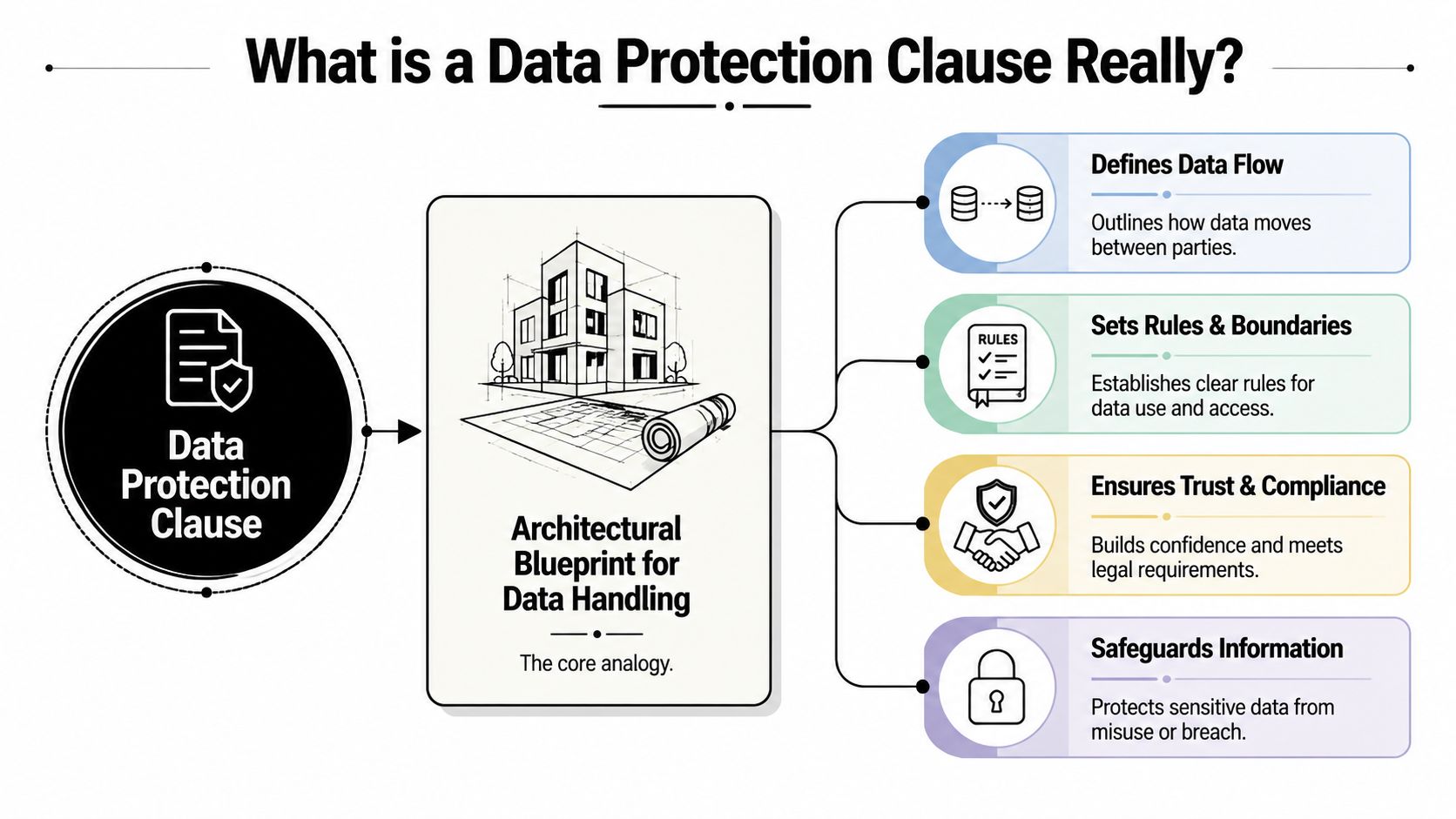
A building blueprint is useful because it turns assumptions into specifications. The same is true here. If the clause is well written, it reduces ambiguity. If it's sloppy, the parties don't share the same understanding of their responsibilities, and security breaks down fast.
The clause defines the operating model
A strong clause usually answers four basic questions:
- What data is involved: Personal data, sensitive categories, client records, employee information, or other defined data sets.
- Why the data is processed: A specific business purpose, not open-ended “business needs.”
- Who has access: Named roles, approved users, and limits on internal and third-party handling.
- What happens in an incident: Notification timing, cooperation duties, and remediation expectations.
That's why the clause shouldn't be treated as a narrow legal artifact. It functions as a shared operating model between organizations.
The legal driver is only part of the story
The growth of privacy regulation explains why these clauses are now standard. By the end of 2024, data protection laws covered 6.3 billion people, or about 79% of the world's population, and by the start of 2025 there were 144 countries with data and consumer privacy laws, according to Usercentrics' privacy statistics summary. That level of global coverage means even local businesses increasingly inherit contractual privacy duties through customers, partners, and vendors.
Still, regulation is only one reason these clauses matter. The better reason is business discipline. A clear clause forces a company to classify information, set access boundaries, and align systems with promises. Businesses that haven't done that groundwork usually struggle with vague terms like “reasonable security,” because nobody inside the company agrees on what that means. That's where data classification planning becomes practical, not theoretical.
A weak data protection clause doesn't just create legal ambiguity. It creates technical confusion.
A business owner should read the clause like an operations document. If the language can't be translated into specific technical and administrative actions, it isn't finished.
The Essential Elements of a Strong Data Protection Clause
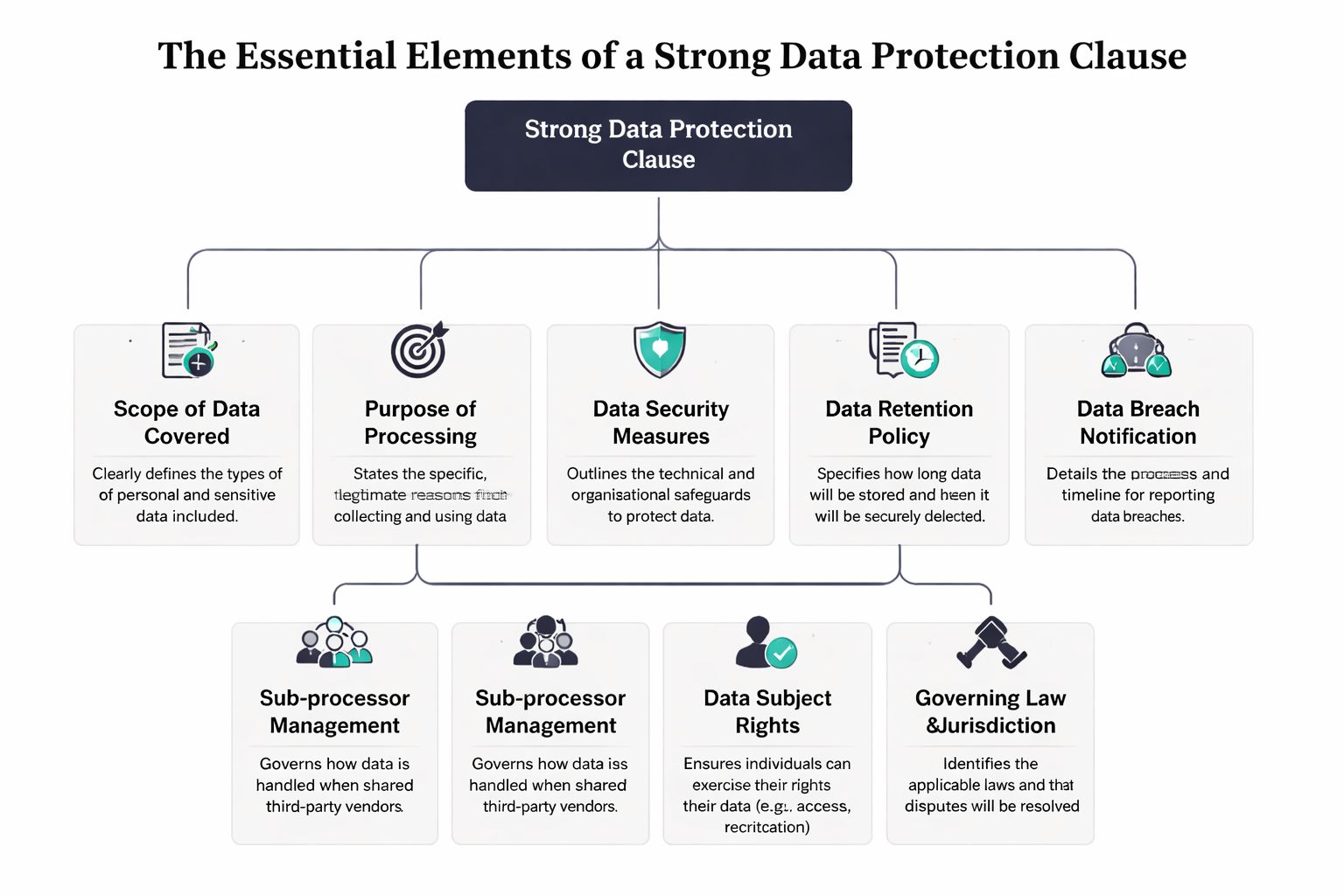
The fastest way to judge a data protection clause is to stop asking whether it sounds professional and start asking whether it tells the business exactly what to do.
It starts with scope and purpose
If a clause doesn't define the data and the purpose of processing, the rest of the section is unstable. The business won't know which systems, users, files, and workflows are in scope. That leads to overreaction in some places and neglect in others.
A useful clause should identify the categories of data covered and tie processing to a legitimate, limited purpose. That sounds simple, but many contracts fail here. They sweep in broad categories without clarifying whether archived files, encrypted backups, logs, or derived reports are included.
Practical rule: If the business can't point to the exact systems and workflows covered by the clause, the scope is still too vague.
Security language must be technical
Many contracts become weak. They rely on phrases like “commercially reasonable safeguards” or “industry standard protections.” That language may sound polished, but it doesn't help a business configure access, storage, or monitoring.
The clause should require specific controls. Verified guidance supports mandating AES-256 for data at rest and TLS 1.3 for data in transit. It should also require role-based access controls paired with multi-factor authentication, which reduces unauthorized access incidents by 94% according to the verified data provided for this article. Those aren't abstract security ideals. They're concrete operational requirements.
A business that needs to implement those controls usually has to review identity structure, privileged access, and user provisioning. That's the point where identity management services become relevant, because the contract language has to map to actual account design and access enforcement.
A practical security section should cover:
- Encryption standards: Specify encryption for stored data and for data moving between systems.
- Access control model: Limit access by role, not convenience, and require stronger authentication.
- Logging and monitoring: State what activity must be recorded and reviewed.
- Administrative safeguards: Require policies, user training, and periodic review of access rights.
Breach response can't be improvised
Incident language must be direct. A good data protection clause states who notifies whom, within what timeframe, and what information must be included. The 72-hour breach notification window is a critical benchmark. Clauses also need remediation obligations and cooperation requirements, because vague incident language slows containment.
The verified data for this article states that clauses lacking specific remediation and cooperation requirements result in a 65% delay in effective breach containment. That should change how business owners read incident language. Notification isn't enough. The clause should also require the parties to preserve evidence, support investigation, and coordinate corrective action.
A short comparison makes the point:
| Clause language | Problem |
|---|---|
| Vendor will notify customer promptly of a breach. | “Promptly” invites argument and delay. |
| Vendor will notify customer within the required period and provide defined incident details, remediation support, and investigation cooperation. | Clearer obligations, easier execution. |
Sub-processors transfers and end of life rules matter
Most SMBs don't process data alone. They rely on hosting providers, outsourced specialists, consultants, and support firms. If the clause ignores sub-processors, it leaves a hole in the chain of responsibility.
A stronger clause should address:
- Flow-down obligations: Third parties handling the data must be bound to equivalent protections.
- Transfer restrictions: Cross-border transfers need defined safeguards and review.
- Disclosure handling: The parties should know how legal requests for data will be handled and contested where appropriate.
- Retention and deletion: The clause should state when data is returned, deleted, or retained for legal reasons.
The end-of-life piece is often overlooked. Businesses focus on collection and access, then forget disposal. That creates lingering risk. Data kept without a clear reason can create unnecessary storage, review, and security burdens.
A strong clause is specific enough that legal counsel can defend it and technical staff can implement it. If either side can't translate the wording into action, the clause still needs work.
Practical Drafting Tips for SMB Contracts
Most SMBs won't write these clauses from scratch. They'll review language sent by a customer, a partner, or a vendor. That shifts the job from drafting to spotting traps quickly.

Vague language creates real work
One of the most common problems is definitional sprawl. As discussed in Foster's guidance on personal data protection clauses, some contracts define personal data so broadly that required protections become operationally unreasonable or effectively expand the business's obligations beyond what the law requires.
That matters because broad definitions don't stay on paper. They affect backup rules, destruction rules, review obligations, and vendor oversight. A business may think it agreed to protect customer records when it instead agreed to treat almost every internal data artifact as protected data under the contract.
Red flags worth pausing on include:
- Undefined use terms: “Business purposes” or “service improvement” without limits.
- Unlimited scope: Definitions that appear to include every copy, derivative, log, and metadata set.
- Soft security promises: Phrases like “reasonable security” with no technical detail.
- One-sided liability triggers: Terms that assign responsibility without considering control over the systems involved.
Specific language reduces disputes because it tells each party what success looks like.
A stronger example looks like this
Bad version:
Vendor will maintain reasonable safeguards and notify customer promptly of any unauthorized access.
Better version:
Vendor will restrict access based on job role, require multi-factor authentication for authorized users, apply encryption to stored data and data in transit, and notify customer within the required contractual or regulatory period after confirming a reportable incident. Vendor will cooperate in investigation, containment, and remediation.
That sample isn't legal advice. It's a standard for clarity. It converts broad intent into actions that legal and IT teams can test.
A few practical review habits help:
- Mark every defined term. If “personal data,” “security incident,” or “sub-processor” is fuzzy, ask for tighter wording.
- Underline every promise that implies technology. If the contract promises segregation, encryption, monitoring, or retention controls, someone needs to verify the systems can support that.
- Check the signing workflow. Fast execution matters, but so does version control and auditability. Businesses updating templates or vendor paperwork may find this guide on how to e-sign NDAs useful because it highlights the process side of contract handling, not just the signature itself.
The right move for an SMB isn't to reject every tough clause. It's to reject ambiguity. Clear obligations are easier to price, implement, and defend.
Your Data Protection Compliance Checklist
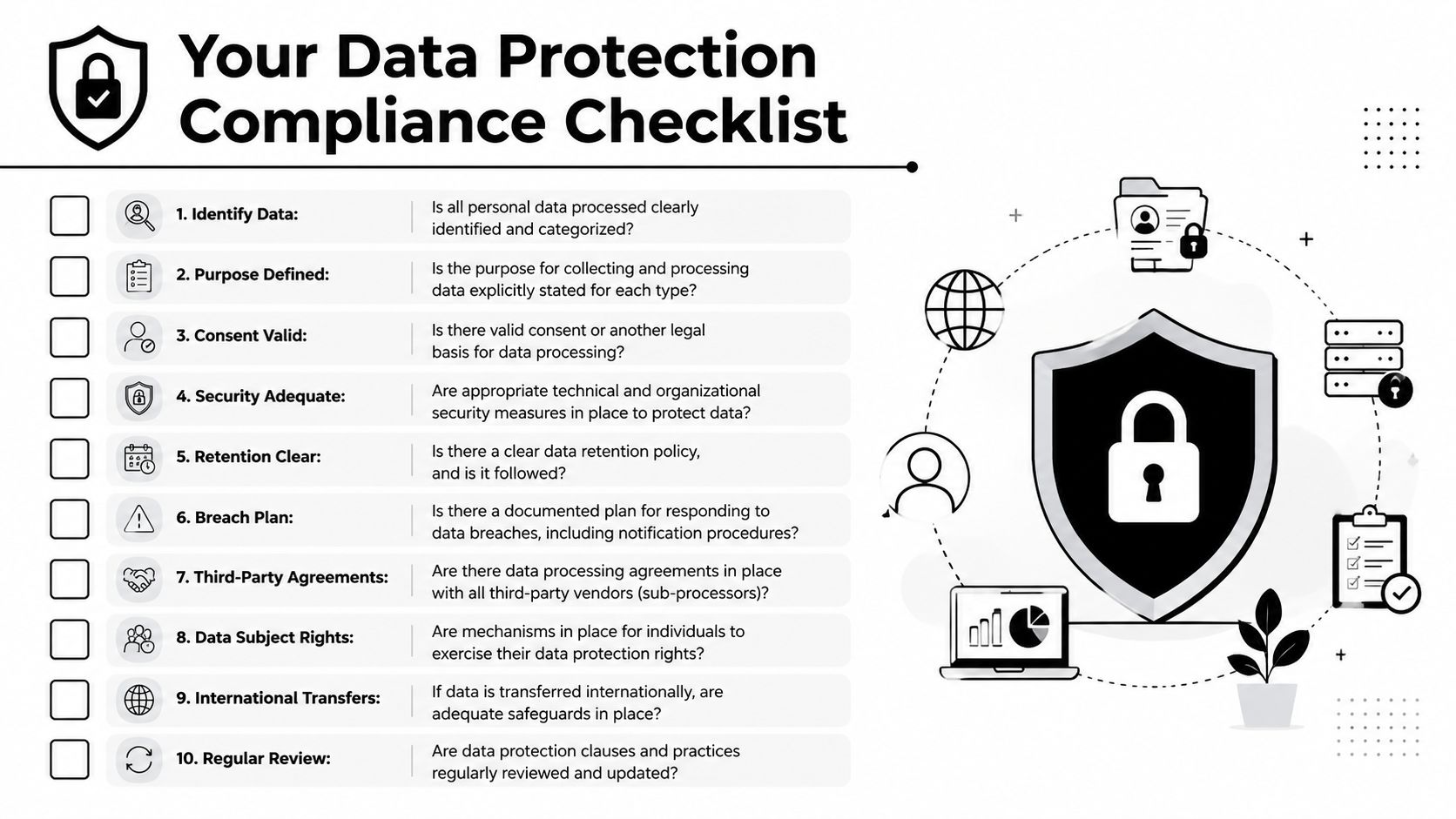
A data protection clause should survive two tests. First, the language has to be clear. Second, the business has to be able to perform what the contract requires.
Contract questions
Use this list to audit current agreements:
- Defined data: Does the clause clearly identify the data categories covered?
- Limited purpose: Does it explain why the data is processed, not just that processing may occur?
- Technical safeguards: Does it require concrete controls instead of vague “reasonable security” language?
- Sub-processor rules: Does it say when third parties can be used and what obligations flow down to them?
- Retention and deletion: Does it explain when data must be returned, deleted, or retained?
Operational questions
Many contracts fail when the business signs a promise, but the systems can't support it.
- Breach timing: Can the business identify and escalate an incident within a 72-hour breach notification window?
- Response duties: Are remediation and cooperation steps documented internally? The verified data for this article states that clauses missing those obligations result in a 65% delay in effective breach containment.
- Access control reality: Are users limited by role, or do staff members still have broad access because it's convenient?
- Logging and evidence: Can the business produce the records needed to investigate and explain an incident?
- Transfer readiness: If data crosses borders or moves through multiple providers, can the company explain the safeguards at each step?
Contracts should be tested against actual workflows, not policy documents sitting in a folder.
A business that answers “not sure” to several of those questions has found the gap that matters. This isn't a reason to panic. It's a reason to fix the mismatch before a customer, regulator, or incident exposes it.
When to Call for Legal and Technical Experts
Some data protection clauses are straightforward. Others carry enough operational and liability risk that a business shouldn't handle them casually.
Call legal counsel for interpretation and negotiation
A lawyer should review clauses that involve cross-border transfers, unusual indemnity language, broad audit rights, or aggressive definitions that expand obligations. Legal counsel is also essential when a customer's terms conflict with the company's existing privacy, retention, or vendor practices.
Industry-specific obligations add another layer. For firms handling regulated information, practical resources such as this legal practice HIPAA checklist can help frame the questions legal and compliance teams should ask before they sign.
Call technical experts for proof and execution
A contract can look compliant and still fail in practice. The verified data for this article notes that enforceable clauses for cross-border data handling should include encryption or pseudonymisation, onward-transfer limits, sub-processor obligations, and a plan for contesting disclosure requests, as outlined in CIS guidance on standard GDPR clauses. That's legal language with technical consequences.
Technical advisors are crucial. Lawyers define what the contract requires. Technical teams determine whether the environment can support those promises through access controls, encryption, monitoring, retention workflows, and incident response procedures. Businesses comparing support options often start by reviewing how to choose a managed service provider, because the core issue isn't generic IT help. It's whether the provider can align infrastructure with compliance obligations.
Technovation LLC is one option for businesses that need that alignment. Its work in managed IT, cybersecurity, and compliance support is relevant when a company needs to verify that contractual security commitments can be implemented and maintained.
Conclusion From Contract to Confidence
A data protection clause isn't filler. It's one of the clearest statements a business makes about how seriously it handles information. That statement affects trust, liability, daily operations, and the company's ability to win and keep good clients.
The practical lesson is simple. Strong language on paper doesn't protect anything by itself. The business still needs defined data scope, enforceable technical controls, workable breach response, disciplined vendor oversight, and realistic retention practices. If those pieces don't exist operationally, the contract is overstating reality.
That's why smart SMBs should stop separating contract review from IT review. The legal wording and the technical environment are tied together. When they match, compliance becomes manageable. When they don't, every audit, client questionnaire, and incident becomes harder than it needs to be.
A business owner doesn't need to become a privacy lawyer or a security engineer. But that owner should insist on clarity, reject vague obligations, and verify that the company can deliver what it signs.
If a business wants to know whether its contracts and systems line up, Technovation LLC can help assess the technical side of the equation. A focused IT health check or security review can show whether existing controls, access practices, and incident response processes support the promises already sitting in signed agreements.