

A lot of DFW financial firm owners are in the same spot right now. The firm is growing, clients expect polished digital service, staff need secure remote access, and every new system seems to create another compliance question. One partner asks for faster reporting. Another employee wants a new workflow app. Meanwhile, leadership still has to protect client data, keep operations moving, and avoid technology decisions that create more risk than value.
That tension is normal. It's also fixable.
The firms that handle it well stop treating IT as a repair function and start treating it as business infrastructure. That shift matters because the global financial services market is projected to grow from $33.5 trillion in 2024 to nearly $45 trillion by 2028. Growth at that scale raises the bar for security, scalability, and operational discipline across the industry. For DFW firms, that means better systems aren't optional overhead. They're part of staying credible, efficient, and ready for the next stage.
For firms evaluating financial IT support and managed services, the key question isn't whether technology deserves attention. It's whether the current environment is helping the business grow with control, or forcing leadership to work around fragile systems every week.
Table of Contents
- Thriving in the DFW Financial Hub
- Matching Modern IT Solutions to Your Needs
- Your Four-Phase IT Implementation Roadmap
- How to Choose an IT Partner in Dallas–Fort Worth
- Calculating the ROI of Your Technology Investment
- Secure Your Firm's Future Today
Thriving in the DFW Financial Hub
Dallas Fort Worth rewards firms that move decisively. A smaller wealth management office, accounting practice, insurance advisory group, or specialty finance firm can grow fast here if operations stay clean and client trust stays intact. The problem is that many firms are expanding with a patchwork of legacy systems, manual reporting habits, and security controls that were never built for today's expectations.
That usually shows up in ordinary ways first. Staff waste time chasing files across email, shared drives, and disconnected applications. Leadership can't get a simple answer about where sensitive data lives. Compliance preparation becomes a scramble instead of a routine. None of that feels dramatic in the moment, but it slows growth and drains confidence.
Strong IT doesn't just prevent problems. It gives a financial firm the confidence to take on more clients, add staff, open locations, and modernize service without losing control.
DFW firms don't need abstract digital transformation talk. They need practical IT solutions for the financial industry that fit an SMB budget, reduce operational friction, and support real compliance obligations. That means secure access, monitored systems, recoverable data, documented processes, and technology decisions tied directly to business outcomes.
A firm needs more than a security stack
A resilient financial firm works like a well-built fortress. Cybersecurity is the reinforced wall. Regulatory compliance is the building code. Business continuity is the backup generator. Data management is the secured vault that keeps critical assets organized and usable.
If one pillar is weak, the whole structure gets shaky. A firm can buy security software and still struggle if backups are unreliable. It can pass an audit and still frustrate clients if data is fragmented. It can have solid infrastructure and still create risk if staff can't follow clean procedures.
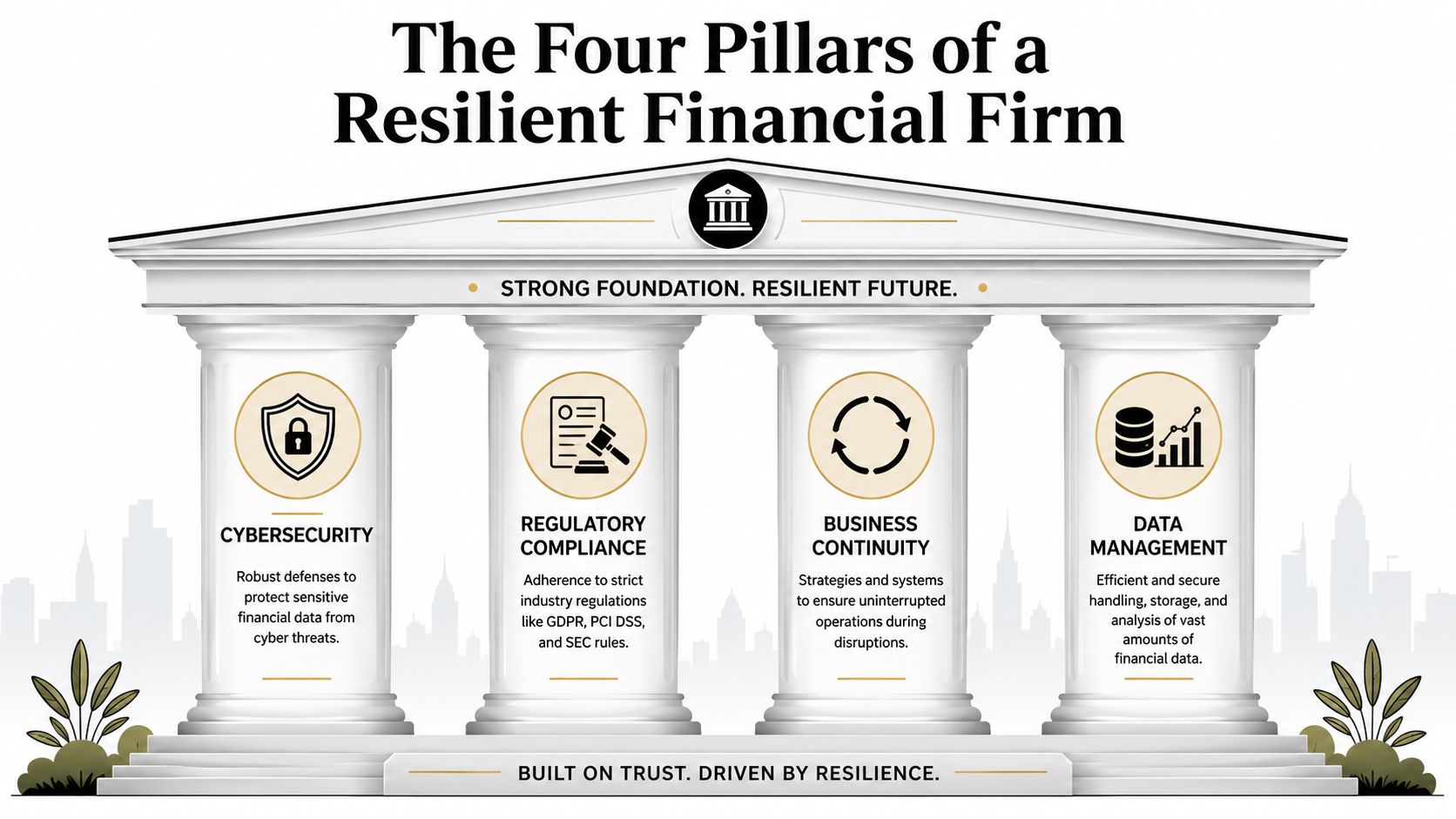
The firms that stay durable don't build around one tool. They build around these four pillars as a system. That's why compliance solutions built for financial services matter more than generic IT support. The work isn't just keeping devices online. It's keeping the business defensible, orderly, and scalable.
Why these pillars work together
Security has to lead because the industry remains a prime target. With 65% of financial organizations reporting they have been victims of ransomware or other cyberattacks, the industry is one of the biggest targets globally. A financial firm doesn't get to treat protection as a nice upgrade. It has to treat protection as operational infrastructure.
The four pillars become clearer when they're tied to daily business reality:
- Cybersecurity protects access: It covers endpoint protection, threat monitoring, account controls, and user behavior.
- Compliance protects the firm's standing: It creates documented accountability, controlled data handling, and audit readiness.
- Business continuity protects service delivery: It keeps advisors, staff, and client operations moving during outages or disruptions.
- Data management protects decision quality: It gives leadership one reliable operational picture instead of scattered fragments.
Practical rule: If a system holds client information, supports transactions, or affects reporting, it belongs inside all four pillars, not just one.
That's the standard small and mid-sized firms should adopt. Not enterprise complexity. Just disciplined architecture.
Matching Modern IT Solutions to Your Needs
Many leaders hear a list of acronyms and tune out. That's understandable. Financial firms don't need more jargon. They need a clear line between a business problem and the right fix.
The strongest IT solutions for financial industry environments are the ones that map directly to the four pillars above and solve a specific operational issue. A firm dealing with account access risk needs different controls than a firm struggling with data sprawl or audit documentation.
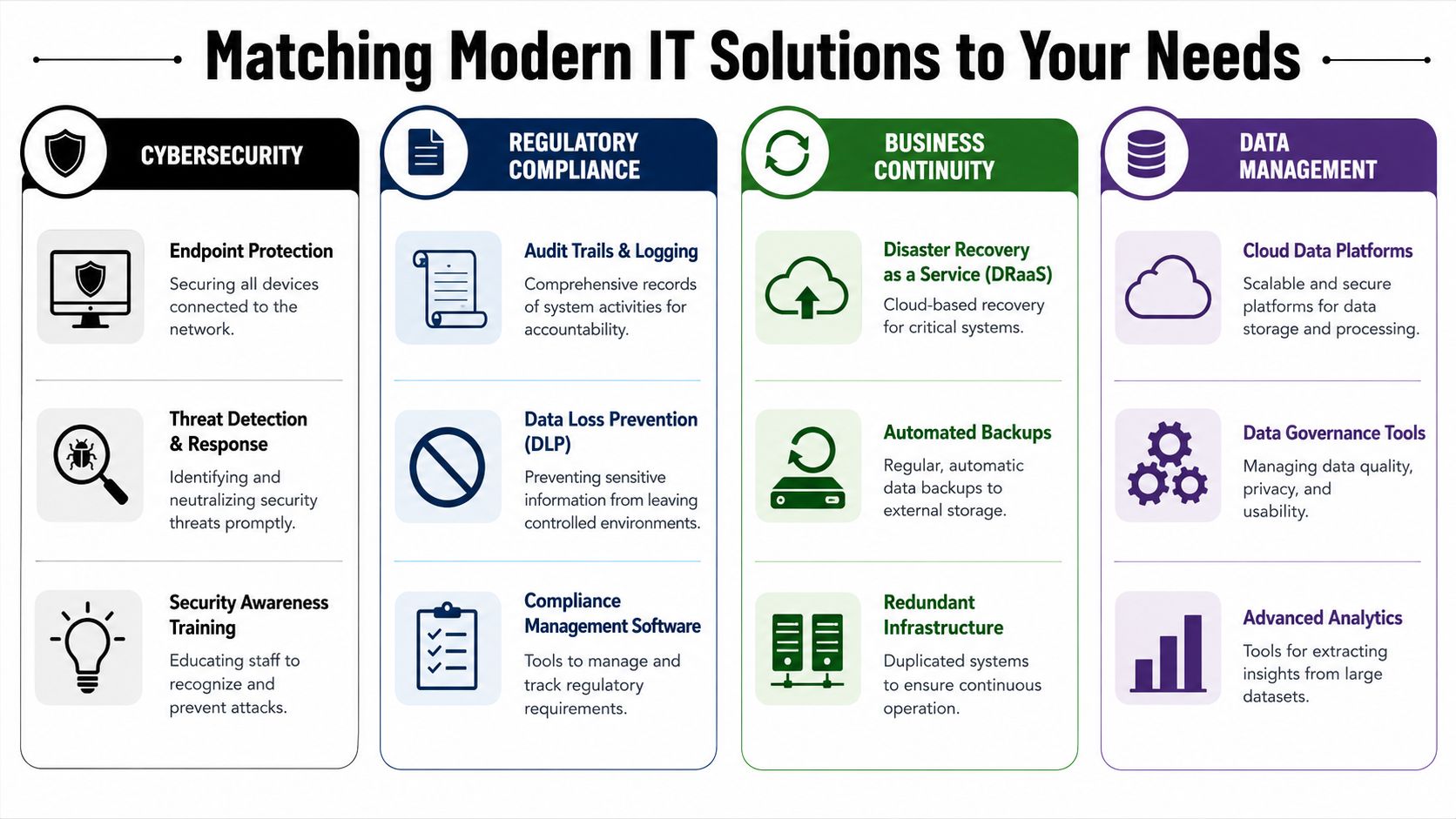
Solutions that map to real business pressure
Some solutions are foundational because they solve multiple problems at once. Specialized managed IT services are critical for financial firms because they deliver Managed Detection and Response, endpoint protection, and real-time monitoring to support compliance with PCI-DSS, FINRA, and SEC standards. In plain English, that means someone is actively watching the environment, defending devices, and spotting suspicious activity before it turns into a business event.
That matters because common financial firm pain points are usually predictable:
- Too many disconnected systems: Client records, communications, and operational data live in separate places.
- Too much manual compliance work: Staff assemble evidence by hand instead of generating clean records automatically.
- Too much recovery risk: Backups exist, but nobody's sure how quickly systems can be restored.
- Too little visibility: Leadership can't see where risk is building until a deadline or incident forces attention.
A smart stack answers those problems with layered controls. Multi-factor authentication protects access. Endpoint protection hardens devices. Managed detection gives the firm ongoing monitoring. Encrypted cloud backups protect recoverability. Logging and audit trails support accountability. Data governance keeps sensitive information organized and controlled.
Firms reviewing workflows tied to customer records should also look closely at Financial services CRM compliance. The CRM isn't just a sales tool. In a financial setting, it can become a compliance and data-governance risk if records, permissions, retention, and communications controls aren't handled correctly.
A practical challenge-to-solution map
The easiest way to evaluate technology is to stop asking what the tool does and start asking what business problem it removes.
| Business challenge | Best-fit IT solution category | Business outcome |
|---|---|---|
| Preventing unauthorized access to sensitive client data | MFA, endpoint protection, role-based access, real-time monitoring | Fewer access risks and stronger control over confidential information |
| Passing a compliance review without chaos | Audit logging, retention controls, policy enforcement, compliance management workflows | Cleaner documentation and less disruption during review cycles |
| Recovering from outage, deletion, or disruption | Encrypted backups, disaster recovery planning, redundant systems | Faster restoration of operations and less downtime pressure |
| Turning scattered records into usable intelligence | Centralized data architecture, normalization, reporting dashboards | Better decision-making and more reliable client service |
| Reducing fraud and anomaly risk | Adaptive monitoring and AI-assisted fraud detection workflows | Faster threat response and stronger risk management |
One more point matters here. Good technology design doesn't only protect the firm. It also helps the firm work better. When systems are connected, secure, and monitored, staff stop inventing workarounds. Processes tighten up. Leadership gets cleaner reporting. Clients get a more reliable experience.
That's why the right solution set should feel boring in the best way. It should remove surprises.
Your Four-Phase IT Implementation Roadmap
Most firms don't need a dramatic overhaul. They need an orderly sequence. The fastest way to make IT expensive is to buy tools before the firm has defined risk, priorities, ownership, and integration requirements.
A practical roadmap keeps momentum without creating disruption.
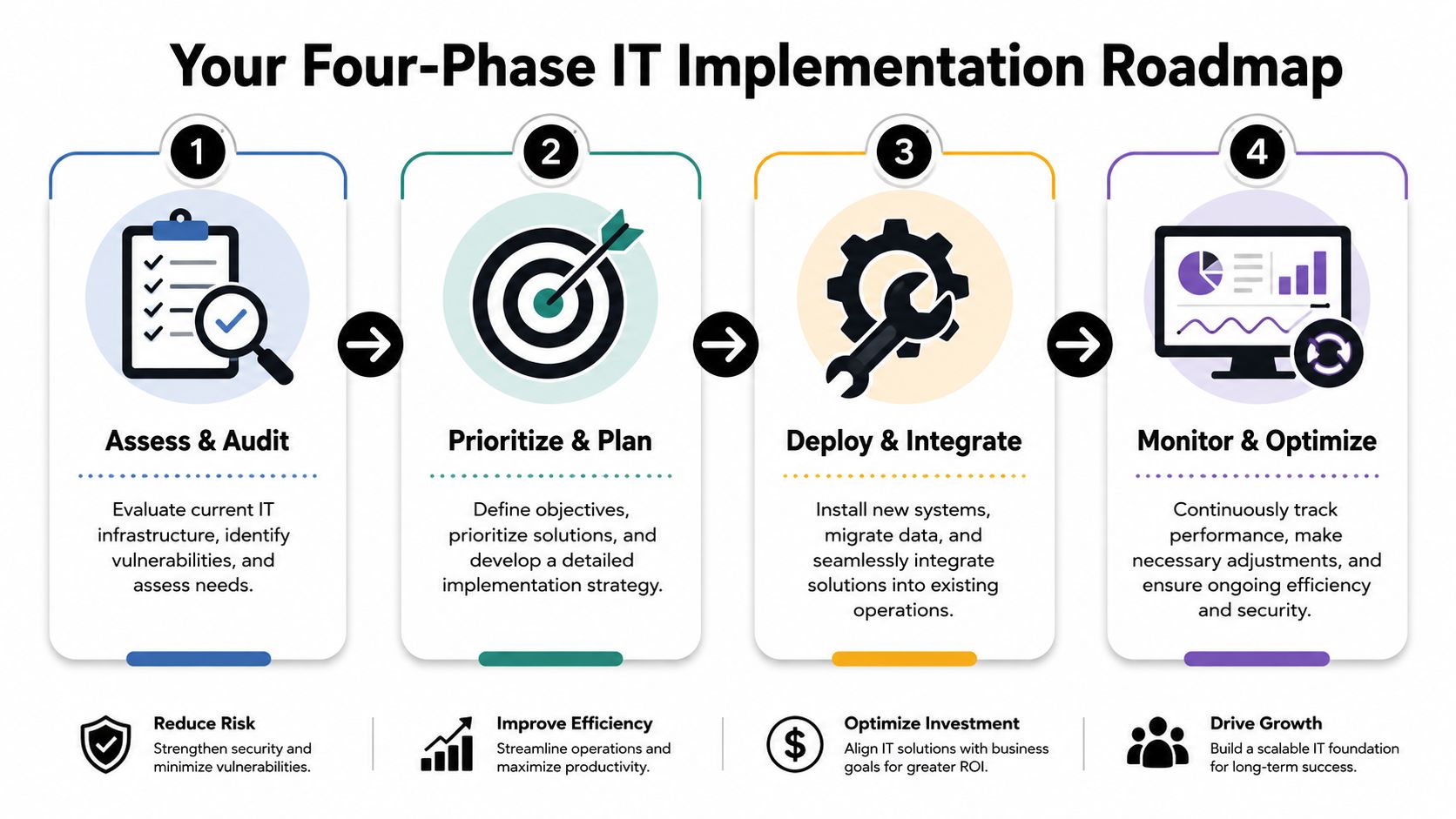
Phase one starts with clarity
The first phase is Assess and Audit. In this phase, a firm reviews infrastructure, access controls, backup posture, compliance processes, vendor dependencies, and data flow. Leadership doesn't need guesswork here. It needs a current-state picture that shows what's working, what's exposed, and what's missing.
The second phase is Prioritize and Plan. Not every issue deserves the same urgency. A weak access-control model should usually move before a cosmetic software change. A backup gap should usually move before a reporting upgrade. Firms that need structure around this kind of sequencing often benefit from a documented digital transformation roadmap for business systems, especially when multiple departments rely on the same systems.
A useful audit doesn't bury leadership in technical language. It translates technical conditions into business decisions.
Execution beats endless planning
The third phase is Deploy and Integrate. During this phase, many projects go wrong because firms install new controls without aligning them to real workflows. If authentication becomes so clunky that staff avoid it, adoption slips. If file systems get reorganized without a clear permissions model, confusion spreads. Good deployment is disciplined and practical.
The fourth phase is Monitor and Optimize. Security controls drift if nobody maintains them. Backup jobs fail if nobody checks them. Compliance processes weaken if nobody owns them. Ongoing monitoring keeps the environment usable, not just technically installed.
A clean rollout usually follows this sequence:
- Audit the current state: Review systems, users, data locations, controls, and dependencies.
- Rank issues by business impact: Address exposure, recovery weakness, and compliance friction first.
- Implement in layers: Start with core protections and operational stability, then improve workflows.
- Maintain relentlessly: Monitor, test, adjust, document, and repeat.
This process shouldn't intimidate a firm owner. It should do the opposite. It turns a vague technology burden into a manageable operating plan.
How to Choose an IT Partner in Dallas–Fort Worth
A financial firm shouldn't choose an IT partner the same way it chooses office supplies. This decision affects client trust, operating resilience, staff productivity, and the firm's ability to respond when something breaks or a regulator asks questions.
That's why the local decision matters. A provider that understands regulated environments in Dallas Fort Worth will usually solve problems faster and with less friction than a generic national help desk model.
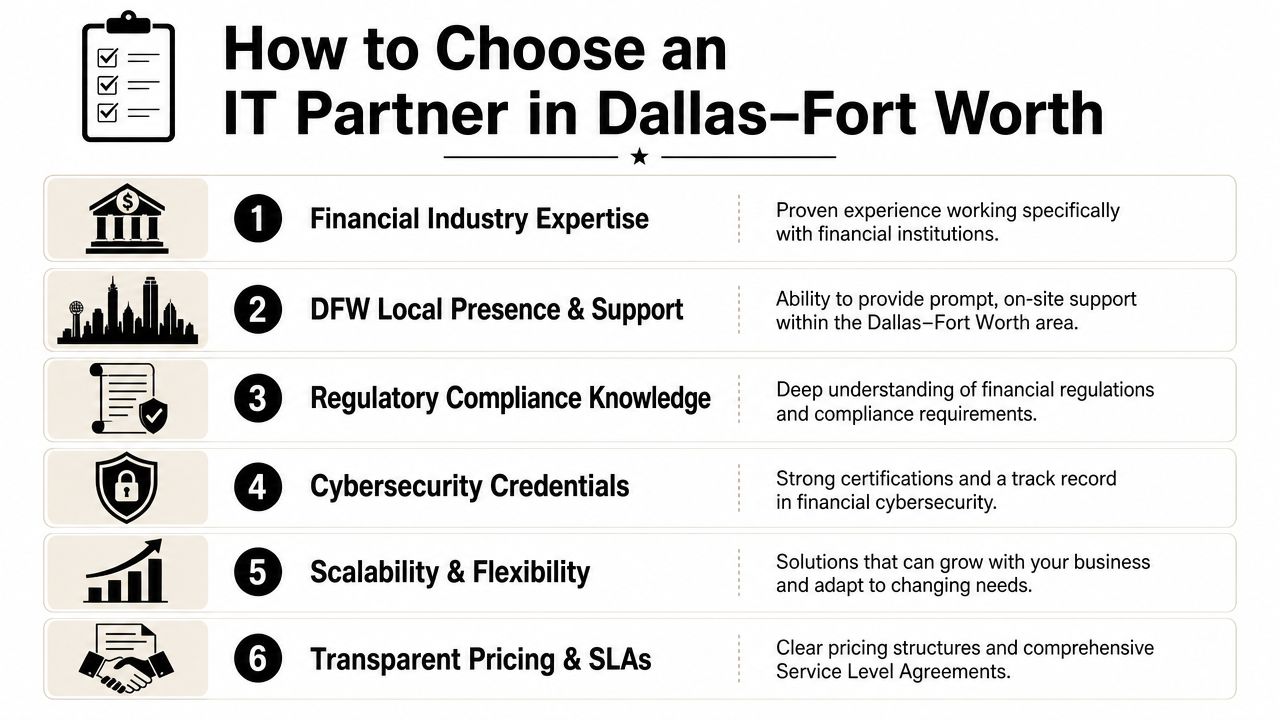
What a financial firm should demand
A strong selection process should be blunt. If a provider can't answer clearly, that's the answer.
A shortlist should include these criteria:
- Financial industry familiarity: The provider should understand how regulated firms handle records, access, documentation, and accountability.
- Local DFW presence: On-site support still matters when leadership needs face-to-face troubleshooting, planning, or incident response.
- Compliance literacy: The provider should speak comfortably about financial controls and documented processes, not just hardware and tickets.
- Proactive monitoring: Break-fix support is too reactive for firms handling sensitive financial data.
- Scalable service model: The provider should support the firm as it adds staff, locations, systems, and workflow complexity.
- Clear agreements: Pricing, response expectations, responsibilities, and escalation paths should be easy to understand.
For firms building that vendor checklist, this guide on how to evaluate a managed service provider is a useful reference point because it forces the right questions early.
Why local support changes the outcome
The local advantage isn't just convenience. It's accountability and context. A DFW-based partner can align support to the firm's pace, culture, growth goals, and operational realities. That shows up in planning meetings, on-site visits, and faster decisions when an issue affects client service.
Trust also belongs in this conversation. Data shows that 46% of financial firms plan to use community channels to enhance product access, and nearly half prioritize trust-building efforts like financial literacy in their IT implementations. That matters because technology in financial services isn't only about defense. It shapes how credible, accessible, and trustworthy the firm feels to the people it serves.
Secure systems build confidence quietly. Clients may never praise the controls directly, but they notice when service is reliable, communication is clear, and the firm handles information with care.
A national provider may offer scale. A local specialist can offer relevance. For an SMB financial firm, relevance usually wins.
Calculating the ROI of Your Technology Investment
Most owners know weak IT is risky. That alone isn't enough to justify a serious investment. The stronger argument is that disciplined technology produces better business performance.
The return starts with efficiency. Well-designed systems reduce manual handoffs, duplicate entry, scattered file storage, and reactive troubleshooting. Staff spend less time searching, rechecking, and improvising. Leadership gets cleaner visibility into operations. That's real business value, even before a single compliance event or security incident is considered.
Where the return actually shows up
ROI in a financial firm usually appears in five places:
- Operational speed: Work moves faster when systems are connected and access is clean.
- Service consistency: Clients get a more reliable experience when teams use controlled, documented workflows.
- Decision quality: Leadership can act faster when reports are based on trusted data instead of fragmented records.
- Scalability: The firm can add people, clients, and services without rebuilding its operating model each time.
- Risk control: Management spends less time firefighting and more time leading.
Financial firms managing cloud infrastructure should also pay attention to reporting discipline. Good governance includes cost visibility, not just technical uptime. This practical guide to effective cloud cost reporting is useful because it frames reporting in business terms that stakeholders can use.
Actionable insights are the payoff
The highest-value technology investments don't just automate tasks. They improve judgment. Generative AI is a permeating trend in financial services, reshaping how institutions manage data and detect fraud. Used well, that shift helps firms move from raw information to actionable insight.
That's where modern IT becomes more than support. Centralized data environments help firms build one source of truth. AI-enabled analysis helps teams spot patterns faster. Automated workflows reduce routine error. Personalized reporting improves client conversations. The business becomes sharper, not just safer.
A good IT strategy should produce three outcomes at once. Better protection. Better operations. Better insight.
If it only does one, it's incomplete.
Secure Your Firm's Future Today
DFW financial firms don't need more noise around technology. They need clarity, structure, and systems that support growth without creating chaos. The firms that perform well over time are usually the ones that stop improvising and put a real operating model behind security, compliance, continuity, and data management.
That work doesn't have to begin with a massive project. It can start with an honest review of the current environment, a list of the biggest business risks, and a practical plan for addressing them in order. That's how IT becomes manageable. It also becomes worth the investment.
For firms thinking about audit readiness, a structured pre-audit assessment for SOC 2 can be a helpful way to understand how readiness reviews work before a formal examination begins. Even for firms not pursuing that exact framework, the discipline is useful. Preparation always beats scrambling.
The smartest next move for a financial firm owner is simple. Stop guessing. Get the environment assessed, identify what matters most, and build from there. The right roadmap will usually reveal that the business is closer to a strong technology posture than leadership assumed. It just needs focus and execution.
Technovation LLC helps DFW financial firms turn IT from a constant concern into a stable platform for growth. The team provides cybersecurity, compliance support, 24/7 monitoring, cloud backup, strategic planning, and free IT health checks built for regulated, security-conscious organizations. Financial firms that want a straightforward conversation about risk, readiness, and practical next steps can connect with Technovation LLC.