
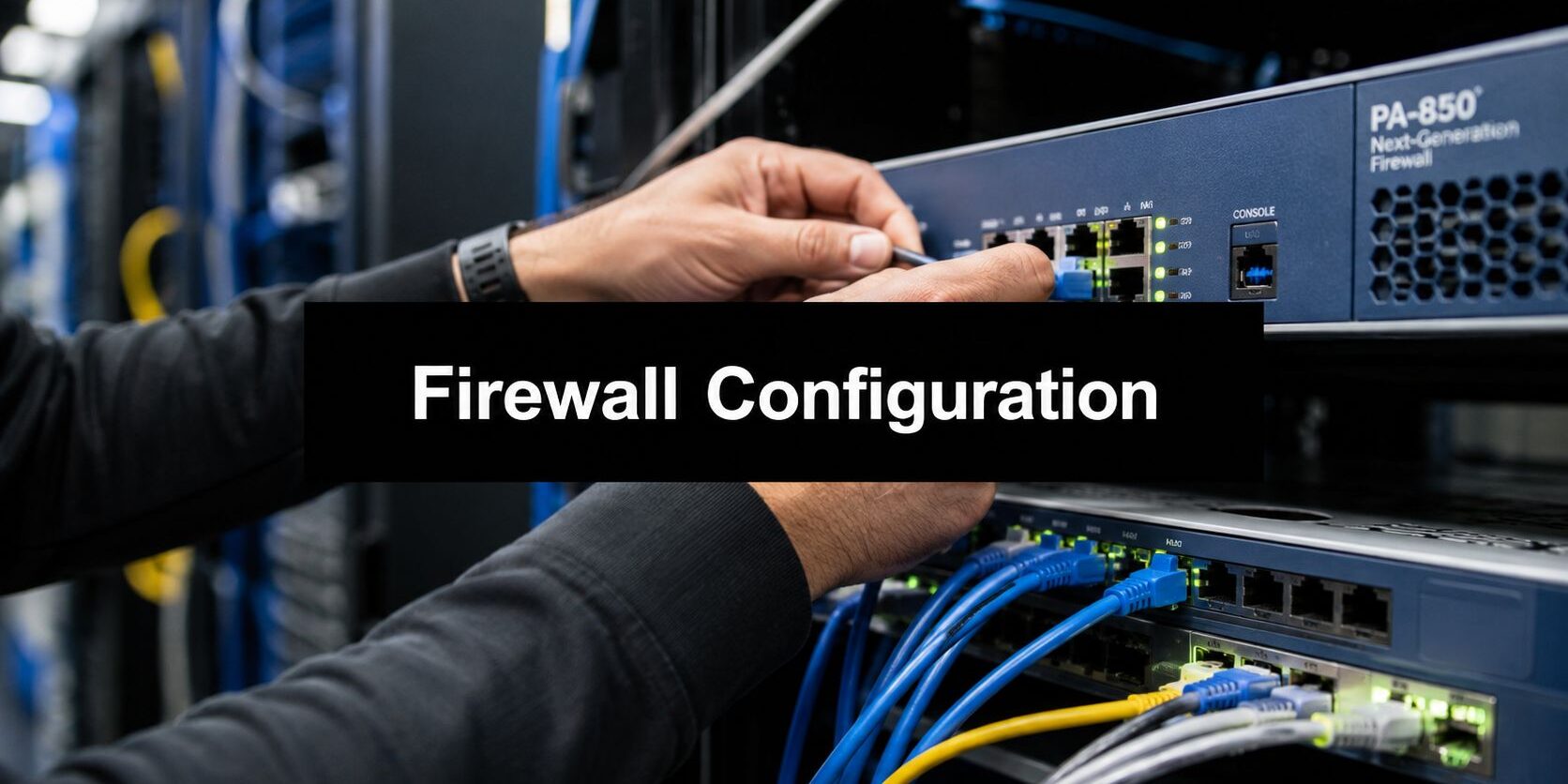
Your firewall probably wasn't treated like a project when it went in. Someone turned it on, pushed a few allow rules, got the business back online, and moved on. That's how SMBs end up with a device that looks fine on a rack but is carrying stale access, undocumented exceptions, and a rule set no one wants to touch.
In regulated environments, that's the core problem. Auditors, attackers, and insurers don't care that the box powers on. They care whether firewall configuration is still aligned to the business, whether management access is hardened, whether old access has been retired, and whether anyone can prove the policy still matches reality.
Table of Contents
- Why Firewall Configuration Is the Real Risk for Growing Businesses
- Planning the Network Topology Before You Write a Single Rule
- Designing Policies with Zones and Least Privilege
- Rule Creation, Ordering, and the Platform Choices That Matter
- Testing and Validation Before Rules Hit Production
- Monitoring, Maintenance, and Rule Lifecycle Governance
- Compliance, Incident Response, and Your First 90 Days
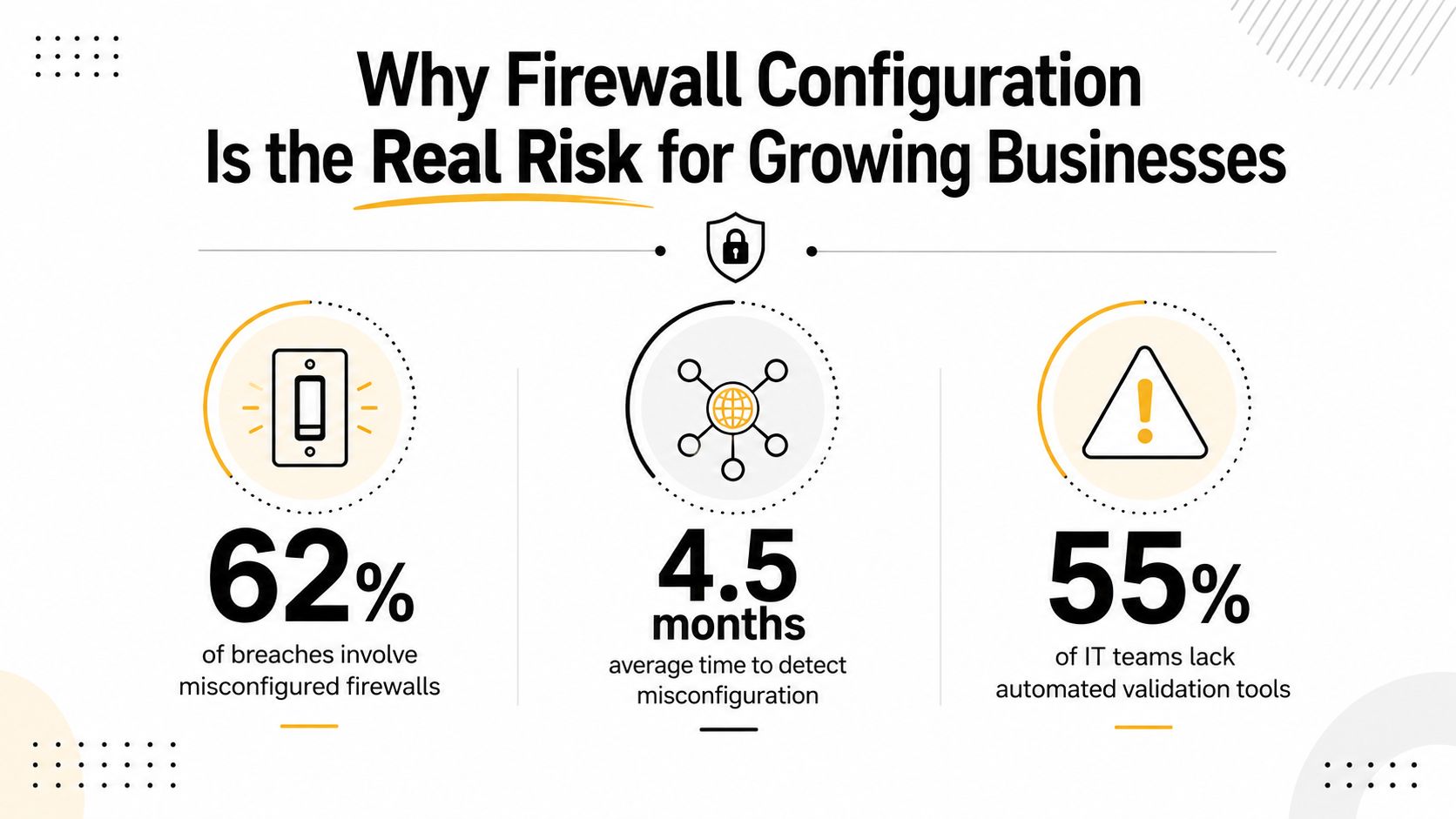
Why Firewall Configuration Is the Real Risk for Growing Businesses
A Dallas-area company can pass vendor questionnaires for years and still fail a third-party risk review because the firewall was never governed like a living control. The pattern is always the same. The business bought protection, but nobody owned the policy after day one, so the rule set filled up with one-off exceptions, stale objects, and broad outbound access that no one could justify.
That is why configuration matters more than the appliance itself. Real enterprise rule sets are large even before they go bad, with deployments ranging from 5 to 2,671 rules and an average of 144 rules per firewall, plus 24 to 5,847 objects with an average of 968 objects and 2 to 13 interfaces with an average of 4.1 interfaces. In that same study, over 42% of surveyed firewalls allowed outside access to Microsoft services, over 80% had the frequent error pattern of allowing outbound SMTP from over 256 IP addresses, and over 45% allowed DNS, FTP, or SMTP to reach over 256 addresses inbound, which shows how quickly “temporary” rules become normal operations. Firewall configuration error research
What that means for leadership
The right question is not whether the firewall is installed. The right question is whether the policy still reflects business reality. That includes the people who own the rule, the traffic it permits, the ports it opens, and the review date that proves someone still needs it.
Practical rule: if no one can explain why a rule exists in one sentence, it should be treated as suspect.
That is also why hiring a network security engineer is often the point where SMBs stop improvising. The role is less about clicking through a console and more about keeping policy, topology, and review discipline from drifting apart.
The hard truth is that a firewall becomes risky when leadership treats it like a checkbox instead of an operating control. Revenue, customer trust, and audit standing all depend on keeping that control current. Technovation approaches firewall work that way, as a managed discipline tied to the business, not a one-time install.
Planning the Network Topology Before You Write a Single Rule
A firewall policy written before the topology is documented gets torn apart later, usually under pressure. That rewrite is expensive, and in a live business it tends to happen during an outage, a failed rollout, or a compliance scramble. The disciplined approach is to map the network first, then write rules only for traffic with a clear business owner.
Start with the flows, not the appliance
The first deliverable should be a plain inventory of assets and traffic paths. List what needs to talk to what, which systems are internal, which are exposed, and which should never share a zone. It sounds basic, but SMBs find the messy reality here, guest Wi-Fi, point-of-sale systems, remote staff, finance workstations, clinical systems, and vendor access often sit inside the same trust boundary.
Network segmentation helps because it turns a vague perimeter into defined boundaries. The planning phase should include a clear review of what network segmentation does and why it matters, because the firewall can only enforce boundaries that someone has already defined.
Build the zone map like a contract
A useful topology map names each zone and the approved crossings between zones. That means the business owner for a flow signs off on what application is involved, what data moves, and which side of the boundary the traffic starts from. Skip that step, and rule requests come in as vague favors. Vague favors turn into permanent exceptions.
A clean topology review should settle a few practical choices:
- Placement: put the firewall where it can enforce the boundary you care about, not just where a rack is open.
- Zones: separate guest, user, server, management, and sensitive business segments instead of forcing everything into one flat trust model.
- Form factor: choose hardware or virtual deployment based on scale, routing design, and whether the business needs one site or several.
- Ownership: assign a human owner to every zone crossing so no rule exists without accountability.
If the business can't draw the flow, it shouldn't open the flow.
That mindset keeps later change control sane. It also makes recertification possible, because the team can revisit each rule against a real map instead of guessing at intent. Technovation's Managed firewall services fit well here because implementation can follow the map, the owner list, and the actual traffic paths instead of a loose checklist.
Designing Policies with Zones and Least Privilege
Most firewall configurations go wrong here, because the ruleset grows faster than the discipline around it. A business starts with a few allows, then adds exceptions for a vendor, a remote office, a cloud app, and a legacy system, until the policy is a flat pile of access nobody wants to remove. That's how you end up with an environment that technically works and operationally scares everyone who reviews it.
Default deny is the only sane starting point
A strong policy starts by blocking everything that is not explicitly documented. Then it adds narrow allow rules for business traffic that has a source, destination, protocol, and port the team can defend. That keeps the firewall readable and makes review possible, which is the difference between a control and a wish list.
Decision rule: every allow should answer who, what, where, and why. If one of those is missing, the rule isn't ready.
The order matters too. Specific denies should sit above broad permits, because a broad allow placed too early can flatten the whole policy. The most dangerous rule is the one that stays in place only because nobody knows whether it still matters.
Keep the objects clear and the management plane separate
Names matter. Use named objects, service groups, and, where available, user-based controls so rules can be understood by someone new to the environment. Avoid the lazy approach of piling everything into broad “any” style entries, especially for legacy vendor access, because those entries almost always outlive the project they were created for.
Management traffic should get its own policy. The firewall itself should not be reachable from general user networks just because it is convenient. A separate management rule set keeps one compromised path from exposing the console, the logs, or the rule editor.
A clean policy structure usually looks like this:
- Business traffic rules: narrow, documented, tied to named systems.
- Management access rules: restricted to trusted admin networks or controlled remote access.
- Denies: explicit blocks for traffic that should never cross the boundary.
- Review fields: owner, purpose, and recertification date on every rule.
Security guidance also emphasizes hardened administration, including removing default accounts, using unique credentials, restricting admin access, and securing logging so it can't be tampered with. Firewall configuration hardening guidance lines up with that view, and so does the practical reality that many incidents begin before a single data flow is inspected.
A policy built this way can be audited, handed to a new hire, or managed by a co-managed IT partner without guesswork. That is the point.
Rule Creation, Ordering, and the Platform Choices That Matter
Two firewalls can share the same intent and still behave differently because of ordering, NAT handling, and platform behavior. That is why policy design is only half the job. The other half is knowing how the platform evaluates the rules you write, and how that changes the traffic the business sees.
Read the engine, not just the screen
Some systems evaluate top-down, some use first-match behavior, and some separate phases for different traffic types. The practical effect is simple. A rule that appears harmless in the console can still shadow a later control or let traffic bypass a more precise deny. That is where stale complexity becomes operational risk.
Document every rule with its owner, purpose, and review date. That sounds bureaucratic until a change request lands at 4:45 p.m. and the only person who remembers the original intent is on vacation. Clear naming and rule grouping keep the policy from turning into a scavenger hunt.
NAT belongs in the same conversation
Outbound translation and inbound publishing are not side topics. They change what the firewall sees and what the rest of the network experiences, so NAT has to be designed with the policy, not after it. Overlapping NAT objects and vague address translation are a common way to create conflicts that only show up under load or during a cutover.
A few platform choices deserve attention before rollout:
- Rule ordering model: confirm whether the system is top-down or phase-based, then document the consequence of a first match.
- Object handling: keep address and service objects named consistently so shadowed rules are easier to spot.
- Policy sections or blocks: use them to separate user access, server access, and management traffic.
- NAT design: map inbound and outbound translation deliberately so the firewall and the application team are aligned.
Buy for clarity, not for features you won't govern
SMBs often overbuy a platform because the feature list looks impressive, then underuse the controls that matter. The better question is whether the team can operate the platform cleanly, review rules without confusion, and maintain the policy after staff changes. That's the reason some organizations choose to bring in outside help rather than let the configuration drift.
For teams that want a structured review of the platform and policy model, secure your business network can be useful as a point of comparison, but the decision should still come down to whether the firewall can be governed cleanly over time.
Testing and Validation Before Rules Hit Production
A firewall rule that looks right on screen can still break a clinical app, block a remote office, or expose a controller. The gap between intent and behavior is where outages start. That gap closes only when changes are staged, reviewed, and validated before production traffic depends on them.
Use change control like a gate, not a ritual
The change request should begin with business justification, then move to technical specification, independent security review, a scheduled implementation window, rollback criteria, and post-change validation. That sequence is not paperwork for its own sake. It forces the team to prove the rule has a reason, a design, a reviewer, and a way out if the result is wrong.
In a small or mid-sized organization, that process can be simple and still be disciplined. The point is not to create a committee. The point is to stop approving changes that nobody has tested against real traffic patterns.
Prove both the allow and the deny
A lab or maintenance window should validate the rule against expected traffic and expected blocks. Packet captures and policy simulator tools help, but only if someone checks the results against the business case. Logging and alerting should also be tested, because a silent firewall is not a control, it is a blind spot.
The workflow should be boring by design:
- Document the intent.
- Stage the rule in isolation.
- Replay real traffic patterns where possible.
- Get approval from the right reviewer.
- Push during the maintenance window with rollback ready.
- Confirm behavior after deployment.
A rule is not finished when it saves successfully. It is finished when the expected allow works, the expected deny still blocks, and the logs prove it.
That last step matters because misconfiguration often hides until someone needs the logs during a real incident. A clean validation record becomes part of the firewall's operating history, which is exactly what regulators and auditors want to see later.
For teams that want to strengthen the testing side of change management, what vulnerability scanning adds to validation is worth understanding in the broader security workflow. Firewall changes should never be the first time anyone discovers the exposure they created.
Monitoring, Maintenance, and Rule Lifecycle Governance
A working firewall is not a finished project. It starts drifting the moment a new vendor is onboarded, a remote worker is added, or a temporary exception becomes permanent because the business got busy. That is why maintenance has to be treated as governance, not housekeeping.
Monitor the right things in real time
Real-time monitoring should focus on denied flows, admin logins, configuration changes, and VPN behavior. Those events tell the team whether the firewall is being used as intended or whether someone is trying to work around it. If logs are not centralised and reviewed, the firewall can be technically active and operationally invisible.
The firewall also needs external or tamper-resistant log storage so records survive an incident. Secure administration guidance recommends that logs be sent off the device, because the device itself is not the place to store the evidence you may need later. That's basic discipline, not luxury.
Retire what no longer earns its place
A rule lifecycle program should answer who owns each rule, when it was last reviewed, and what criteria justify keeping it. Unused rules should be retired, shadowed rules should be cleaned up, and objects that no longer support a live service should be removed. That work is never glamorous, but it prevents the slow build-up of technical debt that turns a manageable policy into a liability.
The modern firewall failure pattern is not dramatic. It is accumulation.
- Owner: every rule needs a named accountable person.
- Recertification: set a review date and force a fresh justification.
- Usage review: remove rules that never get used.
- Object hygiene: purge stale objects so the policy stays readable.
- Backup integrity: verify that configuration backups are usable, not just present.
A managed monitoring partner can help keep that rhythm intact, and how Networking2000 protects networks is a reminder that continuous oversight is a real operational service, not a theoretical best practice.
Treat quarterly review as non-negotiable
Quarterly is a workable cadence for most SMBs. It is frequent enough to catch drift and light enough to sustain without turning the process into a full-time project. The review should cover firewall firmware, backup integrity, rule utilization, and a sample of management logs.
Technovation can take this on as part of a managed service model, but the important thing is the discipline, not the logo. If no one owns recertification, the firewall will slowly become a record of old decisions instead of current controls.
Compliance, Incident Response, and Your First 90 Days
Compliance doesn't start with a form. It starts with controls that can be explained and proven. For clinics, retailers, financial firms, and other regulated SMBs, firewall configuration supports the evidence trail through segmentation, logging, change history, and rule ownership, which are the things reviewers ask about when the questionnaire gets serious.
What audits really want to see
HIPAA environments need evidence that protected systems are segmented and that access is controlled. PCI environments need proof that the cardholder environment is isolated and that firewall changes are managed. GLBA environments need disciplined access control and monitoring. Legal and construction firms usually face client-driven questionnaires that ask the same practical questions in different words, namely who can talk to what, why, and how the business proves it.
The best evidence is not a screenshot taken after the fact. It is a living record of policy, review dates, log retention, and change approvals. That record tells an auditor the firewall is part of governance, not just infrastructure.
A better incident response posture
A well-configured firewall also shortens the path to containment. The team can lock down administrative access, compare the current configuration against a clean baseline, and use logs to build a timeline of what was allowed, blocked, or changed. That makes the first hours of an incident more focused and less chaotic.
The practical incident response playbook belongs with the firewall records. An incident response playbook only helps if the firewall policy, the management plane, and the logs support it during a real event. Otherwise, response teams spend time guessing which rule caused the problem and which one exposed the path.
A simple 30/60/90-day plan
The first 30 days should focus on inventory, topology, and ownership. The next 30 should clean up unused rules, remove stale objects, and validate management access. The final 30 should lock in recertification, log review, and a repeatable change-control rhythm.
That is the point where Technovation becomes a practical next step. The firm can run a free security audit and IT health check, baseline the current firewall posture, and identify where governance has drifted. That gives leadership a clean starting point instead of another vague security project.
Technovation LLC helps SMBs in Dallas–Fort Worth harden firewall configuration, clean up rule sprawl, and put governance around changes, reviews, and logging. If the firewall has been running on habit instead of process, visit Technovation LLC and ask for a free security audit and IT health check. That's the fastest way to find out whether the current policy is protecting the business or just looking busy.