
Most businesses still get firewall advice backwards. They shop for a box, sign a contract, and assume protection is handled. That mindset is exactly why managed firewall services matter, because the value sits in rule discipline, configuration control, patching, policy tuning, and compliance evidence, not in the appliance sitting on a shelf.
For growing companies in Dallas-Fort Worth, that distinction is everything. A firewall that isn't monitored, reviewed, and adjusted becomes another unmanaged risk item, especially when staff are remote, sites are distributed, and auditors expect defensible controls. The better question isn't whether a firewall exists, it's whether anyone is proving that it still works as the environment changes.
Table of Contents
- What Managed Firewall Services Really Mean
- Core Components and Delivery Models
- In-House Versus Managed Side by Side
- Business Benefits That Actually Matter
- Onboarding and Ongoing Management in Practice
- Pricing Models and SLAs Decoded
- An Evaluation Checklist for Choosing a Provider
- What to Do Next and How Technovation Can Help
What Managed Firewall Services Really Mean
A firewall is not a magic shield, and it is definitely not a set-and-forget appliance. Managed firewall services replace that habit with ongoing governance, where a provider handles rule administration, configuration, firmware updates, patching, policy tuning, and compliance documentation through a centralized process [SonicWall glossary on managed firewall]. The value is not the hardware. It is disciplined operation.
A lot of buyers still shop for a branded box and stop there. That is the wrong filter. Managed firewall services market report research shows the category is being bought as an ongoing service, and the trend lines point the same way. The buying decision should focus on whether a provider can prove continuous rule-set optimization, change control, and measurable risk reduction, not whether it can sell you a piece of equipment.
Practical rule: if a provider mostly talks about the box, the brand, or the deployment date, the offer is too shallow.
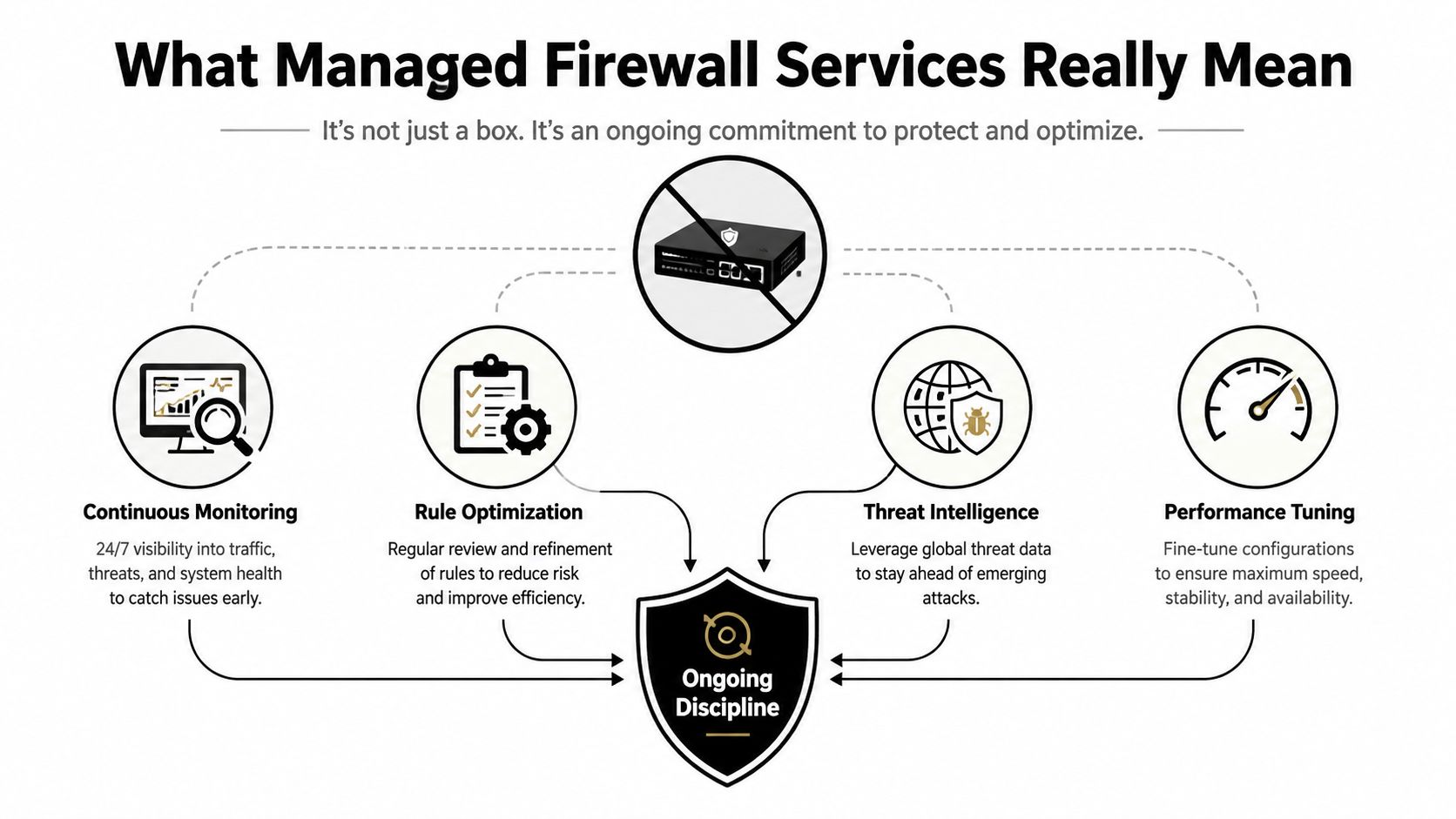
For a business owner, the takeaway is straightforward. A firewall only earns its keep when someone keeps reviewing the rules, tightening the policy, and checking whether the environment has drifted. That means the service is really about governance, not just filtering traffic. If you are evaluating small business firewalls, ask how the provider handles rule review, approvals, and cleanup after business changes, not just how fast it can turn the appliance on.
That discipline is what separates real management from box-moving. It also matters for teams that need a practical guide for WordPress operators who have to block hostile traffic without creating a tangle of stale exceptions [guide for WordPress operators]. A provider like Technovation LLC fits that model by focusing on security operations, compliance support, and ongoing oversight for growing businesses that do not want to gamble on stale rules or half-maintained perimeter controls.
Core Components and Delivery Models
Think of a managed firewall service as a stack, not a single product. The base layer is perimeter filtering, then intrusion prevention, then 24/7 monitoring, and on top of that sits rule-set management. If any one layer is weak, the entire control starts to wobble.
The technical reason is simple. Managed offerings are often built around capacity tiers, not vague promises. One service definition includes virtual firewall sizes with Layer 7 throughput of 50, 200, 500, and 1000 Mbps, session limits of 60,000, 240,000, 500,000, and 500,000, policy scales from 1,000 to 5,000 rules, and VPN support from 25 to 200 site-to-site tunnels [service definition]. That matters because bottlenecks often come from sessions and policy-table growth, not just raw bandwidth.
Delivery models that actually matter
The major delivery choices are fully managed, co-managed, cloud-delivered, and hybrid. Fully managed works when the business wants the provider to own the daily workload. Co-managed makes sense when an internal IT team wants help with oversight but still keeps some control. Cloud-delivered and hybrid models fit environments where users, apps, and sites are no longer anchored to one network edge.
A useful way to separate these is by responsibility. If internal staff can define policy but can't sustain it, co-managed is usually the honest answer. If they can't monitor around the clock, fully managed is the cleaner fit.
For operators who also manage WordPress-hosted environments, the guide for WordPress operators is a useful reminder that network controls still matter at the traffic-filtering level, even when the application layer is doing most of the visible work.
A firewall service isn't “more advanced” just because it's cloud-based. It's better when it can still prove who changes rules, when they're reviewed, and how exceptions are tracked.
That's the standard Technovation should be judged against as well. The right question is whether the provider can keep the policy clean and the operations visible, not whether the dashboard looks impressive.
In-House Versus Managed Side by Side
A lot of business owners want an internal answer because it feels closer, faster, and more controllable. That instinct is understandable, but it only works when there's real staffing depth behind it. A firewall doesn't care whether the company is small or proud of its IT team, it only cares whether someone is available to review rules, respond after hours, and document changes properly.
The staffing gap is not theoretical. Fortinet's 2023 Global Cybersecurity Skills Gap Report found that 62% of organizations lack the internal staff to manage and monitor firewalls around the clock properly [Fortinet report in market research summary]. That shortage is exactly why many SMBs stumble with firewall upkeep even when they have smart people on payroll. The challenge is coverage, not intent.
Side-by-side reality
| Decision point | In-house model | Managed model |
|---|---|---|
| After-hours coverage | Depends on staff availability | Built into the service |
| Rule reviews | Often delayed by other work | Scheduled and ongoing |
| Compliance evidence | Harder to maintain consistently | Easier to document |
| Change control | Can drift when busy | More disciplined |
| Misconfiguration risk | Higher if the team is stretched | Lower when managed properly |
A managed model wins when the business needs continuity more than ownership. That's especially true in regulated environments where a missed review or undocumented exception can become an audit problem later. The enterprise firewall market data also shows North America at 36% share in 2025, with the U.S. projected at USD 11.38 billion by 2035 at a 10.53% CAGR, which shows how much operational weight this category carries in mature markets [enterprise firewall market data].
On the other hand, in-house still makes sense for large security operations, specialized environments, and teams that can prove they have the people to handle it. If that team can't keep pace, the firewall becomes a liability disguised as capability.
For businesses considering a middle path, Technovation's co-managed IT support gives a local example of how shared ownership can work without pretending the internal team has infinite bandwidth.
Business Benefits That Actually Matter
The word “security” sells, but it doesn't help a business owner make payroll, answer an auditor, or close the books on a breach attempt. The benefits of managed firewall services show up in the operations room, the compliance packet, and the incident log.
Start with predictable cost. A managed model shifts firewall operations from surprise-driven maintenance to a recurring service relationship, which is easier to budget than appliance failures, emergency tuning, or rushed after-hours fixes. That matters for growing firms that hate unpredictable spend and can't afford to keep senior technical talent on standby for every policy change.
What owners actually feel
- Audit evidence becomes easier to produce. When firewall changes, logs, and approvals are tracked centrally, the business is in a better position to show control during HIPAA, PCI, or other compliance reviews.
- Response is cleaner under pressure. If a suspicious event happens at night, a provider with defined monitoring and escalation paths can move faster than an overextended generalist.
- Accountability gets sharper. SLA language gives the owner a way to measure whether a provider is doing what it promised, instead of relying on a vague “we're watching it” claim.
- Rule sprawl gets handled. Managed services are built around change control and rule hygiene, which is where many firewall environments degrade.
The hidden win is defensibility. Technovation's network security best practices fit this conversation because they frame security as operating discipline, not just tool acquisition. That's the mindset buyers need if they want results they can explain to an insurer, an auditor, or a skeptical partner.
If a firewall setup can't be explained in plain English to management, it probably can't be defended well under stress.
That's the standard worth using. “Improved security” is too vague to buy on its own. Faster incident handling, cleaner evidence, and tighter rule governance are the benefits that move the needle for healthcare, legal, financial, construction, and nonprofit organizations.
Onboarding and Ongoing Management in Practice
A multi-site healthcare clinic usually starts with messy reality, not a neat diagram. One location has a legacy rule that nobody remembers approving, another has remote staff, and a third has a printer or device exception that was meant to be temporary. The onboarding process has to surface all of that before the provider touches production.
The first step is discovery and inventory. A provider should identify the existing rule base, note active exceptions, map the sites, and confirm what traffic needs to pass. Then comes baseline review, where stale entries, duplicates, and contradictory policies get flagged for cleanup. That's the point where managed firewall services stop being abstract and start acting like a control process.
What steady state should look like
After staging and cutover, the work doesn't stop. Monitoring stays active, alerts get triaged, and rule changes should move through a defined approval path instead of living in email threads. Quarterly reviews are a sensible rhythm for many businesses, because they force the conversation back to whether the rules still match how the company really operates.
That's also where log handling becomes useful in practice. Enterprise managed firewall services commonly include high-availability pairs, up to 1 GB of log data per day, 10 GB of included log storage, and 60 days of retention per firewall pair [Equinix managed firewall service]. The point isn't the numbers themselves, it's that HA reduces the chance that one appliance failure becomes an outage, while retained logs support investigation and compliance evidence.
A good provider doesn't just say a problem was resolved. It shows who changed what, when it changed, and why it was allowed.
That's the difference between a support ticket and a real management process. In steady state, the provider should make the firewall feel quieter, not busier. The business keeps operating while the rule set gets cleaner in the background.
Pricing Models and SLAs Decoded
Most buyers look at the monthly fee and stop there. That's a mistake. The cost of managed firewall services depends on how the provider prices scope, how tightly the SLA is written, and which items get pushed into change requests later.
Three pricing structures show up often. Per-device pricing is simple, but it can punish organizations with many locations or many small appliances. Per-user pricing makes more sense when policy follows people across sites and remote access paths. Per-throughput tier pricing fits environments where traffic volume and policy load are the main drivers. The right model depends on whether the business is buying coverage for endpoints, sites, or traffic capacity.
Clauses that change the actual cost
- Log retention upgrades: a quote can look cheap until longer retention becomes a paid add-on.
- Change-request fees: some providers include routine updates, others bill for every exception.
- Out-of-scope rule reviews: if periodic cleanup isn't included, rule sprawl becomes your problem again.
- Response timing: an SLA that promises service but not fast escalation doesn't help much during a live issue.
A strong SLA should define uptime expectations, response commitments, and what happens if the provider misses them. For regulated businesses, vague wording is a red flag because the contract needs to support evidence, not just reassurance. If the agreement doesn't spell out monitoring windows, review cadence, and escalation paths, the buyer is assuming more than the contract delivers.
The sharpest question is not “How much per month?” It's “What operational work is covered, and what gets billed later?” That question protects budget and forces an honest comparison across vendors, especially in sectors where compliance and recovery are not optional extras.
An Evaluation Checklist for Choosing a Provider
A provider should be able to answer hard questions without sliding into sales language. If it can't, that tells the buyer a lot. The goal is to verify whether the service delivers continuous rule-set optimization, change control, log retention, and incident response discipline, or just promises them in a brochure.
Questions that expose the real quality
- How often are firewall rules reviewed? A strong answer includes scheduled and event-driven review, not only “as needed.”
- Who approves changes? A good provider explains the approval path clearly. A weak one talks vaguely about “the team.”
- How are logs retained and accessed? The answer should cover retention length, storage, and who can pull evidence.
- What does high availability look like? A provider should explain redundancy in plain language, not hide behind abbreviations.
- How are cloud and remote users handled? The service should fit distributed work, not pretend the network is still one perimeter.
- What does incident response include? The provider should describe triage, escalation, and documentation.
- How is compliance reporting supported? Strong providers map controls to evidence instead of making the customer assemble it from scratch.
A red flag is any answer that stays at the product level. Another red flag is an offer that sounds automated but can't explain who owns the exception process. Good firewall management is a process, not a purchase.
Technovation can be used as a local benchmark here because it offers DFW businesses 24/7 monitoring, free security audits, and support across regulated and growth-focused sectors. That doesn't make every provider identical, but it gives buyers a practical standard to measure against when they sit across the table from a sales rep.
If the provider can't show how it prevents configuration drift, the buyer is being sold alerting, not management.
That's the line that separates real service from a dressed-up appliance resale. Use the checklist above, ask for specifics, and don't accept “we handle that” unless the process is written down.
What to Do Next and How Technovation Can Help
The cleanest next move is to stop guessing. Request a free security audit or IT health check, map the findings to the firewall gaps that matter most, then compare the result against the provider checklist above. That sequence keeps the conversation grounded in actual risk, not marketing language.
For Dallas-Fort Worth businesses in healthcare, legal, financial services, construction, and nonprofit work, local accountability matters. When response time, compliance evidence, and trust are on the line, a nearby team with direct operational responsibility is easier to work with than a distant brand that treats every account the same.
Technovation LLC fits that local model because it focuses on proactive monitoring, risk mitigation, compliance support, and strategic IT planning for North Texas organizations. The right question now is whether the current firewall process is being managed, or merely maintained in place.
Technovation LLC offers managed IT and cybersecurity support built for businesses that need disciplined firewall oversight, not just hardware. If the current setup feels too loose, too manual, or too hard to defend during an audit, visit Technovation LLC and start a conversation about a managed firewall scope that matches the way the business actually operates.