
Annual phishing awareness training is widely treated as a security control. Too often, it's only a compliance ritual. Employees watch a module, pass a quiz, receive a completion record, and return to an inbox where a convincing request can still trigger a click, reply, or payment.
The evidence supports a harder conclusion. A major randomized study summarized in a NIST-hosted paper found that typical awareness training produced only a 2% reduction in employees falling for phishing compared with no training. Simulated lures used in embedded programs still persuaded 10% to 30% of employees to click. The answer isn't to abandon training. It's to stop confusing attendance with behavior change.
Table of Contents
- Why Most Phishing Awareness Training Quietly Fails
- Building a Program That Actually Changes Behavior
- Continuous Simulation Versus Annual Training
- Running Simulations and Remediation Without Burning Out Staff
- Metrics That Prove Training Is Working
- Compliance Touchpoints for Healthcare, Finance, and Legal
- Pairing Training With an MSP Partner
Why Most Phishing Awareness Training Quietly Fails
The popular advice says every employee should complete phishing awareness training once a year. That advice is convenient, auditable, and incomplete. Annual instruction often fails because it asks people to remember a generic lesson during a real attack months after the lesson ended.
A large real-world study of more than 12,000 employees found no statistically significant main effect of training on click rates or reporting behavior, with p = 0.450 for clicks and p = 0.417 for reporting, as reported in the study's published analysis. Those results don't prove that every training program is useless. They show that program design is the variable, not the existence of a course.
Four failure modes appear repeatedly:
- Compliance content: Long, generic modules teach definitions instead of decisions employees must make under pressure.
- Punitive reporting: If a click leads to embarrassment or discipline, staff learn to hide mistakes rather than report suspicious messages.
- Uniform cadence: A payroll specialist, executive, receptionist, and systems administrator don't face the same lures or have the same access.
- Annual thinking: A yearly event creates a long gap in which recognition and reporting habits can weaken.
Practical rule: A failed simulation should trigger coaching and investigation, not public blame.
The contrast is straightforward:
| Program Model | Avg. Click Rate Reduction | Reporting Rate | Behavior Lasts Beyond 90 Days |
|---|---|---|---|
| Annual mandated course | Limited or inconsistent | Often unmeasured | Usually unproven |
| Continuous targeted program | Declines tracked over time | Measured as a core behavior | Tested through repeated practice |
Organizations also need a response plan for successful fraud attempts, not just an educational module. Businesses reviewing their exposure may benefit from understanding legal recourse for phishing scams, especially when a phishing event involves financial loss, compromised information, or disputed responsibility.
AI-generated lures make the checkbox mindset even weaker. Messages no longer need obvious spelling mistakes to look suspicious, so teams should pair training with verification procedures, technical controls, and incident response. Technovation's guidance on how AI amplifies phishing danger is useful for leaders updating simulations around more convincing impersonation.
Building a Program That Actually Changes Behavior
An effective program starts with a short policy, not a software purchase. The policy should define acceptable use, explain how employees report suspicious messages, establish who investigates, and make the non-punitive promise explicit. Employees need to know that reporting a questionable email is the desired action, even when the message turns out to be legitimate.
The curriculum should then follow job risk. Finance and accounts payable teams need practice with vendor changes, invoice requests, and payment approvals. Human resources staff need scenarios involving tax forms and employee records. IT personnel need credential-harvesting and privileged-access lures. Legal teams need document-sharing and matter-related impersonation examples.
Build around exposure, not headcount
A department with fewer employees may carry greater risk because it controls payments, sensitive records, or administrative access. Segmentation should therefore consider:
- Role: What requests does the person routinely handle?
- Access: Which systems, accounts, and records can the person reach?
- Authority: Can the person approve money movement or sensitive changes?
- Workflow: Which messages would appear normal during a busy day?
- Tenure: Has the employee learned the organization's reporting process?
Simulations should begin only after staff know how to report a message. Otherwise, the exercise measures confusion about process rather than phishing judgment. New hires and contractors need the reporting workflow during onboarding, followed by reinforcement as they become familiar with internal systems.
The build doesn't have a finish line. Each campaign should produce information about which roles struggle, which lures generate reports, and where procedures create friction. The security owner can then adjust the next lesson, simulation, or escalation path.
For firms handling financial records or tax information, awareness should sit beside broader ransomware defense for tax professionals. Training won't replace backups, access controls, endpoint protection, or recovery planning. It should help employees activate those controls earlier by reporting suspicious activity before an attacker gains access.
Continuous Simulation Versus Annual Training
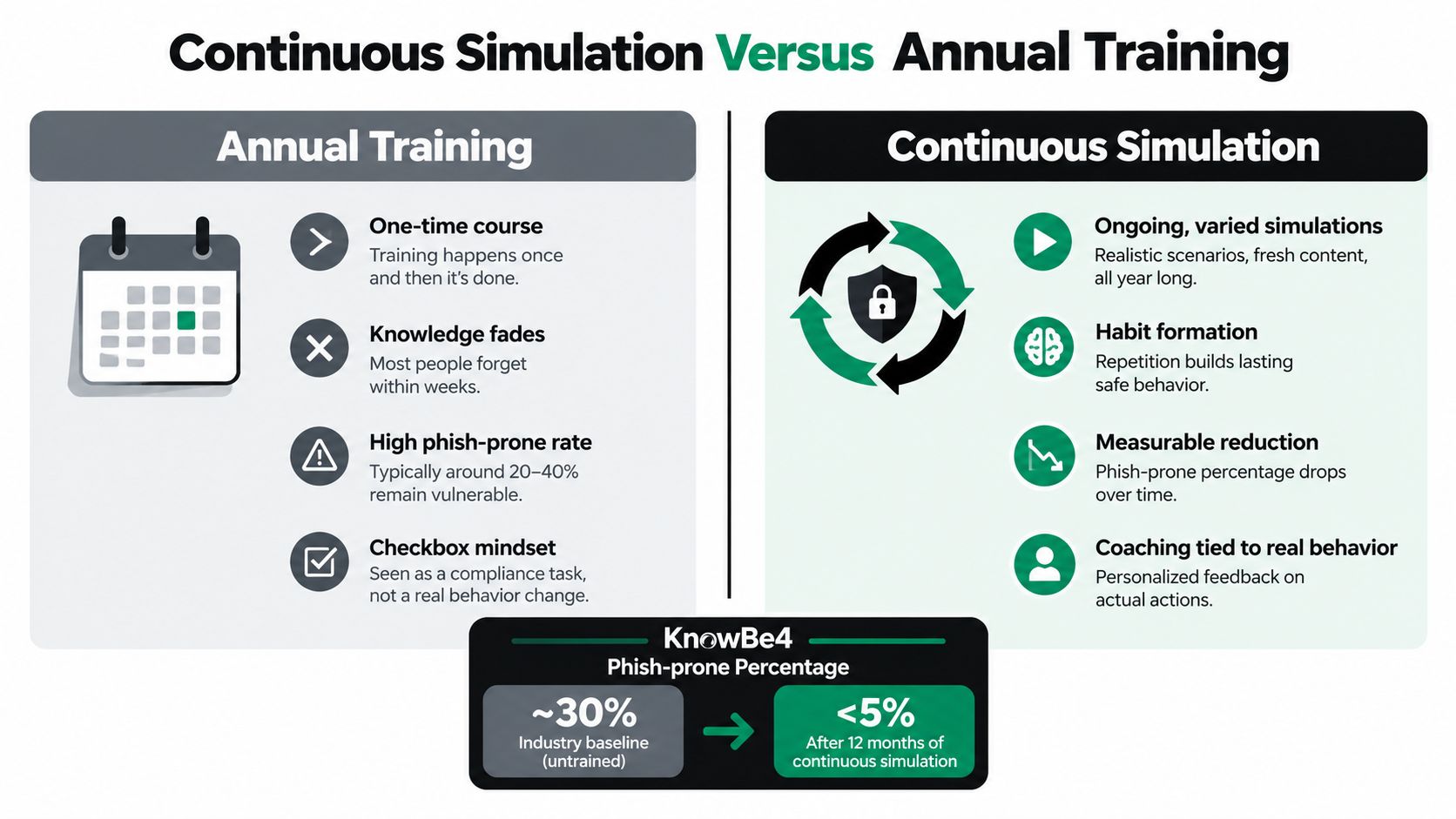
Annual training concentrates attention on a scheduled event. Continuous simulation distributes practice across normal work patterns, which makes it more useful for building recognition and reporting habits. The difference isn't the length of the lesson. It's the quality of repetition, relevance, and feedback.
The strongest benchmark in the available data comes from global benchmarking reported in 2026. Before training, the average phish-prone percentage was 33.2%. After 90 days, it fell to 20.1%, and after one year of continuous training, it reached 4.2%, an overall reduction of roughly 87% from baseline, according to the reported benchmarking data. That pattern supports sustained practice, not a single annual burst.
A longitudinal study found click rates declining from 19% to 10% as awareness training progressed. The same research found that users retained knowledge for at least 28 days, and a reinforcing second training message further reduced the likelihood of submitting information to phishing sites, as detailed in the longitudinal study.
An annual model may document completion, but it rarely answers operational questions:
- Are employees reporting suspicious messages?
- Which departments produce repeat clickers?
- How quickly does the first report arrive?
- Do users verify payment or credential requests through another channel?
A continuous model requires scheduling, templates, feedback, and ownership. That operational work is where many small and mid-sized businesses stall. The decision is therefore a budget allocation question. A company can fund recurring behavior measurement and remediation, or it can fund a periodic compliance activity that may leave the same weaknesses undiscovered.
Running Simulations and Remediation Without Burning Out Staff
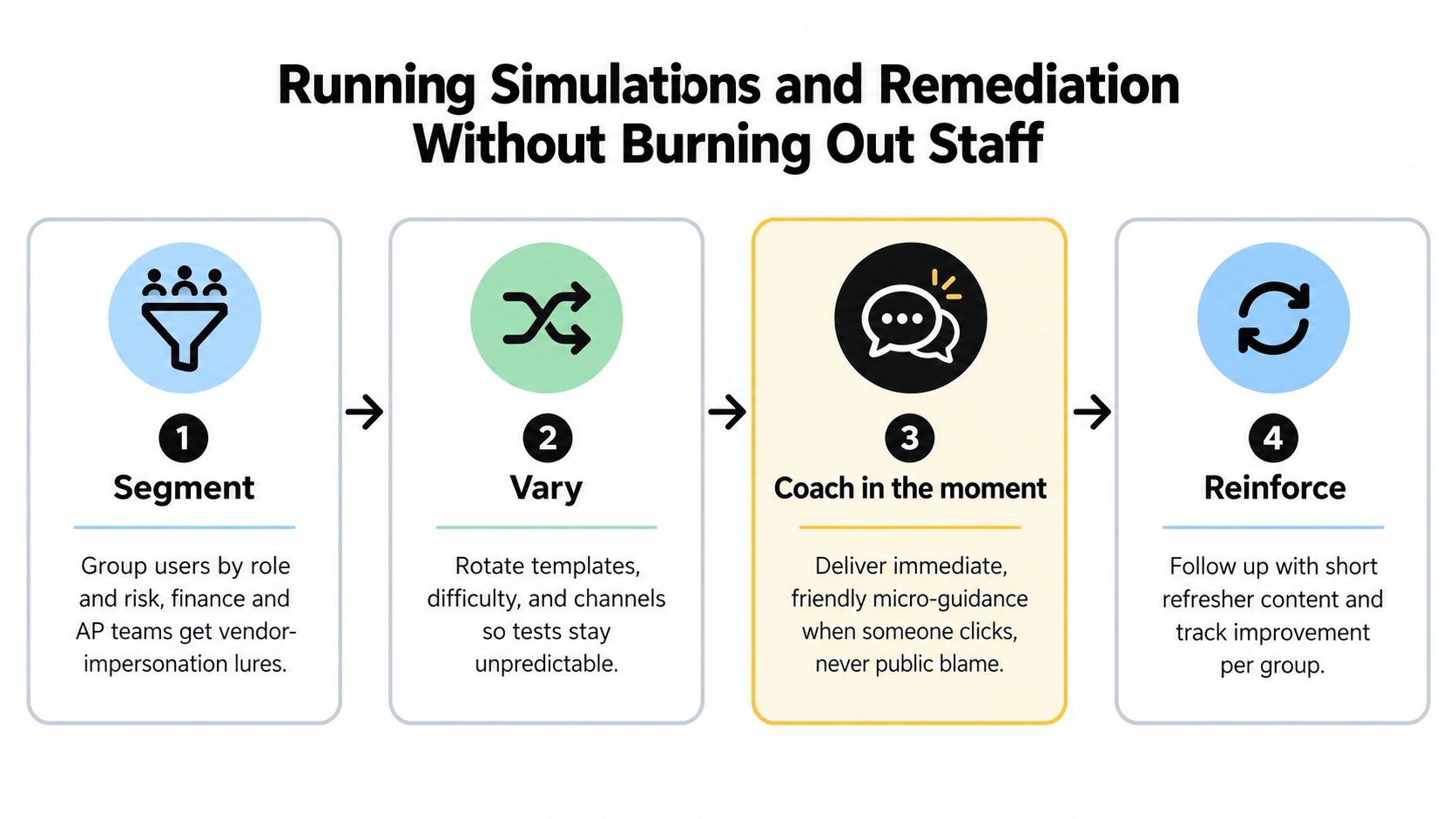
Simulation quality matters as much as frequency. A campaign that sends the same obvious lure to every employee teaches people to recognize the campaign rather than the attack pattern. A campaign that humiliates employees creates silence, which is worse than a visible click because security staff lose early warning.
Begin with role-based scenarios. Finance and accounts payable teams should see vendor impersonation, altered payment instructions, and invoice lures. Executives need spear-phishing, calendar invitations, and authority-based requests. IT staff need credential harvesting, administrative alerts, and access-reset scenarios.
Keep the exercise credible and manageable
Rotate lure types, sender context, and difficulty. Avoid relying on typos as the primary signal because a polished message can still be malicious. Most employees need a light recurring cadence, while high performers can receive less frequent testing and repeat offenders can receive focused remediation.
When someone clicks, the feedback should arrive immediately. A short micro-lesson can explain the missed signal, show the correct reporting action, and reinforce verification. A 90-second intervention is more likely to be completed than another long classroom session.
Publicly praise accurate reporting. Privately coach risky behavior.
The reporting process should be documented before the first campaign:
- The employee uses the reporting control in the mailbox.
- The designated reviewer classifies the message and checks for wider exposure.
- The employee receives immediate, respectful feedback when the message is a simulation.
- Security staff escalate a genuine event according to the incident plan.
- Management reviews trends by role and department, not just individual failures.
Click data belongs beside reporting data. A department with a lower click rate but almost no reports may not be safer. Employees may be ignoring suspicious messages or avoiding the reporting process. Teams can align these workflows with documented incident response procedures so that awareness activity feeds containment rather than sitting apart from security operations.
Metrics That Prove Training Is Working
Completion certificates are administrative evidence. They don't prove that an employee paused before clicking or reported a suspicious message. A useful dashboard tracks behavior under realistic conditions.
NIST-linked guidance identifies reporting rates, repeat clickers, and simulated phishing emails as common awareness metrics, while the NIST Phish Scale publication provides a basis for evaluating the difficulty of phishing messages in the context of both the email and its recipients. That matters because a difficult lure and an easy lure shouldn't be treated as equivalent tests.
| Metric | What It Measures | Useful? |
|---|---|---|
| Click rate trend | Susceptibility to the tested action | Yes, especially over time |
| Report rate | Willingness to flag suspicious messages | Yes |
| Repeat-clicker count | Persistent behavior risk | Yes |
| Time to first report | Detection and escalation speed | Yes |
| Completion rate | Course participation | Limited |
| Quiz score | Recall in a controlled setting | Limited |
A strong program examines the 90-day moving trend rather than reacting to one campaign. It also segments results by department, role, and tenure. Report rates, clicks-to-report ratios, and reports submitted before any click reveal vigilance more clearly than course attendance.
Qualitative signals add context. Security teams should review reported-email ticket volume, false-positive patterns, manager feedback, and whether employees understand the escalation path. Leaders looking for broader practical training measurement tips can use those signals to complement simulation data.
Technovation's cybersecurity monitoring tools can also fit into a wider measurement and response model. The point isn't to create a dashboard full of reassuring colors. It's to show whether risky behavior is declining and whether employees are helping security teams detect attacks sooner.
Compliance Touchpoints for Healthcare, Finance, and Legal
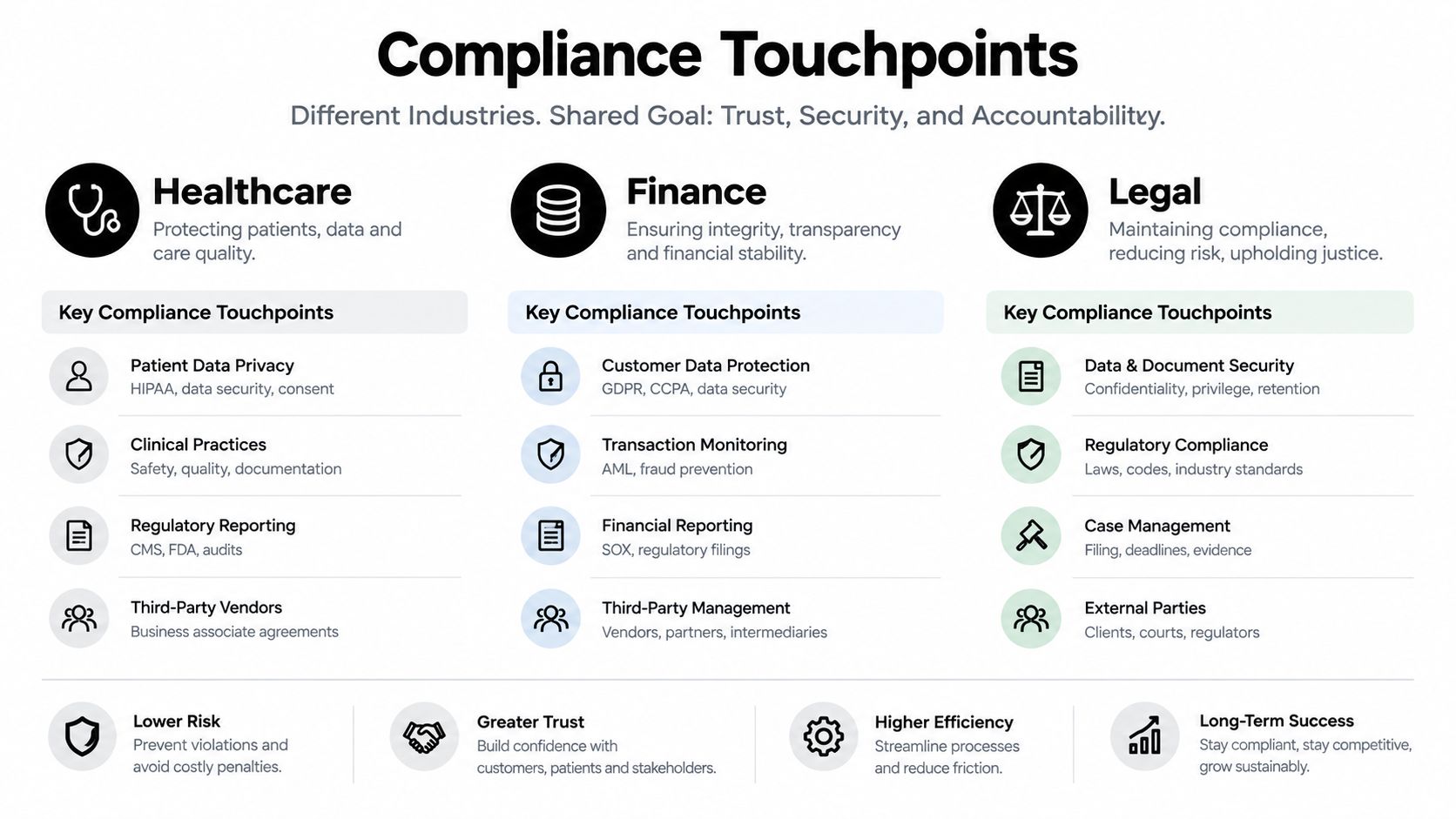
Regulated businesses need more than a course catalog. They need evidence that training addresses relevant risks, occurs according to policy, and connects to incident handling. Auditors and clients may ask for records that show who participated, what was tested, how failures were remediated, and whether leadership reviewed the results.
Healthcare needs traceable workforce instruction
HIPAA-covered entities must address workforce security awareness, including password management and incident reporting, under 45 CFR 164.308(a)(5). A medical practice should retain attendance records, policy acknowledgments, simulation results, remediation records, and evidence that reported phishing messages reached the appropriate reviewer.
A clinic's scenario should reflect its workflow. A fake records-access notice, an unexpected document request, or an impersonated billing contact creates a more useful test than a generic consumer lure. The program should connect an employee report to the clinic's incident-response runbook.
Finance needs governance and evidence
The FTC Safeguards Rule, 16 CFR 314.4, requires covered financial institutions to maintain an information security program that includes security awareness training and monitoring. Financial organizations should preserve campaign schedules, audience segmentation, results, corrective actions, and management reporting.
A bank or accounting firm should also tie training to wire instructions, payroll changes, tax documents, and account access. GLBA-regulated institutions may need to demonstrate that phishing testing and security awareness support broader governance and board-level oversight.
Legal practices need defensible process
Law firms handle confidential client information and face professional duties around technology competence under ABA Model Rule 1.6. Client audits may request training records even where a specific simulation cadence isn't prescribed. Firms should maintain documented expectations, onboarding evidence, reporting records, and remediation logs.
Compliance shouldn't turn the program into theater. A clean evidence pack is useful, but it should describe real behavior, real scenarios, and real follow-up. The strongest audit record shows that training supports the same controls employees use during an actual suspected incident.
Pairing Training With an MSP Partner
Small and mid-sized businesses rarely struggle because employees refuse to learn. They struggle because nobody owns the full operating loop. Internal staff may launch a course, but scheduling simulations, tuning scenarios, reviewing reports, documenting remediation, and producing executive evidence often compete with client work and daily IT demands.
An MSP partner can provide campaign administration, curated scenario libraries, baseline testing, remediation workflows, and reporting. The partner should operate the program without taking ownership of company policy or culture.
| Capability | In-house only | MSP-managed |
|---|---|---|
| Policy ownership | Strong | Advises and supports |
| Campaign scheduling | Competes with internal workload | Managed as a recurring service |
| Role-based scenarios | Often limited by time | Maintained and adapted |
| Click and report review | Dependent on available staff | Assigned operational owner |
| Audit evidence | Built manually | Collected through the program |
| Incident escalation | Internal responsibility | Aligned with response procedures |
| Executive reporting | Irregular | Produced on a defined cadence |
The division of labor should be explicit. A 25-person firm keeps policy decisions, employee communication, culture, and disciplinary choices in-house. The MSP handles campaign scheduling, simulation configuration, immediate remediation messages, trend analysis, and quarterly reporting. That arrangement preserves control while removing the operational burden.
An MSP should be the program operator, not the policy owner.
Technovation LLC offers security awareness training and phishing simulations for SMBs, with support that can connect awareness activity to broader cybersecurity and compliance work. Businesses evaluating providers should use a clear guide to choosing a managed service provider and ask who reviews clicks, who responds to reports, and how evidence reaches leadership.
The practical next step is a free security audit and program review. The review should examine current click and reporting trends, the last tabletop exercise, the remediation workflow, and gaps against applicable FTC Safeguards Rule or HIPAA Security Rule training requirements.
Technovation LLC provides security awareness training, phishing simulations, monitoring, and compliance-focused IT support for Dallas–Fort Worth businesses. Visit Technovation LLC to request a free security audit and program review that turns phishing awareness training from annual checkbox activity into a measurable operating process.