
Most business owners ask the wrong security question. They ask, "Do we have a firewall?" A better question is, "If one device gets compromised, what stops that problem from reaching everything else?"
That gap in thinking is where network segmentation matters. A business network shouldn't work like an open office where anyone can wander into payroll, legal files, or patient records. It should work like a well-run building with locked doors, badge access, and clear boundaries between areas that serve different purposes.
For small and mid-sized businesses in Dallas-Fort Worth, especially in healthcare, finance, and legal services, that distinction has become a business issue, not just an IT issue. Segmentation supports continuity, tightens compliance posture, and makes growth safer. It gives a company room to add staff, devices, cloud systems, and remote access without turning the network into a free-for-all.
Table of Contents
- Is Your Business Network an Open Office or a Fortress
- Building Digital Walls Inside Your Network
- Why Segmentation Is Critical for Security and Compliance
- Common Approaches to Network Segmentation
- A Practical Implementation Plan for Your Business
- Expert Segmentation Is a Strategy Not a Task
Is Your Business Network an Open Office or a Fortress
A growing business often builds its network the same way it builds its first office. Fast. Practical. Good enough for today. A few computers, shared printers, wireless access, cloud apps, remote logins, maybe a server or two. Then the business grows, and all those pieces stay connected in one broad environment because nobody had time to redesign the layout.
That works until one weak point opens the whole place up.
A medical clinic offers a simple example. The front desk needs scheduling access. Billing needs finance systems. Providers need records. Guest Wi-Fi should serve visitors only. Yet many organizations still let all of those systems sit too close together. The digital version of that setup is like letting every employee and visitor roam every hallway in the building.
What is network segmentation? It's the practice of dividing one business network into separate sections so people, devices, and applications only reach what they need. That means isolating sensitive systems from general traffic and placing controls between departments, device groups, and critical workloads.
A business doesn't need more openness inside its network. It needs better boundaries.
This isn't just a technical clean-up project. It's a smarter operating model. A segmented network is easier to manage, easier to audit, and easier to defend when something goes wrong. It also creates a cleaner foundation for remote work, cloud adoption, and secure growth.
Business owners who want a better grasp of perimeter protections alongside internal controls can also review small business firewall guidance. The key point stays the same. A locked front door helps, but internal doors matter too.
Building Digital Walls Inside Your Network
Network segmentation works like renovating a building that was designed with too few walls. The business still operates in the same location, but now different rooms have different access rules. Staff can enter the areas they need. Visitors stay in approved spaces. Sensitive records stay behind additional controls.
What network segmentation actually does
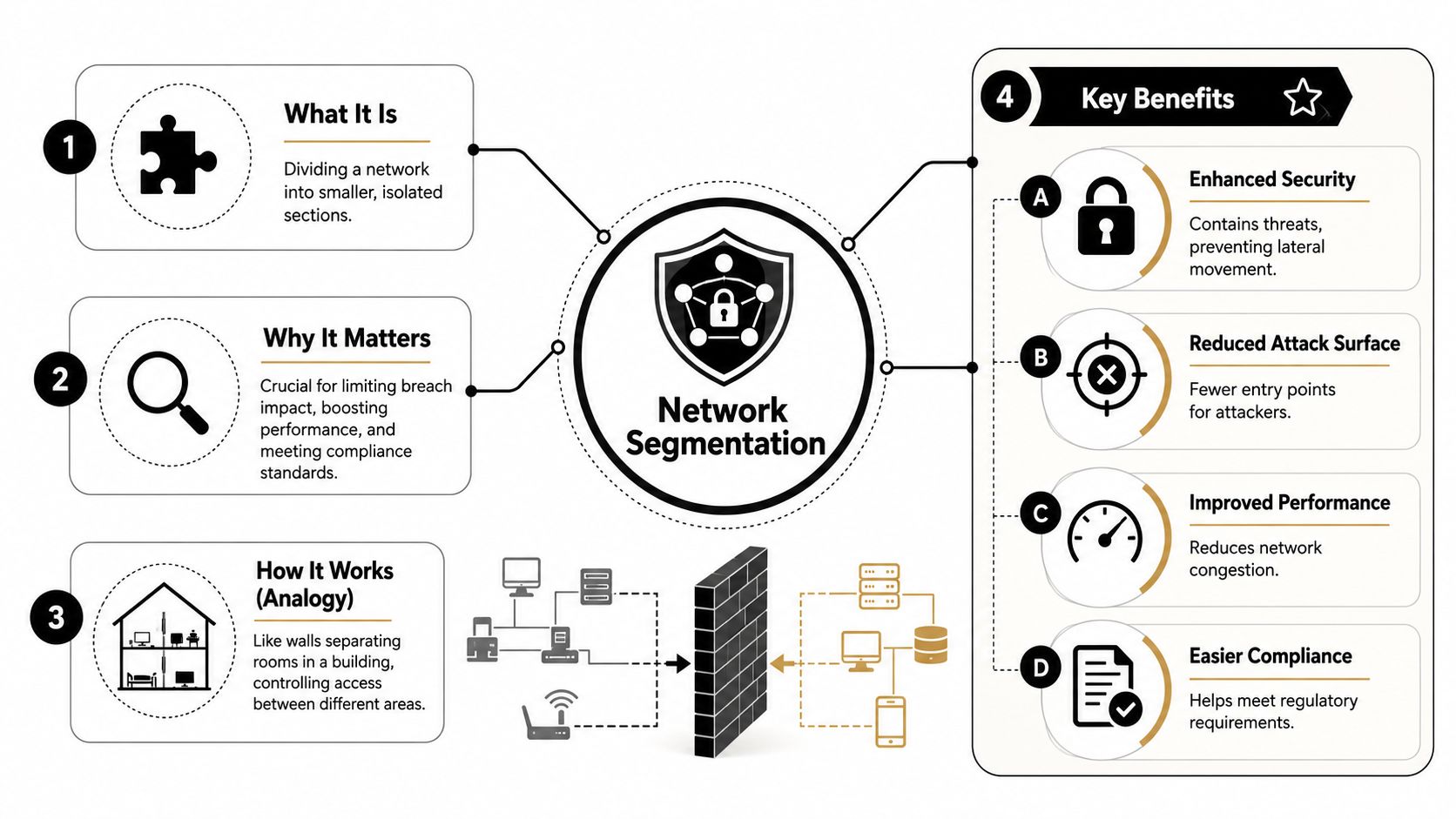
At a practical level, segmentation divides a large network into smaller zones. Those zones can be based on department, role, device type, location, risk level, or application need. The purpose is simple. Control who and what can communicate across those boundaries.
That matters because most problems don't stay where they start. An attacker might enter through a compromised laptop, a weak remote access point, or an exposed device. The next move is often lateral movement, which means moving from that first foothold to more valuable systems elsewhere in the environment.
The business risk isn't the first door that opened. It's how far someone can travel once inside.
Why internal movement matters more than most owners realize
A well-segmented network reduces the blast radius of a bad event. In plain language, that means one incident is more likely to stay contained instead of spreading into payroll data, legal files, financial records, or medical systems.
Consider these common separations:
- Staff and guest access: Guest wireless should never sit beside internal business systems.
- Front office and back office: Reception devices don't need the same access as accounting or executive systems.
- User devices and servers: Everyday laptops shouldn't communicate freely with every backend system.
- IoT and specialty equipment: Cameras, printers, scanners, and connected devices need tighter limits than many businesses give them.
Practical rule: If two systems don't need to talk, they shouldn't be able to talk.
Segmentation can be built with several controls working together, including firewall policy, virtual separation, and access rules between systems. For owners trying to compare business network firewalls, that conversation becomes more useful when it includes internal traffic control instead of focusing only on internet traffic.
For organizations reviewing technical enforcement points, firewall configuration best practices help explain how those boundaries get applied in practice.
Why Segmentation Is Critical for Security and Compliance
Security teams often spend too much time trying to block every possible threat at the edge. That's necessary, but it isn't enough. Businesses also need a way to limit damage after something slips through. Segmentation does that job.

Security problems spread when networks stay flat
Flat networks make life easier for attackers. According to Zero Networks on network segmentation fundamentals, approximately 90% of organizations are currently exposed to at least one viable attack path due to flat network architectures. That statistic should get any business owner's attention because it points to a structural problem, not a one-off mistake.
When a network lacks internal barriers, an attacker who compromises one point can move toward higher-value systems. In a clinic, that might mean moving from a receptionist's workstation toward patient data. In a finance office, it could mean reaching accounting systems. In a law firm, it might expose privileged documents and case materials.
Segmentation acts like a circuit breaker. It prevents a small issue from automatically becoming a company-wide event.
A few direct business benefits follow from that:
- Containment: A compromised device doesn't automatically become a launch point into every other area.
- Reduced operational disruption: Teams can isolate one segment without shutting down the entire business.
- Better decision-making during incidents: Staff can see which zone is affected and respond faster.
- Cleaner security policy: Access rules start matching actual business roles instead of broad, inherited permissions.
Business leaders looking for broader ways to secure your business systems should treat segmentation as one of the controls that makes every other security investment work better.
Compliance gets easier when boundaries are clear
Segmentation also matters because regulators care about separation. According to Cyberhaven's explanation of network segmentation and compliance, network segmentation is a recognized control for PCI DSS, HIPAA, and GDPR, and those frameworks treat it as a mechanism to reduce audit scope and demonstrate isolation of sensitive data.
That point lands hard in DFW industries that handle regulated information every day. A medical practice has to isolate patient data. A CPA firm has to control access to financial records. A law office has to limit exposure to confidential client material. Segmentation helps create those boundaries in a way auditors and compliance reviewers can understand.
The same source notes that the UK's National Health Service requires segmentation to limit the lateral spread of malicious code and to restrict remote access for connected medical devices. That reflects a broader reality. Connected devices and specialized systems create convenience, but they also create pathways. Segmentation closes off unnecessary ones.
For SMBs, a useful starting point is a formal data classification policy for sensitive business information. If a business can't identify its most sensitive data, it can't isolate it properly.
Compliance is easier to defend when the network structure already reflects the business's risk boundaries.
This is why segmentation shouldn't be treated as optional hardening. It's part of how a business proves control, protects trust, and keeps growth from creating silent exposure.
Common Approaches to Network Segmentation
Not every business needs the same design. A small professional office won't segment the same way a clinic with connected medical devices or a hybrid workforce will. The right approach depends on risk, budget, compliance obligations, and how the business operates.
Starting with broad separation
The first level is usually macro-segmentation. This creates larger security zones based on major functions or trust boundaries. Examples include separating office users from servers, guest access from staff access, or finance systems from general business operations.
This level is often enough to correct the most obvious exposure in smaller environments. It creates order quickly and supports practical business goals such as isolating sensitive departments or keeping unmanaged devices away from critical systems.
Traditional methods commonly include:
| Network Segmentation Methods at a Glance | |||
|---|---|---|---|
| Approach | How It Works | Best For | Complexity |
| Physical separation | Uses separate hardware or dedicated environments for different functions | Highly sensitive systems and strict isolation needs | High |
| Firewall-based segmentation | Places policy controls between major network zones | Businesses that need clear boundaries and enforceable access rules | Moderate |
| VLANs and subnetting | Logically separates traffic into different internal segments | SMBs that need flexible separation without rebuilding everything | Moderate |
| Micro-segmentation | Applies fine-grained controls around specific workloads or applications | Regulated environments, cloud workloads, and zero-trust efforts | High |
Some businesses stop too early and assume one guest network equals a segmented environment. It doesn't. Broad separation helps, but it doesn't automatically control movement within each zone.
Adding more precise control
The next layer usually involves VLANs, subnets, and policy enforcement between segments. This is the practical middle ground for many SMBs because it creates separation without requiring a complete hardware overhaul. A useful analogy is creating distinct office suites inside the same building. The business still shares one property, but access between suites is controlled.
Then comes micro-segmentation, which applies much tighter rules at the application or workload level. According to the earlier source from Zero Networks, this is the fine-grained approach that protects specific data flows and individual workloads, rather than just broad departments or user groups.
That makes micro-segmentation especially relevant when a business runs cloud workloads, specialized applications, or compliance-sensitive systems that need very narrow access allowances.
A clear way to think about the trade-offs:
- Broad segmentation works well when the business needs fast improvement and simple administration.
- Virtual segmentation fits organizations that want flexibility and cleaner internal organization.
- Micro-segmentation makes sense when the cost of overexposure is too high to accept broad trust within a segment.
The strongest design usually isn't the most complicated one. It's the one the business can enforce consistently.
For SMBs, the best answer is often layered. Start with obvious boundaries. Add precision where the risk justifies it. Don't chase complexity for its own sake.
A Practical Implementation Plan for Your Business
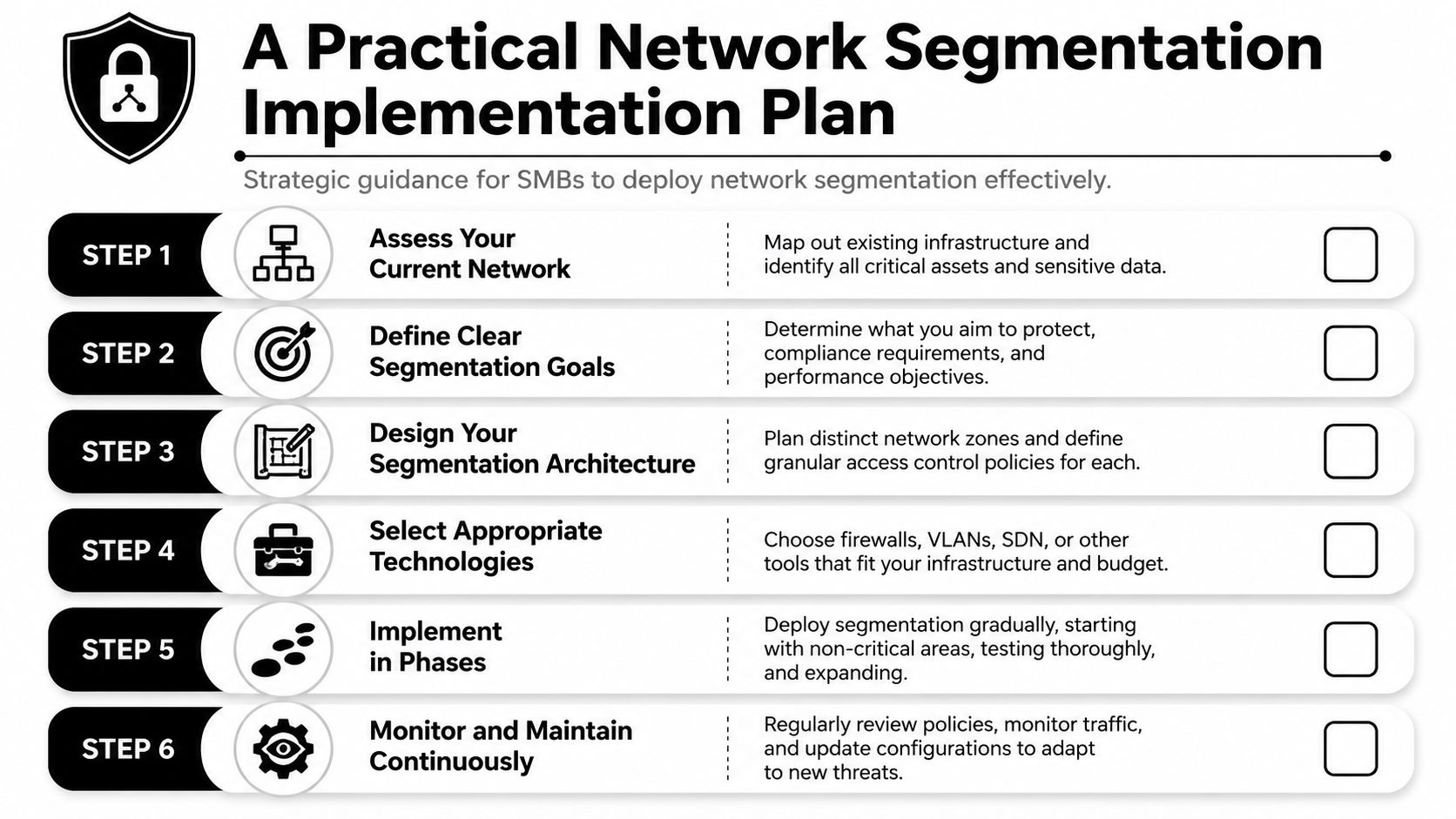
Most businesses shouldn't try to segment everything at once. That's how projects stall, staff get frustrated, and critical workflows break. A smarter plan starts with the business assets that would hurt the most if exposed or disrupted.
Start with the assets that matter most
Every owner should begin with a plain-language question. What are the crown jewels? For a clinic, it's patient data and connected care systems. For a law firm, it's document repositories and privileged communication. For a finance or accounting firm, it's client records, payment-related systems, and internal financial processes.
That inventory should include more than servers. Wireless networks, remote access paths, printers, cameras, specialty equipment, and employee devices all matter. Businesses that want ongoing visibility into whether those controls are working should build segmentation into a broader network monitoring strategy.
A strong implementation sequence usually looks like this:
- Identify critical assets first. Protect the systems that create the highest legal, operational, or reputational risk.
- Map who needs access. Job role should determine access. Habit and convenience shouldn't.
- Define segment boundaries. Separate users, devices, servers, wireless access, and specialty equipment based on risk.
- Set clear rules between segments. Allow necessary traffic. Block the rest.
- Test business workflows. Confirm billing, document management, printing, remote access, and line-of-business applications still work as intended.
Roll it out in phases and watch the traffic
A phased rollout prevents self-inflicted outages. Start with a lower-risk segment or a clear win, such as guest wireless, IoT devices, or a sensitive back-office function. Then expand once normal traffic patterns and business dependencies are understood.
Common mistakes deserve blunt treatment:
- Over-restricting too early: If teams don't understand traffic flows, they block needed processes and lose confidence in the project.
- Ignoring wireless and IoT: Cameras, printers, scanners, and specialty devices are often overlooked and left too exposed.
- Skipping monitoring: Segmentation isn't set-and-forget. Rules need review as staff, software, and workflows change.
- Protecting data but not paths to data: The server may be isolated, while remote access, unmanaged devices, or shared services remain too open.
A good segmentation plan protects the business without making normal work harder.
That balance is what separates a resilient environment from a messy one. The goal isn't maximum restriction. The goal is controlled, intentional access.
Expert Segmentation Is a Strategy Not a Task
Network segmentation sounds straightforward because the core idea is straightforward. Separate what matters. Limit unnecessary access. Contain problems before they spread. But getting that right inside a real business is more than a checklist item.
Poorly designed segmentation creates two bad outcomes. It either blocks legitimate work and frustrates staff, or it leaves so many exceptions in place that the business gains very little protection. Both are common when companies treat segmentation like a one-time configuration instead of an operating decision tied to compliance, growth, and resilience.
That matters even more in DFW industries dealing with patient records, legal confidentiality, financial data, remote teams, and connected devices. Those environments need boundaries that make sense to auditors, leadership, and employees at the same time.
The better view is simple. Segmentation is part of business architecture. It supports secure growth, cleaner compliance, and more predictable operations. Businesses that build those boundaries early put themselves in a stronger position than those that wait for a security event or audit finding to force the issue.
Technovation LLC helps North Texas businesses turn network segmentation from a vague IT concept into a practical protection strategy. With Technovation LLC, organizations can evaluate where their networks are too flat, identify compliance-sensitive systems, and build a customized plan that supports security without disrupting day-to-day work. For healthcare practices, law firms, financial offices, and other DFW businesses that want a clearer picture of their risk, a free security audit is a smart next step.