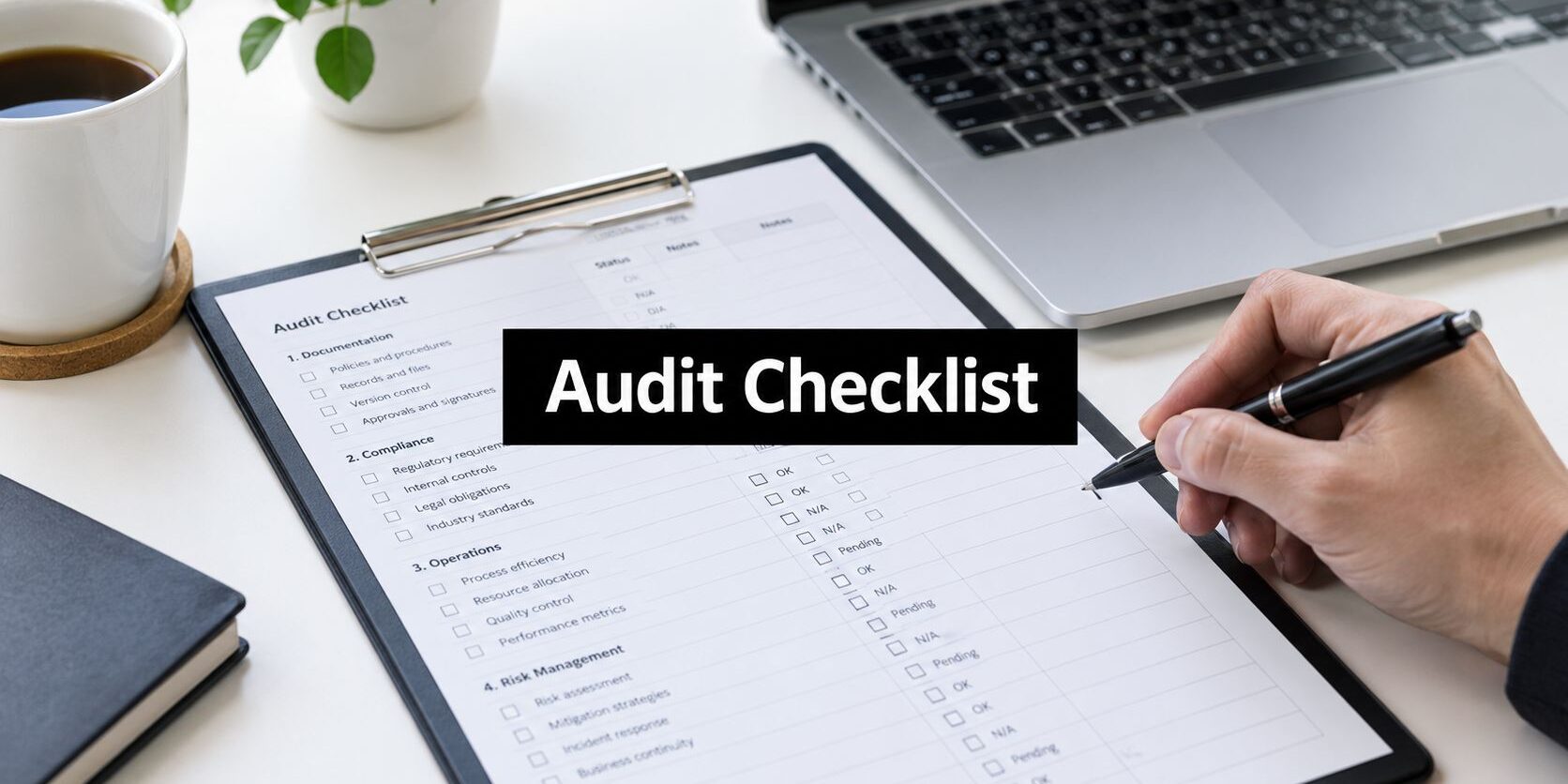
An effective compliance audit checklist usually organizes evidence into about 8 to 14 recurring categories, but it only works when every control has an owner, evidence source, testing method, and remediation priority. The checklist must connect governance, systems, people, and accountability instead of treating compliance as a document collection exercise.
Does a policy prove that a control exists, or does it only prove that someone wrote a policy? A clean audit file starts before the auditor arrives, with evidence that shows how a control operates in daily work, who maintains it, which framework applies, and what happens when the control fails.
A practical checklist can be organized around eight control domains: asset and data inventory, access management, data protection, incident response, third-party risk, logging, training, and configuration and vulnerability management. Each domain should map relevant requirements across HIPAA, SOC 2, and PCI, while avoiding duplicated testing and conflicting ownership. Current checklist guidance also emphasizes documented evidence, assigned owners, current policies, access logs, training records, corrective actions, and recurring review activities rather than a static form (Superdocu's compliance audit checklist guidance).
The practical objective: reliable operations and defensible decisions, not paperwork for its own sake.
Technovation can help organizations identify where controls are missing, inconsistently operated, or poorly documented. Its audits and managed IT services give Dallas–Fort Worth businesses a practical way to move from scattered findings to an ordered remediation plan without turning preparation into a crisis.
Table of Contents
- 1. Inventory and Document All IT Assets and Data Systems
- 2. Establish and Review Access Control Policies
- 3. Evaluate Data Protection and Encryption Standards
- 4. Document and Test Incident Response and Business Continuity Plans
- 5. Review and Validate Third-Party Risk Management
- 6. Implement and Monitor User Activity Logging and Audit Trails
- 7. Conduct Regular Security Awareness and Compliance Training
- 8. Perform Regular Configuration and Vulnerability Management Reviews
- 8-Point Compliance Audit Comparison
- Turn Findings Into a Manageable Security Roadmap
1. Inventory and Document All IT Assets and Data Systems
A compliance audit becomes difficult when nobody can produce a reliable answer to a basic question: which systems store, process, or transmit regulated information? The inventory should include laptops, servers, network equipment, cloud platforms, business applications, databases, backup repositories, removable media, and systems managed by outside providers.
Each record should identify the system owner, business purpose, data classification, connection points, users, service provider, and relevant security controls. A medical practice, for example, should connect its electronic health record, scheduling platform, imaging repository, email system, and backup environment to the patient information each system handles. A law firm should distinguish client files, billing data, privileged communications, and public information rather than labeling every repository “confidential.”
A system that isn't in the inventory can't be scoped, tested, assigned, or remediated reliably.
Evidence that makes the inventory useful
A spreadsheet may be a suitable starting point, but it should contain evidence links rather than only system names. Useful records include:
- Asset register: Hardware identifiers, software versions, cloud accounts, and responsible departments.
- Data-flow records: Connections between applications, users, vendors, and storage locations.
- Ownership evidence: Named business and technical owners, approval records, and review history.
- Scope decisions: The reason a system is included or excluded from HIPAA, SOC 2, PCI, or internal security testing.
Automated discovery can reveal unknown endpoints and cloud services, but manual verification still matters. The finance manager may know why a payment application exists, while the IT team knows how it connects to the network. Technovation can combine technical discovery with stakeholder interviews, then turn the result into a control map that supports audit scoping and ongoing reviews.
The inventory should be reviewed on a recurring cadence, particularly after a new application, acquisition, office move, or vendor change. A system owner should confirm that the record remains accurate and that the documented data classification still matches actual use. This prevents the common failure where an old inventory looks complete but excludes the SaaS tools employees adopted after the last review.

2. Establish and Review Access Control Policies
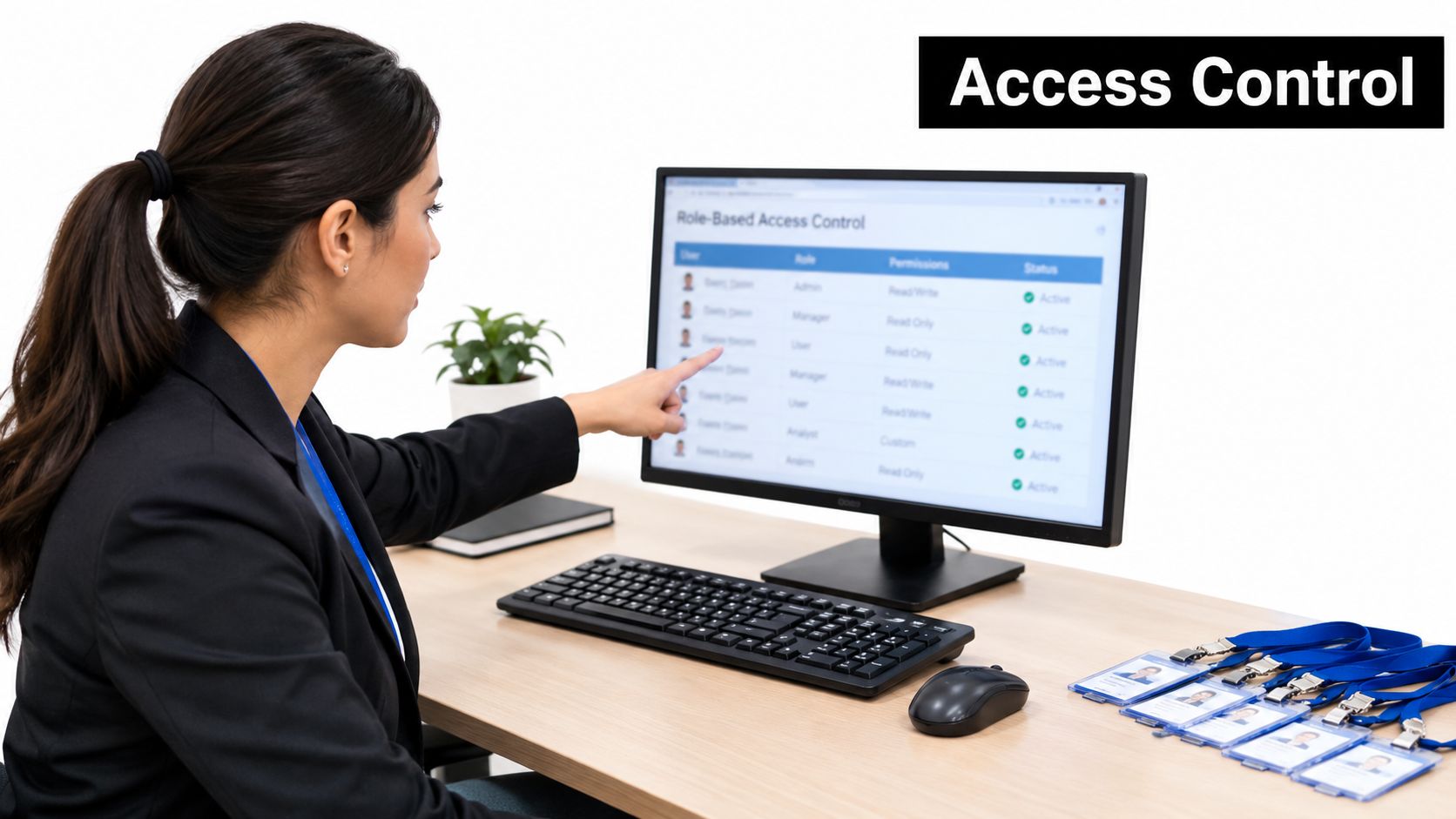
A defensible access review explains why each person or service can reach a system, who approved that access, whether the permission fits the person's role, and when the decision was last confirmed. Account lists alone cannot answer those questions.
Ownership should be shared. IT administers identity systems and produces access reports. The system owner confirms how permissions work in practice, while the department manager approves business need. A clinical leader may need to verify a clinician's patient-data role, a law firm partner may approve access to a privileged client workspace, and a finance leader may approve transaction authority based on job responsibilities.
The control domain changes with the data and process. Healthcare access should be limited to records required for assigned duties. Legal access may follow matters, clients, and privilege boundaries. Financial organizations should separate transaction preparation, approval, and administration where the process requires it.
Review the full access lifecycle and retain evidence for each stage:
- Provisioning: The request, approval, assigned role, and record showing that access was granted correctly.
- Privilege changes: Alerts, approvals, and a reason for administrator access or unusual escalation.
- Periodic review: Manager and system-owner confirmation that permissions remain necessary.
- Deprovisioning: A test showing access is removed when employment or an engagement ends.
- Third parties: Vendor accounts, expiration dates, sponsor ownership, and contractual restrictions.
The evidence should identify an owner, review date, affected system, decision, and any exception. This makes follow-up clear when a permission is excessive, an approval is missing, or an account remains active after a relationship ends.
SOC 2 commonly maps these activities to logical access, governance, monitoring, and change-related controls. HIPAA reviews often examine access to protected health information and related audit logs. PCI scoping requires careful separation between payment environments and ordinary business systems.
A single annual spreadsheet review can fail when managers approve every line without checking current job needs. Role-based access, automated identity records, exception tracking, and targeted review of high-risk permissions provide better control. A practical user access control program helps make those decisions repeatable instead of relying on informal email approvals. Technovation can then help organize findings into a prioritized remediation plan, with owners and next actions.
3. Evaluate Data Protection and Encryption Standards
Can your team show where sensitive data is stored, how it moves, who controls its encryption keys, and how access is restored after a failure? A protection review should connect each data type with its storage location, transmission path, encryption setting, key owner, and recovery process. Cloud services may provide encryption features, but the organization must verify that the right settings are enabled and understand responsibility for keys, backups, exports, and user access.
The security or infrastructure owner should maintain an encryption register covering sensitive data at rest, protected communications in transit, portable devices, backup copies, application databases, and vendor integrations. The relevant business owner confirms that each classification is accurate. IT verifies the technical configuration and records the review date, affected system, decision, and any exception.
Build the evidence around control decisions
Collect configuration exports from cloud storage, databases, endpoint tools, and email systems. Pair them with key-management records that identify custodians, rotation procedures, access restrictions, and recovery arrangements. Backup evidence should show encryption status, storage location, restoration testing, and retention decisions. Data-flow diagrams should identify interfaces where protected data leaves one application or enters another. Exception records should explain why a system cannot use the standard protection method and who accepted that risk.
HIPAA reviews should show how protected health information is encrypted at rest and in transit, alongside the applicable administrative, physical, and technical safeguard policies. SOC 2 may map encryption activities to confidentiality and security controls when those criteria are in scope. PCI reviews should distinguish the cardholder data environment and verify that payment data is not copied into systems that do not need it.
Encryption in a primary application does not prove that exports, portable devices, test environments, email attachments, and backup repositories receive the same protection. Technovation can assess cloud configurations, endpoint protection, backup architecture, and network controls, then document exceptions for business decisions and help convert findings into a prioritized remediation plan with assigned owners and next actions.
Key management also needs operational testing. A team that cannot restore access to encrypted backups, identify a key custodian, or explain an expired certificate has a resilience problem alongside an audit problem. Strong evidence combines configuration records, a named owner, a tested recovery process, and a written rationale for every exception.
4. Document and Test Incident Response and Business Continuity Plans
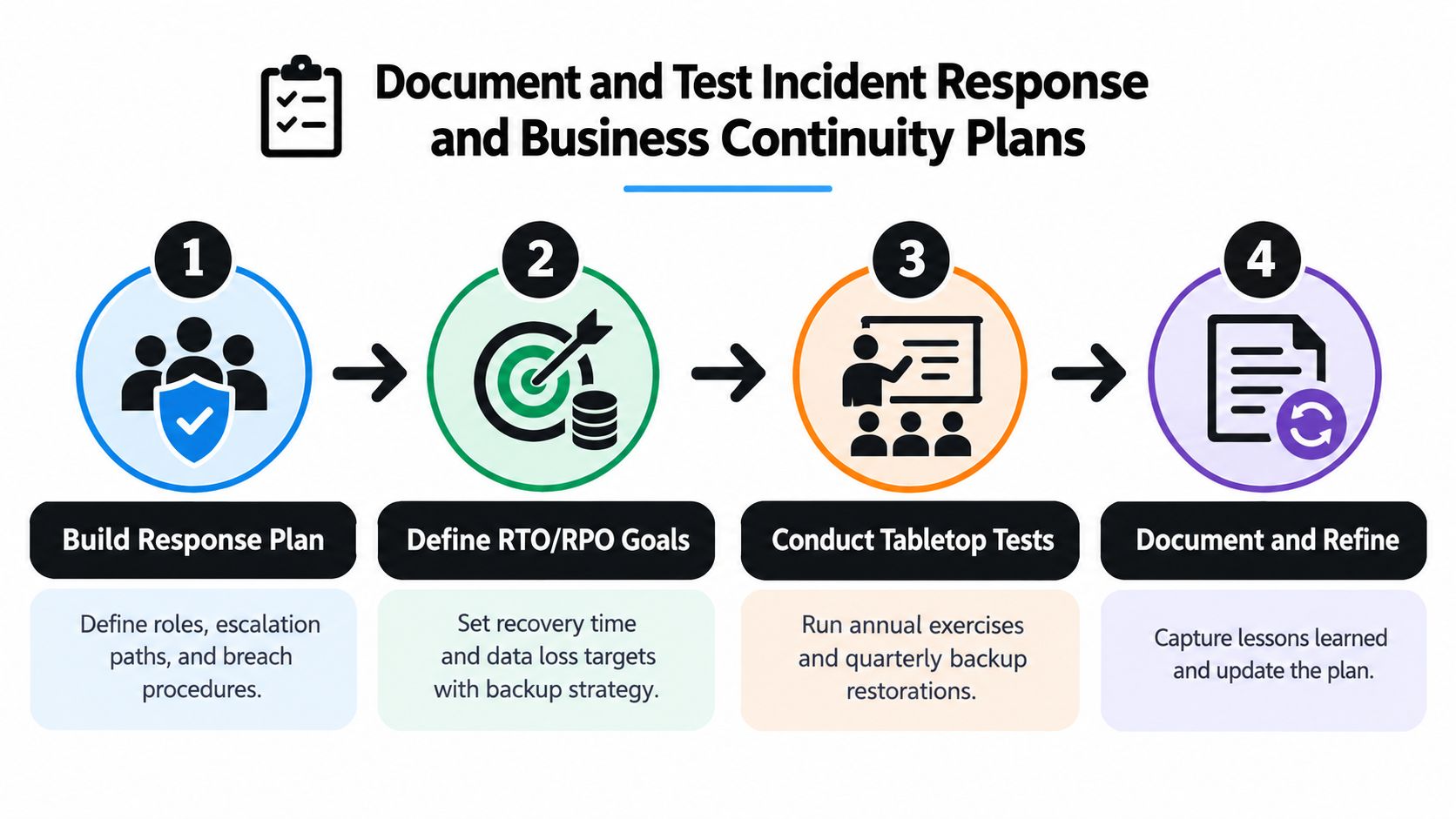
Can your team show who makes decisions, preserves evidence, communicates with affected parties, and restores operations during a serious incident? If the answer depends on personal memory, the plan is not ready for an audit or a real disruption.
Incident response covers detection, containment, communication, and recovery decisions. Business continuity explains how essential work continues, while disaster recovery addresses the restoration of technology and data. Keep the plans connected, with clear boundaries between them. An owner in IT or security should coordinate executives, legal counsel, communications, operations, affected business units, and service providers that support regulated information or critical processes.
Start with the evidence an auditor and response team will need:
- Response procedures: Escalation paths for account compromise, malware, data loss, vendor incidents, and system outages.
- Contact records: Named responders, alternates, service providers, legal contacts, and notification owners.
- Backup records: Completion reports, protected storage details, restoration results, and follow-up for failed jobs.
- Exercise evidence: Scenario, participants, decisions, observed gaps, assigned owners, and corrective actions.
- Incident records: Timeline, containment steps, communications, lessons learned, and closure approval.
Assign each control to a role, not a department. The incident response lead maintains procedures and exercise records. Infrastructure or operations owners provide backup and restoration evidence. Legal and communications owners confirm notification steps. Business leaders decide recovery priorities and accept documented exceptions.
HIPAA-oriented reviews should include incident response and breach-notification procedures, plus evidence that protected health information can be recovered. HIPAA documentation must be retained for 6+ years, making recordkeeping an explicit administrative requirement. SOC 2 may map these activities to security and availability controls. PCI reviews should connect payment operations, technology teams, and external responders within the cardholder data environment.
A tabletop exercise should produce decisions, owners, and dated follow-up work. Test restoration separately so backup completion reports do not stand in for proof that systems and data can be recovered.
Technovation can help compare business continuity and disaster recovery responsibilities, review backup operations, and turn exercise findings into a prioritized remediation plan with owners and next actions. Leadership then sees the recovery capability supported by evidence, not just the plan on paper.
5. Review and Validate Third-Party Risk Management
A third party becomes part of the control environment when it stores data, provides authentication, processes payments, hosts infrastructure, or supports a critical business process. Start with a vendor register that records the service, information accessed, business sponsor, system connections, contract terms, assessment status, renewal date, and exit plan.
Assign ownership by decision, not by department. Procurement tracks the relationship, renewal, and required documents. The business sponsor confirms operational dependence and acceptable disruption. Security evaluates technical safeguards and access. Legal reviews data-processing, confidentiality, breach-notification, subcontractor, and audit provisions.
Match review depth to dependency risk
A local office-supply provider needs a different review from a cloud service that stores patient records or payment information. Set the review scope using evidence such as:
- Data exposure: Information received and whether the provider can create, modify, or delete records.
- Technical access: Remote, administrative, application, or support access, including how that access is approved and removed.
- Independent evidence: SOC 2 or equivalent reports, security questionnaires, penetration-test summaries, and remediation statements.
- Contract terms: Security obligations, breach notification, subcontractor oversight, data return, deletion, and audit rights.
- Ongoing changes: New integrations, ownership changes, expired reports, and changes to the service scope.
Collect the evidence before approving the relationship. A reviewer should record the decision, unresolved exceptions, compensating controls, and the date or event that triggers the next review. A questionnaire can organize requests, including CAIQ where appropriate, but completed answers do not prove that controls operate effectively. Confirm important claims through reports, test results, contract language, and follow-up questions.
HIPAA programs need current Business Associate Agreements for providers handling protected health information. PCI reviews should focus on payment processors and connected service providers. SOC 2 reviews should include supporting services that affect the in-scope system and customer commitments. A provider's certification does not remove the customer's responsibility to understand the service configuration and resulting risk.
Technovation can help build the register, review security evidence, identify missing contractual protections, and rank suppliers by operational exposure. The result should be a prioritized remediation plan with owners, deadlines, and next actions. Store the assessment, reviewer decision, open exceptions, and next review trigger together, so auditors can follow the reasoning instead of sorting through disconnected vendor files.
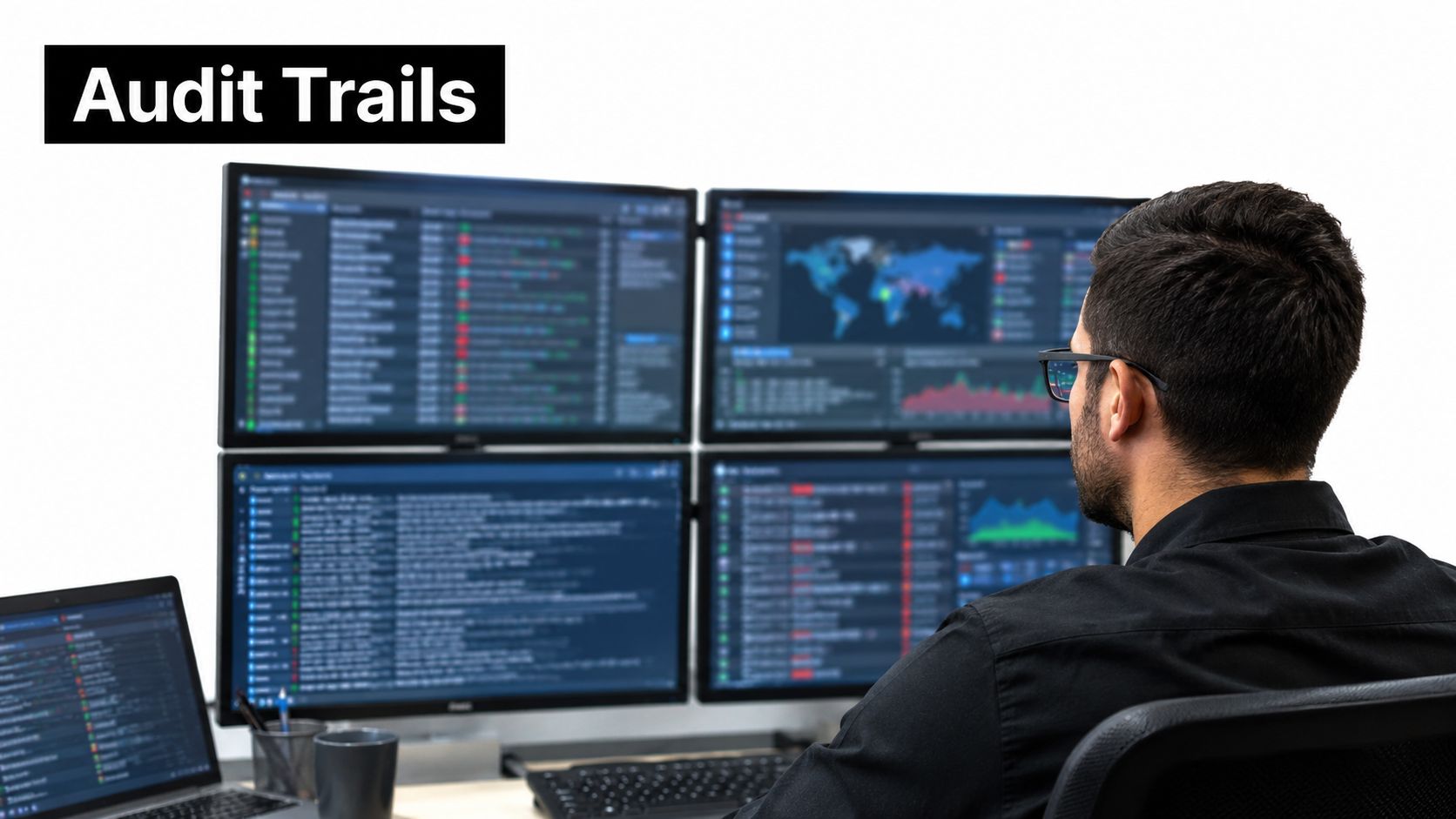
6. Implement and Monitor User Activity Logging and Audit Trails
Can your team show who accessed a record, what changed, and when the action occurred? User activity logging provides that evidence, but only when the organization defines meaningful events, assigns review responsibility, and can retrieve records during an investigation or audit.
Treat logging as the sixth control domain in the checklist. The application owner identifies high-risk actions, such as viewing patient records, downloading client files, approving payments, changing permissions, or disabling security controls. IT or security configures collection, retention, alerting, and access restrictions. Compliance verifies that the process supports the relevant obligations and that review decisions are documented.
Build the control around evidence:
- Coverage validation: Inventory proof that critical applications, identity systems, endpoints, firewalls, and cloud services send relevant logs.
- Integrity protection: Keep logs in centralized storage with restricted administrative access and safeguards against alteration.
- Alert logic: Document notifications for suspicious access, privilege changes, repeated authentication failures, and unusual data movement.
- Review records: Retain triage notes, escalation decisions, investigation findings, and closure evidence for significant alerts.
- Retrieval tests: Record exercises showing that staff can locate and export relevant activity within the required response window.
Collection without review creates storage costs without meaningful assurance. Set a review cadence, define escalation thresholds, and record who approved closure.
The regulatory mapping depends on the environment. HIPAA reviews commonly examine access to protected health information. SOC 2 can connect logging to security monitoring, incident response, and operations. PCI reviews often require detailed visibility into activity affecting payment systems. The scope should reflect the systems and data in use, rather than capturing every possible event without a clear purpose.
A clinic may have an electronic health record audit trail but miss unusual employee access. A law firm may record document downloads while failing to preserve the identity-provider event that shows how the account authenticated. A financial firm may keep transaction approvals and administrative changes in separate systems. Connect these records into an investigation-ready sequence.
Technovation can help centralize logs, tune alerts, protect audit trails, and test whether evidence supports incident investigations. A useful audit trail review process treats logging as an operating control with a defined cadence. Findings should feed a prioritized remediation plan with owners, deadlines, and next actions.
7. Conduct Regular Security Awareness and Compliance Training
Can employees recognize a suspicious request, protect the data they handle, and report a mistake quickly? Training is a control operated by people, so the audit record must show more than attendance. It should connect each employee's role, system access, responsibilities, and required response.
Human resources can track completion. Security or compliance should own the content, while department leaders enforce participation and follow up on gaps. Assign courses by role and record the employee, course, date, status, and action for incomplete training. Retain the material delivered, its policy references, relevant acknowledgments, and the reason for each content update.
The evidence should also show whether learning changed behavior. Use knowledge checks, simulated phishing results, and targeted coaching to identify where staff need support. Record new systems, incidents, policy revisions, and role changes that trigger additional instruction. A manager should be able to identify outstanding training and the action assigned to each person.
The examples should match the working environment. A healthcare clinic needs guidance on patient privacy and access to records. A law firm needs practical instruction for confidential client information and secure collaboration. Financial and accounting teams need procedures for reporting suspicious transactions, handling sensitive records, and escalating security concerns.
HIPAA reviews commonly expect workforce training documentation. SOC 2 can map awareness to security governance and personnel controls. PCI programs should cover people with access to payment information or payment systems. A generic annual video may satisfy an administrative step while leaving employees uncertain during a real incident.
Treat simulation results as coaching signals, not public rankings. Technovation's phishing awareness training can help connect employee behavior, training records, and incident reporting procedures. The control owner can then convert findings into a prioritized remediation plan with responsible owners, deadlines, and next actions.
Training works when accountability is visible. Completion records, follow-up decisions, and updated content give auditors evidence that the organization maintains an operating control across this security domain, rather than assigning a course once a year and closing the file.
8. Perform Regular Configuration and Vulnerability Management Reviews
A configuration review should answer three questions: which systems are exposed, who owns the risk, and what evidence shows the issue was addressed? The control owner sets approved baselines for endpoints, servers, firewalls, cloud services, applications, and network devices. Each exception needs a documented reason, accountable owner, expiration date, and compensating measure.
Start with the system record, not the scan report. Asset context should identify the system owner, business function, data sensitivity, exposure, and dependencies. Configuration evidence includes baseline settings, approved deviations, and related change records. Vulnerability evidence includes scan output, validation details, affected assets, and decisions on false positives.
Assign remediation to the team that can act, while keeping business accountability visible. Remediation ownership records the responsible person or team, target date, current status, and escalation path. A scan only identifies a weakness. The risk owner decides its priority, and the implementation record shows whether it was fixed, accepted, mitigated, or reopened after testing. Verification should include retest results, deployment records, exception approval, and closure evidence.
The owner may be infrastructure, application engineering, or a business manager, depending on the finding. Infrastructure staff may identify a vulnerable server, while the application owner controls the change window and the business owner decides whether downtime is acceptable. Technovation can support scanning, configuration reviews, endpoint management, network hardening, and remediation tracking through a vulnerability management program.
Apply the review to the organization's actual working environment. Healthcare teams should prioritize systems that store or transmit patient information. Law firms should examine confidential document repositories and remote-access services. Financial and accounting teams should rank payment and transaction environments by business impact and defined service commitments.
Close a finding only when evidence supports closure. An authorized owner may accept documented risk, but an unverified verbal claim that someone fixed the issue is not sufficient.
HIPAA can map technical safeguards to systems handling protected health information. SOC 2 can connect configuration, change, monitoring, and vulnerability work to security and operations controls. PCI calls for focused review of the cardholder data environment. Keep these mappings visible while assigning one owner and one next action for each finding.
8-Point Compliance Audit Comparison
| Audit Step | Implementation Complexity 🔄 | Resource Requirements ⚡ | Expected Outcomes 📊 | Ideal Use Cases 💡 | Key Advantages ⭐ |
|---|---|---|---|---|---|
| Inventory and Document All IT Assets and Data Systems | High, organization-wide discovery, mapping, ownership assignment 🔄 | Moderate–High: automated discovery tools + manual verification, cross‑department effort ⚡ | Comprehensive asset map; clearer compliance scope and audit readiness 📊 | Organizations with unknown/fragmented systems; pre-audit preparation 💡 | Prevents unknown systems, enables targeted compliance, baseline for monitoring ⭐ |
| Establish and Review Access Control Policies | Medium–High, RBAC design, provisioning/deprovisioning workflows 🔄 | Ongoing IAM administration, tooling for role management and approvals ⚡ | Enforced least privilege, documented access decisions and audit trails 📊 | Regulated sectors with role-based access (healthcare, finance, legal) 💡 | Reduces insider risk, meets access-related controls, provides auditable evidence ⭐ |
| Evaluate Data Protection and Encryption Standards | Medium, encryption implementation, key management, legacy remediation 🔄 | Cryptography expertise, KMS, cloud config checks and testing ⚡ | Data encrypted at rest/in transit; lower breach impact and compliance alignment 📊 | Handling PHI/PCI or other sensitive data; cloud storage environments 💡 | Meets encryption mandates, reduces liability, protects data if compromised ⭐ |
| Document and Test Incident Response and Business Continuity Plans | Medium, plan development, defined roles, scheduled testing cycles 🔄 | Time for tabletop exercises, backup/DR systems, coordinated testing ⚡ | Faster recovery, documented tests and lessons learned for auditors 📊 | Organizations requiring RTO/RPO proof or continuity for critical services 💡 | Reduces downtime, demonstrates preparedness and regulatory compliance ⭐ |
| Review and Validate Third-Party Risk Management | High, vendor inventory, assessments, contractual and certification reviews 🔄 | Legal/procurement involvement, security questionnaires, ongoing monitoring ⚡ | Reduced supply‑chain risk; documented vendor posture and contractual controls 📊 | Heavy vendor/cloud reliance; outsourced processing or third‑party integrations 💡 | Mitigates vendor-borne breaches, provides due-diligence evidence to auditors ⭐ |
| Implement and Monitor User Activity Logging and Audit Trails | Medium, log centralization, SIEM, retention and integrity controls 🔄 | SIEM/aggregation tooling, analyst review time, long‑term log storage ⚡ | Real-time detection, forensic evidence and regulatory log retention compliance 📊 | Environments needing detailed access histories (health, finance, legal) 💡 | Enables detection and forensics, proves systematic monitoring to auditors ⭐ |
| Conduct Regular Security Awareness and Compliance Training | Low–Medium, program rollout, role-specific content and tracking 🔄 | Training/platform subscription, content development, administrative tracking ⚡ | Reduced human-caused incidents; documented training completion for audits 📊 | All organizations; especially staff handling PHI/PII or privileged systems 💡 | Lowers human risk, fosters security culture, provides audit‑ready records ⭐ |
| Perform Regular Configuration and Vulnerability Management Reviews | Medium, baseline configuration, scanning, prioritization and patching processes 🔄 | Vulnerability scanners, patch management tools, remediation resources ⚡ | Proactive identification and remediation of weaknesses; documented SLAs 📊 | Internet-facing services, critical infrastructure, regulated systems 💡 | Reduces exploitable vulnerabilities, ensures systematic remediation and audit evidence ⭐ |
Turn Findings Into a Manageable Security Roadmap
A completed checklist isn't the outcome. It is the input for an evidence register and remediation plan that tells leadership what needs attention, who will act, and how progress will be verified. This post-audit step is where many organizations lose momentum. They identify gaps, file the report, and leave the hardest decisions to an unnamed future owner.
Every gap should receive a named owner and due date. The record should identify the affected asset, business process, applicable framework, evidence currently available, testing method, risk statement, priority, and closure criteria. It should also distinguish missing documentation from a missing or ineffective control. A missing policy may be resolved through review and approval. A missing backup restoration process requires technical work, testing, and operational ownership.
Build an evidence register that people can use
A practical repository should organize:
- Policies and procedures: Current versions, approvals, review dates, and change history.
- System evidence: Configuration exports, screenshots, architecture records, and access reports.
- People evidence: Training assignments, completion records, acknowledgments, and role approvals.
- Third-party evidence: Assessments, contracts, reports, exceptions, and renewal decisions.
- Monitoring evidence: Log samples, alert reviews, incident records, and escalation notes.
- Testing evidence: Scan results, restoration tests, tabletop exercises, access reviews, and remediation tickets.
The repository should use consistent naming, access restrictions, retention decisions, and an index that lets an auditor follow a control from requirement to evidence. A one-line-per-requirement working document is especially useful because it records the test, evidence, status, owner, and corrective action in one place (Mitti's practical compliance audit checklist).
Prioritize instead of treating every gap equally
Risk ranking should consider data sensitivity, business impact, exploitability, control failure, audit significance, and dependency on other work. A documentation gap affecting a low-risk internal process may need a different response from an access issue involving patient records, payment systems, or privileged client information.
A remediation plan should show dependencies. An organization may need to complete the asset inventory before it can perform a meaningful access review. It may need to identify vendors before it can confirm data flows. It may need centralized logging before it can prove incident detection. Compliance benchmarking increasingly considers audit time allocation, priority frameworks, and audit quality alongside pass or fail readiness (A-LIGN's 2026 compliance benchmark report).
Technovation can provide an independent starting point through a free security audit or IT health check. Its Dallas–Fort Worth team supports compliance readiness, risk mitigation, cloud backup, remote access, endpoint protection, network hardening, and practical IT planning for healthcare, legal, financial, construction, nonprofit, and other security-conscious organizations. Its proactive 24/7 monitoring and managed services can help maintain the controls after the initial findings are closed.
For small and midsized businesses, the right question isn't whether every control can be perfected immediately. The better question is which weaknesses create the greatest exposure, what evidence is missing, and which action will make the next review more reliable. A prioritized roadmap gives leadership a way to approve resources and gives technical teams a way to demonstrate measurable progress.
A downloadable compliance audit checklist template should include these columns:
- Control domain
- Requirement
- Owner
- Evidence
- Framework mapping
- Status
- Risk
- Priority
- Target date
- Remediation notes
Organizations that can't connect findings to owners, evidence, and next actions should contact Technovation before the next audit cycle. A focused assessment can reveal whether the problem is a missing control, weak execution, unclear responsibility, or an evidence process that doesn't reflect the work already being done.
Technovation LLC provides cybersecurity, compliance support, managed IT, 24/7 monitoring, and business continuity services for organizations that need a practical compliance audit checklist and a clear path from findings to remediation. Visit Technovation LLC to request a free security audit or IT health check and turn audit preparation into an organized security roadmap.