
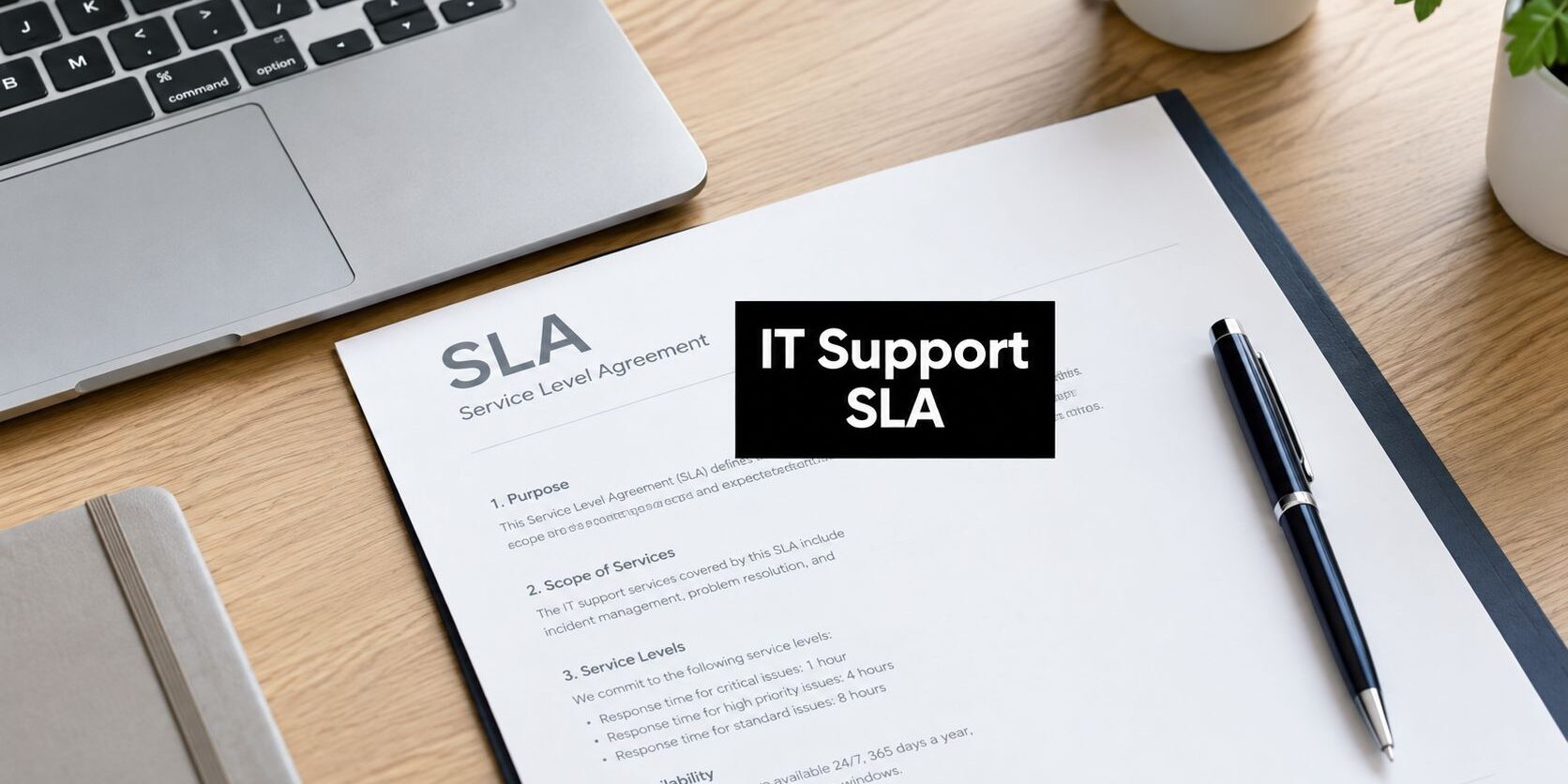
The network goes down during a busy morning. Employees can't access files, phones stop working, and customers wait while someone searches for an IT contact. The provider eventually replies, but nobody can answer the questions that matter: Who owns the incident? When will service return? What happens if the target is missed?
That situation is common among small and midsized businesses across the Dallas-Fort Worth metroplex. A generic support promise may sound reassuring during a sales conversation, yet it offers little protection during an outage, audit, security event, or failed cloud dependency. A well-written service level agreement for IT support converts those promises into operating rules that business leaders can measure and enforce.
Table of Contents
- What an IT Support SLA Actually Guarantees
- Core Metrics That Define Service Quality
- Structuring Priority Levels and Escalation Paths
- Moving Beyond Green Reports to Measure Real Experience
- Compliance and Industry Considerations for DFW Businesses
- Negotiating Penalties and Service Credits
- How Technovation Aligns IT Support with Your Business Goals
What an IT Support SLA Actually Guarantees
A business owner discovers the value of an SLA when normal operations stop. A clinic can't reach a scheduling system, a law firm loses access to case files, or an accounting team can't authenticate to a cloud application. Without defined commitments, the support process often becomes a chain of calls, forwarded emails, and uncertain handoffs.
An SLA changes that pattern. It defines the service scope, priority categories, response expectations, resolution objectives, escalation contacts, reporting method, and remedies for missed commitments. It doesn't guarantee that every technical issue will disappear immediately. It guarantees that the provider must follow a documented process and report performance against agreed standards.
From informal help to accountable service
Historically, IT support matured from ad hoc troubleshooting into a formal service-management discipline. Service levels became measured, audited, and continuously improved instead of being left to chance, as described in this academic IT service-level framework.
That history matters for DFW businesses because operational resilience depends on repeatable decisions. A provider should know whether an issue is a critical outage, a major degradation, or a routine request before an engineer begins work. A customer should know which channel to use, what information to provide, and when management escalation begins.
What the document should make explicit
A practical SLA should answer five questions:
- What is covered: Identify supported systems, locations, users, devices, networks, cloud services, security functions, and support channels.
- When support operates: Separate business-hours service from after-hours monitoring, emergency response, and scheduled maintenance.
- How priorities work: Define severity by business impact, not by the caller's frustration.
- Who acts next: List provider contacts, customer contacts, escalation managers, and technical owners.
- What happens after failure: Document breach reporting, service credits, corrective action, and termination rights where appropriate.
A helpdesk is only one component of the arrangement. Businesses that want a clearer explanation of the operational role can review what help desk support includes, then compare that scope with the services specifically written into the contract.
Practical rule: If a promise can't be measured from a ticket, monitoring record, or monthly report, it doesn't belong in the SLA as a service commitment.
Verbal assurances still have value as an indication of intent, but they aren't a substitute for defined thresholds. The SLA is the blueprint for accountability. It protects the business owner from vague language and gives the provider a fair, visible standard to meet.
Core Metrics That Define Service Quality
An SLA becomes useful when it distinguishes acknowledgment, restoration, and ongoing availability. A quick reply can make a ticket look healthy while the underlying problem remains unresolved. A provider that reports only an average response time may hide serious failures affecting a small number of critical systems.
The measurements that deserve attention
Response time measures how quickly the service desk acknowledges an issue and begins handling it. Mean time to resolution, or MTTR, measures how long it takes to restore service or complete the request. Those measurements must remain separate because a fast acknowledgment doesn't restore payroll, patient access, or document availability.
Availability measures whether an agreed system or service remains usable. The target should identify the measurement window, exclusions, maintenance treatment, dependency boundaries, and reporting method. Effective SLA design also tracks first-contact resolution, error rates, customer satisfaction, and compliance against each ticket's target, as outlined in this ITSM SLA measurement guidance.
For mission-critical environments, the availability discussion is becoming stricter. Guidance on managed-services SLAs notes that systems increasingly require 99.99% uptime rather than 99.9%, reducing allowable downtime from about 43 minutes per month to under five minutes as cloud dependencies and AI automation evolve, according to managed-services SLA guidance.
A practical priority framework
The following targets provide a concrete starting point for a business SLA. They reflect a major academic medical IT example, where critical issues receive materially different treatment from routine requests.
| Priority Level | Target Response Time | Target Resolution Time |
|---|---|---|
| P1 critical | 15 minutes | 80% within 4 hours |
| P2 high priority | 1 hour | 80% within 8 hours |
| Normal request | Defined by service scope | 80% within 5 business days |
The same framework sets channel expectations, including answering 80% of calls in under 60 seconds and handling 80% of online submissions or email requests in under 24 hours, as documented in the enterprise IT service-level agreement example.
These targets aren't universal obligations. They show the logic a strong agreement should follow: critical outages require rapid engagement and restoration, while routine work can follow a predictable business-day path. A DFW company should adjust the framework around operational impact, staffing, regulatory duties, and after-hours requirements.
Why monitoring belongs in the contract
Monitoring should detect failures before employees report them, especially for network, backup, identity, and security systems. The SLA should state which events trigger an alert, how the provider validates the event, and when a human takes ownership. Businesses evaluating this capability should examine the scope of 24/7 network monitoring rather than accepting the phrase “proactive support” without operational detail.
Structuring Priority Levels and Escalation Paths
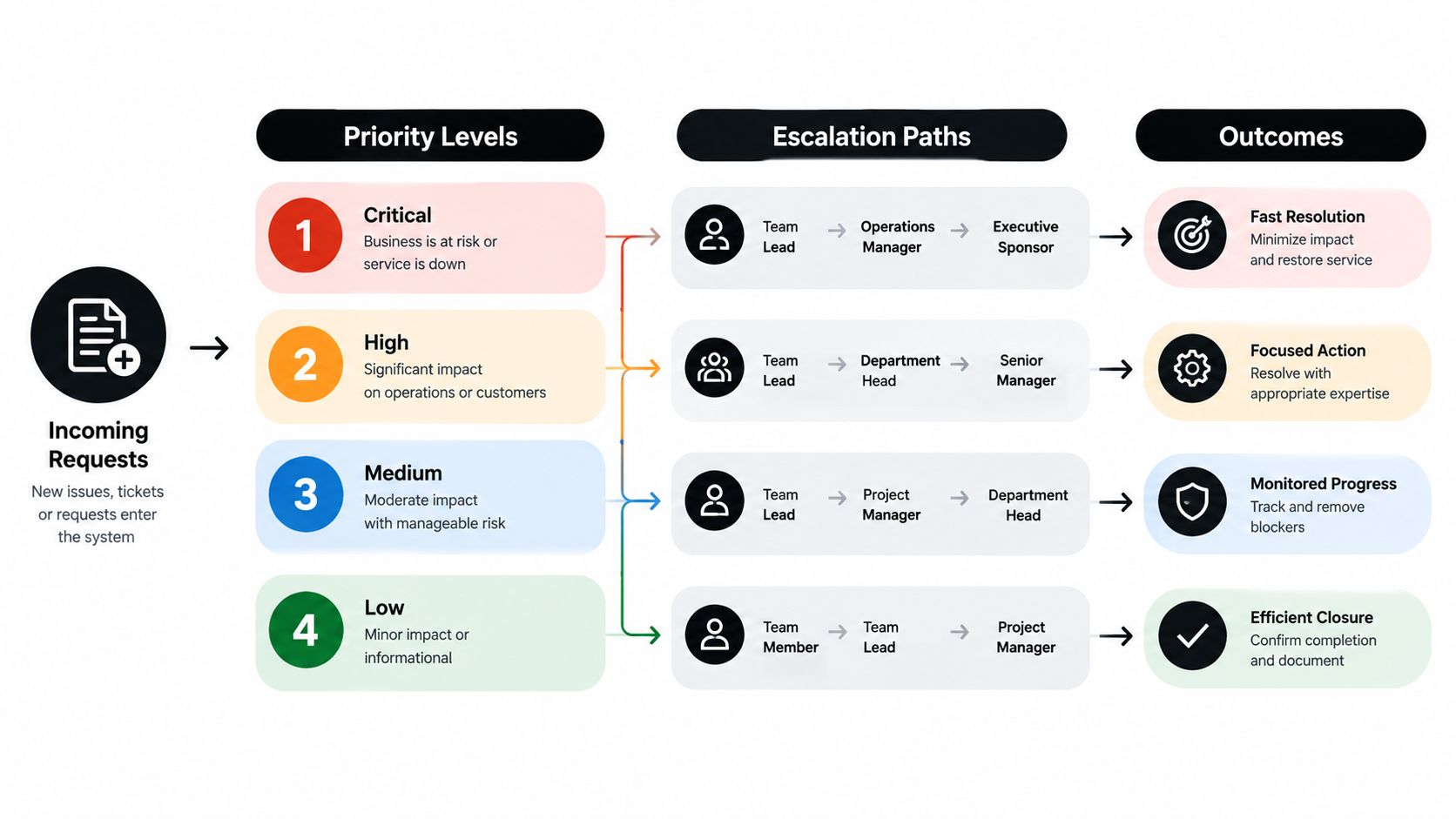
A server outage and a request for a new mouse shouldn't enter the same queue with the same urgency. Priority levels translate business impact into staffing, escalation, and coverage decisions. Without that structure, a provider can meet an acceptable average response time while missing the outage that matters most.
Define severity by impact
P1 critical means a system-wide outage, a severe security event, or a failure that prevents essential business operations. The SLA should require immediate ownership, a named incident lead, frequent status communication, and management visibility.
P2 high priority covers major degradation or a significant business function that lacks a practical workaround. The provider should assign a qualified technician promptly and escalate when progress stalls.
P3 and P4 routine work includes limited-impact incidents, standard requests, access changes, equipment needs, and general questions. These requests still need targets, but they shouldn't consume the same emergency resources as a broad outage.
Priority definitions should use observable conditions. “Urgent” is weak contract language. “All users unable to access the scheduling system” gives both parties a testable basis for classification.
Build escalation into the workflow
A credible escalation path should operate automatically rather than depend on a frustrated customer making repeated calls.
- Classify the incident: Record affected users, systems, locations, business functions, and security implications.
- Assign ownership: Name the technician or team responsible for the next action, not merely the person who received the ticket.
- Set a breach warning: Trigger an alert before the response or resolution target expires.
- Escalate by role: Move the issue to a senior technical resource, service manager, and executive contact when thresholds are at risk.
- Communicate at a defined rhythm: State who sends updates, through which channel, and what each update must include.
- Close with evidence: Record restoration time, root cause when available, follow-up actions, and whether the SLA was met.
Priority-based design forces escalation paths, staffing models, and after-hours coverage to match business impact. It also prevents a provider from masking a missed critical outage behind an acceptable average response time, a point reinforced in this incident-management guidance.
Keep responsibility visible
The customer also has obligations. The agreement should identify authorized contacts, approved support channels, access requirements, maintenance approvals, and dependencies on customer-provided information. Clear responsibilities prevent disputes while preserving the provider's duty to escalate and communicate.
Businesses reviewing whether their current arrangement has enough separation between routine and emergency work can examine IT support tiers and escalation responsibilities. The right structure gives technicians room to resolve ordinary requests without allowing critical incidents to wait behind them.
Moving Beyond Green Reports to Measure Real Experience
A report can show green SLA compliance while employees still struggle. The provider may answer every ticket within target, yet users experience repeated interruptions, temporary fixes, weak status updates, and multiple handoffs. That is the watermelon SLA, green on the outside and red where the user feels the service.
Timing isn't the same as usefulness
A response that says “the issue is being reviewed” may stop the response clock, but it doesn't necessarily help an employee complete a task. A ticket can also be closed after a workaround while the underlying cause continues to disrupt the same department.
Recent ITSM coverage describes a shift toward outcome-based models in which teams can meet SLA targets while experience scores fall. The recommended response is to combine ticket metrics with CSAT and first-call resolution so leaders measure business impact rather than timing alone, as discussed in this XLA and SLA analysis.

Add experience measures to the scorecard
A stronger monthly review pairs operational compliance with user outcomes:
- CSAT by incident type: Separate satisfaction with routine requests from satisfaction after major outages.
- First-call resolution: Show whether technicians solve issues during the first meaningful interaction instead of passing them between teams.
- Repeat incidents: Identify users or departments reporting the same failure after closure.
- Communication quality: Review whether major-incident updates explained impact, current action, ownership, and next decision point.
- Business interruption: Record which functions were unavailable and whether a workaround preserved essential operations.
These measures don't replace response and resolution commitments. They expose where those commitments fail to describe reality. A provider that closes tickets quickly but generates repeat work may need better root-cause analysis, documentation, training, or architecture.
Test the experience before renewal
Business owners should ask employees whether support feels accessible, whether updates arrive when promised, and whether technicians understand business priorities. A concise survey after important incidents can reveal dissatisfaction that a compliance dashboard misses.
A formal IT health check can help connect ticket history, monitoring results, security findings, and user feedback. The objective isn't to punish a provider for every complaint. It's to identify whether the SLA protects productivity or merely produces favorable reporting.
A green report proves that a timer was satisfied. It doesn't prove that the business recovered well.
Compliance and Industry Considerations for DFW Businesses
For a DFW healthcare clinic, compliance risk can appear in a missed backup, an unavailable clinical system, or an access-control failure. A law firm faces confidentiality and continuity concerns around matter data. A financial or accounting firm must protect sensitive records while maintaining reliable access during reporting and transaction deadlines.
An SLA can't replace a compliance program, legal review, or security controls. It should document the operational duties that support those obligations, including monitoring, incident handling, backup verification, access management, evidence retention, and escalation.
Match the contract to the operating environment
A generic agreement often treats every customer the same. Regulated SMBs need terms that reflect their actual risk profile.
- Healthcare practices: Define response and communication for clinical-system interruptions, identity failures, backup concerns, and suspected data exposure.
- Legal organizations: Specify confidentiality expectations, access approvals, device support, and restoration priorities for case-management and document systems.
- Financial services and accounting firms: Align maintenance windows, recovery coordination, logging, and escalation with periods of heightened operational sensitivity.
- Construction, engineering, and architecture companies: Account for field connectivity, shared project files, design workloads, and remote access dependencies.
The contract should also distinguish provider-controlled systems from customer-controlled assets and upstream cloud or telecommunications dependencies. Without that distinction, both parties may argue about responsibility after an incident instead of restoring service.
Put review and maintenance rules in writing
Federal contracting guidance recommends setting severity levels first, reviewing service performance at least monthly, and providing at least 48 hours' advance notice for unplanned maintenance where possible. Those practices support continuity by giving the customer a defined review rhythm and a reasonable opportunity to prepare, as described in this federal SLA guidance.
Monthly review should cover more than a pass or fail percentage. It should include unresolved risks, breach counts, maintenance activity, backup and recovery evidence, security events, recurring incidents, and corrective actions with owners and dates.
Protect evidence and accountability
A regulated business should be able to produce reports showing what happened, when the provider responded, who approved a change, and how service was restored. The SLA should state retention expectations, reporting format, audit cooperation, notification duties, and the process for handling suspected security incidents.
In DFW's interconnected business environment, resilience depends on the full service chain. A provider may monitor the network, while another party operates the cloud application and a third party supplies connectivity. The SLA should identify those dependencies and define how the primary provider coordinates the response.
Negotiating Penalties and Service Credits
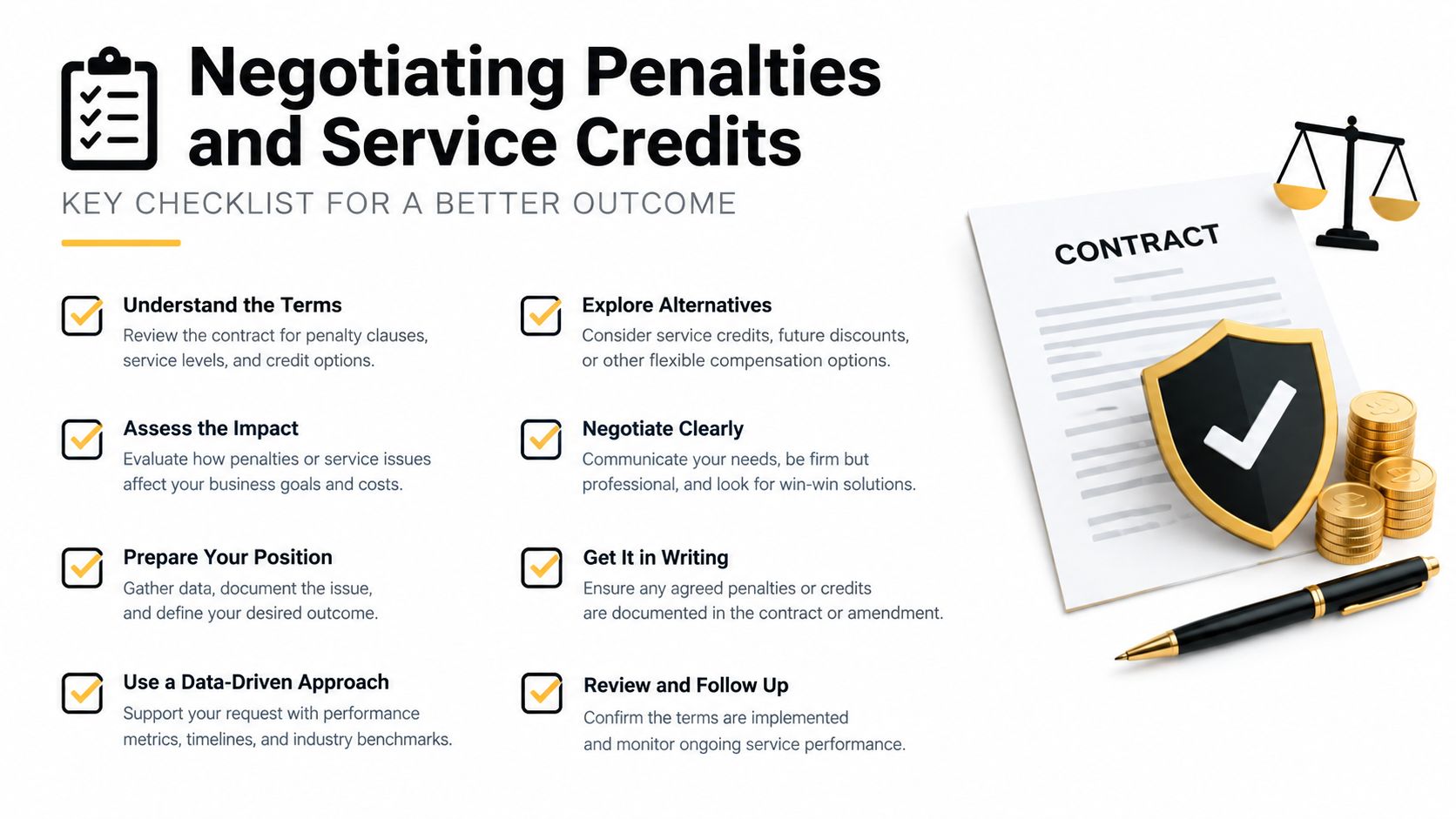
An SLA without consequences is a suggestion. Service credits and penalty clauses don't need to create an adversarial relationship, but they must make missed commitments visible and give the provider a reason to correct recurring failures.
The remedy should match the risk. A missed routine-request target may warrant a review and corrective action. Repeated critical availability failures may justify credits, executive escalation, a remediation plan, or termination rights. The contract should never force the customer to negotiate from scratch after an outage.
Write the remedy in plain language
A clear clause identifies the measurement, breach condition, notification process, remedy, and deadline. It also states whether the customer must request a credit or whether the provider applies it automatically.
The agreement should define exclusions precisely. Scheduled maintenance, customer-caused delays, unavailable customer contacts, force majeure events, and failures outside the provider's contracted scope may receive different treatment. Exclusions shouldn't become a blanket escape route for weak performance.
A service credit is useful only when the customer can calculate it without asking the provider to interpret the contract.
Review causes, not just consequences
A monthly report should show whether delays came from triage bottlenecks, staffing gaps, failed escalation, dependency problems, or inaccurate priority assignment. Effective SLA design includes error rates and compliance reporting to reveal those causes and create a measurable basis for monthly review and enforcement, as explained in this SLA operations guidance.
A useful review separates isolated incidents from systemic failures:
- One-off breach: Document the cause, owner, and prevention step.
- Repeated breach: Require a remediation plan with a deadline and management oversight.
- Pattern across priorities: Reassess staffing, coverage, monitoring, or target realism.
- Dependency-related failure: Clarify vendor coordination and responsibility boundaries.
- Experience failure without breach: Add communication, repeat-incident, or satisfaction measures.
Negotiate for correction, not theater
A provider shouldn't promise impossible targets just to win a contract. Unrealistic commitments produce constant breaches, disputed exclusions, and poor service relationships. Buyers should negotiate targets that protect essential operations and require transparent reporting, while providers should accept consequences they can administer consistently.
The strongest remedy structure combines service credits with corrective action, executive review, and a defined right to revisit the arrangement when performance repeatedly falls short.
How Technovation Aligns IT Support with Your Business Goals
A generic IT contract describes a support queue. A business-centered SLA connects that queue to uptime, compliance, security, user productivity, and growth. The difference appears in what the provider monitors, how it classifies risk, and whether the monthly review produces decisions rather than a colorful dashboard.
Technovation LLC provides managed IT services, cybersecurity, compliance support, business IT services, proactive monitoring, cloud backup, remote access, technology consulting, and strategic IT planning for organizations across North Texas. Its operating model can support both fully managed and co-managed arrangements, with SLA terms shaped around the customer's systems, risk profile, budget, and regulatory environment.
Compare the operating models
| Generic contract | Business-aligned SLA |
|---|---|
| One broad response promise | Priority-specific response and restoration targets |
| Helpdesk activity as the main proof | Ticket, monitoring, security, availability, and experience reporting |
| Reactive escalation after complaints | Proactive alerts and documented escalation ownership |
| Generic maintenance language | Defined windows, notices, dependencies, and approvals |
| Technology scope without business context | Recovery priorities tied to critical functions |
| Annual discussion of performance | Regular service review with corrective actions |
Technovation's DFW focus is relevant to organizations that need local accountability alongside structured operations. Healthcare, legal, financial, construction, engineering, architecture, nonprofit, and general-business teams often need different combinations of endpoint protection, network hardening, backup, remote access, compliance readiness, and user support.
Ask whether the SLA reduces exposure
The right questions are practical:
- Does monitoring identify failures before users report them?
- Does the provider distinguish an outage from a routine request?
- Are after-hours incidents owned by a named team?
- Does the report show restoration, repeat incidents, and user experience?
- Can the provider support audit evidence and compliance workflows?
- Do service credits and escalation rights apply when commitments fail?
- Does the technology plan change as the business grows?
A provider shouldn't sell an SLA as a decorative contract attachment. It should use the agreement to guide staffing, escalation, maintenance, security response, reporting, and continuous improvement. That is how a service level agreement for IT support becomes business protection rather than administrative paperwork.
Technovation LLC offers managed IT support, cybersecurity, compliance guidance, proactive monitoring, backup, and strategic planning for DFW businesses that need measurable operational protection. Visit Technovation LLC to request a security audit or IT health check and compare the current support arrangement with an SLA built around uptime, compliance, and real user experience.