

A Tuesday night in Plano can expose the limits of an internal IT team quickly. The IT lead is still answering tickets at 9 p.m., one engineer is on leave, a phishing alert is firing, and a quarterly audit deadline is approaching. The business isn't facing one dramatic failure. It's facing several ordinary demands that now exceed the team's available coverage.
That's the point at which many DFW firms start asking about co managed services. Hiring may be frozen, after-hours coverage may be inconsistent, security incidents may be consuming leadership time, and strategic projects may be stalled behind routine support work. The right response isn't automatically to outsource IT or add another full-time employee. It's to decide which responsibilities must remain inside the business and which require external capacity, specialist expertise, or continuous coverage.
Table of Contents
- The Moment Most DFW Teams Start Asking About Co Managed Services
- What Co Managed Services Actually Are
- How Responsibilities Split Between Your Team and the Provider
- Compliance and Security Considerations Across Regulated Industries
- A Practical Roadmap for Adopting Co Managed Services
- Pricing Models and SLA Terms Worth Asking About
- A Checklist to Evaluate MSP Partners in DFW
- A Short DFW Case Example and Your Next Step
The Moment Most DFW Teams Start Asking About Co Managed Services
The question usually surfaces during an operating review, not after a catastrophic outage. A DFW firm sees the same internal IT lead carrying support, security follow-up, audit evidence, vendor coordination, and project work. The team remains capable and trusted. Its coverage model no longer matches the business's demands.
The pressure usually appears in several places:
- Hiring freezes: Approved roles remain open while ticket volume and project commitments continue.
- After-hours gaps: Alerts arrive at night or on weekends without a dependable response path.
- Audit deadlines: Evidence collection competes with support queues and planned work.
- Security incidents: A suspicious message or endpoint alert needs investigation while normal operations continue.
- Stalled initiatives: Cloud changes, access reviews, network improvements, and documentation keep moving down the priority list.
Capacity becomes a governance issue when recurring work has no clear owner. In a 2023 industry survey cited in 2026 reporting, 54% of IT departments said insufficient staff coverage was a primary contributor to unresolved or delayed incidents. The figure appears in reporting on co-managed IT operations coverage, and the underlying problem is familiar to regulated DFW firms. A capable team can still leave work unresolved when too many responsibilities depend on too few people.
The decision involves more than hiring
A DFW firm should ask a more useful question than “Can the internal team handle IT?” Ask instead, “Which work is consuming internal capacity without requiring internal ownership?”
Internal IT should usually retain business context, architecture decisions, vendor relationships, executive communication, and end-user trust. A local MSP may take responsibility for continuous monitoring, patch execution, backup verification, overflow support, or specialized security work. The dividing line should be written down, measurable, and accepted by both sides.
Practical rule: If the internal IT lead cannot take planned time away without creating operational anxiety, the business has a coverage problem that requires a formal solution.
Co managed services work as an accountability model, not a headcount shortcut. A provider should own defined tasks, follow documented escalation rules, produce evidence, and attend recurring service reviews. Internal leadership still decides what the business accepts, which risks require escalation, and who has approval authority.
That structure matters when an auditor, executive, or client asks who approved a change, who performed the work, and who verified the control. A local partner should answer those questions with records, named owners, and agreed service levels. If the provider cannot show that evidence, its technical capability does not solve the governance gap.
Start the partner search before the next incident. Document coverage gaps while systems are stable, then evaluate a DFW MSP on accountability, security depth, response coverage, and working fit. The right partner extends the team without blurring who remains responsible for the business.
What Co Managed Services Actually Are
Co managed services are a hybrid operating model. An organization keeps internal control over business context, strategy, and final decisions while an external provider takes on defined operational work or scarce expertise. The arrangement extends the internal team instead of replacing it.
A useful analogy is a company's in-house safety officer working with a fire department. The safety officer knows the building, the people, and the business priorities. The fire department brings specialized equipment, trained responders, and the ability to support an incident that exceeds normal internal capacity. Neither side should assume the other owns the entire safety program.
The same principle applies to IT. Internal leaders may retain control of architecture, business applications, vendor decisions, and access authority. The provider may handle monitoring, patching, after-hours response, security operations, or escalated technical work.
The three operating models
| Model | Who decides | Who handles daily work | Who covers nights and weekends | Who answers to auditors |
|---|---|---|---|---|
| In-house IT | Internal leadership | Internal team | Internal team or an informal on-call arrangement | Internal leadership |
| Co managed IT | Internal leadership within a written operating model | Internal team and provider, with separate ownership | Provider for assigned coverage | Internal leadership, supported by provider evidence |
| Fully managed IT | Provider within agreed business constraints | Provider end to end | Provider | Provider supplies evidence, while the client retains oversight |
Purely in-house IT gives the company maximum direct control, but every ticket, project, incident, and tool remains inside the team's workload. Fully managed IT can provide broad coverage, but the business gives the provider much more operational authority and may lose some day-to-day internal context.
Co managed IT sits between those choices. The organization keeps its internal team and decision-making structure while assigning specific layers of execution to an MSP. That makes the model useful for a firm that wants to preserve ownership but can't realistically maintain every specialty or coverage window internally.
The broader managed services market provides context for why this model has gained attention. One 2026 estimate values the market at about $424.14 billion, with projected growth to $1.27 trillion by 2035, while another values the 2024 market at $302.00 billion and projects $593.63 billion by 2032 at a 10.14% CAGR, as reported in managed services market coverage. The forecasts differ, but both place managed services in a large and expanding category.
How Responsibilities Split Between Your Team and the Provider
The arrangement succeeds or fails at the handoff. A provider that says “shared responsibility” without assigning owners has created ambiguity, not collaboration. For a DFW business, the responsibility matrix should name who controls ticket flow, escalation, security decisions, network administration, backup review, project delivery, and reporting.
Your internal IT team should retain business context, architecture decisions, vendor direction, application knowledge, and the employee relationship. The provider can handle after-hours monitoring, support overflow, patch execution, backup verification, documentation, and specialist response. Co-managed IT service guidance supports the same operating principle: write the split into onboarding documents, then revisit it quarterly as systems, staffing, and risk change.
Ownership needs an operating rhythm
Every critical alert needs a severity level, response window, primary contact, backup contact, and escalation path. Your team may approve a firewall change or access exception. The provider prepares the technical change, applies it within the approved boundaries, and records the evidence. Internal security leadership remains accountable for risk acceptance, particularly when regulated data is involved.
Review cadence turns the matrix into governance. Monthly service reviews should cover ticket trends, recurring failures, and unresolved handoffs. Quarterly business reviews should examine security findings, backup results, patch exceptions, project progress, and emerging risks. Significant incidents need a written report while the facts remain clear.
| Function | Internal IT Owns | Co Managed Provider Owns | Escalation / Reporting |
|---|---|---|---|
| Ticket flow | Business context and priority decisions | Defined overflow and after-hours queue | Severity rules, named contacts, monthly trend review |
| Escalation | Final business impact decision | Technical triage and specialist response | Response windows and documented handoffs |
| Security authority | Risk acceptance and access approval | Monitoring, alert investigation, and control execution | Incident report and quarterly findings |
| Patching | Business blackout periods and approval | Patch deployment, exception tracking, and evidence | Patch report with unresolved exceptions |
| Backup | Recovery objectives and business sign-off | Backup monitoring, verification, and restore testing | Test results reviewed quarterly |
| Projects | Architecture and vendor direction | Assigned implementation capacity | Milestones, risks, and change control |
The same accountability rule applies in other professional service arrangements. A firm assessing in-house vs outsourced medical billing still needs clear ownership of decisions, records, and outcomes, even when an outside party performs defined work.
Do not let co-managed IT become a vague vendor relationship. Give the provider only the access required for its assigned duties. Require visibility into completed work, approval history, unresolved exceptions, and business impact. Measure the partnership by response performance, control evidence, recovery readiness, and whether each open issue has a named owner.
Compliance and Security Considerations Across Regulated Industries
A DFW MSP should adapt the operating model to the client's risk profile. A healthcare practice, law firm, financial organization, construction company, and nonprofit don't face identical obligations, so a generic security package isn't enough.
The provider should distinguish between control operation and compliance ownership. The MSP can operate monitoring, backup, access reviews, patching, and evidence collection. The client remains responsible for business decisions, policy approval, risk acceptance, and the accuracy of representations made to regulators, clients, and auditors.
The control and evidence connection
| Industry | Key Framework | MSP-Owned Controls | Evidence Required |
|---|---|---|---|
| Healthcare | HIPAA | Encrypted backup of EHR data, access monitoring, audit log retention, and support for Business Associate Agreement obligations | Backup verification, access review records, incident logs, and audit-ready control reports |
| Legal | ABA Rule 1.6 | Confidentiality safeguards, ethical wall support, privileged access control, and secure client-file handling | Access records, change history, security reviews, and technology risk documentation |
| Finance | PCI DSS, SOC 2 expectations, and the FTC Safeguards Rule for GLBA-covered firms | Payment environment segmentation, security monitoring, access control, backup oversight, and incident procedures | Control testing, access reviews, alert records, remediation tracking, and review minutes |
| Construction | Project data exposure and subcontractor access requirements | Jobsite connectivity oversight, account lifecycle management, device protection, and third-party access control | User reviews, device inventories, access approvals, incident records, and backup results |
| Nonprofit | State breach notification laws and grant-driven security requirements | Donor data protection, identity controls, endpoint monitoring, and recovery procedures | Security reports, access evidence, backup tests, policy acknowledgments, and remediation plans |
Healthcare firms in the Medical District should require clear handling of Business Associate Agreement responsibilities, encrypted EHR backups, and retained audit logs. The HIPAA compliance resource for healthcare organizations can help frame the discussion, but the engagement still needs a control-by-control responsibility matrix.
Legal firms should pay close attention to confidentiality and ethical walls. A provider may administer systems, but the firm must determine who can access matter data and how technology decisions support the duty of competence.
Financial firms need evidence that connects technical controls to client and regulatory expectations. Construction companies need to control access across temporary workers, subcontractors, offices, and jobsites. Nonprofits often have limited staffing, but donor and grant data still require disciplined protection.
KPMG's 2026 managed services outlook reports that managed services is strategic for 99% of organizations, with almost half ranking it as a top investment priority, and identifies AI management, cybersecurity, and regulatory compliance among leading investment areas. The KPMG managed services outlook supports a practical conclusion: a co managed provider should help modernize risk management, not merely close routine tickets.
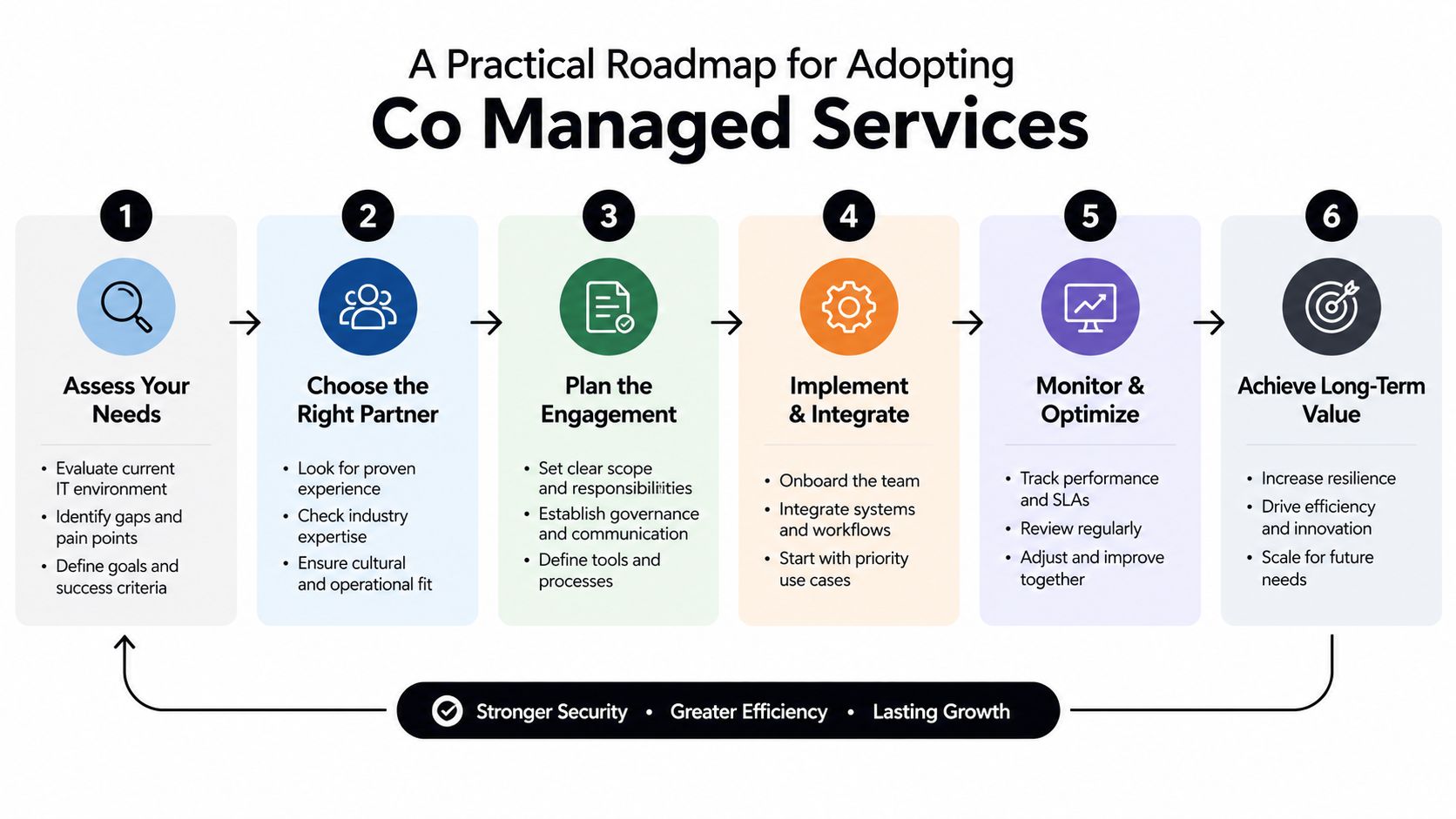
A Practical Roadmap for Adopting Co Managed Services
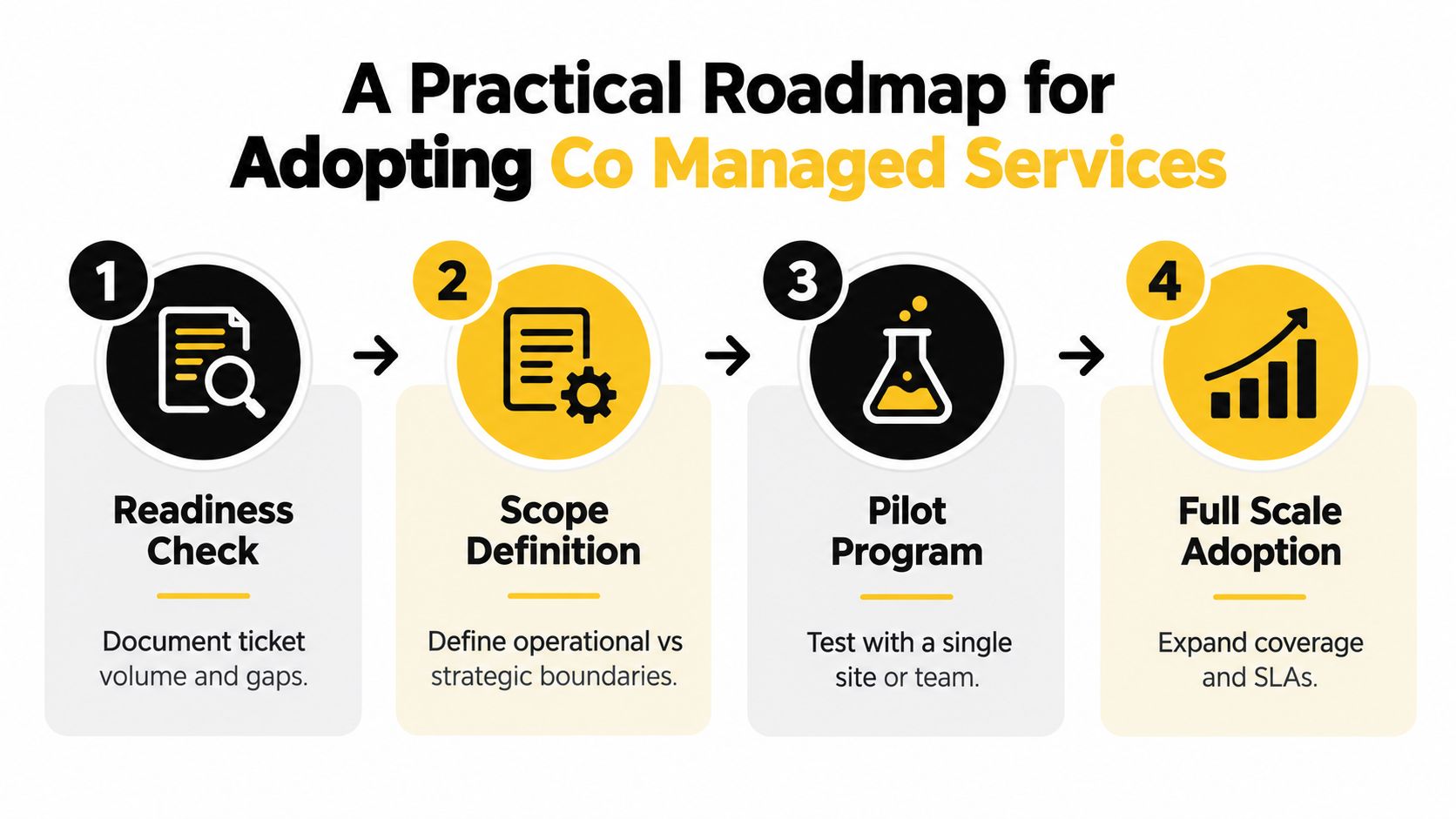
A DFW operations lead can run the adoption process in stages. The mistake is signing a broad contract before the organization knows which work is failing, which tools are authoritative, and which decisions must stay internal.
Start with a readiness check
The firm should document current ticket volume, after-hours coverage gaps, tool overlap, compliance exposure, backup review practices, and strategic projects delayed by operational work. The readiness check should also identify systems that remain internal and systems a provider may manage.
The provider should respond with a written gap summary, not a generic service menu. It should identify the proposed owner for each recurring task and name the evidence that will demonstrate completion.
Define scope before the contract
The scoping conversation should produce a responsibility matrix, escalation map, access model, reporting calendar, and change control process. It should state who handles user support, servers, networks, identity, backup, patching, security alerts, vendors, and projects.
A buyer evaluating how to choose a managed service provider should require the proposed provider to explain what happens when a task falls outside scope. “The provider will coordinate” isn't enough. The agreement should identify who decides, who performs the work, and who receives the report.
Run a controlled pilot
A 60 to 90 day pilot can cover one site, user group, or ticket category. The pilot should have a defined ticket scope, documented severity levels, agreed escalation contacts, and a weekly review. The firm should compare pilot performance with its baseline, including open-ticket aging, response consistency, after-hours handling, unresolved exceptions, and evidence quality.
The pilot should not become an excuse for indefinite ambiguity. At the end, leadership should decide whether to expand, revise, or stop the arrangement.
Formalize and mature
The master services agreement should connect scope, access, confidentiality, service levels, reporting, change orders, and exit obligations. Quarterly business reviews should cover ticket trends, security findings, project progress, and upcoming risks.
At the 12 month maturity check, the firm should revisit scope, renegotiate service levels where needed, and identify the next internal project the co managed team will absorb. A mature relationship changes as the business changes. The responsibility matrix should change with it.
Pricing Models and SLA Terms Worth Asking About
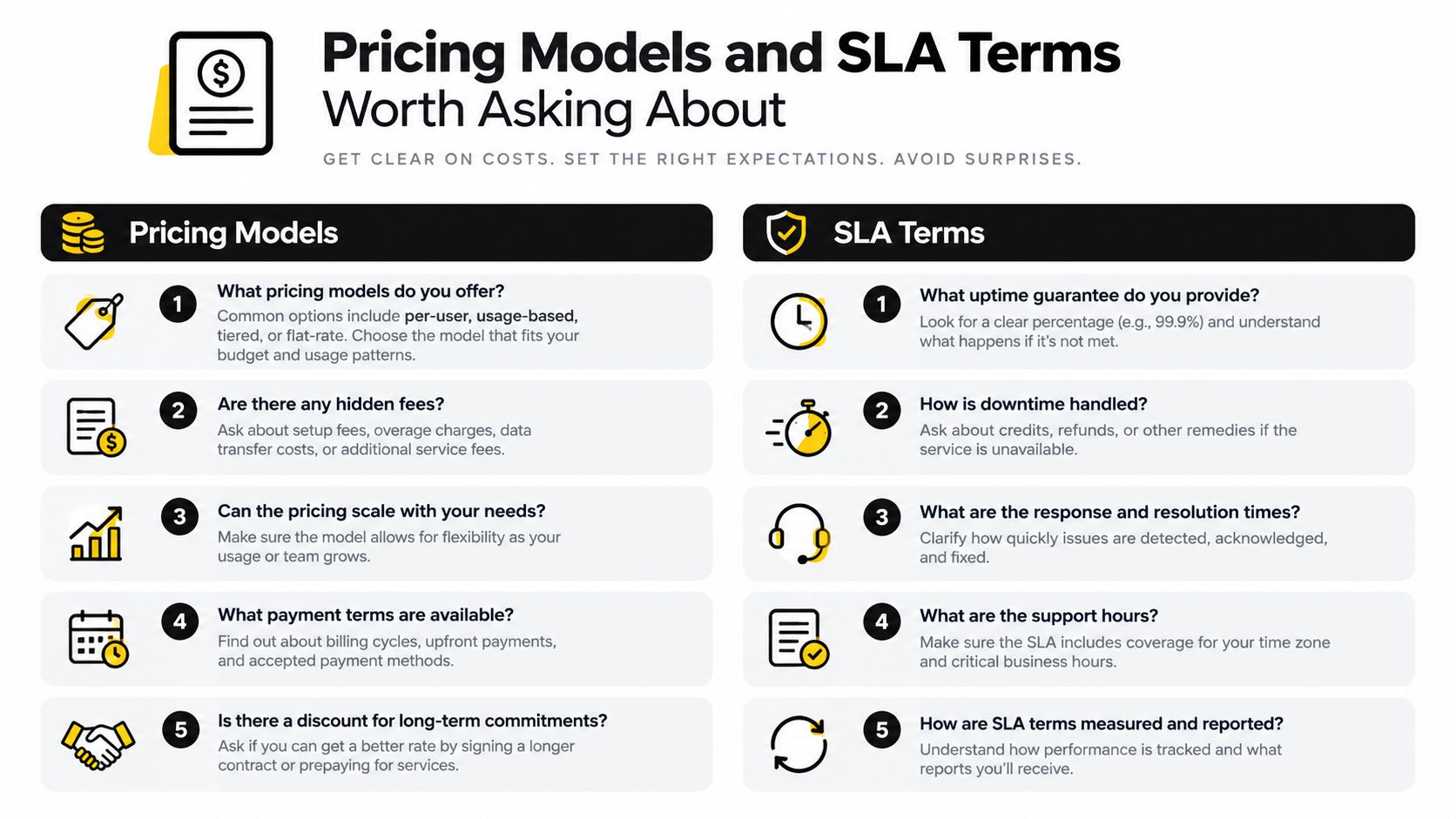
Pricing discussions often hide the operating model. A buyer shouldn't compare monthly fees until the scope, ownership, coverage window, and evidence requirements are comparable.
Per-user pricing is easy to understand, but it can conceal important gaps. The buyer should ask what each user includes, how seasonal staff are counted, whether shared workstations are included, and whether executives receive the same coverage as floor staff. Device, site, ticket, and project assumptions should appear in writing.
A co managed retainer may combine a block of hours with per-ticket or project rates. That approach can work when the handoff process is clear. Break-fix and pure project pricing can create disputes when scope drifts, especially if time-and-materials work has no cap or approval threshold.
SLA questions that belong in the meeting
- Define severity: What qualifies as a critical, high, medium, or low-priority issue?
- Separate response from resolution: How quickly does a human respond, and what does remediation require?
- Name the escalation path: Who receives the call when the first contact doesn't respond?
- Set approval rules: Which changes require internal authorization?
- Document service credits: What happens when the provider misses a measurable target?
- Protect the exit: How quickly must documentation, credentials, configurations, and tooling access return to the client?
A useful primer on contract language is Ares' guide to vendor contracts, especially for distinguishing service commitments from vague promises. The buyer should also insist on a scope clarity document, a formal change order process, audit rights, named account resources, and a defined local presence requirement.
The IT support service-level agreement guide can help a DFW firm organize those questions before negotiations begin.
A source cited in industry coverage states that co managed arrangements typically save 30% to 40% compared with fully managed services, while preserving internal control and institutional knowledge, as described in co-managed IT and fully managed IT comparisons. That figure should be treated as a market claim, not a guaranteed result. The sounder buying decision compares the cost of the defined work against the operational value of reliable coverage, documented controls, and reclaimed internal capacity.
A Checklist to Evaluate MSP Partners in DFW
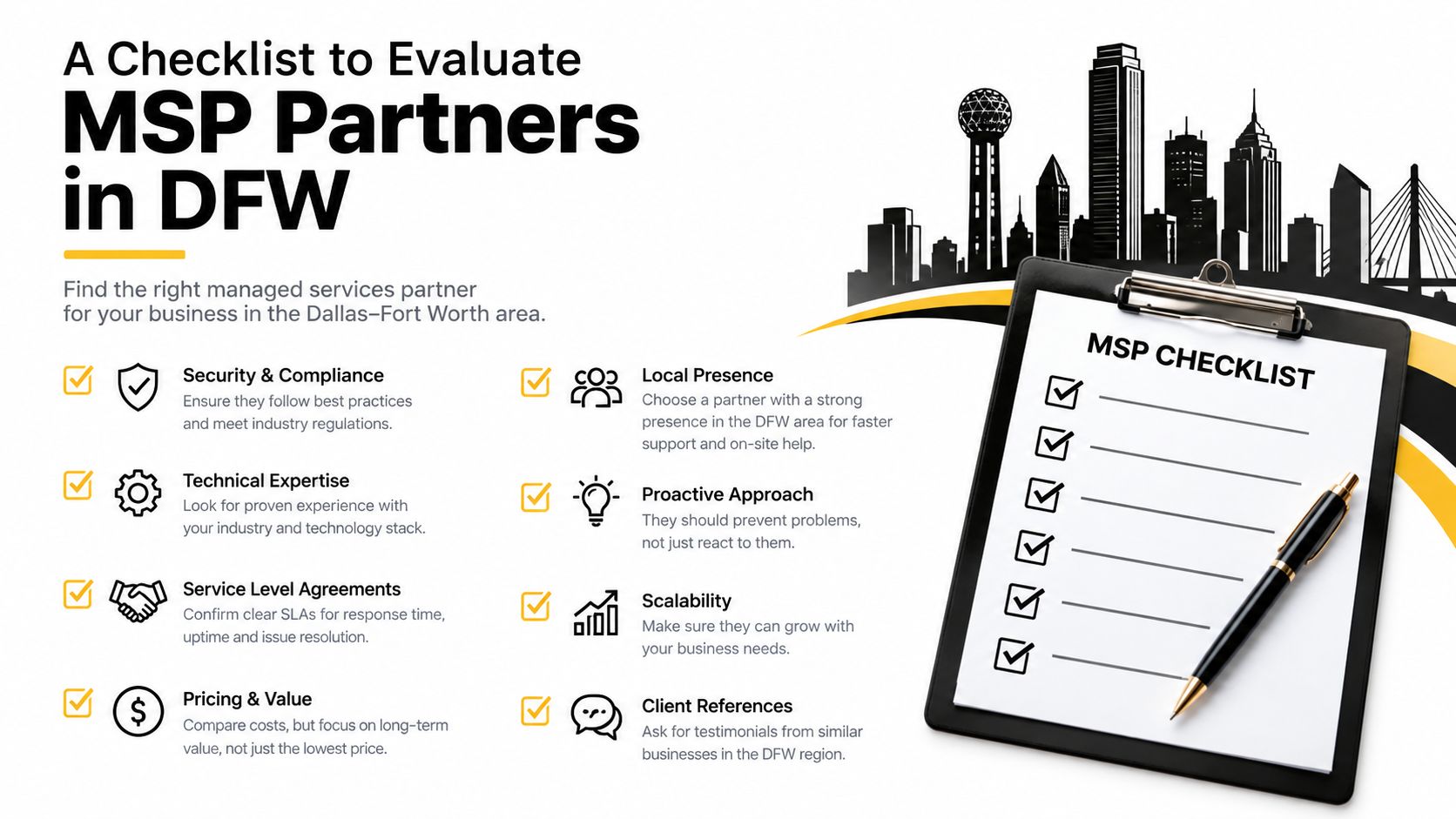
A buyer should leave the first meeting with written answers, not a polished presentation. The evaluation should test whether the provider can operate inside the firm's culture and risk environment.
References and local presence
- Relevant references: Request regulated firms of similar size, not only general commercial references.
- Metroplex coverage: Confirm a staffed office within the DFW area and understand on-site response procedures.
- Named resources: Ask who will handle the account, technical escalations, compliance questions, and executive communication.
- Continuity: Determine how coverage works when the assigned engineer is unavailable.
Security and compliance depth
- Control ownership: Ask the provider to assign an owner to monitoring, patching, backup verification, access reviews, and incident response.
- Evidence quality: Request sample reports with sensitive information removed.
- Audit experience: Ask how the provider supports HIPAA, legal confidentiality, financial controls, construction access, or nonprofit data requirements.
- Tool visibility: Confirm what the internal team can see and what remains provider-managed.
Cultural fit and warning signs
Communication style matters. A DFW firm should notice whether the provider listens to internal staff, explains trade-offs plainly, and accepts pushback without becoming defensive.
Red flags include vague SLAs, unnamed engineers, unclear escalation paths, reluctance to share audit results, and proposals that treat every issue as a billable surprise. A firm can use vendor management best practices to turn those observations into a consistent review process.
The scoring prompt is simple: rate each provider on ownership clarity, local response, security depth, compliance capability, reporting quality, pricing transparency, and cultural fit. Record the evidence behind every score. The partner that receives the highest score isn't automatically the right choice, but a written comparison exposes weak assumptions before a contract does.
A Short DFW Case Example and Your Next Step
Consider an anonymized illustrative scenario involving a mid-sized, healthcare-adjacent firm in Plano. The firm keeps its internal IT lead, but assigns after-hours tickets, HIPAA evidence collection, and a vCIO-led roadmap to a co managed partner. The target outcome is faster ticket resolution, readiness for an unplanned audit, and roughly a day per week returned to the internal lead for project work.
The important result isn't the staffing arrangement. It's the governance structure behind it. The internal lead still owns business priorities and final decisions. The provider owns defined execution, documents the work, and brings unresolved risks into regular reviews.
That model gives leadership a better question than “Is IT expensive?” It asks whether every critical responsibility has a named owner, whether the owner can produce evidence, and whether the internal team has enough capacity to move the business forward.
A DFW firm considering this approach should book a scoping call, share its responsibility checklist, and request a sample SLA and QBR template before making any commitment. The provider should be willing to discuss what stays internal, what moves outside, how escalation works, and how the relationship can end cleanly.
Technovation LLC offers co managed IT support for DFW organizations that need internal ownership with additional coverage, cybersecurity, compliance evidence support, monitoring, backup oversight, and strategic planning. Visit Technovation LLC to request a scoping conversation and evaluate a practical operating model before the next audit deadline or after-hours incident.