

A 25-person business in DFW can run payroll, manage client records, process payments, and deliver every service through cloud applications without operating a traditional server room. That convenience creates a coverage problem many owners discover at the worst possible time. A compromised cloud account, ransomware shutdown, or fraudulent wire request can interrupt the business, while general liability insurance may not respond because the loss came through a digital system.
The usual buying order is backwards. A business shouldn't shop for cyber security insurance for small business first and hope the policy fills every weakness. It should verify its security controls, document the evidence, calculate its actual interruption exposure, and then buy coverage that matches the remaining risk.
Table of Contents
- Why a Small Business Owner in DFW Might Need This Guide
- Figuring Out How Much Coverage You Actually Need
- Hardening Security Before You Apply
- Comparing Policies, Limits, and Deductibles Without Getting Fleeced
- Buying, Binding, and Renewing the Right Way
- How a Managed Service Partner Lowers Premiums and Eases Claims
- Keeping Your Coverage Earnable Year Over Year
Why a Small Business Owner in DFW Might Need This Guide
Consider a local professional-services firm with a few dozen employees. Payroll runs through a cloud platform, employees share documents through hosted applications, client records sit in line-of-business systems, and vendors receive remote access when work requires it. The owner assumes the existing business owner's policy handles a cyber event because the company already carries general liability, property, and business interruption coverage.
Then an employee receives a convincing invoice request. A criminal takes control of a mailbox, changes payment instructions, and persuades accounting to send funds to the wrong account. In another version of the same incident, ransomware locks the files the firm needs to serve clients. The owner calls the insurance agent and learns that the package-policy endorsement has a narrow limit, a social-engineering sublimit, or no meaningful coverage for the actual chain of events.
That isn't a rare concern for large enterprises only. NetDiligence's 2025 cyber claims study found that 98% of claims, representing $2.4 billion, came from SMEs with under $2 billion in annual revenue, and ransomware alone accounted for 2,675 claims. The figures are reported in the NetDiligence 2025 cyber claims study. A smaller company can be an attractive target because it often has valuable access, limited internal security staff, and less time to investigate an unusual login or payment request.
Insurance transfers financial risk, not security responsibility
Cyber insurance is a risk-transfer tool. It can help pay for covered response and recovery costs, but it doesn't prevent an attacker from entering an account, restore an untested backup, or make an inaccurate application answer harmless. The business still needs controls that reduce the chance of an incident and evidence that those controls were active when the policy was bound and when the claim occurred.
First-party coverage addresses the company's direct costs. Depending on the wording, that may include forensic investigation, legal advice, breach notification, system restoration, ransomware negotiation where legally permitted and covered, business interruption, crisis communications, and reputational public relations. A clinic may need help determining which patient systems were accessed. A construction company may need to restore project files and keep payroll operating during an outage.
Third-party coverage addresses claims or demands from others. A client may allege that confidential information was exposed, a partner may demand defense costs after a compromised connection, or a regulator may investigate a privacy incident. Coverage for penalties and sanctions requires careful review because policies commonly exclude amounts the law prohibits an insurer from paying.
The endorsement trap deserves attention
A dedicated cyber policy is generally designed around cyber events and their response costs. A cyber endorsement attached to a general liability policy or business owner's policy may provide useful protection, but its limits, definitions, exclusions, and sublimits can be much narrower. An endorsement can look adequate on an application while leaving the business exposed to ransomware restoration, invoice manipulation, dependent-system interruption, or vendor-related losses.
Common exclusions also matter. War or state-backed attack language can restrict certain events. Prior-known incidents can be excluded because insurance is meant to cover uncertain future losses, not an event the applicant already knows about. Infrastructure failure without a qualifying cyber trigger may fall outside the policy because a utility or cloud outage isn't automatically a cyber incident. The broker should explain each exclusion in relation to the business's actual dependencies.
| Coverage Category | Typical Loss Covered | Example Scenario |
|---|---|---|
| Incident response and forensics | Investigation, containment, and specialist response | A compromised mailbox requires review of access logs and affected records |
| Business interruption | Covered income loss and extra expense, subject to wording | Ransomware prevents the firm from accessing systems used for client work |
| Cyber extortion | Negotiation and related response costs where covered | Criminals encrypt operational files and demand payment |
| Social engineering and funds-transfer fraud | Certain fraudulent payment losses, subject to terms and sublimits | Accounting follows a fake executive request to change bank instructions |
| Privacy and network liability | Defense and certain third-party claims | A client alleges that confidential records were exposed |
| Crisis management and public relations | Communications and reputational response | The company needs a coordinated message after a public incident |
By the end of a proper review, the owner should be able to identify the policy response for a BEC wire-fraud event, a ransomware shutdown, a lost laptop containing client data, and a vendor outage. The sequence matters. Security readiness comes before policy shopping because the carrier evaluates the business that exists, not the one described in a polished questionnaire.
Figuring Out How Much Coverage You Actually Need
A liability limit shouldn't be selected because it fits a budget or appears frequently in advertisements. It should reflect the size of the business interruption exposure, the sensitivity of the records held, and the obligations imposed by contracts or regulation.
Start with four inputs:
- Annual revenue and margins. Revenue helps establish the scale of a potential interruption, but the important question is how much cash the business loses while systems are unavailable.
- Records and data sensitivity. A firm holding protected health information, payment information, legal files, or financial records faces different response and liability demands than a company holding little sensitive data.
- The cost of a full operational day. Include payroll, rent, contractors, missed production, emergency technology work, and customer remediation. A short outage can be more damaging than a small isolated breach.
- Contractual minimums. Clients, lenders, healthcare partners, payment relationships, and procurement departments may require specific limits or security terms.
The practical stress test is simple:
Business interruption exposure + incident response costs + regulatory and third-party liability = the minimum risk picture the policy must address.
Use a ransomware shutdown as the test, not a generic lost-password scenario. Ask how long critical work would stop, how quickly specialists could investigate, whether backups could restore cleanly, and whether customers or regulators would become involved. Then check whether the aggregate limit, per-occurrence limit, waiting period, retention, and sublimits support that scenario.
Industry guidance places a common starting point at about $1 million to $2 million in cyber liability limits, with very small firms at $500,000 to $1 million and regulated or data-heavy businesses at $2 million to $5 million or more. Those ranges come from industry guidance on cyber insurance coverage limits, but they aren't a substitute for the business's own exposure analysis.
Healthcare, legal, financial, and accounting organizations should treat regulatory and contractual requirements as a floor. Construction, engineering, and architecture firms should also review client contracts and dependence on shared project systems. A cybersecurity risk assessment template can help organize the inputs before a broker evaluates the application.
Hardening Security Before You Apply
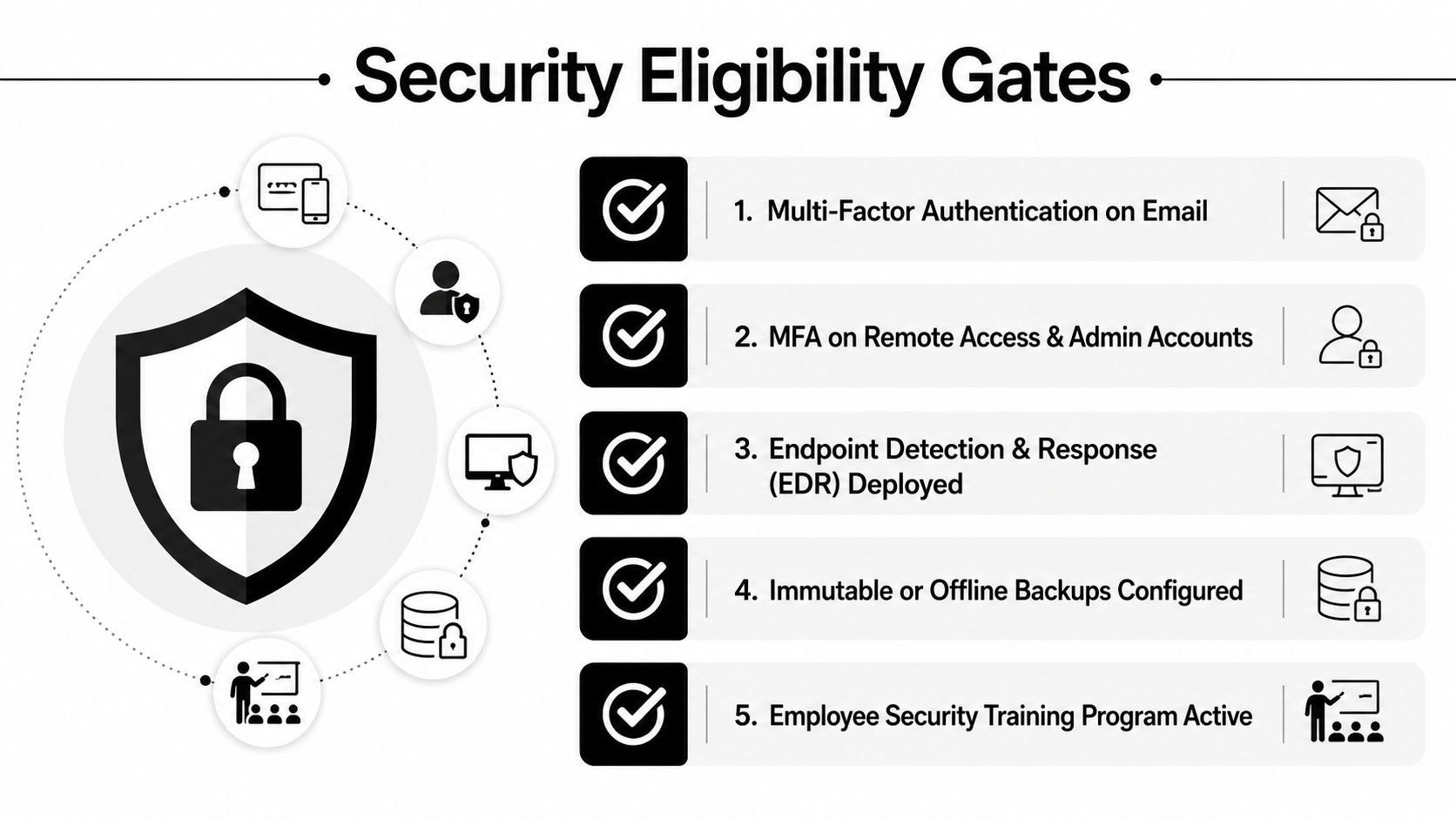
Carriers increasingly treat security controls as eligibility gates, not suggestions. A business that can't verify MFA, endpoint protection, backup resilience, and response planning may receive restricted terms, face additional underwriting questions, or fail to bind the coverage it expected.
Controls that answer underwriting questions
MFA on email, remote access, cloud services, and administrator accounts answers the question, “What stops a stolen password from opening the front door?” The control must be enforced, not merely available. Administrators should retain console evidence showing coverage across the relevant accounts.
EDR on every endpoint answers, “How will the business detect and contain suspicious behavior?” Device inventories and endpoint reports should show that laptops, desktops, and servers are covered. A single unmanaged device can create an exception between the application and the production environment.
Immutable or ransomware-resistant backups answer, “Can the company recover without relying on the attacker?” Backup logs aren't enough. The business should retain restore-test evidence that demonstrates the files can be recovered and that backup systems can't be altered through the same compromised credentials.
Least-privilege access and role-based permissions reduce the damage a compromised account can cause. Full-disk encryption protects data on lost laptops, while a written incident response plan assigns responsibility for notifying the insurer, preserving evidence, contacting counsel, and communicating with customers.
Security-awareness training completes the human side of the control set. It should address phishing, suspicious payment changes, credential prompts, and rapid incident reporting, with completion records available for underwriting.
Documentation is part of the application
Underwriters commonly require evidence, not just policies. They may request MFA screenshots or administrator-console proof, training completion records, backup logs with restore-test evidence, and device inventories showing endpoint protection, as summarized in the small-business cyber insurance documentation guidance.
Practical rule: If a control can't be demonstrated quickly, it isn't ready for underwriting.
A written policy that nobody follows won't protect the application. Businesses that need a broader security primer can review Wisenet Security Ltd cyber security for additional context, then translate the relevant practices into documented operating procedures. The cybersecurity insurance requirements guide can help DFW owners organize those requirements before requesting quotes.
The right sequence is straightforward. Assess the environment, close the gates, collect proof, and only then ask the broker to price the risk. That order gives the carrier a defensible picture and gives the owner a clearer basis for comparing terms.
Comparing Policies, Limits, and Deductibles Without Getting Fleeced
A cyber quote is a contract summary, not a complete risk decision. The premium matters, but the definitions, conditions, sublimits, and retention often determine whether the policy helps during the event that matters most.
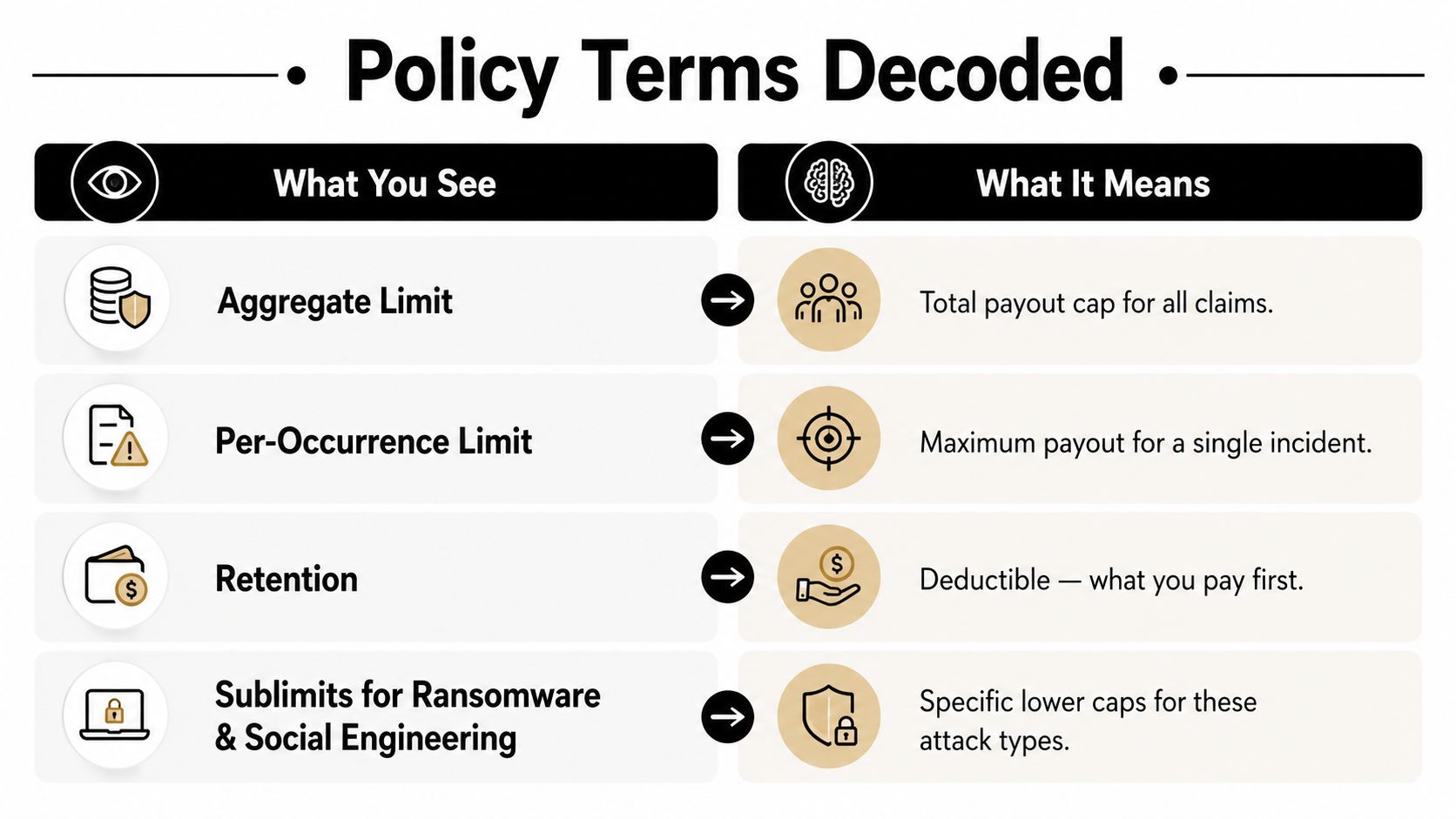
Read the aggregate limit as the total payout cap for all covered claims during the policy period. The per-occurrence limit is the maximum available for one incident. A policy can show a strong aggregate while offering a much smaller amount for an individual ransomware event.
The retention is the amount the business absorbs before coverage responds. Some policies use the word deductible, but the financial mechanics can differ, especially when the insurer controls the response process. A $500 deductible and a $25,000 retention create very different cash demands during a ransomware claim, even if the headline limit is identical.
Sublimits deserve close attention. A policy might carry a broad overall limit but cap ransomware, social engineering, funds-transfer fraud, or dependent business interruption at a lower amount. Coinsurance can require the insured to retain part of the loss when certain conditions apply.
Ransomware and BEC deserve special scrutiny because recent market guidance says they represented about 50% of claims of at least $1,000 across 2020 through 2024 and nearly 55% in 2024. The 2026 cyber market report explains why sublimits and endorsements can materially change the value of a quote.
Questions that expose weak coverage
Ask the broker to answer these questions in writing:
- BEC coverage: Does the policy cover business email compromise, funds-transfer fraud, and invoice manipulation, or does it require a separate endorsement?
- Ransomware response: Are negotiation, restoration, legal review, and payment-related costs covered where legally permitted?
- Dependent interruption: Does the policy respond when a critical cloud provider, hosted application, or outsourced vendor suffers a covered cyber event?
- Waiting periods: When does business interruption coverage begin, and how is the loss calculated?
- Panel restrictions: Must the business use insurer-approved counsel, breach coaches, forensic firms, or public-relations responders?
- Control conditions: What happens if MFA, EDR, backups, patching, or response planning falls below the application statement?
Package endorsements can be useful for limited exposure, but recent market guidance warns that they often cap coverage below realistic ransomware, invoice-manipulation, or dependent-system losses. The least expensive quote can become the most expensive option at claim time if the event lands inside a narrow sublimit or exclusion.
Buying, Binding, and Renewing the Right Way
The buying process has two separate decisions. The business needs an insurance professional who understands cyber wording, and it needs an accurate technical record that supports every answer on the application.
A captive agent may provide continuity with other commercial policies. A specialist cyber broker may offer deeper access to policy forms and underwriting markets. Neither choice removes the owner's responsibility to understand the controls, limits, exclusions, and response obligations. The broker should be able to explain how the proposed policy handles BEC, ransomware, vendor interruption, regulatory investigations, and lost devices.
Build the binder before requesting terms
The application package should include:
- MFA evidence: Screenshots or reports covering email, remote access, cloud services, and privileged accounts.
- Endpoint evidence: A current device inventory and EDR coverage report.
- Backup evidence: Backup schedules, isolation details, and documented restore-test results.
- Response evidence: A written incident response plan with current contacts and escalation paths.
- Training evidence: Completion records and the subjects covered.
- Patch evidence: Records showing the business follows its stated patch cadence.
Answer the questionnaire truthfully. If MFA covers email but not every legacy application, say so. An accurate partial answer gives the broker a chance to negotiate remediation requirements. An overstated answer can create a coverage dispute when investigators compare the application with system records.
Recent reports say insurers increasingly require evidence of MFA, EDR or MDR, tested immutable backups, patch cadence, and incident-response planning, while many small businesses fail assessments or find exclusions only after an incident. Those findings are summarized in the small-business cyber insurance requirements report.
Renewal is an operational discipline
A policy can become harder to defend after binding. A new administrator may be added without MFA, a device refresh may leave endpoints unprotected, or a vendor may retain access after a project ends. Quarterly self-audits should compare the current environment with the statements made on the application and renewal form.
The first 30 days after binding should establish the notification process, approved responders, panel counsel, breach-coach responsibilities, and internal authority for declaring an incident. The policy should be stored where leadership can reach it during an outage, not only in an email inbox that may be inaccessible.
How a Managed Service Partner Lowers Premiums and Eases Claims
Insurance readiness depends on daily execution. MFA must remain enforced, endpoints must stay monitored, patches must be applied, backups must be tested, and evidence must remain organized after the application is submitted.
A managed service partner can turn those requirements into recurring operations. Technovation LLC provides managed IT and cybersecurity support that can include 24/7 monitoring, patch management, endpoint protection, cloud backup, remote-access controls, security audits, IT health checks, and compliance-focused support. The useful distinction is continuity. A one-time project can close a gap, but recurring management helps prevent the gap from reopening before renewal.
Evidence makes underwriting easier
A carrier evaluating a managed environment can review current device inventories, security reports, backup records, training logs, and response documentation instead of relying on verbal assurances. Better evidence doesn't guarantee a lower premium, but it can support a cleaner application, more credible underwriting conversation, broader terms, lower retentions, or premium credits when the carrier offers them.
The economics of scope are visible in the UK SME market. An official government report found that a median premium of £11,500 covered more limited protection, while broader packages covering business interruption, crisis management and public relations, cyber extortion or ransomware, and data breach coverage reached a median of £55,000. The official report on SME cyber insurance shows that broader protection and broader response obligations can materially change the price.
A DFW healthcare clinic with a few dozen employees might discover at renewal that the carrier no longer accepts its prior control answers. A focused pre-bind readiness sprint can identify missing MFA coverage, unmanaged devices, untested backups, and outdated response contacts before the renewal deadline. The clinic then approaches underwriting with current evidence instead of trying to explain gaps after the fact.
Response planning also needs communication discipline. Resources covering workflows for incident responders can help leadership define who communicates, through which channel, and with what approval process. The MSP relationship becomes the maintenance plan for the policy, not an unrelated technology expense. Businesses considering that model can review managed IT and security services as part of the underwriting preparation.
Keeping Your Coverage Earnable Year Over Year
A policy remains valuable only if the business can still satisfy its conditions when a claim occurs. Quarterly reviews should be short, documented, and tied to the exact controls stated during underwriting.
First, confirm MFA after staffing changes. A new administrator or temporary employee may receive access through an old process. If that account lacks MFA, the business may struggle to show that its control statement remained true.
Second, reconcile EDR coverage with the device inventory. Laptop replacements, new remote workers, and personally owned devices can create blind spots. Every approved endpoint should appear in the inventory and show active protection.
Third, run and document a backup restore test. A successful backup job doesn't prove that the business can restore the files it needs. The test should record what was restored, whether the result was usable, and whether the backup remained isolated from ordinary administrative credentials.
Fourth, update the incident response plan. A phone tree with former employees, outdated vendors, or unavailable executives won't help during a shutdown. The plan should identify current decision-makers, insurer notification contacts, legal support, technical responders, and customer communication responsibilities.
A quarterly review should also include access removal, patch cadence, privileged-account checks, and training status. The disaster recovery planning resource can help connect recovery procedures with the insurance response plan.

For a DFW business owner, the practical test is simple: can the company prove that its stated controls are operating today? A free security audit and IT health check from Technovation can identify readiness gaps before an insurer does, giving the business a clearer path to coverage that remains defensible at renewal and claim time.
Technovation LLC helps DFW small and mid-sized businesses prepare for cyber insurance through security assessments, managed IT, monitoring, backup readiness, endpoint protection, and documentation support. Visit Technovation LLC to request a free security audit and IT health check before the next insurance application or renewal.