
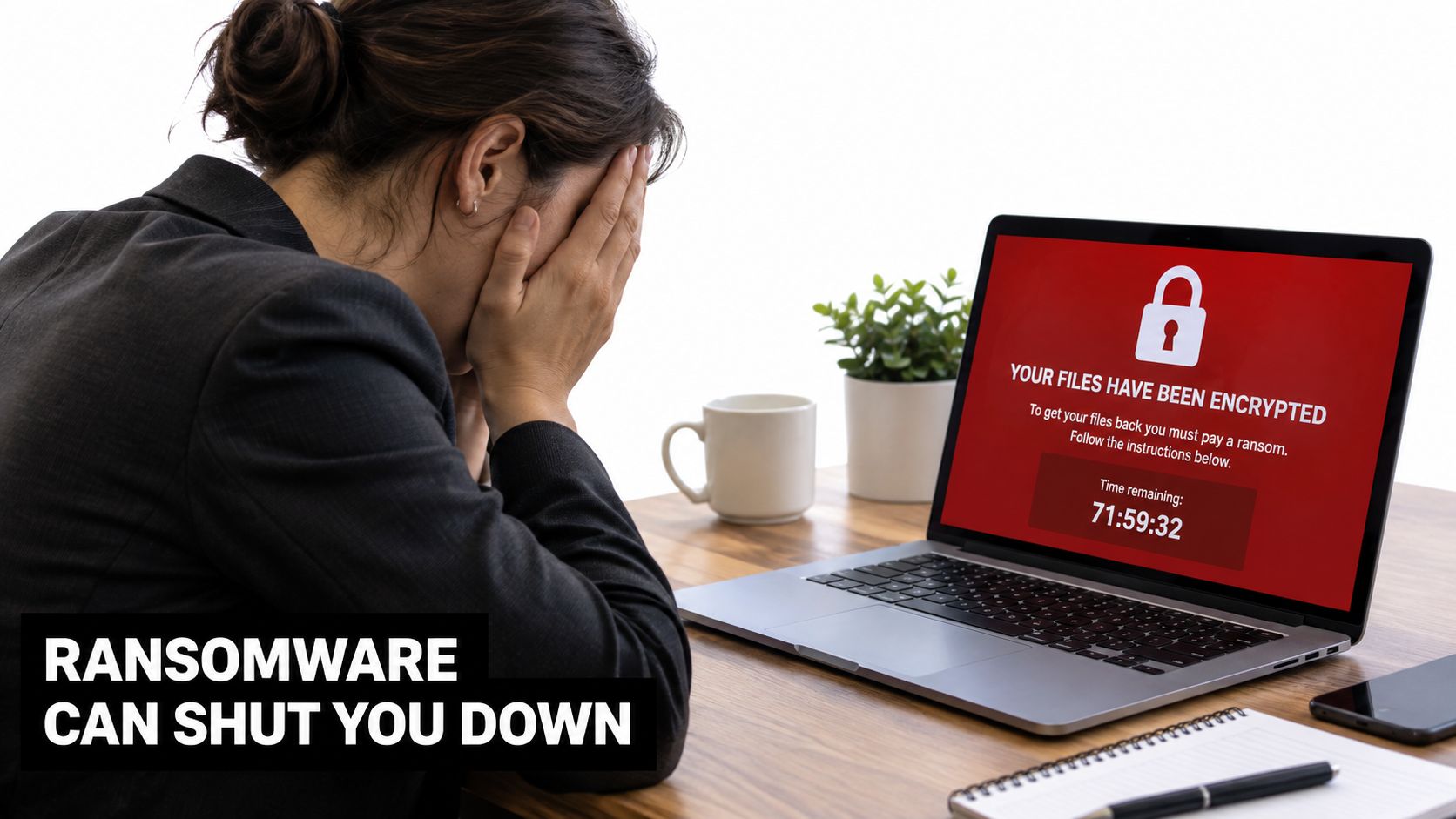
A clinic manager notices that patient files won't open. A law firm's document system displays unfamiliar file extensions, while several employees report ransom notes on their screens. The first reaction is usually understandable: shut everything down, call whoever answers first, and look for a payment option. That response can destroy evidence, spread confusion, and give attackers more time to move.
The safer approach treats ransomware as a business continuity and reporting incident, not merely an IT repair job. The first 24 hours should establish control, preserve facts, protect clean recovery paths, and give leadership enough clarity to make informed decisions without panic.
Table of Contents
- The First Hour – What to Do When You Spot the Lock Screen
- Isolating the Threat and Preserving Critical Evidence
- Restoring Operations from Verified Clean Backups
- Addressing Data Extortion and Confidential Breaches
- Navigating Legal Obligations and Stakeholder Communication
- Moving Forward – Hardening Systems and Building Resilience
The First Hour – What to Do When You Spot the Lock Screen
A shared drive stops opening. One employee reports a ransom note, while another says files are still accessible. The office phones work, email appears normal, and only a few screens show unusual activity. Treat the environment as compromised until responders establish otherwise. Attackers may have stolen sensitive files without encrypting them, creating an extortion event even when operations continue.
Declare an incident immediately. Move coordination away from normal corporate channels if those accounts or devices may be affected. Leadership should appoint an incident lead, an IT decision-maker, a legal contact, and a communications owner. Tell staff to stop using affected devices and not reconnect them. Record observations, times, people involved, and every action taken.
Establish the scope without guessing
Create an initial view of affected endpoints, servers, cloud workloads, network segments, remote-access paths, and shared storage. Classify the event as confirmed encryption, suspected data theft, or both. A functioning payroll application does not show that identity systems, file shares, backup consoles, or synchronization services are safe.
A useful first-hour log includes:
- Detection details: Record the first alert, ransom note, affected user, device, and time.
- System boundaries: Separate confirmed, suspected, and apparently unaffected systems.
- Actions taken: Document account suspension, network changes, device isolation, and evidence collection.
- Decision ownership: Record who approved each material action and who must authorize restoration.
The FBI's Internet Crime Complaint Center recorded 3,611 ransomware complaints in 2025, with reported losses exceeding $32 million. The FBI notes that adjusted ransomware losses generally exclude lost business, employee time and wages, unavailable files or equipment, and third-party remediation services. The headline figure therefore understates operational impact (2025 IC3 report).
Practical rule: Use the first hour to control decisions, preserve facts, and prevent an extortion issue from being treated as a simple file-recovery problem.
Smaller organizations can use an incident response guide for small businesses to assign responsibilities before an emergency. DFW healthcare and legal firms should keep their incident response procedures available through an offline or independent channel. A plan stored only inside an affected environment may be inaccessible when staff need it.
Contact legal counsel, the cyber insurer, and appropriate investigative or law-enforcement contacts early. For regulated businesses, legal counsel should help assess confidentiality, notification, privilege, and reporting requirements while the technical team establishes facts. Communications staff should prepare one approved internal message and prevent employees from speculating with clients or the public. Payment decisions belong with leadership, legal counsel, and the insurer, not one pressured administrator.
Isolating the Threat and Preserving Critical Evidence
Containment requires speed, but speed doesn't mean wiping every visible machine. A compromised endpoint may contain volatile evidence that helps investigators identify the initial access route, lateral movement, credential theft, persistence, and possible data exfiltration. Rebooting, reimaging, or rebuilding too early can remove that evidence before anyone understands the attack.
Disconnect first, preserve where feasible
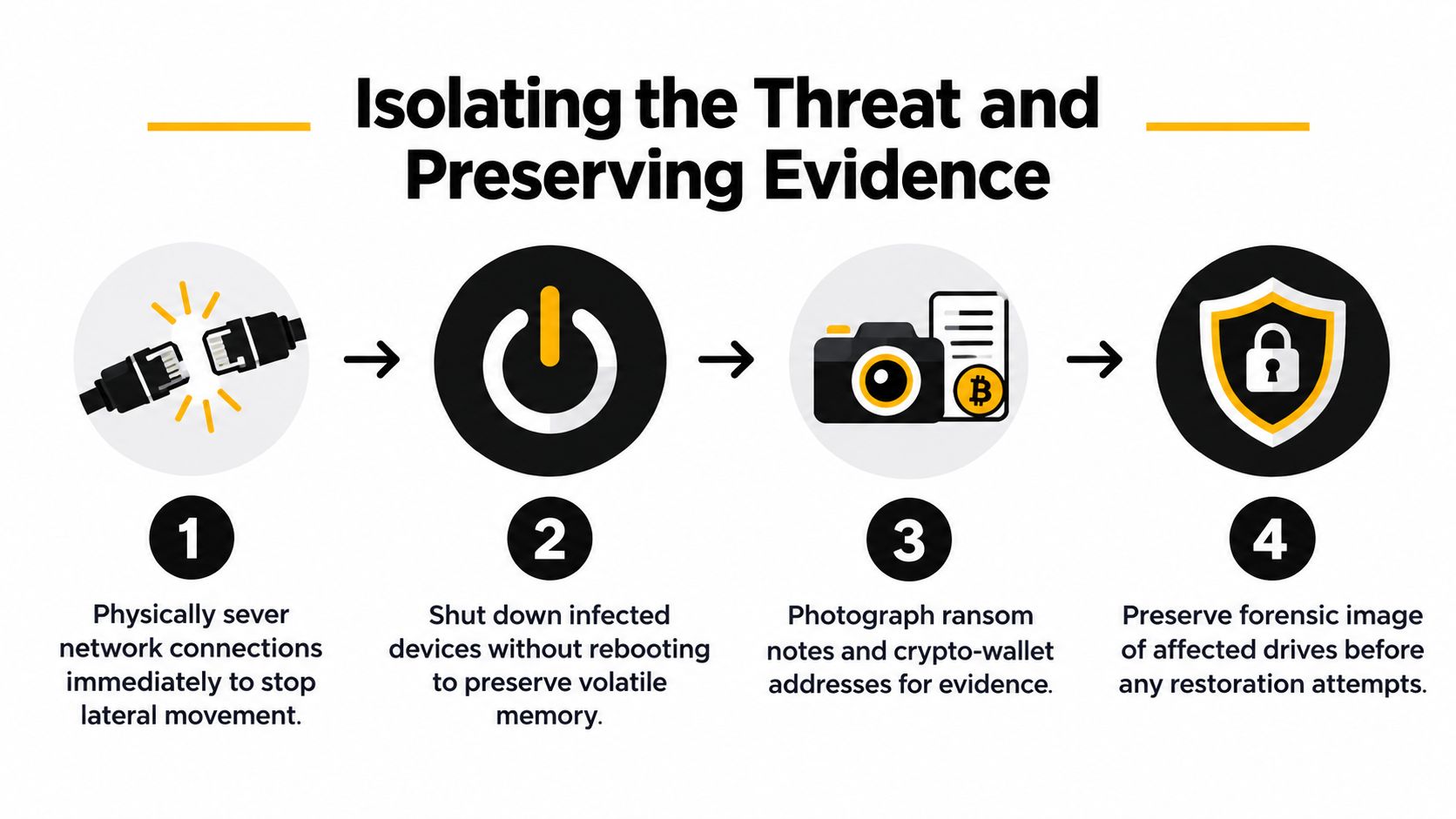
For an individual workstation, responders should remove the Ethernet connection, disable Wi-Fi, and terminate active remote-access sessions. For a server or cloud workload, responders should isolate the system at the network or workload-control layer where feasible, while preserving volatile evidence under the direction of qualified responders. If multiple systems or network segments appear affected, the network may need to be taken offline at the switch level rather than handled device by device.
CISA recommends identifying impacted systems and isolating them immediately. It also recommends taking a system image and memory capture from a sample of affected workstations and servers before rebuilding. That evidence can show whether the visible encryption event was the beginning of the attack or the final step after an attacker had already moved through the environment.
Keep an evidence trail
The response team should preserve ransom notes, affected file samples, system images, memory captures where feasible, relevant logs, firewall records, remote-access activity, and cloud audit data. Photographs can supplement digital preservation, but screenshots alone may omit timestamps, metadata, and file context. A chain-of-custody record should identify what was collected, when, by whom, and where it was stored.
The team should also protect communications. Corporate email, collaboration applications, and shared documents may be accessible to the attacker. Phone calls and pre-established out-of-band channels are safer for sensitive response coordination until investigators establish which accounts and systems remain trustworthy.
A common failure is to treat successful decryption or file restoration as proof that the incident has ended. The organization still has to investigate credential theft, persistence mechanisms, data theft, and reinfection risk before reconnecting restored systems.
NIST's guidance associates law-enforcement involvement with better outcomes in the referenced IBM breach dataset. Organizations that involved law enforcement reduced average breach cost from USD 5.37 million to USD 4.38 million and shortened identification-and-containment time from 297 to 281 days (NIST ransomware guidance). These figures don't guarantee a particular result, but they support early coordination rather than treating investigators as a last resort.
Network segmentation is part of both emergency containment and long-term risk reduction. A practical explanation of what network segmentation means can help business leaders understand why separate clinical, legal, finance, guest, administrative, and backup environments limit the consequences of a compromised account.
Restoring Operations from Verified Clean Backups
A backup job marked “successful” only proves that a copy process completed. It doesn't prove that the data is complete, the restore point predates attacker persistence, the backup credentials remain trustworthy, or the applications will function after restoration. Ransomware recovery depends on restoration engineering, not on the existence of backup files alone.
Sophos's 2025 global survey covered 3,400 organizations affected by ransomware. Among organizations whose data was encrypted, 97% ultimately recovered it, but only 54% used backups to restore the data, the lowest backup-recovery rate reported in the survey's six-year comparison. 49% paid a ransom and obtained their data back.
Those figures don't establish that payment is safer or faster. They show why recovery planning should prioritize verified backups, containment, and restoration rather than assuming that a ransom payment produces a dependable operating environment.
Validate before reconnecting
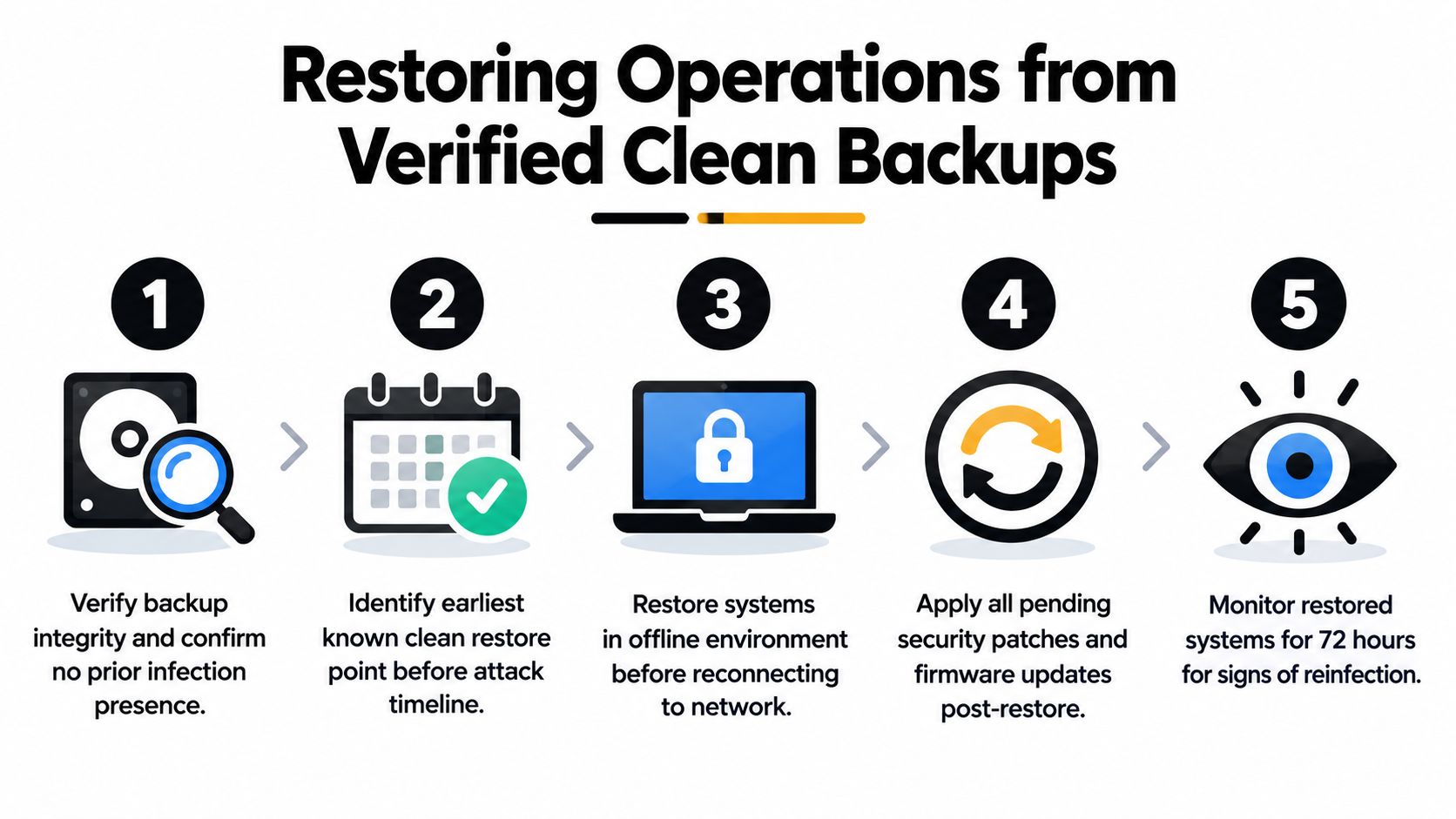
The recovery team should begin with the earliest known clean restore point, not automatically the newest available copy. Investigators should compare backup timestamps with the attack timeline and consider whether an attacker could have accessed or altered the backup environment before encryption became visible.
A controlled validation sequence looks like this:
- Verify integrity: Confirm that the backup set is readable, complete, and protected from unauthorized modification.
- Check the timeline: Establish that the selected copy predates suspected persistence and unauthorized access.
- Use a clean environment: Restore systems into a segmented staging area rather than directly into production.
- Scan and inspect: Check restored images, applications, databases, and management tools for malicious content or suspicious changes.
- Test dependencies: Confirm that identity, authentication, databases, applications, storage, and integrations work together.
- Reconnect by priority: Bring back critical services in a controlled order, with monitoring in place.
NIST calls for backups to be secured, isolated, and tested. That means backup administration should use separate credentials and multifactor authentication, while at least one recovery copy should remain offline, isolated, or otherwise resistant to ransomware access. Restore testing should measure whether the business can successfully recover a working service, not merely whether backup software reports completion.
Restore the business, not just the files
A clinic may need clinical systems and scheduling before general file shares. A law firm may prioritize document management, matter data, and secure communications. An accounting firm may need identity services, financial applications, and payroll. A construction company may place project files and collaboration systems first. Restoration order should follow business impact and technical dependencies.
The recovery plan should define recovery-time and recovery-point objectives for each important system, then document the order in which those systems depend on one another. Restoring everything at once creates avoidable risk. Staged restoration gives responders time to validate each layer and detect reinfection before it reaches the next service group.
An off-site data backup strategy can support this model when it includes isolated recovery points, documented runbooks, and realistic restore testing. The key question for leadership is simple: Can the organization demonstrate a clean restoration under pressure, or does it only possess backup reports?
Addressing Data Extortion and Confidential Breaches
A business can have working systems and still face a serious ransomware incident. Attackers may steal data, threaten publication, and leave the organization responsible for assessing exposure even when files were never encrypted. For healthcare clinics, law firms, accounting practices, and nonprofits, the stolen information may be more damaging than the temporary loss of a file server.
Sophos's 2025 survey found that 14% of all victims experienced data theft, including 28% of victims whose data was encrypted. Smaller organizations were more likely to experience extortion without encryption, with 13% of organizations with 100 to 250 employees reporting that pattern compared with 3% of organizations with 3,001 to 5,000 employees.
Run a separate exposure investigation
Technical restoration answers whether systems work again. A data-exposure investigation answers what the attacker accessed, staged, copied, or threatened to publish. Those questions require different evidence and different decision-makers.
The response team should examine outbound activity, endpoint and server telemetry, file-access records, cloud audit logs, remote-access activity, and attacker communications. It should identify the categories of information involved, such as patient records, protected health information, client files, payroll data, financial records, employee information, or confidential legal material.
A useful exposure register includes:
- Data category: What kind of information may have been accessed?
- Affected population: Which patients, clients, employees, donors, or business partners could be involved?
- Access confidence: What is confirmed, suspected, or not supported by available evidence?
- Contractual impact: Which customer, insurer, processor, or partner agreements may require notice?
- Containment options: Can credentials be revoked, accounts secured, documents invalidated, or access paths closed?
Paying for a decryption key wouldn't remove stolen data from an attacker's possession. That makes ransom analysis only one part of the response, and it should never replace breach assessment, evidence preservation, legal review, or communications planning.
Healthcare organizations need a workflow that accounts for HIPAA responsibilities and patient communication. Legal firms must protect client confidentiality and consider how privilege applies to the investigation and related communications. Financial and accounting organizations should coordinate contractual, privacy, and regulator-facing decisions with counsel.
A practical data breach response resource can help business leaders separate system recovery from the broader disclosure problem. The important operational insight is that restoring availability doesn't close an extortion incident. The organization also needs a defensible account of what happened and a plan for those affected.
Navigating Legal Obligations and Stakeholder Communication
A ransomware response in a regulated DFW business cannot remain an IT exercise. Technical teams can isolate systems, preserve telemetry, and restore infrastructure. Counsel must assess notification duties, privilege, contracts, insurance conditions, and the legal consequences of public statements. That work should begin while the technical investigation is still developing.
Healthcare organizations should involve privacy and legal leadership as soon as patient information may have been accessed. Preserve the investigation record, establish whether protected information was involved, identify affected individuals where the evidence permits, and coordinate required notices with counsel. Legal firms face a different risk. Client files, work product, and privileged communications require controlled handling, with outside investigators operating within a structure that protects legal review as far as applicable law allows.
Create one verified account of the incident
Stakeholders need accurate information, but executives, employees, clients, partners, and regulators need different details. Executives need operational impact, decision points, cost categories, and risk. Employees need instructions for temporary workflows and suspicious follow-on messages. Clients and partners need supported information about availability, possible exposure, and protective steps.
Use a disciplined communication process:
- Use approved channels: Treat compromised email and collaboration systems as potentially monitored until cleared.
- Separate known from unknown: Do not state that no data was accessed unless the investigation supports that conclusion.
- Assign one spokesperson: Keep customer, employee, and regulator communications consistent.
- Record every notice: Retain copies, recipient lists, approvals, and delivery records.
- Set update expectations: Give a specific point for the next update, even if the investigation has not changed.
Report the incident to appropriate authorities, including the FBI, IC3, CISA, or the U.S. Secret Service, as applicable. CISA's ransomware reporting guidance outlines reporting options and the information investigators may need, such as ransom demands, cryptocurrency details, threat indicators, and attacker communications. Keep operational losses in a separate record because reported crime-loss figures may not capture downtime, employee costs, unavailable equipment, or third-party remediation.
Cyber insurance creates another coordination requirement. Policy conditions, approved vendors, documentation standards, and payment restrictions vary. Notify the carrier according to the policy, and involve counsel before making material commitments. Specialist cyber liability guidance can help leadership identify questions to resolve before an incident.
Communication should be transparent without exposing recovery tactics or compromising the investigation. State what is known, what remains under review, what actions people should take, and what protections are being offered. This approach addresses both encrypted systems and data extortion, where stolen information can create legal and reputational exposure even after operations resume.
Moving Forward – Hardening Systems and Building Resilience
Recovery ends only after the organization has removed the attacker's access, corrected the entry path, and proved that restored systems can operate safely. Privileged credentials should be reset from clean administrative workstations. Compromised identity infrastructure may need to be rebuilt from known-good sources, and endpoint telemetry should remain under heightened review after reconnection.
The recovery team should also review backup administration, remote access, network boundaries, patching, logging, and detection coverage. If the attacker reached backup systems through production credentials, the architecture needs more than a password change. Backup access should be isolated, protected with separate credentials, and tested through complete restoration exercises.
CISA recommends creating, maintaining, and regularly exercising an incident-response plan and communications plan that cover ransomware, data extortion, and breach incidents. NIST recommends defined roles and decision-making strategies, along with an offline copy of the recovery plan because attackers may remove access to documents stored on the targeted network (CISA ransomware guidance).

Turn lessons into operating controls
A tabletop exercise should walk leadership through detection, isolation, evidence preservation, legal escalation, stakeholder communication, backup validation, and staged restoration. The exercise should expose who has authority, which contact details are outdated, which systems depend on one another, and where the recovery documentation fails.
Organizations can also draw on broader resilience principles in this guide to the Scottish Business Resilience Centre, while adapting the planning to DFW operations, industry obligations, and local response relationships.
For North Texas businesses, Technovation LLC can support infrastructure rebuilds, recovery sequencing, backup validation, documented runbooks, and ransomware recovery-plan testing. A tested process gives leadership something more valuable than reassurance: a defined way to contain the event, restore priority services, and communicate responsibly.
Technovation LLC provides managed IT, cybersecurity, compliance support, immutable and off-site backup planning, infrastructure recovery, and incident-response preparation for DFW organizations. Visit Technovation LLC to request a security audit or discuss a recovery plan built around the systems, data, and regulatory responsibilities that matter most.