
A renewal application lands in the inbox, and a business owner expects a few questions about revenue, industry, and coverage limits. Instead, the form asks whether multi-factor authentication (MFA) protects every email account, remote access path, privileged account, and cloud console. It asks for endpoint detection and response records, backup restore evidence, patching practices, vendor oversight, and proof that an incident response plan has been tested.
That experience is now common for small and mid-sized businesses. Cybersecurity insurance requirements have shifted from broad recommendations to specific, verifiable controls. The difficult part isn't only deploying the technology. It's proving that the controls exist, cover the entire environment, and continue working when an underwriter reviews the application or renewal.
Table of Contents
- The New Reality of Cyber Insurance for Your Business
- Core Technical Controls Insurers Now Mandate
- Beyond Tech Your Required Procedural Defenses
- Proving It How to Document and Evidence Your Controls
- Understanding Exclusions Limits and Cost Drivers
- Your Checklist for Becoming Cyber-Insurable
- Conclusion How DFW Businesses Can Get Ahead
The New Reality of Cyber Insurance for Your Business
A business may have security products in place and still fail an insurance review. An underwriter needs proof that multi-factor authentication (MFA) covers every critical access route, that endpoint monitoring is active where required, and that backups can be restored. A deployment plan or purchase record does not establish that coverage.
This shift reflects an insurance-market change rather than one new regulation. Insurers increasingly use evidence-based validation to assess eligibility, pricing, and coverage terms. They may request configuration records, access inventories, recovery-test results, and incident response documentation instead of accepting self-attestation. Current cybersecurity insurance guidance identifies MFA for email, VPN and remote access, privileged accounts, and cloud consoles, along with endpoint detection and response on endpoints and servers and tested incident response plans, as expected underwriting controls by 2026.
Why the application feels like an audit
Ransomware and business email compromise can produce losses that become difficult to contain after an attacker obtains access. Insurers therefore examine controls that limit account takeover, expose suspicious activity, preserve recovery options, and support coordinated response.
The practical effect extends beyond large enterprises. Healthcare clinics, law firms, financial firms, and other regulated organizations may need stronger baseline security to obtain or renew coverage. Cyber insurance has become a de facto compliance driver for businesses that once treated security as an internal IT matter.
The application now tests whether security work is documented, maintained, and repeatable. A policy without ownership, a backup without a restoration record, or MFA that excludes an administrative account creates an evidence gap.
Practical rule: A control that cannot be demonstrated may be treated as a control that does not exist.
That standard can feel burdensome, but it gives owners a workable roadmap. Each requirement points to a business capability: controlled access, visible devices, recoverable data, disciplined maintenance, and practiced response. Technovation can help organizations assess those capabilities, close practical gaps, and organize evidence for a more credible insurance application.
Core Technical Controls Insurers Now Mandate
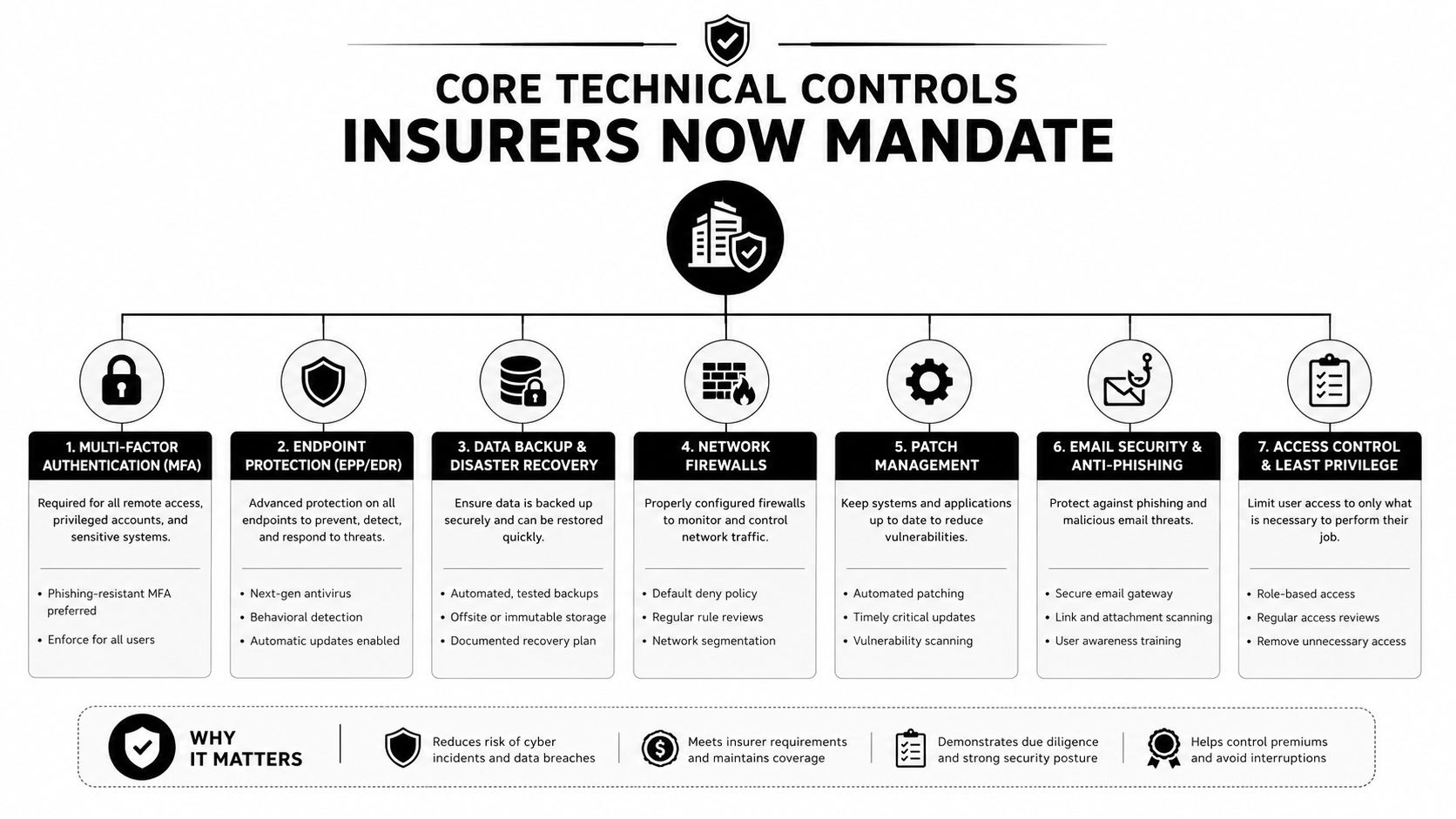
A business can have security tools in place and still struggle to obtain coverage if those tools do not cover the systems named in the application. Insurers now examine both the control and the evidence behind it. Access records, endpoint inventories, backup restoration logs, patch reports, and firewall reviews help underwriters judge whether protection is consistent rather than occasional.
These controls address different failure points. MFA reduces account takeover risk, EDR exposes suspicious activity on devices, resilient backups support recovery, patch management closes known weaknesses, and segmentation limits an intruder's reach.
MFA protects the doors attackers target
MFA requires a second verification factor beyond the password for email, VPN, privileged accounts, and cloud administration consoles. By 2026, insurers broadly expected MFA across these access points, with particular attention to phishing-resistant methods for privileged access.
Coverage gaps matter more than the presence of MFA somewhere in the environment. A company that protects email but excludes remote administration or a cloud console may be unable to answer an application accurately. Shared administrator accounts create another problem because they weaken accountability and make access reviews difficult.
Keep evidence that shows which accounts and systems are enrolled, which exceptions remain, and who approved them. The record should match the environment described in the application.
EDR watches every endpoint
EDR monitors laptops, desktops, servers, and other endpoints for suspicious behavior. It records activity, helps identify compromised devices, and supports containment before an incident spreads. Insurers expect coverage across the environment, not only on selected high-value computers.
A deployment report matters because an installed agent does not prove complete coverage. The report should identify protected devices, missing agents, inactive systems, and unmanaged endpoints that require attention. Retain dated reports so the business can show that coverage was reviewed and corrected over time.
Backups must survive the attack
A standard backup can fail if ransomware reaches the repository and encrypts or deletes its contents. Insurers increasingly look for immutable or offline backups plus documented restore testing, along with encryption, separate credentials, and records showing when restoration was tested. Recent insurance guidance on backup resilience describes these expectations.
The useful question is whether the business can restore critical operations and prove the result. Restore logs should identify what was tested, what succeeded, what failed, and whether recovery objectives were met. A backup policy without a restoration record leaves a material evidence gap.
Patch management closes known routes
Patch management assigns ownership and deadlines for correcting known weaknesses. Critical vulnerabilities should not remain open without a documented reason, responsible owner, and remediation path. Underwriting guidance commonly refers to patch windows of 30 days for critical vulnerabilities, while also expecting routine vulnerability management.
A reliable program needs an asset inventory, a prioritization process, and records showing completion or approved exceptions. Keep vulnerability scans, ticket histories, and exception approvals together so an underwriter can verify that the written policy reflects actual maintenance.
Segmentation limits the blast radius
Network segmentation separates sensitive systems from ordinary user activity. If one workstation is compromised, these boundaries can restrict access to servers, backup systems, and administrative interfaces. Firewalls support the separation, but rules should be reviewed, documented, and tied to business needs instead of left unchanged.
Businesses reviewing perimeter controls can examine firewall practices for businesses. Preserve rule-review records, diagrams, and approved changes. They show how the organization limits unnecessary paths and responds when its network changes.
Technovation can implement and monitor these controls through managed IT, security, backup, access, and compliance services. The work includes maintaining coverage as employees, devices, applications, vendors, and access paths change. That continuing record often matters as much as the initial deployment when renewal arrives.
Beyond Tech Your Required Procedural Defenses
Technology can block an attack, but procedures determine whether people respond coherently after something gets through. Insurers increasingly expect a documented incident response plan, employee security awareness activity, and vendor oversight because these controls show how the organization behaves under pressure.
An incident response plan needs practice
An incident response plan is a fire drill for a cyber event. It should identify decision-makers, technical responders, legal contacts, communications responsibilities, notification steps, backup procedures, and escalation paths for outside response vendors. A document stored in an unused folder won't coordinate a response during a disruptive event.
Insurers expect written plans to be tested at least annually, and some carriers request tabletop exercise records at renewal. A useful exercise records the scenario, participants, decisions, unresolved questions, and corrective actions. The after-action record becomes evidence that the business has tested its assumptions rather than merely written them down.
Organizations building or reviewing an incident response playbook should ensure that the document reflects the actual environment. A plan that names a former employee, an inactive vendor, or a backup process nobody can operate creates risk instead of reducing it.
Employees form the human firewall
Security awareness training should address the actions employees take every day. Staff need clear guidance for suspicious messages, unexpected payment requests, password reuse, removable media, remote work, and reporting possible mistakes. Training works best when employees know exactly how to report an issue and when management treats early reporting as a protective behavior rather than an automatic disciplinary event.
Phishing simulations can test whether the message is reaching people and whether employees know what to do next. Training records should show participation, assigned content, follow-up activity, and unresolved exceptions. The objective isn't to embarrass employees. It's to create a reliable reporting habit before an attacker turns a small mistake into a major incident.
Vendors need an accountable review process
A vendor with access to patient information, legal files, financial data, or administrative systems can affect the organization's insurance risk. Vendor risk management should identify critical providers, record the access they receive, review their security practices, and define what happens if they experience an incident.
Useful evidence may include vendor questionnaires, contractual security terms, attestations, access reviews, and records showing that high-risk providers received follow-up. Small businesses don't necessarily need an elaborate platform. They do need a repeatable process with an owner, review criteria, and documented decisions.
Technovation's vCIO consulting, incident response planning, and security awareness support can help convert informal habits into documented operating procedures. That work gives leadership a clearer view of responsibilities before an insurer or an incident forces the issue.
Proving It How to Document and Evidence Your Controls
An organization may have the right control in place and still struggle with underwriting if it cannot prove its scope, timing, or effectiveness. Cyber insurance is becoming evidence-driven, not just checklist-driven. Insurers may request MFA coverage reports, EDR device rosters, restore-test logs, and vendor attestations during renewal. Treat the application as an evidence exercise, not a form to complete from memory.
Build an evidence package, not a folder of screenshots
Organize supporting records by control, owner, date, scope, and current status. Each file should help an underwriter answer a specific application question.
- MFA coverage: Keep identity-policy screenshots, coverage reports, and enforcement records for email, remote access, privileged accounts, and cloud consoles.
- EDR deployment: Preserve a current device roster, agent status, server coverage, and explanations for unmanaged or inactive devices.
- Backup resilience: Document immutable or offline settings, separate credential controls, restore-test logs, and results from the latest recovery exercise.
- Incident response: Store the written plan, tabletop attendance, scenario notes, after-action review, and proof that identified gaps were addressed.
- Vendor oversight: Maintain questionnaires, attestations, contractual security requirements, access reviews, and risk decisions for critical providers.
- Patch management: Retain vulnerability reports, remediation records, exception approvals, and evidence that responsible staff followed the process.
Assign an owner to refresh the package whenever systems, staff, or vendors change. An outdated device list or report from a former network configuration cannot support an accurate attestation.
A cybersecurity risk assessment template can help teams standardize owners, review dates, exceptions, and supporting records. The format matters less than consistent maintenance and clear accountability.
Self-attestation creates avoidable uncertainty
A “yes” answer can conceal a scope mismatch. For example, “MFA is enabled” does not establish that every privileged account and remote access path uses the required method. Verify the question's scope before submitting the application, then document exceptions rather than hiding them.
Teams that process large volumes of policy records can browse document processing use cases for ideas on organizing application materials and extracting evidence from recurring paperwork. Automation can improve retrieval, but a person still needs to confirm that each record satisfies the policy language.
Technovation can manage underlying controls and curate an insurer-ready evidence package through a structured assessment process. The result should be a defensible record that helps the owner answer accurately, with exceptions and remediation work visible before an underwriter asks for them.
Understanding Exclusions Limits and Cost Drivers
Insurance coverage is a contract with conditions, exclusions, deductibles, sub-limits, and reporting duties. Review those requirements before an incident, because a policy can respond only when the business has followed its terms and preserved evidence.
Read exclusions as operating requirements
Policies may restrict coverage for acts of war, unapproved activity, or failures to maintain stated controls. A known critical vulnerability left unpatched without a documented exception can become relevant during a claim review. The exact wording varies, so the broker, legal adviser, and technical team should examine the contract together. Record who approved each exception, why it was accepted, and when it must be reviewed.
Sub-limits can narrow recovery for specific events. Social engineering, funds transfer fraud, regulatory response, forensic work, business interruption, and notification costs may each have different limits from the headline policy amount. Confirm the limit, deductible, waiting period, and required notification process for every coverage category your business depends on.
Security posture affects the financial terms
Insurers evaluate industry, data sensitivity, revenue exposure, access patterns, third-party dependencies, and the maturity of security controls. Stronger controls may improve eligibility, pricing, deductibles, and coverage terms, but no security provider can promise a particular premium or payout.
Claims scrutiny reflects the difficulty of assessing whether a business maintained its stated controls. Insurers therefore request dated records, access reviews, vulnerability reports, backup tests, incident procedures, and proof that exceptions received approval. A completed questionnaire without supporting documentation leaves room for disputes about the environment represented during underwriting.

Treat insurance readiness as an investment in operational resilience, not a promise of cheaper premiums. For organizations improving application intake and review workflows, an insurance quoting automation case study shows how structured information can support insurance processes. Technovation's role is to strengthen the underlying environment, identify gaps before renewal, and preserve evidence that helps demonstrate what the business maintained. That record can reduce disputes over control scope, exceptions, and remediation status.
Your Checklist for Becoming Cyber-Insurable
A ransomware incident exposes weak preparation quickly. An underwriter sees the same risk during application review when access records, backup tests, and response documents do not support the answers submitted. Build the readiness program in the order the review should occur: verify controls, test operations, organize evidence, then complete the application. This sequence reduces unsupported answers and gives leadership a clearer remediation plan.
Phase one confirms foundational controls
Start with the access paths and systems attackers commonly target.
- Map every critical access route. Identify email, VPN, remote desktop, privileged accounts, cloud consoles, service accounts, and third-party administrative access.
- Enforce phishing-resistant MFA where required. Confirm coverage across the full critical path, not only employee email.
- Inventory endpoints and servers. Compare the asset inventory with endpoint detection and response records. Investigate every device without protection or current reporting.
- Protect recovery data. Confirm immutable or offline backups, separate backup credentials, encryption, and documented restoration procedures.
- Review patch operations. Assign owners, track critical vulnerabilities, document remediation, and approve exceptions with an expiration or review point.
- Limit lateral movement. Use firewall rules, segmentation, least privilege, and access reviews so a compromised workstation cannot reach sensitive systems.
A NIST compliance checklist can organize this work around a recognized security structure. The application still requires accurate answers about what the organization has implemented, including scope and exceptions.
Phase two tests operational readiness
Controls carry more weight when staff can operate them during a disruption. Preserve records that show whether the process worked, not merely that a policy exists.
- Exercise the response plan: Run a tabletop scenario, record decisions and participants, and assign owners to corrective actions.
- Train the workforce: Provide security awareness training, phishing simulations, reporting instructions, and follow-up for incomplete participation.
- Review critical vendors: Document access, security expectations, attestations, incident contacts, and decisions for unresolved risk.
- Validate recovery: Perform a restore test and preserve the result, including limitations discovered during the exercise.
Paradigm International's strategic approach offers useful context for treating risk advisory as a business planning discipline rather than a collection of isolated technical tasks.
Phase three prepares the evidence
Create a controlled evidence register with the control name, responsible owner, source record, review date, coverage scope, and exception status. Link each item to the policy, system record, test result, or approval that supports the application answer. Evidence should be readable by a non-technical underwriter while retaining enough detail for a technical reviewer to validate the claim.
Keep dated versions and record remediation decisions. A current document without a review history may not show what was operating when the insurer assessed the risk.
Phase four completes the application accurately
Compare every answer with current evidence before submission. If the organization does not meet a requirement, disclose the gap and create a documented remediation plan instead of answering from an intended future state. Repeat the review before renewal because employee changes, new applications, vendor access, and infrastructure changes can make an older answer inaccurate.
Technovation's free security audit and IT health check can provide a practical starting point. The review can identify backup readiness, remote access exposure, account risks, recovery concerns, and compliance gaps, then give leadership a prioritized path toward insurability.
Conclusion How DFW Businesses Can Get Ahead
Cyber insurance is no longer a simple transaction completed by paying a premium. It's an ongoing demonstration that the business maintains controlled access, monitored systems, recoverable data, practiced response, and accountable vendor relationships.
That expectation matters across the Dallas-Fort Worth area, particularly for healthcare practices, legal organizations, financial firms, construction companies, and other businesses handling sensitive information. A strong application depends on more than technical intent. It depends on evidence that matches the business's current environment.
Technovation provides DFW organizations with managed IT, cybersecurity, compliance support, backup, risk assessment, incident handling, and strategic technology planning. A local partner can help business owners connect daily IT operations with the documentation insurers now expect, making insurance readiness part of routine governance instead of a renewal emergency.
Technovation LLC provides security audits, IT health checks, managed cybersecurity, backup integrity support, access control, incident response planning, and compliance assistance for DFW businesses. Visit Technovation LLC to request a cyber insurance readiness assessment and identify the evidence gaps that could affect coverage.