Most DFW owners think their security is fine because the office is open, the phones work, and nobody has complained. That's a dangerous way to judge it. The quietest breaches are the ones that matter, because they hide behind normal business activity while someone else watches emails, invoices, logins, and cloud accounts in the background.
That's why managed IT security services have become a practical operating decision, not a luxury line item. The point isn't to buy more alerts. The point is to replace guesswork with visibility, response, and accountability that a busy internal team usually can't sustain around the clock.
Table of Contents
- Why Your Current IT Setup May Not Be as Secure as You Think
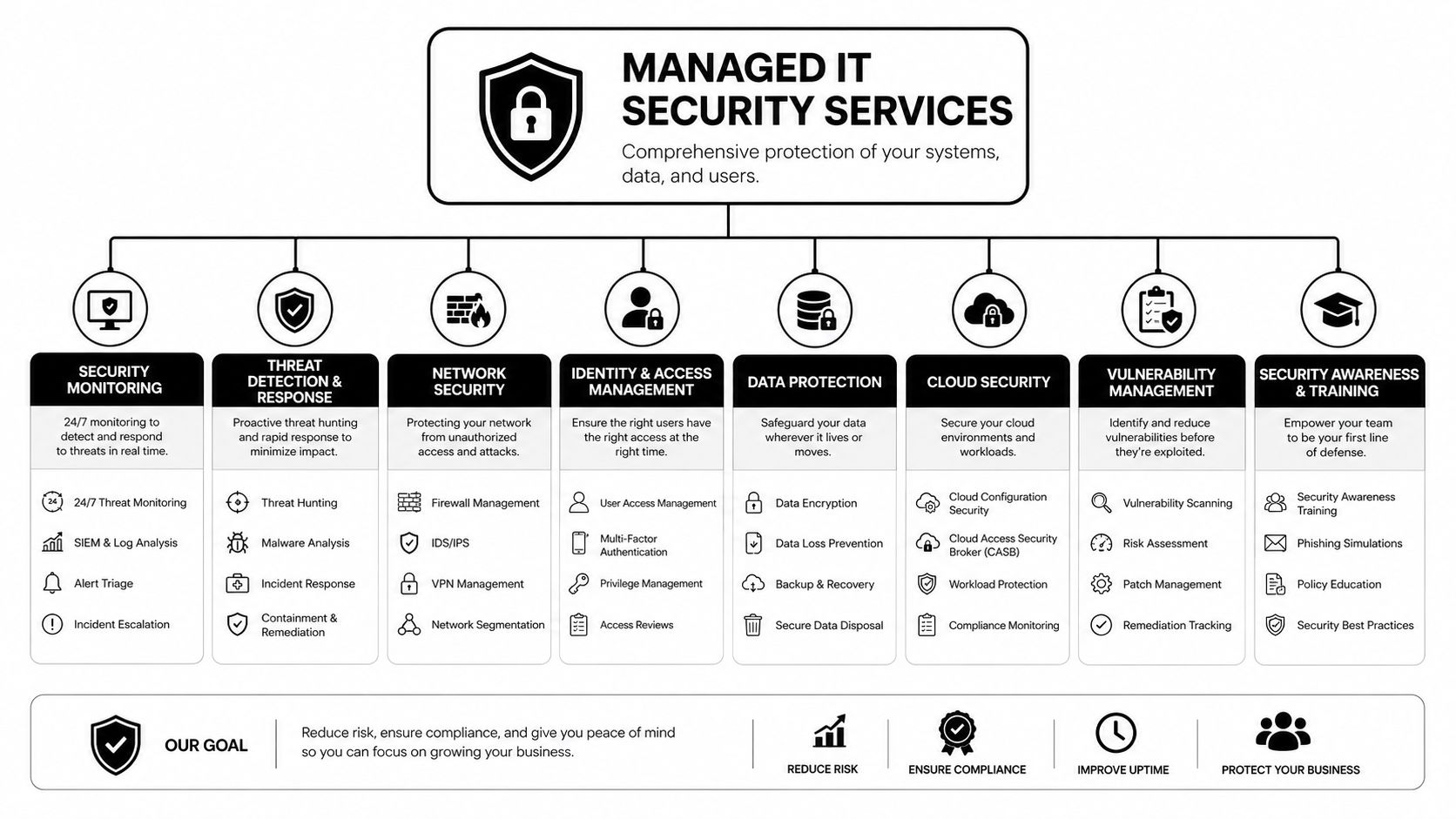
- What Managed IT Security Services Actually Include
- The Business Case for Outsourcing Security Operations
- Compliance Requirements for Regulated Industries
- How to Evaluate Managed Security Providers
- Why Local DFW Expertise Matters for Security Response
- Taking the Next Step Toward Proactive Security
Why Your Current IT Setup May Not Be as Secure as You Think
A warehouse office in Grand Prairie can run all week without a single complaint and still be exposed. A law firm in Plano can have working laptops, a responsive help desk, and clean email delivery while a compromised account sits undetected. Security failures rarely announce themselves with flashing lights. They usually blend into ordinary operations until someone notices missing money, odd login activity, or a client asking a hard question.
That is the trap. Owners confuse functioning IT with defended IT. Those are not the same thing, and attackers rely on that gap.
Practical rule: If the only proof of security is that nothing has broken yet, visibility is probably too thin.
The core challenge is that many businesses still lack a clear view of what is happening across endpoints, identity, cloud apps, and network traffic. A setup can look healthy on the surface while an attacker moves laterally, collects credentials, and waits for a better moment. Managed detection and response exists to close that gap, which is why managed detection and response basics for business owners should be part of any serious security conversation.
The market has grown because businesses have learned that monitoring and response cannot be improvised after the fact. One industry forecast places managed security services at USD 35.27 billion in 2024, rising to USD 39.47 billion in 2025 and potentially USD 66.83 billion by 2030, with 11.1% CAGR over 2025 to 2030, while North America accounted for 39.17% of revenue in 2025 in that forecast, and another forecast also puts North America in the lead with 29.05% revenue share in 2025. That growth matters because it reflects a broad shift from hoping the environment is fine to proving where the risks sit.
McKinsey points to the market's unresolved problems as the visibility gap, technology fragmentation, the talent gap, and the measurement of ROI. That tells a simple story, many businesses still cannot tell what their security team or provider is preventing. If a provider cannot show what it sees, what it blocks, and how fast it responds, the business is paying for reassurance instead of control.
That is why passive IT support is not enough anymore. Managed security has to prove outcomes, not just activity. If your current setup cannot show clear detection, clear response times, and clear evidence of risk reduction, it is leaving too much to chance.
What Managed IT Security Services Actually Include
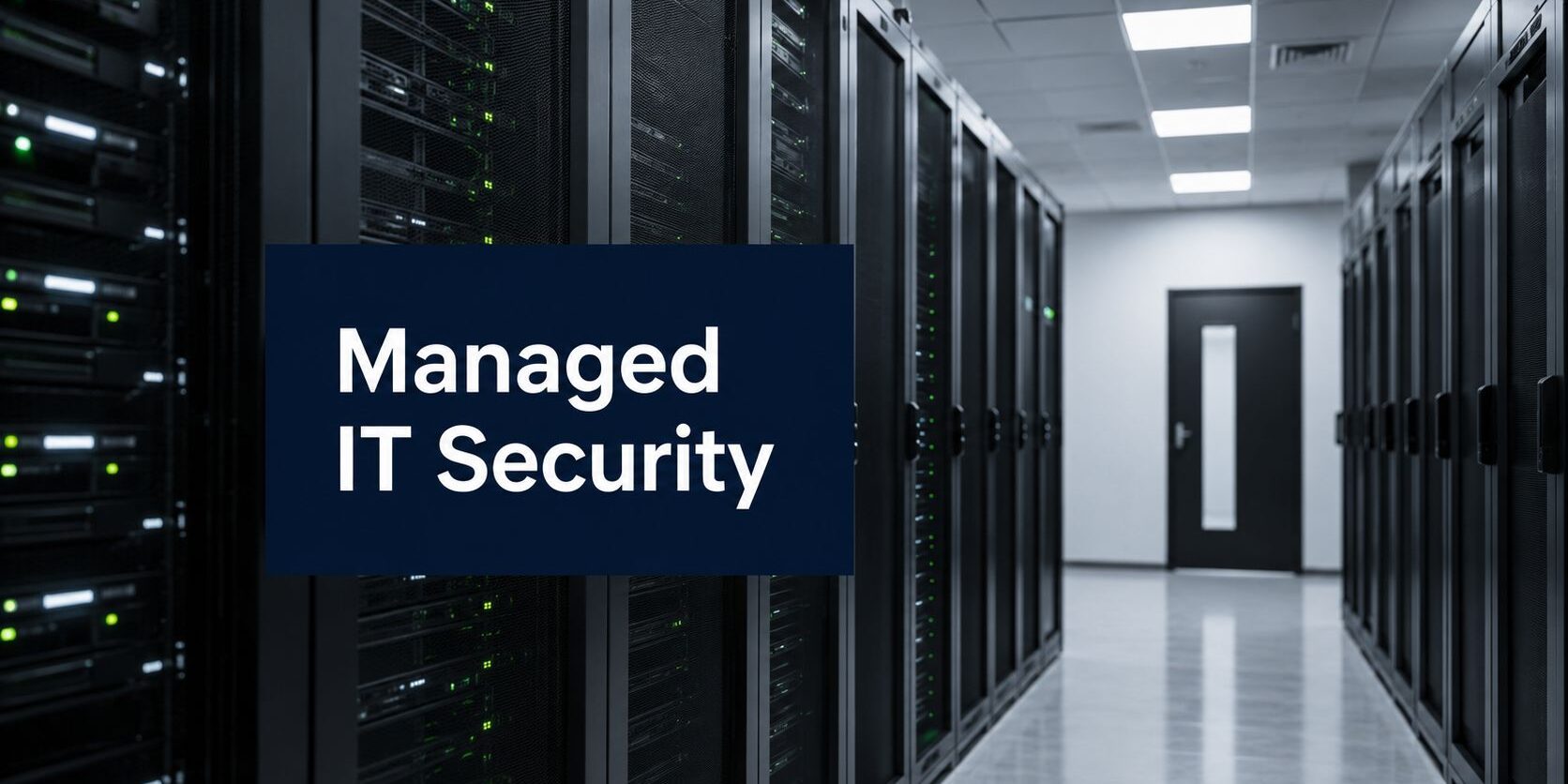
The simplest way to think about managed security is this: it's a 24/7 watchtower with a playbook. Instead of one person checking logs when time allows, a service keeps collecting signals from endpoints, networks, applications, cloud platforms, and identity systems, then turns them into information a human can act on. Industry glossaries describe managed security services the same way, as ongoing monitoring and response that make scattered alerts usable.
That matters because the visibility gap is real. If a provider cannot show what it sees, what it blocks, and how fast it responds, you are buying reassurance, not control.
The core pieces that matter
A strong service usually combines a few layers that work together:
- Continuous monitoring: Watching endpoints, networks, cloud workloads, and user activity so suspicious behavior does not sit unseen for days.
- Threat detection and response: Correlating events, confirming whether an alert is real, and taking action such as isolating a host or blocking traffic when needed.
- Identity and access oversight: Watching for suspicious logins, privilege changes, and account misuse, because identity compromise is now a central breach path.
- Cloud and application coverage: Extending protection beyond office devices, since business data now lives in more places than it used to.
- Compliance support: Keeping evidence, access controls, and process documentation aligned with industry requirements.
Managed Detection and Response deserves special attention because it goes beyond sitting on alarms. In plain English, MDR means a provider does not just watch the fence, it also checks whether someone is already inside the yard and moving toward the building. A clear breakdown of that model is available in Technovation's explanation of managed detection and response.
Security monitoring that never triggers containment is just observation. Businesses need observation plus action.
Buyers are moving in that direction because active defense gives them something they can measure. The broader market has also shifted toward cloud-based delivery and managed detection and response, which tells you what owners want from a provider, faster response, cleaner coverage, and fewer blind spots. That is the practical test. Ask any provider how it proves detection quality, response speed, and risk reduction in a way your leadership team can review without a technical decoder ring.
The Business Case for Outsourcing Security Operations
Security often gets treated like a cost center because the payoff is hard to see until something breaks. That framing misses the point. The choice is between predictable protection with measurable response, or hoping an internal generalist can juggle alerts, compliance, backups, phishing, and incident handling at the same time.
The money question starts with containment speed. Analysts have found that organizations using managed detection and response can contain breaches faster than in-house teams, which means less downtime, less spread, and fewer emergency hours spent cleaning up avoidable damage. That is the kind of outcome a business owner can use when deciding whether the spend makes sense.
What buyers usually get wrong about cost
Most owners compare managed security with the salary of one person. That comparison is too narrow. A real cost review has to include after-hours coverage, alert review, escalation handling, reporting, and the cost of being wrong when a threat slips through. A managed provider spreads that burden across a system built for that work.
Pricing also needs context. Basic managed security for small and midsize businesses is usually positioned in a lower monthly range, while managed detection and response with active response sits higher because it includes investigation and containment, not just monitoring. Those ranges matter because they give owners a practical way to compare vendor quotes against internal staffing, lost productivity, and reactive recovery.
| Service Tier | Core Capabilities | Monthly Cost Range | Best For |
|---|---|---|---|
| Basic managed security | Monitoring, alert review, baseline protection | $1,000 to $5,000 | Small businesses that need coverage without a full internal security team |
| Comprehensive MDR | Monitoring plus active investigation and response | $10,000 to $20,000 | Regulated SMBs that need stronger response and tighter control |
| Advanced managed operations | Broader coverage, reporting, and response coordination | Varies by scope | Larger organizations with more complex risk and compliance needs |
Market research also points to staying power, not a passing trend. Industry analysis shows managed services have moved into mainstream operations at scale, with channel-delivered revenue continuing to grow and a large partner base supporting that demand. That is a sign buyers are treating outsourced security as an operating model, not an experiment.
Bottom line: If a provider cannot explain how it reduces risk in dollars, downtime, or labor hours, the business is probably buying activity, not outcomes.
For regulated businesses, the cost case gets sharper because controls need to hold up under scrutiny, not just look good in a proposal. A healthcare clinic, for example, should ask for proof that the provider understands how patient data is handled, documented, and protected. A practical starting point is HIPAA compliance guidance for healthcare providers, because that is where security work becomes a business requirement, not a nice-to-have.
Compliance Requirements for Regulated Industries
A clinic, a law practice, a financial firm, and a construction company do not face the same risk profile. They all need security, but the controls that matter most are not the same across every business. The key question is whether a provider can show what data it can touch, how it protects that data, and what happens when something goes wrong.
Buyers should treat outsourcing as a due diligence exercise, not a sales decision. Before signing a contract, they should identify which data the provider can access, define sensitivity levels, check legal compliance, review access control and encryption, and confirm incident response, business continuity, supply-chain integrity, and data-destruction practices. That is the checklist that matters before any agreement is signed.
The questions regulated businesses should ask
A strong provider should answer these clearly, without hand-waving:
- Who can access what data: The business needs role-based access, not broad permissions.
- How sensitive data is separated: Client, patient, and financial records should not sit in a loose shared pile.
- What encryption is used: Data in transit and at rest both need protection.
- How incidents are handled: The owner should know who gets called, when, and with what authority.
- How records are destroyed: Offboarding and retention need clear disposal rules.
Healthcare is the clearest example, but it is not the only one. A legal practice needs confidentiality controls that match client obligations. A financial firm needs tighter handling of account and reporting data. Construction and engineering firms often hold bids, project plans, and partner information that can be just as sensitive in the wrong hands. For a DFW healthcare-specific reference point, Technovation's HIPAA compliance guidance shows why the compliance conversation has to start with access, process, and documentation.
Identity security deserves special attention because the entry point is often a stolen login, not a dramatic attack. Industry breach reports indicate that identity compromise appears in a large share of incidents, and organizations using MDR often see faster breach containment than teams handling everything in-house. That is the point business owners should care about. Governance and access control are not paperwork, they are front-line security, and they are also where the visibility gap shows up first when a provider cannot prove what changed, what was contained, and what still needs attention.
How to Evaluate Managed Security Providers
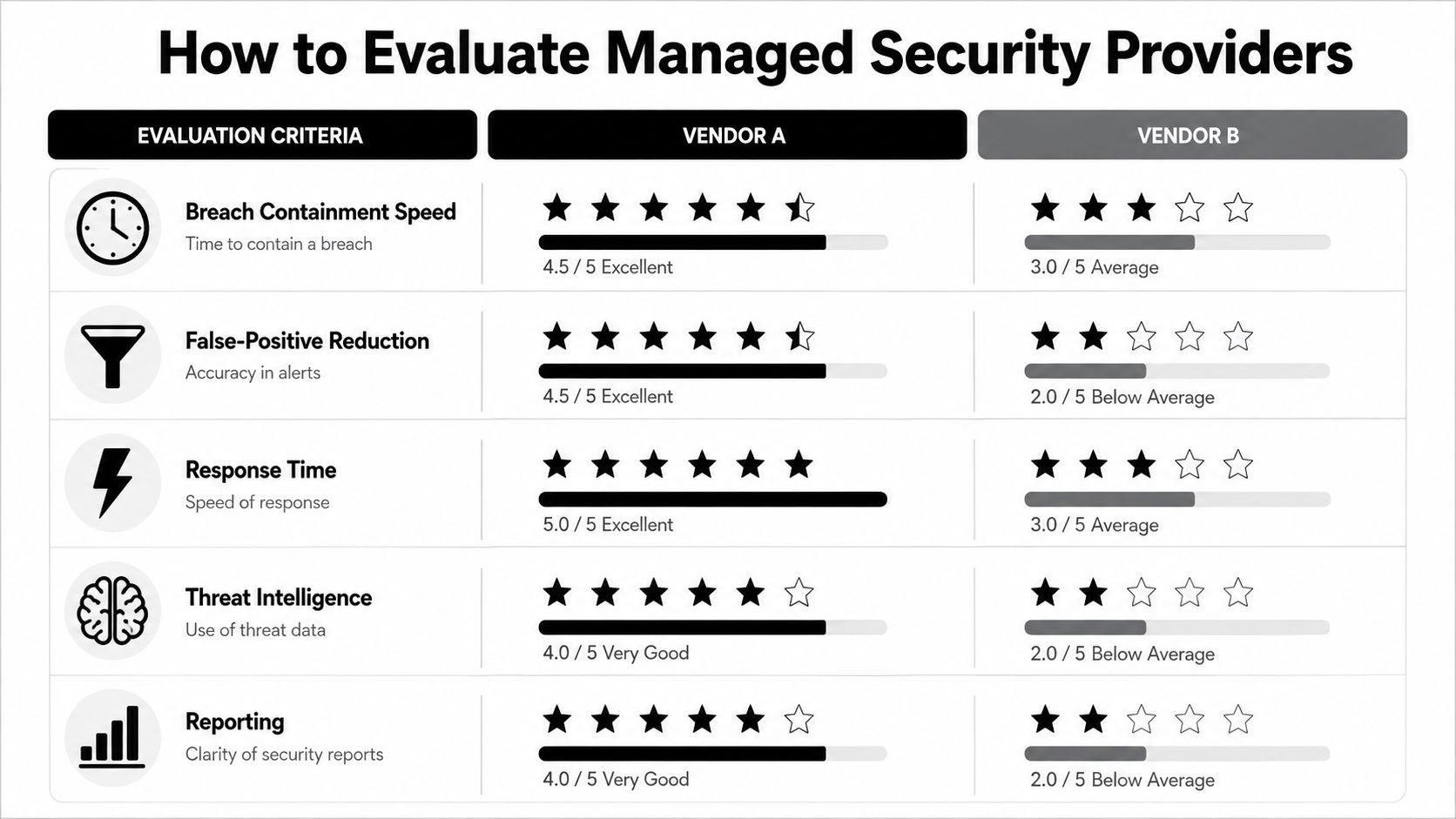
The mistake most buyers make is choosing the provider with the slickest brochure. That usually leads to more alerts, more dashboards, and very little clarity about whether risk went down. A better evaluation focuses on business outcomes, escalation discipline, and reporting quality.
Start with the outcomes that can be measured
Ask direct questions that tie the service to results your business can see:
- How fast is breach containment: Ask for examples of how quickly threats are isolated after confirmation.
- How much false noise gets removed: Your staff should not spend time sorting through irrelevant alerts.
- How clear is the reporting: Reports should show what was found, what was done, and what remains open.
- How does escalation work: One person needs clear ownership when a real incident begins.
- What proof is available: Look for recurring metrics, not vague promises.
That approach deals with the visibility gap McKinsey points to. If the provider cannot connect daily work to a measurable drop in risk, the business is still guessing about ROI, and guessing is a poor way to buy security.
Read the contract like a risk document
The service terms matter as much as the sales pitch. A business should confirm whether coverage hours are continuous, whether response obligations are written down, whether reporting is detailed enough for audit use, and whether data ownership stays with the client. The contract should also spell out what happens during an incident, who communicates first, and what proof of work is delivered after the fact.
A local business should also ask whether the provider can function as an operating partner, not just a ticket queue. How to choose a managed service provider is a useful starting point because the evaluation has to go past price and into operational fit.
A good provider reduces uncertainty. A weak one just adds another place for alerts to sit.
Technovation LLC belongs in this conversation as a local option for businesses that want managed monitoring, response, compliance support, and strategic IT planning under one roof. The question is not whether the provider has every shiny feature. The question is whether it can show what gets monitored, how incidents are handled, and how the service ties back to business continuity.
Why Local DFW Expertise Matters for Security Response
A national provider can look impressive on paper and still miss the realities of a Dallas, Fort Worth, or Plano business. Local operations usually need faster coordination, familiar communication, and a better grasp of the regional compliance environment. That matters most when an issue moves from a ticket to a real business interruption.
There's also a practical side to proximity. When a situation calls for an on-site visit, a local team can respond without turning geography into a delay. When a business has sensitive records, branch offices, or hybrid workers, a provider that understands the local footprint tends to make cleaner decisions about access, escalation, and handoff.
Why regional context changes the result
Technovation has spent 25 years serving DFW organizations across healthcare, legal, financial, construction, nonprofit, and general business environments, which means the service model isn't built around one template. That kind of tenure matters because a clinic's needs are not the same as an architecture firm's, and a nonprofit's budget constraints are not the same as a financial office's. The value is in matching protection to actual operating reality.
For a Dallas-focused view of that local posture, Technovation's Dallas IT security page is the right reference point. Local expertise also pairs well with the regional market picture, because North America is the largest managed security market in the available forecasts, with one placing it at 39.17% of revenue in 2025 and another at 29.05% in 2025 (MarketsandMarkets managed security services market forecast). The exact percentages differ by model, but the message is the same, this market is mature and demanding.

Local advantage: The best security partner isn't the one with the biggest logo, it's the one that understands how your business actually operates on Monday morning.
That's where local accountability matters. A DFW business owner wants straightforward answers, quick escalation, and a provider that can work inside the practical constraints of staff, budget, and compliance. Remote-only support can still help, but it usually doesn't replace the confidence that comes from a nearby team that knows the market and can respond with context.
Taking the Next Step Toward Proactive Security
The right move isn't buying a bigger stack of tools. It's getting a clean picture of what's exposed, what's already covered, and where the business is relying on luck. A professional audit or health check gives that visibility, which is the starting point for any serious security decision.
Technovation offers free security audits and IT health checks that help DFW owners see the gaps before they turn into downtime or compliance trouble. That kind of review is useful because it turns security from a vague concern into a plan with priorities, budgets, and responsibilities attached. Businesses that act on that information usually get more than better protection, they also get cleaner operations and fewer surprises.
If the goal is reduced downtime, clearer response, stronger resilience, and security that can be measured instead of assumed, the next conversation should be simple and direct. Contact Technovation for a practical review of the current environment, the likely risks, and the options that make sense for the business.
Technovation LLC helps DFW businesses turn managed IT security services into something measurable, with monitoring, compliance support, and practical response planning built around real operations. For owners who want fewer surprises and better visibility, a conversation with Technovation LLC is a low-risk way to understand what protection should look like and what it should cost.