
How does a Dallas medical practice, law firm, or accounting office know it's secure if nothing looks broken?
That question exposes the biggest flaw in how many small and mid-sized businesses think about cybersecurity. If staff can log in, files are opening, and clients aren't calling with complaints, leadership assumes the business is fine. It often isn't. Cyber risk usually remains hidden in overlooked admin accounts, stale backups, unreviewed vendor access, poorly classified data, and business processes nobody mapped.
A strong Cybersecurity Risk Assessment Template fixes that blind spot. It turns vague concern into a working document that shows what matters, what could go wrong, how severe the damage would be, and what needs attention first. For DFW businesses in regulated industries, that's not paperwork for paperwork's sake. It's how operational reality gets translated into a manageable plan.
Table of Contents
- Is Your Business Safer Than You Think It Is
- Laying the Foundation What to Protect in Your Business
- Mapping Your Threats and Operational Vulnerabilities
- How to Score and Calculate Your Cyber Risk
- From Assessment to Action Your Mitigation Roadmap
- Building Long-Term Resilience with Technovation
Is Your Business Safer Than You Think It Is
Most owners judge security by visible uptime. That's understandable, but it's the wrong test. A business can appear stable while carrying serious exposure in email, cloud storage, remote access, backup procedures, or employee permissions.
A cybersecurity risk assessment template gives leadership a way to stop guessing. It creates a written record of critical systems, data, likely threats, weak points, business consequences, and treatment decisions. That clarity matters most when the business handles patient data, financial records, legal files, or sensitive operational information.
Regulators already treat this process as essential. Cybersecurity risk assessments are mandated by major regulations like HIPAA and NYDFS (23 NYCRR 500), which requires annual assessments. Failures can lead to suspended operations or penalties averaging $150,000 per violation in 2024, according to this compliance overview on cybersecurity risk assessment templates. That makes the template a compliance tool and an operational control at the same time.
Why owners miss the problem
The trouble is simple. Cyber risk rarely announces itself clearly.
- Hidden access creep: Employees change roles, but old permissions stay active.
- Unseen weak points: Aging systems keep running, so nobody asks whether they're still defensible.
- Process gaps: Teams know how work gets done, but they haven't documented what happens if one key platform goes offline.
- False reassurance: No recent incident gets mistaken for good security.
Practical rule: If a business can't point to its top risks on one page, it doesn't understand its exposure yet.
That's why the template should be introduced early, not after an incident. It gives decision-makers a baseline. It also makes broader security planning more useful, especially when paired with practical guidance on cybersecurity best practices for small businesses.
What a good template changes
A solid template changes the conversation from “Are we safe?” to better questions:
| Business question | Better risk assessment question |
|---|---|
| Are systems working? | Which systems are critical to revenue, service delivery, or compliance? |
| Are employees being careful? | Where could human error create the most business disruption? |
| Do we have security tools? | Which controls actually reduce our highest risks? |
| Are we compliant? | Can the business document identified risks, owners, and mitigation status? |
That shift matters in DFW's regulated SMB market. A clinic doesn't just need computers online. It needs scheduling, records access, staff communication, and regulatory documentation intact. A law firm needs case files, deadlines, intake workflows, and privileged communications protected. A financial office needs more than antivirus. It needs evidence that risk is identified, prioritized, and managed.
Laying the Foundation What to Protect in Your Business
A useful cybersecurity risk assessment template starts with business reality, not an IT asset dump. Listing laptops and firewalls isn't enough. The primary job is identifying what the business must keep running, what data it can't afford to lose, and which people and systems those functions depend on.
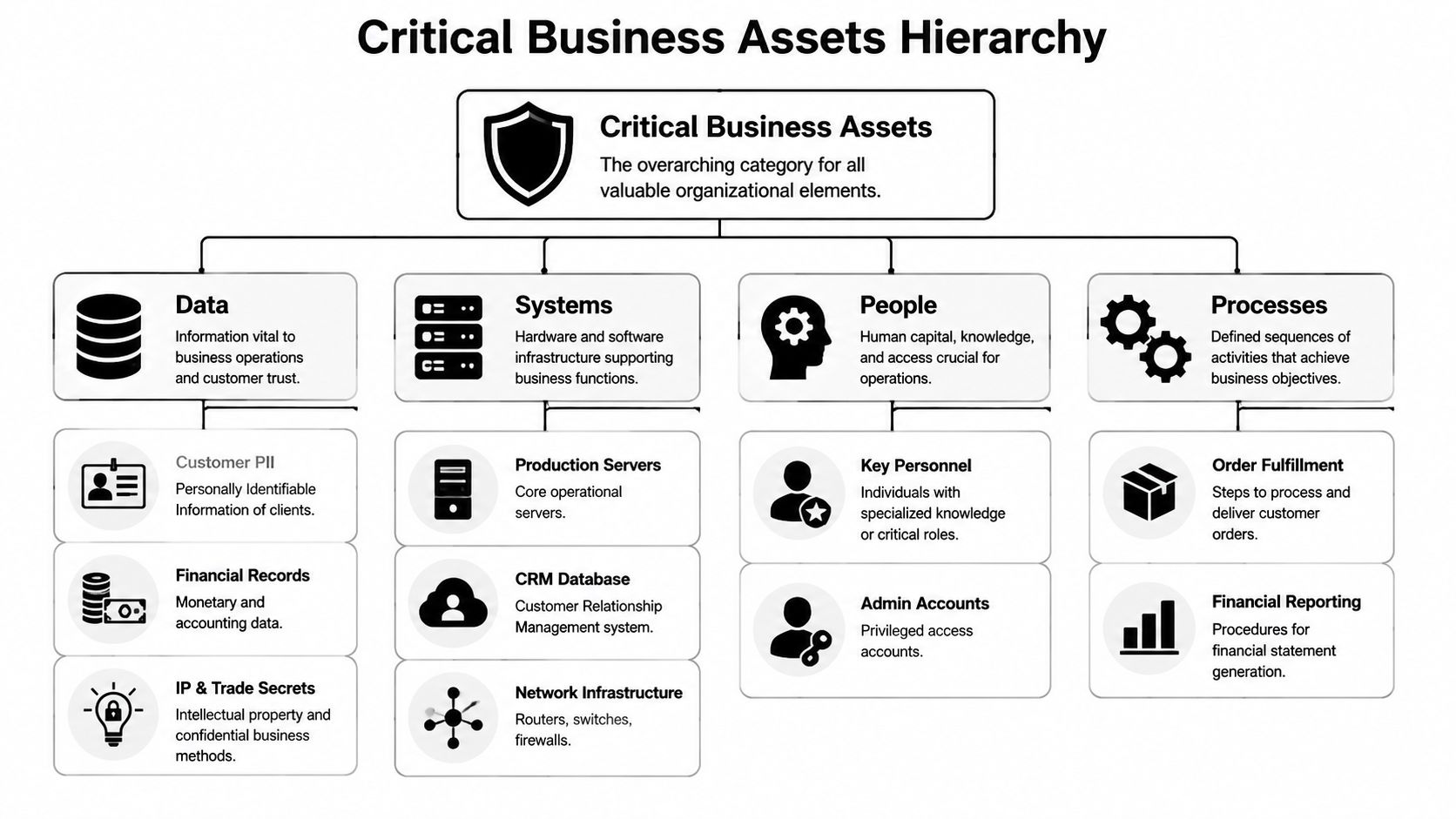
The right starting point is a Business Impact Analysis. The assessment process requires a Business Impact Analysis (BIA) to identify critical business functions and group assets by sensitivity. This allows the template to calculate a Residual Risk Rating after controls are applied, providing a clear metric of risk reduction, as outlined in this guide to essential cybersecurity risk management planning.
Here's the asset hierarchy most owners need to see:
Start with business functions, not devices
A DFW law office shouldn't begin with “12 desktops, 3 printers, and a file server.” It should begin with client intake, document management, deadline tracking, billing, and attorney communication. A medical practice should start with appointment scheduling, patient records access, claims workflows, prescribing, and internal coordination. A financial firm should identify tax preparation, bookkeeping data, approvals, reporting, and client communications.
That approach is more accurate because devices only matter in relation to what they support.
A practical first pass usually includes:
- Revenue-driving processes: Intake, billing, scheduling, collections, reporting.
- Compliance-heavy functions: Handling regulated records, retention obligations, audit evidence.
- Service delivery workflows: The systems and people needed to produce work on time.
- Dependency points: Shared inboxes, admin accounts, cloud apps, remote access, and vendors.
Classify assets by sensitivity and dependency
Once business functions are identified, the template should group assets by sensitivity. Regulated data should never sit in the same mental bucket as general office files. A practice management database, a scanned ID, a settlement file, payroll records, and a marketing brochure don't carry the same risk.
A workable structure usually looks like this:
- Regulated data: Patient information, financial records, confidential legal matters, contract records.
- Critical business data: Pricing files, internal reports, job schedules, project documents.
- General operational data: Routine documents that matter, but won't trigger major fallout if unavailable briefly.
That classification is where policy and execution start to meet. Businesses that need a cleaner framework for labeling and handling sensitive information should formalize data classification policy standards.
Asset inventory should answer one blunt question: if this disappears, gets altered, or becomes public, what breaks first?
A template also needs to capture systems, people, and process dependencies around those assets. For example:
- Data may live in shared drives, cloud platforms, email, and local devices.
- Systems may include remote access, line-of-business applications, and network infrastructure.
- People include executives, billing staff, paralegals, clinicians, and admins with privileged access.
- Processes include approvals, record retention, scheduling, and client communication.
This is also the point where secrets and credentials deserve more attention than most SMB templates give them. A company with scripts, integrations, service accounts, and shared credentials can reduce avoidable exposure by adopting stronger practices for effective DevOps secrets handling. Even businesses that don't think of themselves as “DevOps shops” often have automation and credential sprawl hiding in plain sight.
When this foundation is done properly, the rest of the assessment gets easier. Leadership can see which assets matter, why they matter, and what level of disruption would hit cash flow, service delivery, or compliance first.
Mapping Your Threats and Operational Vulnerabilities
Once the business knows what it depends on, the next question is blunt. What could hurt it?
Most templates do a mediocre job here. They produce generic lists of malware, phishing, weak passwords, and missing patches. Those issues matter, but a useful cybersecurity risk assessment template has to connect them to local operating reality. In DFW, that means asking what happens to patient care, legal deadlines, invoicing, field operations, or payroll if a cyber event interrupts a business process.

Threats and vulnerabilities are not the same thing
A simple analogy helps. A threat is the storm. A vulnerability is the hole in the roof. The storm may come from outside, but the damage depends on what's already weak.
For a typical SMB, common threats include phishing, ransomware, unauthorized access, insider misuse, and vendor-related exposure. Common vulnerabilities include unpatched software, poor password hygiene, weak approval workflows, broad user permissions, and lost or unmanaged devices.
The template should pair each threat with a specific weakness and a specific business asset. For example:
| Threat | Vulnerability | Affected asset | Likely business consequence |
|---|---|---|---|
| Phishing email | Weak email verification habits | Shared finance mailbox | Fraudulent payment approval |
| Ransomware | Incomplete backup testing | Patient records system | Appointment disruption |
| Lost laptop | No encryption or poor access controls | Legal files | Confidentiality breach |
| Unauthorized internal access | Excessive permissions | Financial reports | Data exposure or manipulation |
That level of mapping beats generic checklists every time. It also helps teams understand where vulnerability scanning fits. Scanning can reveal technical weaknesses, but it won't tell leadership which weakness threatens payroll, intake, or compliance deadlines unless the business context is already built into the assessment.
Operational impact belongs in the template
This is the part most templates skip, and it's a serious mistake. Only 12% of industry guides explicitly mandate evaluating how cyber failures affect physical operations, patient care, or legal deadlines, according to this analysis of the elements of a good cybersecurity risk assessment. That omission leaves SMBs with technical findings but weak business judgment.
A server issue is never just a server issue. It's delayed filings, missed appointments, stalled projects, unpaid invoices, or a team that can't work.
For North Texas businesses, the missing operational layer often includes:
- Healthcare impact: Delayed chart access, disrupted scheduling, slower patient communication.
- Legal impact: Missed filing windows, delayed discovery work, inaccessible client records.
- Financial impact: Broken approval chains, delayed close processes, compromised reporting accuracy.
- Construction and engineering impact: Stalled field coordination, inaccessible plans, schedule slippage.
A worthwhile template should include a dedicated field for real-world operational consequences. Not a vague “high impact” label. A plain-language note such as “if this account is compromised, billing stops and approvals get delayed” is much more useful.
That single change makes the assessment more strategic. It gives owners a basis for prioritizing controls that protect continuity, not just infrastructure.
How to Score and Calculate Your Cyber Risk
A risk assessment becomes useful when it stops being descriptive and starts being comparative. Leadership needs a way to rank problems. That's where scoring comes in.
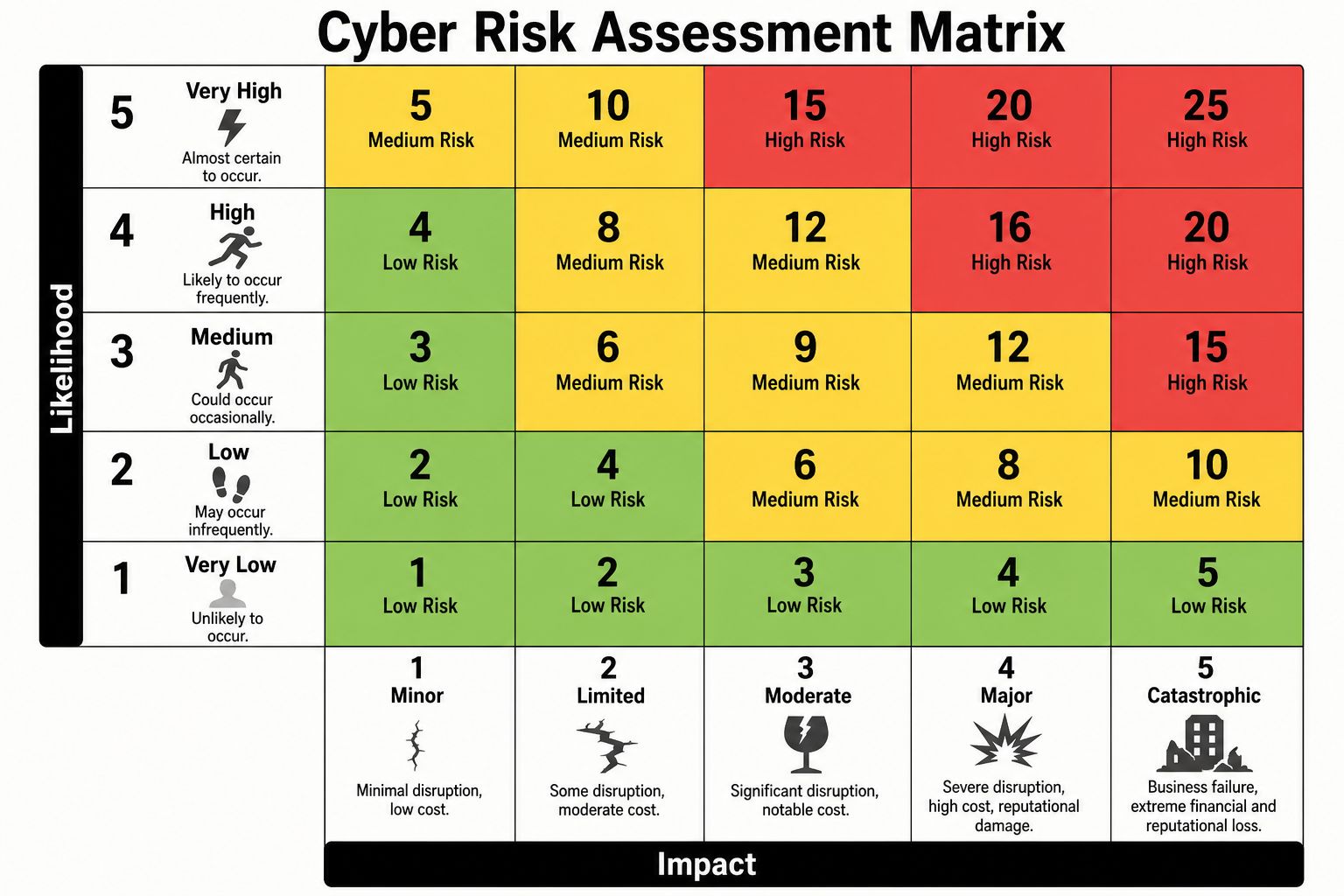
A rigorous template uses a quantitative method where Risk Rating = Likelihood × Impact. The template should define Likelihood on a 1 to 5 scale from Rare to Almost Certain, and Impact on a 1 to 5 scale from Negligible to Severe, with formulas calculating scores automatically for consistent prioritization, as described in this detailed breakdown of a cybersecurity risk assessment template.
This matrix makes the process easier to understand and defend:
Use a simple scoring model that people will actually use
A template doesn't need to be academically perfect. It needs to be repeatable.
Most SMBs do well with this scoring structure:
- Likelihood 1: Rare
- Likelihood 2: Unlikely
- Likelihood 3: Possible
- Likelihood 4: Likely
- Likelihood 5: Almost Certain
And for impact:
- Impact 1: Negligible
- Impact 2: Minor
- Impact 3: Moderate
- Impact 4: Major
- Impact 5: Severe
The math is straightforward. Multiply the two values to produce a score from 1 to 25. That score then drives prioritization.
A simple interpretation model works well:
| Score range | Priority meaning | Typical response |
|---|---|---|
| 1 to 5 | Low | Track and review |
| 6 to 15 | Medium | Plan remediation |
| 16 to 25 | High | Act quickly |
A practical scoring example
Take a common DFW scenario. A finance employee receives a convincing email, enters credentials into a fake login page, and an attacker gains access to the mailbox used for approvals and vendor communication.
A practical assessment might look like this:
- Threat: Phishing leading to account compromise
- Affected asset: Finance approval workflow and email records
- Likelihood: 4, if staff training is inconsistent and controls are limited
- Impact: 4, because payment fraud, disclosure, and process disruption could follow
- Inherent risk score: 4 × 4 = 16
That score lands in the high-risk range. It should move near the top of the remediation list.
Decision lens: If two issues cost the same to fix, tackle the one with the higher score first.
After new controls are added, the template should record residual risk. For example, stronger email protections, staff training, tighter approval processes, and restricted access may reduce likelihood or impact. The point isn't to chase zero risk. It's to make the remaining exposure visible and acceptable.
The biggest benefit of scoring is political, not mathematical. It gives owners, managers, and IT leaders a shared language. Instead of arguing over opinions, they can compare risks using the same method every quarter or every year.
From Assessment to Action Your Mitigation Roadmap
A risk register without action is just a spreadsheet with anxiety in it. The reason to use a cybersecurity risk assessment template is to make decisions faster, allocate effort better, and stop treating every issue as equally urgent.
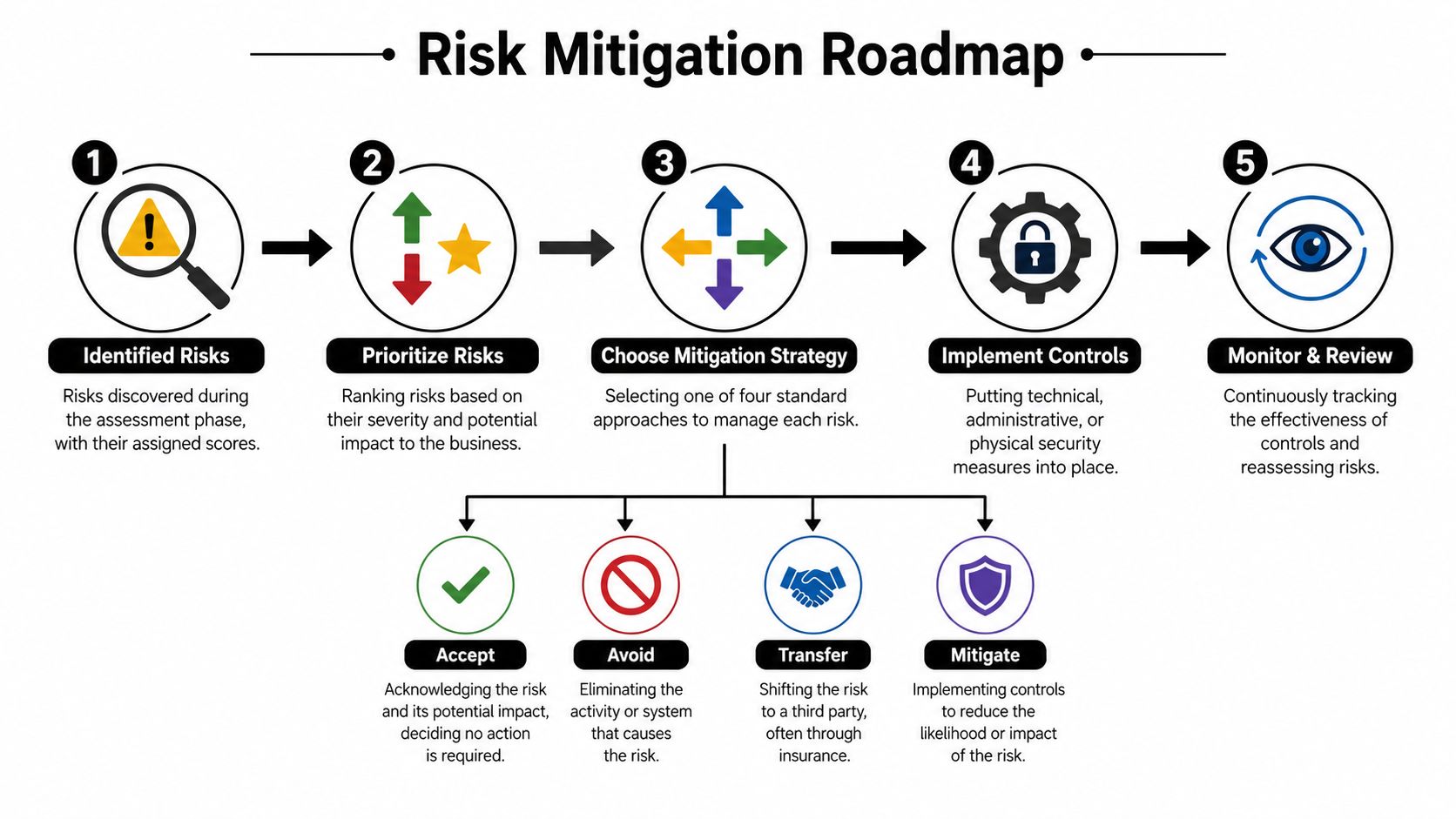
The standard treatment choices are simple. Every identified risk should be assigned one of four actions: accept, avoid, transfer, or mitigate. That decision should be documented with an owner, a target date, and a clear success measure.
This roadmap is the difference between analysis and execution:
Choose one of four actions for every risk
The four choices aren't complicated, but they should be used deliberately.
- Accept: Use this when the risk is low, the business impact is limited, and the cost of fixing it outweighs the benefit.
- Avoid: Stop the activity creating the risk. If a process is unnecessary and dangerous, remove it.
- Transfer: Shift part of the financial burden through contracts or insurance.
- Mitigate: Add controls to reduce likelihood, reduce impact, or both.
A common mistake is defaulting to mitigation for everything. That wastes budget and burns out teams. Some risks should be accepted. Some should be avoided entirely. Some belong in policy, contracts, or cyber insurance discussions.
A stronger treatment plan usually includes:
| Risk item | Chosen action | Owner | Success measure |
|---|---|---|---|
| Shared admin credentials | Mitigate | IT lead | Unique named admin access in place |
| Unnecessary legacy remote access | Avoid | Operations manager | Legacy access retired |
| Limited ransomware financial coverage | Transfer | Executive leadership | Coverage reviewed and updated |
| Low-value isolated workstation issue | Accept | Department head | Reviewed and documented |
Turn scores into budget decisions
Many templates fall apart because they identify technical issues but don't help leadership justify spending. Only 8% of available risk assessment templates include a formula to calculate per-year financial exposure. This leaves SMBs unable to justify security budgets to stakeholders who demand ROI, and the gap becomes more serious as 68% of cyber insurers now require quantitative risk data, according to this review of how to perform a cybersecurity risk assessment.
That gap matters. A business owner doesn't just want to know that a risk is “high.” Leadership wants to know whether a proposed control protects cash flow, reduces downtime, supports insurance eligibility, or lowers audit pressure.
This is why the roadmap should include business language next to technical language:
- Operational value: Does the fix protect scheduling, billing, reporting, casework, or project delivery?
- Compliance value: Does it strengthen audit readiness or required documentation?
- Insurance value: Does it support underwriting expectations?
- Financial value: Does it reduce the likely business cost of disruption?
Some incidents also require parallel fact-finding beyond standard IT work, especially when insider misuse, fraud, or policy circumvention is suspected. In those cases, organizations may need support such as corporate private detectives to help clarify what happened and support internal decision-making.
For businesses formalizing next steps, a structured risk mitigation strategy should tie each high-priority item to a deadline, owner, and follow-up review. If the template can't answer “who's fixing this and by when,” it isn't finished.
Building Long-Term Resilience with Technovation
A cybersecurity risk assessment template should never become a one-time compliance artifact. Businesses change. Staff changes. Vendors change. Workflows change. The threat environment changes right along with them.
That's why the assessment should become a recurring management process. The first version gives leadership a snapshot. The next versions show whether risk is going down, whether controls are working, and whether the business is keeping pace with its obligations.
A risk assessment is a living business tool
For regulated SMBs in DFW, the ongoing value is practical.
A mature assessment process helps a business keep asset inventories current, revisit critical workflows, review changes in user access, and update treatment plans when new systems or vendors are introduced. It also simplifies audit preparation because the organization already has structured documentation of risks, controls, residual exposure, and decision owners.
Security maturity isn't built by collecting more documents. It's built by revisiting the right document consistently and acting on it.
That discipline improves resilience without creating unnecessary drama. It gives owners a way to run cybersecurity like the rest of the business. Identify priorities, assign responsibility, track progress, and review results.
Why outside execution usually wins
Most SMBs can start the template internally. Very few maintain it well without help.
The challenge isn't understanding the concept. The challenge is completing the work thoroughly, translating technical findings into operational consequences, assigning realistic treatment plans, and keeping the document aligned with actual business change. That takes time, discipline, and security judgment that busy internal teams rarely have available.
A managed partner provides significant value. The right partner shortens the process, improves the quality of the assessment, and helps the business act on findings instead of shelving them. That means stronger remediation planning, better documentation, clearer accountability, and a security program that keeps moving instead of stalling after the first workshop.
For DFW organizations in healthcare, legal, financial, construction, nonprofit, and general business sectors, that ongoing support is often the difference between “assessment completed” and “risk reduced.”
Technovation LLC helps North Texas businesses turn cybersecurity assessments into real protection. The team supports regulated and security-conscious organizations with practical risk reviews, compliance alignment, remediation planning, 24/7 monitoring, and ongoing IT security management. Businesses that want a faster, clearer, and more actionable path from assessment to resilience can contact Technovation LLC.