
A business owner in Plano can approve a security assessment, receive a polished report, and still have no clear answer to a simple question: what should be fixed first? The report may identify phishing, ransomware, vendor exposure, access weaknesses, and compliance gaps, yet the owner still needs to decide whether the next budget should fund stronger backups, access changes, infrastructure replacement, staff training, or a recovery exercise.
That gap defines the practical challenge of a business risk assessment. Technical findings matter, but they become useful only when they're connected to revenue, downtime, customer obligations, regulatory exposure, and the people required to keep operations moving. For Dallas-Fort Worth small and mid-sized businesses, the most effective process turns a manageable risk register into decisions that leadership, finance, operations, and IT can act on together.
Table of Contents
- Why Most Business Risk Assessments Miss the Mark
- Building Your Asset Inventory and Threat Landscape
- Scoring Risks with Likelihood and Impact
- Aligning Risk Findings with Business Objectives
- Implementing Controls and Continuous Monitoring
- Common Pitfalls That Undermine Your Assessment
Why Most Business Risk Assessments Miss the Mark
A 40-person accounting firm in Plano spends $15,000 on a national consultancy's assessment. The firm receives a 90-page PDF filled with advanced persistent threats, supply-chain vulnerabilities, and other enterprise-level language. What it doesn't receive is a clear comparison between an aging file server, unencrypted backup drives, an exposed remote-access pathway, and a critical vendor dependency.
That result is common because the assessment answers, “What risks exist in general?” instead of, “Which risk could interrupt this firm's work, expose client information, or create an unacceptable recovery burden?” A long inventory can look thorough while leaving the owner without a sequence, owner, budget rationale, or deadline.
Generic templates hide business context
Generic inventories often treat every organization as though its critical assets, operating model, and tolerance for disruption are interchangeable. They aren't. A dental practice depends on patient records, imaging, scheduling, and clinical availability. A law firm depends on matter files, deadlines, confidentiality, and defensible access history. A contractor may depend on project documents, field connectivity, payroll, and a small number of people who understand specialized systems.
The historical development of risk management helps explain this problem. The discipline grew from a narrow insurance-focused function into broader enterprise oversight. The first major risk management textbook was published in 1963, and the modern enterprise risk management model accelerated after major corporate failures in the early 2000s. COSO's 2004 Enterprise Risk Management, Integrated Framework helped establish that risk assessment belongs with strategy, internal control, and governance, not only insurance or compliance. This history of enterprise risk management shows why a modern assessment must connect technical exposure to management decisions.
Scores without consequences don't prioritize anything
A vulnerability score may identify a serious technical condition, but leadership needs to know what happens if that condition becomes an incident. Does the business lose access to billing? Can staff continue serving clients? Could a missed deadline create liability? Would a vendor outage affect the entire operating schedule?
A credible assessment records the consequence in business language, assigns an accountable owner, and identifies the control that changes the exposure. Without those fields, the report becomes documentation rather than a planning instrument.
One-time reviews become stale
Risk changes when the business adds a cloud service, hires remote workers, changes vendors, opens a facility, or suffers a near miss. ISACA describes a practical assessment cycle that moves from context and risk identification through qualitative and quantitative analysis, response planning, control implementation, and continuous residual-risk monitoring. ISACA's risk assessment guidance reinforces the point that an assessment should remain a living process.
Practical rule: If a risk register doesn't change after a major business or technology change, it isn't monitoring risk. It's preserving an old opinion.
Building Your Asset Inventory and Threat Landscape
Before scoring risk, a business needs a reliable picture of what it owns, uses, depends on, and must protect. The inventory doesn't need to become a massive spreadsheet. A maintained list of 30 well-understood assets is more useful than a 300-item register nobody validates or updates.
Start with business-critical assets
Build the inventory around business functions first, then document the technology supporting each function. For every asset, record its owner, location, data sensitivity, users, dependencies, recovery needs, and current safeguards.
A dental practice might map patient records across practice management software, imaging servers, workstations, and cloud backups. A law firm may need to include matter management, document management, e-discovery providers, email, and the people who administer litigation workflows. A regional financial advisory firm may depend on custodian portals, a customer relationship system, secure document exchange, and a small group of employees who manage client access.
The inventory should include more than equipment:
- Hardware: Servers, laptops, network equipment, phones, imaging devices, and facility systems.
- Software and services: Line-of-business applications, cloud platforms, remote-access services, backup systems, and collaboration tools.
- Data repositories: Patient information, client matters, financial records, employee data, contracts, and operational documents.
- Third parties: Payment processors, hosted applications, e-discovery providers, payroll services, custodians, suppliers, and building-management vendors.
- People and dependencies: Administrators, application specialists, executives with approval authority, and single employees who hold undocumented process knowledge.
A physical access system can belong in this inventory too. For example, a business evaluating a connected entry system can use this GSM gate opener explained resource to understand how a remotely managed physical-control device may create dependencies involving connectivity, credentials, maintenance, and facility access.
Identify threats by category
After listing assets, ask how each asset could become unavailable, exposed, altered, or misused. Use categories to prevent the discussion from narrowing into cybersecurity alone.
- Cyber threats: Ransomware, phishing, credential theft, malicious insiders, accidental disclosure, and unauthorized access.
- Operational threats: Vendor outages, process failure, key-person dependency, unsupported systems, and inadequate recovery procedures.
- Physical threats: Unauthorized facility access, theft, fire, water damage, power interruption, and environmental conditions.
- Regulatory threats: Compliance deadline changes, audit findings, contractual obligations, and incomplete evidence of control operation.
A useful record connects each threat to an asset and a business function. “Phishing” is too broad by itself. “Credential theft affecting the billing manager's cloud account, causing payment delays and unauthorized access to customer records” gives leadership something to evaluate.
| Asset | Industry Example | Threat Category | Initial Risk Flag |
|---|---|---|---|
| Patient record system | Dental practice management platform | Cyber and operational | High attention |
| Matter document repository | Law firm document management system | Cyber, regulatory, and legal | High attention |
| Client portfolio access | Financial advisory custodian portal | Cyber and third-party | High attention |
| Remote entry controller | Office or warehouse access system | Physical and operational | Monitor dependencies |
| Backup repository | Encrypted cloud or local backup storage | Cyber and operational | Validate recoverability |
For a ready starting structure, the Technovation cybersecurity risk assessment template can help organize critical functions, sensitive assets, and likelihood multiplied by impact without forcing a business into an oversized governance program.
Scoring Risks with Likelihood and Impact
A risk list without scoring is a brainstorm. Scoring creates a common language for deciding which exposures deserve immediate funding, which require monitoring, and which can be accepted with documented approval.
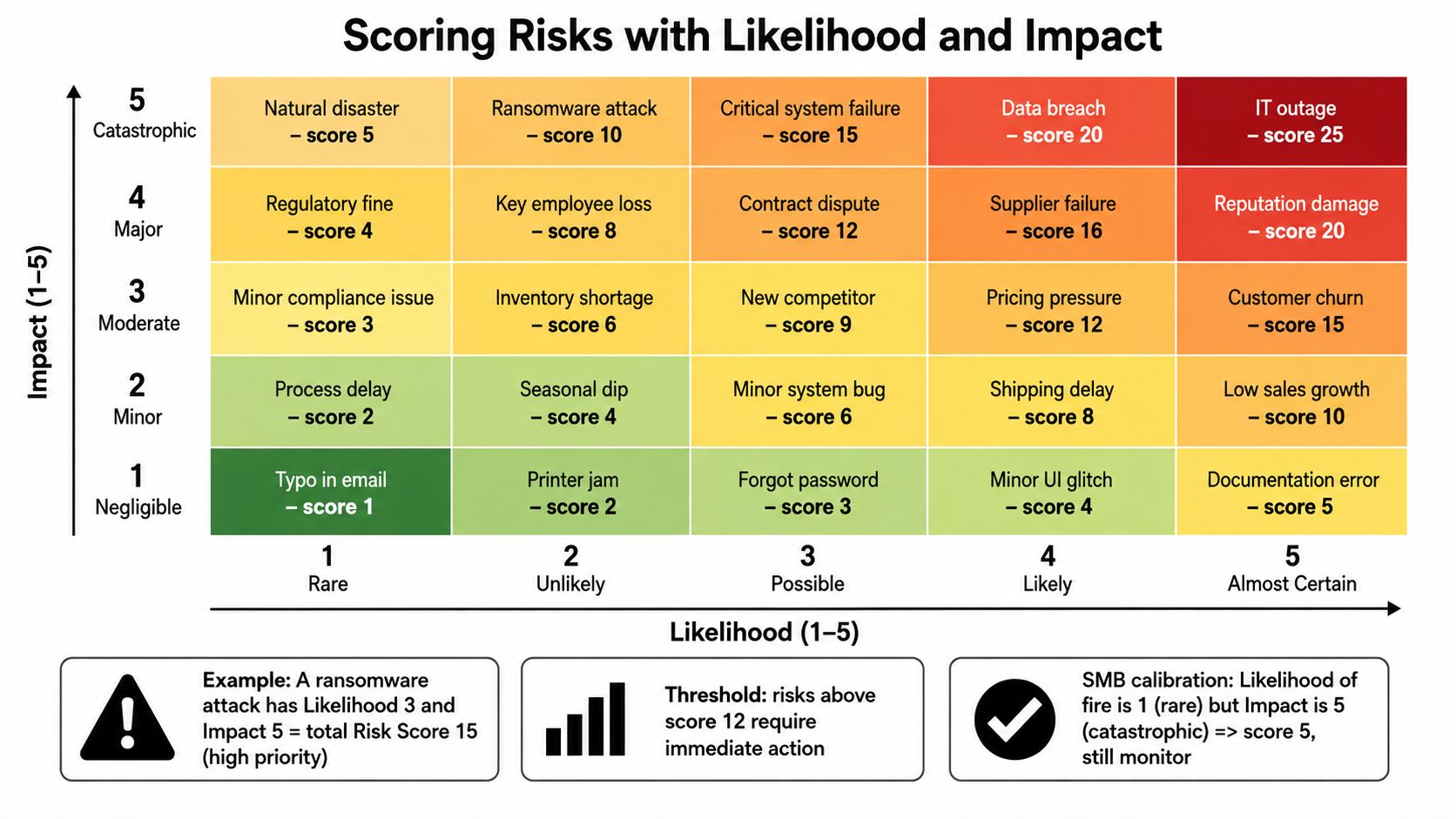
A practical SMB model uses five likelihood levels and five impact levels. Likelihood reflects how plausible the event is for the business, based on observed conditions, industry experience, current exposure, and available threat information. Impact reflects the business consequence, not merely the technical severity of the underlying weakness.
Define the two axes before rating risks
Use plain labels that managers can understand:
- Likelihood: Rare, Unlikely, Possible, Likely, and Almost Certain.
- Impact: Negligible, Minor, Moderate, Major, and Catastrophic.
The scoring rule is simple: likelihood multiplied by impact equals risk score. An ISO 31000-style pack provides a five-point model and illustrates a 12 out of 25 result when likelihood is 3 and impact is 4. This ISO 31000 risk assessment pack offers a repeatable foundation, but each business should define what “major” means in its own operating terms.
For a manufacturing company, a ransomware event might be Possible, rated 3, because the organization has meaningful exposure but no confirmed incident history. If production systems, order processing, and customer commitments would be seriously disrupted, impact might be Catastrophic, rated 5. The resulting score is 15, which belongs above a mitigation threshold. A physical security concern with Rare likelihood and Catastrophic impact would score 5, so it shouldn't be ignored, but it may belong in a monitored treatment plan rather than the immediate action queue.
Calibrate the numbers to decisions
The matrix matters less than the reasoning behind each rating. Define evidence for every level, document assumptions, and require business leadership to challenge scores that appear convenient. An isolated technical asset may have a severe vulnerability but limited business impact, while a moderately exposed production system may deserve faster treatment because it supports critical operations.
A practical RPN guide for engineers can help teams understand prioritization mechanics without confusing a technical ranking with a complete business decision. For cyber findings, the vulnerability scanning guidance from Technovation provides useful context for distinguishing discovery from prioritization and remediation.
Consistency matters more than false precision. If the finance leader, operations manager, and IT provider apply the same definitions and record why a risk received its score, the matrix can support a defensible budget conversation.
Aligning Risk Findings with Business Objectives
A risk matrix earns its place in a leadership meeting only when every important row connects to something the business is trying to protect. Revenue, customer trust, delivery commitments, regulatory standing, employee safety, and operational continuity should appear beside technical descriptions.
Consider a patient portal vulnerability at a dental practice. The technical finding may involve weak authentication or an outdated component. The business interpretation includes unauthorized access to patient information, notification obligations, interruption to scheduling, and loss of patient confidence. Those consequences may justify stronger authentication and access review even if the vulnerability doesn't carry the highest technical severity.
A law firm's document management exposure presents a different chain. Unauthorized access could affect confidentiality, matter strategy, client obligations, and malpractice exposure. The assessment should therefore identify the responsible partner or operations leader, not leave the decision entirely with the infrastructure team.
Use compliance frameworks as control maps
Compliance frameworks can strengthen the assessment when they support business priorities. They shouldn't become a substitute for understanding operations. NIST Cybersecurity Framework 2.0 is positioned as a practical approach based on existing standards, guidelines, and practices, and NIST provides a small-business quick-start guide for organizations that need an accessible starting point. NIST's CSF 2.0 small-business guidance can help connect governance, identification, protection, detection, response, and recovery activities to identified risks.
ISO 22301 adds a continuity perspective. Clause 8.2 requires organizations to identify disruption risks affecting prioritized activities and supporting resources, analyze and evaluate those risks, and determine which ones need treatment. The ISO 22301 Clause 8.2 explanation is particularly useful for separating the source of disruption from the recovery plan.
| Identified Risk | Business Objective Impacted | Compliance Mapping | Priority Score |
|---|---|---|---|
| Weak remote access authentication | Protect customer information and maintain service availability | NIST CSF Govern and Protect | Set by approved matrix |
| Backup failure during an outage | Restore critical operations | ISO 22301 continuity and recovery | Set by recovery impact |
| Vendor access to confidential files | Preserve client trust and contractual obligations | NIST supply-chain governance | Set by data sensitivity |
| Missing access review evidence | Maintain audit readiness | Applicable security and privacy controls | Set by exposure and consequence |
A single control can address multiple objectives. Multi-factor authentication may reduce credential misuse, support access governance, strengthen customer-data protection, and provide evidence for a compliance review. That benefit matters when an SMB has a limited security budget. A documented cybersecurity risk management process from Technovation can help translate those connections into prioritized remediation work.
Implementing Controls and Continuous Monitoring
Prioritization creates a queue. It doesn't reduce risk until someone implements, tests, and maintains the selected controls. The treatment plan should distinguish immediate exposure reduction from projects that require planning, staff time, vendor coordination, or operational downtime.
Sequence work by risk tier
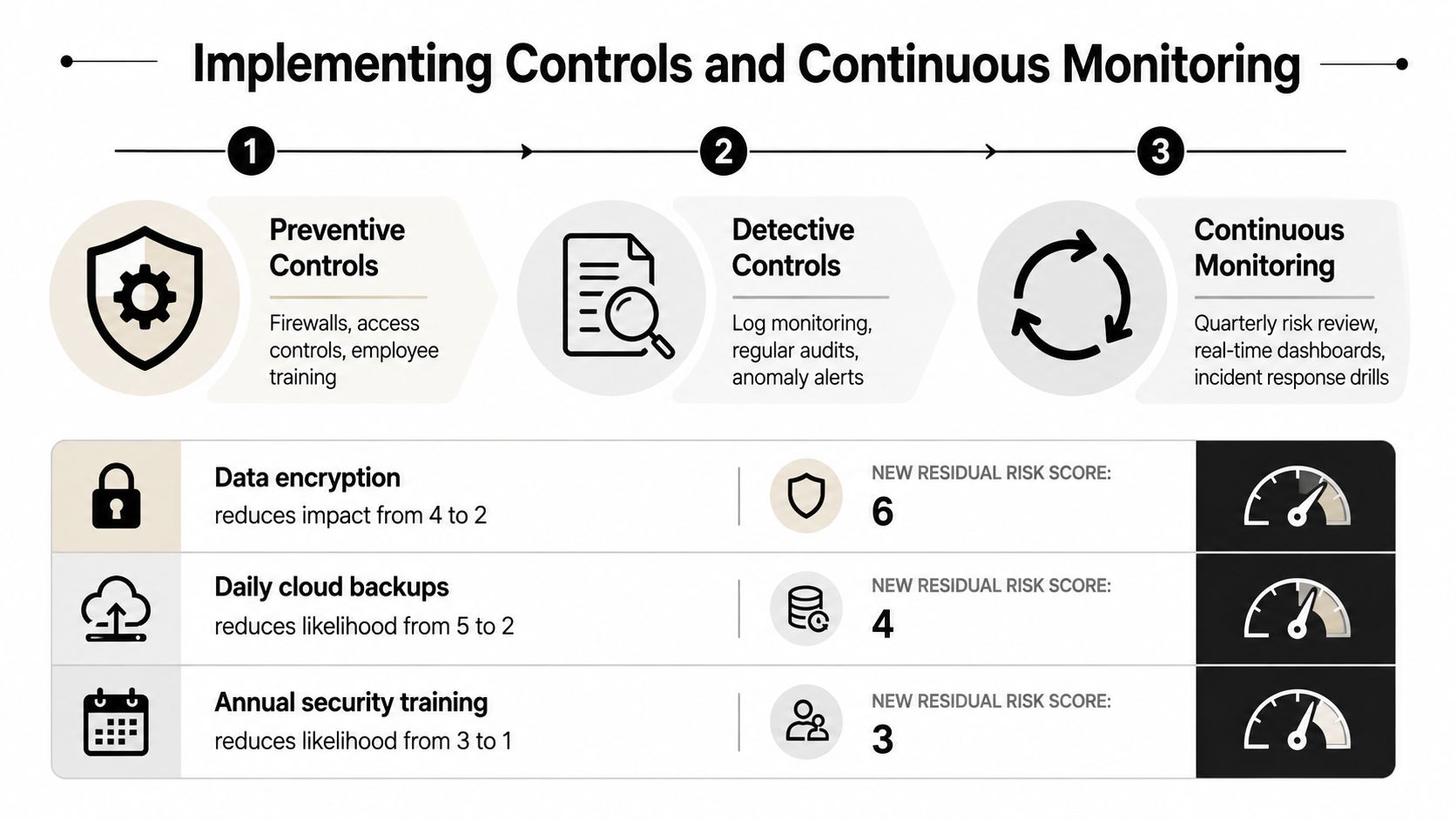
Critical risks need containment and verification first. That may mean removing exposed remote access, disabling unused accounts, applying urgent patches, confirming backup isolation, or restricting an overprivileged integration. High risks can become short-term projects involving network segmentation, stronger endpoint detection, improved identity controls, or recovery testing. Moderate risks may fit into longer-term awareness programs, vendor reviews, documentation improvements, and process redesign.
A workable 90-day sequence can look like this:
- Days 1 through 30: Confirm the asset inventory, validate the highest-ranked findings, close exposed access paths, review privileged accounts, and verify that backups can be restored.
- Days 31 through 60: Deploy or improve segmentation, endpoint monitoring, authentication controls, logging, and remediation workflows. Assign owners and record exceptions.
- Days 61 through 90: Test incident procedures, review vendor dependencies, update business-impact assumptions, and present residual risk to leadership for acceptance or further treatment.
Monitor control performance, not activity
Cadence should match volatility and consequence. Daily review may suit security alerts and critical logs. Weekly vulnerability scanning can identify newly exposed systems. Monthly access audits can catch stale privileges. Quarterly risk reassessments can align the register with business planning, technology changes, and operational performance.
The important measure is residual risk. A closed ticket isn't proof that the business is safer. The team should confirm that the control changed likelihood, impact, exposure, recovery capability, or monitoring confidence.
SMBs often need outside support for continuous monitoring because they don't have dedicated security staff covering every shift. A managed provider can supply alert monitoring, detection and response coordination, control evidence, and compliance reporting while internal leaders retain ownership of business decisions. The right arrangement may be fully managed or co-managed, depending on existing staff and operational requirements.
Common Pitfalls That Undermine Your Assessment
A risk register can look complete while leaving the owner exposed. The usual failure is not the scoring formula. It is a decision process that avoids trade-offs. A technical team may reduce a rating because remediation is inconvenient. Leadership may accept a risk without naming the person accountable for that decision. Operations may be left out, even though its staff know which outage would stop shipping, payroll, customer service, or production.
Five failure patterns
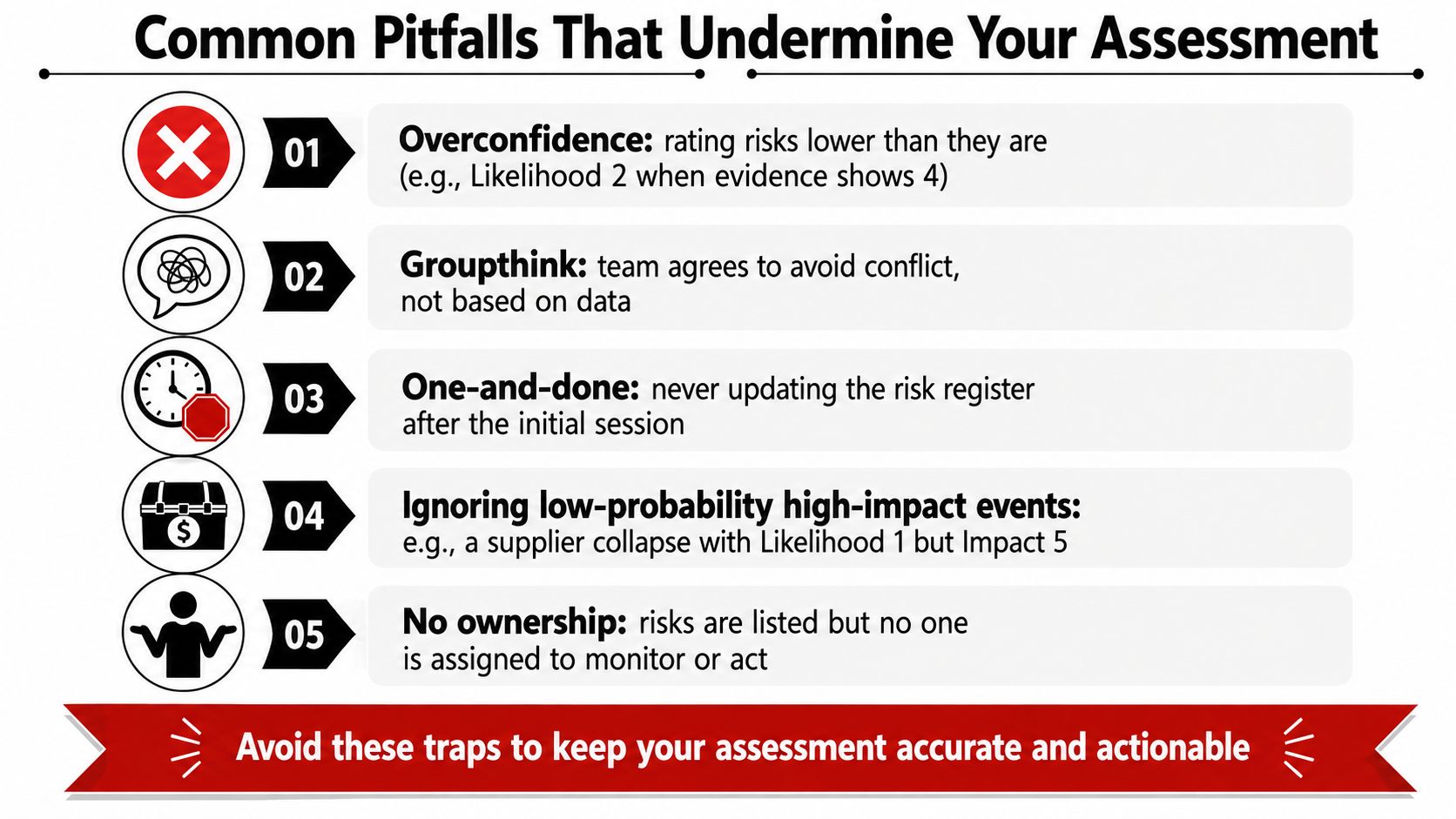
One-and-done reviews create registers that become stale. A new supplier, facility, application, or remote-work process can change exposure before the next scheduled assessment. Add risk review to quarterly business planning, and trigger an off-cycle review after a major incident, near miss, or material change.
IT-only scoring leaves financial, legal, customer, and operational consequences out of the discussion. Have finance, operations, compliance, and business leadership validate impact ratings. Technical staff should describe the condition and likely failure mode. Business owners should decide what the consequence means in lost capacity, delayed revenue, contractual exposure, or recovery effort.
Cybersecurity tunnel vision leaves physical disruption, supplier dependency, continuity gaps, and key-person risk unexamined. Review the asset inventory by category, then ask what could interrupt each critical activity without an attacker. A failed building system, unavailable supplier, or absent specialist can deserve the same attention as a security alert.
Unowned remediation turns an action plan into a wish list. Every material risk needs a named owner, target action, review date, and acceptance authority. Risk acceptance should be explicit, time-bound, and approved by someone with authority to accept the business consequence. If an incident occurs before treatment is complete, the response path should already be clear. Document that path in an incident management process.
Reports disconnected from budgets create paperwork without change. Tie each high-priority risk to a proposed control, its operational trade-off, and the business objective it protects. A decision-maker can then compare the cost of treatment with downtime, lost sales, legal exposure, or reduced service capacity.
External risk requires the same discipline. A 2025 Marsh survey found that fewer than 50% of companies assess systemic climate risks affecting infrastructure and supply chains, while over 20% don't evaluate future climate impacts at all. The Marsh survey coverage shows why an internal-only inventory can miss exposure moving through suppliers, facilities, transportation, and regional dependencies.
Cyber prioritization has a similar business-context gap. In a 2025 cyber-risk survey, only 30% of organizations said risk management is prioritized based on business objectives, and 19% still relied on single-method scoring such as CVSS alone. The survey discussion of business-aligned cyber risk supports a practical rule: technical severity informs the decision, while asset criticality, operational dependency, and business impact determine its priority.
A usable assessment should answer four questions without forcing leadership to search through a long report:
- Visibility: Are critical assets, vendors, data stores, and dependencies documented?
- Prioritization: Can leadership explain why the highest risks come first?
- Ownership: Does every treatment action have an accountable person?
- Evidence: Can the business show that controls operate and residual risk is reviewed?
The scope must extend beyond internal technology. Coface's Global Risk Dashboard includes 160 country assessments, reflecting how market, financial, political, customer-credit, and internal-control factors can intersect. A 2025 business-risk summary reported that nearly 75% of enterprises experienced at least one critical risk event in the prior year, with cyberattacks and IT failures accounting for most critical events globally. The same summary reported that organizations without board-level ERM visibility were 20% more likely to experience six or more critical events, and 37% of enterprise risk managers identified information security or cyber risk as a primary concern. Coface's global business risk dashboard provides market context for treating risk as an ongoing management responsibility rather than an annual compliance exercise.
Technovation LLC helps Dallas-Fort Worth businesses turn technical findings into a prioritized risk register, practical remediation plan, monitoring process, and compliance-ready evidence. Visit Technovation LLC to request a security audit or IT health check that connects cybersecurity, continuity, and business objectives to the decisions the organization needs to make next.