
Is a quiet network secure, or is nobody looking closely enough to notice what's happening? For many Dallas–Fort Worth business owners, “nothing has gone wrong” means the systems must be safe. That assumption is expensive. A network can run normally while stolen credentials, unauthorized access, and suspicious data movement remain hidden from employees and leadership.
Network security monitoring replaces that assumption with evidence. It combines network traffic, logs, endpoint signals, and security alerts so a business can identify unusual behavior, investigate context, and respond before a small anomaly becomes a serious operational problem. The goal isn't to create a mountain of alerts. The goal is to prove that the business can see the threats that matter.
Table of Contents
- Why Absence of Problems Does Not Mean You Are Safe
- Core Components of Network Security Monitoring
- Detection Versus Visibility in Modern Networks
- Deployment Patterns for Small and Mid-Sized Businesses
- Key Performance Indicators That Matter
- When to Outsource Network Security Monitoring
- Your Next Steps to Better Network Visibility
Why Absence of Problems Does Not Mean You Are Safe
Could your network be compromised while every system appears to work normally? For many Dallas–Fort Worth business owners, no outage, ransomware message, or customer complaint feels like proof of security. It is only proof that no visible disruption has surfaced.
Attackers often keep their activity ordinary. A stolen credential can look like a legitimate login. Slow data theft can blend into routine cloud traffic. Unauthorized access may use a valid account and leave performance unchanged. That creates a dangerous gap between business continuity and security visibility, especially when employees work across office networks, remote connections, and cloud services.
Practical rule: A lack of complaints is an operations signal, not a security verdict.
Network security monitoring closes that gap with continuous evidence. It can show which systems communicate, which accounts authenticate, which destinations receive traffic, and whether activity differs from an established baseline. That record lets an analyst decide whether an event deserves investigation instead of treating a quiet dashboard as proof of coverage.
The historical record matters
Retention determines how far back an investigation can reach. A widely cited industry survey found that 71% of organizations keep network security monitoring data online for 60 days or more, while 10% retain it for more than a year (Cisco's industry survey). Those retention windows matter when an incident develops slowly or an isolated event becomes meaningful only after related activity appears.
Short retention can erase the trail needed to reconstruct lateral movement, identify the first compromised account, or connect delayed data transfer to an earlier intrusion. A monitoring program must preserve enough historical telemetry for investigations, compliance work, and informed decisions. Collecting alerts without retaining the supporting evidence leaves the business unable to prove what happened.
Monitoring changes the question
Without monitoring, leadership asks, “Have we had a breach?” Incomplete visibility makes that question difficult to answer. A better question is, “Which assets are covered, which behaviors are being evaluated, and who investigates the results?”
That shift tests whether defensive controls work in the actual environment. It also exposes false confidence created by unmonitored cloud services, remote access paths, or network segments that produce no alerts because they produce no telemetry.
vulnerability scanning remains useful for identifying weaknesses before attackers exploit them, but it does not replace continuous observation of activity. A DFW business needs both: knowledge of what could be exploited and evidence of what is happening now. The objective is clear coverage with fewer irrelevant alerts, not a larger alert queue.
Core Components of Network Security Monitoring
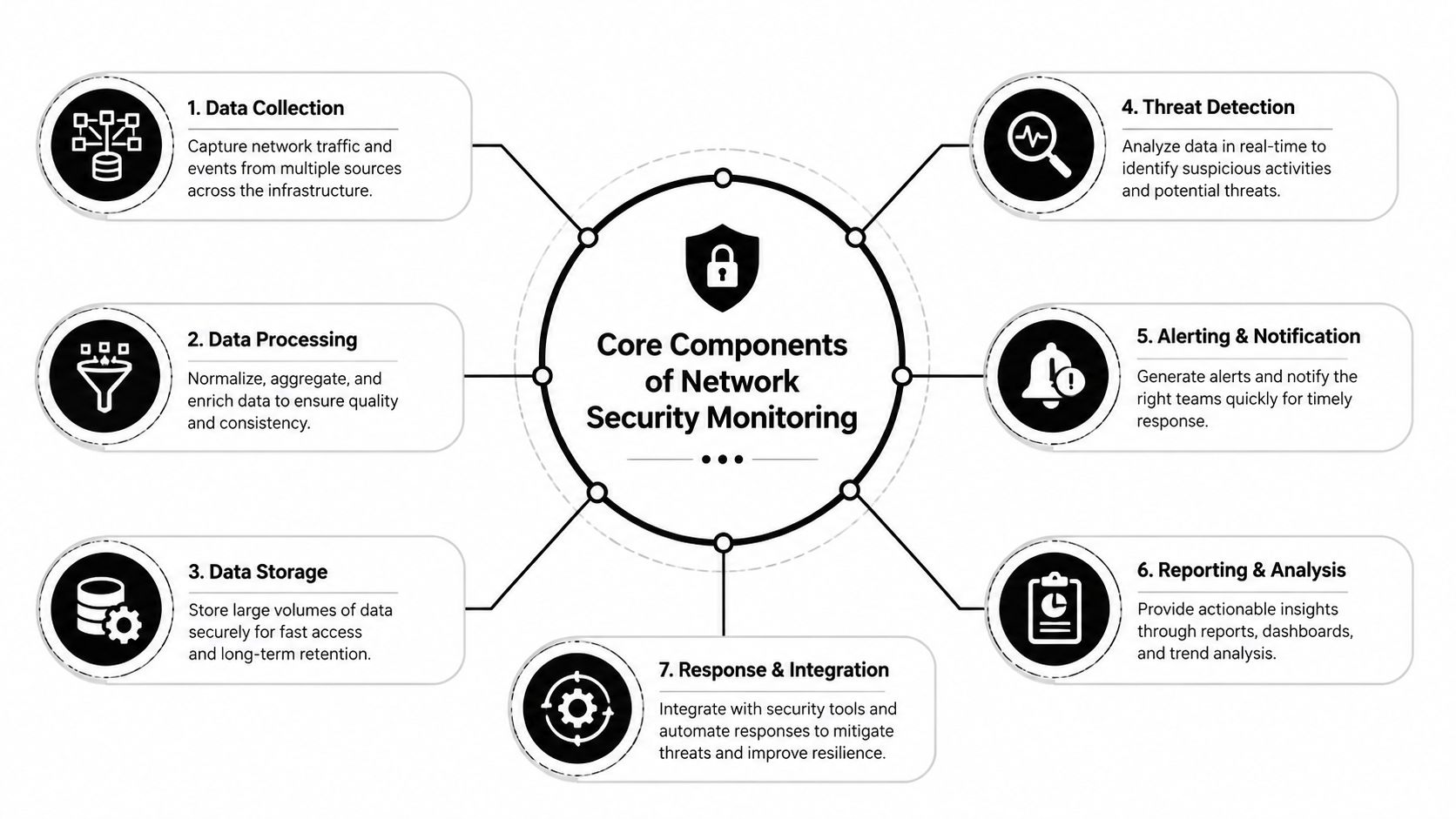
What does your monitoring program prove? A useful stack does more than collect alerts. It shows which assets generate telemetry, connects related activity, and gives an analyst enough evidence to decide what requires action. Each component answers a different question, and the value comes from joining those answers across on-premises systems, remote access, and cloud services.
Start with collection
Sensors and network taps observe traffic at useful points, including the internet edge, internal segments, remote access paths, and cloud connections. They can provide packet or flow information, but placement matters more than adding another dashboard. A sensor that misses a server segment creates a blind spot that later analysis cannot repair. Document each sensor's coverage, then review whether important systems and data paths appear in the collected telemetry.
Logs provide the surrounding record. Firewalls, identity systems, endpoint agents, servers, applications, and cloud services each capture different parts of an event. Log management brings those records together, protects them from early deletion, and makes them searchable during an investigation. Complexity and cost depend on log volume, retention, and the number of sources. Set collection priorities around critical assets instead of accepting every available feed.
Detect and correlate
Intrusion detection and prevention systems identify suspicious signatures or behavior and generate alerts. Prevention can block or interrupt activity, but an automatic block without context can disrupt legitimate traffic. Define which events require immediate prevention and which require human review. The guide to intrusion detection systems helps leadership separate those functions before approving a deployment.
A SIEM aggregates records, correlates related events, and prioritizes findings. A failed login may be routine. The same login pattern followed by successful authentication, an unusual endpoint action, and an unexpected outbound connection deserves investigation. SIEM work often requires the most operational discipline in an SMB environment because rules need tuning, field mappings must be accurate, and someone must review the resulting cases. Test correlation rules against known activity, then confirm that each case includes the evidence needed for a decision.
Add the endpoint perspective
Endpoint telemetry shows activity on laptops, servers, and workloads. Network data may show that a device contacted an unusual destination. Endpoint records can identify the initiating process, account, or recent system change. Use both views to connect a network event with an actual device and user.
Email and identity events belong in the same investigation path. A suspicious message or account takeover can begin outside the traditional perimeter and produce network activity later. An email spam test can help examine email-related risk, but its findings should feed the wider security process rather than stand alone.
The practical recommendation is to build an integrated system in stages, starting with critical assets and high-value data paths. Track what each source covers, what it misses, and whether alerts include supporting evidence. An IDS without log context, a SIEM without reliable data, or endpoint agents without network visibility leaves activity between tools. Collecting more alerts does not prove coverage. Connected telemetry, documented gaps, and repeatable review do.
Detection Versus Visibility in Modern Networks
Detection answers a narrow question: did a tool identify something that matches a rule, signature, or threshold? Visibility answers the questions that determine business impact: who initiated the activity, what systems were involved, what data moved, whether the behavior spread, and what should happen next.
A firewall may flag and block a suspicious connection. That's detection. Visibility requires the surrounding context, including the originating account or device, related connections, destination reputation, timing, data volume, and evidence of activity elsewhere. An alert can be correct while still being insufficient for response.
A familiar alert problem
Consider a mid-sized logistics company that receives 300 alerts daily but has no reliable way to determine which alerts represent genuine compromise and which are routine noise. The number sounds active, yet the program may be failing. Analysts who spend their day closing repetitive alerts have less time to investigate unusual behavior, validate coverage, or hunt for activity that never triggered a rule.
A smaller alert queue can be healthier when every high-priority event includes usable context. Flow analysis can show communication patterns across systems. Packet evidence can support deeper investigation where available. Endpoint and identity records can connect network activity to a user, process, or workload.
| Threat Scenario | Detection-Only Result | Full Visibility Result |
|---|---|---|
| Unusual login followed by internal connections | An authentication alert is generated | The team correlates the account, device, destinations, timing, and affected systems |
| New outbound connection from a server | A rule flags an unfamiliar destination | Analysts review the process, traffic pattern, data movement, and related hosts |
| Repeated internal connection attempts | A scan alert enters the queue | The team distinguishes an approved scanner from reconnaissance and checks for follow-on access |
| Suspicious cloud activity | A cloud alert is generated separately | Cloud records are correlated with endpoint and on-premises network activity |
The perimeter no longer tells the whole story
DFW businesses increasingly rely on cloud applications, remote workers, hosted infrastructure, and distributed offices. Traditional perimeter detection can't see every relevant event when users authenticate directly to cloud services or workloads communicate inside a cloud environment.
The answer isn't to collect every possible event without a plan. It's to correlate the sources that matter. On-premises traffic, cloud logs, identity records, endpoint telemetry, and firewall events should support a shared investigation process. More alerts without deeper visibility exhausts IT teams while leaving meaningful activity buried in noise.
Deployment Patterns for Small and Mid-Sized Businesses
SMBs should choose a monitoring pattern based on critical assets, remote access, cloud dependence, compliance obligations, internal staffing, and the speed of response the business requires. Start with the coverage your environment needs, then match the design to the team that will maintain it.
Three practical patterns
A smaller organization with fewer than 50 endpoints can often start with an agent-focused design. Endpoint telemetry, selected firewall logs, identity events, and cloud-native alerts feed a managed review process. This limits hardware and deployment work, but it provides less network detail than sensors positioned across internal segments. Document that limitation before relying on the design.
A mid-sized organization with 50 to 250 endpoints and a hybrid environment needs visibility across both local and cloud systems. Place network sensors at important chokepoints, then send cloud and endpoint events into centralized analysis. Assign daily review to an internal analyst or managed team. That owner must tune noisy rules, verify that high-priority systems continue sending usable data, and prove that expected traffic sources remain covered.
Organizations with compliance requirements, distributed offices, or high-value data may need selective packet capture at defined boundaries, endpoint detection agents, centralized correlation, and automated response workflows. Full capture creates storage, access-control, and investigation demands, so apply it where the evidence value justifies the operating cost. Focused depth at high-risk locations usually produces better coverage than recording everything everywhere.
| Pattern | Best For | Key Components | Typical Monthly Cost | Staffing Required |
|---|---|---|---|---|
| Lightweight endpoint approach | Smaller offices with limited infrastructure | Endpoint agents, firewall logs, essential identity and cloud events | Depends on endpoint count, retention, and service scope | Internal owner with managed review support |
| Hybrid visibility approach | Mid-sized firms with on-premises and cloud systems | Network sensors, cloud log aggregation, endpoint telemetry, centralized analysis | Depends on data volume, sensor placement, and analyst coverage | Daily analyst review, internal escalation contact |
| Full coverage approach | Regulated organizations and distributed environments | Selective packet capture, endpoint agents, centralized SIEM, correlation and response rules | Depends on retention, compliance evidence, and response requirements | Security operations ownership with documented escalation |
The table avoids false precision. A provider that quotes a monthly figure before reviewing asset count, data volume, retention, and response expectations is guessing. A practical managed IT security services assessment should connect the architecture to actual exposure, staffing, and response ownership rather than placing the business into a fixed bundle.
Choose coverage before convenience
Ask one question first: “Which assets and data paths must never become invisible?” The answer commonly includes identity systems, financial systems, clinical or legal data, backup infrastructure, remote access, and externally reachable services. Extend monitoring from those priorities into the surrounding traffic and dependencies.
A lean deployment can work when its limits are written down, tested, and reviewed. An expensive deployment can fail when nobody validates data feeds, checks blind spots, or acts on findings. The design should prove what it sees, what it misses, who reviews the evidence, and how the business responds. Operational ownership determines whether collected alerts become dependable monitoring coverage.
Key Performance Indicators That Matter
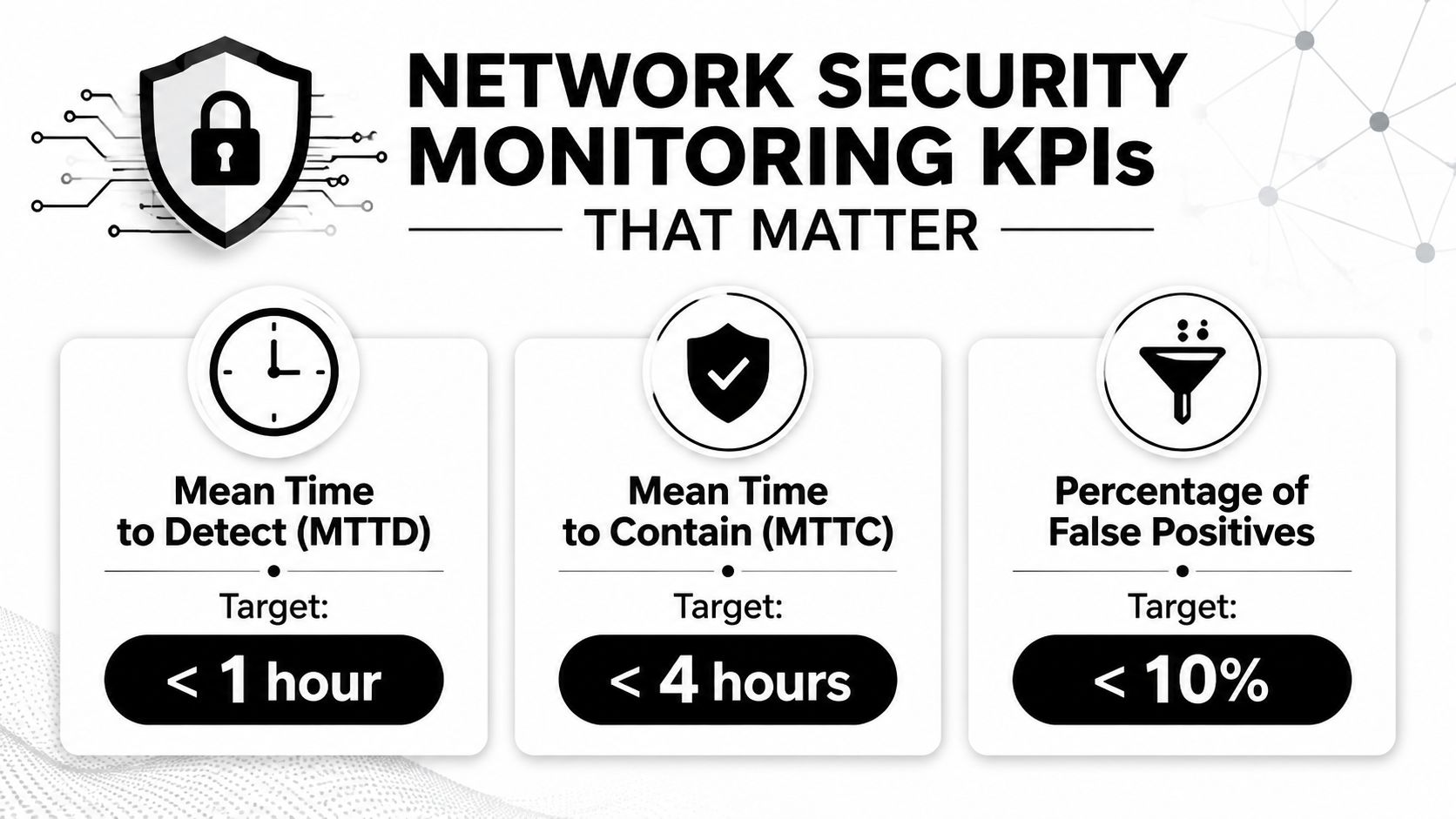
Meaningful KPIs connect monitoring activity to risk reduction. Alert volume alone says little about security maturity. A team can receive a steady stream of notifications while missing important systems, leaving rules untested, or taking too long to contain a confirmed incident. For a DFW business, the stronger question is whether monitoring proves visibility across on-premises, cloud, remote access, and hybrid dependencies without burying analysts in false positives.
Mean Time to Detect measures the time between suspicious activity entering the environment and a team identifying it as a genuine threat. Mean Time to Respond measures the time between recognition and containment. Alert-to-Incident Ratio shows whether rules produce actionable cases or mostly noise. Coverage shows whether critical assets send usable telemetry.
Measure the operating loop
NIST SP 800-137 describes continuous monitoring as a program with defined metrics, assessment frequencies, and a closed loop of analyze, report, respond, review, and update (NIST continuous monitoring guidance). That framework turns monitoring from passive collection into a management discipline.
Establish a baseline for each KPI, then review changes over time. The dashboard is only useful when it supports decisions. The operating goal is a faster, more reliable path from event to investigation, containment, and documented follow-up.
Build a defensible coverage measure
Calculate coverage against a defined inventory, rather than counting devices that happen to appear in a portal. A critical asset is covered only when relevant telemetry arrives, required fields are populated, retention supports investigation, and someone owns the response.
A useful review asks:
- Asset coverage: Are critical servers, endpoints, identities, cloud workloads, and remote access paths represented?
- Data completeness: Do events include timestamps, asset identity, user context, and action details?
- Rule quality: Does each important attack behavior have an active rule or review process?
- Operational response: Does every high-priority alert have a named owner and escalation path?
- Testing: Can the team safely confirm that alerts fire and cases move through response?
CardinalOps reporting summarized in a 2025 report says enterprise SIEMs miss 79% of MITRE ATT&CK techniques, 12% of SIEM rules never fire because of misconfigurations or missing fields, and coverage is weaker in areas including Linux and Mac systems, cloud, email, productivity services, and containers (the 2025 CardinalOps report summary). Collecting data does not prove coverage. Test the rules, fields, and assets that support the business's real threat model, then record the gaps and assign ownership.
When to Outsource Network Security Monitoring
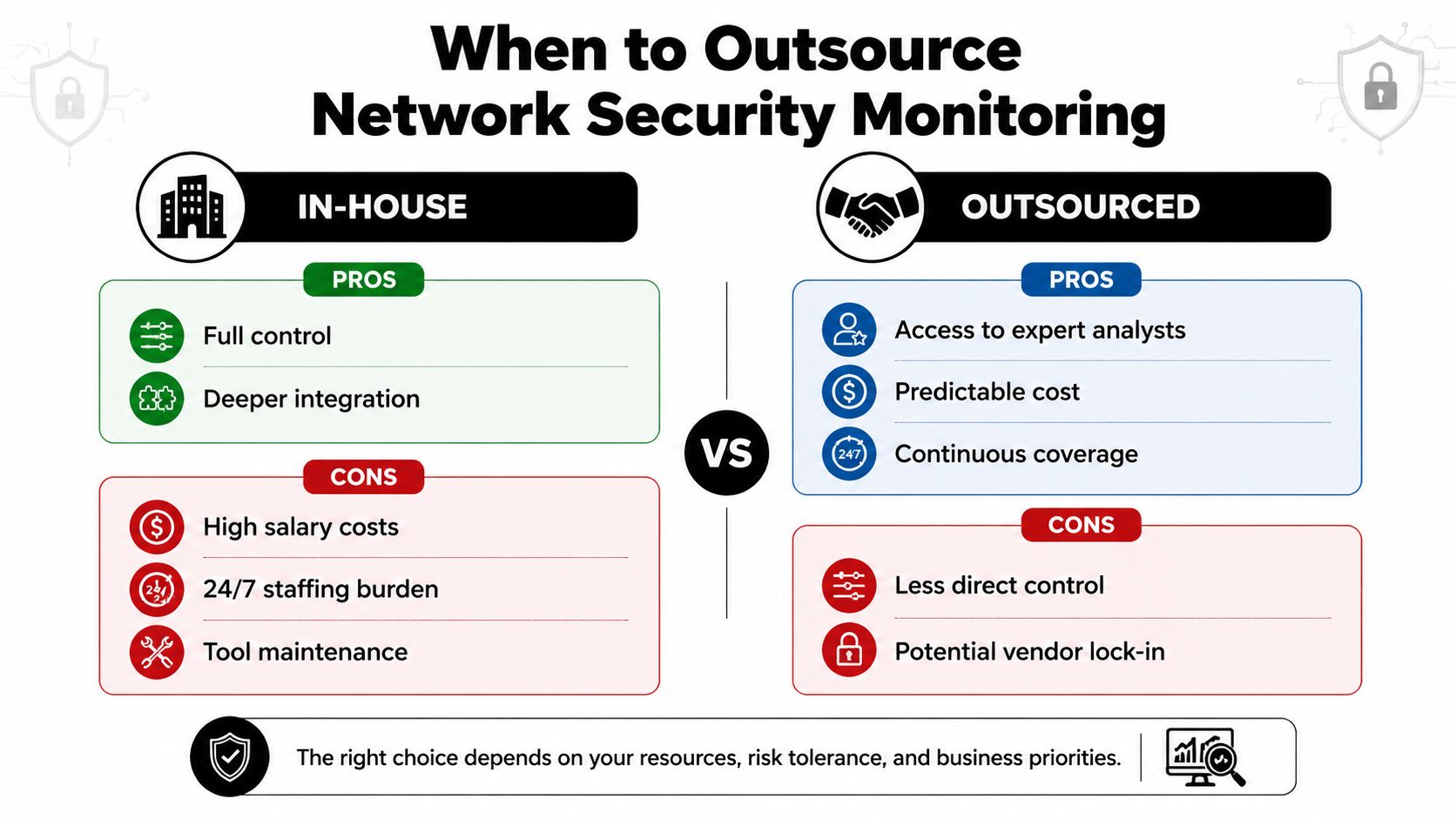
Is your team collecting alerts without proving that someone reviews them? Outsourcing makes sense when the business needs after-hours review, faces compliance expectations, spans cloud and on-premises systems, or experienced an incident that exposed response gaps. It also fits leadership teams that want a named security process without hiring and managing every specialist internally.
In-house monitoring requires analysts, tooling, rule maintenance, investigation procedures, and dependable coverage outside normal business hours. A small IT team may manage infrastructure well while lacking the capacity to investigate security events consistently. The practical test is simple: can your staff maintain visibility across hybrid and cloud environments while separating useful findings from false positives?
What a useful provider does
A managed provider should do more than forward alerts. The service should define asset scope, normalize incoming data, tune detection rules, investigate suspicious events, document decisions, and escalate confirmed issues according to agreed procedures. Ask for evidence of those activities, not just access to a dashboard.
A 2025 SANS survey identifies cloud detection difficulty, limited cloud security expertise, multicloud complexity, and false positives as significant operational barriers (the SANS 2025 detection and response survey). For DFW businesses, the provider needs practical hybrid-visibility experience and a clear process for proving which systems and data receive meaningful review.
Questions to put in the agreement
A service level agreement should answer these operational questions in plain language:
- Response timing: How quickly does a person review and acknowledge a priority event?
- Escalation: Who contacts the business, through which channels, and under what conditions?
- Retention: How long are logs and network records available for investigation?
- Coverage: Which assets, cloud services, identities, and endpoints are included?
- Threat hunting: Is proactive hunting included, or billed separately?
- Rule tuning: Who removes false positives and validates changes?
- Incident support: Does the provider help contain and investigate, or only notify the client?
Reject a provider that sells portal access without explaining who investigates alerts. Treat universal-coverage promises with the same caution when the proposal ignores asset inventory, cloud architecture, retention, compliance, or business-critical workflows.
Businesses evaluating managed detection and response should judge the service by documented decisions, completed actions, and demonstrated coverage, rather than by notification volume.
Your Next Steps to Better Network Visibility
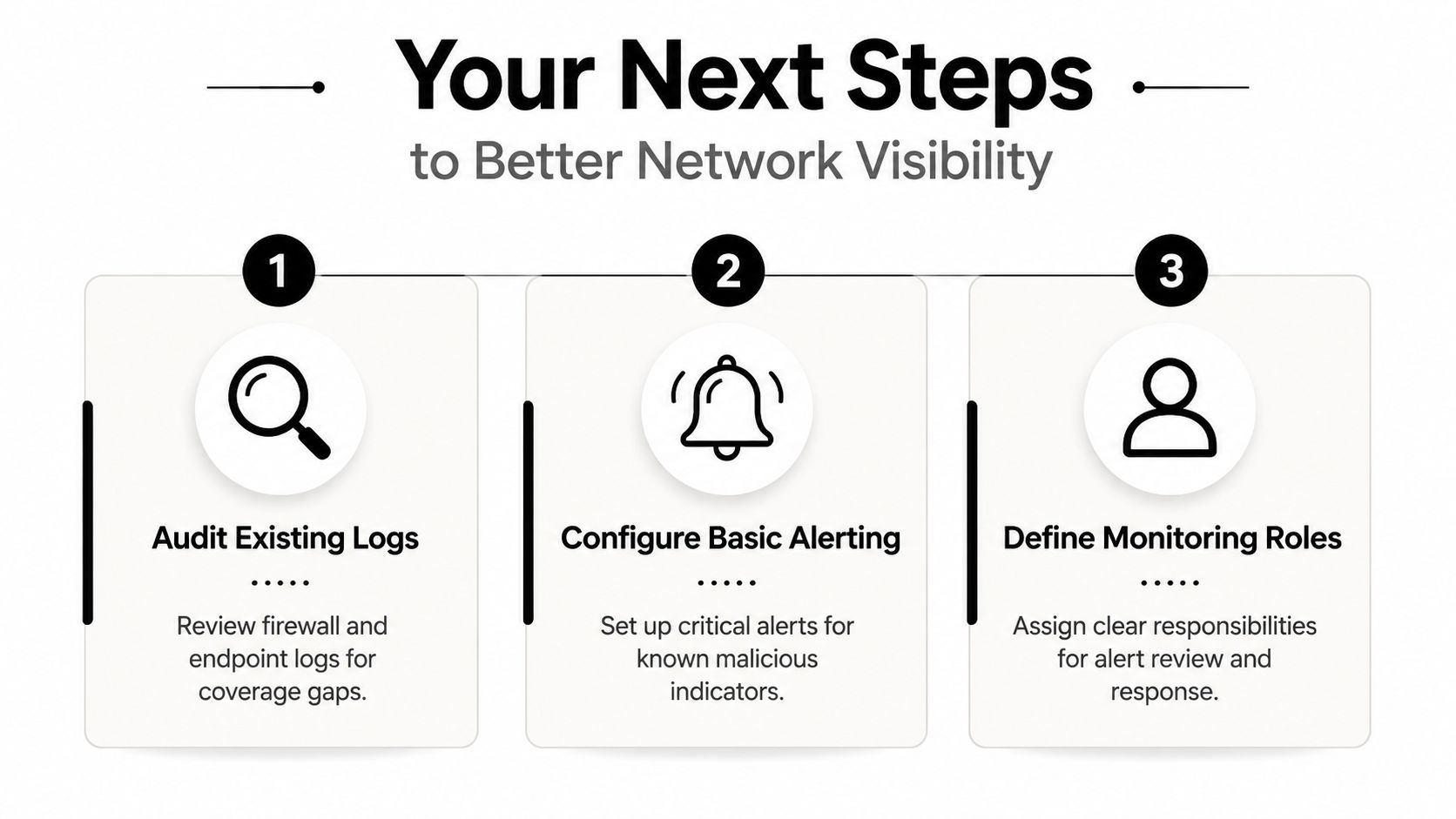
How can a DFW business prove that monitoring covers the systems that matter, instead of collecting alerts no one reviews? Start by identifying existing telemetry, assigning ownership, and closing the gaps that leave hybrid and cloud environments unseen. The goal is usable visibility with fewer false positives, not a larger alert queue.
Complete the first review
Begin with checks that expose coverage quickly:
- Audit existing logs: Confirm that firewall, endpoint, identity, cloud, backup, and remote access logs are enabled, arriving, searchable, and assigned to a reviewer. An alert has little value if nobody can verify its source or act on it.
- Map critical assets: List systems containing sensitive information, supporting revenue, or controlling access. Mark assets with missing telemetry, unclear ownership, or no documented review path.
- Establish normal patterns: Record expected administrative access, common cloud connections, remote work behavior, backup traffic, and vendor activity. These baselines help analysts distinguish unusual behavior from routine noise.
NIST defines information security continuous monitoring as ongoing awareness of security, vulnerabilities, and threats so organizations can make risk-based decisions (NIST information security continuous monitoring guidance). Set the monitoring strategy according to business risk before choosing additional tools. Define what coverage means for each asset, who reviews the data, and what evidence proves the review occurred.
Decide whether to build or partner
An in-house model can work when the organization has available staff, technical depth, clear ownership, and a realistic plan for coverage outside normal working hours. A managed or co-managed model is usually more practical when internal staff already handle infrastructure, the environment includes cloud services and remote users, or regulatory expectations require evidence the business cannot currently produce.
Monitoring frequency should reflect control volatility, risk tolerance, threat and vulnerability information, system impact, and known weaknesses, as described in NIST guidance (NIST monitoring frequency guidance). Review high-risk or frequently changing assets more often than stable, low-impact systems. Confirm that the schedule still applies after cloud, identity, or network changes.
Evaluate proposals carefully
Before signing with an MSP, leadership should ask:
- What is covered: Which assets, logs, cloud services, identities, and network paths are included?
- What happens after an alert: Who investigates, who contacts the client, and what actions can the provider take?
- What are the SLAs: Are response and escalation times written clearly?
- How long is data retained: Can the business investigate older activity when necessary?
- What is threat hunting: Is it included, limited, or billed separately?
- How is coverage tested: Does the provider validate rules, fields, data feeds, and blind spots?
Judge the service by documented decisions, completed actions, and demonstrated coverage, not notification volume. Technovation can help a DFW business audit current visibility, organize monitoring responsibilities, and align managed or co-managed services with its risk and compliance needs.
Technovation LLC provides managed IT and cybersecurity services, including 24/7 monitoring, security audits, compliance support, and ongoing firewall oversight for DFW organizations. Business owners can visit Technovation LLC to discuss a network security monitoring assessment and identify the visibility gaps that deserve attention first.