

Most business owners think security is working because nothing obvious has happened. That’s the wrong test. The actual question is simpler and more uncomfortable. If someone is already probing systems, moving between devices, or using stolen access unnoticed, who would notice first?
A firewall can block a lot. Endpoint tools can catch a lot. Backups can save a bad day. None of that guarantees anyone is watching for suspicious behavior as it unfolds. Silent compromise is what hurts small and mid-sized businesses most, especially those handling regulated data, client files, financial records, or sensitive operational information.
That’s why intrusion detection systems matter. Not as a buzzword. Not as another box in a rack. As visibility. They give a business a way to see activity that would otherwise blend into normal traffic and normal work.
For Dallas-Fort Worth organizations, that visibility becomes even more important when leadership assumes the internal network is mostly safe. It often isn’t. A useful reality check is MSP Pentesting’s internal assessments, which show why internal visibility matters after an attacker, contractor, or compromised account gets past the front door.
Table of Contents
- Is Your Business Security Actually Watching?
- What Are Intrusion Detection Systems
- How an IDS Actually Detects Threats
- Benefits for Compliance and Their Hidden Limits
- Where IDS Fits in Your Modern Security Strategy
- In-House vs Managed IDS The True Cost for an SMB
- An Actionable Checklist for Your Next Step
Is Your Business Security Actually Watching?
A lot of businesses confuse having security tools with having security oversight. Those aren’t the same thing. A company can own strong technology and still miss a slow-moving attack because nobody is reviewing the right signals at the right time.
That gap usually stays hidden until an incident forces the issue. A server starts behaving oddly. Staff notice login problems. A vendor asks why strange emails were sent from a real account. By then, the important question isn’t whether protection existed. It’s whether anyone saw the warning signs early enough to act.
Visibility is the real issue
An intrusion detection system gives a business a watchtower. It monitors system or network events and analyzes them for signs of possible incidents, which is how NIST describes intrusion detection in its guidance on IDS methods and architecture. That matters because many damaging events don’t begin with a dramatic outage. They begin with quiet reconnaissance, odd authentication behavior, or unusual traffic patterns.
Practical rule: If a business can’t answer who reviews suspicious activity after hours, it doesn’t have a monitoring strategy. It has a hope strategy.
A busy owner in DFW doesn’t need another abstract security acronym. That owner needs to know whether unusual internal traffic, suspicious logins, or strange application behavior would trigger an alert that reaches a qualified person. If the answer is unclear, security isn’t watching.
No alert review means no real value
An IDS can improve visibility. It can also become shelfware. That’s the part too many vendors gloss over. Buying detection without planning for triage and response creates a dangerous false confidence.
A practical view is this:
- If alerts aren’t reviewed, suspicious activity sits in logs.
- If tuning never happens, staff drown in noise.
- If response steps aren’t defined, a good alert still turns into a slow reaction.
For regulated firms, that’s not just a security concern. It’s an operational one. Leadership still has to explain what happened, what was detected, and how the team responded.
What Are Intrusion Detection Systems
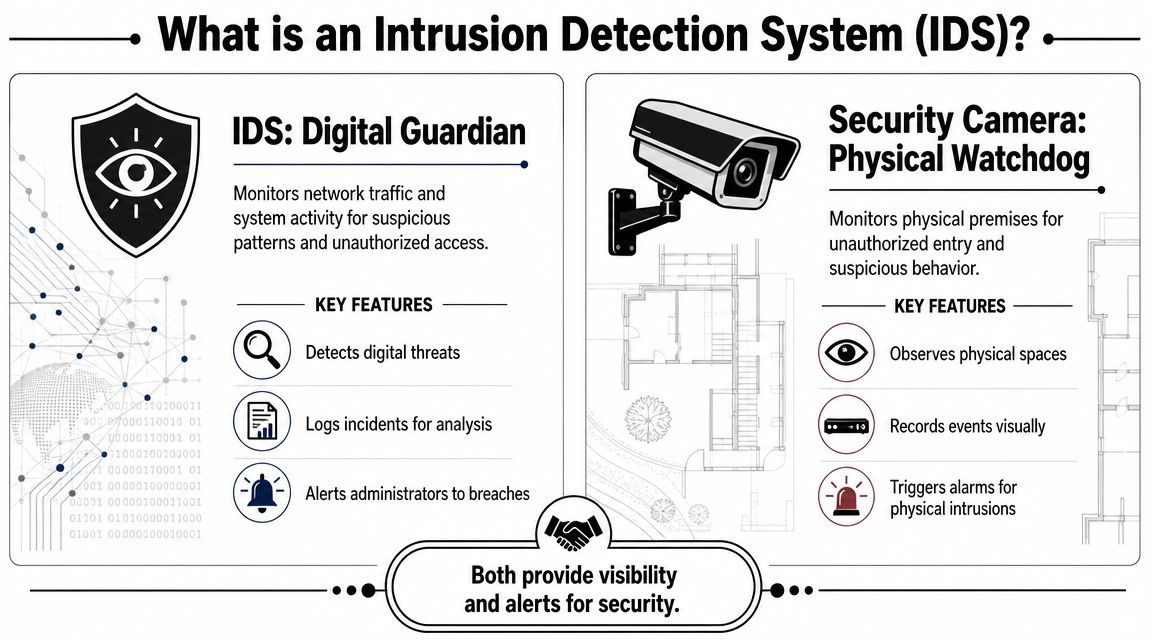
An intrusion detection system is a monitoring tool that watches network traffic, endpoint activity, or both for signs of unauthorized access, misuse, or attack. It does not block threats by itself. Its job is to detect suspicious behavior early enough for someone to investigate and act.
For a small or mid-sized business, that distinction matters. Owners often assume buying an IDS means the business is now protected. It does not. An IDS gives you visibility. Protection comes from what your team does with that visibility, how quickly alerts are reviewed, and whether someone can separate real risk from background noise.
The simplest way to think about an IDS
An IDS works like a security camera for your IT environment. It records what is happening, flags suspicious behavior, and gives investigators evidence after the fact. It does not replace firewalls, endpoint protection, access controls, or a response plan.
That still makes it useful.
A good IDS helps a business:
- Catch suspicious activity earlier so small issues do not turn into expensive incidents
- Create records for investigations and audits when leadership needs answers
- Improve visibility across systems that no one on staff has time to watch continuously
The history behind IDS supports that role. Early academic work on intrusion detection focused on spotting abnormal behavior in computer systems, a model that still shapes modern detection methods, as described in SRI International’s overview of Dorothy Denning’s foundational IDS work. The takeaway for an SMB is simple. Detection has always existed to solve a staffing problem. People cannot watch everything manually, especially after hours.
Network IDS and host IDS
Most IDS deployments fall into two categories.
A network-based IDS, or NIDS, monitors traffic moving across the network. It usually sits out of band so it can inspect activity without slowing production systems. That makes it useful for spotting scans, suspicious connections, odd internal traffic, and other signs of attacker movement. It also creates a practical limitation. If the sensor is placed in the wrong part of the environment, it misses what matters.
A host-based IDS, or HIDS, monitors activity on a specific server, workstation, or other endpoint. It is better suited for catching system-level changes, suspicious processes, unauthorized file changes, and persistence techniques that may not stand out in network traffic.
A network IDS shows how activity moves across the business. A host IDS shows what is happening inside a specific machine.
For most SMBs, the right question is not which one sounds better. The right question is where your blind spots are. If you run cloud apps, remote endpoints, a small IT team, and no one reviews alerts overnight, detection only has value if it is deployed where risk is highest and backed by people who can respond. That is why managed detection is usually the smarter path. The technology matters, but the operating model matters more.
How an IDS Actually Detects Threats
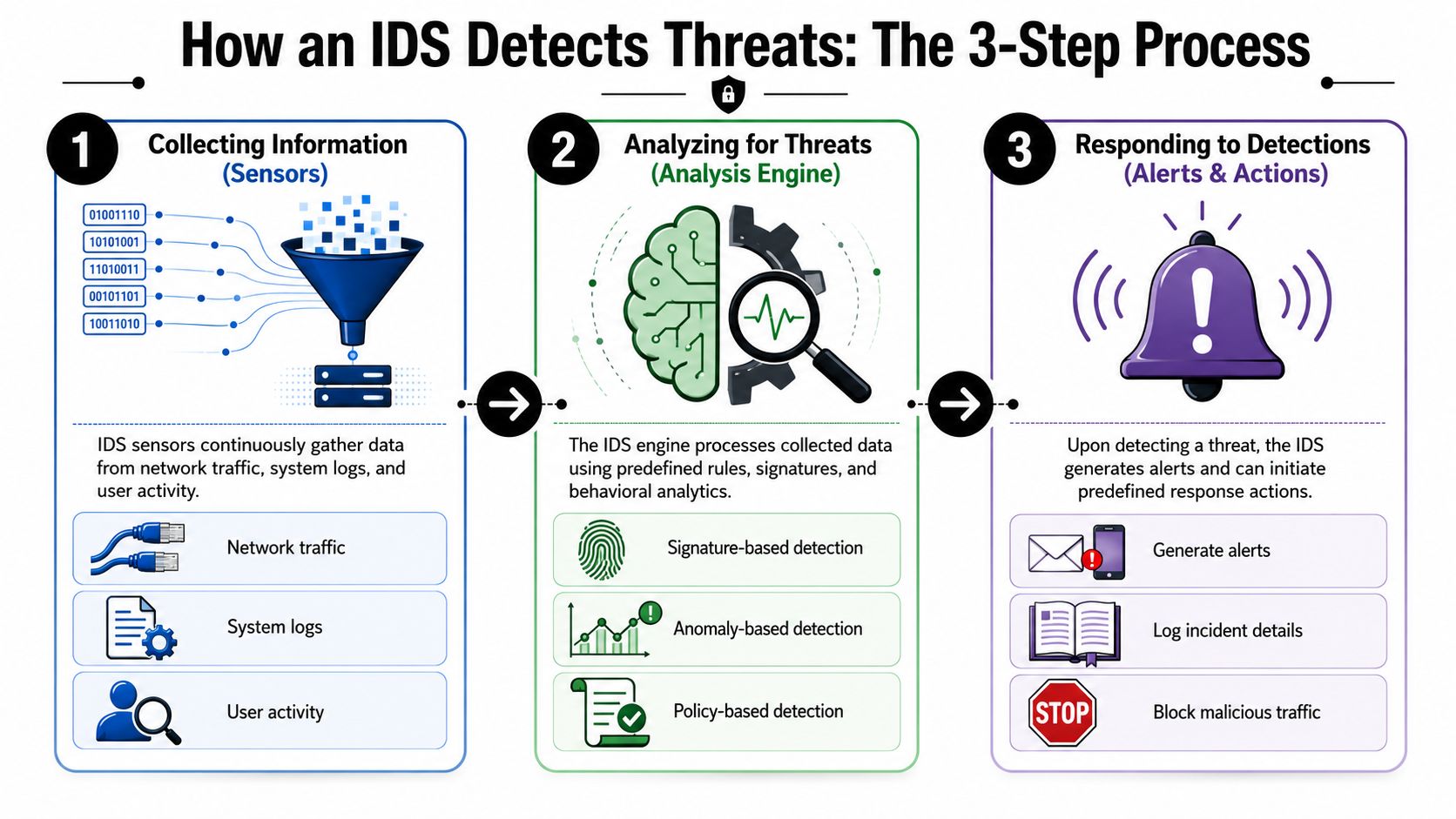
How does an intrusion detection system catch a real threat before it turns into downtime, legal exposure, or a long weekend for your IT team? It follows a simple process. It collects activity, analyzes what it sees, and sends the issue to someone who can act.
That process sounds straightforward. Running it well is not.
NIST describes IDS as a three-stage process built on information sources, analysis, and response. In plain terms, the system only performs as well as the data it receives, the rules and baselines used to inspect that data, and the people handling the output, as explained in NIST SP 800-31 on IDS architecture and operation,%202001-11.pdf).
The three-part pipeline
First, the IDS gathers information. That includes network traffic, endpoint activity, login behavior, file changes, and other system events that can reveal misuse or compromise. If the sensor placement is poor or the business is not collecting the right telemetry, the IDS starts with a blindfold on.
Next comes analysis. The system reviews incoming data and checks for known attack behavior, suspicious deviations, or actions that break policy. Many SMB deployments struggle here. Loose rules create noise. Overly narrow rules miss threats. A detection program needs tuning that reflects how your business really operates, not how a default template assumes it operates.
Then comes response. In most environments, an IDS does not block the attack on its own. It creates an alert, records supporting evidence, and pushes that event into a review process. If nobody reviews alerts after hours, or if the team cannot tell a false positive from a real incident, the business still carries the same risk. Detection without response is expensive theater.
The two detection methods that matter most
Most IDS platforms rely on two core methods.
- Signature-based detection compares activity to known attack patterns. It is efficient and useful for catching familiar threats, repeated tactics, and common exploit behavior.
- Anomaly-based detection flags behavior that falls outside a normal baseline. It helps surface new or unexpected activity that a fixed signature may miss.
Both matter. Both have limits.
Signature-based detection is dependable against known threats, but attackers change tools and techniques quickly. Anomaly-based detection gives broader coverage, but it can overwhelm a small team if the environment is noisy or the baseline is poorly tuned. Busy business owners should care about one practical outcome. Alert volume is not the same as security value.
A strong IDS reduces uncertainty. A poorly run IDS creates more of it.
That is why smart SMBs ask operational questions, not marketing questions.
- What data can the system see across our network, endpoints, and cloud services?
- Who tunes detections so routine business activity does not drown out real threats?
- Who investigates alerts at night, on weekends, and during holidays?
Those questions get to the actual cost of intrusion detection. The software is only one piece. The daily work of triage, tuning, escalation, and response is where the burden shows up. For most small and midsize businesses in Dallas-Fort Worth, managed detection is the practical answer because it closes the gap between seeing a threat and doing something about it. For leadership teams building that response muscle, CTO Input’s incident response guide is a useful companion resource.
An IDS creates value when it feeds a monitored, staffed, and repeatable response process. Without that, it is just another dashboard producing alerts no one owns.
Benefits for Compliance and Their Hidden Limits
Why do so many Dallas-Fort Worth businesses add IDS to the budget? Because auditors, insurers, clients, and attorneys all want the same thing after a security event. Proof. They want records that show what happened, when it happened, and whether anyone was watching.

Why businesses buy IDS in the first place
An IDS helps document suspicious activity, retain event history, and show that monitoring exists inside a larger security program. That matters in healthcare, legal, finance, and any business handling sensitive customer or operational data. It also matters when leadership has to answer hard questions from cyber insurance carriers, outside counsel, regulators, or enterprise clients reviewing your controls.
After an incident, logs and alerts help establish scope. Was it one compromised laptop, or was someone moving across systems for days? That answer changes the response plan, the communication plan, and the business impact.
A useful companion resource for leadership planning is CTO Input’s incident response guide. Detection only pays off when your business already knows who investigates, who approves containment, and who communicates with staff, customers, and legal counsel.
Where IDS disappoints unmanaged teams
An IDS is a detection tool, not a lock or a cleanup crew.
That distinction matters more than many SMBs realize. Compliance checklists can make IDS look like a box to check. In practice, its value depends on daily operations. If no one reviews alerts consistently, tunes noisy detections, and escalates real threats fast, the system creates paperwork without reducing risk.
The hidden limits usually show up in three places:
- Audit evidence without action. You can show that monitoring exists, but you cannot show a disciplined response process.
- Alert volume without ownership. The tool generates warnings, but no one is accountable for triage after hours or during vacations.
- Logs without business context. Raw events pile up, but nobody connects them to the systems, users, and processes that matter most.
That gap is where SMBs get burned. Leadership assumes the company is being watched. In reality, the business is collecting signals and hoping someone notices the right one in time.
A managed model closes that gap. When IDS feeds a staffed process like a security operations center, alerts are reviewed, investigated, and escalated in a repeatable way. That is the difference between having evidence for compliance and having coverage that helps contain an attack.
Compliance value drops fast when monitoring exists on paper but response is inconsistent in the real world.
For an SMB, that is the real lesson. IDS supports compliance, but unmanaged IDS rarely delivers the operational follow-through that makes compliance meaningful. Managed detection and response is usually the smarter investment because it turns monitoring from a technical purchase into an active security function.
Where IDS Fits in Your Modern Security Strategy
An intrusion detection system shouldn’t be treated like a standalone answer. It has a job inside a broader security stack. When leadership understands that role, buying decisions get much smarter.
It’s one role in a larger security team
A useful analogy is physical security. One control handles entry. Another watches what happens inside. Another protects specific assets. Cybersecurity works the same way.
A firewall acts like a gatekeeper. Endpoint security watches activity on individual devices. An IDS watches for suspicious behavior moving through the environment or occurring across systems. A central monitoring layer then ties those signals together so someone can see the bigger picture.
That’s why many organizations pair IDS alerts with a centralized operations process. For business owners who want to understand that model better, Technovation’s overview of what a security operations center is gives a practical picture of how monitoring, triage, and escalation fit together.
Why it still matters in cloud and connected environments
Some leaders assume IDS is old-school because they’ve moved workloads into cloud platforms or added modern endpoint tools. That’s a mistake. The need for visibility hasn’t gone away. It’s gotten messier.
Recent e-healthcare research highlights that intrusion detection for IoT-linked medical systems requires adaptive, model-based detection rather than simple signature matching, especially in environments with encrypted traffic and distributed workloads, as described in this research on IDS for modern e-healthcare and IoT environments. That lesson applies far beyond healthcare.
A modern business may have remote users, cloud apps, branch offices, mobile devices, and specialized equipment on the same operational map. Security leaders still need a way to notice unusual behavior across that sprawl.
A sensible strategy looks like this:
- Use prevention controls to stop common threats early.
- Use endpoint visibility to monitor device-level activity.
- Use intrusion detection systems to surface suspicious patterns across networked operations.
- Feed alerts into a defined response process so detections become actions.
The businesses that handle this well don’t chase single products. They build coverage.
In-House vs Managed IDS The True Cost for an SMB
Many SMB decisions often go sideways at this stage. Leadership compares the price of a tool with the price of a service and assumes the tool is cheaper. That comparison is incomplete.
The cost question isn’t “What does IDS software cost?” A more pertinent question is “What does it take to operate intrusion detection systems well enough to matter?”
What DIY really requires
An in-house IDS program needs more than deployment. It needs people, process, and steady attention. Someone has to decide where sensors go, what data sources matter, which alerts are noisy, which detections need escalation, and what happens after an event is flagged.
That work doesn’t disappear after setup. It becomes ongoing operational overhead.
| Consideration | In-House IDS (DIY) | Managed IDS Service (Technovation) |
|---|---|---|
| Deployment design | Internal staff must choose placement, coverage, and data sources | Service team helps align coverage with business risk |
| Alert monitoring | Internal team must watch alerts consistently | Monitoring is handled as part of the service |
| Tuning and maintenance | Staff must adjust rules and reduce noise over time | Ongoing tuning is included in the operational model |
| After-hours coverage | Often limited unless the business staffs for it | Broader coverage is built into managed operations |
| Incident escalation | Internal team must create and maintain workflows | Escalation processes are structured and repeatable |
| Budget predictability | Costs vary with staffing and internal workload | Service costs are typically easier to forecast |
| Expertise depth | Depends on whoever is available internally | Access to a team focused on detection and response |
A DIY approach can make sense for a business with dedicated security staff and clear monitoring discipline. Most SMBs don’t have that setup. They have an IT generalist, an outside consultant, or an overextended internal team juggling user support, vendors, compliance tasks, and infrastructure issues.
Why managed IDS is usually the practical choice
For most smaller organizations, managed service is the honest answer because the hard part of IDS isn’t buying it. The hard part is operating it every day without letting alerts pile up or tuning fall behind.
A managed model makes sense when the business needs:
- Consistent review: Someone watches alerts instead of checking them when time allows.
- Operational discipline: Escalation paths, investigation workflows, and reporting stay active.
- Specialized judgment: Analysts can separate a nuisance event from a meaningful threat.
- A predictable path to action: Detection ties into response instead of stopping at notification.
Businesses evaluating that route should understand how managed detection works at the service level, not just the product level. Technovation explains that model in its guide to managed detection and response.
The cheaper option on paper often becomes the more expensive option in practice when a business has to supply the missing labor, coverage, and expertise itself.
That’s the true cost conversation. Not hardware versus subscription. Capability versus wishful thinking.
An Actionable Checklist for Your Next Step
A business owner doesn’t need a perfect security architecture diagram before making progress. A short set of honest questions will reveal whether intrusion detection systems are being considered strategically or just added as another checkbox.
Questions leadership should answer now
- Who reviews alerts after hours? If a serious detection appears on a Saturday night, there should be a named process, not a vague assumption.
- What data needs visibility? Sensitive client files, regulated records, financial systems, line-of-business applications, and remote access paths should all be accounted for.
- Is there a response plan tied to detection? Alerts without triage and escalation steps create delay.
- Can the current team tune and maintain the system? Detection quality drops when nobody owns rule review, baselining, and false-positive reduction.
- Does the business need proof of monitoring? Regulated and security-conscious organizations often need evidence that oversight is active, not informal.
- Would leadership know the difference between a nuisance alert and a meaningful incident? If not, outside expertise is usually the better path.
A smart next step is a practical review of monitoring gaps, response readiness, and business risk. That gives leadership a clear answer on whether an internal approach is realistic or whether managed coverage makes more sense.
Technovation LLC helps Dallas-Fort Worth businesses turn security monitoring into an operational capability instead of a pile of alerts. For organizations that need practical guidance on intrusion detection systems, compliance readiness, and response planning, Technovation LLC offers a free, no-obligation security audit specific to the business’s environment, risk profile, and internal capacity.