

A clinic manager in Dallas often knows the feeling. The waiting room is full, claims are moving, staff are stretched, and then an email lands about a policy update, a vendor questionnaire, or a security review. Nobody opened a practice to spend the week chasing documentation, but that's the present state of modern care delivery. Patient data sits in scheduling tools, EHR workflows, billing systems, laptops, tablets, and email. If compliance is still handled with spreadsheets, scattered policies, and verbal reminders, the clinic is already behind.
That's why healthcare compliance solutions matter now as an operating system, not a side project. The global healthcare compliance software market was valued at USD 3.0 billion in 2025 and is projected to reach USD 6.0 billion by 2032, growing at a 10.6% CAGR, according to Research and Markets' healthcare compliance market outlook. That projection matters because it reflects a larger shift. Clinics aren't moving to automated compliance because it sounds modern. They're moving because manual oversight breaks down fast in a digital practice.
For small and midsize clinics across Dallas-Fort Worth, the practical question isn't whether compliance matters. It's whether the current setup can survive an audit, a staff mistake, or a security incident without disrupting patient care.
Table of Contents
- Beyond the Checklist Navigating Modern Healthcare Compliance
- Decoding Key Regulations Like HIPAA and HITECH
- The Two Pillars of an Effective Compliance Solution
- A Step-by-Step Compliance Readiness Roadmap
- Common Compliance Pitfalls and How to Avoid Them
- Measuring the ROI of a Strategic Compliance Partnership
- Why Your DFW Clinic Needs a Local Compliance Partner
Beyond the Checklist Navigating Modern Healthcare Compliance
A lot of clinics still treat compliance like a binder on a shelf. Policies get written once, signed once, and ignored until someone asks for them. That approach fails because compliance isn't paperwork. It's the set of controls that protects the practice when staff are busy, turnover happens, and systems change.
What a busy DFW clinic is really managing
A typical practice doesn't struggle because the team is careless. It struggles because daily operations create risk faster than manual processes can keep up. Front desk staff need access to schedules. Nurses need fast chart visibility. Billing teams move data across systems. Providers work from more than one location. Every convenience creates another point where protected information can be exposed, mishandled, or left untracked.
That's why healthcare compliance solutions should be viewed as part of business continuity. Strong compliance supports patient trust, cleaner workflows, and better decision-making around technology purchases.
Practical rule: If a clinic can't show who has access, what changed, and how incidents are handled, it doesn't have a compliance program. It has good intentions.
The shift away from manual tracking is already reshaping the market. The growth cited earlier shows that healthcare organizations are investing in automation because regulatory complexity keeps increasing and digital records keep expanding. For DFW clinics, that means the old model of “the office manager keeps tabs on it” isn't enough.
Trust is built in small operational details
Patients rarely ask whether a clinic has role-based access controls or documented response procedures. They assume those basics are already in place. Trust breaks when the clinic can't answer simple questions after a problem occurs. Who accessed a record. Whether data was encrypted. Whether staff were trained. Whether the issue was documented and fixed.
A practical compliance program answers those questions before anyone asks.
Clinic managers who want a grounded starting point can review broader compliance guidance from Technovation's compliance resources. The core value isn't legal theory. It's operational clarity. Which systems hold sensitive data, which gaps matter first, and which controls should be implemented now instead of “later.”
The checklist mindset is too small
A checklist has value, but it can't carry the whole load. A clinic also needs accountability, repeatable workflows, and documented follow-through. That's the difference between passing tasks around and running a resilient practice.
The right healthcare compliance solutions don't just reduce risk. They make the clinic easier to manage.
Decoding Key Regulations Like HIPAA and HITECH
Compliance rules work a lot like building codes. A medical office can look clean, professional, and welcoming, but if the wiring is unsafe and the exits are blocked, the building isn't sound. Healthcare data works the same way. A clinic can have good people and decent software, but if patient information isn't protected by the right safeguards, the practice is exposed.
HIPAA is the foundation
HIPAA sets the base rules for protecting patient information. In practical terms, it tells a clinic how protected health information should be used, disclosed, secured, and monitored. The Privacy Rule addresses how patient information is handled. The Security Rule focuses on electronic protected health information. The Breach Notification Rule addresses what must happen when data is exposed.
This visual breaks down the hierarchy.
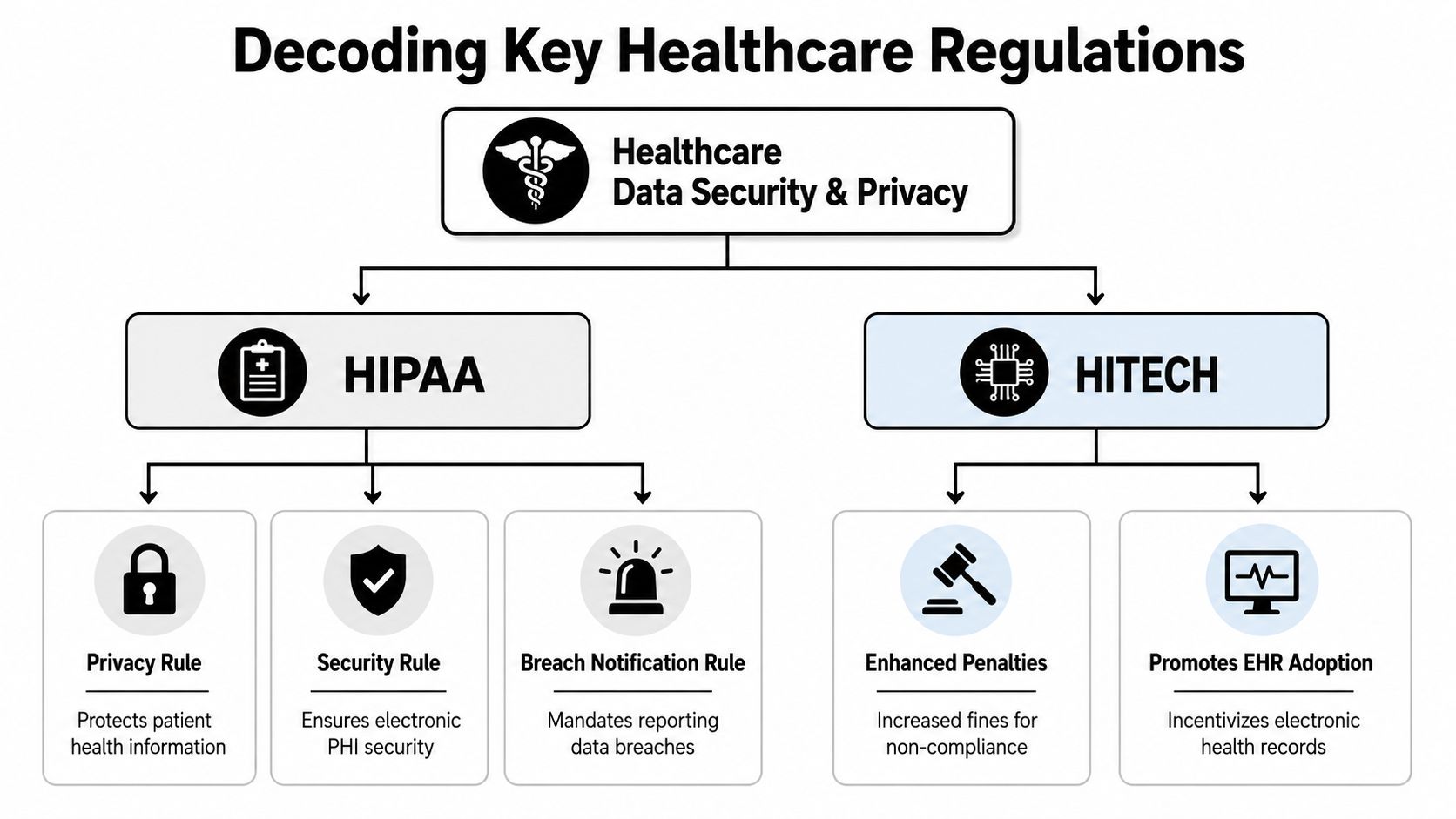
A clinic manager doesn't need to memorize every citation. The practical takeaway is simpler. HIPAA expects the practice to control access, protect electronic data, document decisions, and respond properly when something goes wrong.
HITECH raised the stakes
HITECH pushed healthcare further into digital records and reinforced the need to secure that environment. That matters because many clinics adopted electronic workflows faster than they built governance around them. Scanning paper into a system isn't the same as building a secure, auditable process.
For managers evaluating software and workflow changes, a useful outside perspective is this guide to achieving HIPAA compliance in software. It helps connect development and operational decisions to compliance expectations without turning the issue into legal jargon.
A clinic doesn't become compliant because it bought software. It becomes compliant when people, systems, and policies all enforce the same rules.
What these rules mean in daily operations
The easiest way to translate HIPAA and HITECH is to map them to daily clinic behavior:
- Access must be limited: Staff should only see the information needed for their role.
- Systems must be protected: Devices, accounts, and stored data need safeguards that match the sensitivity of the information.
- Actions must be traceable: The clinic should be able to review what happened, who did it, and when.
- Incidents must be handled formally: Problems need documented response, not hallway conversations.
A clinic that wants to connect these regulatory demands to day-to-day IT planning can also review managed IT considerations for healthcare operations. That's where regulation becomes operational. Access, backups, device controls, remote work, and monitoring all sit inside the same risk picture.
The Two Pillars of an Effective Compliance Solution
Too many clinics buy technology and assume the purchase solved the problem. It didn't. Software without process creates blind spots. Policy without enforcement creates theater. Effective healthcare compliance solutions rest on two pillars: technical controls and administrative controls.
Pillar one is technical control
Technical controls are the systems that enforce protection every day, even when staff are distracted or rushed. These controls shape who can access data, how activity is logged, how risk is detected, and how incidents are escalated.
An effective compliance stack should include Data Security Platforms, Access Management Systems, Audit and Monitoring Tools, Training Management Platforms, Risk Assessment Tools, and Incident Response Systems, and a phased implementation can reduce compliance gaps by 40 to 60 percent compared with fragmented manual processes, according to WTT Solutions' healthcare compliance software analysis.
That matters because most SMB clinics can't fix everything at once. They need sequence.
| Technical control area | Why it matters in a clinic |
|---|---|
| Data security | Protects sensitive records in storage and transit |
| Access management | Limits who can see what based on role |
| Audit and monitoring | Creates visibility into user actions and system events |
| Risk assessment | Identifies weak points before they become incidents |
| Incident response | Turns confusion into a documented process |
A clinic with no logging, broad shared access, and scattered device management doesn't have a technology gap. It has a governance gap.
Pillar two is administrative control
Administrative controls are the human and procedural side. Policies, training, documented responsibilities, escalation paths, and follow-up all sit here. This pillar matters because even good technical tools fail when staff don't know the rules or managers don't enforce them.
Three administrative controls carry outsized weight:
- Clear policies: Staff need written guidance that matches actual workflow, not a generic template buried in a folder.
- Role accountability: Someone must own reviews, approvals, follow-up, and documentation.
- Routine training: Training has to reflect real clinic tasks, including intake, scheduling, billing, mobile access, and vendor coordination.
Operational test: If a front desk employee leaves tomorrow, can the clinic prove that access was reviewed, policies were acknowledged, and procedures were followed?
Why the two pillars have to work together
Technical controls catch what people miss. Administrative controls tell people what to do when the technology flags a problem. One without the other creates friction, confusion, or false confidence.
A structured service model offers valuable support. Technovation LLC supports healthcare organizations with cybersecurity, compliance readiness, ongoing monitoring, and strategic IT planning that align these two pillars into a practical operating model. That type of support matters most for clinics that don't have internal compliance depth but still need disciplined execution.
A Step-by-Step Compliance Readiness Roadmap
Most clinics don't need a thicker policy manual. They need an order of operations. Compliance gets manageable when the work is broken into a repeatable cycle.
This roadmap gives clinic managers a sequence they can act on.
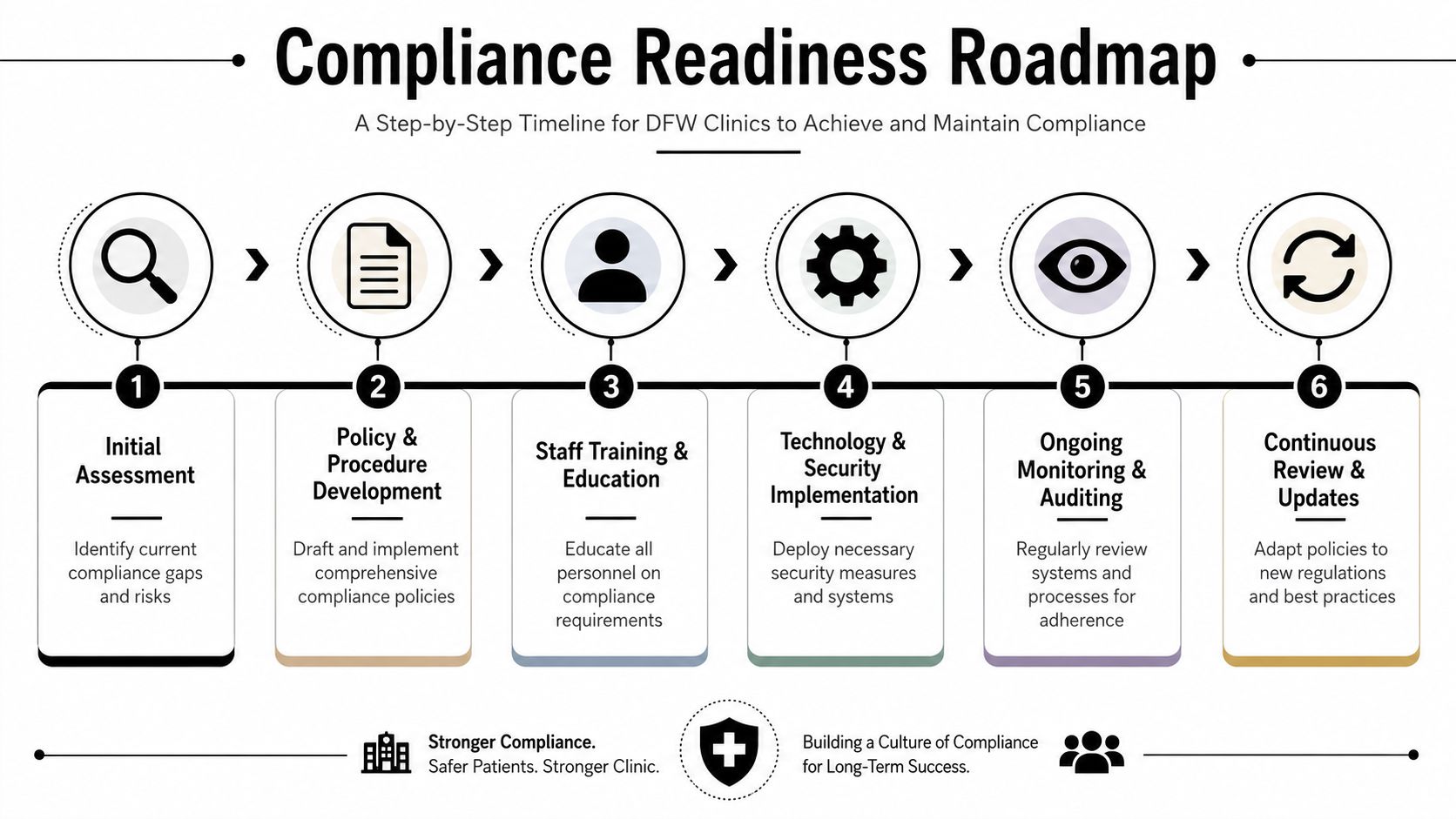
Start with risk analysis
Under HIPAA §164.308(a)(1), healthcare organizations must conduct an annual security risk analysis to evaluate the security of ePHI, and that work must be documented with corrective action plans for identified gaps, as outlined by Compliance Services Authority's healthcare compliance requirements guidance. This is not optional, and it's not a one-time exercise after a software rollout.
The risk analysis should examine systems, users, workflows, devices, vendors, and points where information enters or leaves the clinic. If the process ends with a vague list of concerns and no owner attached to each issue, it isn't complete.
Build the remediation plan
Once the gaps are known, the clinic needs to rank them and fix them in a sensible order. Not every issue deserves the same urgency. Broad access rights, missing documentation, outdated endpoint protections, and weak incident handling usually deserve immediate attention because they affect multiple workflows at once.
A useful remediation plan includes:
- Defined actions: Each issue should have a specific fix, not a generic note to “improve security.”
- Responsible owners: One person should own completion, even if several people help.
- Target dates: Open-ended tasks tend to stay open.
- Proof of completion: Updated settings, revised policies, training records, or test results should back up the change.
Document the way the clinic actually works
Policies fail when they describe an imaginary office. A real compliance program documents how the clinic handles patient intake, chart access, remote work, vendor access, password practices, device use, and incident escalation as they happen in daily operations.
That's why process matters as much as policy language. A clinic that wants a structured model for assessments, remediation, and operational follow-through can review Technovation's service process for managed IT and compliance work. The key is consistency. Every fix should move from assessment to action to documentation.
Good compliance documentation is usable. Staff should be able to follow it during a busy Tuesday, not just admire it during an audit.
Train everyone, then keep auditing
Training can't stop with providers or office leadership. Front desk teams, billing staff, part-time workers, and contractors all touch risk in some form. Training should be role-based and reinforced when workflows change.
After that, the clinic needs ongoing monitoring. Access reviews, audit log checks, policy updates, incident drills, and recurring reassessment turn compliance into a business process instead of a yearly scramble.
Common Compliance Pitfalls and How to Avoid Them
Most compliance failures don't come from one dramatic mistake. They come from routines that drift. A clinic gets busy, postpones a review, assumes staff understand a policy, and keeps moving. Months later, the risk isn't theoretical anymore.
Pitfall one is set-it-and-forget-it security
A clinic updates systems once, installs protection, and assumes the environment stays safe. It doesn't. Staff roles change, devices are replaced, remote access expands, and vendors get added. Security controls that aren't reviewed become stale fast.
The fix is routine governance. Access reviews, log reviews, policy checks, and documented follow-up should sit on a schedule, not on someone's memory.
Pitfall two is weak staff training
Many clinics train during onboarding and never go much further. That leaves too much room for casual workarounds. A rushed employee forwards records the wrong way, shares credentials, uses the wrong device, or skips an internal reporting step because nobody reinforced the process.
A better approach is targeted, recurring training tied to actual clinic tasks.
- Use role-specific examples: Front desk staff face different risks than billers or providers.
- Keep training practical: Show what staff should do when a patient requests records, a device goes missing, or a suspicious email arrives.
- Track completion and understanding: Attendance alone isn't enough if the message didn't stick.
Compliance training should answer one question clearly: what should this employee do next when something feels off?
Pitfall three is buying a generic solution that doesn't fit
This is common in smaller practices. Leadership buys a polished platform or downloads a generic policy package, then discovers it doesn't match actual staffing, infrastructure, or workflow. The result is shelfware and confusion.
A short comparison makes the problem obvious:
| Approach | Likely outcome |
|---|---|
| Generic enterprise template | Doesn't reflect the clinic's actual process |
| One-time software purchase | Leaves policy, training, and review gaps |
| Tailored operational model | Fits staffing, systems, and day-to-day reality |
The right healthcare compliance solutions should reflect how the clinic delivers care. If a process can't work with the clinic's staffing level and technical reality, it won't last.
Measuring the ROI of a Strategic Compliance Partnership
Clinic owners often look at compliance as overhead because the cost is visible and the payoff seems abstract. That's the wrong lens. The better question is what the clinic gains when compliance becomes organized, documented, and actively managed.
The return shows up in operations first
A strategic compliance partnership reduces friction in places clinic managers feel every week. Access gets cleaned up. Documentation stops living in random folders. Staff know who handles incidents. Technology decisions become easier because someone is reviewing risk before a new system or workflow gets pushed into production.
That kind of structure helps a clinic avoid expensive confusion. It also saves leadership time. Instead of reacting to questionnaires, audits, or internal uncertainty, the practice can respond with a defined process and current records.
Outsourcing is often more sensible than hiring internally
Small clinics regularly ask whether they need a full-time compliance officer. In many cases, they don't. What they need is the right level of specialized oversight without carrying a full internal salary burden.
That's where outsourced support can make financial sense, but only if the clinic vets the provider correctly. For small healthcare entities, key factors include verifying healthcare-specific expertise, requiring at least $3 million in professional indemnity insurance, and reviewing hourly rate expectations so the clinic doesn't overpay or rely on underqualified help, according to Compliance.com's guidance for small healthcare entities.
A clinic should also ask practical questions before signing anything:
- Who owns the roadmap: The clinic needs visibility into priorities, status, and next steps.
- Who maintains documentation: Deliverables should be easy to access and audit.
- Who responds when something happens: Incident support shouldn't be vague.
- Who understands healthcare workflows: Generic compliance advice often misses operational realities.
The biggest return is confidence
A good partnership doesn't just lower exposure. It helps leadership make decisions with less uncertainty. That matters when adding locations, expanding remote access, rolling out new software, or answering patient and vendor questions about data handling.
That's real ROI. Less scramble. Better control. Clearer accountability.
Why Your DFW Clinic Needs a Local Compliance Partner
National providers often treat compliance as a remote paperwork exercise. That may work for generic administration. It doesn't work well for a DFW clinic that needs someone to understand local business realities, visit the environment when needed, and adapt recommendations to actual staffing and infrastructure.
Small and rural-adjacent clinics face a problem that larger systems can often absorb with internal teams. They operate with limited budgets, thinner IT support, and less room for waste. Guidance aimed at enterprise healthcare usually misses that reality. A key gap in the market is helping smaller clinics achieve HIPAA compliance under those constraints, especially when they need low-infrastructure solutions instead of oversized enterprise platforms, as discussed in River Axe's analysis of rural and underserved healthcare digitization.
Local context changes the quality of support
A local partner can assess more than a checklist. It can see how the practice operates. Which locations share staff. Which devices move between rooms. Which workflows were improvised over time. Which fixes the clinic can support now, and which should wait.
That matters because healthcare compliance solutions fail when they ignore operational reality. A suburban family clinic, specialty practice, or growing multi-site office around Dallas-Fort Worth doesn't need bloated process. It needs control that fits.
This summary captures the difference.
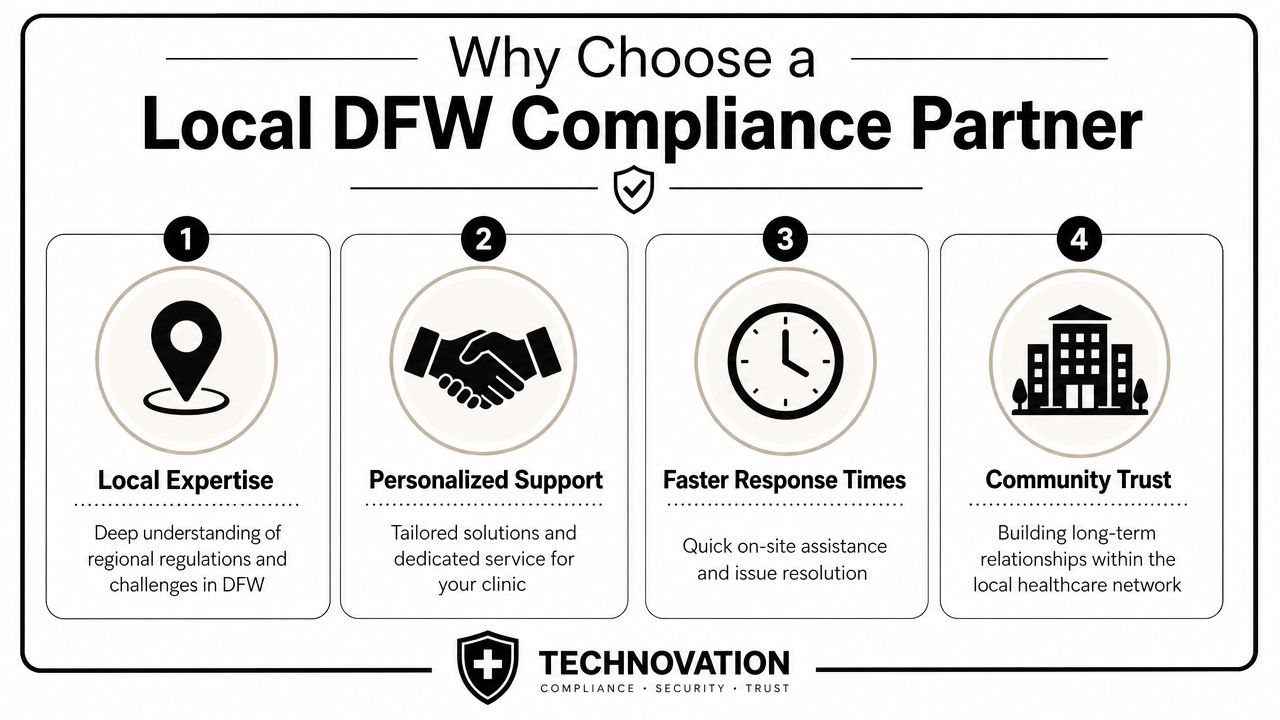
Why local wins for smaller healthcare organizations
A local provider is usually better positioned to deliver four things that SMB clinics care about:
- Faster alignment: Recommendations reflect the clinic's actual size, budget, and staffing.
- Better accountability: It's easier to get direct answers from a nearby team than from a rotating support queue.
- Practical implementation: Policies, training, and controls can be customized to the clinic's workflow.
- Long-term continuity: The relationship can extend beyond a one-time assessment.
Clinics evaluating that type of relationship can review why organizations choose Technovation for managed IT and security support. The key issue isn't branding. It's whether the partner can translate federal requirements into workable local action.
Smaller clinics don't need more complexity. They need sharper priorities, cleaner documentation, and support that matches how they actually operate.
A DFW practice that gets compliance right gains more than audit readiness. It gains a steadier business, stronger patient trust, and fewer operational surprises.
Technovation LLC helps North Texas clinics turn compliance from a recurring headache into a managed process. For healthcare organizations that need clearer risk visibility, stronger safeguards around patient data, and practical support without building a full in-house compliance function, Technovation LLC offers healthcare-focused IT, cybersecurity, and compliance guidance built for real-world operations. A free security audit is a sensible next step for any clinic that wants an honest view of its current posture and a workable plan to improve it.