
If a clinic, law firm, or accounting shop in DFW is talking about cloud migration and the conversation still starts with “which platform,” the assessment is already late. The first question should be simpler and harsher, can the current environment move without breaking compliance, blowing up costs, or exposing dependencies nobody has documented yet? A cloud computing readiness assessment is the answer to that question, and it should be treated like a diagnostic, not a cheerleading exercise.
Most stalled migrations fail for ordinary reasons, not dramatic ones. A workload looked easy until someone finally checked data handling, licensing, bandwidth, or the age of the server hosting the application. By then, the team has spent time, budget, and executive attention on a plan that was never grounded in the actual environment. That is why a readiness assessment matters before anyone starts buying services or writing cutover dates. It builds the evidence base for the migration plan, not the migration plan itself, and it should produce a clear application-by-application disposition, a remediation list, and a sequencing plan.
For regulated SMBs, that distinction is everything. The best-run assessments don't stop at infrastructure and security. They also force the hard questions about governance, compliance exposure, operating ownership, and post-migration cost control. If those pieces are missing, the cloud becomes a more expensive way to keep the same problems.
Table of Contents
- Why Most Cloud Migrations Stall Before They Start
- Defining Scope and Getting Stakeholders Aligned
- Building a Technical Inventory That Decides Migration Waves
- Scoring Security and Compliance for HIPAA, FINRA, and PCI Workloads
- Turning Cost and Operations into Numbers a CFO Will Accept
- Risk Scoring and Sequencing Workloads into Migration Waves
- Your Remediation Roadmap and How Technovation Shortens the Path
Why Most Cloud Migrations Stall Before They Start
A medical group decides to move its practice management platform, billing system, and file shares to the cloud. The vendor demo looks clean, the team feels momentum, and the leadership team approves the project. Then the migration team finds that one workload handles regulated data, one depends on an older server with weak supportability, and one has licensing and bandwidth constraints that were never scored. The schedule slips, the budget gets uncomfortable, and the board starts asking why nobody surfaced those issues before work began.
That is the common failure pattern. Teams treat migration as a technical move, then discover too late that cloud readiness is a cross-functional problem. A cloud computing readiness assessment is a pre-migration diagnostic that maps constraints, capabilities, and gaps before money starts moving. It is not a verdict. It is the evidence that supports the verdict.
The historical point matters here. Readiness assessment grew into a structured practice that evaluated infrastructure, applications, security, data, and organizational factors before migration, and one framework used 12 readiness factors, including leadership support, business case and budget, number of servers, server age, virtualization, and network connectivity (source framework). That multi-dimensional view still holds up because migration failures rarely come from one isolated flaw.
Practical rule: if the assessment cannot tell leadership what to move, what to fix, what to delay, and what to retire, it is not a readiness assessment, it is a paperwork exercise.
A serious assessment should produce three things. First, an application-by-application migration disposition, usually rehost, replatform, redesign, replace, or retire. Second, a prerequisite-remediation list that names what has to be fixed before any wave starts. Third, a sequencing plan that groups workloads by dependency, risk, and business impact. AWS's modernization guidance treats the assessment as a structured discovery process with stakeholder interviews, documentation, observations, and a debrief that drives next steps (AWS modernization assessment process).
A structured approach, like a cloud governance and innovation blueprint, keeps governance, regulated-data exposure, and post-migration cost control in view from the start. That matters for healthcare, legal, and finance firms, where the wrong workload in the wrong wave creates compliance risk and spending problems before the first cutover. If the assessment ignores who approves change, where sensitive data lives, and how the cloud bill will be managed after go-live, it misses the decisions that decide whether the migration is safe at all.
A useful way to think about it is simple. If the migration plan is the map, the readiness assessment is the survey that tells everyone where the cliffs are. That mindset keeps the work grounded in reality instead of optimism, and it stops leadership from approving a cloud program that cannot survive first contact with the actual environment.
Defining Scope and Getting Stakeholders Aligned
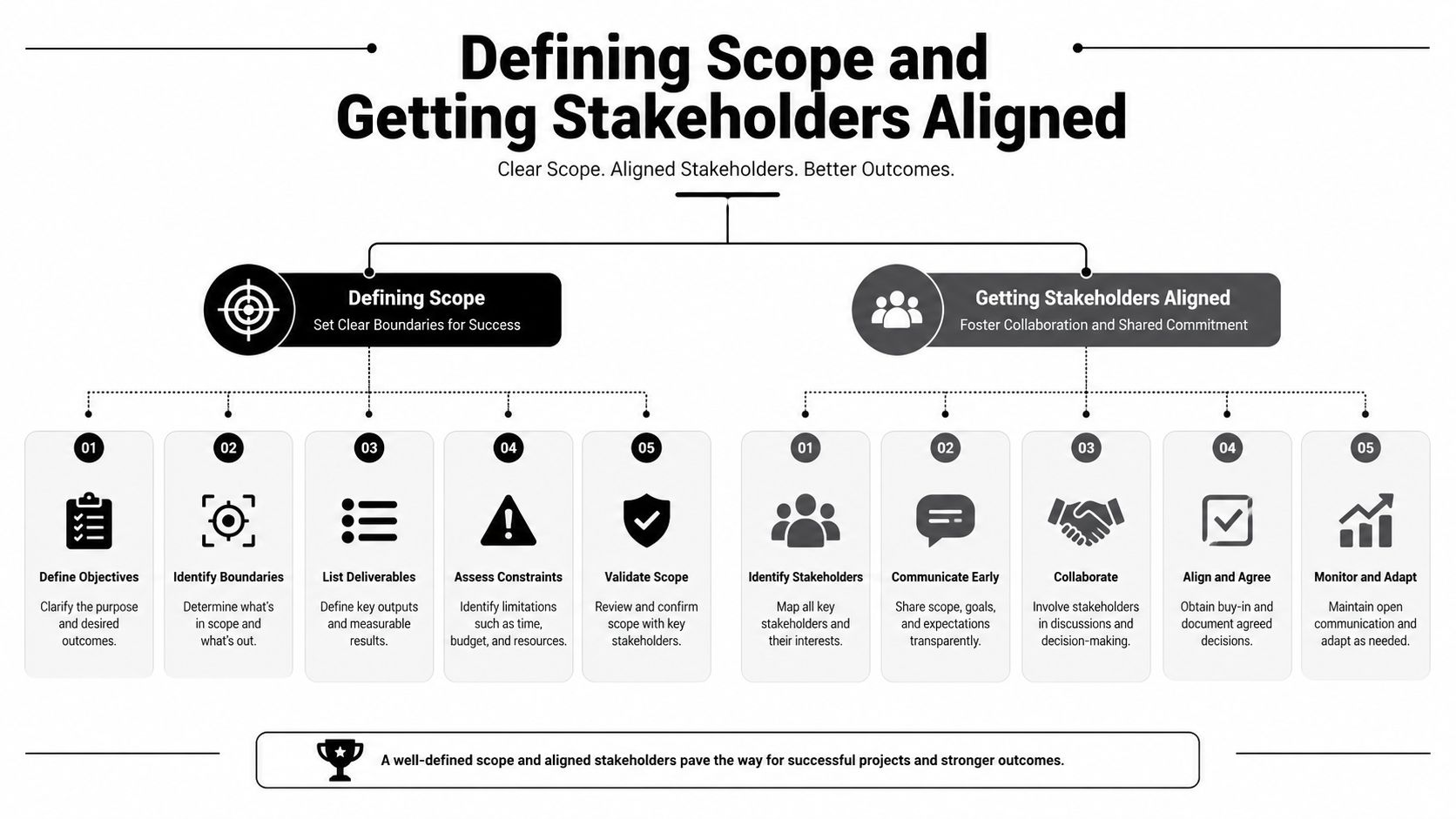
The first deliverable is a one-page scope statement. Not a slide deck. Not a loose email thread. A real written scope that names the business goals, success measures, in-scope systems, out-of-scope systems, timeline, and decision rights. Without that, the assessment becomes an IT fishing expedition, and IT ends up carrying decisions that should have been owned by the business from the start.
A clean scope needs four owners. The executive sponsor ratifies why the assessment exists and what business outcome it supports. The technical lead owns system inventory, architecture questions, and dependency discovery. The compliance lead defines the regulatory boundaries, the required controls, and the evidence that must be collected. The finance lead signs off on cost assumptions, funding logic, and what counts as acceptable spend during discovery and remediation.
What each owner must approve
- Executive sponsor: the business goal, the definition of success, and the final decision path.
- Technical lead: the in-scope platforms, the systems to inspect, and the inventory method.
- Compliance lead: the control set, retention expectations, and regulated-data boundaries.
- Finance lead: the cost baseline, the remediation budget logic, and the funding owner.
A good scope statement also calls out what's not being touched. That keeps the assessment from drifting into every adjacent system that someone vaguely remembers. It also forces the team to identify dependencies outside the obvious application boundary, which is where many migration surprises hide.
The quickest way to waste a readiness effort is to let everyone assume someone else already defined the boundary.
This is also where governance gets real. Readiness work is not just an IT checklist, it's a governance exercise. If the leadership team won't approve who gets to make tradeoffs, the migration wave plan will collapse later when the first conflict appears between compliance, budget, and uptime. That's why a useful cloud computing readiness assessment starts with agreement on decision rights, not with server spreadsheets.
Building a Technical Inventory That Decides Migration Waves
The technical inventory is the backbone of the entire effort, but only if it is detailed enough to drive decisions. A shallow list of servers and apps will not cut it. The assessment needs concrete information on hardware, network devices, data-center setup, server utilization, network bandwidth, storage capacity, application architecture, dependencies, and licensing models (inventory guidance).
What to capture per workload
Each workload should be documented the same way so the output can be compared apples to apples. Capture the application owner, the technical owner, supporting infrastructure, user groups, upstream and downstream dependencies, licensing constraints, backup and recovery behavior, and whether the workload has a hard external dependency that cannot move yet. That last item matters more than many teams admit.
Server age and virtualization coverage deserve special attention. Readiness frameworks have used number of servers, server age, virtualization, and network connectivity as variables for years because they shape whether a workload can move at all. Old hardware can kill a migration path, and poor bandwidth can make a “compatible” application behave badly during cutover even if the software itself is cloud-friendly.
The inventory should also include the stuff people hate writing down, like unsupported software, shadow systems, and undocumented integrations. Self-reported inventories usually miss those. That is why the assessment has to combine stakeholder interviews, document review, process observation, and hands-on technical validation. If the team only asks managers what exists, the list will be incomplete.
If an application cannot be traced to an owner, a dependency map, and a recovery method, it is not ready for a migration wave.
A practical template helps. One row per workload. One set of columns for technical state, one for dependency risk, one for licensing, one for data sensitivity, and one for migration disposition. That structure turns the inventory from a spreadsheet into a decision tool. It also makes it much easier to spot which systems are easy wins and which ones should stay put until remediation is complete.
Technovation's data classification policy fits naturally into this step because inventorying the environment without classifying the data is how regulated businesses understate risk. The point is not to create more paperwork. The point is to stop guessing.
Scoring Security and Compliance for HIPAA, FINRA, and PCI Workloads
Security can't be a separate cleanup project that happens after architecture is chosen. If that happens, the migration team will keep moving while the risk team keeps discovering issues, and the project will stall in the middle. A better method is to score security and compliance as part of readiness, using the data classifications and control requirements that govern the workload.
Map the regulation to the workload
For HIPAA-covered workloads, the assessment should check PHI handling, access controls, and audit logging against the actual data flow, not just a policy binder. For FINRA-aligned environments, it should verify data retention, supervision, and WORM storage expectations where those apply to the business process. For PCI DSS, the assessment has to define cardholder data scope, segmentation, and encryption in transit and at rest before migration begins. Those are not optional details, they determine the boundary of the entire design.
The most useful way to score compliance is to connect it to the controls the workload needs. That means identity and access controls, encryption, logging, retention, segmentation, vendor risk, and incident response all get reviewed together. The assessment should record each gap as a remediation item with an owner and a target state. “Looks okay” is not a control outcome.
A compliance-first score also requires governance maturity. Guidance aimed at regulated SMBs points out that readiness depends on stakeholders, goals, governance, operational maturity, and GRC capability, not just infrastructure and apps (governance and GRC readiness). That matters in healthcare, legal, and finance because the business cannot afford a migration that is technically successful and procedurally wrong.
The controls that should never be hand-waved
- Identity and access: who can touch the data, who can approve access, and how privileged access is reviewed.
- Logging and evidence: whether activity can be reconstructed after an incident or audit.
- Encryption and segmentation: whether sensitive data is isolated and protected in transit and at rest.
- Retention and supervision: whether regulated records stay retrievable for the required business process.
- Incident response fit: whether the team knows what to do when the environment changes.
Technovation's HIPAA compliance guidance belongs in this conversation because healthcare buyers need more than generic cloud advice. The core question is whether the workload can move without weakening the controls that keep the firm audit-ready. If the answer is uncertain, the workload is not ready.
Turning Cost and Operations into Numbers a CFO Will Accept
Cloud spend goes sideways when cost is treated like a footnote. A serious readiness assessment has to put cost and operations into the same scoring model as technology and security. Otherwise, the migration may be “successful” and still leave the finance team dealing with surprise run-rate pressure and unclear ownership.
The cleanest way to frame cost is in two buckets. One-time migration cost covers discovery, re-platforming, training, and any parallel run required to move safely. Run-rate impact covers compute, storage, egress, support, and the post-cutover operating pattern. That split matters because the CFO needs to see both the transition cost and the steady-state burden.
Operating readiness needs the same treatment. Someone has to own monitoring, patching, identity, backup, and disaster recovery after cutover. If those responsibilities are fuzzy before migration, they'll be messy after migration. Readiness should also test whether the team has the skills and processes to keep the environment stable once it's live. A cloud move that doesn't include an operating model is just a deferred support problem.
Technovation's virtual CIO service fits here because the finance conversation gets sharper when someone can translate technical risk into budget logic. The point is not to make cloud look cheap. The point is to make it predictable.
| Readiness Dimensions and Their Cost Levers | |||
|---|---|---|---|
| Readiness Dimension | What It Scores | Cost or Operational Lever | Owner |
| Business readiness | Cloud goals, success measures, funding ownership | Planning time, approvals, prioritization | Executive sponsor |
| Technology readiness | Workloads, dependencies, platform fit | Rework, re-platforming, testing | Technical lead |
| Security readiness | Identity, encryption, logging, controls | Control remediation, monitoring lift | Security lead |
| Cost readiness | One-time and run-rate economics | Migration spend, ongoing cloud spend | Finance lead |
| Operating readiness | Monitoring, backup, DR, support ownership | Staffing, runbooks, escalation | Operations lead |
A good assessment doesn't stop at cost estimates. It ties the estimates to owners and to specific decisions. That's how the conversation stays grounded. The CFO doesn't need optimism. The CFO needs a controlled path, an ownership model, and a clear explanation of why some workloads should wait until the economics make sense.
Risk Scoring and Sequencing Workloads into Migration Waves
Migration waves should follow risk, not ego. The first wave is often where teams make their worst mistake, because they want to start with the most visible application or the one the board talks about most. That's usually the wrong move. Early waves should build confidence with workloads that have manageable dependency chains, lower compliance exposure, and a clean remediation path.
A simple scoring model works well. Rate each workload on technical complexity, business criticality, compliance exposure, and dependency risk. Then group systems into waves based on the score, not the politics. A low-risk, high-value workload may be a good candidate for wave one. A regulated workload with PHI, cardholder data, or supervised communications usually belongs later, after the team proves the controls and operating model work in practice.
Move the easiest system that still teaches the team something useful. Don't use wave one to prove bravery.
The point of sequencing is to reduce business interruption. If a workload depends on another system that isn't ready, both should be held back until the dependency is resolved. If a workload's security or retention requirements are still being finalized, it should not jump the line just because leadership wants a visible win.
A practical sequence usually looks like this:
- Low-risk, high-value systems with clean dependencies and well-understood operations.
- Medium-complexity workloads that need scheduled remediation before movement.
- Compliance-heavy systems once controls, logging, and ownership are verified.
- Lowest-risk legacy survivors only after the team knows how the environment behaves.
The sequencing plan should be explicit about prerequisites, milestones, and rollback thinking. That gives leadership a real roadmap instead of a vague “go live later” promise. It also keeps fragile systems from being rushed because they are old and apparently easy. Old is not the same thing as simple.
Your Remediation Roadmap and How Technovation Shortens the Path
A good assessment ends with a roadmap, not a recommendation slide. The roadmap should name the remediation items, the owners, the prerequisites, and the order of execution. It should also separate work that must happen before migration from work that can happen in parallel, because that distinction changes budget and timing fast.
That's where a managed IT and compliance partner can help. A firm like Technovation LLC can run discovery, score readiness across the five dimensions, build the migration wave plan, and stay engaged through remediation and cutover for healthcare, legal, financial, and construction SMBs across DFW. For organizations that don't have the bandwidth or compliance depth in-house, that kind of structure keeps the project from drifting.
The strongest modern data programs also borrow from broader modern approaches to data migration, especially where quality checks and validation have to happen before the move, not after it. That's the right mindset here too. Don't migrate first and inspect later.
Technovation's cloud migration services belong in the final handoff because the assessment only matters if it turns into execution. The roadmap should make it obvious which systems are ready, which ones need fixes, and which ones should stay where they are for now.
The next step is straightforward. Build the scope. Inventory the environment. Score compliance, cost, and operations. Sequence the waves. Then decide whether the internal team can carry remediation alone or whether a partner needs to close the gap.
A CTA for Technovation LLC.