
A business owner usually feels compliance only when a customer asks for proof, a contract requires a report, or an auditor wants documents fast. That moment can expose weak access controls, missing policies, scattered evidence, and unclear ownership. A compliance audit is the independent review that tells a business whether its activities and records match the laws, standards, and internal policies it claims to follow.
For DFW SMBs, that review is no longer a rare event. A 2026 industry benchmark reports that 92% of organizations conduct two or more audits per year, and 58% conduct four or more IBM's compliance audit overview. That reality changes the job. Compliance has become a repeatable operating discipline, and the businesses that treat it that way are the ones that stay ready, win trust faster, and spend less time in panic mode.
Table of Contents
- Understanding the Modern Compliance Audit
- Common Types of Compliance Audits for SMBs
- The Anatomy of a Typical Audit Process
- How to Prepare for a Smooth Compliance Audit
- Understanding Common Findings and Remediation
- Your Partner in Compliance Readiness and Remediation
- Frequently Asked Questions About Compliance Audits
Understanding the Modern Compliance Audit
A client asks for proof of security controls. A payment partner wants assurance around card data. A clinic needs to show it handles patient information correctly. That's where the modern compliance audit stops being an abstract requirement and starts acting like a business control.
A compliance audit is an independent review of an organization's activities and records to verify adherence to laws, standards, and internal policies. Scope can cover cybersecurity, privacy, financial reporting, and health and safety. Under INTOSAI ISSAI 400, the work is an independent assessment of whether the subject matter complies with applicable authorities, and the auditor has to test activities, financial transactions, and information against defined criteria INTOSAI ISSAI 400.
Why SMBs should treat it as an operating discipline
A good audit isn't a paperwork exercise. IBM notes that compliance audits commonly end with a formal report and follow-up monitoring, which means the process is built to verify corrective action over time, not just spot a gap once IBM's compliance audit overview. That matters because a business that only “gets ready” when a deadline hits is already behind.
For SMBs in regulated industries, the practical takeaway is simple. Compliance needs owners, routines, evidence, and review cycles. The businesses that build that structure don't just survive audits, they use them to tighten operations, reduce confusion, and show customers they can be trusted.
Practical rule: If a control can't be proven with records, logs, or a repeatable process, it isn't audit-ready.
For Dallas–Fort Worth firms looking to build that foundation, the right starting point is a focused compliance and security review, which is why many teams begin with a local resource like Technovation's data security and compliance guidance.
Common Types of Compliance Audits for SMBs
Most owners don't need every framework. They need to know which audit touches their business, what it protects, and what kind of evidence it demands. The most common ones for SMBs usually fall into a few clear categories.
The main frameworks in plain English
HIPAA applies to covered healthcare entities and their business associates. It protects patient health information, so a local medical clinic, specialty practice, billing service, or therapy office has to care about it. The audit focus usually lands on how PHI is handled, documented, and protected.
PCI DSS applies to businesses that process card payments. It protects credit card data and cardholder information, so it matters for retailers, e-commerce stores, service firms taking card payments, and any business with a point-of-sale environment. If card data moves through the business, PCI discipline matters.
SOC 2 is for service organizations that need to prove they handle client data responsibly. It looks at internal controls around security, availability, processing integrity, confidentiality, and privacy. SaaS firms, managed service providers, and outsourced operations teams run into this when customers want assurance, not just promises.
ISO 27001 is about information security management. It's a strong fit for organizations that operate internationally, serve security-conscious customers, or want a formal structure for managing risk. It's less about one narrow system and more about whether the organization can consistently govern information security.
Key Compliance Audits at a Glance
| Audit Type | Primary Focus | Who It Affects | Example Business |
|---|---|---|---|
| HIPAA | Patient health information | Covered entities and business associates | A DFW medical clinic |
| PCI DSS | Credit card data | Businesses that accept or process cards | A local e-commerce shop |
| SOC 2 | Internal controls for customer trust | Service organizations handling client data | A managed IT provider |
| ISO 27001 | Information security management | Organizations seeking formal security governance | A regional professional services firm |
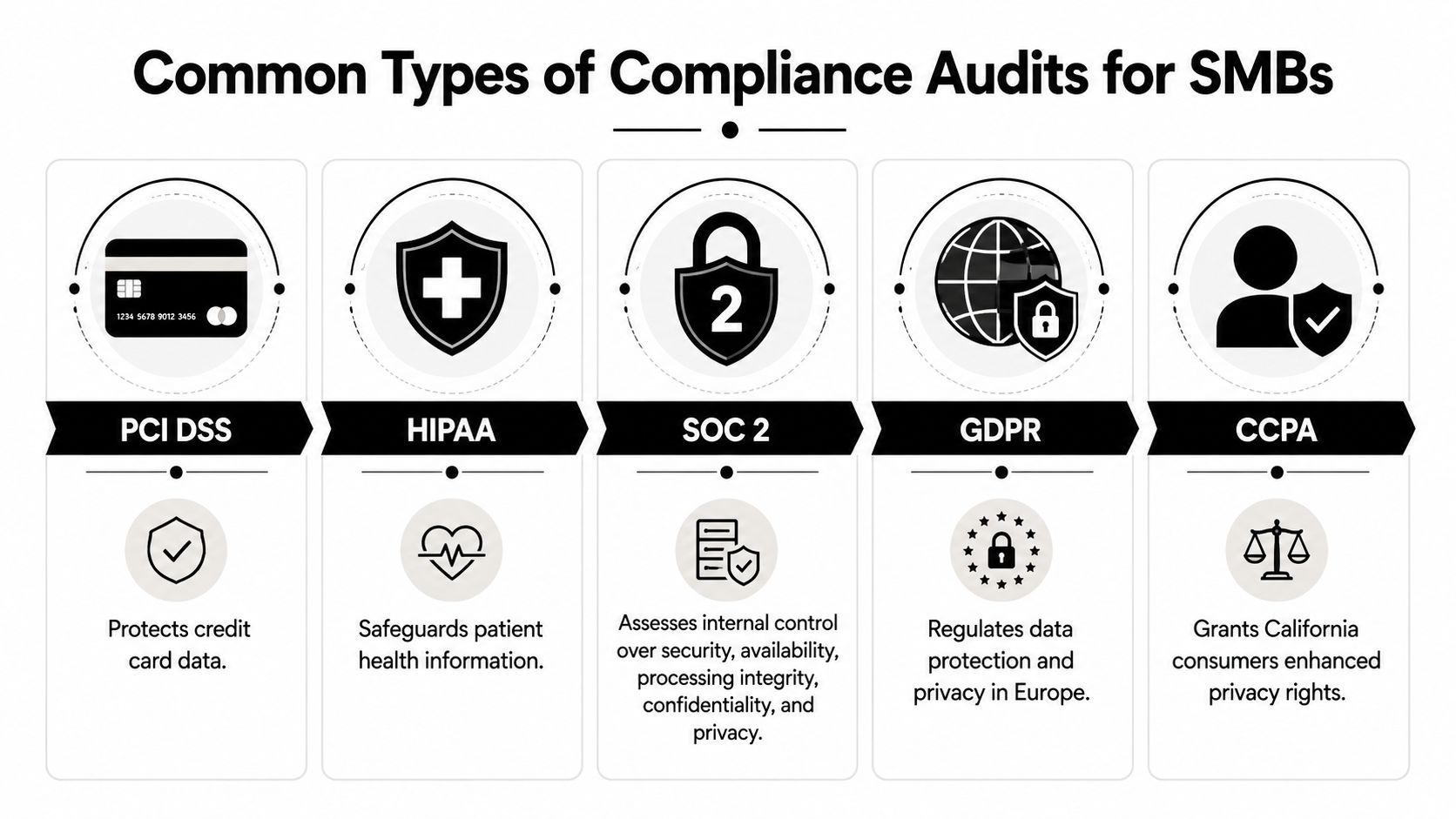
The mistake SMBs make is trying to “be compliant” in general. That's too vague to manage. The better move is to identify the exact framework or frameworks that apply, then build controls and evidence around those rules instead of guessing.
For businesses also dealing with financial reporting obligations, a useful internal reference is the discussion of SOX compliance requirements, because finance controls and security controls often overlap in real operations.
Bottom line: the audit type determines the evidence burden, the control set, and the people who need to be involved.
The Anatomy of a Typical Audit Process
Audits feel chaotic when the workflow is hidden. They're far easier to manage when the business knows the sequence in advance and assigns the right people to each step.
What happens first
The process usually starts with planning and scoping. That means the auditor and the business agree on what's in scope, what criteria will be used, and which systems, processes, or locations matter. After that, the business should expect evidence gathering, which is where documents, logs, interviews, and technical tests come into play.
SailPoint describes the standard sequence as planning, gathering evidence, evaluating evidence, forming conclusions, and reporting results SailPoint compliance audit workflow. That's the roadmap owners should use internally as well. If the business can't identify the right records early, the rest of the audit becomes slower and more painful than it needs to be.
What the auditor is really checking
The middle of the audit is where most owners get surprised. Auditors don't just ask for policies, they want to see whether the controls are operating. That can include reviewing a process walkthrough, testing a sample, or checking whether a review happened when it was supposed to happen.
IBM's description of the audit's formal closeout matters here too, because the process doesn't end with a conversation. It ends with a report and often follow-up monitoring IBM's compliance audit overview. That means the business should be ready to answer findings, not just collect them.
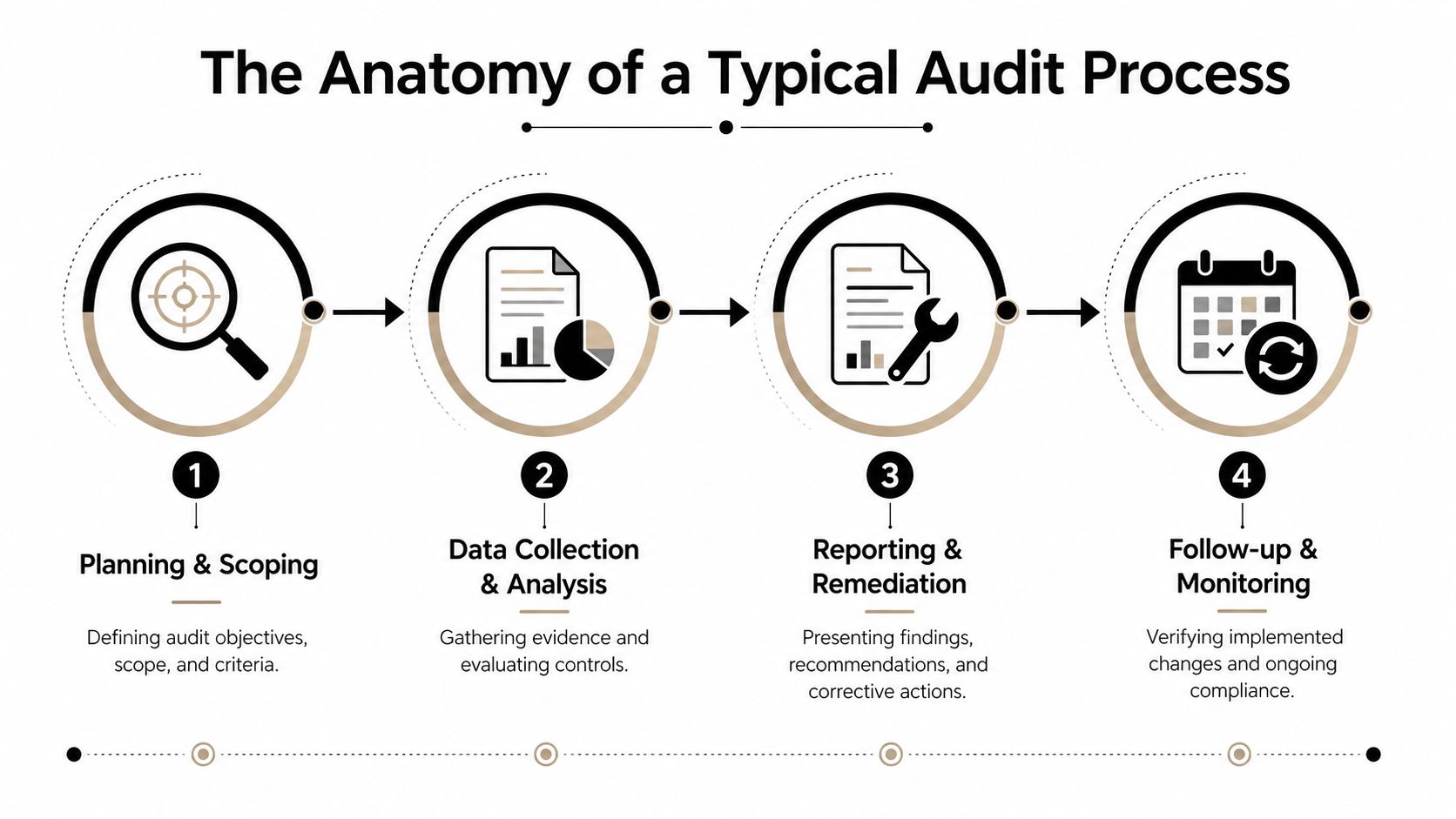
The best way to think about an audit is as a chain. If one link is weak, usually the issue is scope, evidence, or ownership, not the framework itself.
For a business owner, that means three things need to be clear before fieldwork starts, the scope, the point person, and the evidence set. Everything else flows from those decisions.
How to Prepare for a Smooth Compliance Audit
Last-minute scrambling is what makes audits expensive. Continuous readiness is what makes them manageable.
Build the evidence system before the auditor arrives
Recent guidance for 2026 stresses documentation quality, spot checks, and clear audit trails Hyperproof compliance audit checklist. SMBs should aim for this standard. Not perfect paperwork, just a repeatable evidence system that can survive a surprise review, a renewal cycle, or a customer due diligence request.
The most practical starting point is simple:
- Identify applicable controls: Map the frameworks and internal rules that apply.
- Document policies and procedures: Make sure they're current and easy to find.
- Run an internal gap review: Find weak spots before the auditor does.
- Train staff on their roles: People can't support controls they don't understand.
- Keep audit trails clean: Preserve logs, approvals, and review evidence.
- Review vendors and contracts: Third-party gaps become your problem fast.
Make readiness part of daily operations
A readiness program works best when records are created as work happens, not reconstructed later. That's why centralized evidence ownership matters, and why businesses often benefit from a structured cybersecurity risk assessment template to organize controls, risks, and artifacts before the audit calendar gets tight.
Practical rule: If the evidence lives in five inboxes and three shared drives, the audit will slow down.
There's also value in using outside preparation resources when the team needs a second set of eyes. A useful complement to internal preparation is reducing audit stress for your business, especially when the goal is to keep records organized and avoid a fire drill.
The business owner's job is not to become the auditor. It's to make sure someone owns each control, each document set, and each follow-up action. When that structure exists, the audit becomes a routine proof exercise instead of a crisis.
Understanding Common Findings and Remediation
Most audit findings are boring in the best possible way. They usually point to missing documentation, weak access control, inconsistent monitoring, or a control that exists on paper but not in practice.
What findings usually mean
A finding doesn't automatically mean the business is failing. It usually means the auditor saw a gap between the control the business claims to run and the evidence available to prove it. Missing policies, outdated approvals, unclear role assignments, and incomplete logs are common reasons findings show up.
The important move is to treat findings as a work plan, not a verdict. That means assigning an owner, setting a corrective action, documenting the fix, and confirming the control works after the fix is made. If the issue is not immediately fixable, it still needs to be tracked and monitored until closure.
Why remediation matters financially
The reason remediation gets serious attention is simple. Sprinto reports that the global average cost of a data breach is $4.4 million in 2025, and that the U.S. SEC ordered $600 million in penalties for recordkeeping failures alone in FY2024 Sprinto compliance statistics. Those numbers show that weak controls don't stay abstract for long. They turn into legal, financial, and operational damage.
A business that fixes findings quickly is doing more than appeasing an auditor. It's lowering exposure and improving the odds that the next review goes faster. That's the point of remediation, to close the gap before the gap becomes an incident or enforcement problem.
Bottom line: A finding is a management task. Ignore it, and it becomes a business risk.
Your Partner in Compliance Readiness and Remediation
SMBs don't need more compliance theory. They need a partner who can turn controls, evidence, and remediation into something operational.
Where support actually helps
Technovation's value is in the unglamorous parts that make audits pass. Free security audits and IT health checks help identify weak controls before a formal review. Ongoing monitoring helps keep logs, alerts, and system changes from drifting out of compliance. Remediation support helps update technical controls, tighten access, and create cleaner evidence for the next audit cycle.
That matters in a DFW environment where many businesses are juggling customer demands, regulated data, and lean internal teams. The audit burden gets much easier when a managed partner handles the repetitive control work and keeps the evidence trail organized. For businesses using a shared IT model, co-managed IT support can be the difference between scattered responsibility and a clear operating rhythm.

What a strong partner should do
A real compliance partner doesn't just point out gaps. It helps close them, documents the fix, and keeps the business ready for the next review. That includes supporting policy updates, coordinating evidence, and making sure the technical environment matches what the business says in its audit narrative.
The strategic win is bigger than passing one audit. It's creating a predictable compliance rhythm that protects revenue, shortens sales cycles, and reduces the operational drag that audit season creates. For SMBs that want that outcome, Technovation LLC is built to provide the IT and security support that makes compliance sustainable, not episodic.
Frequently Asked Questions About Compliance Audits
Is a compliance audit always pass or fail? No. A compliance audit can produce an audit opinion, certification, or report on compliance depending on the framework Optro's compliance audit overview. Noncompliance can still carry consequences even when the result isn't framed as a failed exam.
How much does a compliance audit cost for a small business? It depends on scope, the number of systems involved, and how organized the evidence already is. A narrow review with clean records is easier to manage than a broad audit with multiple frameworks and messy documentation.
How should evidence be managed between audits? Evidence should live in one organized system with clear owners, naming rules, and retention habits. The best approach is to keep policies, logs, contracts, training records, and remediation status current all year instead of rebuilding them at the last minute.
What's the smartest first move for an SMB? Start with a readiness review, identify the controls that matter, and assign one accountable owner for the process. That's the fastest way to reduce confusion and make the next audit far less disruptive.
If your business needs a clearer path to audit readiness, reach out to Technovation LLC for practical help with security reviews, remediation, and ongoing compliance support that keeps your team prepared all year.