
A lot of DFW business owners are already dealing with identity management problems. They just aren't calling them that yet.
It usually looks ordinary. A growing medical practice has logins stored in a spreadsheet because people need quick access. A law office shares one account for a specialized system because it's easier than setting up separate users. A construction firm keeps an old superintendent's account active because nobody is fully sure what it touches. A nonprofit brings on a contractor fast, grants broad access, and forgets to clean it up later.
None of that feels like a major project in the moment. It feels like getting work done.
But those workarounds create drag, confusion, and blind spots. They also create compliance headaches for healthcare, legal, finance, and other regulated businesses across Dallas-Fort Worth. Identity management services exist to clean that up. They give a business a sane way to control who gets access, when they get it, and when it should be removed.
Table of Contents
- Your Business Has an Identity Problem You Might Not See
- Beyond Passwords A Digital Gatekeeper for Your Business
- The Core Components of a Modern Identity Strategy
- From IT Cost to Strategic Business Advantage
- Implementing IdM in Your Regulated Business
- A Practical Checklist for Selecting Your DFW Provider
- Your Next Step Toward Secure and Efficient Operations
Your Business Has an Identity Problem You Might Not See
A common SMB pattern goes like this. The company starts small, everyone knows everyone, and access gets handed out informally. Then the business grows, adds cloud apps, hires part-time staff, works with outside vendors, and suddenly nobody has a clean answer to a basic question: who has access to what?
That is an identity problem.
Growth usually creates access chaos
One office manager creates accounts. Another person resets passwords. A department head asks for "admin rights just for now." Someone leaves, but their account stays live because shutting it off might break a workflow. The business isn't reckless. It's busy.
For regulated firms, that mess creates more than inconvenience. It creates exposure around client data, patient information, financial records, contracts, and internal documents. Legal teams dealing with confidentiality concerns often run into the same issue, which is why resources on Implementing law firm data security are useful reading even outside the legal field.
The biggest identity risk in a small business usually isn't a sophisticated attack. It's unmanaged access that built up one exception at a time.
The warning signs are easy to miss
A business likely needs identity management services if any of this sounds familiar:
- Shared accounts exist: Multiple people use the same login for a line-of-business system.
- Offboarding is manual: Access gets removed only when someone remembers.
- Vendors have long-term access: Third parties keep credentials long after the original project ends.
- Nobody owns the process: HR, operations, and IT each handle one piece, but no one sees the whole picture.
- Audits are painful: Pulling a clean access report takes too long and still feels incomplete.
This isn't a moral failing. It's a maturity issue. Growing organizations outgrow informal access practices before they realize it.
The real issue isn't passwords alone
Passwords are only the visible part. The deeper issue is identity sprawl. Every employee, contractor, temp worker, vendor, and service account becomes a doorway into business systems. When that access isn't governed centrally, the company loses visibility. Once visibility is gone, control usually follows.
That is why identity management services matter. They take a problem most owners feel only as friction and turn it into a managed business process.
Beyond Passwords A Digital Gatekeeper for Your Business
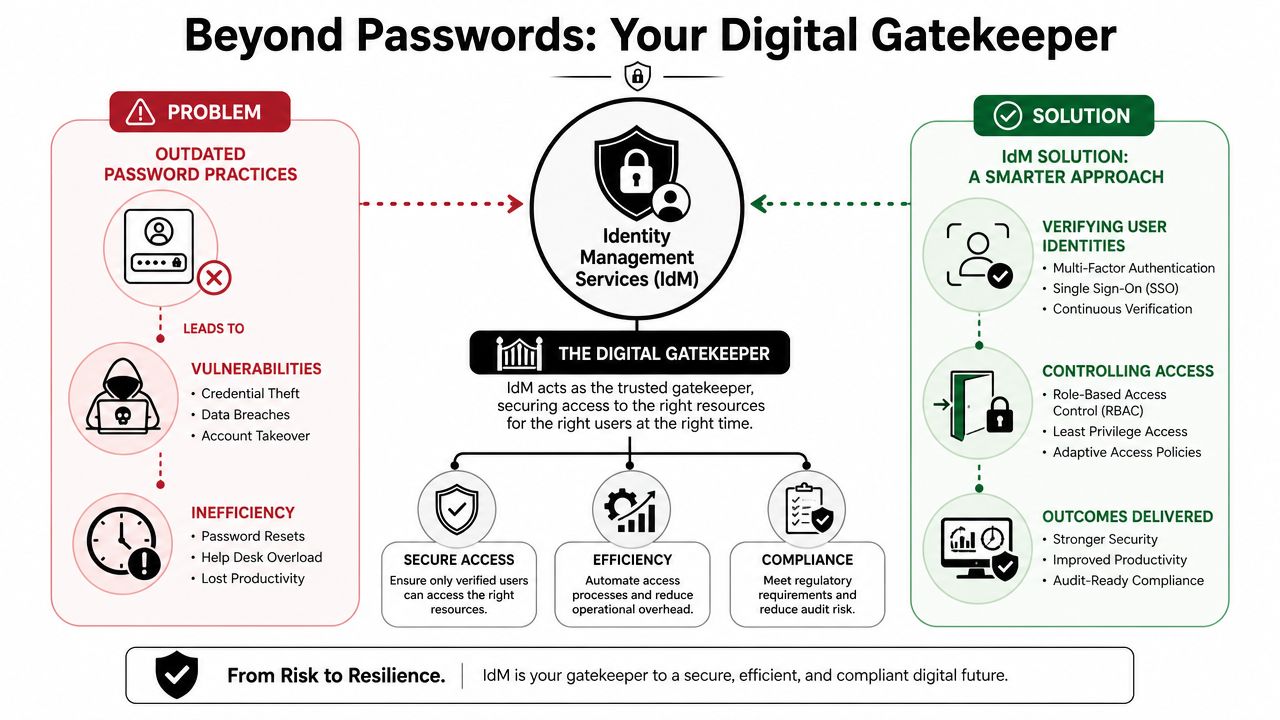
Identity management services should be understood as a digital gatekeeper for the business. Not a password vault. Not a one-off security tool. A gatekeeper.
That gatekeeper decides who can enter, what doors they can open, and what should happen when their role changes.
What the gatekeeper actually does
At a practical level, identity management services help a business do four things well:
- Verify identity
The system confirms a user is who they claim to be.
- Grant the right access
Users get access based on role, job function, location, or policy.
- Block improper access
The wrong person, wrong device, or wrong request gets stopped.
- Remove access fast
When a person leaves or changes roles, access changes with them.
That is the difference between modern identity management and old-school login administration. One is strategic control. The other is just account maintenance.
Why this moved to the center of security
Identity has become a primary attack surface. In a 2022 survey, 89% of organizations said they'd experienced an identity-based attack, and 80% believed these attacks were becoming more complex, according to SentinelOne's IAM overview.
That should change how business owners think about the issue. Identity management isn't an IT cleanup task anymore. It's part of core business protection.
Practical rule: If a company can't quickly confirm who has access to sensitive systems today, it doesn't control its environment as well as it thinks it does.
Good identity management should reduce friction
Business owners often assume tighter identity controls will slow everyone down. Poorly designed controls do. Well-designed ones do the opposite.
A strong identity program lets employees sign in with less confusion, fewer reset requests, and clearer access paths. It also reduces the bad habit of sharing credentials because people can get proper access faster. For many SMBs, a sensible place to start is stronger sign-in protection. This small business guide to implementing multi-factor authentication is useful because MFA is often the first identity control that delivers immediate value.
Centralization matters
Without a central system, access decisions are scattered across email threads, sticky notes, admin panels, and tribal knowledge. With identity management services, those decisions move into a governed process.
That gives leadership something it usually doesn't have today. Visibility.
The Core Components of a Modern Identity Strategy
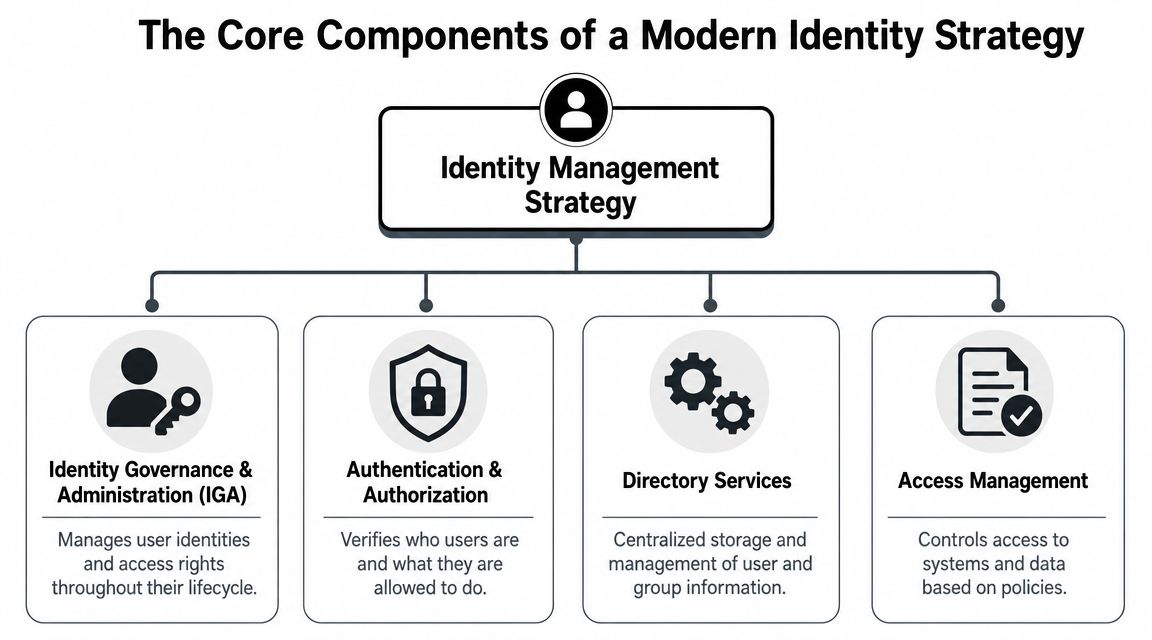
A modern identity strategy isn't one feature. It's a set of connected controls that work together. When those controls are missing or disconnected, a business ends up with loose access, duplicate work, and avoidable compliance trouble.
Authentication, federation, and token services
Good identity architecture separates core services instead of jamming everything into one overloaded process. Effective systems are commonly broken into authentication, federation, and token services to improve scalability and enforce policies like least privilege across multiple applications, as explained in Curity's identity management system guidance.
For a business owner, that means:
- Authentication handles sign-in and account recovery.
- Federation lets users move between systems without constant reauthentication chaos.
- Token services manage secure access for web apps, mobile apps, and APIs.
The technical labels matter less than the operational outcome. Each part has a job, and that separation makes the whole system easier to manage and secure.
The components that matter most to SMBs
A useful identity strategy for a DFW SMB usually includes these working parts:
- Single sign-on
Staff stop juggling a mess of separate passwords. Access becomes faster and cleaner.
- Multi-factor authentication
A stolen password alone shouldn't be enough to get in.
- Lifecycle management
New hires get the right access quickly. Departing staff lose access just as quickly.
- Role-based access
People get access tied to what they do, not whatever somebody approved in a hurry last year.
- Directory and group management
User information lives in one controlled place instead of scattered across systems.
The hidden architecture issue most SMBs miss
A strong identity system should use a unidirectional flow of authoritative data from source systems into identity stores. Circular modification is discouraged in identity architecture guidance because it creates sync conflicts, stale entitlements, and audit problems when personnel records change, according to The Open Group's identity architecture guidance.
That sounds technical, but the business point is simple. There should be one trusted source for identity facts.
If HR marks an employee inactive, the identity system should inherit that change cleanly. It shouldn't depend on three separate teams editing three separate systems and hoping they all match.
Businesses should decide where identity truth lives before they buy anything. If that decision is fuzzy, access control stays messy.
Classification strengthens identity decisions
Identity and access work better when the business also knows which data matters most. A team that understands sensitive records, internal-only documents, and general-use information can apply access rules with much more precision. Under these conditions, data classification becomes practical, not academic.
Identity strategy works best when it answers one blunt question: who needs access to which information, and why?
From IT Cost to Strategic Business Advantage
A lot of owners still view identity management services as overhead. That's outdated thinking. Properly implemented identity controls create business value in four very practical ways.
Security gets stronger without adding chaos
The obvious gain is better control over access to systems and data. But the stronger point is consistency. The business stops relying on memory, favors, and improvised exceptions.
When access follows policy instead of habit, there are fewer loose ends. Fewer people carry broad permissions they no longer need. Fewer former workers linger in systems. Fewer vendors stay connected after the engagement is over.
Productivity improves because access stops being a scavenger hunt
Employees lose time when they can't get into the tools they need, or when they have to bounce between multiple sign-ins with no clear process. Identity management services reduce that noise.
A smoother sign-in experience also reduces shadow behavior. People are less likely to share credentials, reuse risky shortcuts, or bypass process when the approved path is easier than the workaround.
| Business issue | What identity management changes |
|---|---|
| New hires wait for access | Access can be tied to role and provisioned in a repeatable way |
| Staff forget passwords constantly | Sign-in becomes more streamlined and support requests drop |
| Managers over-approve access | Permissions can be standardized and reviewed |
| Departing users stay active too long | Offboarding becomes controlled and faster |
Compliance gets easier to prove
Regulated businesses don't just need control. They need evidence of control.
Healthcare groups, legal practices, financial firms, and contractors working under strict requirements all benefit when access approvals, changes, and removals are visible. Audit preparation gets easier when the business can show who had access, who approved it, and when it changed.
Better compliance usually starts with better access records, not better excuses during the audit.
IT gets out of manual cleanup mode
Effective identity and access management is a prerequisite for a zero-trust security model and can reduce IT burden through automated workflows for onboarding, offboarding, and access requests, according to GuidePoint Security's IAM overview.
That matters for SMBs because their IT teams are often thin. When skilled staff spend their day resetting passwords, chasing approvals, and manually disabling accounts, they aren't working on resilience, planning, or business improvement.
Identity management services free that time up. That's not just an efficiency gain. It's better use of expensive talent.
Implementing IdM in Your Regulated Business
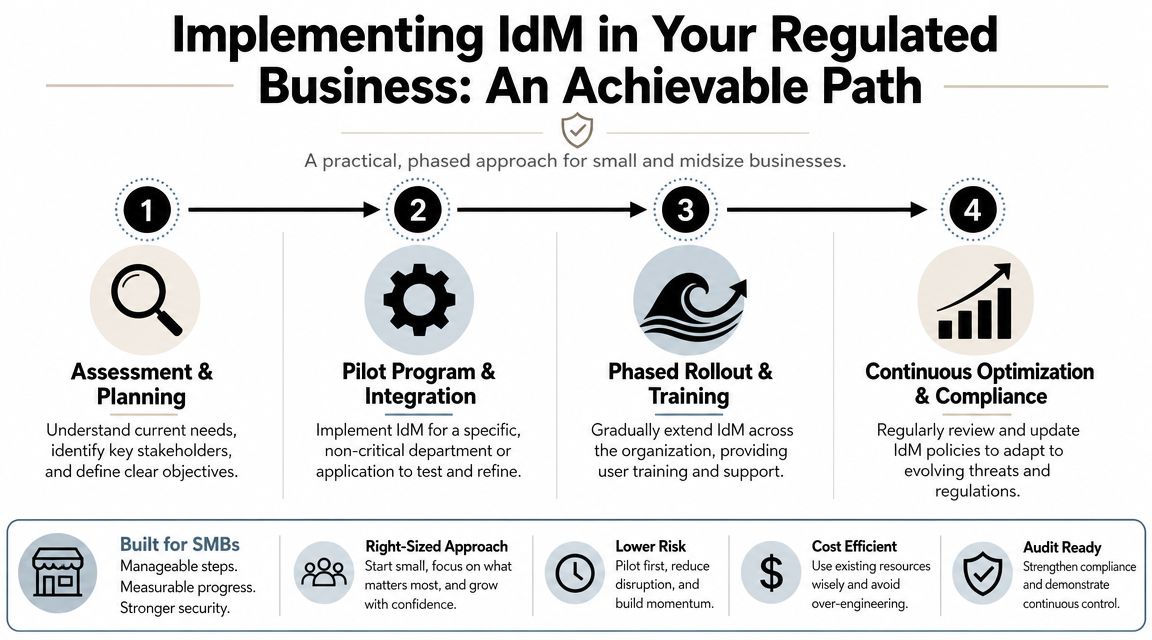
Most SMBs delay identity work because they assume implementation will be disruptive. It doesn't have to be. The right approach is phased, practical, and tied to business risk.
Start with the access mess that hurts most
A regulated business doesn't need to fix everything at once. It needs to identify the systems and users creating the most risk or operational pain.
A sensible rollout often starts here:
- Critical user groups first: Admins, finance staff, clinicians, legal staff, or leadership.
- High-value systems next: Email, file access, line-of-business apps, remote access, and client or patient data systems.
- Offboarding before optimization: Revoking access reliably matters more than polishing edge cases.
That sequencing works because it addresses the biggest business exposure early.
Regulated firms need third-party control
Many SMBs think identity management is mostly about employees. In regulated environments, that view is too narrow. Healthcare guidance makes the point clearly: IAM is critical for managing vendors, contractors, and other external users, and automating the lifecycle of those third-party identities improves visibility and reduces hidden risks that many SMBs overlook, according to HealthTech's healthcare IAM reporting.
That lesson applies well beyond healthcare. Law firms use expert consultants. Construction companies use subcontractors. Nonprofits use outside accountants and grant specialists. Every one of those relationships creates identity exposure.
Third-party access should have an owner, a purpose, and an end date. If it doesn't, it shouldn't exist.
A workable rollout for SMBs
A practical identity rollout usually follows a rhythm like this:
- Assess current access
Find shared accounts, stale users, broad permissions, and vendor access.
- Define access rules
Decide who should approve what, which roles need which systems, and how offboarding should trigger removal.
- Roll out foundational controls
Put strong sign-in controls and centralized access policies in place first.
- Automate lifecycle tasks
Connect onboarding, role changes, and terminations to repeatable workflows.
- Review and refine
Check logs, approvals, exceptions, and policy drift regularly.
Healthcare, legal, and other compliance-driven organizations should also make sure identity work supports their formal obligations. For organizations focused on medical data handling and regulated operations, HIPAA-compliant IT services are part of the larger access governance picture.
A Practical Checklist for Selecting Your DFW Provider
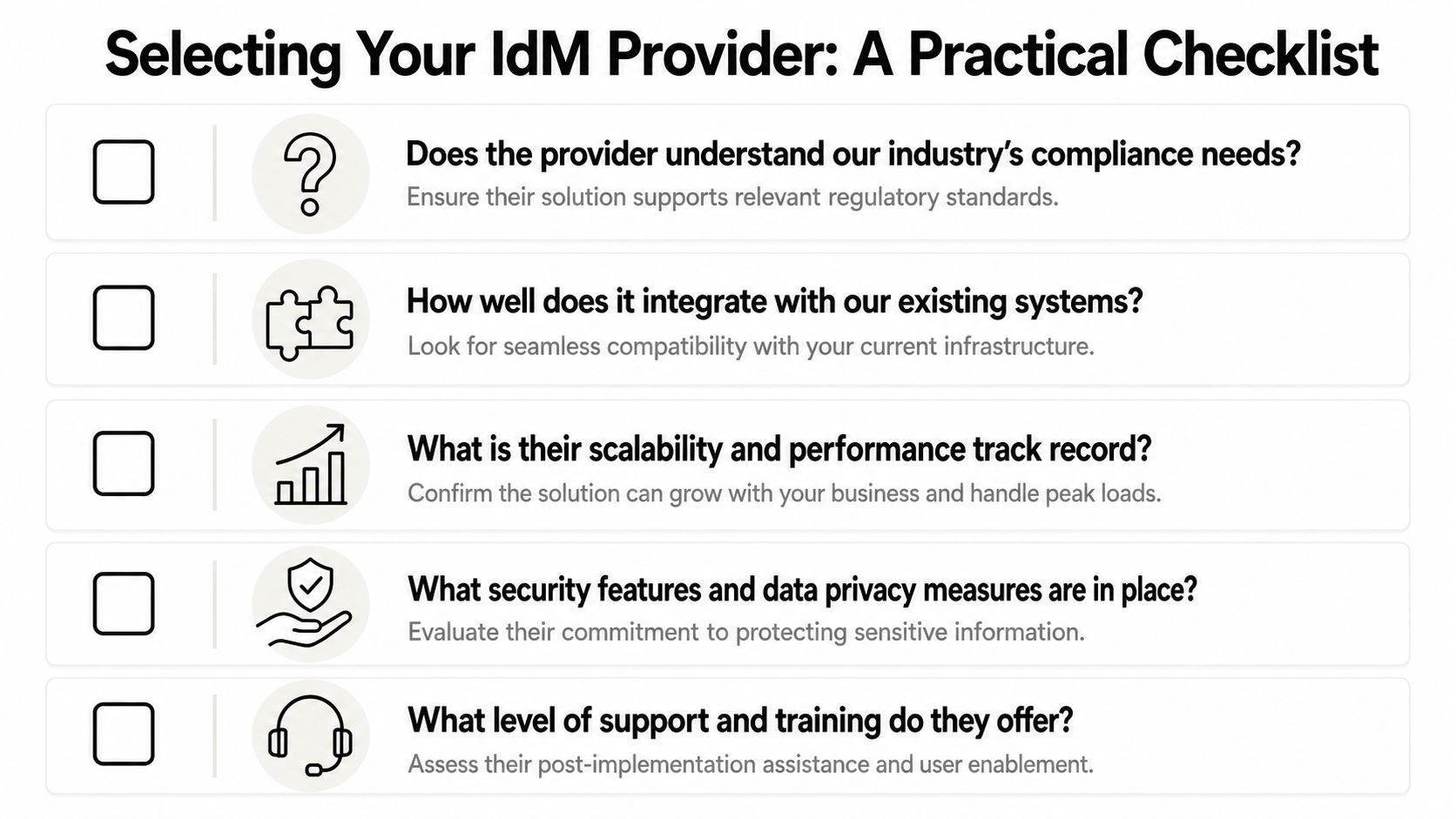
Not every provider is equipped to handle identity management services well. Some can install software. Far fewer can align identity controls with regulated workflows, business operations, and real accountability.
Ask better questions before signing anything
A business owner should press on specifics, not broad promises. These questions reveal whether a provider understands the work.
How do they handle regulated environments?
A provider should be comfortable mapping identity controls to healthcare, legal, financial, nonprofit, or contractor-heavy operations.How do they approach third-party access?
Vendors and contractors create real risk. A weak answer here is a red flag.Can they support both security and usability?
If their answer is only about lockdown, they may create user revolt. If it's only about convenience, they may create exposure.What does offboarding look like in practice?
The answer should be process-based, not improvised.How do they review access over time?
Identity isn't a one-time setup. Access needs governance.
Look for operational maturity, not product talk
A strong provider talks about workflows, approvals, auditability, and business alignment. A weak one talks only about features.
Use this shortlist when evaluating options:
| What to ask | What a strong answer sounds like |
|---|---|
| Do they understand the business model? | They ask about employees, contractors, departments, systems, and compliance obligations |
| Can they support local operations? | They understand response expectations and stakeholder coordination in a DFW business environment |
| Do they plan in phases? | They avoid pushing an all-at-once rollout |
| Do they define ownership? | They clarify who approves access, who reviews it, and who handles exceptions |
The provider should feel like an advisor
A business doesn't need a vendor that drops in a tool and disappears. It needs a partner that can translate identity controls into daily operations. That means working with leadership, HR, compliance stakeholders, and internal IT without turning every access decision into a ticketing nightmare.
For DFW organizations evaluating broader support quality, this guide on how to choose a managed service provider is useful because it separates reactive support from strategic partnership.
If a provider can't explain identity management in plain language to leadership, they probably can't implement it cleanly for the business either.
Your Next Step Toward Secure and Efficient Operations
Identity management services have moved out of the background. They are now part of how serious businesses protect operations, support compliance, and keep teams productive. The market reflects that shift. One projection values the global identity and access management market at USD 25.34 billion in 2026 with a projected 15.10% CAGR, according to Fortune Business Insights' IAM market outlook.
That growth matters because it confirms what regulated SMBs already feel on the ground. Identity is no longer a niche IT concern. It's a core security and operations discipline.
For DFW businesses, the practical lesson is simple. If access still depends on spreadsheets, shared logins, manual offboarding, and scattered approvals, the business is carrying more risk and inefficiency than it needs to. The good news is that this is fixable. It doesn't require a giant transformation project. It requires a disciplined approach, the right priorities, and a partner that understands both compliance and day-to-day business reality.
The strongest next step is an honest review of the current environment. Which accounts are still active that shouldn't be? Where does third-party access exist? Which systems have weak approval processes? Where are employees fighting the sign-in process instead of working?
Those answers usually surface the roadmap.
Technovation LLC helps Dallas-Fort Worth businesses turn identity management from a recurring headache into a controlled, compliant, and efficient business process. For healthcare practices, law firms, financial organizations, construction companies, nonprofits, and other regulated teams, a focused identity review can reveal where access is too broad, too manual, or too hard to track. Contact Technovation for a complimentary, no-obligation IT health check or security audit and get a clear picture of the current identity security posture.