
Most Dallas-Fort Worth companies asking about CMMC Level 3 are starting with the wrong question.
The first question isn't how to pass it. The first question is whether the business should be preparing for it at all.
That matters because CMMC Level 3 isn't a bigger, shinier version of Level 2. It's a narrow requirement for a small, high-risk slice of the defense industrial base. Many business owners hear “highest tier” and assume they need to chase it early. That's a fast way to waste time, overbuild security controls, and distract the team from the requirements that affect current contracts.
For companies that need to navigate CMMC for government contracts, clarity on scope comes first. For DFW businesses already reviewing broader data security and compliance services, CMMC Level 3 should be treated as a business qualification issue, not just a technical checklist. The companies that handle this well don't panic. They validate need, lock down Level 2, and only then build the advanced operational muscle that Level 3 expects.
Table of Contents
- An Introduction to CMMC Level 3 Readiness
- What Is CMMC Level 3 and Who Really Needs It
- Mapping the 134 Security Practices
- The CMMC Level 3 Assessment and Certification Path
- Creating Your Gap Remediation Plan
- The Timeline and Cost of CMMC Level 3
- Your CMMC Readiness Checklist for DFW Businesses
An Introduction to CMMC Level 3 Readiness
CMMC Level 3 gets talked about like a badge. It's not. It's a serious operational commitment tied to sensitive DoD work.
That distinction matters for DFW owners who already manage healthcare, legal, finance, manufacturing, engineering, or mixed commercial and government operations. A business can be security-conscious, well-run, and nowhere near needing Level 3. Another company can have a modest headcount and still need it because one program exposes it to a much higher threat profile.
The real business question
A practical view of CMMC Level 3 starts with contract reality, data exposure, and mission sensitivity. If leadership can't explain which systems handle CUI, which teams touch it, and why a contract would require heightened protection, then it's too early to discuss advanced controls. The business has a scoping problem first.
That's why Level 3 readiness isn't just an IT matter. Legal, operations, program management, procurement, and executive leadership all have a role. If those groups aren't aligned, the compliance effort turns into a documentation exercise with no operating discipline behind it.
Practical rule: If a company hasn't already built a clean, defensible Level 2 environment, any Level 3 conversation is premature.
Why this topic creates so much confusion
The market over-discusses controls and under-discusses applicability. That leads many SMBs to assume Level 3 is the natural next step after Level 2. It isn't. Some businesses will never need it, and that's fine. The right move is to confirm need early, then invest in the right level of protection with intent.
Busy owners don't need more noise. They need a clean answer to one question: does this requirement affect current or target contracts enough to justify a major readiness program?
What Is CMMC Level 3 and Who Really Needs It

CMMC Level 3 is the top tier of the DoD's model, but that label causes confusion. The important point isn't that it's “higher.” The important point is that it applies to a small, high-risk subset of contractors handling CUI tied to national security-sensitive work, not to the general contractor population, as explained in this overview of CMMC levels and applicability.
Start with the contract, not the rumor mill
A business owner shouldn't assume Level 3 because a prime contractor mentioned stricter requirements or because a peer company is talking about it. The right starting point is the actual contract path.
Use these decision filters:
- Program sensitivity: If the work supports highly sensitive programs, leadership should assume the government may expect more than baseline CUI protection.
- CUI criticality: If the handled information is ordinary contract CUI, Level 2 may be the likely target. If the CUI is tied to national security risk, the conversation changes.
- Buyer language: If the solicitation or contract path points toward enhanced safeguards, that deserves immediate review by counsel, compliance leadership, and IT.
Many firms spend months preparing for the wrong level because nobody stopped to validate scope.
A better analogy for Level 3
Level 2 is like commercial flight operations. It requires discipline, training, checklists, and repeatable controls. Many organizations in the defense space will need that level of rigor.
Level 3 is more like operating a mission-critical aircraft in contested conditions. The environment is different. The threats are different. The tolerance for weak process is much lower.
That's why CMMC Level 3 isn't a general upgrade from Level 2. It's a specialized requirement for companies supporting the most sensitive programs. The business implication is simple. If a company doesn't clearly fit that profile, it shouldn't build toward Level 3 out of fear or marketing pressure.
A company can be very mature and still not be a Level 3 candidate. Need drives scope. Scope drives investment.
For DFW SMBs, this is good news. The right answer for many firms will be to harden Level 2, tighten data handling, and avoid building an advanced compliance machine they don't need. For the smaller group that does qualify, the job is to prepare deliberately and accept that Level 3 is less about paperwork and more about sustained defensive capability.
Mapping the 134 Security Practices
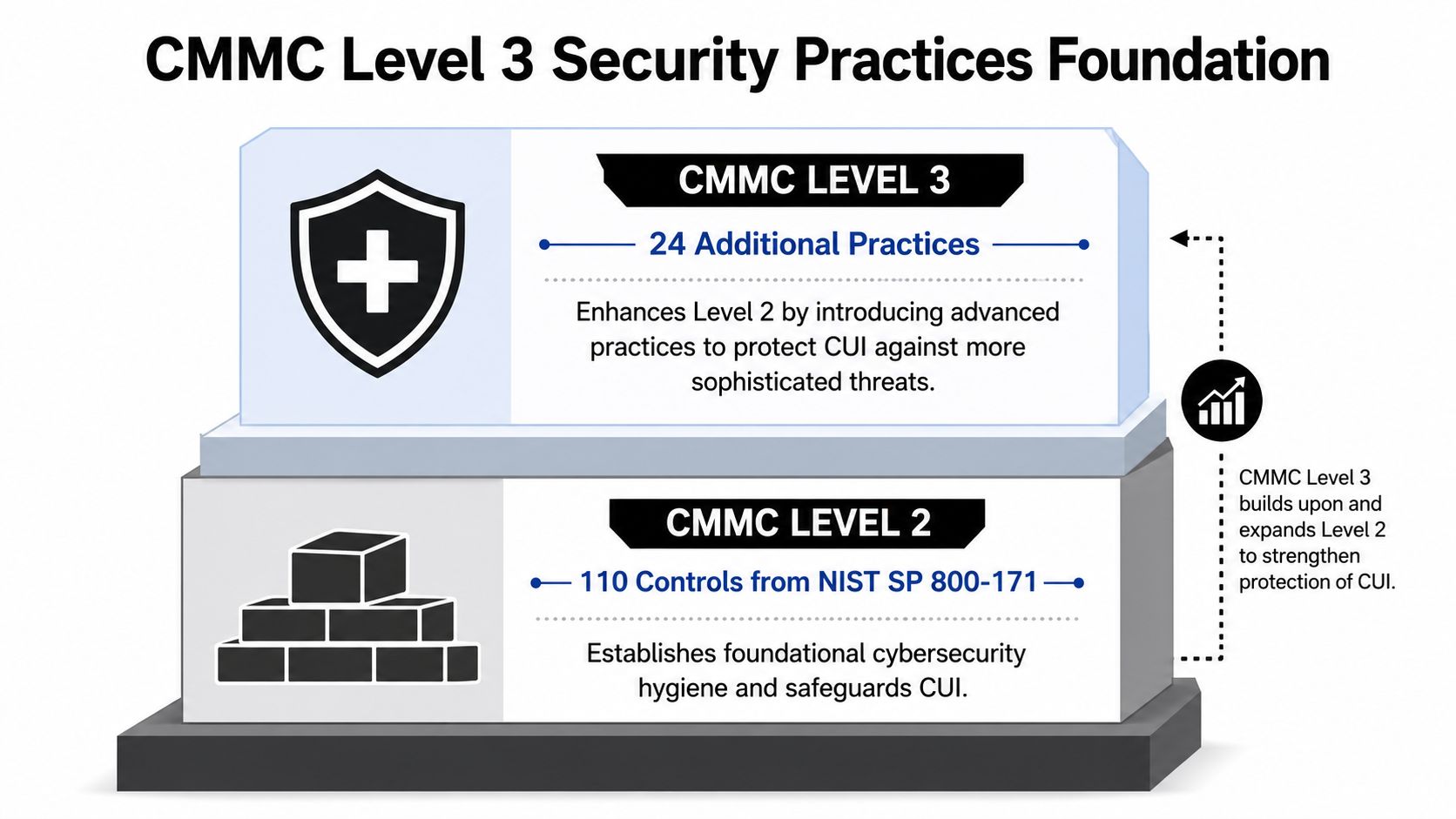
The structure is straightforward even if the implementation isn't. The DoD states that an organization must first achieve Final Level 2 for the same scope, then add 24 NIST SP 800-172 practices on top of the 110 NIST SP 800-171 Rev. 2 practices, for 134 total practices aimed at stronger resilience against advanced persistent threats in the DoD CMMC program overview.
The foundation is already heavy
A company that treats Level 2 as a checkpoint will struggle at Level 3. The base layer already demands disciplined handling of CUI, defensible access management, documented procedures, and technical safeguards that are effective in production.
Poor data classification practices become expensive. If the business can't clearly separate CUI systems from general business systems, the assessment scope spreads fast. More systems, more users, more evidence, more operational burden.
A simple way to view the structure is this:
| Layer | What it includes | Why it matters |
|---|---|---|
| Level 2 foundation | 110 practices from NIST SP 800-171 Rev. 2 | Establishes baseline protection for CUI |
| Level 3 expansion | 24 additional practices from NIST SP 800-172 | Adds stronger defenses against advanced threats |
| Combined expectation | 134 total practices | Requires both technical controls and mature operations |
What the extra practices are trying to accomplish
The added practices aren't random. They push the organization toward a more active defensive posture.
- Threat detection and response: The business needs stronger monitoring, faster response capability, and the ability to identify suspicious activity before it becomes a full compromise.
- Resilience against complex attacks: These practices are meant to improve resistance to advanced persistent threats, not just commodity malware or routine phishing.
- Stronger system separation: Physical or logical isolation techniques matter more when the mission impact of compromise is higher.
- Security validation: Annual penetration testing and around-the-clock operational capability reflect a shift from policy-based compliance to performance-based defense.
- Safer information handling: Secure transfer of sensitive information must be intentional, documented, and consistently enforced.
Bottom line: Level 3 expects a company to operate security as a living function, not a set of policies in a binder.
For leadership, that changes budgeting and staffing discussions. The business may need expanded logging, stronger segmentation, better incident workflows, tighter privileged access control, and documentation that matches day-to-day operations. If any of that sounds unfamiliar, the company isn't close yet. That's not failure. It's a planning signal.
The CMMC Level 3 Assessment and Certification Path
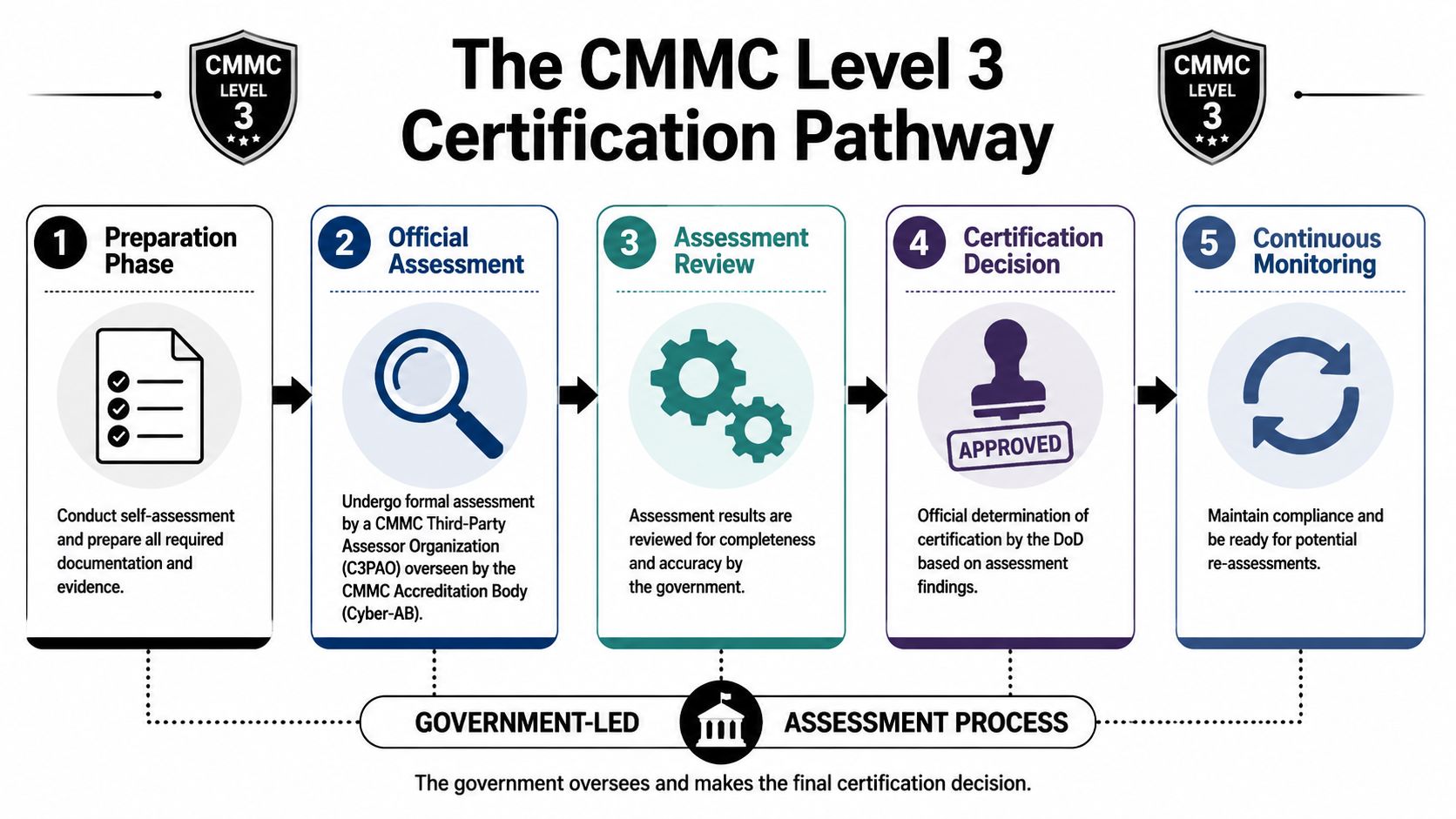
The certification path is stricter than many executives expect. One summary of the process notes that Level 3 requires prior Level 2 status, a perfect SPRS score of 110, no open Level 2 POA&Ms, and then a government review that may grant conditional status only if the organization meets at least 80% of the requirements and remediates the remainder within 180 days, as outlined in this CMMC Level 3 assessment summary.
The gate before the gate
The first mistake companies make is treating Level 3 as its own lane. It isn't. The business must arrive with a clean Level 2 posture for the same scope. That means unresolved Level 2 weaknesses don't just follow the company into the next phase. They stop progress.
The path looks more like a readiness funnel than a normal audit:
- Lock the scope: Define the environment that supports the covered work.
- Close Level 2 issues: No open cleanup list for foundational controls.
- Validate SPRS standing: The score has to reflect full completion at the required level.
- Prepare evidence for government scrutiny: Policies alone won't carry the assessment.
- Stand up the advanced operating model: Monitoring, response, testing, and isolation practices must be real.
For organizations retiring hardware or media as part of scoping or cleanup, this guide to data sanitization best practices is a useful operational reference.
What the government review changes
Level 3 raises the bar because the government is looking for sustained capability, not a staged demo. A business can't fake mature operations under that kind of scrutiny.
That's why the difference between vulnerability assessments and penetration testing matters. Finding weaknesses is one thing. Proving the organization can validate defenses, respond effectively, and keep controls working over time is another.
Consider what leadership should demand before any formal review:
- Evidence consistency: Documentation, system settings, and team behavior must match.
- Role clarity: Security, IT, operations, and leadership need defined responsibilities.
- Remediation discipline: Conditional status isn't a strategy. It's a short-term recovery path.
- Executive ownership: The assessment outcome can affect contract eligibility, so this can't sit only with the IT manager.
If the company is still debating who owns incident response, Level 3 readiness is not close.
This process rewards companies that treat compliance as an operating model. It punishes those that treat it as a project with an end date.
Creating Your Gap Remediation Plan
Level 3 remediation fails when companies attack it as a list of disconnected technical tasks. That approach burns budget and leaves the organization with half-built controls no one can sustain.
A useful remediation plan starts by separating foundational gaps from advanced operational gaps. The company should assume that the advanced items will require process redesign, documentation updates, and cross-functional ownership, not just tool configuration. Identity, access, monitoring, incident handling, and segmentation often intersect. That's why access architecture and identity management services become central in many environments.
Treat remediation like an operations program
The strongest plans usually organize work into a few business tracks instead of twenty-four isolated control projects.
- Scope and architecture: Confirm which people, systems, data flows, and locations are in play.
- Detection and response maturity: Build repeatable monitoring, escalation, and response practices that function outside business hours.
- Validation and assurance: Schedule penetration testing, evidence reviews, and internal readiness checks.
- Governance and documentation: Align policies, procedures, diagrams, inventories, and decision records with what the team really does.
A general 2026 network security audit framework can also help leadership think more clearly about recurring review cycles, especially when the environment has grown quickly.
Where businesses usually get stuck
Some firms underestimate how much operational maturity Level 3 expects. They buy security products, update a few policies, and assume they're progressing. Then the team discovers the actual issue. Nobody owns after-hours response. Logging is incomplete. Segmentation exists on paper but not in practice. Evidence is scattered. Exceptions were never formally resolved.
Use this triage model when building the remediation plan:
| Priority | What to target first | Why |
|---|---|---|
| Immediate | Scope definition, ownership, unresolved foundational gaps | These affect every later decision |
| Near-term | Monitoring, response workflows, access discipline, evidence collection | These shape day-to-day readiness |
| Strategic | Advanced isolation, recurring testing, sustained operations | These usually require the biggest organizational change |
Operator's note: The right remediation plan reduces audit stress because it fixes how the company works, not just how the company documents itself.
Leadership should insist on one roadmap, one owner, one reporting cadence, and one definition of done for each gap. Without that structure, Level 3 becomes a drifting compliance effort that drains attention from contracts and delivery.
The Timeline and Cost of CMMC Level 3
Executives usually want a number and a date. That's understandable. It's also the wrong way to estimate CMMC Level 3.
The better approach is to judge readiness by complexity. The organization's existing maturity, the cleanliness of its Level 2 environment, how tightly it controls CUI scope, and how much operational change is still needed will drive both timeline and budget. A company with a disciplined environment and strong documentation will move differently than one with mixed systems, weak ownership, and unclear data boundaries.
What drives the timeline
One reliable fact shapes every plan. CMMC Level 3 is highly selective. One industry source says the DoD estimates about 1% of the Defense Industrial Base will need it, and organizations must already hold a final CMMC Level 2 certification before they can even qualify for Level 3 assessment, according to this industry summary of Level 3 selectivity.
That means the clock doesn't start at Level 3. It starts with getting the business to a clean, stable, certifiable Level 2 state for the same scope. If that scope is messy, the schedule stretches.
Common timeline drivers include:
- Environment sprawl: More systems and users usually mean more evidence and more remediation.
- Operational maturity: A business with real monitoring and tested procedures moves faster than one starting from policy templates.
- Leadership availability: Decisions about scope, budget, staffing, and risk tolerance can't sit unresolved.
- Third-party dependence: External providers, inherited controls, and contract responsibilities often slow validation.
What actually drives cost
The expensive part isn't the label. It's the operating model behind it.
Cost usually comes from four buckets:
- Architecture work: Segmentation, secure transfer paths, access redesign, and isolation measures.
- Security operations: Monitoring, response readiness, logging discipline, and recurring validation.
- Documentation and evidence: Policies, procedures, inventories, diagrams, and proof of execution.
- Specialized expertise: Readiness planning, internal assessments, remediation management, and executive guidance.
For companies that need Level 3, this is not optional overhead. It's the price of staying eligible for sensitive defense work. For everyone else, chasing it early is wasteful. That's why the smartest move is still the same. Confirm applicability before funding a major program.
Your CMMC Readiness Checklist for DFW Businesses
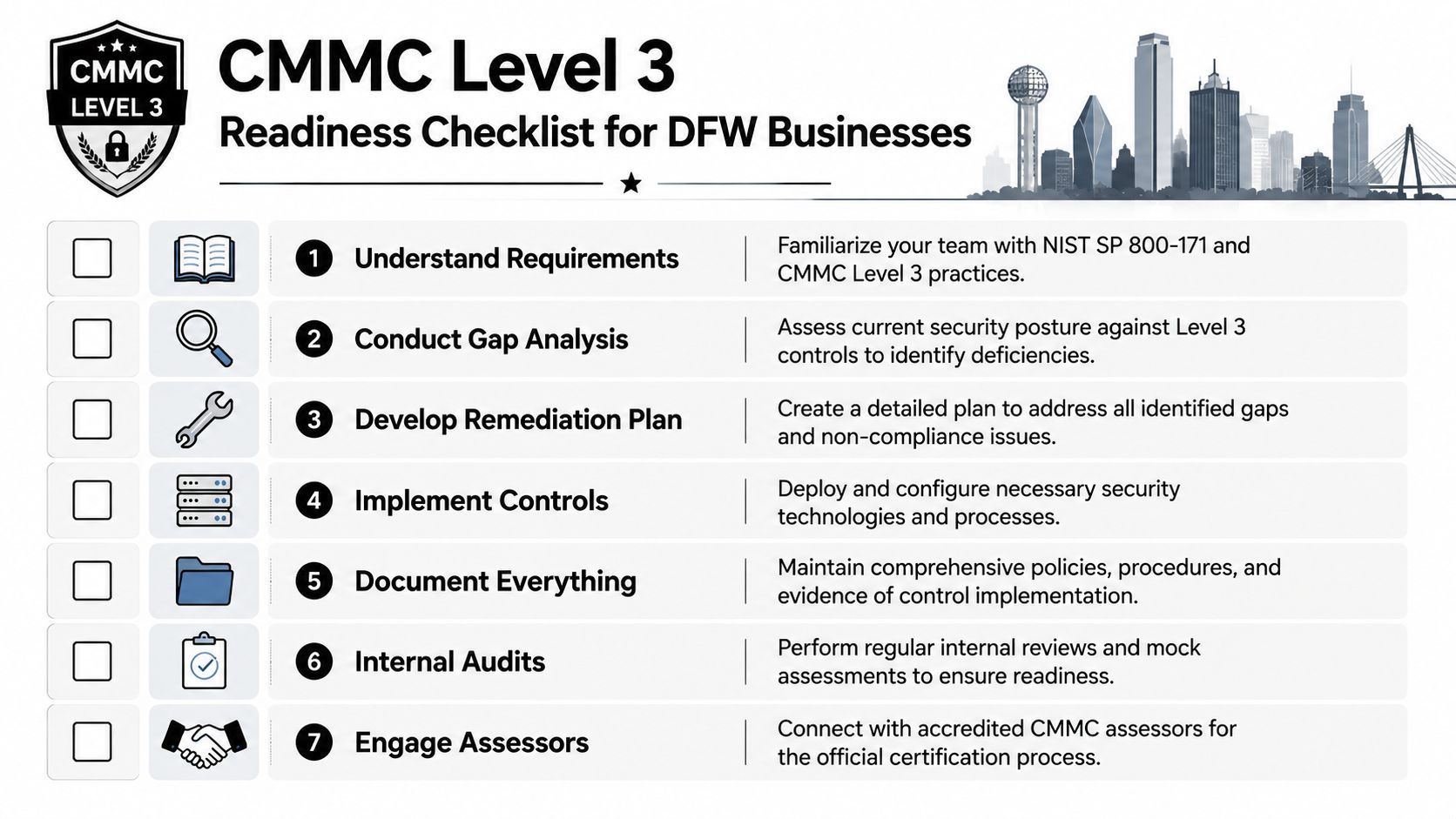
CMMC Level 3 readiness should end in a simple executive view. Either the business has a credible path, or it doesn't. Everything else is noise.
A practical seven-step checklist
Confirm the requirement
Validate that current or target contracts point the business toward Level 3. If the requirement is speculative, pause.Define the CUI boundary
Identify the systems, users, workflows, and locations tied to the sensitive work. Keep that scope tight and defendable.Stabilize Level 2 operations
Make sure the underlying environment is clean, documented, and sustainable. A shaky foundation will derail the advanced effort.Assess the advanced gap
Review the added practices with an operational lens. Focus on what the business must do every day, not just what it must write down.Build one remediation roadmap
Assign owners, dates, dependencies, and evidence requirements. A scattered control-by-control effort won't hold together.Run internal readiness reviews
Test whether documentation matches the live environment and whether staff can explain how controls operate.Prepare leadership for assessment ownership
The executive team should understand scope, residual risk, budget, and the consequences of delays before the formal process begins.
What smart DFW firms do next
A strong local company doesn't need fear tactics. It needs a disciplined decision.
If Level 3 doesn't apply, leadership should stop chasing it and focus on the controls that support real business risk and current contract obligations. If Level 3 does apply, the company should move early, tighten scope, and build a program that can survive scrutiny.
Readiness is less about sounding compliant and more about operating that way when nobody is watching.
For DFW businesses, local coordination matters. Leadership teams often need help translating federal requirements into practical workstreams across IT, compliance, operations, and executive management. The firms that handle this best move with structure, not drama.
Technovation LLC helps North Texas organizations turn security and compliance requirements into practical action plans. For DFW businesses that need a clear read on CMMC Level 3 applicability, tighter CUI scoping, stronger control implementation, or a realistic readiness roadmap, Technovation LLC offers local guidance grounded in business operations, not compliance theater.