
The phone rings too early, the office is already loud, and somebody says email is down again. The front desk can't send confirmations, the clinic can't pull charts, the law office can't find the latest thread, and three people start asking who's on it while nobody has a clean answer. That's what a weak incident management process looks like in a small business, not a technical failure, but a business one, because the clock starts bleeding money the moment ownership gets fuzzy.
A lot of DFW owners think downtime is solved by having a good technician on speed dial. That's not enough. You need a process that decides what gets logged, who gets called, how fast the issue gets classified, and when outside help takes over, because the pain isn't just the outage, it's the scramble.
Table of Contents
- The Moment an Outage Wakes You Up
- What the Incident Management Process Actually Is
- The Five Phases from the First Alert to the Final Review
- Setting Severity and Priority When Business Impact Is Unclear
- A Sample Playbook and Checklists You Can Actually Use
- Tools and Metrics That Turn the Process Into a Program
- Compliance and Industry-Specific Considerations in the DFW Market
- Putting It Together With a Partner Who Owns the Process
The Moment an Outage Wakes You Up
A dental office opens at 8:00, and by 8:05 the patient portal is frozen. The receptionist refreshes the screen, the office manager calls the internal contact, and the internal contact starts checking messages from three different places. Nobody has a written path, so the same question gets asked five times, and the first 20 minutes disappear into confusion instead of recovery.
That's the moment most small businesses finally feel the difference between “we have IT” and “we have control.” A real incident management process is built to stop that waste. It turns a panic-driven morning into a sequence where someone detects the issue, logs it with context, classifies it, and hands it to the right owner without waiting for a debate.
Why the first hour matters
The first hour is where SMBs either contain the mess or let it spread. If the outage touches scheduling, billing, login, or phone systems, the business feels it immediately, even if the technical root cause is still unknown. A documented process keeps the team from improvising under pressure.
Practical rule: if the business can't explain who owns the incident in one sentence, the process is already failing.
That's why outside support matters. Technovation's role is to make the response predictable, not dramatic, so the business isn't forced to invent structure during an outage. For a deeper look at how response planning is organized, the Overton Security incident response resources are a useful reference point for building discipline before the next disruption hits.
If the current response still depends on one overworked person remembering what to do, that's not resilience. A better model is a standing team, clear escalation, and a partner who can absorb the pressure instead of adding to it. In practical terms, a business can map its current response against Technovation's incident response team and see where the handoff breaks down.
What the Incident Management Process Actually Is
A strong incident management process is a closed-loop operating system. It doesn't just put out fires, it captures what happened, who owned it, how long it took, and what should change so the same problem doesn't keep returning. That's the difference between support and control.
The five phases that matter
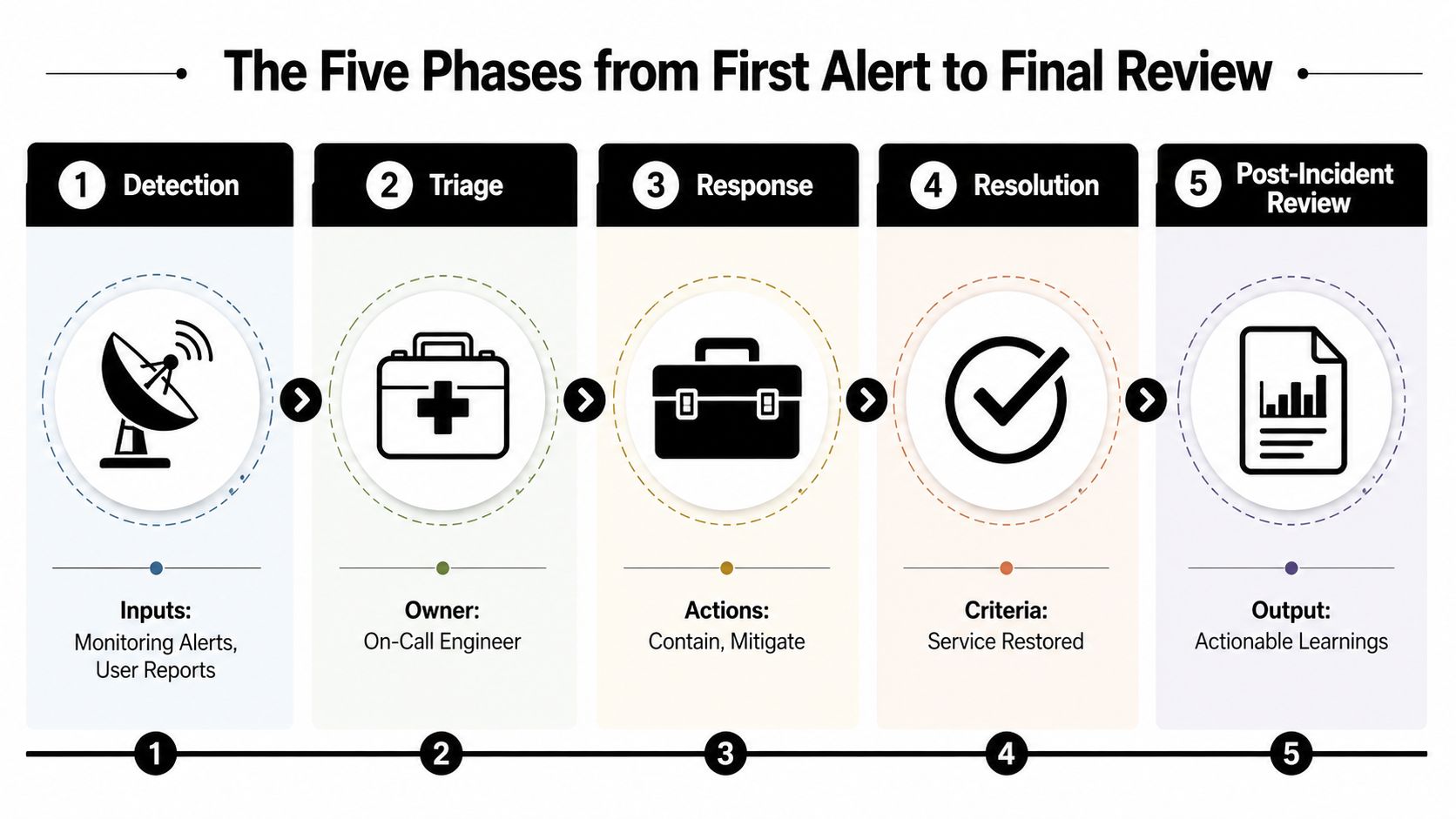
The cleanest way to think about it is as five phases, detection, triage, response, resolution, and review. Detection means someone or something notices the issue. Triage means the incident gets judged and routed. Response is the active work to contain and mitigate. Resolution is the point where service is restored. Review is where the team learns from the event and hardens the process.
This is not just theory. ITIL V3 treated incident handling as a measurable service-management discipline and pushed teams to track total incident volume, backlog, major incidents, mean elapsed time to resolution or workaround, response-time compliance, cost per incident, and reopened incidents as signs of process health. That matters because a ticket being closed is not the same as the business being stable, and reopened incidents are a blunt reminder that the first fix didn't stick. Micro Focus's incident management KPI guidance makes that logic plain.
The goal isn't to move tickets. The goal is to restore service, keep the business informed, and reduce recurrence.
The process never really ends, because the review phase feeds back into the next detection and triage cycle. A good MSP treats that loop as the operating model, not as a postscript after the outage is gone.
The Five Phases from the First Alert to the Final Review
Detection and logging
Detection starts with an alert, a user report, or a monitoring trigger. The first record needs the reporter, timestamp, symptoms, affected service, and a unique incident ID, because missing metadata makes every later handoff slower. Atlassian's incident guidance stresses structured logging, classification, prioritization, and escalation for exactly this reason, and it lines up with the SEI model of detect, triage, respond. Atlassian's incident management guidance is a solid shorthand for the intake discipline that keeps responders from guessing.
Triage and escalation
Triage is where the incident gets sorted, not just acknowledged. The responder decides what this affects, who should own it, and whether it needs to move immediately to a higher tier. NIST's incident handling lifecycle frames this work as part of detection and analysis, then containment, then post-incident activity, which is the same logic in a more formal security structure. NIST SP 800-61r2 gives that lifecycle its strongest technical backbone.
Response, resolution, and review
Response is the active containment stage. The team isolates, mitigates, reroutes, or disables what's causing the pain. Resolution comes when service is restored, not just when the issue looks smaller. Then the review phase captures what failed and what needs to change. IBM's incident management overview describes that same flow from detection and triage through mitigation, resolution, and review, which is exactly why the process should be run as a loop and not a one-time event. IBM's incident management overview aligns with that closed-loop model.
Operational truth: the biggest gains usually come from better triage and containment, because that shortens the window where one fault can spread into a bigger outage.
A DFW SMB should want every one of those steps documented, repeatable, and easy to hand off. That's how a managed service provider earns its keep, by making the path from first alert to final review boringly clear.
Setting Severity and Priority When Business Impact Is Unclear
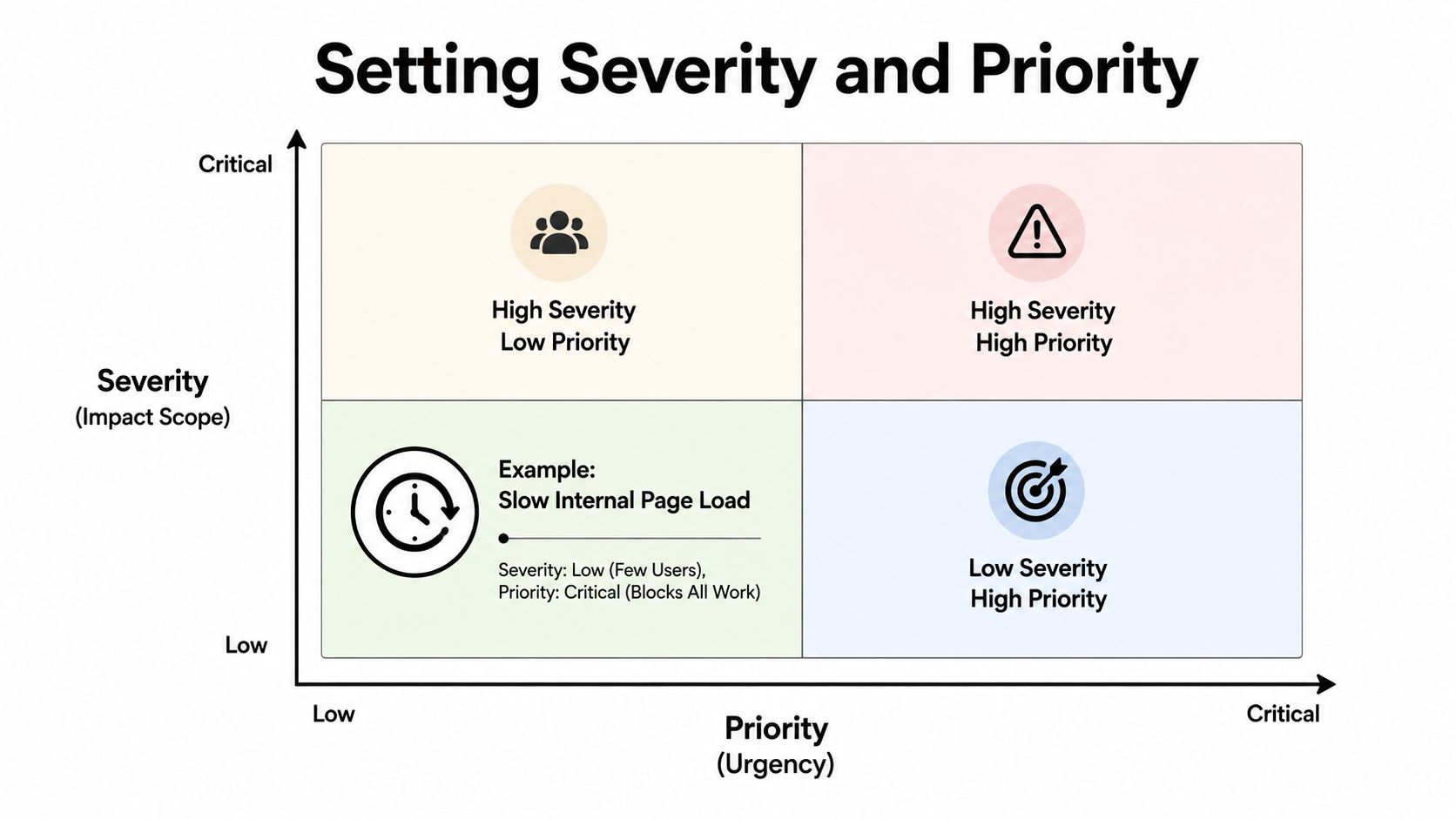
A slow laptop is easy to classify if it belongs to one person in a back office. It gets harder when the same delay blocks a clinic from finishing charts, a law firm from filing on time, or an accounting team from sending a client package. That's where a lot of incident handling goes wrong, because the technical severity can look mild while the business impact is severe.
Use business context, not just technical symptoms
The right way to judge severity is to combine the technical issue with business context, affected dependencies, regulatory exposure, and downtime cost. ENISA says organizations should define roles, severity levels, escalation paths, and communication procedures before an incident occurs, because unclear triage is what creates delay. ENISA's incident management guide is blunt about that structure.
CISA's incident-management guidance also emphasizes structured detection, triage, analysis, response, and improvement, which matters when business impact crosses teams. A failed email thread might be annoying in one department and urgent in another if it blocks a filing deadline or a patient notification. CISA's incident management resource guide reinforces the need for situational awareness, coordination, and feedback loops.
Make the decision model simple enough to use
A practical SMB model should ask four questions.
- What is broken: Is the issue affecting one user, one department, or a shared service?
- Who is blocked: Is the incident slowing admin work, revenue work, or regulated work?
- What's the dependency chain: Does the failure touch identity, file access, communications, or a customer-facing portal?
- What happens if it waits: Does delay raise legal, compliance, or client-trust risk?
When those questions are answered early, the team can assign urgency without drama. That's also why Technovation's disaster recovery planning belongs in the conversation, because recovery choices get easier when the business already knows what's critical.
A business doesn't need a complicated scoring system. It needs a defensible one that stops people from arguing about labels while the outage keeps hurting operations.
A Sample Playbook and Checklists You Can Actually Use
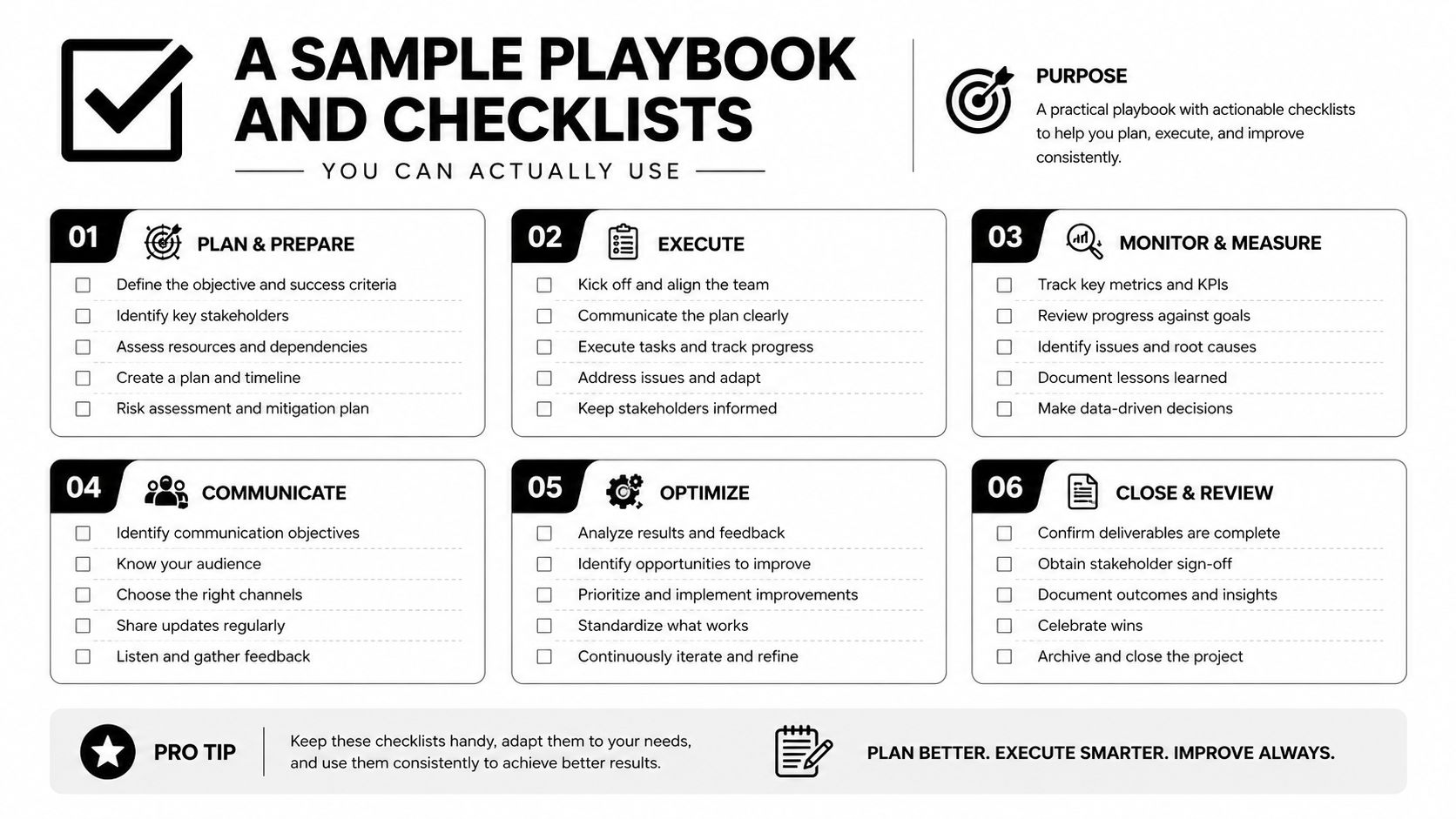
A usable playbook is short enough to run under pressure and specific enough that a new person can follow it without improvising. The first step is always to log the incident in one place, then assign ownership, then tell the right people what's happening. A playbook that skips those steps usually fails when the outage is real.
A simple operating sequence
- Alert triggered. Verify the signal is genuine, not noise or a duplicate.
- Classify. Assign severity and priority based on impact, urgency, and business dependency.
- Notify. Use the defined channel for stakeholders, not side conversations.
- Escalate. Bring in the managed service provider or specialist responder when the issue is outside internal capacity.
- Review. Hold the post-incident review, document decisions, and update the playbook.
That sequence sounds basic because it should be. The point is consistency, not cleverness.
Who does what in the first 30 minutes
- Front-office lead: Confirms the business impact, notes who is blocked, and keeps client-facing updates aligned.
- IT contact: Logs the incident, captures symptoms, and starts containment or diagnostics.
- Executive sponsor: Makes urgency calls when the issue affects revenue, compliance, or reputation.
- External partner: Owns coordination if the internal team is stuck, overloaded, or missing a specialized skill.
A solid communication template helps too. Internal updates should name the service, state the impact, identify the current owner, and give the next update time. Customer-facing messages should stay factual, avoid speculation, and never promise a fix timeline nobody can defend.
For teams that want a ready structure to adapt, Technovation's incident response playbook is the right model to compare against the current mess. The goal is simple, get the first 30 minutes out of people's heads and into a repeatable document.
Tools and Metrics That Turn the Process Into a Program
A process on paper doesn't prevent downtime. A program does. That's why the right stack matters, ticketing and ITSM for records, monitoring and alerting for detection, communication and on-call scheduling for coordination, and post-incident documentation for learning.
What the tooling has to do
The tools should reduce friction, not add ceremony. Alerts need to land where responders work. Ticket data needs to carry context forward. Documentation needs to be easy to update after the event, not buried in a folder nobody opens. AI-assisted triage can help with classification and summary work, but it should support the responder, not replace judgment.
Technovation can fold that operational layer into its managed service model, and its 24×7 support, network server management, endpoint management, network security, and patch management all fit naturally into incident handling. For SMBs that don't have a full internal operations team, that's the difference between a pile of tools and one coordinated response path. Technovation's cybersecurity automation is the relevant place to look for that automation mindset.
What to measure every month
| Metric | What It Measures | Typical SMB Target |
|---|---|---|
| Total incident volume | How many incidents the business is handling | Keep it stable or trending down |
| Backlog | Unresolved incidents still waiting for action | Keep it small and visible |
| Major incidents | High-impact events that disrupt key services | Minimize and review immediately |
| Mean elapsed time to resolution or workaround | How quickly service gets usable again | Shorten steadily |
| Response-time compliance | Whether responders meet the target window | Track against the internal SLA |
| Cost per incident | The operational burden of each event | Keep it from rising as volume grows |
| Reopened incidents | Whether the original fix actually held | Keep reopens low |
ITIL's KPI focus is still the right frame here because it forces the business to look at control, not guesswork. Atlassian-reported benchmark data cited in an industry roundup says 68% of teams used a proactive incident-response approach in 2024, up 12 percentage points from the prior year, 63% of organizations were already using AI for incident response, 34% planned to adopt it, and MTTR was tracked by 86% of respondents. The same roundup says businesses typically take 197 days to discover a breach and 69 days to contain it, which explains why speed still dominates the conversation. The incident management statistics roundup gives useful context for why faster detection and response are now board-level concerns.
Compliance and Industry-Specific Considerations in the DFW Market
In healthcare, legal, financial, construction, and nonprofit work, the incident process isn't just about uptime. It's also about evidence, notification discipline, and proving that the business handled the issue in a controlled way. If the response lives in someone's memory instead of a record, the business is exposed twice, once during the outage and again during the audit.
Why regulated SMBs need written ownership
HIPAA, PCI-DSS, GDPR, and SOC 2 expectations all reward the same thing, clear documentation of who knew what, when they knew it, and what they did next. A clinic that can't show how it handled a system outage has a harder time defending its response. A law firm that misses communication discipline risks client trust. A financial firm that can't preserve a clean trail invites headaches it doesn't need.
A process built around roles, escalation paths, and review also makes training much easier. That matters because compliance isn't just policy, it's behavior under pressure. A useful reference for building that behavior is Knowlify's complete compliance training guide, especially for businesses that need more than one employee to understand the playbook.
Why local execution matters in DFW
Technovation's 25 years of experience, 24/7 monitoring, and DFW-based response model fit this market because outages here usually hit busy teams, not generic environments. A construction firm that loses access to shared plans, a clinic that can't reach records, or a nonprofit that loses donor systems needs a partner who can respond quickly and preserve evidence at the same time.
The right partner doesn't just fix machines. It helps the business keep records straight, communicate cleanly, and exit the outage with a stronger process than it had at the start. That's what makes incident handling a compliance issue and a resilience issue at once.
Putting It Together With a Partner Who Owns the Process
A business doesn't need more theory. It needs someone to own the process before the next outage exposes the gaps. When Technovation runs incident management end to end, the result is a documented policy, 24/7 monitoring, defined escalation, tested runbooks, post-incident review, and compliance-ready records that don't depend on a single employee remembering the steps.
That matters because ownership is the dividing line. If the business still has to ask who is on call, where the log lives, or when the review happens, then the process is still fragile. A managed service partner should remove that uncertainty and keep the workflow moving even when the internal team is busy with clients, patients, or deadlines.
The smartest next step is simple. Map the current response against the phases in this article, mark where logging breaks, where escalation stalls, and where reviews never happen. Then get a free security audit or IT health check and use it to expose the weak spots before they become the next Monday-morning outage.
Technovation LLC helps DFW businesses build an incident management process that's documented, monitored, and ready when downtime hits. If the current response still depends on guesswork or a single overbooked tech, visit Technovation LLC and start a conversation about a cleaner, faster way to protect uptime, data, and client trust.