
Managed services are the better choice when the business needs security, governance, and defined outcomes owned by a provider. Staff augmentation is the better choice when an internal team needs temporary capacity or niche project skills while retaining operational responsibility.
A Dallas–Fort Worth business owner may face that decision after a compliance requirement exposes a gap in access reviews, endpoint protection, or incident response. Hiring a full-time specialist feels too slow and expensive, while bringing in a contractor appears practical. The difficult question isn't whether someone can complete the work. It's who remains accountable when the audit trail is incomplete, a control fails, or the specialist leaves.
Table of Contents
- The Leadership Dilemma – Extra Hands or Full Responsibility
- Core Differences in Operating Models and Accountability
- Cost Models and Total Budget Impact
- Scalability, Speed, and Security Risks
- Sector-Specific Use Cases and Decision Framework
- Next Steps and Vendor Selection Checklist
The Leadership Dilemma – Extra Hands or Full Responsibility
A North Texas professional-services firm may already have a capable office manager, an outsourced accountant, and a technically inclined employee handling everyday IT. Then a client questionnaire demands stronger evidence of access control and documented response procedures. The owner needs help quickly, but the business doesn't need a permanent security department.
A contractor can complete a defined remediation project. That may solve the immediate documentation gap, but the owner still needs to decide who will maintain the controls, review alerts, manage departures, and answer questions during the next audit. The work may be finished while the operating responsibility remains unresolved.

The decision behind the decision
Staff augmentation adds people to an existing management structure. The client sets priorities, assigns work, reviews progress, and owns the surrounding process. A useful overview of how businesses can augment your tech team can help leaders understand that model as a capacity decision, not a transfer of accountability.
Managed services make the provider responsible for an operating function and its agreed results. That can include monitoring, escalation, maintenance, reporting, and continuous improvement, depending on the agreement. The provider's team manages its own delivery, while the client manages the relationship and evaluates performance against defined expectations.
Practical rule: If the business needs another pair of hands, augmentation may fit. If it needs someone to own a recurring result, managed services deserve serious consideration.
Why DFW owners feel the tension
Small and midsized companies often have lean leadership teams. The owner, controller, practice administrator, or operations director may be expected to approve technology decisions without having time to supervise every technical task. That creates a dangerous middle ground, where a contractor is present but nobody has full visibility into the process.
A virtual technology adviser can help clarify the operating model before a purchase is made. Businesses evaluating that strategic role can review Technovation's virtual chief information officer services alongside their internal planning needs.
The history of managed services explains why the model is different. The approach traces back to the early 1960s, when EDS ran clients' data processing under long-term fixed-price contracts. IBM's 1989 Kodak data-center deal helped bring the model into the mainstream, and remote monitoring later made recurring managed IT delivery practical for smaller businesses in the late 1990s and early 2000s. The underlying idea has remained consistent: a provider takes operational responsibility for a function, rather than just supplying labor.
Core Differences in Operating Models and Accountability
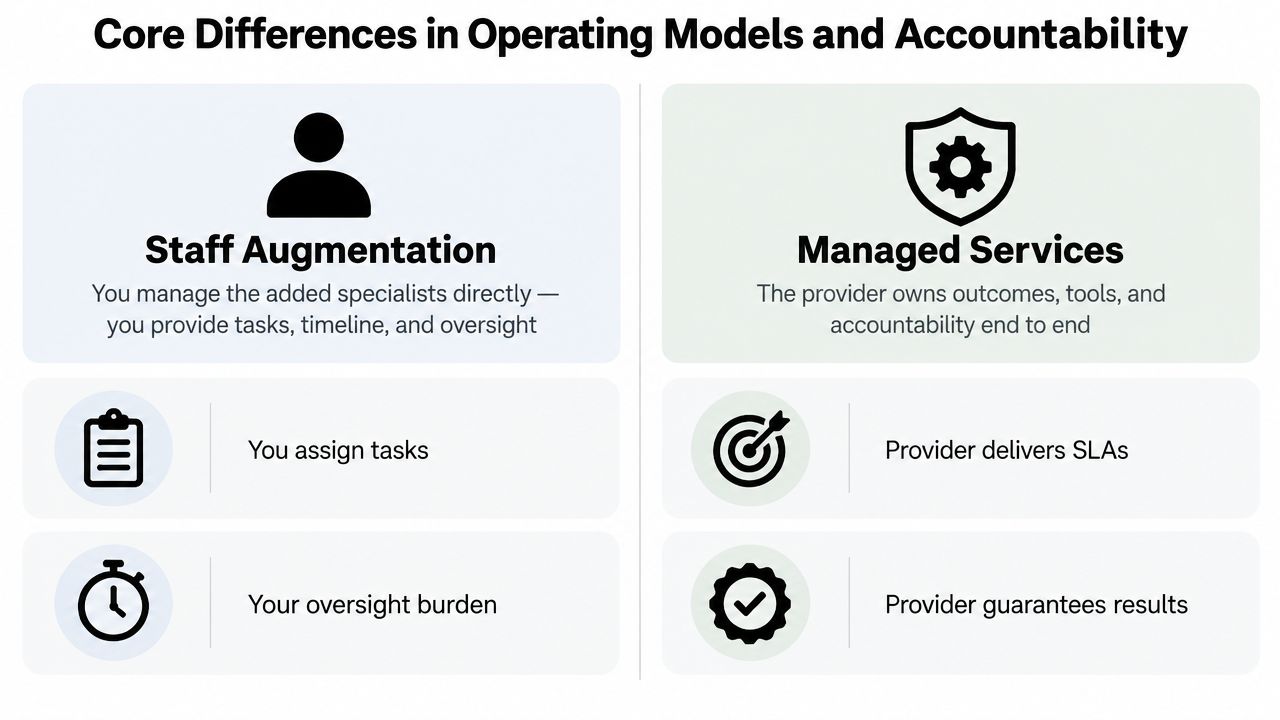
The central difference in IT managed services vs staff augmentation isn't where the workers sit. It's who directs the work and who carries the outcome.
In staff augmentation, the client supplies the task list, workflow, tools, deadlines, and daily supervision. The provider supplies qualified people and may handle recruiting, payroll, or replacement logistics. The client still owns execution.
In managed services, the provider manages its own personnel, processes, and tools, then accepts responsibility for defined service outcomes under service-level agreements. That structure creates clearer escalation paths and gives the client a performance framework rather than a list of hours.
A direct operating comparison
| Decision criterion | Staff augmentation | Managed services |
|---|---|---|
| Daily direction | Client assigns tasks and priorities | Provider manages delivery |
| Accountability | Client retains responsibility for execution | Provider accepts defined outcome responsibility |
| Best fit | Temporary capacity or niche project skills | Recurring operations, security, and support |
| Management burden | Higher for the internal team | Lower day-to-day burden |
| Control | Client keeps granular process control | Provider receives latitude to achieve agreed results |
| Contract focus | Time, role, and availability | Scope, service levels, reporting, and escalation |
The practical contrast is activity management versus outcome ownership. An augmented security specialist might configure controls exactly as directed, but the client still has to decide whether those controls remain effective, whether evidence is retained, and whether alerts receive timely attention. A managed provider is expected to operate the function continuously within the agreed scope.
That distinction matters in regulated environments. The insight from GENTY recruitment is useful for understanding augmentation as an embedded capacity model, where the client retains close control over the work.
Where each model fails
Staff augmentation fails when the client lacks a technical manager who can set priorities, review work, and resolve conflicts. Adding specialists to a disorganized environment often adds coordination rather than capacity. It also fails when the business assumes that a contractor's presence automatically transfers responsibility for security or compliance.
Managed services fail when the scope is vague, the SLA measures the wrong things, or the client expects unlimited strategic work inside a narrow support package. A provider can't own an outcome that hasn't been defined. Businesses should establish service boundaries, decision rights, reporting expectations, and transition duties before signing.
For companies that need to distinguish basic response from broader operational ownership, a structured review of tiers of IT support can make the decision more concrete.
Cost Models and Total Budget Impact
A Dallas-Fort Worth manufacturer may approve a contractor at an attractive hourly rate, then discover that its IT manager is spending evenings reviewing access, coordinating work, and rebuilding documentation. The invoice looked lean. The operating cost was not.
Staff augmentation usually exposes labor as the primary line item. The company also absorbs internal management time, onboarding, access provisioning, tool configuration, security reviews, and transition work. For a regulated SMB, those hidden tasks affect more than budget. If nobody owns the evidence trail, the business can create an audit gap while believing it has only added capacity.
United States IT staff augmentation costs about $50 to $240 per hour in 2026, or approximately $8,700 to $41,500 per contractor per month. A mid-level software developer is near $95 per hour in the cited benchmark. Treat these figures as planning references, not quotes. Role complexity, location, seniority, and engagement length change the final price. (IT staff augmentation cost guidance)
Geography also affects the spread. A 2026 pricing guide places developer rates at roughly $90 to $150 per hour in North America, $40 to $60 per hour in Eastern Europe, and $20 to $35 per hour in India, while offshore and nearshore delivery may save 40% to 60%. Those differences matter only after leaders price time-zone coverage, communication, security controls, and internal supervision. (Regional staff augmentation pricing guidance)
The complete augmentation budget
Build the estimate around the work the business must perform, not only the contractor's rate:
- Base labor: Multiply the hourly rate by expected hours and project duration.
- Vendor fees: Include sourcing, administration, replacement, or coordination charges.
- Onboarding: Budget for training, documentation, access setup, and internal supervision.
- Security and tools: Include licenses, device controls, identity management, and monitoring.
- Transition costs: Allow for handoff, documentation, offboarding, and knowledge retention.
A pricing model guide warns that headline hourly rates understate the total budget when these categories are omitted. (Staff augmentation pricing model guidance)
| Model | Cost structure | Pros | Cons |
|---|---|---|---|
| Staff augmentation | Hourly, daily, or role-based contractor pricing | Flexible, direct control, useful for defined projects | Internal management, variable spend, transition exposure |
| Managed services | Recurring fee tied to users, scope, coverage, or service levels | Predictable baseline, bundled operations, defined accountability | Less granular control, poor fit for very short or undefined work |
Speed changes the calculation
Staff augmentation can turn fixed headcount into variable spend and reduce a hiring process to two to four weeks. Another comparison describes a flat monthly fee and a seven-day pipeline for pre-vetted candidates. (Staff augmentation delivery guidance)
That speed fits a defined project with a clear owner and endpoint. It becomes less economical when temporary work turns into permanent support. The company may keep paying contractor rates while retaining the supervision, control testing, and documentation duties that a managed service is contracted to own. In regulated environments, that distinction determines whether extra hands become a strategic asset or an unassigned compliance obligation.
Scalability, Speed, and Security Risks
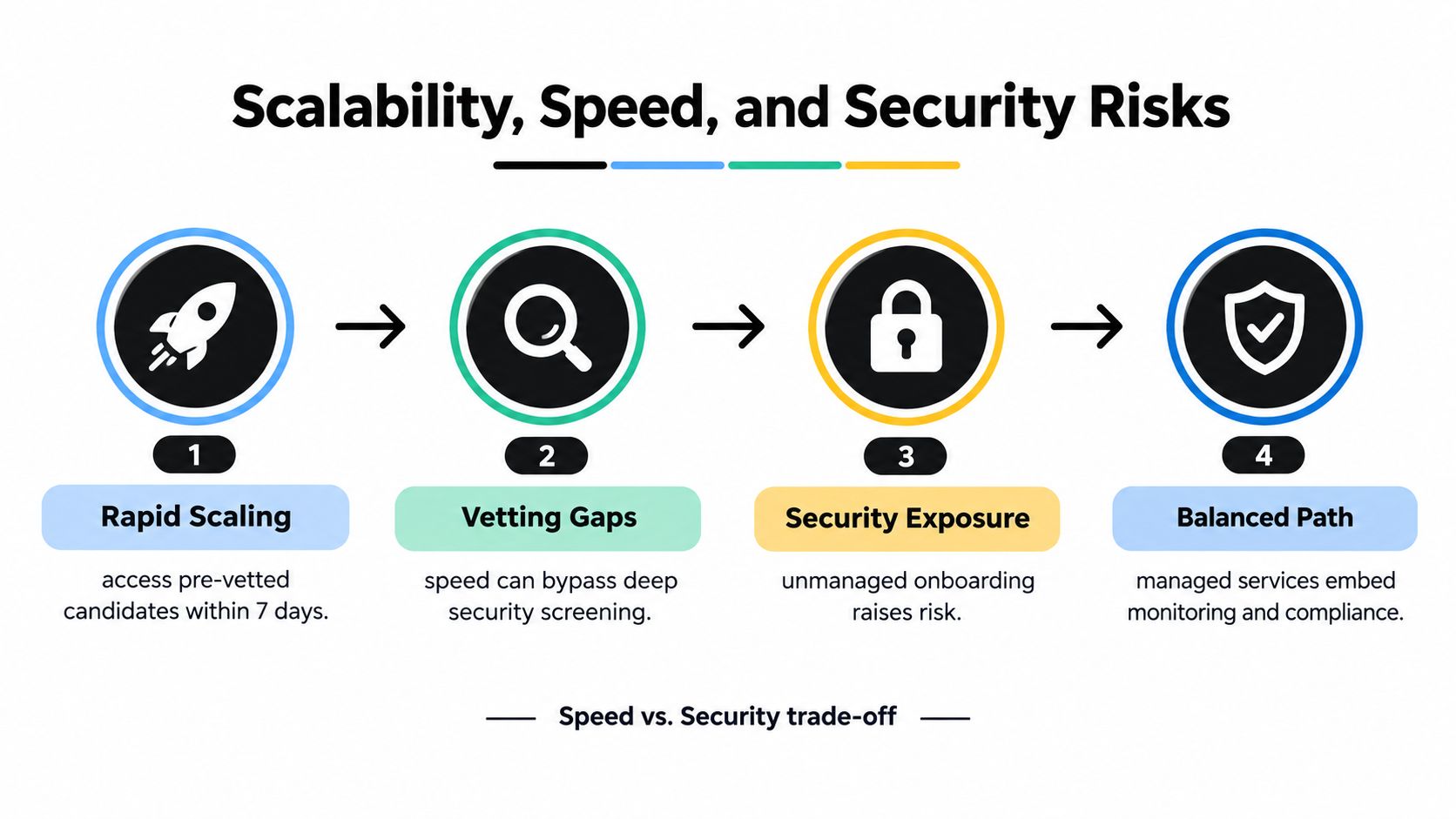
A regulated business can add a qualified specialist quickly and still fail an audit months later. The gap usually appears in access records, control testing, incident escalation, or documentation. Extra capacity addresses workload. It does not automatically create governance or outcome ownership.
Staff augmentation can provide access to pre-vetted candidates within seven days. That speed can help during a migration, application build, or time-boxed remediation project. The client still owns onboarding, permissions, supervision, documentation, and continuity. If those responsibilities have no named owner, faster staffing can create a security exposure rather than remove one.
The hidden governance gap
A temporary specialist may finish a security task without becoming part of a lasting operating process. After that person leaves, the business may find incomplete records, active credentials, missing handoff details, or no assigned owner for the next review. The problem is not contractor use. The problem is treating project completion as ongoing control ownership.
Healthcare clinics, law firms, financial businesses, and accounting practices need repeatable evidence, disciplined access, escalation procedures, and continuity when personnel change. Augmentation fits only when the client has the leadership capacity to maintain those duties after the project ends.
Speed is useful only when the business can control what arrives with it.
What managed security changes
Managed services can place monitoring, maintenance, escalation, and reporting within one operating framework. The provider manages its staffing and procedures, while the client receives defined service commitments and performance evidence. Client governance remains necessary, but fewer operational tasks sit directly with internal leaders.
Businesses assessing this model can review managed IT security services to see how risk mitigation can become part of regular IT operations. The decision should rest on scope, not labels. Confirm who owns controls, reporting, response, access reviews, and evidence when an employee or contractor changes. That ownership can turn outsourced operations into a strategic asset instead of an audit gap.
Sector-Specific Use Cases and Decision Framework
The right answer depends on the function, not merely the industry label. A law firm may need managed support for identity, endpoints, and network operations, while using an augmented specialist for a temporary document-system project. A construction company may need consistent remote support across distributed sites, then bring in project capacity during a major deployment.
Match the operating model to the exposure
Healthcare practices usually face continuous sensitivity around patient information, access, availability, and documented procedures. Managed services fit recurring infrastructure and security responsibilities because the provider can define monitoring, escalation, and reporting. Augmentation can still work for a bounded implementation, but the clinic must retain a clear owner for compliance continuity.

Law firms may benefit from augmentation when a litigation platform, workflow, or document migration needs specialized skills for a defined period. Managed services are generally more appropriate for day-to-day access administration, endpoint protection, backup, and user support, where interruptions affect every matter.
Financial and accounting firms should treat outcome ownership as a central test. If the function affects sensitive financial data, continuity, or audit evidence, a provider with defined responsibilities may offer a stronger operating structure than an individual contractor. Temporary augmentation makes sense when internal leadership can supervise a specific application, reporting, or integration project.
Construction, engineering, and architecture companies often need support for mobile users, remote offices, project collaboration, and field connectivity. Managed services can provide consistent operational coverage, while augmentation may suit a software rollout or specialized design-system effort.
A practical decision filter
Use these questions before selecting a model:
- Is the work temporary? A clear beginning and end favor augmentation. An ongoing function favors managed services.
- Who can supervise it daily? If no internal leader has time and technical authority, extra hands may create hidden workload.
- What happens when the specialist is unavailable? A continuity plan should exist before access is granted.
- Does the function touch regulated data? If it does, define evidence, escalation, and ownership before comparing rates.
- Is success measurable? If success can be expressed through service levels, managed delivery may be appropriate.
- Does the business need process control or an outcome? Control favors augmentation. Outcome ownership favors managed services.
A hybrid arrangement can be sensible. A business might place recurring helpdesk, monitoring, and security responsibilities with a managed provider while using temporary specialists for a migration or application project. The important point is to assign one accountable owner to each function, rather than allowing responsibility to disappear between contracts.
Next Steps and Vendor Selection Checklist
A vendor conversation should begin with responsibility, not product features. Before reviewing proposals, the business should list every recurring IT function, identify the current owner, and mark where failures would affect security, compliance, revenue, or continuity.
Questions for an augmentation provider
Ask who will supervise the specialist, how access will be approved, what documentation the contractor must produce, and what happens when the engagement ends. The agreement should address confidentiality, intellectual property, device handling, access revocation, replacement procedures, and knowledge transfer.
The client should also ask whether the proposed specialist has worked within the relevant compliance environment. Technical skill alone doesn't establish that the person understands evidence retention, least privilege, separation of duties, or incident escalation.
Questions for a managed services provider
A serious evaluation should include:
- Scope definition: Which systems, users, locations, and responsibilities are included?
- Service levels: What response, resolution, availability, and escalation commitments are documented?
- Security operations: Who monitors alerts, handles incidents, reviews access, and maintains security records?
- Reporting: What will leadership see each month, and how will unresolved risks be tracked?
- Continuity: How does the provider cover absences, emergencies, and personnel changes?
- Transition: What happens to credentials, documentation, configurations, and data if the agreement ends?
- Strategic guidance: Can the provider connect daily support to budgeting, compliance preparation, and growth?
Service levels deserve special attention. A business should compare the proposed service-level agreement structure with its actual risk tolerance, rather than accepting generic response language. A fast response to a low-priority ticket doesn't compensate for unclear ownership during a security event.
A useful selection process
Start with an IT health check, then separate immediate remediation from recurring operations. Document which needs require project labor and which require continuous accountability. Finally, ask each provider to map its scope to business outcomes, reporting, escalation, and transition duties.
Technovation LLC offers managed IT, cybersecurity monitoring, compliance support, remote access, backup, consulting, and strategic planning for organizations across the Dallas–Fort Worth area. Its free security audit and IT health check can help a business determine whether it needs temporary specialists, managed operations, or a combination of both.
Technovation LLC can assess the difference between an unresolved staffing gap and an ownership gap, then design managed IT or co-managed support around the business's systems, compliance needs, and budget. Visit Technovation LLC to request a free security audit or IT health check and get a practical plan for reducing operational exposure.