

A DFW business rarely notices its continuity gap on a quiet Tuesday. It notices when phones go to voicemail, the ERP stops moving orders, remote staff can't reach files, and someone finally admits the backups were never tested under pressure. By then, the outage is already doing what outages do best, turning a technical problem into a customer problem, a cash-flow problem, and a credibility problem.
That's why IT continuity services are no longer a back-office insurance policy. They're the operating discipline that decides whether a firm keeps serving clients during a bad week, a bad storm, or a multi-week disruption that drags on longer than anyone expected. In North Texas, that difference shows up fast, because local businesses don't get paid for having good intentions, they get paid for staying available.
Table of Contents
- The Moment a DFW Business Realizes It Needed IT Continuity Services
- What IT Continuity Services Actually Cover and Why RTO and RPO Matter
- Choosing Between Fully Managed, Co-Managed, and Break-Fix Service Models
- Regulatory and Industry Expectations in Healthcare, Legal, and Finance
- How to Select a Continuity Provider in DFW Without Getting Sold Hype
- Implementation Best Practices and Testing That Actually Proves Resilience
- ROI, Downtime Economics, and the Insurance and Ransomware Reality Check
- Building a Continuity Partnership That Pays Off When It Matters
The Moment a DFW Business Realizes It Needed IT Continuity Services
A 40-person logistics firm in Arlington can operate for years without testing its continuity plan. Then a storm disrupts the office. The ERP stops, phones fail, shipments stall, and leadership discovers that the last verified backup is eighteen months old. Dispatch, customer updates, and billing all depend on systems nobody can restore with confidence.
That outage exposes the continuity problem. The question is not whether backups exist. It is whether the company can keep serving customers through a disruption that lasts days or weeks, while staff work from another location and systems return in a controlled order.
Downtime becomes expensive quickly. Industry summaries cite average unplanned outage costs of about $9,000 per minute, with some incidents exceeding $17,000 per minute (business continuity statistics summary). Other industry reporting describes rising data-center outage costs, along with recurring annual IT downtime that consumes substantial staff time and reduces a company's ability to generate revenue. Those figures vary by business and incident, but the operational lesson holds: an outage can create a six-figure loss before an SMB has restored normal service.
Readiness Is Measured, Not Assumed
The common SMB mistake is treating backup software as proof of resilience. A licensed tool in a closet cannot confirm that payroll will run, calls can be answered, orders can be processed, or client work can continue during restoration.
Practical rule: If leadership cannot name its recovery targets, the recovery plan is probably a comfort blanket.
A workable continuity program documents which functions come first, who owns each decision, where staff work during an outage, and how systems are restored in sequence. It also tests those instructions under realistic conditions, including unavailable applications, missing personnel, and extended disruption.
For a local small business, that discipline separates a difficult day from a damaged quarter. Review the plan alongside Technovation's disaster recovery guidance for small business, then require evidence that the business can operate, not merely restore data, throughout a multi-week incident.
What IT Continuity Services Actually Cover and Why RTO and RPO Matter
A ransomware event takes down the file server on Monday morning. Staff cannot access records, phones depend on the same network, and the internet provider has no immediate answer. Backups may preserve data, but continuity also requires disaster recovery, cybersecurity controls, incident response, alternate connectivity, and a documented way to keep revenue-producing work running during a prolonged disruption.
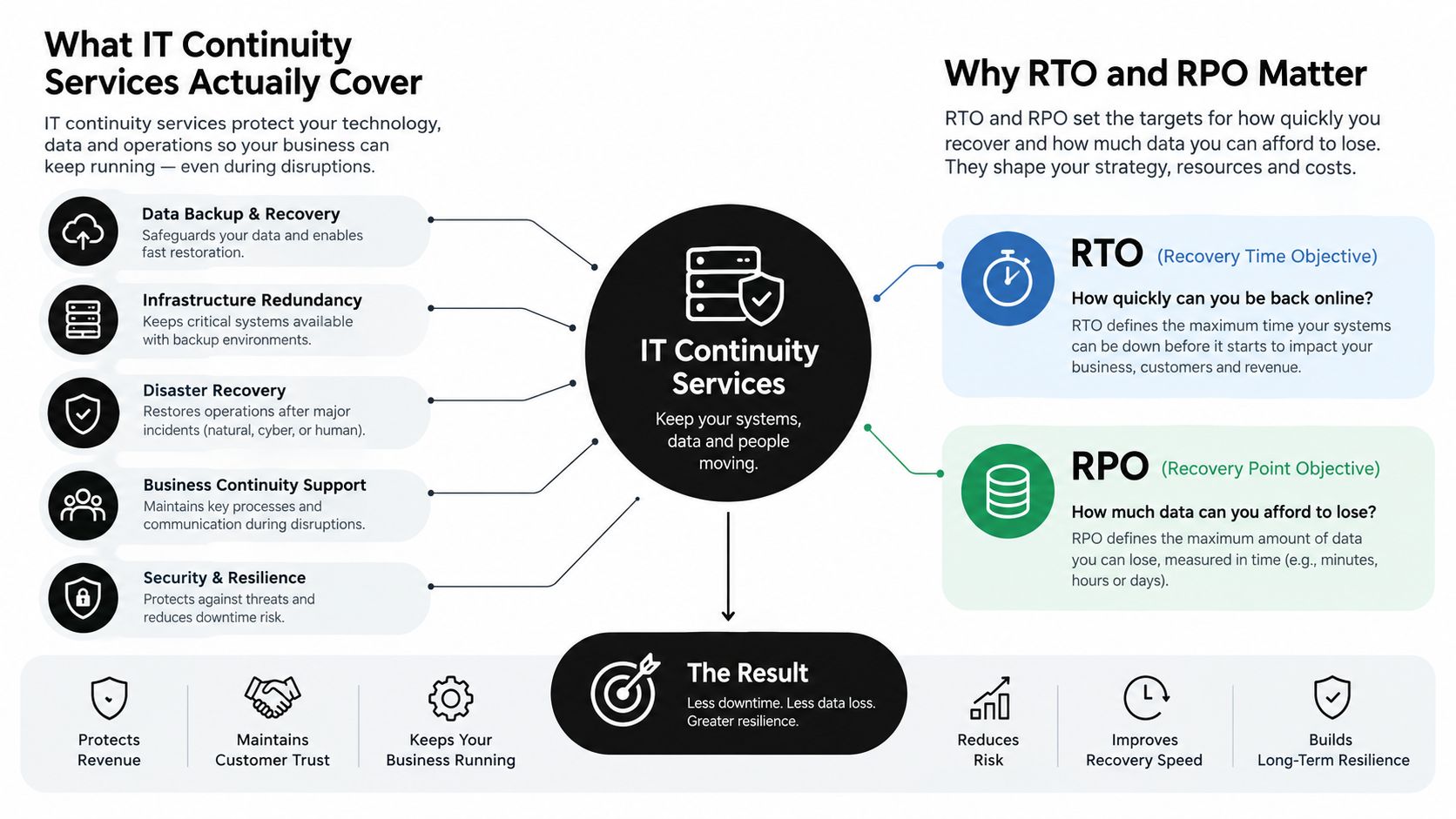
The two operating targets that matter most are RTO and RPO. Recovery Time Objective (RTO) is the maximum acceptable delay between interruption and restoration. Recovery Point Objective (RPO) is the maximum acceptable time since the last recoverable data point (disaster recovery guidance). These targets force a business decision: how long can each function remain unavailable, and how much recent work can the company afford to lose?
Different Workloads Need Different Targets
A Plano dermatology clinic and a Fort Worth estate planning firm should not use identical recovery targets. The clinic may need patient records restored within an hour because staff cannot safely work without them. The law firm may tolerate a few hours without email, while requiring client documents and version history to remain available.
Set targets by business function, then price the architecture required to meet them. Tighter RTO and RPO targets usually require faster-failover designs, such as warm standby and more frequent backups. Looser targets can use simpler backup-and-restore patterns. The technician should configure the solution around the business decision, not choose a target because it is convenient to implement.
Connectivity belongs in the plan. A backup internet for business option can keep cloud applications, phones, payment systems, and remote staff connected when the primary circuit fails. Review the broader planning principles in this small-business disaster recovery guide, then test whether employees can perform priority work during an extended outage.
RTO sets the restoration deadline. RPO sets the acceptable data gap. A continuity plan earns credibility only when both targets are tested under conditions that resemble the outage the business fears.
Choosing Between Fully Managed, Co-Managed, and Break-Fix Service Models
The right service model depends on three things, cost predictability, internal control, and how much risk the business wants to push onto a provider. Fully managed support fits firms that want the provider to own more of the operational burden. Co-managed works when the internal generalist still has a role. Break-fix is what happens when the business chooses to pay for every outage after the outage has already become a problem.
| IT Continuity Service Models Compared for DFW SMBs | ||||
|---|---|---|---|---|
| Model | Monthly Cost Predictability | Internal Control | Risk Transfer to Provider | Best Fit in DFW |
| Fully Managed | High | Lower | Higher | Regulated or fast-moving firms that need consistent coverage |
| Co-Managed | High to moderate | Shared | Shared | Firms with an internal IT generalist who still needs outside continuity muscle |
| Break-Fix | Low upfront, unstable in practice | Highest on paper, weakest under pressure | Lowest | Only for businesses willing to absorb reactive downtime risk |
A 25-person creative agency in Deep Ellum can make co-managed support work if the internal person handles strategy and the partner handles monitoring, failover testing, and response discipline. A 75-person manufacturer in Garland running ERP and operations technology usually needs more risk transferred off the building. A business that depends on uptime should not pretend that hourly chaos is a cost-saving strategy.
The hidden cost of break-fix is not the invoice. It's the unbudgeted interruption, the delayed customer work, and the fact that a ransomware event becomes a capital event the company was never ready to absorb.
Technovation's fully managed IT support fits the firms that want continuity planning tied to ongoing operations instead of one-off emergency calls. That matters because continuity only works when someone owns the boring parts before they become the urgent parts.
Regulatory and Industry Expectations in Healthcare, Legal, and Finance
Regulated DFW firms don't get to treat continuity as optional. The requirements may be written in compliance language, but the operational meaning is simple, keep working, protect data, and prove it. A plan that looks good in a binder but fails during a real outage is not a plan, it's a liability.
Healthcare and Legal Cannot Afford Guesswork
HIPAA's Security Rule expects a documented contingency plan, data backup, disaster recovery, and emergency mode operations. In a Dallas specialty clinic, that means staff need a way to keep seeing patients, accessing records, and communicating when the EHR disappears mid-morning. The plan has to function during the interruption, not after the fact.
In legal, the duty to protect client data collides with the need to keep matter files, email, and document management reachable. If the team can't find a document, reply to a client, or access the latest version of a filing, the outage has already become a service failure. For clinics building out that discipline, Technovation's HIPAA compliance support for healthcare fits naturally into continuity planning.
Finance Demands Evidence, Not Promises
Broker-dealers, merchants, and financial firms face continuity expectations that are tied to resilience, testing, and documentation. The same controls repeat across frameworks, defined RTO and RPO, tested backups, alternate work capability, and evidence that the controls work. Auditors don't care that a business bought software, they care that the business can prove recovery.
| Continuity Obligations by Industry in DFW | |||
|---|---|---|---|
| Industry / Framework | Key Continuity Requirement | Operational Control | Evidence Auditors Expect |
| Healthcare / HIPAA | Documented contingency planning | Backup, disaster recovery, emergency mode operations | Written plan, restore evidence, staff procedures |
| Legal / Client-duty expectations | Protect client data and keep matter access available | Redundant access, tested backups, communications fallback | Access logs, restore validation, documented procedures |
| Finance / Operational resilience | Maintain continuity under disruption | Recovery targets, alternate work capability, tested response | Exercise records, recovery evidence, issue tracking |
| Payments / PCI and GLBA-aligned programs | Resilience and incident readiness | Backup, incident response, access control | Test results, response documentation, policy alignment |
The compliance lesson is blunt. Regulators expect proof that the business can operate, not just hope that it will.
How to Select a Continuity Provider in DFW Without Getting Sold Hype
A provider can promise uptime and still leave your business unable to operate after a multi-week disruption. Judge continuity by demonstrated operating capability, not a sales presentation. Contracts without documented RTO and RPO, recovery tests conducted only in the provider's lab, and ransomware exclusions buried in fine print deserve immediate scrutiny.
Ask how the provider measures whether critical workflows can continue, not merely whether systems can be restored. Get clear answers on the recovery architecture, runbook ownership, testing access, and after-hours response. A DFW business should know who answers at 2 a.m. when staff cannot access systems, process payments, or serve clients.
Use this checklist:
- Recovery scope: Which systems, data, and workflows are covered, and what is excluded?
- RTO and RPO: Are targets documented for each workload rather than stated generally?
- Testing cadence: How often do restore tests, failover exercises, and tabletop drills occur?
- Incident ownership: Who leads the response, and who makes final decisions?
- Runbook access: Can the client review, approve, and update procedures?
- Backup isolation: Are backups immutable, offline, or segmented from production?
- Ransomware coverage: Does the service include recovery after a cyber event, or exclude it?
- Local response: Is there a DFW presence, or only a remote help desk?
- Audit rights: Can the client review controls, test results, and unresolved findings?
- Insurance alignment: Do the provider's controls support cyber insurance requirements?
Require evidence before signing. Review restoration records, observe a test, and ask the provider to demonstrate how employees would work during a prolonged outage. A successful backup restore proves only that data returned. It does not prove that staff can access applications, communicate, accept work, and maintain essential workflows for weeks.
The common DFW mistake is buying continuity from a provider that has never had to explain a failed recovery to a business owner. Out-of-state support can work, but only with clear response obligations, local operational understanding, and a right-to-audit clause.
Implementation Best Practices and Testing That Actually Proves Resilience
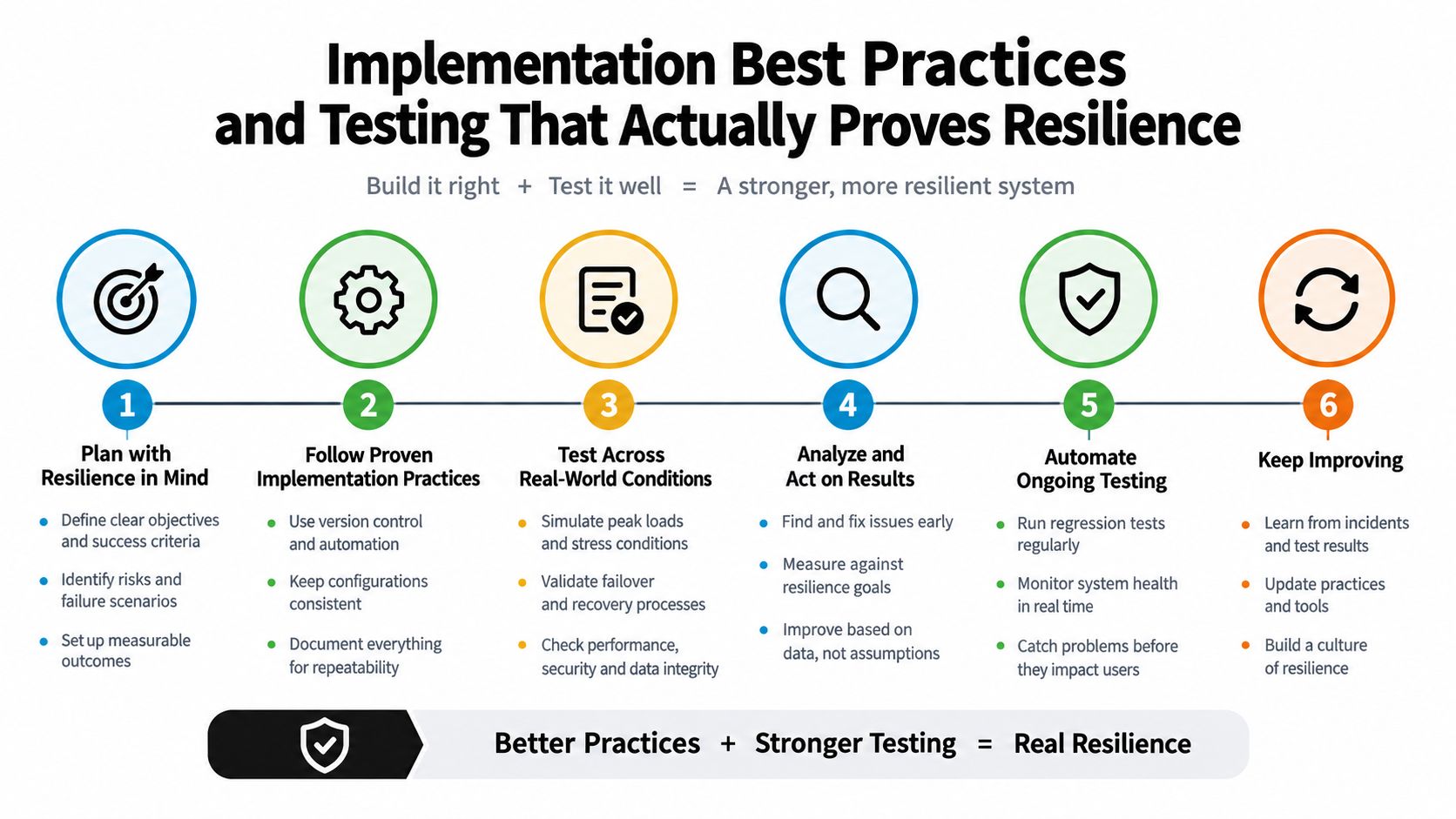
Good continuity programs don't start with tools. They start with dependency mapping. If leadership can't say which applications, data sets, and workflows the business cannot live without for more than a few hours, the recovery design is already fuzzy. That's the first job, then the architecture follows.
Four Phases That Hold Up Under Pressure
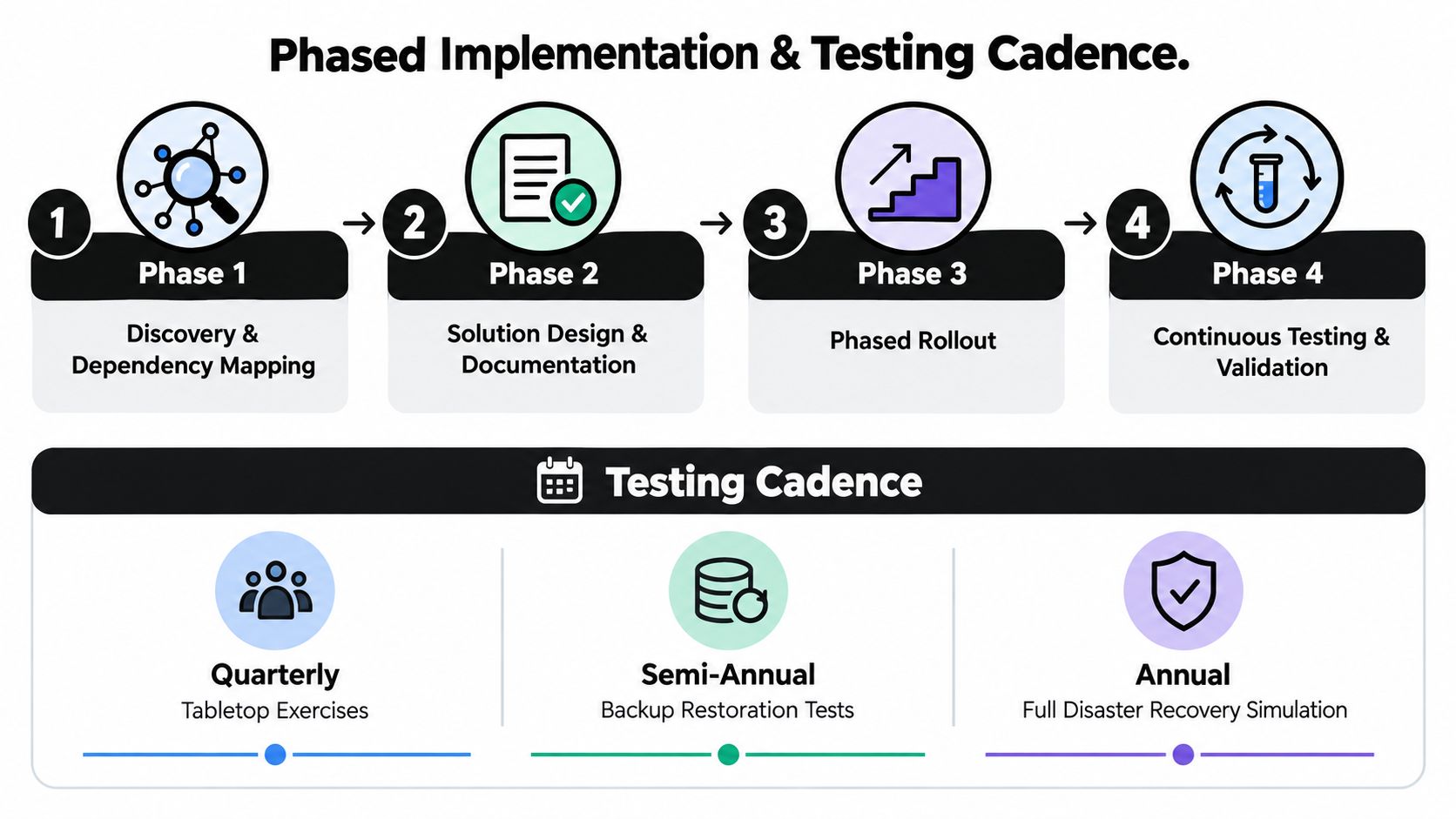
The practical rollout is straightforward. First, discover the critical systems and the dependencies behind them. Second, document RTO and RPO by system, then build the recovery architecture and the runbooks. Third, layer in monitoring, alerting, and immutable backups. Fourth, keep testing until the plan proves itself under pressure.
A good runbook does not impress anyone in a meeting. It helps an on-call engineer make the right call when nobody wants to guess.
Testing is where most providers reveal whether they're serious. Quarterly tabletop exercises should walk leadership through a ransomware or outage scenario. Semi-annual restoration tests should validate that the backups can come back. Annual full disaster recovery simulation should happen if budgets allow, because a paper plan is not a recovery plan. Surprise game-day tests are even better, because they expose overconfidence before the outage does.
The industry's weak spot is obvious. Teams often declare victory after a backup restore, then discover the business still can't operate because identity, email, or a third-party dependency is down. That gap is exactly why Technovation's incident response procedures should sit beside recovery planning, not after it.
Score the Test, Don't Just Celebrate It
Every exercise should produce a scorecard. What restored, what failed, who made the call, how long the business stayed impaired, and what changed in the runbook after the review. If the gap doesn't get logged, it gets repeated.
ROI, Downtime Economics, and the Insurance and Ransomware Reality Check
At 9 a.m., the ERP stops processing orders. By lunch, staff are using personal workarounds. By the end of the day, customers are asking for updates and leadership is calculating lost revenue. That is the test of IT continuity services: whether the business can keep operating through a disruption that lasts weeks, not whether backups exist somewhere.
A continuity plan must withstand the finance conversation. An hour of ERP downtime can stop orders, a day without EHR access can slow care, and a week without files can freeze legal work. Continuity is therefore a revenue-protection control, not a technology expense.
Published estimates place outage costs around $9,000 per minute, with some reaching $17,000 per minute. Reported SMB losses range from roughly $82,200 to $256,000 per incident (cost and ROI of business continuity programs). Those figures make the business case for monitoring, automated backups, and recovery testing. The right question is whether those controls restore operations before customers, staff, and cash flow feel the outage.
Ransomware and insurance add another test. Insurers increasingly require enforced MFA across email, VPN, RDP, cloud applications, and administrator accounts, along with offline or immutable backups. Applications may also ask about EDR, privileged access management, email security, and patch cadence (cyber insurance statistics 2026). A provider that cannot document these controls leaves the business exposed during underwriting and recovery.
Downtime Cost Versus Continuity Investment Comparison
| Business Profile | Avg. Hourly Downtime Cost | Estimated Annual Continuity Cost | Break-Even Payback |
|---|---|---|---|
| 50-person distributor | High enough that a short ERP outage can outweigh prevention spending | Ongoing monitoring, backup validation, recovery testing | One serious incident can justify the program |
| Specialty clinic | High operational and compliance exposure during EHR downtime | Recovery planning, tested backups, alternate work capability | Avoiding one prolonged outage often covers the investment |
| Mid-size law firm | File access and email interruption quickly hurt billable work | Continuity controls and documented response | One week of disruption can wipe out months of protection |
The MY CYBER GUARD on attack costs provides broader context for how quickly a cyber event becomes a business interruption. Use that perspective to set recovery targets, then measure whether the company can keep serving customers while restoration remains underway.
Building a Continuity Partnership That Pays Off When It Matters
The only useful readiness question is blunt. Can the business keep serving customers during a multi-week disruption, or does it only have backups that restore someday? If the answer is unclear, the continuity program is incomplete.
A real partner works like this. Quarterly business reviews stay tied to risk, not just ticket counts. Leadership joins tabletop exercises. Playbooks get reviewed annually, then corrected after each test. After an incident, the lessons learned loop feeds straight back into the plan instead of dying in a meeting note.
That's also where a local provider matters. A vendor sends reports. A partner calls out drift, pushes for better controls before renewal, and can get onsite in DFW traffic when the recovery plan needs a human, not a queue number. Technovation fits that model by combining 24/7 monitoring, cloud backup, remote access, and continuity planning with the kind of hands-on support SMBs need when the building gets quiet and the phones stop ringing.
Technovation LLC helps DFW businesses build continuity plans that are measured, tested, and tied to real recovery targets. If the current setup has backups but no proof of operational recovery, visit Technovation LLC to start a conversation about continuity, disaster recovery, and the controls that keep the business moving when systems fail.