

A 40-person firm can have plenty of technology and still lack IT leadership. The owner sees three vendors recommending different approaches to a Microsoft 365 migration, while an internal administrator adds another security subscription without approval. Nobody can explain which contracts renew next quarter, which risks matter most, or whether the technology budget supports the business plan.
That pattern is common in Dallas–Fort Worth SMBs. IT decisions accumulate across vendors, department heads, and well-intentioned employees until technology becomes an operating risk instead of a back-office function. Duplicate platforms, surprise renewals, audit findings, and cybersecurity incidents expose the same underlying problem: nobody owns the technology portfolio, roadmap, or risk register.
A virtual chief information officer, or vCIO, can bring those decisions under one accountable operating model. The role isn't valuable because it adds another advisor to a meeting. It matters when it gives leadership a clear way to decide, fund, govern, and report technology priorities.
Table of Contents
- The Moment SMBs Realize They Need IT Leadership
- What a Virtual Chief Information Officer Actually Does
- Core Responsibilities of a vCIO in Practice
- Why Regulated SMBs Benefit Most from a vCIO
- Governance, Not Cheaper Advice: Where vCIO Value Comes From
- vCIO Pricing Compared to a Full-Time CIO
- How to Decide If a vCIO Is the Right Fit
- Bringing a vCIO Into Your Business
The Moment SMBs Realize They Need IT Leadership
Recognition typically arrives during a decision that should have been straightforward. A business owner asks whether the company should move more work into the cloud, replace aging systems, or tighten access controls. Three vendors provide three recommendations, each shaped by what that vendor sells. The internal administrator has already purchased another tool because the existing setup seemed insufficient.
The owner isn't facing a shortage of effort. Staff members are working, vendors are responding, and invoices are being paid. The missing piece is one person accountable for the whole technology portfolio. Nobody has authority to decide which platform stays, which contract gets challenged, which project waits, or which risk belongs on the leadership agenda.
The symptoms often appear before the owner names the problem:
- Scattered spending: Departments buy overlapping services without a shared budget or approval path.
- Unplanned renewals: Contracts renew automatically because nobody maintains a vendor register.
- Unclear priorities: Every vendor presents its project as urgent, while business leaders lack a common scoring method.
- Audit friction: The company owns controls and policies, but cannot quickly produce evidence that they operate.
- Reactive security: The business adds protections after an incident instead of managing risks against a defined plan.
managed IT services and executive IT leadership must be distinguished in this context. A managed provider can execute technical work effectively, but execution doesn't automatically create decision rights, budget discipline, or board-level accountability.
The operating risk behind the technology noise
A vCIO consolidates scattered recommendations into a roadmap tied to business outcomes. That roadmap should show what the company will change, why the change matters, what it costs, who owns execution, and which risks remain.
The owner should expect direct answers to practical questions. Is the migration necessary now? What business process does it improve? Which vendors are accountable? What happens if the project slips? Which controls must be documented before an auditor, insurer, or client asks for evidence?
Practical rule: If nobody can explain why a technology expense exists and who owns its outcome, the company doesn't have an IT strategy. It has an invoice collection.
The vCIO becomes the accountable leader between the CEO and the execution team. Internal staff or a managed provider can handle implementation, support, and maintenance. The vCIO makes sure those activities serve a coherent operating model rather than a series of disconnected requests.
What a Virtual Chief Information Officer Actually Does
A virtual chief information officer is a fractional executive function, usually provided remotely, part time, or as needed through an IT consulting firm or managed services provider. The role owns strategic technology direction. It doesn't replace the helpdesk, serve as a full-time systems administrator, or function as a project coordinator with a more impressive title. A vCIO is typically an externally filled technology leadership role, rather than a permanent internal hire.
The cleanest way to understand the role is to separate direction from execution:
- The vCIO sets direction. This includes business-aligned strategy, a 12- to 36-month roadmap, capital planning, vendor decisions, governance, and risk reporting.
- The execution layer delivers the work. Internal IT staff, a managed provider, or specialist contractors configure systems, resolve incidents, migrate data, and maintain infrastructure.
- Leadership reviews the outcomes. The CEO and department leaders approve priorities, accept business risk, and measure progress through a recurring reporting cadence.
An IT director often manages internal operations and staff. A managed services provider typically delivers day-to-day technical support and infrastructure management. A CTO generally focuses on technology products or development when technology itself is the company's offering. A vCIO focuses on enterprise IT strategy, infrastructure, security, compliance, business alignment, and executive decisions.
How the engagement should operate
A credible engagement has a rhythm, not just an occasional consultation. The vCIO should hold scheduled executive meetings, conduct quarterly business reviews, provide on-demand decision support for major purchases, and produce reporting that nontechnical leaders can use. The exact cadence can vary, but the outputs must remain visible and documented.
The vCIO should own the technology roadmap, annual IT budget, vendor governance process, risk register, project prioritization method, and leadership reporting. The role should also translate technical constraints into business choices. “The system needs an upgrade” isn't enough. Leadership needs to know what risk the upgrade addresses, what business capability it enables, and what competing priority it displaces.
This is comparable to other fractional executive models, where a business receives leadership capability without adding a permanent executive seat. For readers evaluating that broader approach, Paradigm International's fractional HR leadership resource offers useful context on how fractional leadership can fill an executive capability gap.
The cost question
SMBs often need CIO-level judgment before they need a full-time CIO. Full-time CIO compensation can range from about $250,000 to $400,000 or more per year, according to industry guidance on virtual CIO services. A fractional structure lets a company buy the leadership function at the level of attention its operating model requires.
The right deliverable isn't a stack of recommendations. It is a practical digital transformation roadmap that gives leadership a defensible sequence of decisions and gives the execution team clear boundaries.
Core Responsibilities of a vCIO in Practice
The vCIO role becomes useful when it produces artifacts an owner can inspect. A title isn't a deliverable. The business should be able to point to the roadmap, budget, vendor register, risk register, governance charter, and executive dashboard and see who is responsible for maintaining each one.
Six deliverables that expose ownership gaps
Roadmap ownership means building and maintaining a technology plan covering 12 to 36 months. The plan connects initiatives to business goals, identifies dependencies, estimates investment, and states what the company won't pursue yet.
Budget control separates capital and operating spending, tracks forecasts against actual costs, and ties each major expense to a business outcome. A vCIO should be able to explain whether an expense protects the business, improves capacity, supports growth, or continues an inherited arrangement.
Vendor governance covers contract reviews, service-level enforcement, renewal strategy, and performance reporting. The vCIO should maintain an approved vendor register and challenge automatic renewals that no longer fit the company's direction.
Security and compliance oversight aligns controls and evidence with the organization's exposure. Relevant obligations can include HIPAA, PCI DSS, CMMC, and SEC cyber rules. Guidance on cybersecurity insights for medical devices can help healthcare leaders see why connected technology requires both security planning and privacy consideration.
Decision rights require an IT steering committee or equivalent leadership forum. The committee doesn't need to be bureaucratic. It needs to define who approves projects, who accepts risk, who controls spending, and who resolves conflicts between departments.
Executive reporting turns technical conditions into business information. A board-ready dashboard should cover priority risks, roadmap status, budget position, vendor performance, compliance evidence, and decisions requiring leadership approval.
| Responsibility | Typical SMB Reality | vCIO Deliverable |
|---|---|---|
| Roadmap | Projects start from urgency or vendor pressure | Prioritized 12- to 36-month roadmap |
| Budget | Leadership sees invoices but not a plan | Forecast separating capital and operating spend |
| Vendors | Renewals and performance lack central ownership | Vendor register, scorecards, and renewal strategy |
| Security and compliance | Controls exist unevenly, with evidence gaps | Risk-prioritized control plan and evidence cycle |
| Decision rights | Department leaders make conflicting requests | IT charter and steering committee process |
| Reporting | Technical updates don't support executive decisions | Board-ready KPI and risk dashboard |
These responsibilities are governance outputs, not hands-on technical tasks. The vCIO decides what should happen and why. The internal IT team or managed provider executes the work, reports blockers, and maintains the environment.
The test is simple: If the engagement doesn't leave behind a decision, an owner, or a measurable artifact, it may be consulting activity without executive accountability.
Why Regulated SMBs Benefit Most from a vCIO
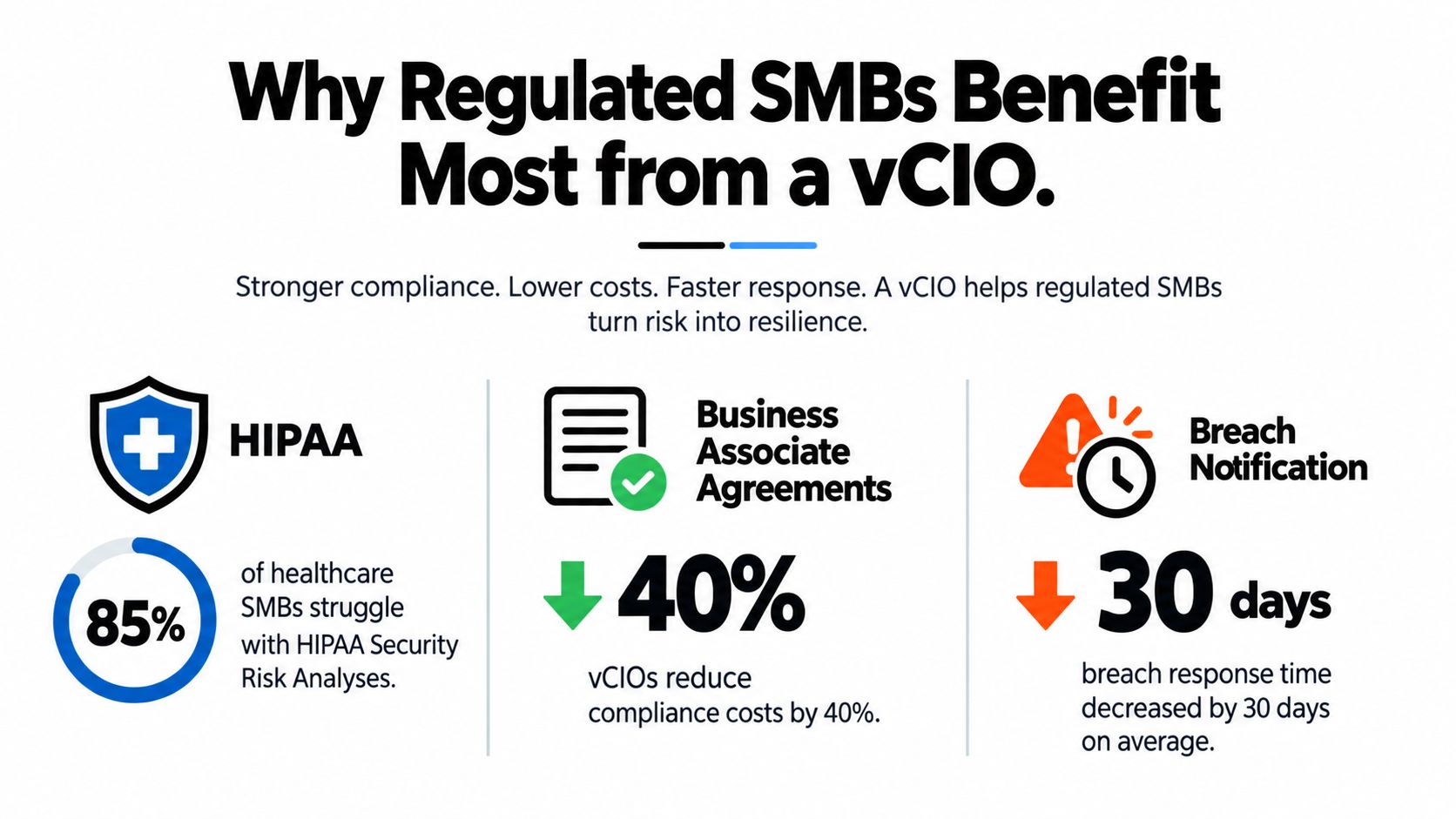
Regulated businesses don't experience IT risk as an abstract concern. A healthcare practice must manage HIPAA Security Risk Analyses, Business Associate Agreements, and breach notification obligations. A law firm must protect client confidentiality, maintain ethical walls, and manage document retention. Financial services firms face GLBA, PCI DSS, evolving state privacy requirements, and client due diligence. Construction and engineering companies may handle controlled unclassified information on government work.
Those demands create a recurring operating problem. The business may have policies, security tools, and outside providers, yet nobody owns the control set auditors, insurers, and clients expect to see. A vCIO turns that scattered material into a standing workflow with owners, evidence dates, exceptions, and escalation paths.
Compliance becomes an operating process
The vCIO should establish a quarterly evidence collection cycle rather than waiting for an annual audit request. That process can assign evidence owners, document control operation, track remediation, and report unresolved exceptions to leadership. The outcome is a more defensible posture when a regulator, client, insurer, or contracting authority asks difficult questions.
For healthcare organizations, Technovation's HIPAA compliance guidance provides a practical starting point for connecting compliance expectations to everyday IT controls. The vCIO then places those controls inside the broader roadmap, budget, and accountability structure.
Why the role affects growth
A regulated SMB can lose time and commercial momentum when it cannot answer a security questionnaire, demonstrate controls, or explain how it handles a vendor incident. A vCIO helps shorten audit cycles, reduce findings, support cyber-insurance renewals, and give leadership a documented basis for accepting or reducing risk.
The value extends beyond healthcare. Legal, financial, construction, and engineering firms often need technology decisions that preserve eligibility to bid, maintain client trust, and support expansion. The vCIO makes compliance a business capability rather than an isolated technical project.
A vCIO also needs enough depth to address AI use-case selection, data readiness, model-risk management, workforce adoption, third-party risk, and disaster recovery. Current market coverage describes virtual CIO consulting as expanding from approximately USD 781.61 million in 2026 to a projected USD 1.12 billion by 2032, with demand connected to cloud adoption, distributed work, regulatory scrutiny, and skills shortages, as reported by this virtual CIO consulting market analysis. The implication for regulated SMBs is direct. Strategic leadership must govern new technology, not merely approve its budget.
Governance, Not Cheaper Advice: Where vCIO Value Comes From
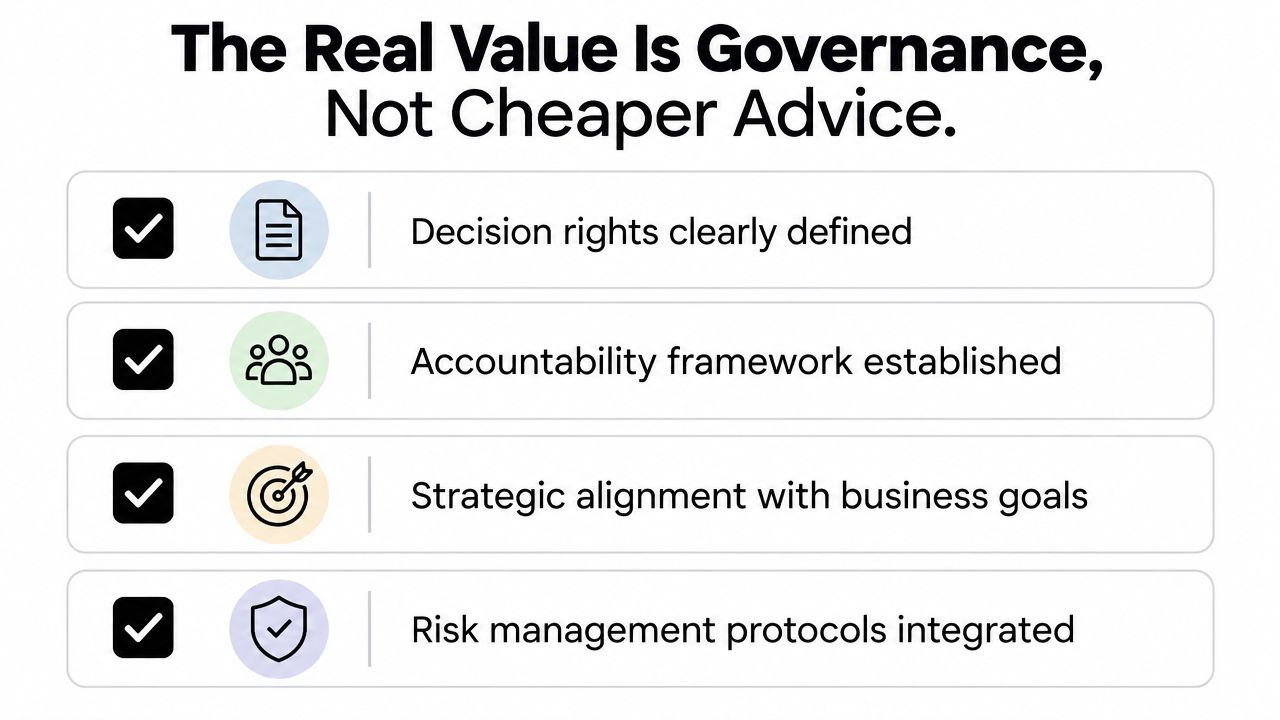
The engagement pays for itself when it creates decision rights and accountability where the business currently has neither. That makes the vCIO an operating-model role. The question is not whether the company needs another technology advisor. It is whether leaders have a repeatable way to decide, approve, execute, and report on technology work.
A vCIO cannot fix a company that refuses to establish that structure. The engagement requires access to operations, vendors, spending, and agreed success measures. Without it, the vCIO can provide sound recommendations, but the business will keep producing meetings instead of decisions and accumulating projects without clear ownership.
The artifacts that make governance real
A serious engagement should produce a small set of durable working documents:
- IT charter: Defines IT's purpose, the vCIO's authority, approval thresholds, and leadership responsibilities.
- Project intake model: Applies consistent tests for business value, risk, urgency, dependencies, and effort to every proposed initiative.
- Approved vendor register: Records ownership, contract terms, renewal dates, service expectations, and business purpose.
- Monthly risk register: Tracks risk status, treatment plans, accountable owners, and decisions requiring executive acceptance.
- Board-ready dashboard: Reports roadmap progress, material risks, budget position, compliance status, and vendor performance.
These artifacts must change with the business. A yearly assessment quickly becomes outdated. A register reviewed every month keeps decisions visible and assigns responsibility before an issue becomes an executive surprise.
Authority matters more than access
Access to systems and meetings is insufficient. A vCIO must be able to challenge a department purchase, pause a weak project, and escalate an unresolved security gap. The CEO needs a technology leader who establishes the resolution process and identifies the executive responsible for the final call.
The same standard applies to an existing managed provider. The vCIO should review performance, enforce service expectations, and separate provider recommendations from business priorities. The provider executes approved work. The vCIO protects the company from funding projects that do not support its goals.
Organizations assessing governance maturity can use NIST beyond cybersecurity to examine how structured frameworks support decisions beyond technical defense.
Governance standard: The business should know who decides, who executes, who reports, and who accepts residual risk. If those answers change from meeting to meeting, the structure is failing.
With that structure in place, the vCIO becomes the accountable technology leader. Leadership knows who owns each recommendation, while the vCIO knows which business executive owns the final decision. That clarity is the deliverable. સલ
vCIO Pricing Compared to a Full-Time CIO
An SMB can spend heavily on technology and still lack executive ownership. Compare a vCIO with a full-time CIO by total operating cost, decision coverage, and accountability, not by hourly rate alone. Published vCIO pricing commonly ranges from $200 to $300 per hour or $2,000 to $15,000 per month on retainer, according to industry pricing coverage for virtual CIO services. SMB-focused advisory retainers are also commonly cited around $2,000 to $10,000 per month. U.S. salary data places average annual virtual chief information officer compensation at $348,285, with a 25th to 75th percentile range of $306,524 to $372,992, according to Salary.com's virtual CIO salary data. Compensation data for the role is not the same as the cost of a fractional engagement.
A full-time CIO adds salary, benefits, bonuses, recruiting, severance, and executive overhead. A vCIO converts that leadership function into a defined operating model, with capacity tied to the company's complexity and reporting needs.
| Cost Factor | Full-Time CIO | Virtual CIO |
|---|---|---|
| Compensation model | Salary, benefits, bonuses, and executive overhead | Hourly, project, or monthly retainer |
| Coverage | Dedicated executive capacity, whether fully used or not | Capacity scaled to business complexity |
| Time to value | Recruiting and onboarding precede impact | Assessment and governance work can begin within the engagement |
| Continuity risk | Leave, turnover, severance, and replacement exposure | Provider continuity depends on contract and team structure |
| Strategic scope | Broad ownership if the hire has the right fit | Defined scope around roadmap, budget, risk, and governance |
| Execution gap | Still requires an IT operations layer | Still requires internal or managed execution |
The cheaper option can become expensive when leadership choices remain unclear. A poor hire may delay projects, tolerate weak providers, or misread regulatory exposure. A departing executive may leave undocumented decisions and an unfinished roadmap. A fractional engagement fails for the same reason when its scope is vague, its team lacks regulated-industry experience, or executives refuse to participate.
A practical budget rule
Choose a vCIO when the company needs executive technology judgment but cannot keep a full-time CIO productively occupied. The model works when leadership funds the function, attends regular reviews, and maintains an execution layer for approved work.
Treat the decision as an operating-model choice. Define who sets priorities, who prepares evidence for audits or customer reviews, and who reports unresolved risk. Then price the leadership capacity required to run that model.
Adjacent capability gaps deserve the same discipline. A business that needs analytical decision support can find your fractional data partner instead of turning every executive capability into permanent headcount.
How to Decide If a vCIO Is the Right Fit
The decision should start with operating facts, not the provider's sales language. A business can test its readiness across four signals: governance maturity, regulatory exposure, technology spend, and growth complexity.
Four questions for leadership
Governance maturity: Does a named executive formally own IT decisions today? If the answer is no, or if multiple leaders can approve technology independently, the business has a clear governance gap.
Regulatory exposure: Does the organization handle protected health information, payment data, controlled information, confidential legal material, financial records, or client-mandated controls? Regulatory exposure increases the value of documented ownership and recurring evidence management.
Spend signal: Is annual IT spending above $250,000, or is spending rising without a clear return? That threshold can indicate that technology deserves executive oversight, but the number matters only when paired with complexity and accountability.
Growth complexity: Is the business adding locations, integrating an acquisition, preparing for board reporting, or replacing a major system? Growth creates dependencies that informal technology decisions rarely handle well.
Score each area based on the table below. A score of 6 to 8 indicates that leadership should hire now. A score of 3 to 5 supports planning an engagement within six months. A score of 0 to 2 suggests the business should prepare its inventory, ownership, and budget before bringing in a vCIO.
| Readiness Signal | Hire Now, 2 pts | Hire in 6 Months, 1 pt | Not Yet, 0 pts |
|---|---|---|---|
| Governance | No clear IT decision owner | Owner exists but lacks authority or cadence | Executive ownership is documented and active |
| Regulatory exposure | Active obligations or client control demands | Exposure is increasing | Limited exposure and straightforward controls |
| Spend signal | Spending exceeds $250,000 or lacks ROI clarity | Spending is rising with partial visibility | Spending is controlled and tied to outcomes |
| Growth complexity | Multi-location, M&A, or board reporting | Growth plans are forming | Stable operations with limited change |
The model fails when leadership expects the vCIO to perform hands-on systems administration. It also fails when executives can't commit approximately two hours a week to reviews, decisions, and follow-through. Strategic leadership requires access to the people who control budgets, operations, risk acceptance, and business priorities.
A provider should be able to define the first engagement's scope, named deliverables, meeting cadence, escalation rights, and success measures. If the proposal only lists meetings and “strategic guidance,” it isn't specific enough to approve.
Bringing a vCIO Into Your Business
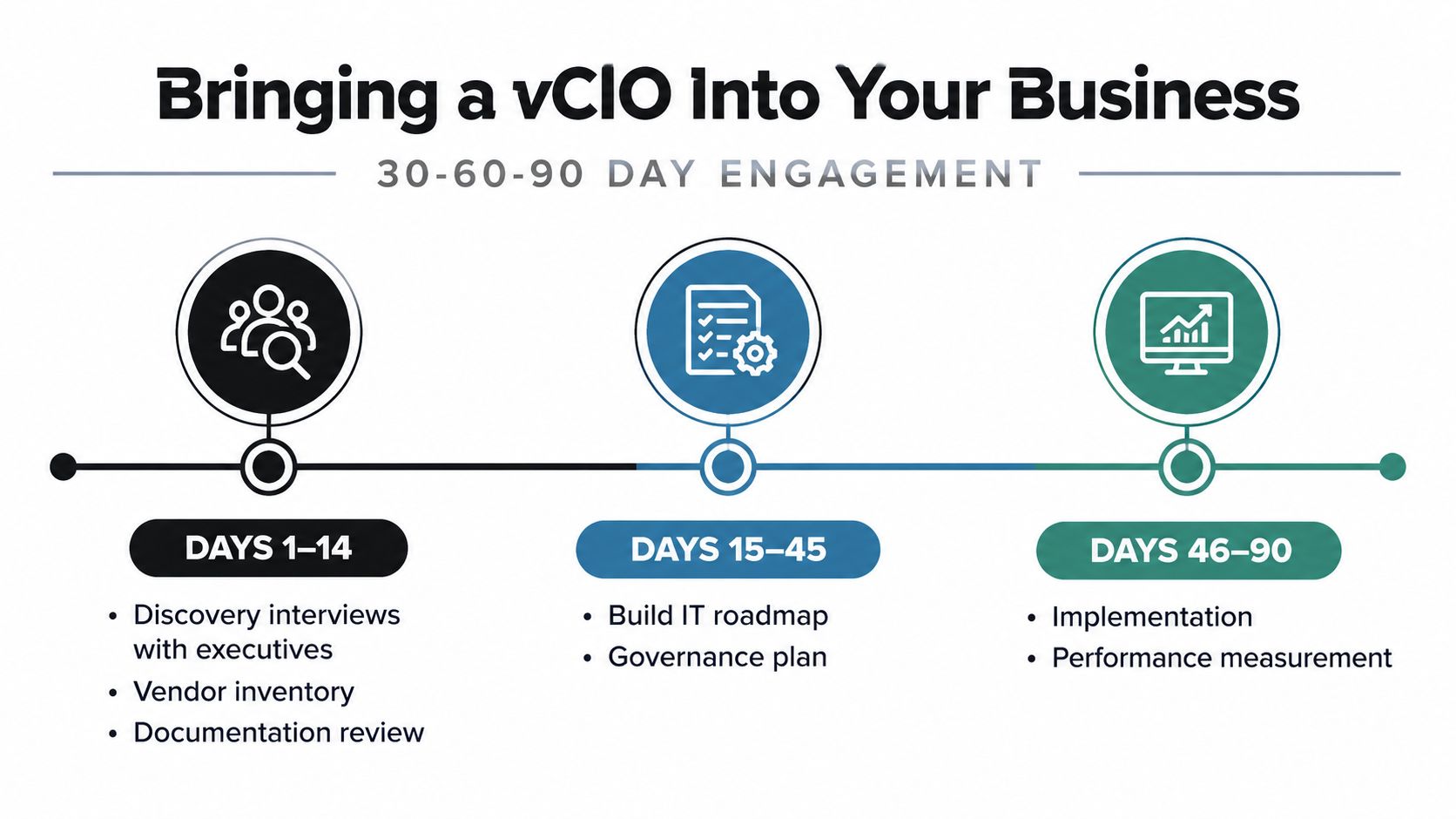
A good vCIO engagement should create momentum without creating dependency. The first 90 days should leave the business with a clear baseline, a prioritized plan, and a repeatable decision framework that remains useful even when individual people change.
Days 1 through 14 establish the facts
The vCIO interviews executives and department leaders, reviews existing documentation, inventories vendors and contracts, and identifies how technology decisions currently get made. The work should expose duplicate services, unassigned renewals, undocumented risks, and projects that lack an accountable owner.
The first written deliverable should be a current-state assessment. It should distinguish urgent exposure from ordinary maintenance and show where leadership needs to make a decision.
Days 15 through 45 create the operating plan
The vCIO builds the IT risk register, drafts the 12-month roadmap, and develops the governance plan. Spend is mapped to business priorities, vendor performance is reviewed, and proposed initiatives receive a consistent priority score.
A company shouldn't accept a roadmap that only lists technical upgrades. Each item should state the business objective, decision owner, expected dependency, funding requirement, and risk of delay.
Days 46 through 90 make accountability visible
The vCIO presents the roadmap to leadership, formalizes the monthly review cadence, and delivers the first board-ready metrics. The business should receive a vendor scorecard and a cybersecurity posture summary alongside the roadmap and current-state assessment.
Leadership should ask four direct questions before signing. Which decisions will the vCIO own? Which work remains with the internal team or managed provider? What artifacts will leadership receive, and how often will they be updated? What happens when a department rejects the agreed process?
Technovation LLC offers virtual CIO and virtual CISO services that cover executive IT leadership, technology roadmaps, risk prioritization, budget planning, and growth planning for DFW organizations. Businesses evaluating this model can visit Technovation LLC to discuss a vCIO engagement customized for their regulatory exposure, operating complexity, and execution resources.