

An IT governance framework is a structured set of policies, processes, and controls that ensures technology investments align with business objectives while managing risk and ensuring compliance. COBIT 2019 contains 40 governance and management objectives across five domains, while ISO/IEC 38500 is built around six principles and an Evaluate, Direct, Monitor cycle.
But does selecting a recognized framework really improve governance, or can it merely produce more policies that nobody follows?
For a Dallas-Fort Worth business, the practical answer is straightforward. Governance works when leaders can connect technology decisions to business priorities, assign decision rights, test controls, and produce evidence without interrupting daily operations. It fails when teams treat COBIT, ISO/IEC 38500, ITIL, HIPAA, SOC 2, and other requirements as separate paperwork projects.
The most effective approach is to build one operating model, then use the appropriate frameworks as layers within it.
Table of Contents
- What IT Governance Frameworks Actually Are
- Comparing COBIT, ISO 38500, and ITIL
- Real-World Success Stories from DFW Organizations
- How to Implement an IT Governance Framework
- Avoiding Policy Theater Through Framework Integration
- Why Technovation Can Help Your Organization Succeed
What IT Governance Frameworks Actually Are
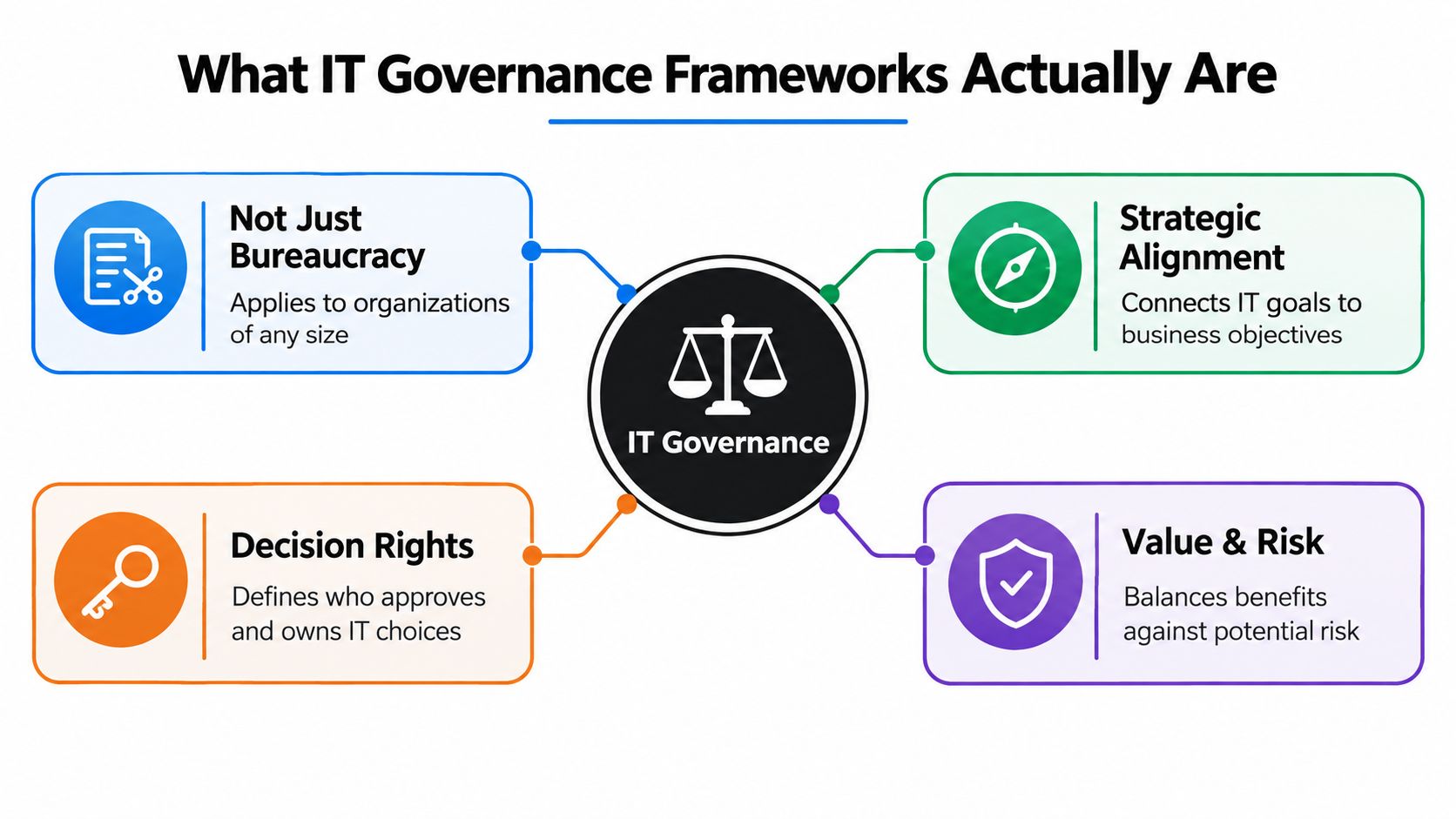
IT governance isn't reserved for large enterprises with extensive internal audit departments. ISO/IEC 38500 applies to organizations of all sizes, including public and private companies, government entities, and not-for-profit organizations, according to the official ISO standard description.
An IT governance framework gives an organization a repeatable way to answer practical questions:
- Who approves technology spending?
- Who owns a system or business process?
- Which risks are acceptable?
- How does the business know that a control is working?
- What evidence can leaders provide to an auditor, client, or regulator?
Without those answers, technology decisions often depend on individual judgment. A department may acquire an application without a security review. A former employee's access may remain active. A critical system may have no clearly accountable owner. None of these failures necessarily results from bad intentions. They result from unclear responsibility.
Governance is different from IT operations
Operations manages the work. Governance determines whether the work supports the organization and whether leaders can demonstrate responsible oversight.
ISO/IEC 38500 frames governance around Responsibility, Strategy, Acquisition, Performance, Conformance, and Human Behavior, supported by an Evaluate, Direct, Monitor cycle, as documented by ISACA's discussion of ISO/IEC 38500 and COBIT. A technology manager may operate backup systems, for example, while executives decide the required resilience level, approve investment, and monitor whether the arrangement meets business needs.
That separation improves traceability. A board member or owner doesn't need to inspect every technical task. The leader needs a reliable way to see who made a decision, what objective it supports, what risk was considered, and whether the expected result is being delivered.
Practical rule: Governance should make important decisions easier to trace, not make ordinary work harder to perform.
Why smaller organizations need structure
DFW healthcare clinics, law firms, financial businesses, and engineering companies all depend on technology, even when they don't have a formal governance office. Client confidentiality, patient information, financial records, vendor access, and business continuity create governance obligations regardless of company size.
A useful framework connects those obligations to routine activity. Access approvals become part of onboarding. Vendor reviews become part of procurement. Recovery testing becomes part of operational planning. Change records become evidence rather than an afterthought.
Organizations that want a broader explanation of how governance connects with security can review why frameworks like NIST matter beyond cybersecurity. The central point remains the same: governance isn't a stack of documents. It's the structure that helps business leaders make defensible technology decisions.
Comparing COBIT, ISO 38500, and ITIL
These frameworks aren't competing answers to one question. They address different management needs.
COBIT provides the broadest governance and management structure. ISACA traces its development from COBIT Version 1.0 in 1996 through later releases, including COBIT 5 in April 2012 and COBIT 2019 in 2018, representing more than 25 years of continuous development (ISACA's COBIT history). COBIT 2019 connects enterprise strategy, risk profile, compliance requirements, and sourcing model to governance objectives and evidence artifacts.
ISO/IEC 38500 operates at the board level. It gives directors and executives principles for evaluating, directing, and monitoring the use of information technology. It doesn't attempt to prescribe every service desk workflow or technical procedure.
ITIL is most useful for service management. It helps technology teams define how services are requested, changed, supported, restored, and improved. For an organization with recurring service issues or inconsistent change handling, ITIL practices can supply the operational discipline that a board-level standard doesn't provide.
| Framework | Best For | Key Strength | Maturity Required |
|---|---|---|---|
| COBIT 2019 | Regulated organizations needing broad governance and audit evidence | Tailored governance objectives, defined roles, and evidence expectations | Moderate, because the framework requires deliberate prioritization |
| ISO/IEC 38500 | Boards and executives seeking clear oversight | Simple principles for responsibility, strategy, acquisition, performance, conformance, and human behavior | Foundational to moderate |
| ITIL | Organizations managing a complex service environment | Repeatable service delivery, support, change, and improvement practices | Foundational to moderate |
Choosing based on the immediate business problem
A financial services organization may need COBIT's evidence-oriented structure because leaders must connect risk, compliance, ownership, and control testing. A medical practice may begin with ISO/IEC 38500 to clarify accountability before adding operational controls. A growing construction or engineering firm may prioritize ITIL-aligned service practices because project teams need dependable technology support without unnecessary approval delays.
The choice doesn't need to be permanent. COBIT's design-factor approach supports tailoring rather than forcing every organization to implement every objective. ISO/IEC 38500 can provide executive principles, COBIT can organize governance and evidence, and ITIL can guide service operations.
The right question isn't “Which framework wins?” It's “Which framework supplies the missing structure, and how will its requirements fit the controls already in place?”
Incident handling is a good example. A governance model may assign ownership and reporting expectations, while service management defines the workflow. Organizations can strengthen that connection by documenting an incident management process that identifies escalation authority, evidence requirements, communication duties, and post-incident review.
Real-World Success Stories from DFW Organizations
What does effective IT governance look like in a DFW business? The clearest answer appears in daily decisions, evidence, and accountability. A healthcare clinic must control patient information. A law firm must protect client files and demonstrate that safeguards operate. A financial services firm must assign ownership for systems supporting sensitive transactions.
These examples show operating patterns that leaders can test against their own baselines, control results, and audit evidence.

A medical practice clarifies accountability
A mid-sized medical practice applied ISO/IEC 38500's six principles to structure technology decisions and HIPAA preparation. Leaders assigned owners for core systems, recorded who could approve access, connected technology purchases to clinical and operational priorities, and scheduled recurring reviews of conformance and performance.
The reported result was a 60 percent reduction in audit preparation time, alongside improved protection of patient data, as described in the supplied case planning material. Replicate the operating design: assign owners and capture evidence during normal work, then measure your own audit preparation baseline before and after implementation.
A law firm builds evidence into daily work
A DFW law firm used COBIT 2019 to organize governance objectives around client data protection, access management, supplier oversight, incident handling, and audit records. Each priority was mapped to evidence, including access approvals, configuration baselines, change records, incident records, training records, supplier records, and audit records.
That structure supported the firm's pursuit of SOC 2 Type II certification and gave clients a clearer basis for evaluating data protection practices. The practical control is ownership. Assign a responsible person to each control, define the required evidence, and review whether the procedure operated consistently.
A project-driven firm protects delivery speed
A construction and engineering company aligned service management practices with its governance expectations. It defined which changes required approval, which could follow standard procedures, and who could restore service when project teams faced disruption.
The result was a risk-based approval path. High-impact changes received greater scrutiny, while routine work followed a defined process without unnecessary delay. DFW businesses can apply the same rule: reserve executive attention for decisions with material risk, and give trained owners authority over repeatable work.
Framework integration determines whether these controls support operations or become policy theater. Map each requirement to one owner, one workflow, and one evidence record. Remove duplicate approvals and retain the control that addresses the actual risk.
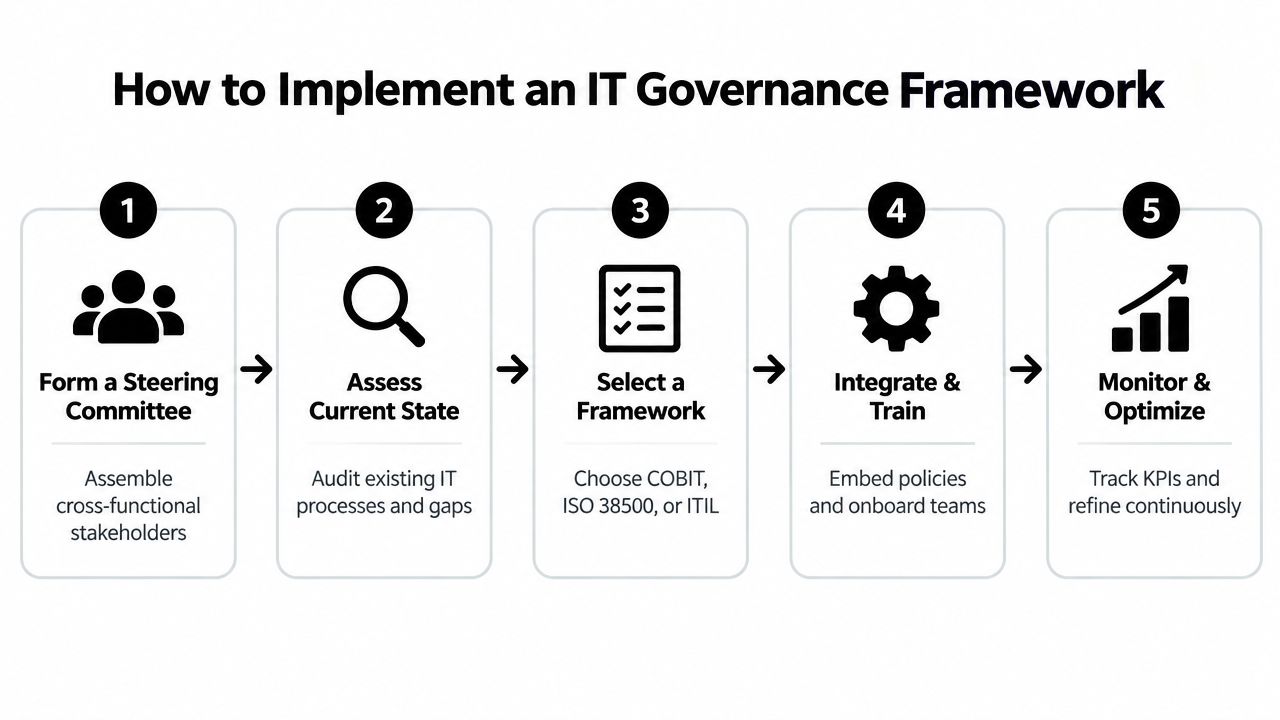
How to Implement an IT Governance Framework
Implementation should begin with the business problem, not with a large document library. A clinic may need stronger access ownership, a law firm may need audit evidence, and a growing business may need clearer technology investment decisions.
Start with ownership
Form a steering committee with IT leadership and business stakeholders. The group doesn't need to become another standing meeting that reviews every ticket. It should make decisions that require cross-functional judgment, such as risk acceptance, system ownership, major acquisition, resilience priorities, and compliance commitments.
A short governance charter should define:
- Authority: Which decisions require committee, executive, or system-owner approval?
- Accountability: Who owns each critical system, process, risk, and control?
- Escalation: What happens when a control fails or a business owner doesn't respond?
- Evidence: Which record demonstrates that the decision or control occurred?
- Review: When will leaders evaluate performance, risk, and continued relevance?
A charter that names owners but doesn't grant decision authority won't change behavior. The committee must be able to approve priorities, assign remediation, and require evidence.
Assess the current state
Before selecting a framework, document how technology decisions work today. Review systems, vendors, privileged access, onboarding and offboarding, backup arrangements, changes, incidents, policies, and audit requests.
The assessment should identify both gaps and duplication. A business may discover that three policies require separate annual reviews for what is effectively one access control. That finding will become important when the organization integrates frameworks rather than adding another independent process.
Organizations preparing for this work can begin with an IT infrastructure assessment to establish a practical baseline of systems, dependencies, risks, and ownership.
Choose the smallest useful scope
Select the framework that matches the immediate exposure. COBIT can structure enterprise governance and evidence. ISO/IEC 38500 can establish board-level principles. ITIL can improve service management. The first implementation should cover a meaningful business area, not every process in the organization.
For a regulated DFW business, an initial scope might include:
- Critical applications and their owners.
- Access approval, review, and removal.
- Change management for production systems.
- Incident escalation and reporting.
- Vendor and supplier oversight.
- Backup and recovery evidence.
Define meaningful measures
KPIs should help leaders make decisions, not decorate a dashboard. Useful measures include the proportion of critical systems with named owners, the status of overdue access reviews, unresolved high-priority control issues, changes completed with required approval, recovery exercises completed, and supplier reviews awaiting action.
A measure becomes useful when it has an owner, a threshold, a review cadence, and a defined response. “Security awareness is good” isn't a KPI. “Training records are complete for assigned personnel” is closer to a testable control, provided the organization defines who checks it and what happens when records are missing.
Operate, test, and expand
Embed controls into existing workflows. Connect onboarding and role changes to access approvals. Record changes as they happen. Store incident evidence in a consistent location. Keep supplier records with obligations and review decisions. Test whether controls work, not merely whether policies exist.
Start small, correct gaps, and expand coverage as the organization learns. Technovation LLC can support this work with identity governance, policy and procedure development, compliance readiness, infrastructure assessment, monitoring, and strategic IT planning aligned to the client's operating needs.
Avoiding Policy Theater Through Framework Integration
Framework sprawl creates a subtle failure mode. An organization may maintain COBIT objectives, ISO/IEC 38500 principles, ITIL procedures, HIPAA-related safeguards, and SOC 2 evidence requests, yet still lack a dependable way to prove that one control operates.
The problem isn't having multiple reference points. The problem is treating each reference point as a separate program. That approach produces duplicate approvals, conflicting terminology, repeated evidence collection, and policies that describe behavior nobody measures.
Recent expert commentary identifies the central 2026 governance challenge as integrating frameworks into an evidence-based operating model rather than choosing one framework over another, with greater attention to demonstrable control, AI accountability, and continuous oversight (ISACA's framework integration commentary).
Build layers instead of parallel programs
A practical governance architecture has one operational foundation and several interpretive layers.
- Business layer: Defines objectives, risk appetite, priorities, and decision rights.
- Control layer: Describes the actual control, its owner, frequency, procedure, and evidence.
- Framework layer: Maps the control to COBIT, ISO/IEC 38500, ITIL, contractual obligations, and regulatory requirements.
- Evidence layer: Stores approvals, tickets, configurations, reviews, training records, incidents, supplier records, and test results.
Suppose access reviews support a COBIT objective, an ISO principle, a client requirement, and a privacy obligation. The organization shouldn't run four separate reviews. It should operate one access review with defined scope, accountable owners, documented exceptions, remediation tracking, and mappings to each applicable requirement.
Policy theater begins when documentation becomes the deliverable. Effective governance treats documentation as evidence of a control that people actually perform.
Consolidate the work that auditors can test
Create a control register with one entry for each real control. For every entry, record the requirement mappings, owner, systems covered, procedure, evidence source, testing method, exceptions, and remediation status.
This structure reveals conflicts early. If one framework expects monthly review and another expects a different cadence, leaders can select a defensible approach based on risk and document the rationale. If two procedures assign different owners, the control register forces a decision.
A recent academic review identifies weaknesses in existing governance models around hybrid organizations, sustainability metrics, innovation, advanced analytics, and continuous learning, as discussed in the related framework study. The practical implication is that an IT governance framework must evolve with the business. Static policy binders won't govern cloud services, changing suppliers, or AI-assisted processes effectively.
Why Technovation Can Help Your Organization Succeed
DFW business owners don't need governance theater. They need a workable structure that connects technology decisions with patient care, client confidentiality, financial responsibility, project delivery, and growth.
Technovation supports regulated and security-conscious organizations across North Texas with cybersecurity, compliance, business IT services, strategic planning, proactive 24/7 monitoring, cloud backup, remote access, risk mitigation, and technology consulting. The firm brings 25 years of experience managing IT for regulated industries, including healthcare, legal, financial, construction, nonprofit, and general business organizations.
That support can begin with a focused question. Which systems lack owners? Which controls depend on manual reminders? Which evidence would be difficult to produce today? A security audit or IT health check can help leadership identify practical priorities before the organization commits to a broader governance program.

Governance should support growth
Technovation can help select an appropriate framework, map overlapping requirements, clarify system ownership, develop policies and procedures, organize evidence, and embed controls into daily workflows. Organizations that need strategic leadership without hiring a full-time executive can also evaluate a virtual CIO service for planning, prioritization, vendor guidance, and executive-level technology oversight.
The objective isn't to create more bureaucracy. It's to give leaders enough visibility and accountability to approve technology with confidence, demonstrate compliance, and let employees work without constant uncertainty about who decides what.
Technovation LLC offers framework selection, governance integration, compliance readiness, infrastructure assessments, cybersecurity, and managed IT support for Dallas-Fort Worth organizations. Visit Technovation LLC to request a security audit or IT health check and discuss a practical governance roadmap built around the organization's risks, systems, and business goals.