
Most companies don't plan to end up with multiple clouds. One team buys a service because it solves a problem fast, another team chooses a different provider because it fits a project, and a third team keeps legacy workloads where they already run. Soon enough, the business is paying for flexibility with scattered visibility, messy ownership, and cost surprises that show up after the fact.
That's the core job of multi-cloud management. It isn't about stopping cloud adoption. It's about putting governance around the sprawl that already exists, so leaders can see what's running, who controls it, what it costs, and where the risk sits before the next outage, audit issue, or budget meeting.
Table of Contents
- Why Multi-Cloud Sprawl Happens Before Anyone Plans For It
- What Multi-Cloud Management Actually Means
- The Business Case for Coordinated Cloud Governance
- Governance and Security Considerations for Regulated Industries
- Controlling Costs and Optimizing Performance Across Clouds
- Migration and Integration Checklist for Multi-Cloud Environments
- Operational Best Practices for Long-Term Success
- How Technovation Simplifies Multi-Cloud Management
Why Multi-Cloud Sprawl Happens Before Anyone Plans For It
A practical example is easy to find. A department launches a cloud project because it needs speed. Another team picks a different provider because the software they bought fits there better. A third team keeps a workload where the data already lives, because moving it looks expensive and risky. None of those choices are irrational on their own, but together they create a fragmented operating model that no one is fully governing.
That's how businesses drift into multi-cloud sprawl. The problem isn't cloud usage itself, it's the absence of a shared control layer. Virtana's 2024 survey found 83% of respondents were using more than one cloud service provider, 54% were managing more than eight public cloud instances, and 73% said their on-premises and cloud teams work in silos, which makes the situation worse quickly. The same report found 47% struggled to get a global view of utilization and spend, while 44% were worried about rising costs, a clear sign that the operational pain lands after the initial rollout rather than before it. Virtana's 2024 multi-cloud management survey
The hidden cost is coordination
Once cloud ownership gets split across teams, the company starts paying for duplicate effort. One group tags resources carefully, another group doesn't, and a third group monitors something else entirely. That's how cost reporting becomes unreliable and why security reviews keep turning up surprises.
Practical rule: if no one can explain who owns a workload in one sentence, the company doesn't have a cloud strategy, it has a collection of subscriptions.
There's a second problem too. Every new cloud instance adds another place where data, access, and configuration can drift apart. That's why the discussion has shifted from “Should the business use multiple clouds?” to “Who is governing them, and with what evidence?” Multi-cloud management is the answer to that question, because it brings structure after the fact instead of pretending the sprawl won't happen.
What Multi-Cloud Management Actually Means
At the simplest level, multi-cloud management is coordinated control across more than one cloud environment. In practice, that means one operating approach for visibility, identity, policy, automation, and reporting, even when the underlying providers are different. Without that layer, each cloud behaves like its own island, with its own console, billing model, IAM structure, and operational logic. HPE's multicloud management guidance
The control layer is the point
The technical mess comes from fragmentation. Each provider exposes different APIs, billing structures, identity systems, SLAs, and consoles, which creates tool sprawl and inconsistent governance across environments. That fragmentation makes it harder to see health, cost, and security in one place, and it turns root-cause analysis into a longer, more manual process. Network World on multicloud management challenges
A real management model includes four things working together:
- Centralized visibility, so leadership can see workloads, spend, and risk across providers.
- Unified identity and access management, so access rules don't change from one cloud to another.
- Consistent policy enforcement, so security and compliance standards hold up everywhere.
- Automation and orchestration, so routine changes don't depend on manual work and tribal knowledge. Mirantis best practices and tools
That's also why multi-cloud management is not a single product category. It's a discipline. Some organizations start with monitoring, others with policy, and others with cost controls, but mature environments eventually need all of them tied together. The literature review citing the 2022 Flexera report is useful here, because it found 89% of surveyed organizations used multi-cloud while only 25% used multi-cloud management tools, which says a lot about how often sprawl exists without control. Literature review on multi-cloud management
What business leaders should buy
The buying decision shouldn't start with features. It should start with the operational gaps the business can't afford. If the pain is inconsistent access, the priority is identity consolidation. If the pain is blind spend, the priority is unified reporting. If the pain is manual provisioning, the priority is automation with policy guardrails.
That's the mental shift. Multi-cloud management is not “another tool for IT.” It's the structure that makes the existing cloud footprint governable.
The Business Case for Coordinated Cloud Governance
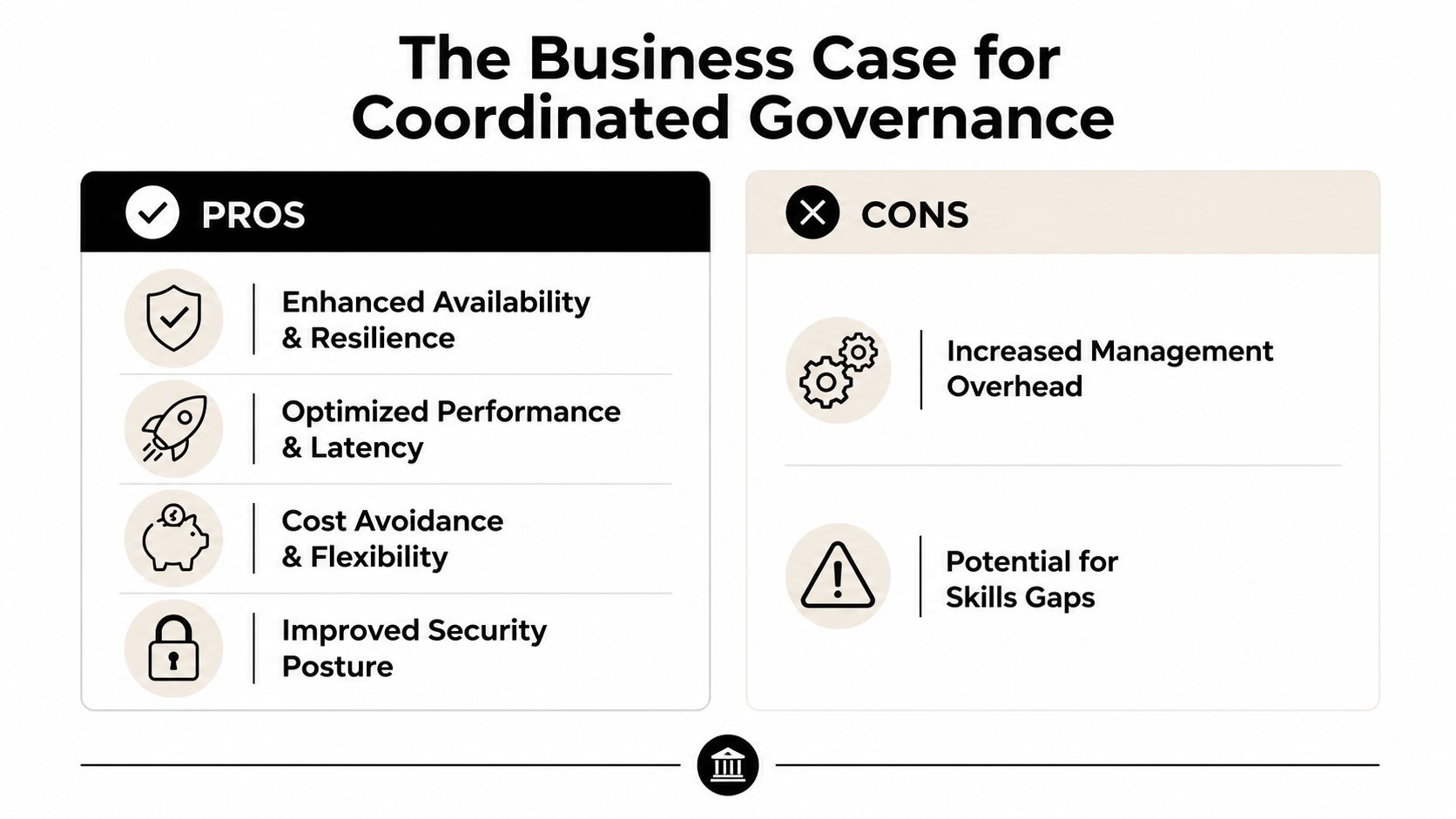
The strongest case for coordinated cloud governance is simple. Unmanaged multi-cloud environments waste time, hide risk, and make spend harder to defend. Managed environments do the opposite. They make it possible to explain why workloads live where they do, how the business controls cost, and what resilience exists when one provider has a problem.
The upside is operational, not theoretical
The benefits of multi-cloud are usually framed as availability, performance, scalability, and cost optimization. Those are real, but they only materialize when planning, automation, orchestration, security, and cross-functional training are in place. KPMG's guidance also starts with a strategic rationale for why multi-cloud, then moves into roadmaps, application assessment, controls, and exit strategy, which is the right order because architecture without governance creates expensive cleanup later. Multi-cloud strategy and planning guidance
A multi-cloud setup should earn its keep by improving resilience, compliance, or cost control. If it only increases tooling and meetings, it's overhead, not strategy.
The downside of leaving sprawl alone is equally concrete. Cross-cloud data movement can trigger egress charges, introduce latency, and make reliability worse when applications depend on frequent traffic between providers. That's not a rare edge case, it's a common consequence of distributing workloads without placing them carefully. CAST AI on multi-cloud challenges and best practices
For SMBs, especially in regulated sectors, the business case is stronger than many assume. A smaller firm often has fewer people to untangle access problems, documentation gaps, and data protection questions, so the cost of disorder lands harder. The question is not whether multi-cloud is complex enough for a small business. The question is whether the business can absorb the overhead of leaving it unmanaged.
Governance changes the economics
A governed environment is easier to audit, easier to explain to leadership, and easier to scale without drama. It also makes provider choice less emotional. Instead of asking which cloud feels convenient this quarter, the business can ask which placement supports the workload's compliance, performance, and cost profile. For firms that need help aligning cloud footprint with residency rules, the internal data residency requirements resource is the kind of checklist that exposes weak spots before they become audit findings.
Governance and Security Considerations for Regulated Industries
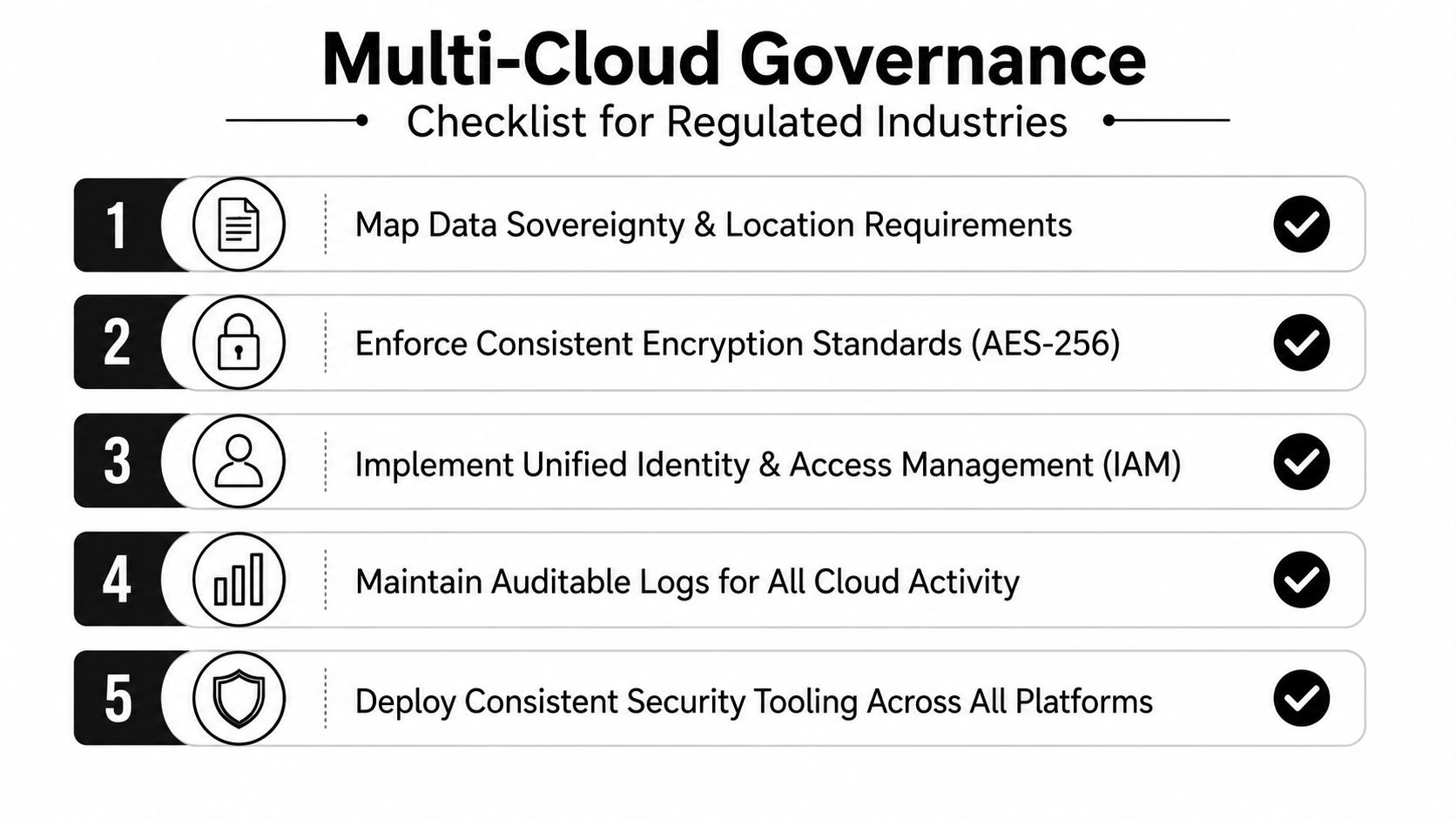
Regulated businesses do not get to treat cloud governance as optional. Healthcare clinics, law firms, and financial services providers need clear answers on where data lives, who can access it, how logs are retained, and whether backup and recovery work across every environment they depend on. A multi-cloud setup without those controls is a compliance risk with a cleaner interface.
Start with identity and policy
The first control point is identity and access management. Governance frameworks, clear policies, centralized identity management, and single sign-on across providers keep access consistent and easier to audit. Once identity fragments, permissions drift and review becomes a mess. HPE on multi-cloud management
The next control point is policy-as-code. Shared policies for identity, access, and compliance, plus standardized configuration controls and infrastructure-as-code, keep environments from drifting away from the approved baseline. That is the difference between saying a policy exists and proving it is being enforced the same way everywhere. Mirantis best practices and tools
A practical checklist for regulated organizations looks like this:
- Map data residency requirements to every workload, backup, and replication path.
- Standardize encryption and key management, then verify the same standard applies everywhere.
- Consolidate identity, so privileged access follows one approval model.
- Audit logs centrally, with retention rules that meet the firm's obligations.
- Test backup and recovery across clouds, not just inside one provider.
The test is whether the environment stays governable without slowing the business down. Ongoing compliance monitoring matters more than one-time documentation. The architecture-focused architecture-focused GDPR checklist helps teams turn legal obligations into system design without hand-waving.
Backup is one of the most overlooked gaps in multi-cloud. If the team cannot prove recovery paths and visibility across every cloud, the business is assuming resilience that may not exist.
The internal data residency requirements resource belongs early in that process because it shows where placement, replication, and retention choices can break policy before migration locks them in. For regulated industries, that is where governance becomes real.
Controlling Costs and Optimizing Performance Across Clouds
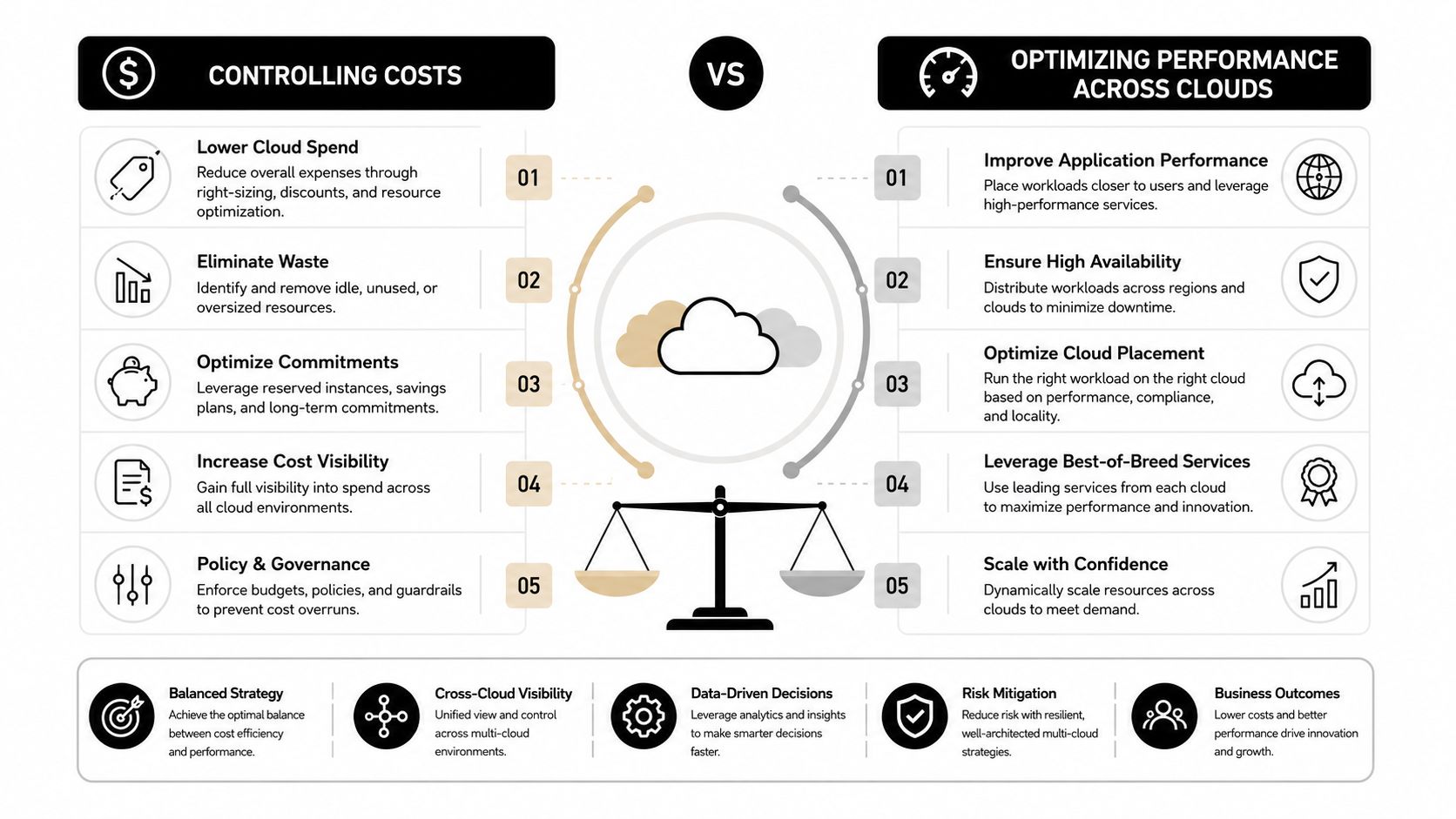
A multi-cloud setup starts to bleed money when no one watches the handoff points between providers. The surprise line items usually come from cross-cloud traffic, egress charges, oversized resources, and workloads running in the wrong place for how they behave. The business does not feel that pain on day one. It feels it when the invoices climb and the applications still do not run faster.
Cost control starts with visibility
Get a clean view of spend across every provider first. That means tagging that works, chargeback or showback people trust, and a cost model that separates infrastructure spend from data movement and backup. The most overlooked gap is backup visibility and data protection spend, because teams track compute and miss the cost and complexity of protecting data consistently across clouds. NOPS on multi-cloud management challenges
FinOps-style oversight belongs in the operating model because it makes cost ownership real. The 2026 guide to FinOps from Credit for gives teams a practical way to tie spend to actual usage instead of treating the monthly bill like a mystery. The point is discipline. Cost needs to be a workload-level conversation, not a finance-only surprise after the fact.
Performance follows placement
Performance is not just a bigger instance. It comes from placing workloads where data, users, and dependencies fit the way the application behaves. Guidance on multi-cloud challenges makes the same point clearly, moving datasets between clouds can add latency and reliability problems when applications depend on frequent inter-cloud traffic. That is why placement analysis comes before anyone moves a workload because it looks flexible on paper. CAST AI on multi-cloud challenges and best practices
A practical rule set keeps the decision honest:
- Keep data close to the workload when traffic is frequent and latency-sensitive.
- Use cross-cloud movement sparingly when the business can tolerate transfer costs and slower paths.
- Right-size regularly so idle capacity does not become a silent tax.
- Review backup architecture separately, because data protection can turn into its own spend center if nobody audits it.
For business owners, the message is blunt. If multi-cloud makes data protection hard to see or egress costs unpredictable, the design needs work. The answer is not to abandon the model. The answer is to govern placement, routing, and backup choices so the model does not become wasteful.
For teams trying to separate backup sprawl from real protection, the internal cloud backup solutions for small business resource is the right place to start.
Migration and Integration Checklist for Multi-Cloud Environments
Moving into a governed multi-cloud model is a planning exercise, not a copy-and-paste job. Every provider makes different assumptions, every workload carries different dependencies, and every compliance rule changes how the rollout should happen. Businesses that get this right do not improvise. They map the move before the first workload changes hands.
Use a checklist before you move a workload
Start with workload placement analysis. Evaluate each application by data movement, latency, compliance needs, and the way its dependencies behave across environments. The business should choose where each workload belongs based on operational fit, not on which cloud team is most comfortable with.
Provider evaluation comes next. Compare what each environment handles cleanly, what it complicates, and what becomes difficult to unwind later. Exit planning belongs in the same conversation. If a workload gets tied too tightly to provider-specific services, portability drops and future migration costs rise.
Before rollout, the checklist needs clear answers to a few questions:
- Assess the workload first, including data gravity, compliance needs, and network dependency.
- Standardize templates, so deployments start from approved patterns instead of one-off builds.
- Minimize provider-specific dependencies, unless there is a clear business reason to keep them.
- Train cross-functional teams, because operations, security, and application owners all need the same operating picture.
- Document the exit path, so the company is not trapped by its own deployment choices.
The hidden cost is usually in the move itself. Egress charges, latency, validation work, and rework often show up after the migration plan already looks approved. That is also why backup visibility deserves its own review. If the team cannot see where data protection lives, it cannot judge whether the design is controlled. A practical readiness review, such as the Technovation cloud computing readiness assessment, helps expose those gaps before a migration wave starts.
The cleanest migration is the one that knows which workloads should stay put. That decision is not a failure. It is disciplined governance.
Before any large move, the business should also check the surrounding content and dependencies that will follow the workload through the process. A multi-brand migration SEO guide is useful here because it reinforces a basic rule that applies in both web and cloud work, do not move what you have not mapped.
For business owners, the rule is simple. Move only what has a business reason to move. If the team cannot explain the operational gain in plain language, the migration is not ready.
Operational Best Practices for Long-Term Success
Once the clouds are connected, the temptation is to declare victory. That's the wrong move. The hard part starts after implementation, when the business has to keep the environment consistent, prove the controls still work, and show that the operating model is paying for itself.
Make drift hard to hide
Infrastructure-as-code is the first line of defense against configuration drift. Mirantis recommends using templates, policy-as-code, automation, and CI/CD workflows so environments are built from the same definitions instead of being repaired by hand later. That approach cuts variation and makes changes easier to review. Mirantis best practices and tools
Continuous monitoring matters for the same reason. The business needs one view of logs, metrics, traces, and security posture across providers, because isolated dashboards don't reveal the whole story. If a team can't correlate incidents across clouds, it's still operating in fragments.
Measure success by outcomes
The under-answered question in multi-cloud is how to prove the model is working. The answer should include a small set of business-facing metrics, not a long list of noisy indicators. That usually means tracking whether cost attribution is clearer, whether incidents are resolved faster, whether backup and recovery are unified, and whether policy exceptions are shrinking over time.
A simple operating rhythm helps:
- Review workload placement on a fixed cadence.
- Audit identity and policy drift across environments.
- Validate backups and recovery paths in real conditions.
- Compare spend to business value, not to last quarter's guess.
- Train teams together, so process knowledge doesn't stay trapped in silos.
If the company cannot show that multi-cloud reduced risk or improved control, then it probably just added tools.
Mature organizations stop treating multi-cloud as a collection of products and start treating it as a governance model. That's the mindset shift. The clouds themselves are just infrastructure. The discipline is in how the business keeps them aligned.
How Technovation Simplifies Multi-Cloud Management
Technovation makes sense for businesses that want cloud flexibility without losing control of the operating model. For Dallas–Fort Worth organizations, that means a practical mix of free security audits, IT health checks, compliance readiness assessments, proactive 24/7 monitoring, and planning that aligns cloud decisions with budget, risk, and business priorities.
Its cloud managed data center services fit the exact problem multi-cloud creates, too many moving parts, not enough centralized oversight. With 25 years of experience and local support, Technovation helps clients tighten governance, reduce exposure, and keep the environment manageable instead of chaotic.
If a business is stuck between cloud sprawl and compliance pressure, the right next step is a candid assessment, not another tool purchase. Technovation can help turn the footprint into a governed system the business can defend.
Technovation LLC helps Dallas–Fort Worth businesses bring order to cloud sprawl with security audits, compliance readiness assessments, IT health checks, and managed services built for real operational control. Visit Technovation LLC to start a conversation about multi-cloud governance that fits the company's risk, budget, and growth plans.