
A payroll platform, accounting application, benefits portal, cloud file service, or outside IT provider may have more influence over a small business's security than the owner realizes. In a 5–50 person company, vendor access often grows one practical decision at a time, until nobody can confidently list every company that can reach business data, systems, or facilities.
That gap between confidence and visibility is the SMB supply chain problem. SecurityScorecard reports that 90% of leaders believe they could continue operating through a vendor breach, while 78% say their security programs cover less than half of their total vendor ecosystem. Only 8.8% can map exposure across their supplier ecosystem in under four hours during an incident, according to its 2026 supply chain cybersecurity trends report.
A large enterprise may have dedicated procurement, security, legal, and response teams. A North Texas business with a few dozen employees usually has an office manager, an owner, an accountant, and an outside IT partner trying to keep operations moving. Supply chain security has to work in that environment. The practical question isn't whether every vendor is perfectly secure. It's whether the business knows where access exists, limits that access, and can respond when a trusted provider becomes the entry point.
Table of Contents
- The Vendor You Trust Is Already Inside Your Network
- What Supply Chain Security Actually Means for Small Businesses
- Common Threats and How Incidents Actually Start
- Compliance Expectations Translated Into Plain Decisions
- A Vendor Assessment and Contract Checklist You Can Use
- A 90-Day Risk-Mitigation Roadmap for SMBs
- Incident Response and Continuous Monitoring Without an In-House SOC
- How Technovation Helps You Put This Into Practice
The Vendor You Trust Is Already Inside Your Network
A 22-person professional services firm in the Dallas–Fort Worth area has just finished dealing with a ransomware scare. Employees changed passwords, restored several systems, and spent days checking whether client files were exposed. Three weeks later, the firm learns that the incident entered through a compromised update channel used by its payroll provider.
Nobody at the firm had made a reckless decision. The payroll service was established, familiar, and necessary. Employees trusted its updates because the software had always been part of the normal monthly routine. That normal routine gave attackers a path into the business.
The same pattern can involve a cloud accounting service, a document management platform, a benefits administrator, a software integration, a contractor's remote access account, or an outside support provider. The vendor doesn't need to be physically located in the office. A trusted connection, shared credential, API permission, browser session, or automated update can create a route into the company's operations.
The blind spot attackers count on
Most small businesses can name their most important providers. Far fewer can produce a complete, current list of every third party that touches company information or systems. The list often misses:
- A payroll or benefits subprocessor
- A contractor with remote administrative access
- A software integration that copies customer records
- A cloud backup service
- A marketing platform holding contact data
- A vendor's support account that was created years ago
- A fourth party used by a primary provider
That inventory problem matters because an organization can't protect an access path it doesn't know exists. SecurityScorecard's findings show the danger of relying on executive confidence while leaving much of the vendor ecosystem outside the security program. Static audits and manual remediation also create delays, while AI-driven threats are now ranked as the top supply chain risk in the cited report.
A plain-language definition
Supply chain security means knowing who has access, what they can do, what information leaves the business, and how the company will detect and contain a problem.
That definition applies whether the provider supplies software, logistics, payroll, cloud hosting, maintenance, consulting, or managed IT. The objective isn't to eliminate vendors. It's to make trusted relationships visible, limited, documented, and monitored.
Practical rule: If a vendor can access business data or systems, that vendor belongs in the company's security conversation, regardless of how ordinary the service seems.
What Supply Chain Security Actually Means for Small Businesses
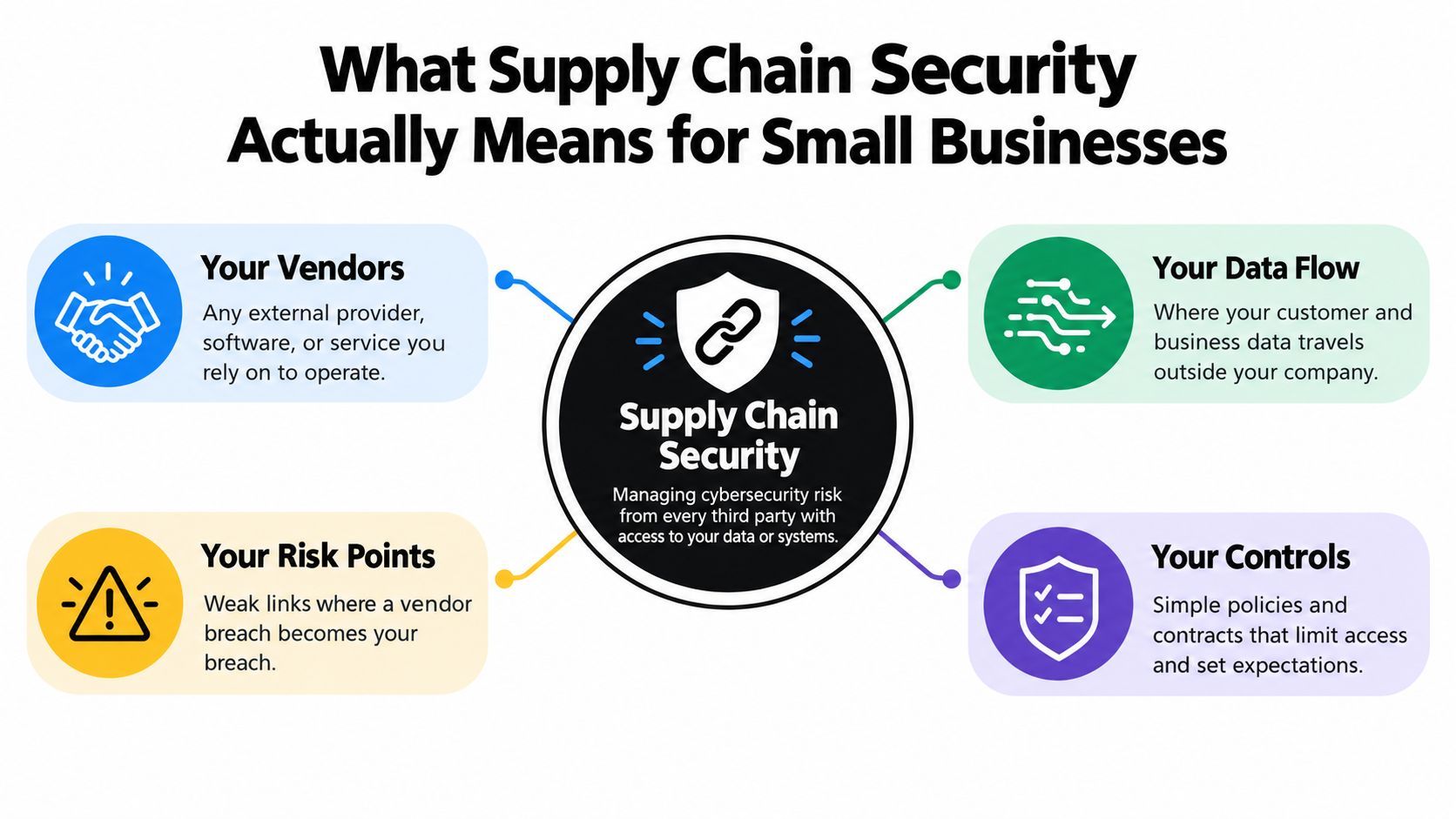
Supply chain security is the discipline of managing cybersecurity risk introduced by every third party that stores, processes, transmits, or connects to business data. That includes direct vendors and, where the information is available, the providers those vendors use behind the scenes.
A useful analogy is a commercial building where cleaning crews, HVAC technicians, delivery drivers, security contractors, and property managers all receive keys. The building owner doesn't assume every keyholder is dangerous. The owner records who has each key, limits access to the necessary rooms, retrieves keys when a contract ends, and investigates when a door opens at an unusual time.
Business technology needs the same discipline. A vendor may need access to one application but not the entire network. A contractor may need temporary administrative rights but not a permanent account. A data processor may need customer records but not payroll information. Supply chain security turns those decisions into repeatable controls.
Four risk categories deserve attention
Software dependencies include upstream code, open-source packages, automatic updates, plugins, integrations, and application programming interfaces. A company doesn't need to write software to depend on this category. A standard business application may rely on many components that the buyer never sees.
Service providers include SaaS companies, managed service providers, consultants, contractors, payroll firms, and support desks. Their employees and systems may hold credentials, administrative privileges, or access to sensitive records.
Hardware and physical components include laptops, networking equipment, access-control systems, cameras, printers, and devices installed or maintained by another company. Physical compromise and poor maintenance can create both operational and cyber exposure.
Data handling partners receive, process, store, or transmit customer, employee, financial, or regulated information. Their subprocessors matter too, because a primary vendor may send information onward under terms the SMB never reviewed closely.
Why smaller companies attract attention
Attackers understand that small organizations often have less formal vendor governance, fewer contractual security requirements, and limited ability to detect lateral movement from a compromised partner. That doesn't make every SMB an easy target, but it does create opportunities when access remains broad and nobody owns the review process.
A sensible program starts with three questions:
- Who can reach the business?
- What access does each party need?
- What evidence will show that access was misused?
Those questions are more valuable than collecting a thick policy binder that nobody follows.
Common Threats and How Incidents Actually Start
Supply chain incidents rarely begin with a dramatic breach of the company's front door. They often begin with an update, a reused password, an overlooked integration, a support request, or a routine data transfer.
The risk has become material enough that it deserves executive attention. In 2025, one widely cited industry analysis reported that 30% of breaches involved a third party, compared with 15% the year before, while another major report found an average supply chain compromise breach cost of $4.91 million and had a mean lifecycle of 267 days, the longest of any tracked attack vector, as summarized in this supply chain attack statistics analysis. Those figures describe the scale of the problem, not a prediction that every SMB will experience the same outcome.
The normal business activities that create exposure
| Threat Type | How It Reaches an SMB | Typical Impact |
|---|---|---|
| Malicious software update | A trusted provider distributes compromised code through its normal update process | Malware installation, credential theft, or operational disruption |
| Tampered package or dependency | A developer, contractor, or application pulls a malicious or altered component | Compromised applications, exposed secrets, or hidden persistence |
| Third-party data exposure | A SaaS account, hosting provider, or subprocessor misconfigures storage or suffers a breach | Customer, employee, or financial information becomes accessible |
| Credential reuse or session hijacking | A stolen vendor password, token, or active session reaches an account connected to the SMB | Unauthorized access, privilege escalation, or fraudulent activity |
| Provider compromise | An MSP or service provider account is compromised and used across client environments | Cascading access, remote tooling abuse, and difficult containment |
Software compromise deserves special attention even for organizations that don't employ developers. Incident patterns involving trusted software updates, altered packages, and registry typosquatting show how attackers can use familiar components to bypass suspicion. The software and AI supply chain is also broadening. Docker's 2026 study reports that 77% of organizations experienced a software supply chain incident in the past 12 months, 57% expect more than half their code to come from third-party sources within 12 months, and only one of twelve security tool categories was rated very effective by a majority of respondents, according to its software supply chain security report.
JFrog's 2026 findings add a warning for organizations using AI-enabled development workflows. The report describes a 451% surge in malicious npm packages, says 53% of organizations still pull models from public registries where malicious payloads have been found, and reports that 18% have zero governance over IDE or MCP servers used in developer workflows, as included in the same cited research context.
For a small business, the mental model should be simple: every major threat arrives through something the company already does. Vendors send updates. Employees log in. Systems exchange data. Contractors request access. Detection and governance beat hoping every provider stays clean.
Businesses also need to separate supply chain compromise from employee misuse. Guidance on insider threat indicators can help teams distinguish unusual internal behavior from activity that may originate through a trusted external account.
Compliance Expectations Translated Into Plain Decisions
Compliance becomes more manageable when the owner asks one question for every vendor:
What regulated data does this provider touch, and what does that require from the business?
HIPAA applies when a healthcare organization handles protected health information. PCI DSS matters when payment card data enters the environment or process. GLBA applies to covered financial institutions and the customer information they handle. CMMC concerns organizations participating in the applicable defense industrial base requirements. NIST and CISA guidance provides a practical risk-management foundation even when a specific regulation doesn't mandate a particular control.
The frameworks use different terminology, but their vendor expectations overlap. Each pushes the business toward controlled access, documented responsibilities, incident notification, evidence retention, and oversight of subcontractors.
| Framework | Applies When You Handle | Core Third-Party Requirement | SMB Action |
|---|---|---|---|
| HIPAA | Protected health information | Business associate responsibilities and safeguards | Identify every provider touching protected health information and document agreements |
| PCI DSS | Payment card data | Managed access, monitoring, and responsibility across service providers | Maintain a current provider list and verify payment environment responsibilities |
| GLBA | Nonpublic personal information in covered financial services | Safeguards and oversight for service providers | Document data flows, security expectations, and review evidence |
| CMMC | Covered defense information and contract-related requirements | Controlled handling, access, and supplier responsibilities | Map provider access to contract obligations and retain supporting evidence |
| NIST and CISA guidance | Organizational cybersecurity and software supply chain risk | Risk identification, assessment, mitigation, and software transparency | Use a documented supply chain risk process and apply it to procurement |
NIST SP 800-161 Revision 1, published in May 2022, is designed to help organizations identify, assess, and mitigate cybersecurity supply chain risks across the full supply chain. Its guidance integrates cybersecurity supply chain risk management into broader risk management through strategies, implementation plans, policies, and risk assessments, as described in the NIST supply chain risk management guide.
CISA defines an SBOM as a nested inventory of software components and describes it as a building block for software security and supply chain risk management. In 2026, CISA and partners updated SBOM minimum elements to apply across software, including open-source software, AI software, and SaaS, according to the NIST SBOM guidance. For procurement teams, that makes component transparency a business requirement, not merely a developer preference.
A five-minute self-test works well:
- Does a vendor receive regulated data?
- Can the vendor access a production system or administrator account?
- Does the contract require prompt breach notification?
- Can the vendor identify subprocessors?
- Can the business prove access reviews and data disposal?
An answer of “unknown” deserves the same treatment as a risk until someone verifies it. Businesses that need to validate email addresses before sending sensitive workflows or account notices can also review an Email Validation API as part of broader data-quality and communication controls.
A Vendor Assessment and Contract Checklist You Can Use
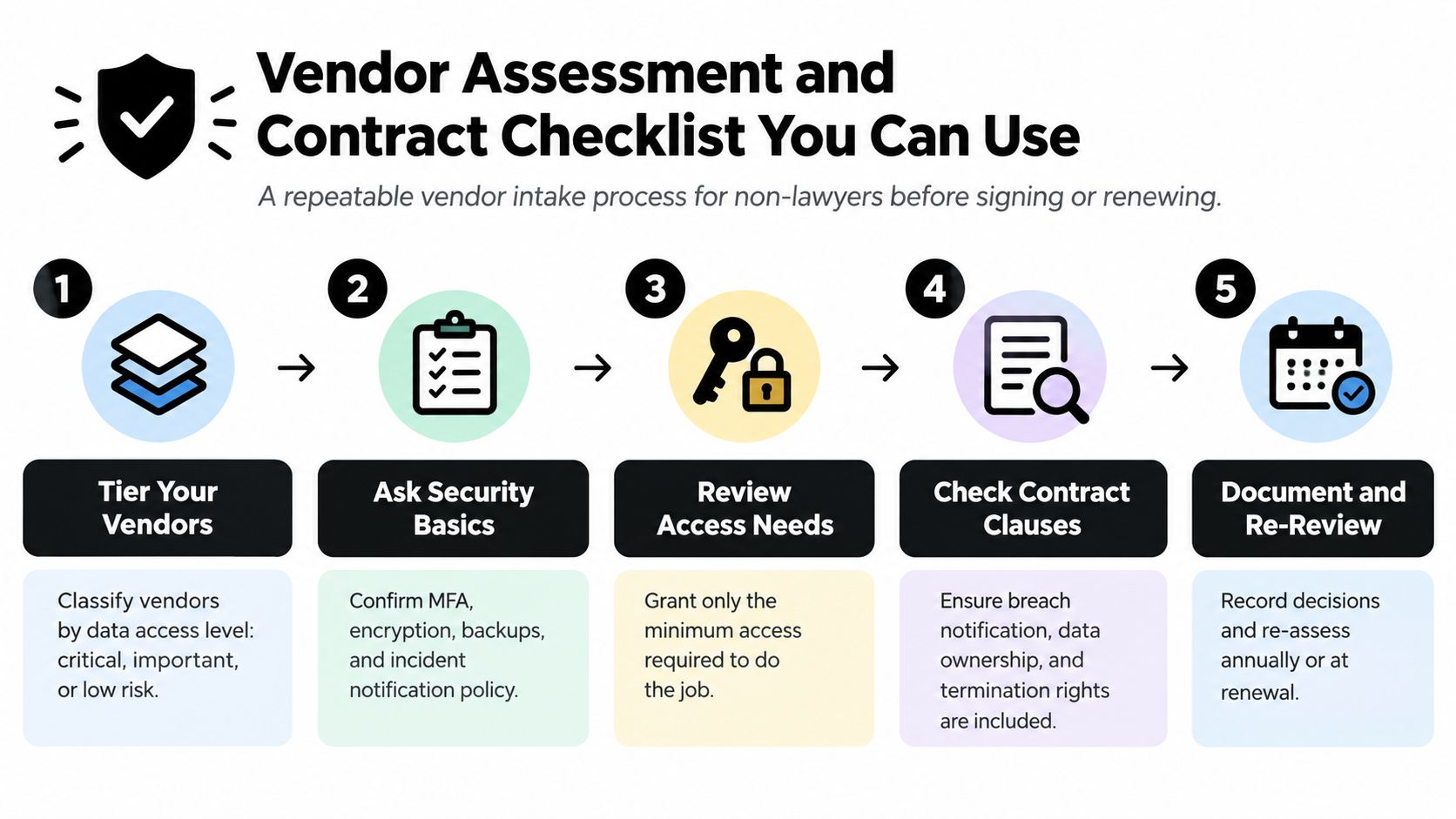
Vendor review shouldn't be a one-time legal exercise performed only for a major purchase. It should happen during intake, renewal, material service changes, and any event that expands data or system access.
Start by assigning each provider a tier:
- Tier 1, critical exposure: Handles regulated data, controls an essential business process, or has access to systems and networks.
- Tier 2, important exposure: Stores non-regulated business data or supports an important workflow without broad administrative access.
- Tier 3, limited exposure: Has little or no access to sensitive information, systems, or facilities.
The tier determines how much evidence the business should collect. Tier 1 providers should be able to produce relevant independent assurance evidence, such as a SOC 2 Type II report or ISO 27001 certification, along with cyber insurance information, a breach history, and a current subprocessor list. Lower-tier vendors still need basic questions answered, but they shouldn't consume the same review effort.
Contract terms that protect the relationship
The contract should make security responsibilities specific. It should address:
- Breach notification within 72 hours or less, with a named contact and escalation route.
- A right to audit or obtain independent assurance evidence when risk justifies it.
- Subcontractor approval or notification, including responsibility flow-down.
- Data return and destruction when the service ends.
- MFA and encryption requirements appropriate to the access and information involved.
- Cyber insurance thresholds that reflect the provider's role and the potential loss.
The business should also define access boundaries outside the contract. A vendor that only supports one application shouldn't receive unrestricted network access. Temporary administrative privileges should expire, shared accounts should be eliminated where possible, and access should be reviewed at renewal.
Contract test: If the agreement says a provider will use “reasonable security,” the business still needs to ask what that means, how it will be evidenced, and what happens after a suspected breach.
Red flags should stop or pause a deal. These include refusal to complete a security questionnaire, vague breach language, inability to name subprocessors, and resistance to MFA requirements. A practical discussion of broader vendor strategies for enterprises can provide useful context, but a five-person firm should adapt the process to its actual risk and staffing.
For businesses handling sensitive information, a documented data protection clause can help turn general expectations into contract language that procurement and counsel can review.
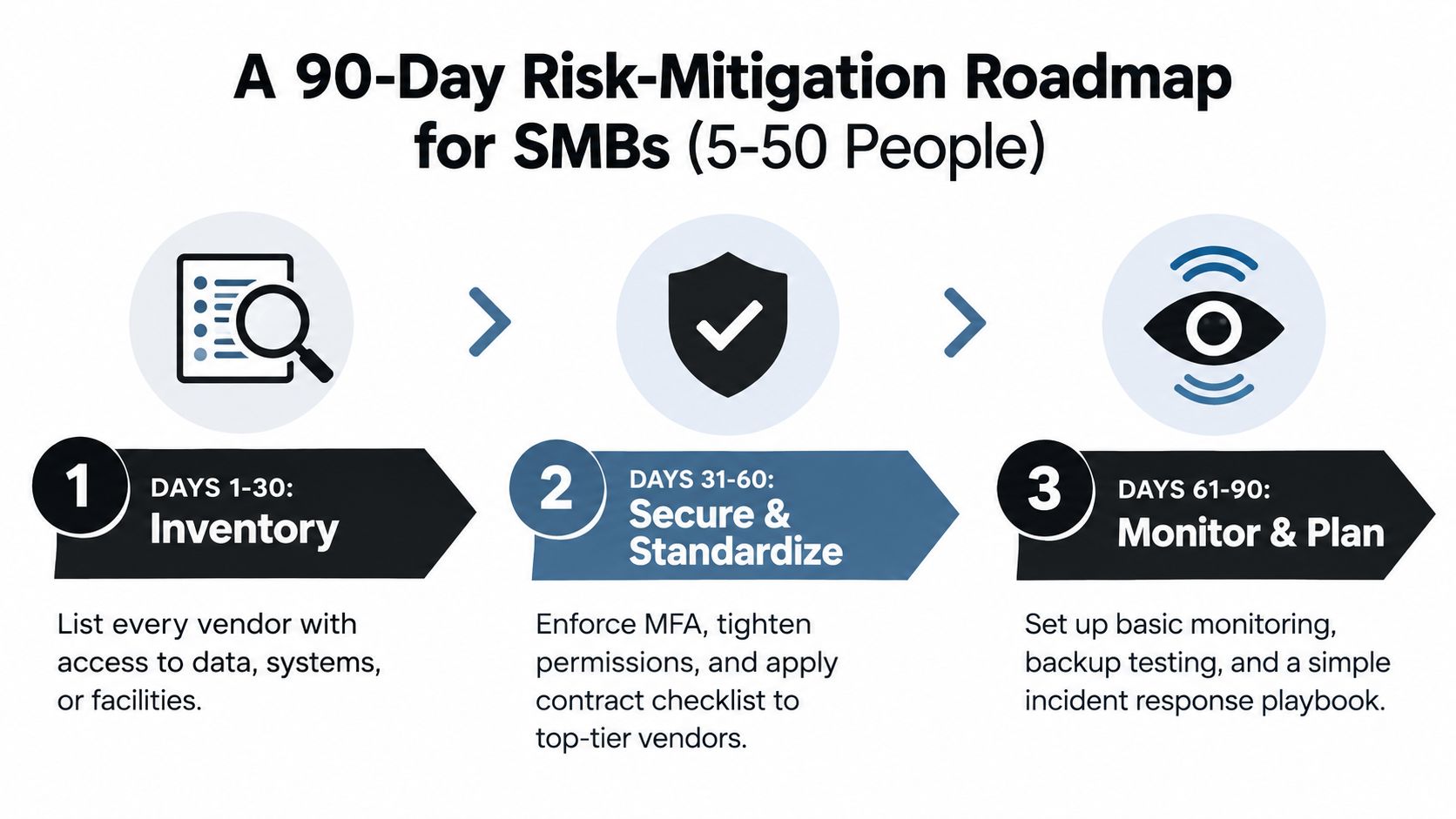
A 90-Day Risk-Mitigation Roadmap for SMBs
A 5–50 person company doesn't need to build an enterprise security department this quarter. It needs to complete a short sequence of high-impact actions and create an operating rhythm that continues after the first review.
Days 1 to 30, build the inventory
The first month is about visibility. List every vendor with access to data, systems, networks, facilities, or business-critical workflows. Record the purpose of the relationship, information involved, access level, contract owner, renewal date, security contact, and whether the vendor uses subprocessors.
During the same period, enable MFA on every critical SaaS account and require MFA for remote administrative tools. Remove dormant accounts, review shared credentials, and confirm that former contractors no longer retain access. The result should be a usable register, not a spreadsheet that nobody maintains.
Days 31 to 60, secure the highest exposures
Send security questionnaires to the ten vendors with the greatest data exposure or operational importance. Review the available SOC 2 reports, ISO 27001 evidence, insurance certificates, breach history, and subprocessor information. Missing evidence doesn't automatically end a relationship, but it should change the vendor's risk rating and trigger a remediation discussion.
A lightweight external exposure scan should identify the three most exploitable issues connected to the business. Patch or otherwise address those issues first. The point isn't to generate a large technical report. It's to close the weaknesses most likely to provide an attacker with a practical route in.
Days 61 to 90, make the controls durable
Use the contract checklist on the two highest-risk agreements. Negotiate notification, MFA, encryption, audit, subcontractor, data destruction, and access terms. Deploy endpoint detection on every company laptop, including devices used to access third-party services.
Then document a simple incident response playbook. Name the internal decision-maker, IT contact, legal contact, cyber insurance contact, and contacts at the five most critical vendors. The roadmap should continue through quarterly reviews, with each quarter adding one layer of maturity rather than attempting enterprise-grade controls immediately.
A focused cybersecurity risk management process can help keep the roadmap tied to business priorities instead of turning it into a collection of disconnected technical tasks.
Incident Response and Continuous Monitoring Without an In-House SOC
A small company doesn't need a security operations center to define a useful response. It needs clear triggers, authority to act, reliable escalation, and someone who can investigate activity before an alert becomes an outage.
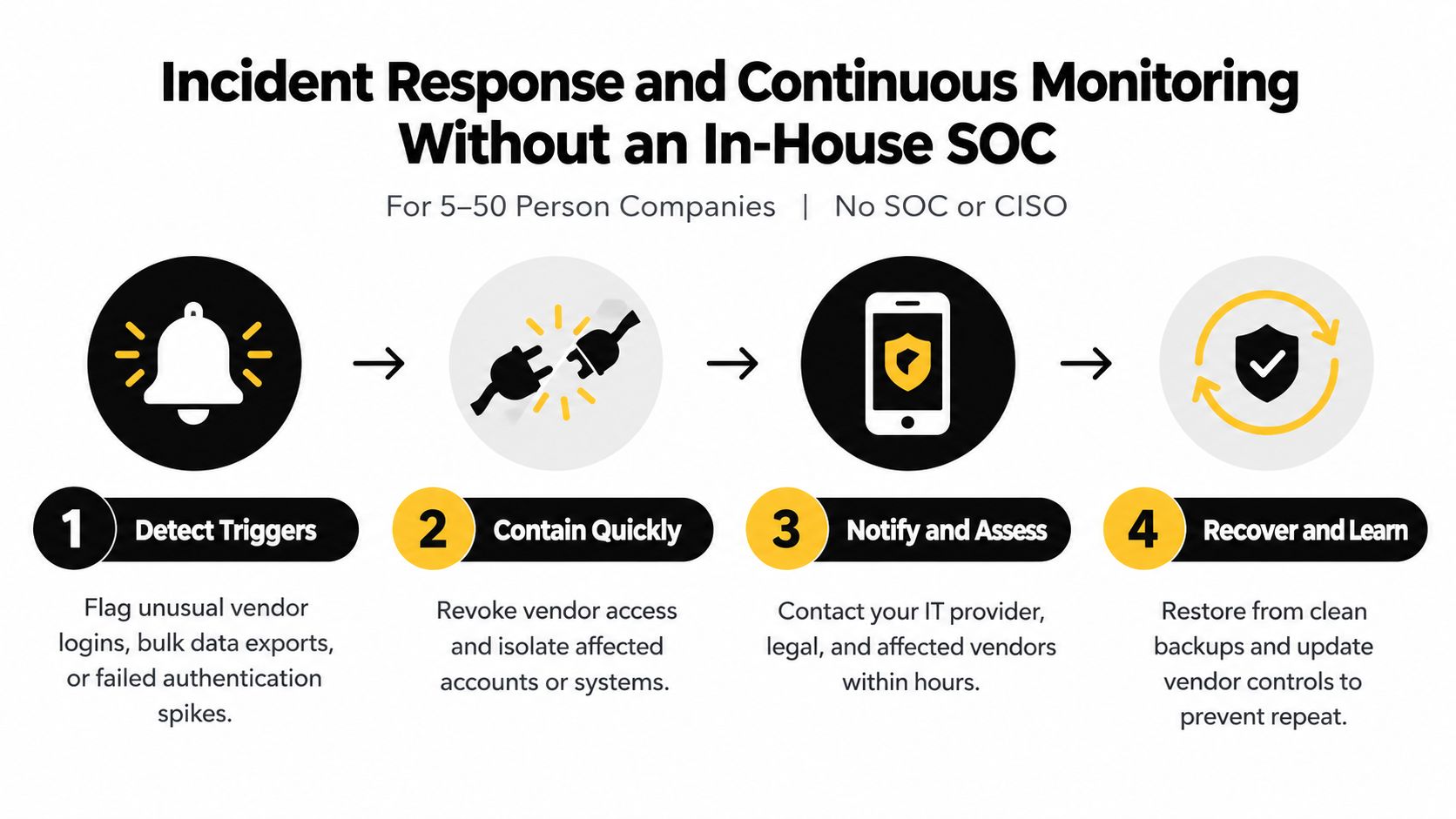
Useful triggers include an unusual vendor API call, a privileged login from a new geography, a sudden bulk data export, a burst of failed authentication attempts, or ransomware indicators on an endpoint connected to a third-party tool. Each trigger should produce a known action, such as suspending the account, revoking the vendor session, isolating the device, preserving logs, and contacting the response partner.
The first day should be written down
During the first hours, the business should:
- Call the response lead: Notify the managed IT or security provider and the internal decision-maker.
- Contain access: Revoke suspected vendor credentials, isolate affected systems, and avoid deleting evidence.
- Activate advisors: Contact legal counsel and cyber insurance according to the policy's requirements.
- Assess scope: Determine which vendor, accounts, systems, and data may be involved.
- Control communication: Coordinate customer, employee, regulator, and vendor communications through authorized people.
The company shouldn't improvise public statements while technical facts remain unclear. It also shouldn't wait for perfect certainty before containing a clearly suspicious account.
Continuous monitoring for an SMB usually means outsourced managed detection and response, not a complex deployment that produces alerts nobody reviews. The provider should collect relevant endpoint, identity, cloud, and remote-access signals, investigate meaningful anomalies, escalate confirmed concerns, and provide monthly summaries that translate technical activity into business risk.
The local MSP matters during this stage because the partner already knows the environment, users, vendors, backups, and normal operating patterns. A national hotline may be available, but a DFW business benefits from a responder who can move quickly and coordinate with local leadership.
Businesses without a security team can use managed detection and response to establish that monitoring and escalation layer without hiring an in-house SOC.
How Technovation Helps You Put This Into Practice
Supply chain security becomes useful when someone owns the work after the policy is approved. Technovation LLC can begin with a supply chain risk assessment that produces a vendor inventory, maps access and data flows, and identifies a prioritized gap list. The review should focus on business risk, such as payroll interruption, exposed patient information, disrupted legal matters, or loss of access to project systems.
The operating model should remain practical:
- Managed detection and response connects suspicious vendor-related activity to an escalation process.
- Vendor risk reviews turn procurement and renewal decisions into documented security decisions.
- Security awareness training helps employees recognize credential theft, fake support requests, and malicious update prompts.
- Vulnerability management identifies and prioritizes weaknesses across endpoints and externally exposed systems.
- Co-managed compliance support helps organizations align vendor evidence and controls with HIPAA, PCI, and GLBA obligations.
Quarterly roadmap reviews should measure progress against the vendor register, access controls, unresolved findings, contract gaps, response readiness, and business priorities. Ticket volume isn't a meaningful supply chain security outcome if the company still can't identify who can access its data.
Technovation's DFW presence also supports on-site workshops, same-time-zone response, and engineers who can work with the customer's existing technology stack. That local context matters when a vendor incident affects payroll, clinical operations, client confidentiality, construction project files, or financial records at the same time.
A sensible first engagement should be low friction. Technovation can provide a no-cost supply chain security assessment, deliver a written gap report within two weeks, and scope and price the first 90 days of work before the business signs anything.
Technovation LLC offers DFW businesses managed IT security, monitoring, response, compliance support, and strategic planning built around real vendor access and operational risk. Visit Technovation LLC to schedule a no-cost supply chain security assessment and get a written, prioritized plan for the next 90 days.