
The alert arrives after business hours. A staff account is signing in from an unfamiliar location, a file server is behaving strangely, and the person with the most technical knowledge is trying to determine whether the event is serious. Meanwhile, an executive wants an answer, a client is asking whether its data is safe, and nobody can confirm who may shut down a system or contact legal counsel.
That is how incident calls unfold for Dallas–Fort Worth businesses. The weak plans usually contain plenty of technical language, but they don't answer the questions that matter under pressure: Who decides? Who speaks? Who preserves evidence? Who can act when the logs, backups, and communication systems may already be compromised?
A workable program connects policy to execution. NIST Special Publication 800-61 Revision 3 reflects that maturity, moving incident response from an emerging security practice toward a continuously updated governance discipline. The latest IBM benchmark reinforces the business stakes: across 602 organizations with breaches occurring between March 2025 and February 2026, the global average breach cost reached USD 4.99 million, while the U.S. average reached USD 11.5 million. The same report placed mean time to identify and contain a breach at 247 days, with an estimated burden of roughly USD 1,100 per hour of unresolved breach time. IBM's 2026 breach-cost reporting makes the point plainly: preparation affects exposure.
Table of Contents
- What an Incident Response Plan Actually Has to Cover
- Building the Core Response Phases
- Roles and Decision Authority When Things Get Real
- Communications That Hold Up Under Pressure
- Evidence Preservation and Recovery Dependencies
- Testing the Procedures Before You Need Them
- Turning Lessons Learned into a Living Playbook
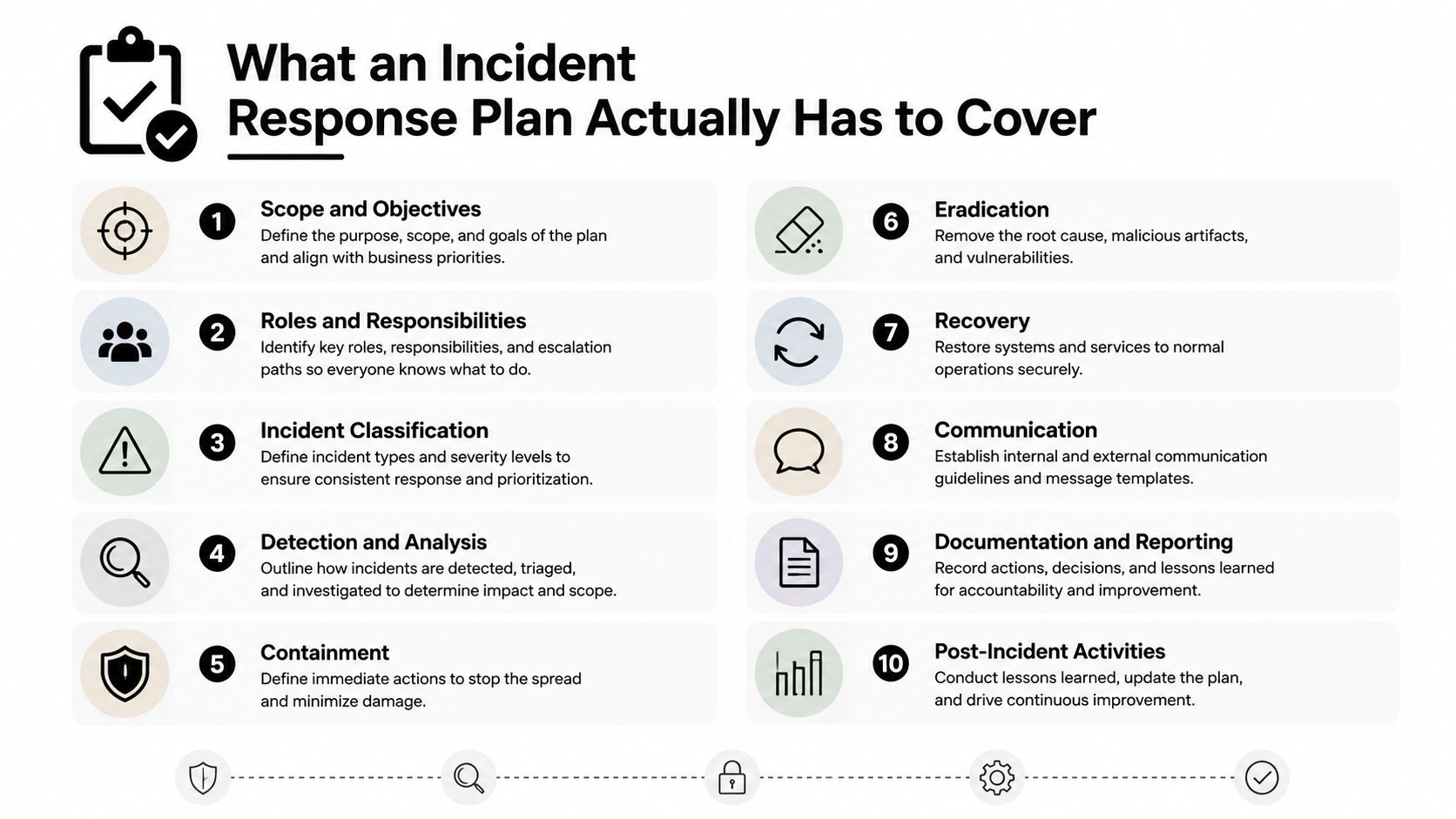
What an Incident Response Plan Actually Has to Cover
Most plans fail before the first alert because they describe tools instead of decisions. A small or mid-sized business needs a document that gives people permission to act, defines the boundaries of that action, and identifies the person accountable for every major choice.
Five decisions belong in the plan
Scope comes first. Name the systems, sensitive data, cloud services, remote access paths, vendors, and third-party connections covered by the plan. State what remains outside the plan, such as physical security or an HR investigation, so the incident commander can prevent scope creep during a live event.
Severity must reflect business impact. A technically moderate event affecting payroll, patient records, client files, or production scheduling may outrank a technically severe event on an isolated test system. Severity criteria should identify the operational, legal, financial, and customer consequences that trigger escalation.
Authority must be explicit. The plan should identify who can isolate an account, take a host offline, suspend a service, approve emergency spending, authorize a ransom decision, or approve customer notification. “Leadership will decide” isn't a decision right. It's an invitation to wait.
Communication must be ready before the call. Pre-approved templates for an outage, suspected data exposure, ransomware, and third-party compromise keep teams from drafting sensitive language at 3 a.m. Legal counsel should review the templates in advance, with a clear threshold for when counsel must participate in a new statement.
Escalation must work outside the normal directory. List the internal team, managed security provider, cyber insurer, outside counsel, forensic provider, and e-discovery contact. Verify the phone numbers quarterly, and provide an out-of-band channel if email or identity systems are unavailable.
Practical rule: Every assignment needs a named owner, a backup owner, a phone number, and a review date.
The policy-to-procedure chain matters. NIST's incident response guidance states that procedures should be based on the incident response policy and plan, then spell out how technical and operating processes are performed. Businesses that need a practical planning reference can also review these top incident response tips for MSPs, particularly when vendor coordination and escalation are part of the operating model.
For regulated organizations, the plan should map to the controls and documentation obligations that matter to the business. A NIST compliance checklist can help leadership identify missing ownership, evidence, and review practices before an incident exposes them.
Building the Core Response Phases
A useful playbook should match the way an incident unfolds in a real SMB environment. The sequence below is more operational than a generic instruction to “respond quickly,” because each phase has a different owner, decision, and stopping point.
Detection and triage
Detection starts with coverage across endpoints, identity providers, email gateways, firewalls, and SaaS audit logs. Alert thresholds need tuning. Excessive noise creates alert fatigue, and an analyst who treats every notification as urgent will eventually miss the one that matters.
Triage should fit on one page. The responder needs to answer four questions:
- Affected assets: Which users, hosts, applications, and data stores show signs of compromise?
- Blast radius: Is the event isolated, or are identities and systems spreading the activity?
- Data movement: Is information leaving the environment, and can the team validate that conclusion?
- Active threat: Is the attacker still operating, or is the event historical?
The triage worksheet should assign severity according to business impact and identify the next decision owner. It shouldn't require a committee meeting before a compromised account is disabled.
Containment and eradication
Containment is a trade-off between stopping the attacker and preserving business operations. Pre-authorized actions can include disabling a compromised account, blocking a malicious domain, isolating an endpoint, suspending a remote-access path, or taking a host offline. The responder should know which actions require escalation and which can happen immediately.
Eradication means removing the cause, not merely rebuilding a visible machine. Reset affected identities, rotate exposed keys and secrets, invalidate active tokens, patch the entry vector, and search for persistence elsewhere. Reimaging one endpoint while leaving a compromised identity active is not eradication.
Recovery and closure
Recovery begins with known-good systems and validated backups. The team should confirm backup integrity, establish restoration order, reconnect dependencies carefully, and monitor for re-entry. Each phase needs a time-box and an exit criterion, such as “containment is complete when privileged access is reviewed and active indicators no longer appear.”
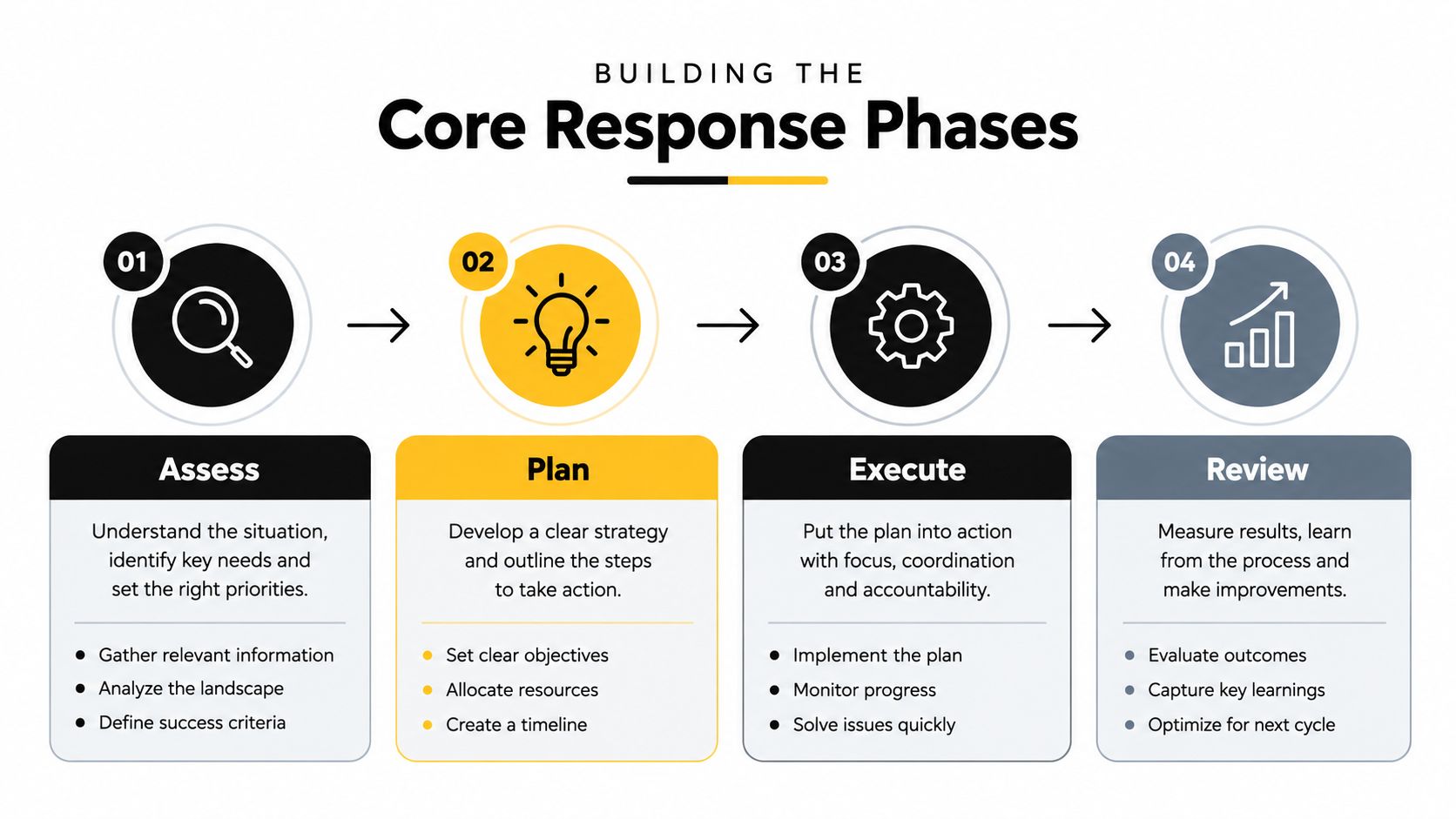
A documented incident management process gives teams a practical operating sequence, but the value comes from assigning people and decisions to each step. A playbook that says “contain the threat” without defining who can isolate production is still incomplete.
Roles and Decision Authority When Things Get Real
A common assumption is that a smaller company can rely on the person who knows the network best. That person may be an excellent technical responder, but technical skill doesn't establish authority to shut down a revenue-producing system, approve customer notification, or accept legal risk.
A 75-person company doesn't need a 20-person response team. It does need four named roles, documented decision rights, and an external backup for each role. Sygnia's 2026 CISO survey found that 90% of respondents struggled to coordinate key stakeholders, 89% cited limited executive or board involvement, and 75% said legal and communications slowed decisions. Those figures point to a governance problem, not just a tooling problem.
Core Incident Response Roles and Decision Rights
| Role | Primary Responsibility | Pre-Authorized Decisions | External Backup Required |
|---|---|---|---|
| Incident Commander | Runs the call, sets severity, coordinates business and technical work | Emergency containment actions and defined emergency spending within the approved limit | Outside incident response lead |
| Technical Lead | Directs investigation, containment, eradication, and technical recovery | Account isolation, host isolation, blocking, and evidence collection under the playbook | External technical responder |
| Communications Lead | Manages employee, customer, executive, and regulator-facing updates | Routine internal updates using approved templates | Communications or public-relations advisor |
| Scribe | Records decisions, timestamps, evidence references, and rationale | Maintains the official incident record and requests missing inputs | Documentation coordinator |
The incident commander owns the call, but doesn't become the technical lead by default. The technical lead advises on blast radius and options, while the communications lead prevents contradictory statements. The scribe matters because memory won't survive later questions from counsel, insurers, regulators, or the board.
SMBs should map these roles to existing employees and test the rotation when someone is unavailable. The incident response team structure should list names, phone numbers, alternates, and decision thresholds. If nobody is authorized to act at 3 a.m., the organization doesn't have a response team. It has a contact list.
Communications That Hold Up Under Pressure
Communications usually break before the technology does. People send partial updates through ordinary channels, executives receive different versions of the facts, and a well-meaning employee promises a conclusion that the investigation can't support.
The fix is to separate the message tracks and assign one owner to each. Internal staff need operating instructions. Customers need confirmed facts and service guidance. Regulators and other formal audiences need legally reviewed disclosure decisions.
Communication Tracks and Decision Owners
| Audience | Channel | Owner | Legal Review Threshold |
|---|---|---|---|
| Employees and contractors | Dedicated internal channel or emergency bridge | Communications Lead | Review when the message describes data exposure, suspected cause, or required employee action |
| Customers and partners | Approved customer notice channel | Communications Lead with executive approval | Review before any statement about affected information, responsibility, or remediation |
| Regulators and formal authorities | Designated legal or regulatory channel | Legal lead or appointed executive | Required for disclosures, notifications, and jurisdiction-specific reporting |
| Board and executive leadership | Restricted executive bridge and written update | Incident Commander | Review when material business, legal, or customer consequences are possible |
Templates should cover ransomware, suspected exfiltration, service outage, and third-party compromise. Every external statement needs a fact owner, a timestamp, and a clear distinction between what has been confirmed, what remains under investigation, and what customers should do now.
Silence isn't a strategy. A confirmed update window is better than a confident guess.
The plan should document notification requirements relevant to the business, including HIPAA, GLBA, GDPR, and applicable state breach laws. It should also identify the cyber insurance carrier's breach coach, because the carrier's approved process may control access to counsel, forensic services, and communications support. Guidance on how to craft compelling stakeholder messages can help communications leads build messages that stay clear without making unsupported promises.
The public spokesperson should never speculate about attribution, root cause, or the scope of exposed information. Organizations handling a breach need a defined data breach response process that connects verification, legal review, evidence handling, customer communication, and recovery.
Evidence Preservation and Recovery Dependencies
Logs and backups serve two purposes during an incident. They help investigators understand what happened, and they support recovery. The order in which the team touches them can determine whether either purpose remains possible.
Investigators should preserve volatile memory where appropriate, endpoint telemetry, firewall records, identity-provider audit trails, email gateway records, access histories, and relevant SaaS logs before retention rules purge them. The scribe should record who collected each artifact, when it was collected, where it was stored, and whether the original was altered.
Preserve before changing
Backups should move to immutable or offline storage when the environment may be compromised. Chain-of-custody records should include hashes, timestamps, storage location, and the engineer who accessed each copy. A backup that contains the same persistence mechanism or poisoned credential isn't a clean recovery asset.
Recovery also requires dependency mapping. Applications may depend on identity services, DNS, certificates, databases, integrations, and downstream partners. The recovery lead should document the load order and validate each dependency before reconnecting a restored system to production.
A clean-room rebuild is the safer pattern when compromise is suspected. Rebuild from known-good images, rotate secrets, reissue tokens, validate administrative access, and monitor the rebuilt environment before reconnecting it. Businesses that lack specialized support can distinguish ordinary restoration from professional data recovery services near me when storage failure, corruption, or inaccessible media complicates evidence and recovery.
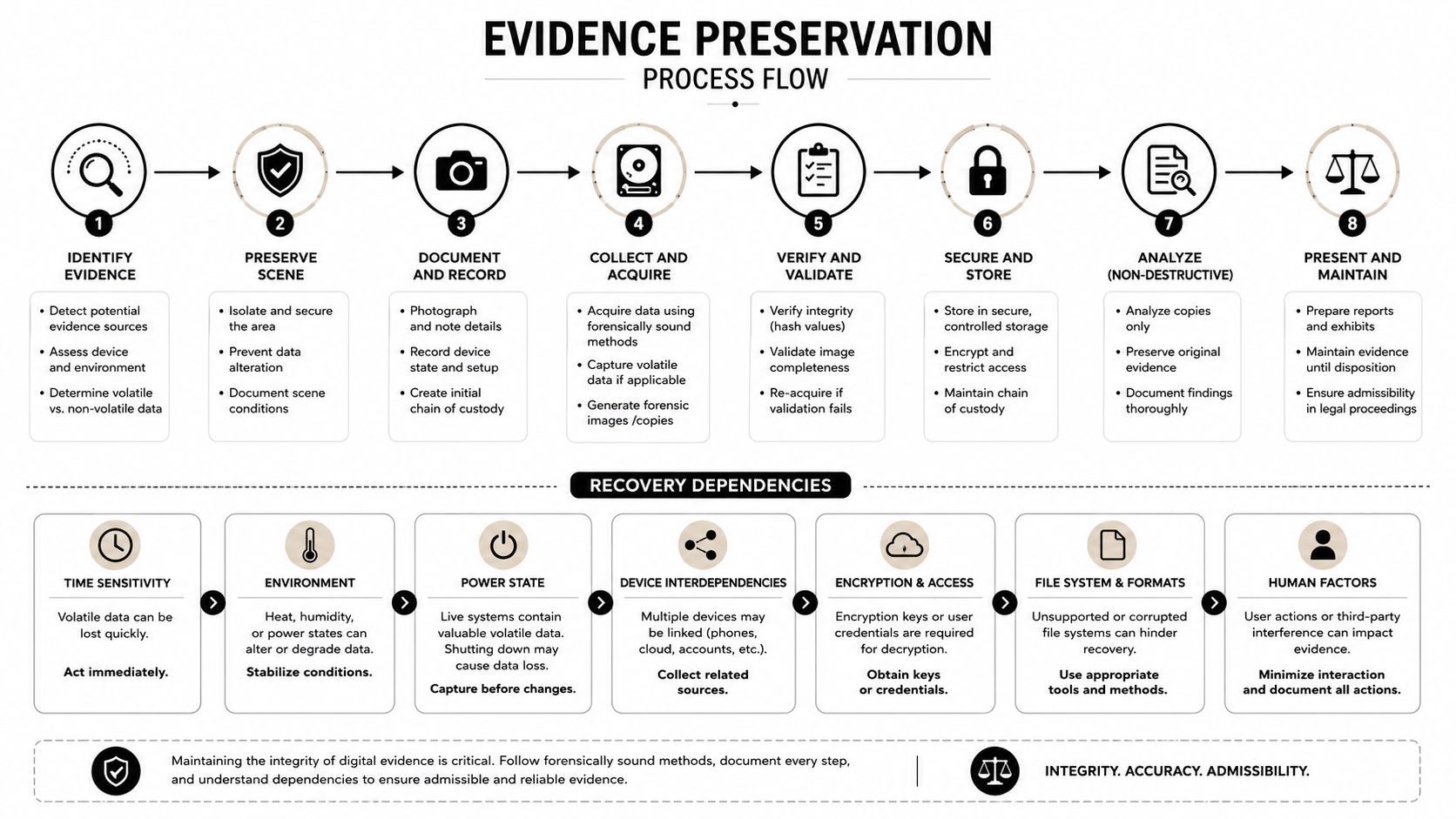
A practical preservation register should include:
- Identity records: Authentication events, privilege changes, token activity, and account actions.
- Endpoint records: Alerts, process activity, isolation history, and volatile data where available.
- Network records: Firewall events, remote access, segmentation activity, and relevant traffic records.
- Messaging records: Email gateway events, suspicious messages, and mailbox audit data.
- Cloud and SaaS records: Administrative activity, access logs, configuration changes, and provider notifications.
- Recovery records: Backup versions, integrity checks, restoration tests, and the people who approved each step.
Retention should satisfy forensic needs, contractual obligations, insurance requirements, and applicable regulatory requirements. The minimum period should be documented by legal and compliance owners rather than guessed during the crisis.
Testing the Procedures Before You Need Them
A procedure nobody has executed is an assumption. Testing reveals whether the contact list works, whether the decision-maker can be reached, whether the team can operate without its primary systems, and whether recovery depends on one person's undocumented knowledge.
NIST guidance emphasizes checklists, walk-throughs, tabletop exercises, and simulations. It also recommends using qualitative and quantitative information to improve processes, with useful measures including total labor per incident, elapsed time to discovery and containment, response time to the first report, and time to notify management or external entities. The important distinction is effectiveness. Handling more incidents isn't automatically better, and a lower incident count may reflect stronger controls rather than weaker performance. NIST testing guidance supports measuring whether the response works, not merely whether people stayed busy.
Use three levels of validation
Tabletops test leadership. Present a ransomware, insider exfiltration, third-party SaaS compromise, denial-of-service event, or identity-provider compromise. Ask who decides, who calls the insurer, who preserves evidence, and who approves customer messaging.
Partial simulations test the technical team. Remove a compromised endpoint, suspend a test identity, make a log source unavailable, or simulate a failed backup. The exercise should expose whether the team can contain and recover when a preferred dependency is missing.
Full exercises test the organization. Include executives, technical staff, legal, communications, and relevant vendors. The exercise should impose realistic constraints, such as phone-only communication, a temporary loss of internet access, or one unavailable decision-maker.
ISACA's exercise guidance recommends tabletop exercises at least annually. For SMBs with regulated data, a stronger operating cadence is a quarterly tabletop and an annual full simulation. A separate SMB tabletop guide recommends annual exercises at minimum and quarterly exercises for regulated industries, with sessions lasting 90 to 120 minutes and an after-action report produced within 48 hours. That exercise guidance also calls for each gap to receive an owner, priority tier, and deadline.
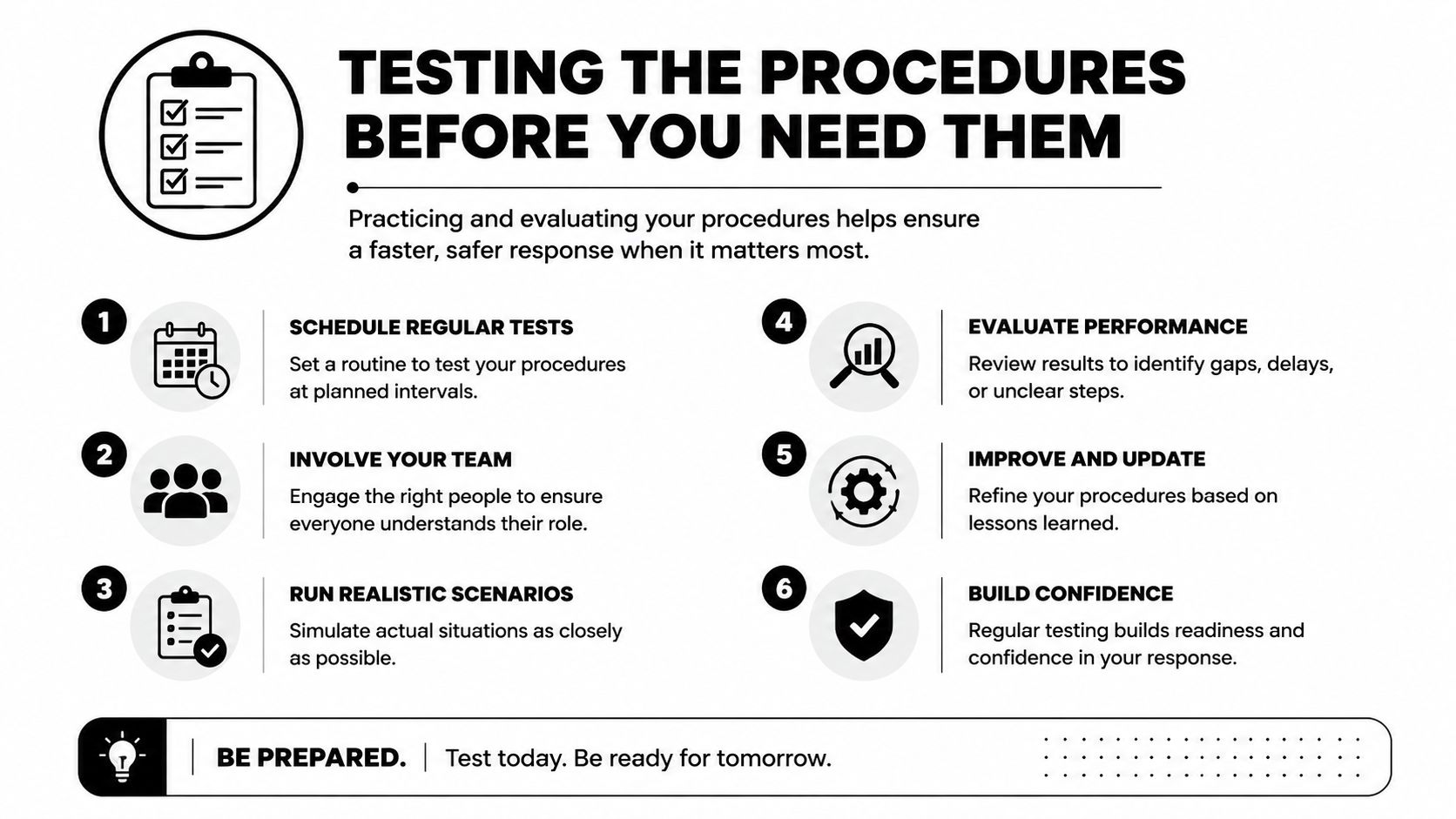
Capture detection-to-decision, decision-to-containment, and containment-to-eradication timing. Record missing credentials, undocumented failover paths, inaccessible runbooks, and staff who hold the only copy of a critical procedure. Update the playbook immediately, version the change, and publish what changed.
Turning Lessons Learned into a Living Playbook
A post-incident review isn't a ceremony. It is the mechanism that turns an uncomfortable event into better decisions, stronger evidence handling, and fewer assumptions during the next call.
The review should occur within five business days while details remain available. It should produce four concrete artifacts:
- A precise timeline: Record detection, escalation, decisions, containment, recovery, and communication events with minute-level precision where the evidence supports it.
- A decision record: Identify which decisions worked, which stalled, who had authority, and where approval became a bottleneck.
- An evidence map: Show which records were available, which were missing, and which systems erased or obscured useful information.
- An assumption register: List every belief that proved wrong, including backup integrity, contact availability, vendor access, and recovery order.
Convert findings into owned changes
Each finding needs a specific update. A revised runbook step may solve one gap. A new detection rule, a corrected contact list, an additional evidence source, or removal of an unused procedure may solve another. The owner and deadline belong beside the change, not in a separate meeting note.
The highest-risk gap should define the next exercise. If the incident exposed unclear authority, the next tabletop should force a shutdown decision. If logs were incomplete, the next simulation should remove a preferred data source. If recovery stalled on identity services, the exercise should begin with that dependency unavailable.
Store the playbook in version control so changes remain auditable and rollback is possible. Technovation LLC can help Dallas–Fort Worth organizations assess incident response procedures, coordinate managed monitoring and escalation, document incidents, validate recovery dependencies, and align practical controls with compliance needs across healthcare, legal, financial, construction, nonprofit, and other regulated environments. The next step is to schedule a security review through Technovation LLC before an after-hours alert forces the organization to discover its gaps live.