PCI DSS is the payment card industry's mandatory data security standard, and as of 2026 the active version is v4.0.1, which carries 51 future-dated requirements that became enforceable on March 31, 2025. Compliance means maintaining the required security controls all year, not checking a box once before an annual assessment.
A Plano dental office may process every payment correctly while still carrying an avoidable compliance problem. A front-desk tablet accepts a patient's card, a practice-management system sends the transaction to a processor, and an old workstation retains payment information in logs or temporary files. The owner may believe the office is “covered” because the processor handles the payment, but the business still needs to understand what systems touch cardholder data and whether its controls remain effective.
That's the practical answer to what is PCI DSS compliance. It's a security program for businesses that store, process, or transmit payment card data. It governs access, network protection, vulnerability management, monitoring, testing, policies, and the handling of stored and transmitted card information.
The standard was created by the major card brands and is maintained by the PCI Security Standards Council. PCI DSS isn't a federal law. It's a contractual requirement enforced through payment brands, acquiring banks, processors, and other participants in the payment ecosystem. A business that ignores it can face compliance fees, forensic investigations, remediation demands, or restrictions on card processing.
For North Texas SMBs, the right approach is straightforward: define the cardholder data environment, reduce it wherever possible, fix control gaps, document the work, and keep checking the environment after the assessment is complete. Businesses looking for a practical overview of the key 2026 PCI compliance rules can use that resource alongside the current standard. A local support partner can also help organize the work through data security and compliance services rather than leaving an office manager or overloaded IT generalist to interpret every requirement alone.
Table of Contents
- What PCI DSS Compliance Means for Your Business
- The 12 Core Requirements and Six Security Objectives
- Mapping Your Cardholder Data Environment and Scope
- Merchant Levels SAQ RoC and QSAs Explained
- How SMBs Can Prepare and Maintain Compliance
- Common PCI Mistakes and How to Avoid Them
- Costs Timelines and Local Support in DFW
What PCI DSS Compliance Means for Your Business
A small law firm accepting retainers by card and a regional healthcare organization collecting copays face the same basic obligation: protect payment information within their environments. PCI DSS applies to merchants, service providers, and payment processors that store, process, or transmit cardholder data, regardless of business size or transaction volume.
The standard is contractual and ongoing
Major card brands created PCI DSS as a shared security framework. The PCI Security Standards Council publishes the standard and supporting guidance through its PCI Security Standards Council document library. PCI DSS is not a federal law. Payment brands, acquiring banks, processors, and other payment participants enforce it through contractual relationships.
PCI DSS v4.0 was published on March 31, 2022. Version 4.0.1 followed in June 2024. Version 3.2.1 retired on March 31, 2024, and v4.0 retired on December 31, 2024, leaving v4.0.1 as the active version. Its future-dated requirements became effective on March 31, 2025, so businesses need controls that operate throughout the year, not only during an assessment.
Version 4.0 introduced 64 new or updated requirements, including 51 future-dated requirements. The critical question is whether the current environment satisfies the active standard today, not whether the company passed last year. A forgotten account, software change, or vendor connection can alter scope and create a gap after an assessment closes.
Practical rule: A completed questionnaire records what the business documented for an assessment. It does not protect a payment environment after its systems, users, or connections change.
North Texas SMBs should assign ownership, review changes, preserve evidence, and address control failures on a recurring schedule. A local partner such as Technovation can organize that work through data security and compliance services, helping leadership and IT maintain the program between assessments. Businesses reviewing the key 2026 PCI compliance rules should still verify requirements against the active standard and their payment setup.
What happens when controls fail
Noncompliance can create direct financial pressure. One reported range places payment-brand or processor fines at $5,000 to $100,000 per month until compliance is achieved, as described in PCI DSS guidance for Level 4 organizations. The exact consequence depends on the payment relationship, the incident, and the organization's obligations. Delayed remediation usually makes the problem more expensive and harder to explain.
A suspected compromise may require forensic work, processor inquiries, notifications where applicable, and documented corrective action. Serious cases can also result in lost card-processing privileges. PCI DSS belongs with business leadership, finance, operations, and IT, not only with the person who completes the SAQ.
The 12 Core Requirements and Six Security Objectives
PCI DSS organizes its control framework into 12 mandatory requirements across six security objectives. The objectives provide the structure, while each requirement translates a security goal into an operational expectation. Treating the list as a stack of paperwork misses the reason the framework exists. Each requirement closes a specific path an attacker could use to reach payment data.
Six objectives, twelve control areas
| Objective | Requirements | Business Risk Mitigated |
|---|---|---|
| Build and maintain a secure network | 1. Install and maintain network security controls. 2. Apply secure configurations to all system components. | Reduces unauthorized network paths and weak default settings that expose payment systems. |
| Protect cardholder data | 3. Protect stored account data. 4. Protect cardholder data with strong cryptography during transmission over open, public networks. | Limits the usefulness of stolen databases and intercepted payment traffic. |
| Maintain a vulnerability management program | 5. Protect systems and networks from malicious software. 6. Develop and maintain secure systems and software. | Reduces exposure to malware, outdated software, insecure development, and exploitable defects. |
| Implement strong access controls | 7. Restrict access by business need to know. 8. Identify users and authenticate access. 9. Restrict physical access to cardholder data. | Limits what compromised accounts, careless insiders, and unauthorized visitors can reach. |
| Regularly monitor and test networks | 10. Log and monitor access. 11. Test security systems and processes regularly. | Improves the chance of detecting suspicious access and proving that defenses work. |
| Maintain an information security policy | 12. Support information security with organizational policies and programs. | Gives employees, contractors, and leadership clear responsibilities instead of relying on informal habits. |
Requirement 3 matters when an old point-of-sale database contains years of dormant transactions. If the business doesn't need to retain cardholder data, deletion is the cleaner control. If retention is necessary, stored primary account numbers need strong protection or equivalent safeguards. Requirement 4 addresses the journey between systems, requiring protected transmission over open or public networks. These controls work together, because reducing retention limits the amount available to steal while encryption limits the value of intercepted traffic. The PCI DSS control framework overview provides additional context on stored data, transmission, monitoring, and testing.
Authentication now reaches deeper into the environment
PCI DSS v4.0 expanded multi-factor authentication so it applies to all access into the cardholder data environment, not only remote administrative access. That means an SMB needs to review internal accounts, privileged access, support workflows, and third-party connections. A stolen password shouldn't provide a direct route into systems handling payment information.
Version 4.0.1 also puts more attention on payment-page scripts, targeted risk analyses, and evidence that controls operate as designed. The 51 future-dated controls are now live, so a policy that says “MFA will be added later” isn't a current compliance strategy. Organizations can use access control policies to define who receives access, what approval is required, how privileged accounts are handled, and when access must be removed.
Mapping Your Cardholder Data Environment and Scope
A small clinic's cardholder data environment resembles a restricted records room. The card terminal, payment application, network equipment, support accounts, and connected systems may all influence what happens to the payment data. A law firm may have fewer transactions but more complicated workflows, such as card details received by phone, entered into billing software, copied into a spreadsheet, and included in a backup.
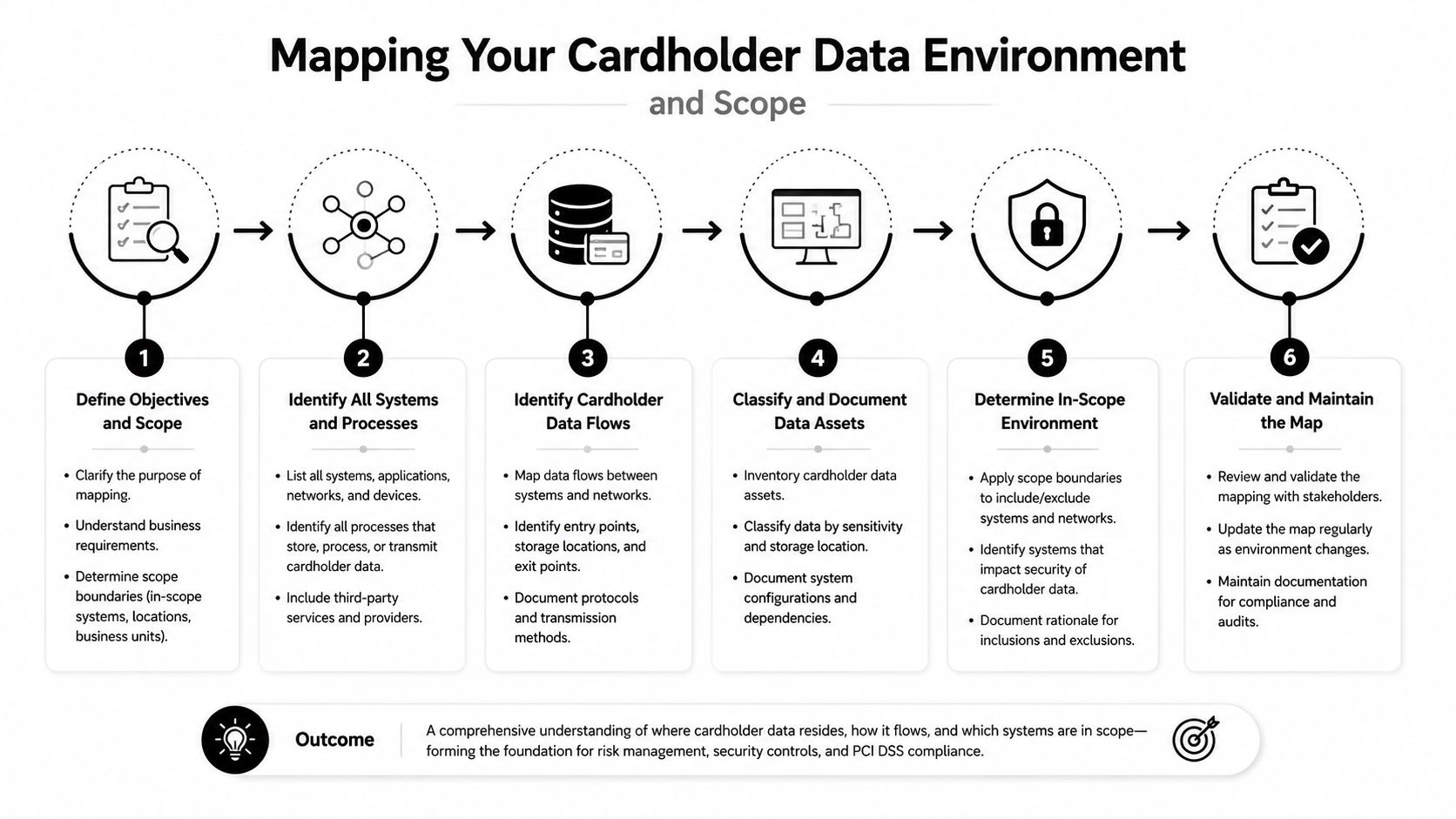
The first job is to identify the payment data flow, not to start filling out a questionnaire.
Build the boundary in a deliberate order
- Identify every place a primary account number is accepted. Include terminals, online forms, phone-based entry, recurring billing, mobile devices, and manual workarounds.
- Trace transmission paths. Document which systems send payment data to a processor, payment gateway, internal application, or service provider.
- Locate storage. Check databases, exports, logs, email, spreadsheets, backups, removable media, and support tickets. A forgotten copy still affects scope.
- Map connected systems. Firewalls, wireless networks, administrative workstations, identity systems, monitoring platforms, and vendor access may connect to the cardholder data environment.
- Segment where practical. Proper network segmentation can keep unrelated business systems outside the defended boundary, but the organization needs evidence that the separation works.
- Document the result. Maintain network diagrams, dataflow diagrams, asset inventories, system descriptions, and ownership information.
The process is easier when a business classifies information consistently instead of treating every file as an exception. A documented data classification policy can establish how payment data is labeled, stored, transmitted, retained, and destroyed.
Scope reduction requires proof
A traditional terminal environment may bring more systems into scope because the merchant's network, devices, and supporting services influence payment handling. A validated point-to-point encryption solution or hosted payment page can shrink the environment substantially, but outsourcing payment processing doesn't eliminate the merchant's responsibility. The business still needs to confirm the provider's role, validate the implementation, and monitor changes.
Underscoping is one of the most expensive mistakes in an assessment. If a backup server contains last year's transactions, or a support account can reach the payment application, an assessor may expand the review to include those systems. Accurate scoping turns a sprawling environment into a defensible boundary and gives management a clearer remediation budget.
Merchant Levels SAQ RoC and QSAs Explained
PCI validation depends on transaction volume, payment architecture, card-brand rules, and the organization's acquiring relationship. A small business usually follows a different path from a high-volume merchant, but “small” doesn't automatically mean “no assessment.” The business still needs to identify the correct merchant level and the correct questionnaire for its payment method.
Match volume to the validation path
| Merchant Level | Annual Transaction Volume | Validation Required | Assessor Type |
|---|---|---|---|
| Level 1 | Generally over 6 million transactions annually | Annual Report on Compliance, with supporting validation requested by the payment relationship | Qualified Security Assessor, or an approved internal assessment function where permitted |
| Level 2 | 1 to 6 million transactions | Generally an annual Self-Assessment Questionnaire, with an Attestation of Compliance and other validation as required | Internal Security Assessor or Qualified Security Assessor, depending on obligations |
| Level 3 | 20,000 to 1 million e-commerce transactions | Generally an annual Self-Assessment Questionnaire and Attestation of Compliance | Internal team or Qualified Security Assessor, depending on obligations |
| Level 4 | Fewer than 20,000 e-commerce transactions, or up to 1 million total transactions per year | Generally an annual Self-Assessment Questionnaire and Attestation of Compliance | Internal team, with processor or acquirer requirements determining additional review |
The volume thresholds are summarized in PCI merchant-level guidance. Payment brands and acquiring institutions can impose additional validation obligations, so a company shouldn't choose an SAQ solely because it's convenient.
SAQ, RoC, AoC, QSA, and ISA are different
An SAQ, or Self-Assessment Questionnaire, is a structured validation document for organizations eligible to self-assess. The correct SAQ depends on how payment data enters the environment. A business that uses a fully outsourced payment page may have a narrower questionnaire than one whose website controls payment-page scripts or whose employees manually enter card data.
A RoC, or Report on Compliance, records a formal assessment. Level 1 merchants and service providers generally complete an annual RoC, while Level 2 through Level 4 organizations generally complete an annual SAQ. Many brands also require an annual AoC, or Attestation of Compliance. The RoC and SAQ comparison explains why these documents serve different validation paths.
A QSA, or Qualified Security Assessor, is an approved external assessor who evaluates the environment and produces formal assessment evidence where required. An ISA, or Internal Security Assessor, is a trained internal professional who can support assessment activities when the organization's obligations allow it. Neither role transfers accountability away from the merchant. Management remains responsible for the controls, evidence, vendor decisions, and remediation.
How SMBs Can Prepare and Maintain Compliance
Most SMBs don't fail PCI because the owner lacks an advanced security laboratory. They fail because nobody owns the recurring work. A forgotten user, unreviewed payment-page script, missing scan, stale policy, or untested response plan can undermine a carefully prepared annual questionnaire.
The preparation process should begin with a v4.0.1 gap assessment. That review needs to include the 51 requirements that became mandatory on March 31, 2025, not an outdated checklist built around an earlier version. The PCI Security Standards Council's current FAQ coverage is useful when an organization needs to verify how current requirements are interpreted.
Reduce exposure before fixing controls
A business should first ask whether it needs to handle or retain card data at all. Hosted payment pages, tokenization, and validated encryption approaches can reduce the number of systems that touch primary account numbers. Scope reduction doesn't excuse weak governance, but it can remove unnecessary storage and simplify evidence collection.
Then assign an owner to each gap. The remediation plan should identify the affected asset, the required action, the responsible person, the deadline, and the evidence that will prove completion. Common SMB trouble spots include:
- Payment-page scripts: Inventory scripts, approve them, document their purpose, and monitor for unauthorized changes.
- Targeted risk analyses: Record the reasoning behind flexible control frequencies instead of choosing intervals by habit.
- MFA coverage: Apply multi-factor authentication to access into the cardholder data environment, including internal, privileged, and third-party paths.
- Logging and review: Capture access to network resources and cardholder data, then demonstrate that someone reviews the relevant events.
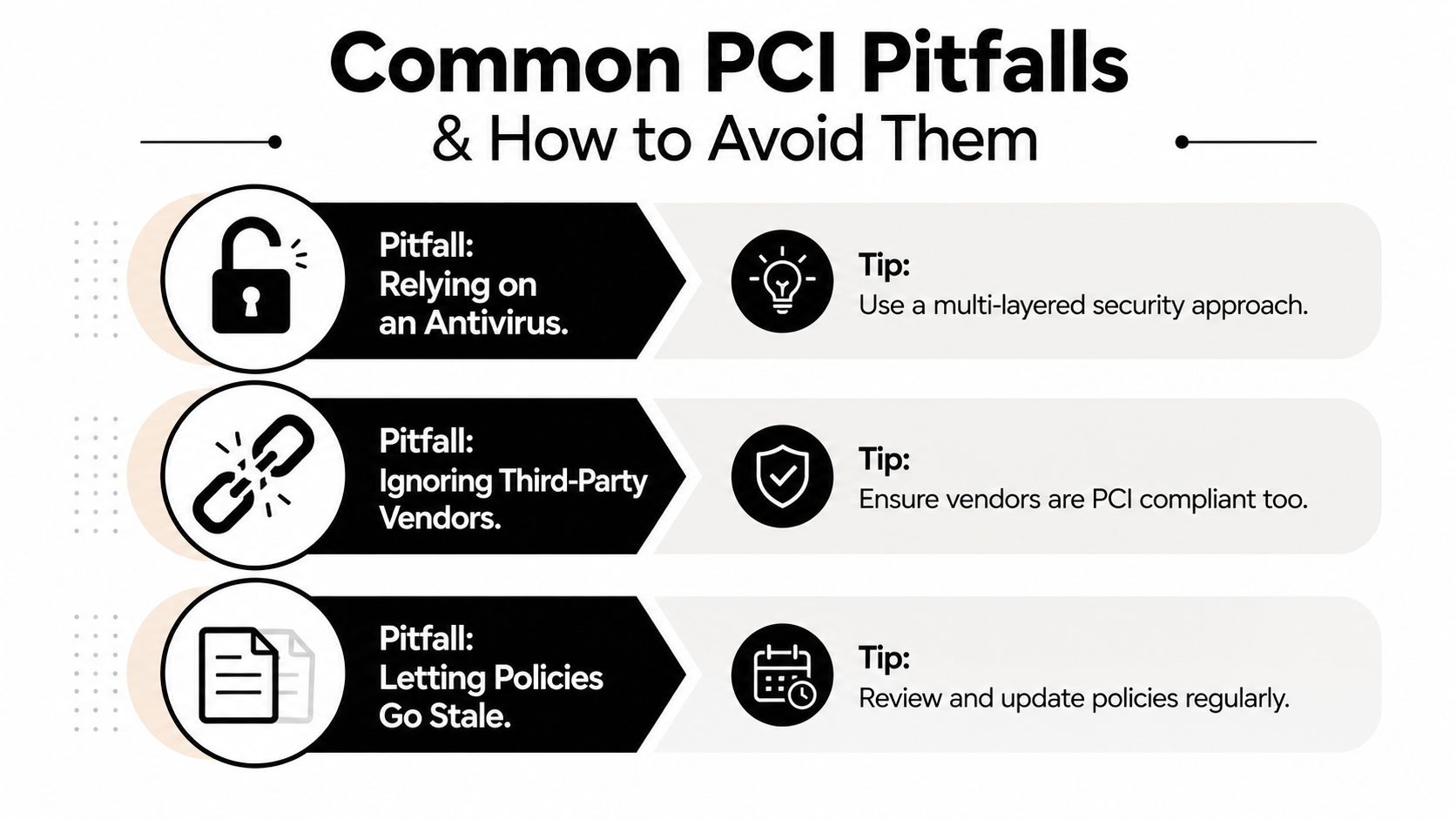
- Vendor oversight: Obtain current compliance information from payment, booking, billing, and support providers, and document the review.
Turn the assessment into a recurring operating rhythm
The business should schedule its maintenance activities before the assessment date is known. External vulnerability scans should run on a recurring quarterly cadence where required, with failed results assigned for remediation rather than filed away. Policies should receive an annual review, and access should be reviewed whenever staff roles change. Vendor due diligence should be documented rather than handled through informal assurances.
An incident response plan also needs practical ownership. It should tell staff who receives an alert, who contacts the processor, who preserves evidence, who makes business decisions, and how the organization records corrective action. Technovation LLC can support this operating model through managed cybersecurity, monitoring, policy maintenance, and compliance readiness services for North Texas businesses.
Common PCI Mistakes and How to Avoid Them
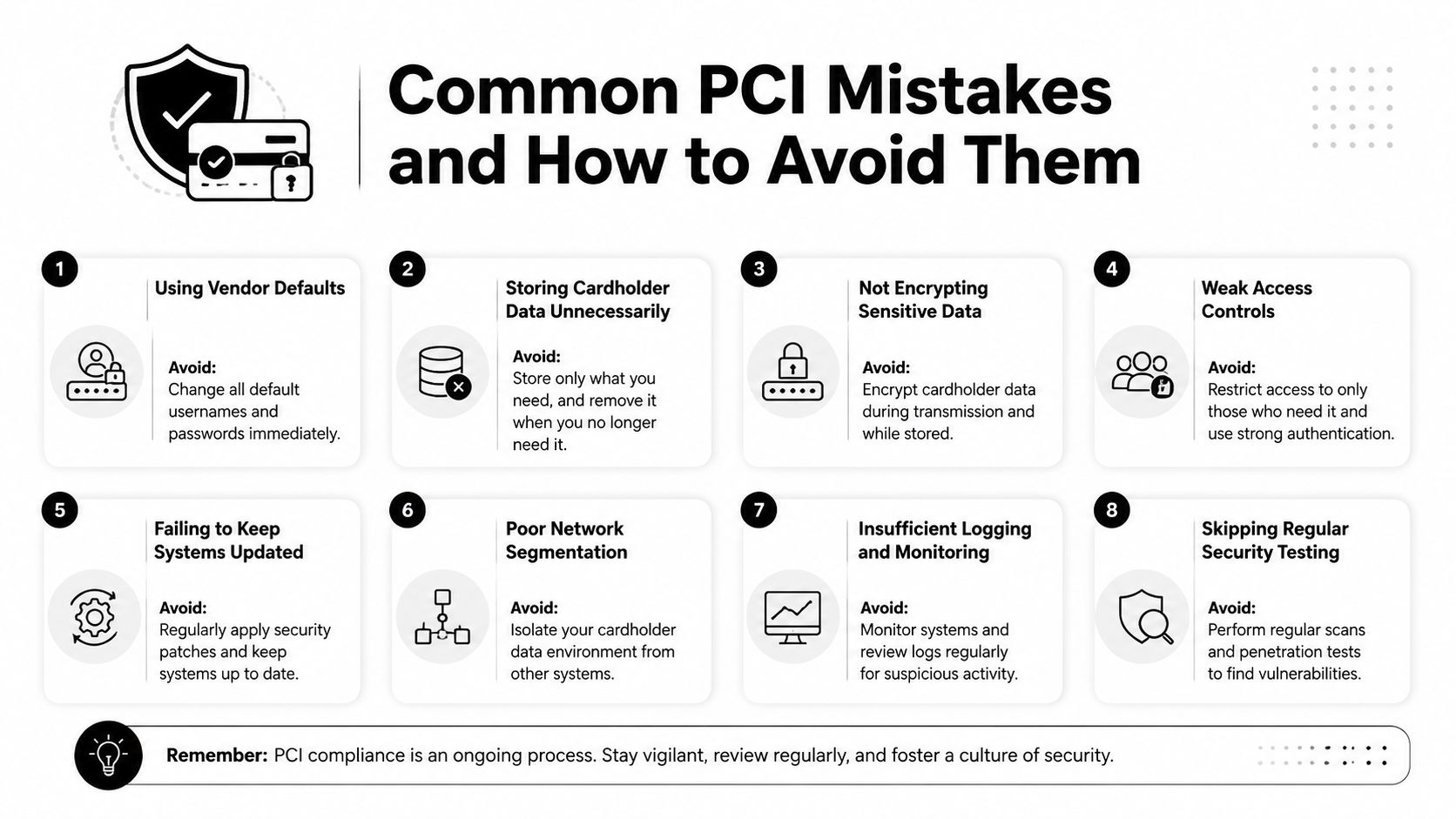
The same avoidable errors appear across retail offices, clinics, legal practices, and professional-services firms. The pattern isn't usually a lack of concern. It's a mismatch between what the owner believes the payment workflow does and what the systems retain or expose.
The recurring failures
Using an outdated standard. A binder built around v3.2.1 or an early v4.0 interpretation doesn't reflect the active v4.0.1 requirements. The fix is to anchor the gap assessment, policies, and evidence requests to the current version.
Claiming a low-scope SAQ without verifying the environment. A firm may believe it qualifies for a narrow questionnaire because a payment processor hosts the transaction page, while full card numbers still appear in web logs, customer-service notes, or back-office systems. The correct approach is to trace the data and confirm that the implementation matches the SAQ eligibility criteria.
Treating scans as paperwork. A scan that produces a failed result is a remediation ticket, not a document to archive. The business needs to investigate the finding, correct the exposure, rerun validation, and preserve the evidence.
Retaining sensitive authentication data. Card verification values shouldn't be stored, even temporarily, after authorization. Payment workflows, logging settings, exports, and support procedures all need review.
Ignoring vendors. Booking engines, hosted billing services, payment processors, and outsourced support providers can affect scope and risk. Their contracts, responsibilities, and PCI status belong in the organization's vendor inventory.
Assuming the assessor owns compliance. A QSA or ISA can evaluate, advise, and document, but the merchant remains accountable for decisions and controls. Leadership should know which gaps remain open and who is responsible for closing them.
Online merchants can also review practical e-skimming safeguards for crypto companies when payment-page scripts and browser-side threats are part of the environment. The lesson applies beyond one industry: a legitimate payment page can still become a collection point if unauthorized code changes what customers submit.
Costs Timelines and Local Support in DFW
PCI DSS compliance costs depend on the cardholder data environment, system architecture, remediation needs, validation level, assessor involvement, scanning, testing, documentation, and the evidence already available. A generic flat quote is unreliable before anyone maps the environment. A narrow, segmented setup may require less work than a larger environment with unclear data flows and years of retained payment records.
Timeline estimates need the same discipline. Level 4 SMBs often prepare over months, while Level 1 environments may need a longer assessment and remediation program. Treat these as planning ranges, not promises. An undocumented CDE, unresolved scan findings, or missing evidence can extend the schedule.
Compare the work by merchant level
| Merchant Level | Annual Volume | Assessment Type | Estimated Cost Range | Typical Timeline |
|---|---|---|---|---|
| Level 1 | Generally over 6 million transactions | Annual RoC and formal assessment | Higher, scope-dependent pricing | Longer, scope-dependent preparation |
| Level 2 | 1 to 6 million transactions | Generally SAQ, AoC, and additional validation as required | Moderate to high, depending on environment | Multi-stage remediation and assessment |
| Level 3 | 20,000 to 1 million e-commerce transactions | Generally SAQ and AoC, with required scans or testing | Moderate, based on scope and findings | Several remediation phases may be needed |
| Level 4 | Fewer than 20,000 e-commerce transactions, or up to 1 million total transactions | Generally SAQ and AoC, with validation required by the payment relationship | Lower than larger merchant levels, but still scope-dependent | Often a focused project when records and controls are organized |
PCI DSS does not set one universal compliance price. The budget should account for the work involved: gap assessment, remediation, scanning, penetration testing where required, policy updates, employee training, assessor support, and ongoing monitoring. A low initial quote can become expensive if it excludes evidence collection or unresolved findings.
The March 31, 2025 future-dated v4.0.1 requirements reinforce the need for an operating program rather than an annual paperwork exercise. North Texas SMBs should maintain controls throughout the year, track ownership, review changes, and keep evidence ready before an assessment begins.
Local support makes the program easier to operate
DFW businesses can use approved scanning services, qualified assessors, internal security staff, or a managed IT partner. Location matters less than operating discipline. The provider should keep asset inventories, access reviews, scan results, policies, vendor records, and incident documentation current between assessments.
A business evaluating a managed partner should review its approach to choosing a managed service provider. Require a concrete plan: complete a gap assessment, document remediation, establish the scan schedule, confirm vendor responsibilities, and engage a QSA when the validation path requires one.
Technovation LLC provides North Texas SMBs with managed IT, cybersecurity monitoring, compliance readiness, policy maintenance, and remediation support based on the actual cardholder data environment. Visit Technovation LLC to request a security review and turn PCI DSS into a maintained business process.