
A DFW business owner walks into the office at 7:30 a.m. and finds email unavailable, a server showing a blinking red light, and two employees waiting for instructions. The first call goes to whoever fixed the last problem. The second call goes to an internal employee who knows enough to restart a device but not enough to assess the risk. By midmorning, the business is paying people to wait.
That Monday is often the moment leadership decides it's done managing technology only after something breaks. A managed IT services provider changes the arrangement from emergency purchasing to ongoing operational ownership. The right provider protects uptime, security, compliance readiness, and predictable spending, while the wrong one creates another vendor to chase.
Table of Contents
- What a Managed IT Services Provider Actually Does
- Core Service Models and How They Fit Your Business
- The Service Stack Behind Modern Managed IT
- Pricing Models and What a Fair Quote Looks Like
- Compliance and Cybersecurity for Regulated SMBs
- How to Evaluate and Choose the Right Provider
- Why Local DFW Expertise Changes the Equation
What a Managed IT Services Provider Actually Does
A managed IT services provider is a third-party firm that manages part or all of a company's technology under an ongoing agreement with defined responsibilities. The provider may monitor systems, maintain endpoints, administer cloud accounts, support employees, protect data, and help leadership plan technology investments. The important distinction is continuity. The provider works on the environment before a failure becomes a business interruption.
A break-fix shop waits for the call, diagnoses the immediate issue, and bills for the time involved. An internal IT hire offers direct organizational knowledge but may lack coverage during absences, specialized security expertise, or enough capacity for major projects. A software vendor supplies a platform. An MSP accepts responsibility for operating technology across multiple layers, usually through a service-level agreement.
The shift from reaction to control
Consider the difference between discovering a failed backup after a ransomware event and receiving a documented alert when a backup job fails. The first approach creates an emergency. The second gives the provider time to investigate, correct the failure, and verify that recovery remains possible.
Managed services typically include:
- Monitoring and alert response: Systems, networks, storage, and critical services receive continuous oversight.
- Patch and endpoint management: Devices receive updates and security policies consistently instead of depending on individual users.
- Backup administration: Backup jobs, retention, restore points, and recovery procedures receive operational attention.
- User support: Employees have a defined path for access issues, device problems, and routine technical requests.
- Planning and reporting: Leadership receives a view of risks, recurring issues, technology priorities, and upcoming spending.
A benchmark based on managed-business telemetry reported 1.18 unplanned outages per year for managed clients, compared with roughly five in its industry comparison set. It also reported an average outage duration of 132 minutes and estimated annual downtime costs of about $32,500 for a 50-employee managed firm, compared with $175,000 at an industry-average 14 hours of unplanned downtime. Those figures come from the SMB Technology and Cyber Resilience Index, and they illustrate why the value of an MSP should be measured through operational exposure, not ticket volume.
Practical rule: An MSP should be judged on whether it reduces avoidable disruption and keeps controls working, not on how many tickets it closes.
For DFW businesses considering fully managed IT support, the contract should identify who owns monitoring, escalation, restoration, user support, and planning. If the provider can't explain those duties plainly, the agreement isn't ready to sign.
Core Service Models and How They Fit Your Business
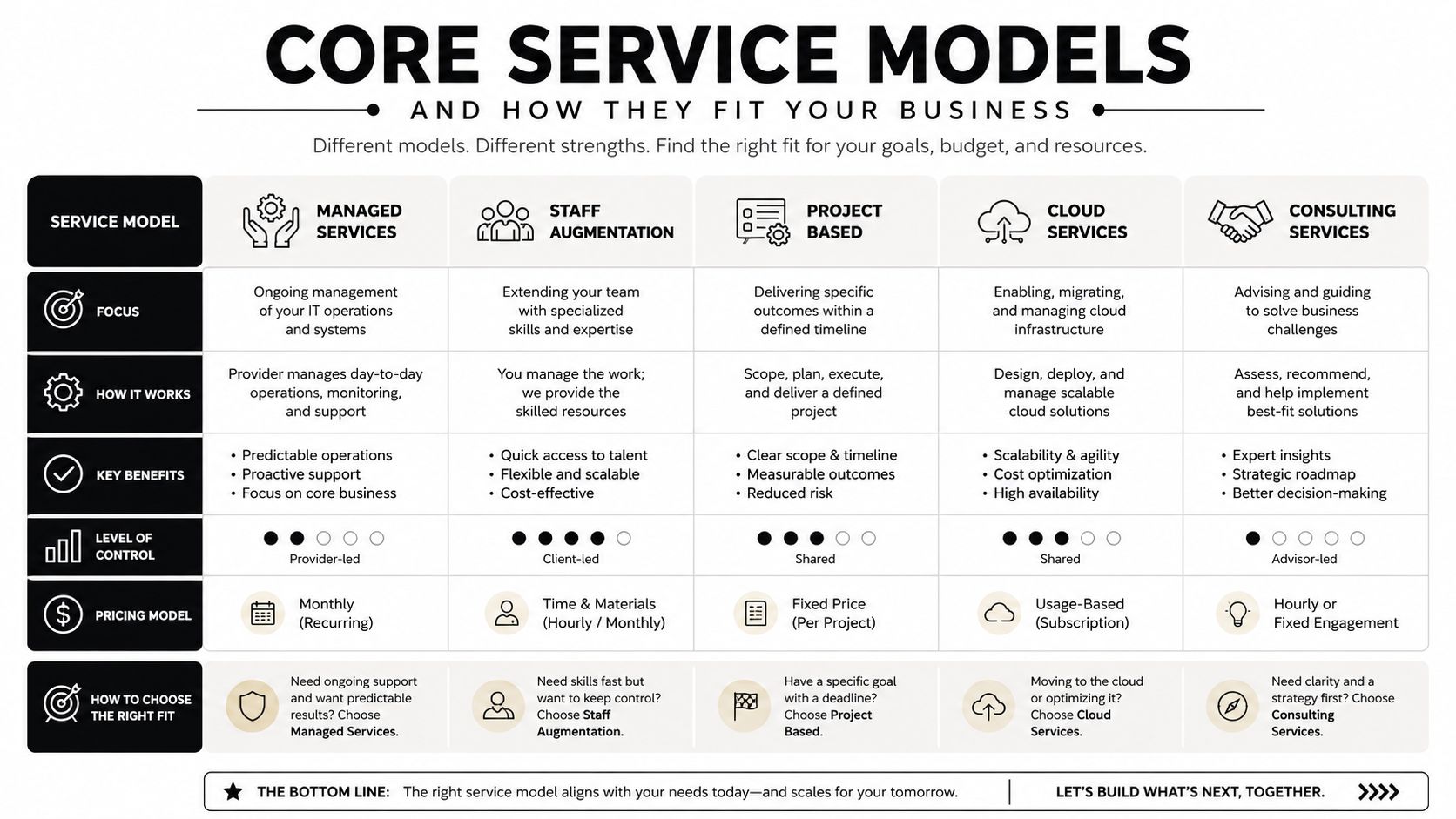
Choosing an IT service model is similar to choosing responsibility for a commercial property. A full-service lease places most maintenance duties with the property manager. A shared arrangement leaves some work with the tenant and assigns specialized duties to a service partner. A project contractor handles a defined renovation, then leaves when the work is complete.
The same distinction applies to managed IT. Businesses should select the model based on internal capability, risk, and the amount of daily ownership leadership wants to retain.
Fully managed support
A fully managed arrangement places day-to-day technology operations largely with the provider. It usually suits a small or mid-sized organization without internal IT leadership, or a company that wants employees focused on business work rather than maintenance.
The provider may handle endpoint policies, help desk operations, network monitoring, cloud administration, backup oversight, cybersecurity coordination, and strategic reviews. The trade-off is that the company may pay for broad coverage it doesn't use if the scope isn't designed carefully. A proposal should state which users, devices, locations, applications, and support windows are included.
Co-managed IT
Co-managed services supplement an internal IT director or small team. Internal staff may retain control of business applications and user relationships while the MSP provides after-hours coverage, security operations, network expertise, backup administration, or project capacity.
This model works when the company has capable people but not enough hours or specialized depth. It breaks down when responsibilities remain vague. A co-managed agreement needs a responsibility matrix that identifies who approves changes, who handles incidents, who communicates with leadership, and who owns documentation.
Project-based services
Project work has a defined outcome, scope, and end point. Typical examples include a cloud migration, office relocation, network redesign, compliance cleanup, or recovery planning exercise.
Project-based work can solve an urgent need without creating a long-term service agreement. It shouldn't be mistaken for ongoing management. A migration completed without post-project monitoring, patching, backup verification, and user support can leave the business with a new environment and the same operational weaknesses.
Businesses comparing support tiers can use Technovation's IT support tiers to clarify how coverage should match internal staffing and business risk. The correct model isn't the one with the longest service list. It's the one with clear ownership after the sales team leaves.
The Service Stack Behind Modern Managed IT
A modern MSP engagement is a stack of operating disciplines, not a single monitoring dashboard. Each layer addresses a different failure point. A business with strong help desk coverage can still lose data if backups aren't tested, and a business with excellent backup can still suffer a breach if access controls remain loose.
Six layers that need to work together
Monitoring and help desk form the operational nervous system. Monitoring identifies failed services, storage problems, and availability issues. The help desk gives employees a controlled way to report problems and gives leadership a record of recurring friction.
Endpoint management applies consistent policies to laptops, desktops, and mobile devices. It includes device inventory, patching, encryption settings, access controls, and lifecycle planning. Without a reliable inventory, the provider can't confidently say which systems remain exposed.
Backup and disaster recovery deal with the moment normal operations stop. A credible program includes protected copies, defined restoration priorities, documented recovery steps, and actual restore testing. A file copied somewhere isn't automatically a usable recovery plan.
Cloud and productivity administration covers account creation, license assignment, access removal, tenant configuration, and security settings. It also connects daily administration to broader migration planning. Companies preparing for a major move can consult this 7-step enterprise cloud migration planning guide for a structured view of planning dependencies.
Cybersecurity and compliance operations combine email filtering, multifactor authentication, endpoint detection, vulnerability management, access reviews, logging, and staff awareness. These controls should operate as repeatable processes, not as a one-time installation.
Strategic consulting turns technical observations into decisions. Quarterly reviews should connect recurring incidents, aging equipment, security gaps, compliance requirements, and upcoming business changes to a practical budget and roadmap.
| Service Layer | Primary Job | Risk It Reduces |
|---|---|---|
| Monitoring and help desk | Detect issues and coordinate support | Extended disruption and unresolved user problems |
| Endpoint management | Apply device policies and maintain inventory | Unpatched or unmanaged devices |
| Backup and recovery | Preserve and restore business data | Data loss and prolonged interruption |
| Cloud administration | Manage accounts, settings, and services | Misconfiguration and access sprawl |
| Cybersecurity and compliance | Operate protective and evidence-producing controls | Breach exposure and audit friction |
| Strategic consulting | Align technology decisions with business priorities | Reactive spending and poor planning |
The layers compound. A flat-rate contract covering five layers doesn't compensate for a missing sixth layer when the missing layer controls the business's most important risk.
Pricing Models and What a Fair Quote Looks Like
Pricing deserves more scrutiny than a polished service catalog. The proposal should show what the business pays each month, what the provider does, and which events create additional charges.
The four structures most SMBs encounter are:
| Model | Typical DFW Range | Best Fit For | Watch For |
|---|---|---|---|
| Per-user | $125 to $200 per user per month | Staff-centered environments with several devices per employee | Shared accounts, after-hours charges, excluded projects |
| Per-device | Varies by managed endpoint count | Businesses with predictable device inventories | Servers, mobile devices, and network equipment billed separately |
| All-inclusive flat fee | $1,500 to $4,000 monthly for 10 to 25 users | Smaller organizations seeking broad predictable coverage | Narrow definitions of “included” support |
| Co-managed | Fixed staffing component plus defined services | Organizations with an internal IT team | Duplicate responsibilities and unclear escalation |
The ranges above are practical quote-checking figures from the planned pricing framework, not universal market rates. A DFW provider may adjust pricing for on-site requirements, multiple offices, compliance documentation, legacy systems, project demands, or unusual support hours.
The line items that cause surprises
A low base price often becomes less attractive after exclusions appear. Businesses should ask about after-hours support, cloud license markups, hardware procurement margins, migration fees, project labor, emergency response, and on-site visits.
A fair proposal places the monthly recurring cost, included scope, exclusions, and out-of-scope triggers on one page. It also explains onboarding separately, because onboarding often requires documentation, discovery, remediation, and transition work that shouldn't be hidden inside an unclear monthly fee.
“Predictable monthly spend” only works when the contract predicts the circumstances that change the bill.
The right question isn't whether a quote is cheap. It's whether the price reflects the business's actual exposure. A clinic with protected health information, a law firm facing filing deadlines, and a contractor operating from project sites shouldn't receive identical coverage merely because each has a similar headcount.
Compliance and Cybersecurity for Regulated SMBs
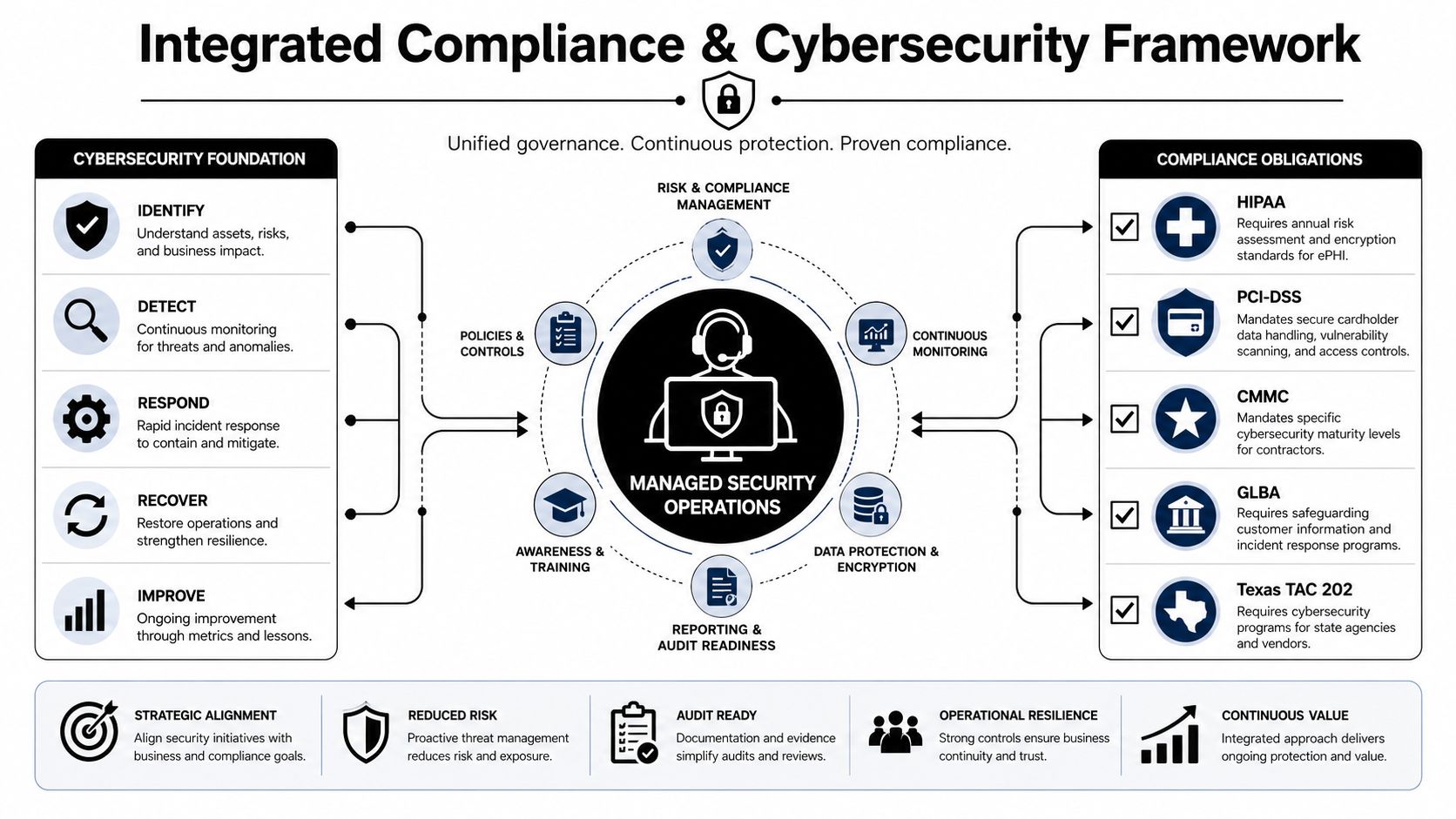
Compliance and cybersecurity are often treated as separate projects. That's a mistake. The same operational work supports both: asset inventory, patch records, access reviews, encryption, logging, vendor oversight, incident procedures, and tested recovery.
Under HIPAA, covered entities and business associates must implement administrative, physical, and technical safeguards to protect electronic protected health information, according to the U.S. Department of Health and Human Services. The FTC Safeguards Rule also requires many financial institutions to maintain a written information security program that includes oversight, risk assessment, monitoring, and encryption or compensating controls. Those obligations make technology management an operational responsibility for healthcare and financial organizations, not a back-office convenience.
Controls should run as routines
Healthcare practices, legal firms, financial organizations, and other regulated businesses should expect documented processes for:
- Identity protection: Multifactor authentication, role-based access, timely account removal, and periodic access reviews.
- Endpoint security: Managed patching, endpoint detection, encryption, and a current device inventory.
- Resilience: Isolated backups, restoration testing, recovery priorities, and an incident-response playbook.
- Evidence production: Reports showing what was checked, when it was checked, what failed, and how the issue was corrected.
- Third-party oversight: A method for reviewing vendors that handle sensitive information or connect to business systems.
The common audit failures are rarely mysterious. They include shared administrator accounts, undocumented patching, missing asset inventories, incomplete vendor records, and backups that have never been restored in a test. An MSP reduces friction by making those activities repeatable and assigning ownership.
The cybersecurity burden is broad even for organizations without a formal regulatory framework. Independent research reported that 94% of SMBs had experienced at least one cyberattack, while 83% planned to invest more in cybersecurity in the next 12 months, with an average planned budget increase of 19%. The same research found 94% were using an MSP, while 59% outsourced all or most IT infrastructure and 57% outsourced all or most IT cybersecurity. These figures appear in ConnectWise's 2024 SMB cybersecurity research.
Construction firms, nonprofits, and professional services companies still face ransomware, insurance requirements, customer-data expectations, and operational deadlines. Businesses can also check if their domain is blacklisted when email delivery problems raise concerns, although a blacklist check is only one small part of a complete security review.
For DFW organizations needing ongoing control operation, managed IT security services should be evaluated as part of the IT agreement, not added after a security incident.
How to Evaluate and Choose the Right Provider
A sales presentation tells a business what a provider wants to sell. The evaluation process should reveal how the provider works when an employee can't log in, a critical system fails, or an auditor asks for evidence.
Start with response obligations
Ask whether the SLA defines response time, resolution time, escalation, and after-hours coverage separately. “Rapid response” means little without a clock, an escalation path, and a remedy when obligations aren't met.
DFW geography matters. A provider should explain how it handles a failed switch at a Plano office, a clinic near the I-635 corridor, or a job-site outage in Fort Worth. The answer should identify who receives the call, which technician investigates, when remote support ends, and when on-site service begins.
Test the security depth
Ask for the actual security stack and the operating responsibility behind each control:
- Detection: Who reviews endpoint and network alerts, and who decides whether an event is an incident?
- Identity: Who enforces multifactor authentication and reviews privileged access?
- Vulnerability management: How are missing patches and known weaknesses prioritized?
- Recovery: Who verifies backups and leads restoration during a ransomware event?
- Training: How does the provider handle employee awareness and reporting?
A single security product isn't a security program. A provider that can't describe escalation, evidence, and restoration should make the buyer pause.
Examine the contract before the pitch gets comfortable
The contract should address auto-renewal, early termination, data ownership, documentation return, transition assistance, project rates, and responsibility for third-party systems. A provider that refuses to share a sample agreement or an exit plan is creating avoidable risk.
The managed service provider selection guide can help organize the questions before vendor meetings. The final test is operational: require a documented onboarding plan, named technicians, clear ownership assignments, and a formal review after the first 90 days.
Buyer's standard: If the provider can't show how the relationship starts, operates, measures performance, and ends, the provider hasn't shown the full service.
References should come from organizations with similar compliance demands, locations, applications, and support expectations. A reference from an unrelated business may confirm that the provider is pleasant to work with, but it won't prove technical fit.
Why Local DFW Expertise Changes the Equation
A managed services agreement is a long operational relationship, and geography shapes the quality of that relationship. Remote support can resolve many problems quickly, but a failed switch, damaged equipment, power event, or site-specific network issue may still require someone who can arrive in person.
A regional provider can dispatch to a Plano office, a Southlake clinic, or a Fort Worth construction site when the situation calls for physical support. That matters when a network fails during quarter close, a server won't boot before patients arrive, or a project team needs access restored before a contractual deadline.
Local context improves technical judgment
DFW businesses operate through conditions that a generic national playbook may overlook:
- Weather and power events: Tornadoes, severe storms, and summer heat can affect facilities, connectivity, and equipment.
- Healthcare operations: Clinics along the I-635 corridor need technology available for patient scheduling, records, communication, and daily care.
- Legal deadlines: Law firms and title or escrow operations can face time-sensitive filings and transactions where an outage creates immediate business pressure.
- Construction cycles: North Texas construction, engineering, and architecture firms often move between offices, field locations, subcontractors, and project systems.
Local expertise also helps with accountability. A DFW business can verify where technicians are based, request an on-site meeting, and involve the provider in a facilities, insurance, or compliance discussion without turning every issue into a remote coordination exercise.
The market's scale reinforces the business decision. One industry estimate valued the worldwide managed services market at USD 401.2 billion in 2025, projecting USD 847.4 billion by 2033 at a 9.9% CAGR, with North America holding 33.0% of regional share in 2025. The same source estimated the U.S. market at USD 128.07 billion in 2025, with a projection of USD 162.52 billion by 2030, as reported by Grand View Research's managed services market analysis. A large market gives buyers options, but it also makes disciplined selection more important because the MSP label alone proves very little.
Technovation LLC can provide a complimentary DFW-focused IT health check or security audit, scoped to the organization's systems, locations, compliance pressures, and risk profile. That review gives a business owner a practical baseline before deciding whether fully managed, co-managed, or project-based support makes sense.
Technovation LLC provides managed IT, cybersecurity, compliance support, cloud backup, remote access, monitoring, and strategic technology planning for DFW SMBs and regulated practices. Business owners can visit Technovation LLC to request a complimentary IT health check or security audit and discuss a support model built around operational needs, on-site realities, and predictable monthly spending.