
A small clinic can look compliant right up until someone asks for proof. The policies are in a shared folder, staff members remember completing training, and the risk assessment exists somewhere. Then an auditor asks who currently has access to the EHR, when the last access review occurred, whether a terminated employee's account was disabled promptly, and where the encryption evidence is stored. Silence follows.
That moment exposes the difference between written intent and demonstrable control. Healthcare compliance audits don't assess how organized a binder appears. They test whether the clinic can show that its policies match daily operations, its safeguards function as described, and its evidence is complete, current, and attributable to the right owner.
Table of Contents
- The Audit Notice That Changed Everything
- What Healthcare Compliance Audits Really Are
- The Main Types of Healthcare Compliance Audits
- How an Audit Unfolds From Start to Finish
- Where Healthcare Audits Keep Finding Problems
- Your Healthcare Compliance Audit Readiness Checklist
- How Technovation Helps You Prepare and Pass
- The Real Risk Most Practices Still Underestimate
The Audit Notice That Changed Everything
A six-provider primary care clinic received an audit notification from its business associate's compliance officer on an otherwise ordinary morning. The practice manager opened the shared drive and found policies that hadn't been updated in three years, a workforce training log that stopped in mid-2022, and a risk assessment PDF signed by a former IT vendor.
The leadership huddle began with document collection. It quickly turned into an operational review. The clinic had a policy for access management, but nobody could immediately identify the person responsible for the latest EHR access review. The policy required encryption, but the evidence folder contained no current device report. The breach response plan listed escalation steps, yet staff couldn't agree on where an incident ticket should be opened.
The binder looked compliant on paper. It couldn't answer basic questions about how the practice protected protected health information.
Practical rule: Every important control needs an owner, a current date, and evidence showing that someone performed it.
That clinic's problem wasn't unusual. HIPAA compliance often fails at the handoff between policy and execution. A policy may require quarterly access reviews, but an auditor wants the review record, the exceptions identified, the approval, and proof that remediation occurred. A training policy may be accurate, but the auditor will ask for completion records tied to the current workforce.
Healthcare leaders can use resources such as healthcare compliance with FaxZen to reinforce the broader privacy obligations surrounding patient information. The practical priority, however, is operational evidence. A focused readiness review can turn an anxious response into a measurable 60-day workplan, with missing evidence assigned, weak controls tested, and remediation tracked before the audit becomes a formal finding.
What Healthcare Compliance Audits Really Are
A healthcare compliance audit is a formal, evidence-based review of whether a covered entity or business associate operates according to selected requirements under the HIPAA Privacy, Security, and Breach Notification Rules. The modern U.S. framework was formalized by the HITECH Act of 2009, which requires HHS to periodically audit covered entities and business associates for HIPAA compliance. The first HIPAA audit phase ran in 2011 and 2012 and produced 115 audits covering 169 requirements across privacy, security, and breach notification according to HHS.
An audit differs from an informal internal review. An internal review may ask whether a policy exists. An auditor asks whether the policy maps to a specific HIPAA standard, whether staff follow it, and whether records prove consistent execution. OCR's published HIPAA audit protocol makes that mechanics clear. The protocol reviews policies and procedures adopted and employed to meet selected standards and implementation specifications.
What auditors test
Auditors generally test three connected questions:
- Does the required documentation exist? This includes policies, risk analyses, business associate agreements, training records, incident records, and approvals.
- Does the documented control operate as described? A written termination process means little if former users remain active or the clinic can't produce deprovisioning evidence.
- Can staff demonstrate consistent execution? Interviews, tickets, logs, sampled records, and walkthroughs show whether the process works beyond the policy file.
A general IT security assessment may identify vulnerabilities without evaluating patient-rights workflows, minimum-necessary decisions, or breach-notification records. A compliance audit examines the regulatory obligation and the evidence supporting it. The scope may include administrative, physical, and technical safeguards, but it doesn't evaluate clinical quality or determine whether care was medically appropriate.
Small practices can use the same logic in an internal readiness review. A useful guide to PsyBA reflection requirements also illustrates a broader audit principle, documentation should show what happened, not merely what an organization intended to happen. Clinics seeking a structured HIPAA framework can review Technovation's HIPAA compliance guidance before assigning owners and evidence requirements.
The Main Types of Healthcare Compliance Audits
An audit notice can focus on one control or expose weaknesses across the program. The initiating party and trigger determine whether the review examines privacy rights, security safeguards, breach handling, vendor oversight, or several areas together. Clinics should identify that scope before assembling evidence, because a narrow response can leave unrelated control failures untouched.
Federal HIPAA audits are periodic, not continuous. HHS expanded OCR's program in 2016 and 2017 by auditing 166 covered entities and 41 business associates, with the Phase 2 industry report released in 2018. HHS later reported that OCR initiated no formal audits in 2020 or 2021 because of financial-resource constraints. That pause does not remove exposure. Compliance reviews can still arise through complaints, breaches, contracts, oversight activity, or internal escalation.
Healthcare Compliance Audit Types at a Glance
| Audit Type | Who Initiates | Typical Trigger | Scope | Common Outcome |
|---|---|---|---|---|
| OCR HIPAA audit | HHS OCR | Program selection, complaint, or breach-related concern | Privacy, Security, Breach Notification, or combined | Findings, corrective action, or further enforcement |
| OIG review | HHS OIG | Oversight concern involving HIPAA implementation or ePHI protection | Targeted administrative, physical, or technical controls | Recommendations, corrective action, or referral |
| Business associate review | Health system, clearinghouse, payer, or contracting partner | Vendor oversight, onboarding, incident, or contract requirement | Usually security and privacy controls tied to the relationship | Remediation plan, contract conditions, or escalation |
| Internal readiness audit | Clinic leadership or compliance owner | Scheduled assurance review or identified risk | Selected controls or full program | Remediation tracking and evidence package |
| Independent third-party review | Clinic leadership and outside assessor | Need for validation beyond self-assessment | Risk-based, often combined | Gap report, prioritized plan, and retesting |
A Security Rule review examines risk analysis, access control, audit controls, incident response, backups, and related safeguards. A Privacy Rule review tests patient access requests, minimum necessary decisions, disclosures, and Notice of Privacy Practices content. A breach-driven review concentrates on the event that triggered scrutiny, including investigation records, notification decisions, timelines, and corrective action.
The category sets the evidence burden. A clinic may satisfy a narrow review while carrying failures in controls the reviewers never sampled. HHS OIG found that OCR's audit program assessed only 8 of 180 HIPAA requirements, and only 2 of those 8 involved administrative safeguards. None addressed physical or technical security safeguards as documented by HHS OIG. Treat the table as a scoping aid, not a readiness plan.
An independent readiness review should test the controls an auditor could sample and the operating evidence behind them. Managed monitoring then keeps access changes, vendor obligations, incident records, and recurring reviews visible between assessments. That combination addresses the gap between a written policy and a control the clinic can demonstrate.
How an Audit Unfolds From Start to Finish
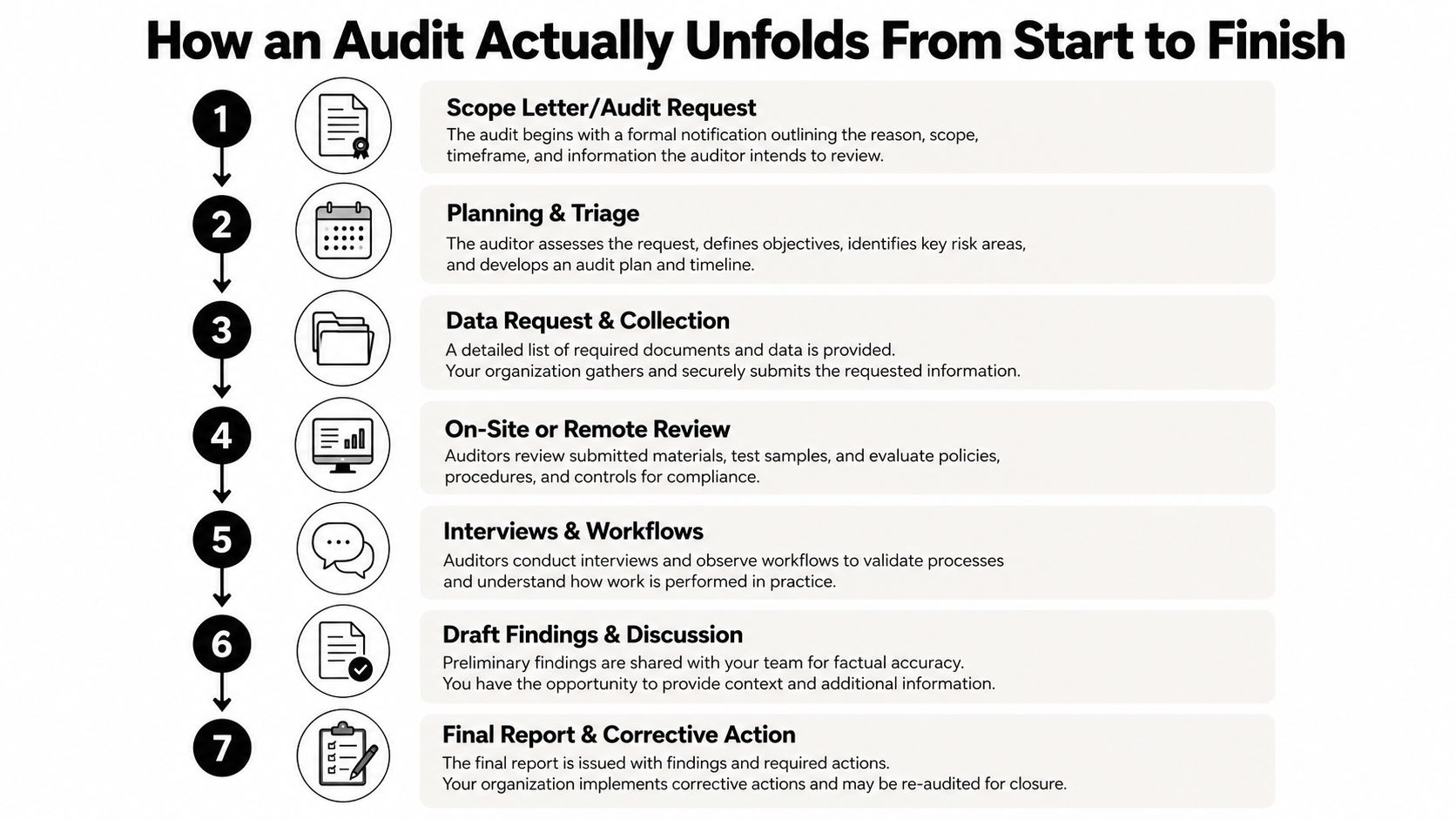
A clinic receives an audit notice on Monday and discovers by Friday that its policies, system records, and staff answers do not align. The response must create one reliable account of how controls operate, not just assemble a folder of documents. An independent readiness review exposes those gaps before auditors do, while managed monitoring keeps evidence current between reviews.
The seven phases
- Scope letter or audit request. The notice defines the standards, systems, documents, time periods, and contacts under review. Preserve it, clarify ambiguous requests, and avoid sending unrelated material.
- Planning and triage. Assign one point of contact, build a response calendar, confirm document owners, and separate verified facts from assumptions. Staff should route answers through the same process.
- Data request and collection. Gather policies, training records, access reports, risk analyses, incident histories, vendor agreements, tickets, logs, and approvals. Missing or stale evidence becomes visible immediately.
- Sample selection. Auditors choose users, patients, incidents, workstations, devices, or transactions. Their samples test whether controls operated in real situations, not whether a policy reads well.
- Interviews and workflow review. Auditors may speak with leadership, privacy and security officers, IT personnel, clinicians, and front-desk staff. They compare spoken answers with procedures and system evidence.
- Draft findings and discussion. Review preliminary observations, correct factual errors, and document remediation already completed. Respond with evidence and precise explanations, not speculation.
- Final report and corrective action. The report identifies findings and required responses. Practices commonly receive a limited period, often described operationally as 30 to 90 days, to submit a corrective action plan, although the exact deadline depends on the review.
Use Technovation's IT security audit checklist to organize access, endpoint, network, backup, and logging questions before the request arrives. Pair that preparation with recurring monitoring so access changes, vendor obligations, incidents, and review approvals remain demonstrable after the audit closes.
Where Healthcare Audits Keep Finding Problems
The recurring failure isn't usually the absence of every security technology. It's the inability to prove that the organization understood its risks, assigned responsibility, performed the required review, and corrected exceptions.
OCR's Phase 2 report found that many covered entities met breach-notification timeliness requirements and that many satisfied website-posting requirements for the Notice of Privacy Practices. It also found widespread failures involving PHI safeguards, the individual right of access, and complete Notice of Privacy Practices content in the Phase 2 industry report. That pattern points directly to process execution and evidence retention.
Common Audit Findings by Control Family
| Control Family | Common Finding | Why It Fails |
|---|---|---|
| Administrative safeguards | Stale or incomplete risk analysis, missing approvals, unclear ownership | The document doesn't reflect current systems, vendors, threats, or responsibilities |
| Technical safeguards | Unreviewed access, weak logging evidence, incomplete encryption or backup proof | The control may exist, but the clinic can't demonstrate operation over time |
| Physical safeguards | Incomplete device inventory, weak workstation practices, missing disposal records | Physical activity often sits outside the compliance owner's evidence process |
| Workforce and vendor management | Training gaps, unsigned agreements, inconsistent sanctions or vendor reviews | Staff and vendors change faster than the document repository |
Why the binder fails
An access policy doesn't prove that access was reviewed. A backup policy doesn't prove that restoration was tested. A business associate agreement template doesn't prove that every applicable vendor signed the current version.
Auditors don't award credit for a control that exists only as a statement of intent.
The most dependable evidence carries a date, owner, scope, result, exception record, and remediation status. That can include access review reports, ticket histories, training attestations, device inventories, incident logs, and signed approvals. A clinic reviewing disposal and chain-of-custody evidence can also consult this practical audit trail guide for ITAD operations for a useful example of how operational records should support an auditable process.
Annual reviews and paper attestations create long gaps. Ongoing monitoring produces a defensible record of what the practice checked, what it found, and how it responded.
Your Healthcare Compliance Audit Readiness Checklist
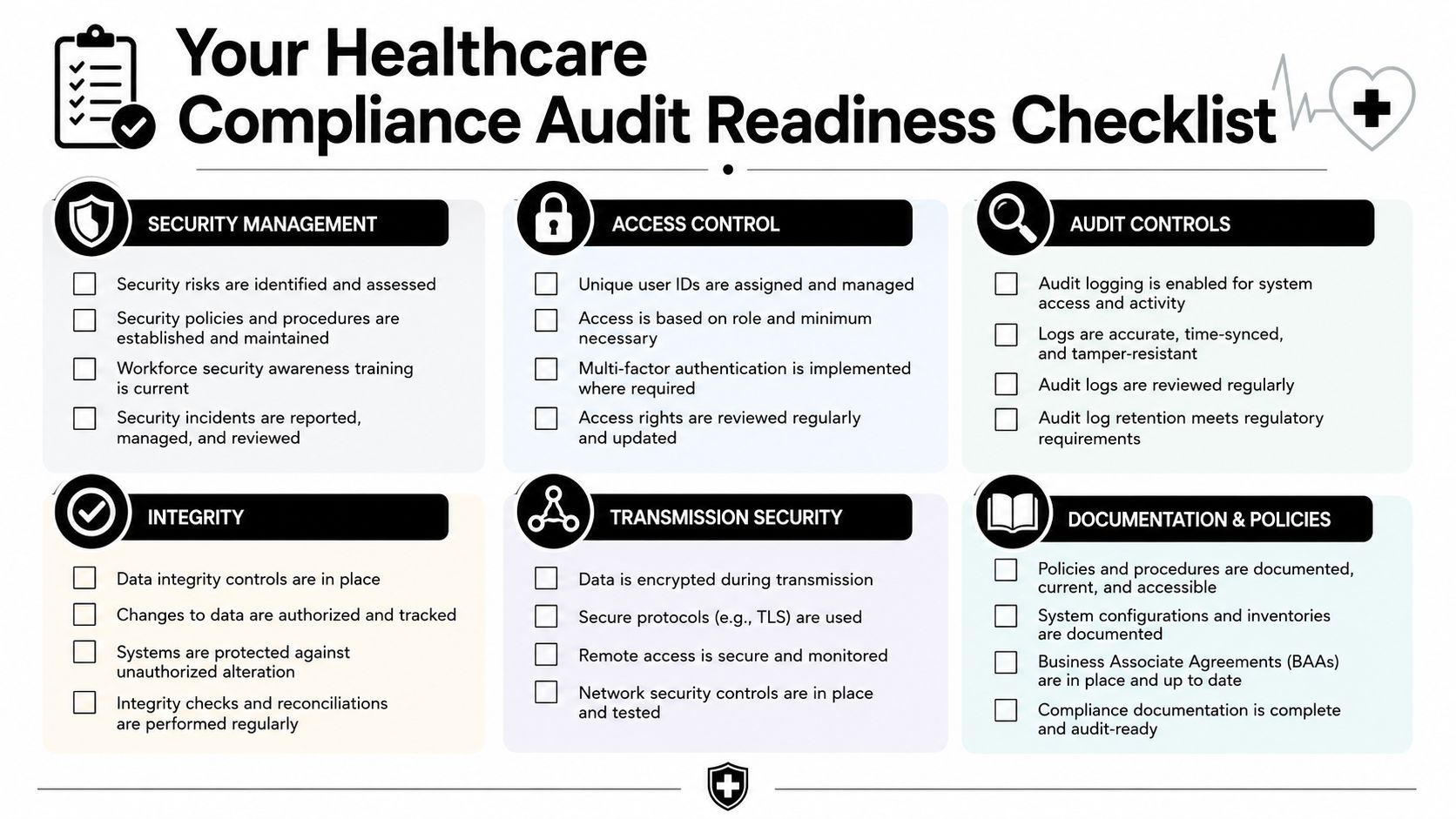
A clinic with 30 to 60 days before a scheduled review should stop collecting documents randomly. The practice should create an evidence register, assign an owner to every item, identify missing records, and test whether the control still matches daily work.
Administrative safeguards
Start with governance and risk documentation. The risk analysis should carry a current date, identify systems and ePHI flows, document threats and vulnerabilities, and show how the practice prioritized remediation. Policies should describe actual workflows, not an ideal process that staff don't follow.
Collect:
- Risk analysis evidence: Approved assessment, scope, methodology, identified risks, owners, and remediation status.
- Role assignments: Current privacy and security officer appointments, job responsibilities, escalation routes, and leadership approval.
- Policy records: Current policies, version history, approval dates, distribution records, and evidence that staff can access them.
- Sanctions evidence: Sanctions policy, investigation records, decision approvals, and proof that the policy has been applied when appropriate.
- Training records: Workforce roster, course content, completion records, reminders, exceptions, and records covering the past year.
Technical safeguards
Technology evidence should connect users, devices, systems, and events. Pull provisioning and termination records, unique user ID evidence, multi-factor authentication settings for systems containing ePHI, audit-log review records, encryption status for laptops and mobile devices, and backup test results with documented restoration dates.
Don't accept a screenshot without context. The evidence package should identify the system, reporting period, person who reviewed it, exceptions found, and action taken.
Physical safeguards
Physical controls require observation as well as paperwork. Review facility access logs, clean-desk observations, workstation placement, visitor procedures, device inventory, storage practices, and disposal records for retired hardware.
A walkthrough should test reality. If staff leave printed schedules in an open area or share a workstation account despite a written policy, the practice should correct the behavior and retain evidence of the correction before an auditor observes it.
Vendor management
Build a complete business associate register. For each vendor, retain the signed and current agreement, service description, data-access rationale, risk review, renewal record, and incident-reporting contact. Confirm that subcontractor obligations are addressed where applicable.
A practical readiness tracker should show:
- The control being tested.
- The evidence required.
- The assigned owner.
- The date last completed.
- The exception or gap.
- The remediation deadline.
- The reviewer's approval.
Clinics can use Technovation's HIPAA risk assessment checklist as a starting point, then adapt it to the practice's systems, vendors, workforce, and physical environment.
How Technovation Helps You Prepare and Pass
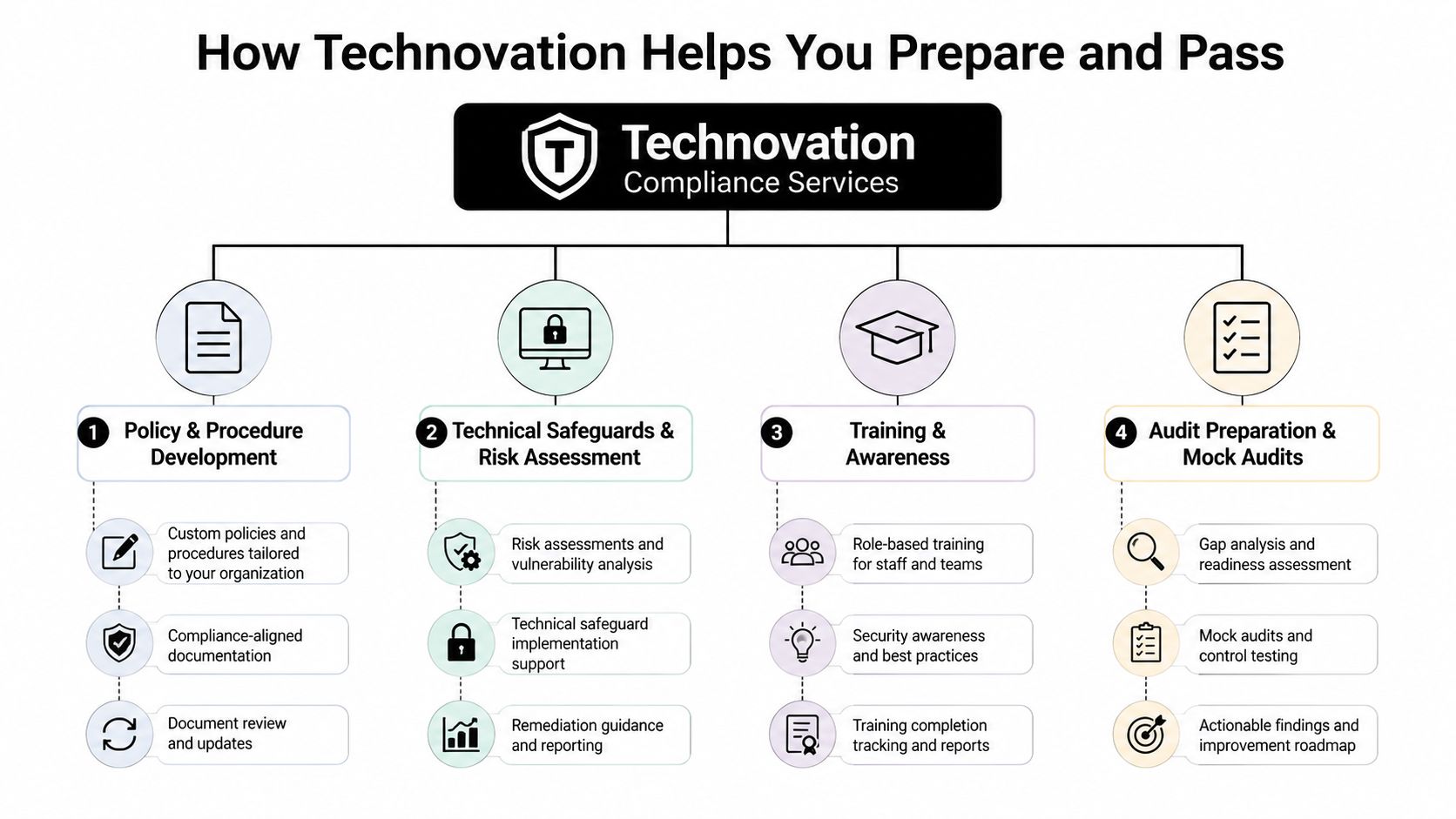
Readiness support only matters when it closes a specific evidence gap. A clinic doesn't need another generic policy packet. It needs independent validation, reliable monitoring, and documentation that links each control to an accountable person.
Independent security audits
An independent security audit stress-tests the technical safeguards a policy claims to enforce. The review can examine access provisioning, termination, authentication, endpoint protection, encryption, network hardening, backup configuration, incident response, and logging.
The output should be more useful than a list of vulnerabilities. Each finding should identify the affected system, business impact, evidence required for closure, responsible owner, priority, and retesting method. That structure gives leadership a remediation plan rather than a file of unresolved observations.
Quarterly IT health checks
Systems change between formal audits. New workstations appear, staff roles change, remote access expands, and vendors receive new permissions. Quarterly IT health checks create recurring opportunities to identify misconfigurations, unsupported systems, backup concerns, and access inconsistencies before those issues enter an audit sample.
A health check should produce dated evidence. It should also distinguish a confirmed control from an assumption, because auditors will do exactly that.
Continuous monitoring
Monitoring supports the records auditors expect for access and event review. Relevant evidence may include alerts, review tickets, escalation records, endpoint status, backup activity, and remediation history. The value isn't the volume of logs. The value is a repeatable process showing that someone reviews meaningful events and responds to exceptions.
A managed service model can give a small practice access to ongoing oversight without requiring it to build an internal security operations function. Technovation LLC offers managed IT support, compliance readiness, security audits, IT health checks, and monitoring for healthcare organizations.
Documentation support
Documentation support turns existing policies into an audit-ready evidence package. That means version control, ownership records, approval history, evidence naming conventions, cross-references, and a clear explanation of how each artifact proves control operation.
The practical service connection is straightforward:
- Stale risk analysis: Independent assessment and scheduled review identify what changed.
- Unreviewed access: Access reports and monitoring create review evidence.
- Training gaps: Workforce records are reconciled against the current roster.
- Vendor uncertainty: Agreements and vendor risk reviews are organized in one register.
- Weak remediation: Findings receive owners, deadlines, closure evidence, and retesting.
Clinics evaluating managed support can review Technovation's managed IT services for medical practices to understand how recurring technology oversight can support operational readiness.
The Real Risk Most Practices Still Underestimate
The most dangerous assumption in healthcare compliance audits is that a complete policy binder signals compliance. It doesn't. A binder proves that someone wrote requirements. It doesn't prove that users received the right access, staff followed the breach process, backups were restored successfully, or vendors remained under review.
Federal enforcement activity reinforces the need for a broader view. HHS's 2024 Annual Report to Congress recorded 730 initiated compliance reviews and 797 completed compliance reviews, while also stating that no formal audits were initiated in 2024 because of financial-resource constraints in the annual report. Formal audit activity can pause while compliance reviews and other scrutiny continue.
The same report also cites HHS OIG's finding that OCR performed 207 audits between 2016 and 2020, while the audit program examined only a narrow set of HIPAA requirements in the report to Congress. A narrow external review doesn't justify a narrow internal program. It should prompt leadership to understand what the audit covers and what it leaves untouched.
The operational standard
The stronger standard is continuous evidence collection:
- Access reviews are completed and approved on schedule.
- Training records match the active workforce.
- Risk analyses reflect current systems and vendors.
- Incident records show investigation, decisions, and remediation.
- Backups and restoration tests have dated results.
- Policies are versioned and aligned with actual workflows.
Contrarian takeaway: The primary audit risk isn't a missing policy. It's the gap between what the policy says and what systems, logs, and staff behavior prove on the review date.
Healthcare organizations should schedule an independent readiness review before the next audit cycle begins, then use managed monitoring to keep the evidence current. Waiting for a finding letter turns ordinary control maintenance into an urgent remediation project.
Technovation LLC provides healthcare compliance readiness, security audits, IT health checks, managed monitoring, backup support, and documentation assistance designed to close the gap between policy and operational evidence. Visit Technovation LLC to schedule a readiness conversation before the next audit request arrives.