
A litigation paralegal in a mid-sized DFW firm opens what appears to be a routine document-signing envelope. The authentication prompts fail, so the paralegal continues working. By 9 a.m., fraudulent trust-account wire instructions have reached a client, attackers have accessed the mailbox, and confidential case files are leaving the firm's environment.
That incident isn't an IT ticket. It affects fiduciary duties, client confidentiality, malpractice exposure, deadlines, privilege, and the firm's reputation. The technical intrusion may have started with one message, but the professional consequences begin when the firm has to decide what to preserve, whom to notify, and how to keep practicing.
Cybersecurity for law firms therefore needs two halves. Prevention matters, but the first 24 to 72 hours after discovery often determine whether a breach becomes a contained disruption or a prolonged professional crisis.
Table of Contents
- Why Cybersecurity for Law Firms Is a Practice Risk, Not Just an IT Problem
- The Modern Threat Landscape Targeting Law Firms
- Regulatory and Ethical Obligations Every Firm Must Meet
- Prioritized Technical and Administrative Controls
- Incident Response and Breach Notification Checklist
- How to Evaluate a Managed Security Partner for Legal Work
- A 90-Day Roadmap and Checklist for DFW Law Firms
Why Cybersecurity for Law Firms Is a Practice Risk, Not Just an IT Problem
The Monday-morning scenario is realistic because law firms combine three qualities attackers value: trusted relationships, sensitive records, and payment activity. A compromised attorney mailbox can expose settlement discussions, draft pleadings, discovery, health information, intellectual property, and instructions that appear legitimate to clients. A locked document system can interfere with filings, hearings, legal holds, and billing.
The professional responsibility follows the data. ABA Formal Opinion 477R treats electronic communication security as a risk-based professional judgment, not a purely technical preference. Texas lawyers also have duties involving competence, confidentiality, supervision, and client communication. Texas Disciplinary Rule 1.01 makes competence part of competent representation, and that obligation increasingly includes making informed technology decisions or retaining qualified assistance.
The trust problem reaches beyond confidentiality
Clients rarely see the security controls behind a legal practice. They see whether the firm protects their information, answers accurately, meets deadlines, and handles money correctly. When a confidential file is exposed or a wire is redirected, the client may not distinguish between a phishing failure, a vendor compromise, and an internal process gap. The firm remains the accountable relationship.
Malpractice carriers are also asking more detailed questions about identity protection, endpoint monitoring, backups, incident response, and employee access. A firm that can't explain how it detects suspicious sign-ins or restores matter data will have difficulty demonstrating reasonable safeguards to clients, insurers, regulators, or a court.
Downtime creates a fee problem as well. Attorneys and staff may be unable to access matter files, communicate securely, record time, or meet deadlines. The lost revenue is only one part of the impact. A missed filing, delayed response, or compromised legal hold can create consequences that no IT recovery plan can erase.
Practical rule: A law firm's incident plan should be reviewed by the managing partner and outside counsel, not left solely with the person who resets passwords.
A business risk assessment from Technovation can help map systems, vendors, access rights, data flows, and operational dependencies before an incident exposes those gaps. Credential exposure deserves separate attention too, and the Horus Intelligence credential exposure guide offers useful context for reviewing compromised credentials and exposed identities.
The playbook that follows treats prevention and response as one operating discipline. Identity controls reduce entry, monitoring shortens detection, and a privilege-aware response process protects the firm's ability to make defensible decisions under pressure.
The Modern Threat Landscape Targeting Law Firms
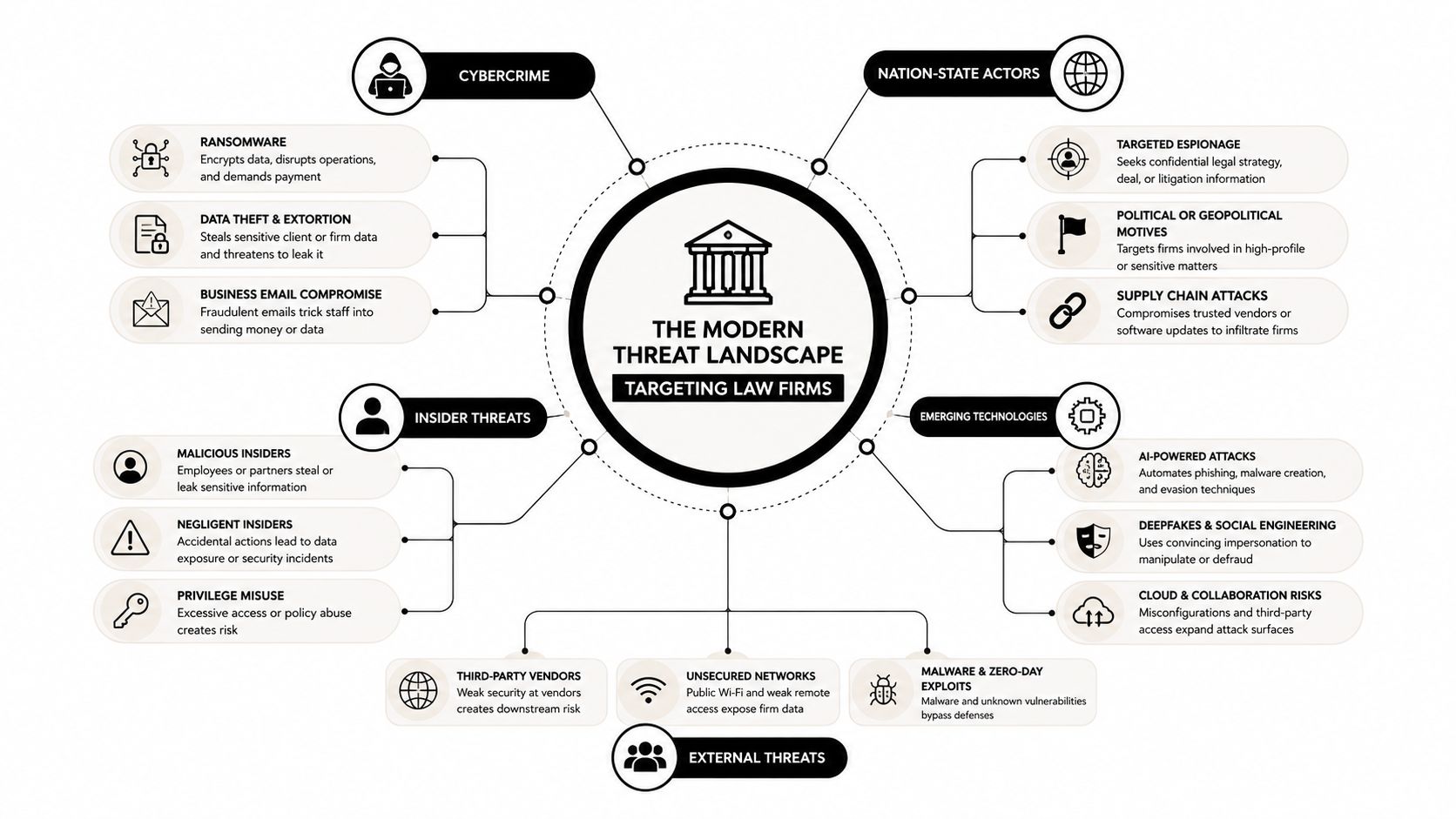
Law firms aren't being attacked through one predictable route. Small practices often face commodity phishing, credential reuse, and poorly protected remote access. Mid-sized firms attract more targeted business email compromise, especially where partners manage settlements, escrow, real estate closings, or other transfers. Every practice also inherits exposure through case-management providers, e-filing services, document platforms, legal research accounts, and other connected vendors.
AiTM phishing now deserves priority. In one 2026 threat-intelligence dataset, AiTM phishing accounted for 28.57% of initial access events in the legal sector, while credential and identity activity represented 56.3% of threats overall. The same dataset associated Tycoon2FA with 52.3% of AiTM-related account compromises, and conventional credential theft represented 16.96%, compared with a 26.01% cross-industry average. These figures indicate a bypass problem. Attackers aren't always trying to steal a password at the login page. They're using proxy infrastructure, phishing kits, and stolen sessions to operate after authentication. (Infosecurity Magazine's legal-sector AiTM coverage provides the dataset context.)
Why authenticated sessions matter
Legacy MFA can stop simple password reuse, but it won't reliably stop an attacker who captures a valid session. Firms need phishing-resistant MFA, conditional access, rapid session revocation, device checks, and alerts for unusual mailbox rules or consent activity. Training still matters, but training alone can't protect a user whose authenticated session has already been stolen.
Ransomware creates a different form of pressure. Legal organizations hold draft pleadings, confidential settlement positions, M&A materials, discovery collections, and client records. Attackers can steal data before encrypting systems, then threaten disclosure while the firm struggles to preserve deadlines and legal holds.
The legal sector report from the UK National Cyber Security Centre records that 75% of solicitor firms reviewed by the Solicitors Regulation Authority had been targeted by a cyber attack, and 18 law firms were victims of ransomware attacks in 2021. It also says nearly three-quarters of the UK's top-100 law firms had been affected, while smaller firms with limited or no dedicated cyber support faced increasing ransomware risk.
A separate analysis identified 138 publicly confirmed ransomware attacks on law firms since 2018, affecting at least 2,907,031 records. It reported 45 attacks and 1.56 million records affected in 2023, more than half the dataset total, alongside a 615% increase from 218,473 records in 2022. The reported average ransom demand was $2.47 million, with an average payment of $1.65 million. (Comparitech's legal-sector ransomware analysis documents those figures.)
Supply-chain exposure adds another layer. A vendor can provide a legitimate path into matter information without an attacker first compromising the firm's own endpoint. For DFW firms, detection lag is the practical multiplier. The initial intrusion may be limited, but unreviewed mailbox rules, unmonitored administrative activity, and unsegmented access give attackers time to expand.
Deepfake-enabled social engineering also makes voice and video verification less reliable. Legal teams handling urgent transfers should use an independent callback process, and the AI Video Detector deepfake guide provides useful background for improving verification during virtual communications.
Regulatory and Ethical Obligations Every Firm Must Meet
A managing partner doesn't need a 200-page policy to understand the firm's core obligations. The firm needs a clear map from the type of information involved to the people responsible for protecting it, responding to an incident, and communicating with affected clients.
The first layer is professional conduct. Technology competence requires attorneys to understand relevant technology risks or obtain qualified assistance. Confidentiality duties extend to electronic client information. Supervising attorneys remain responsible for reasonable oversight of staff and vendors with access to client data, and material errors or adverse developments may require prompt client communication.
Three layers of responsibility
The second layer comes from ABA ethics guidance. Formal Opinion 477R addresses securing client communications and recognizes that more sensitive matters may require stronger safeguards than ordinary correspondence. Formal Opinion 483 addresses obligations after a data breach, including the need to investigate, restore security, and evaluate notification duties. Ransomware and extortion add further questions about legal authority, sanctions, client interests, evidence preservation, and whether payment is permissible.
The third layer consists of breach-notification laws and contracts. A firm may need to evaluate obligations involving personally identifiable information, protected health information, financial information, affected residents, client agreements, and insurers. Texas Business and Commerce Code Chapter 521 is relevant to affected Texas residents, and the Texas Identity Theft Enforcement and Protection Act includes a 60-day notification clock for applicable breaches. Contract terms may require faster notice than statute.
A one-page workstation map should answer four questions: what happened, what information may be involved, who owns the decision, and what deadline applies.
| Trigger Event | Applicable Rule or Statute | Required Action | Timeframe |
|---|---|---|---|
| Unauthorized access to client information | Texas confidentiality duties and applicable ethics guidance | Preserve evidence, restrict access, involve designated counsel, assess affected matters | Immediately |
| Personal information of Texas residents may be exposed | Texas Business and Commerce Code Chapter 521 and related Texas requirements | Determine scope and prepare legally appropriate notification | Within the applicable statutory deadline, including the 60-day Texas requirement where applicable |
| Matter-specific contract requires breach notice | Client agreement or outside-counsel terms | Notify the designated client contact using the contractual process | Follow the contract, often sooner than a statute |
| Protected health or financial information may be involved | Applicable sectoral and state requirements | Conduct a data classification and notification analysis | Counsel determines the applicable deadline |
| Trust-account or settlement instructions may be altered | Fiduciary duties and firm financial controls | Freeze or verify transfers, contact financial institutions, preserve communications | Immediately |
The map should sit beside a workstation because staff shouldn't have to search a policy binder while an attacker is active. The law firm's response process must be understandable to a paralegal, partner, administrator, and IT lead.
Prioritized Technical and Administrative Controls
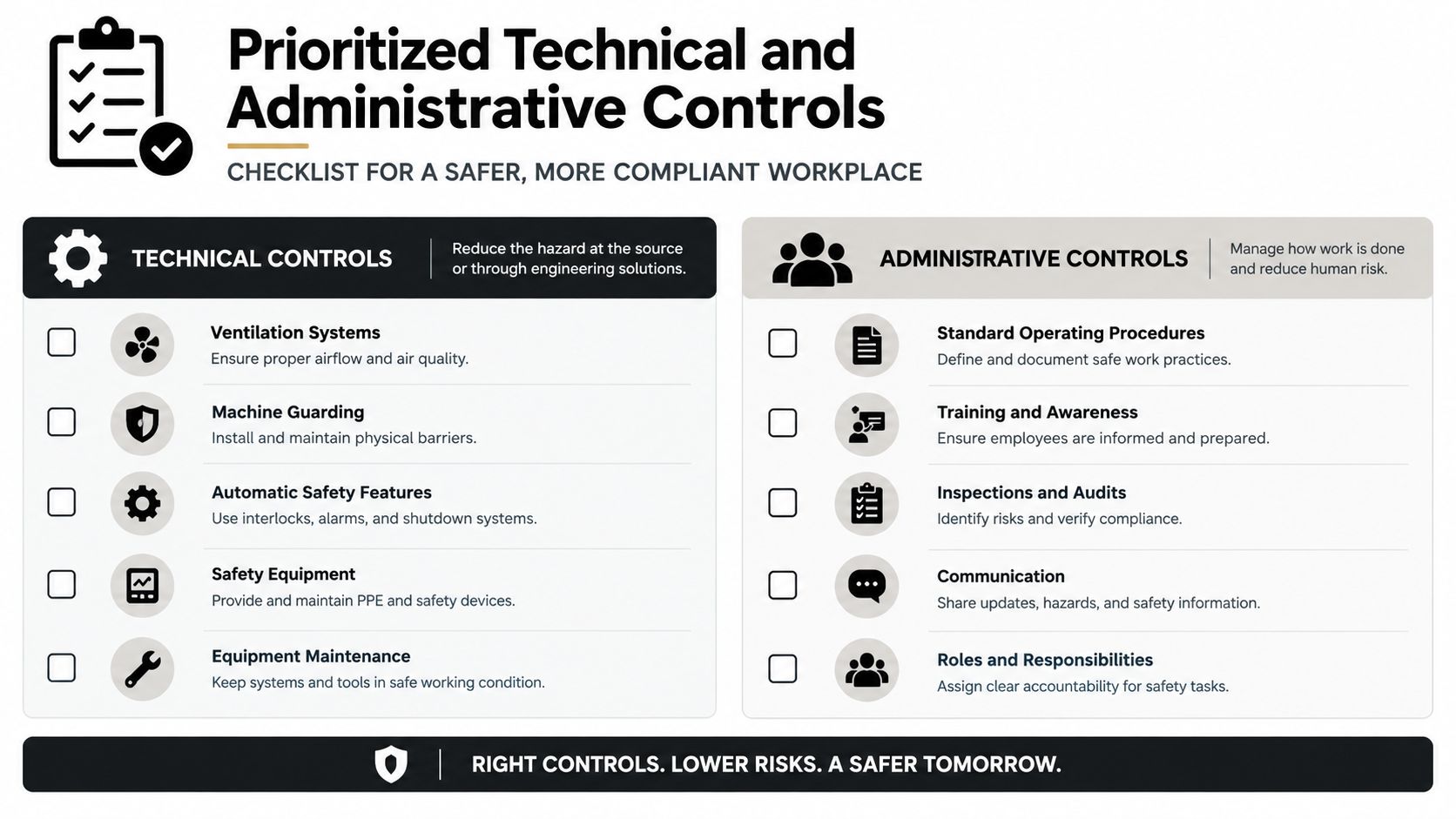
Controls should be ranked by impact, not by vendor pitch. A DFW firm can spend heavily and still leave attorney email exposed if identity, endpoint visibility, and recovery are treated as afterthoughts.
Start with identity
Deploy phishing-resistant MFA. Use hardware-backed security keys or platform passkeys for email, document systems, remote access, and administrative accounts. SMS and ordinary push prompts are no longer sufficient for attorney email in 2026 because AiTM attacks target the authenticated session.
Add conditional access and session controls. Restrict access by device health, location patterns, risk signals, and application sensitivity. Revoke sessions quickly when a user reports a suspicious prompt or when monitoring identifies anomalous activity.
Protect every endpoint. Patch laptops, servers, document systems, and remote devices. Install endpoint detection and response on firm-owned equipment and approved home devices. Identity controls stop many intrusions, but endpoint monitoring catches malicious activity that gets through.
Harden mailboxes. Configure domain authentication, inbound filtering, malicious-link inspection, attachment controls, external sender warnings, and alerts for forwarding rules. Financial instructions need independent verification regardless of how authentic an email appears.
The multi-factor authentication setup service can support firms that need to move from basic prompts to a more resilient identity design.
Build recovery around matter continuity
Limit privileged access. Administrators should use separate accounts, approval workflows, and logging. Matter repositories should follow least privilege so one compromised account doesn't expose every client.
Encrypt data and document key custody. Full-disk encryption, protected email, and secure file exchange reduce exposure when devices or transmissions are intercepted. The firm should know who controls keys and how access is recovered.
Segment and test backups. Backups must be isolated from ordinary administrative credentials and tested through actual restoration. A backup that hasn't been restored under pressure is an assumption, not a recovery plan.
Replace broad network trust. Use Zero Trust Network Access principles, device verification, application-specific access, and strong logging instead of treating a VPN connection as proof that a user should reach the entire environment.
Simulate behavior. Annual awareness training should include AiTM prompts, callback phishing, fraudulent wire requests, and suspicious document-sharing invitations. The purpose isn't blame. It's to test whether people know how to stop and verify.
Technovation LLC can combine security audits, identity and device reviews, managed monitoring, remote support, backup oversight, and compliance-oriented planning for legal practices that need an operating partner rather than disconnected point solutions. The sequence matters. Identity reduces entry, endpoint detection finds what identity misses, and tested backups determine whether ransomware becomes an inconvenience or a malpractice event.
Incident Response and Breach Notification Checklist
The checklist activates when the firm confirms unauthorized access to a matter database, encrypted file shares, unusual administrator sign-ins, suspicious mailbox activity, or an extortion contact. Staff shouldn't wait for complete certainty before escalating. The incident lead can narrow the scope after the response team preserves evidence and limits further access.
The first hours protect evidence and privilege
The firm should preserve forensic state before reimaging or wiping devices. Outside counsel should direct the investigation where privilege and work-product protection are appropriate, while the technical team captures mailbox audit records, identity logs, endpoint data, access histories, and relevant network evidence. The cyber-insurance carrier should be contacted according to the policy's reporting requirements, before the firm makes an external statement or authorizes major remediation.
The response team then identifies which matters, clients, systems, and data categories may be involved. Trust-account activity requires immediate financial verification with an independent contact method. Evidence handling should document who collected each item, when it was collected, where it was stored, and who accessed it afterward.
| Hour | Trigger or Finding | Required Action | Owner |
|---|---|---|---|
| 0 to 4 | Confirmed unauthorized access, encryption, or extortion | Isolate affected systems without destroying evidence, activate the response roster, preserve logs | IT lead or managed security partner |
| 4 to 12 | Mailbox, identity, or endpoint compromise suspected | Revoke sessions, disable malicious rules, reset affected credentials, collect audit records | Identity administrator |
| 12 to 24 | Client-confidential or trust-account information may be involved | Engage outside counsel and carrier, verify transfers, classify affected data and matters | Managing partner and counsel |
| 24 to 48 | Scope remains uncertain or evidence shows broader access | Retain DFIR support, establish chain of custody, identify contractual contacts and deadlines | Counsel and incident lead |
| 48 to 72 | Notification analysis is complete enough for decisions | Prepare client, regulator, and contractual notices, document decisions and assumptions | Outside counsel and communications lead |
A firm may self-investigate only when the event is narrow, logs are available, no privileged matter data appears affected, and an experienced responder can preserve evidence. Any uncertainty involving broad access, ransomware, trust funds, legal holds, or client confidentiality warrants a pre-arranged DFIR retainer.
The incident response procedures should include a client-notification template that is factual and restrained: state what the firm detected, what it secured, what information is being assessed, what protective steps the client should take, and who will provide updates. It should avoid speculation, admissions beyond verified facts, and unnecessary technical detail that could compromise the investigation.
Notification may involve Texas residents under Chapter 521, contractual client requirements, insurers, and other applicable laws. The firm should document why it did or didn't notify each relevant party, because the decision record can matter as much as the notice itself.
How to Evaluate a Managed Security Partner for Legal Work
A general IT provider that resells remote monitoring tools isn't automatically a security partner. Legal practices need a provider that understands privileged data, matter-based access, trust-account fraud, litigation holds, vendor exposure, and the pressure of a first-day incident.
The financial comparison should include the full gap, not just a salary. An in-house security engineer still needs coverage for nights, weekends, holidays, threat monitoring, incident response, specialized forensics, backup validation, compliance documentation, and vacation or sick-day coverage. A legal-focused managed security partner can make those capabilities predictable, provided the contract clearly defines scope and response obligations.
Questions that expose weak coverage
A managing partner should ask finalists:
- Privilege handling: Will outside counsel direct forensic work when appropriate, and does the provider understand attorney-client confidentiality?
- Response coverage: Is there a staffed 24/7 security operations center, or is monitoring passed to another organization?
- DFW presence: What is the on-site response time within the Dallas-Fort Worth metroplex?
- Assurance: Can the provider produce relevant SOC 2 Type II reporting and explain its control environment?
- Insurance: Does it carry cyber liability coverage with appropriate errors-and-omissions protection?
- Operational proof: Can it show a written incident playbook and describe tabletop exercises completed with clients?
- Access discipline: Does it use separate privileged accounts, documented approvals, and auditable administrative access?
A useful test: Ask the provider to describe the first four hours after a compromised attorney mailbox is discovered. Vague answers reveal vague coverage.
Red flags include hourly-block billing without defined deliverables, no named incident coordinator, no written escalation path, no restoration testing, and no experience supporting legal environments. A practical scorecard can rate each finalist on legal-sector experience, identity controls, endpoint coverage, monitoring, backup recovery, response time, privilege-aware investigations, reporting, and contract clarity.
The managed service provider selection framework gives firms a starting point for comparing operational maturity instead of choosing on price alone. Two or three finalists should receive the same scenario and the same questions. Their answers should be reviewed by the managing partner, IT lead, and insurance or compliance contact.
A 90-Day Roadmap and Checklist for DFW Law Firms
A 90-day program works when each task has an owner and a target date. The schedule below fits a solo practice or a firm with dozens of attorneys because it starts with access and recovery, then adds governance.
Days 1 through 30 focus on exposure
The IT lead should enable MFA on every mailbox and critical cloud service, patch the document-management environment, inventory endpoints, and enroll every approved device in endpoint protection. The managing partner should identify the person authorized to declare an incident, while the administrator should confirm current insurance contacts and client notification clauses.
Days 31 through 60 establish operating discipline
The firm should run phishing simulations that include AiTM prompts and callback fraud, apply conditional access policies, and test encrypted backups against a representative ransomware recovery scenario. Outside counsel and the IT lead should produce written incident procedures that identify Texas confidentiality and notification considerations.
Days 61 through 90 turn controls into governance
Vendor risk reviews should cover access to matter data, breach-notification terms, authentication, subcontractors, and recovery commitments. The managing partner should participate in a tabletop exercise, review insurance alignment, and set a quarterly cadence for access reviews, backup tests, incident metrics, and policy updates.
| Target Period | Deliverable | Owner | Target Date |
|---|---|---|---|
| Days 1 to 30 | MFA enabled across mailboxes and critical systems | IT lead | Assigned date |
| Days 1 to 30 | Document system patched and endpoints enrolled | IT lead or MSP | Assigned date |
| Days 1 to 30 | Incident authority and insurance contacts documented | Managing partner | Assigned date |
| Days 31 to 60 | Phishing and callback simulations completed | Security partner | Assigned date |
| Days 31 to 60 | Conditional access and encrypted backup testing completed | IT lead or MSP | Assigned date |
| Days 31 to 60 | Response procedures mapped to Texas duties | Managing partner and counsel | Assigned date |
| Days 61 to 90 | Vendor access and contract reviews completed | Administrator | Assigned date |
| Days 61 to 90 | Tabletop exercise completed and gaps assigned | Managing partner | Assigned date |
| Ongoing | Quarterly access, backup, and response review scheduled | Firm leadership | Recurring date |
A firm that completes this checklist will have more than isolated security products. It will have assigned accountability, stronger identity protection, tested recovery, and a response process designed for the professional realities of legal work.
Technovation LLC provides DFW law firms with managed cybersecurity, compliance support, endpoint and identity protection, backup oversight, remote access hardening, and incident-response planning. Visit Technovation LLC to request a security audit and turn the firm's first 90 days into a documented, measurable risk-reduction program.