
A dental practice in Plano can have a quiet office, a reliable firewall, and updated antivirus while still carrying weaknesses across its patient portal, remote laptops, cloud applications, and electronic health record connections. A law firm in Las Colinas can face the same problem after adding remote work and cloud-based case files. Each business decision improves productivity, but each new system also creates another place where an attacker may find an opening.
That's why the answer to what is vulnerability management isn't “running a scan” or “installing patches.” It's a continuous business practice for finding weaknesses, judging which ones create meaningful exposure, fixing them within defined timeframes, and confirming that the risk is reduced. For DFW healthcare, legal, financial, and construction businesses, the discipline connects cybersecurity with compliance, continuity, and responsible technology planning.
Table of Contents
- The Quiet Risk Sitting Inside Every Growing Business
- How the Vulnerability Management Lifecycle Actually Works
- Prioritization That Matches How Attackers Really Think
- Why Scanning Alone Is No Longer Enough
- What This Looks Like Inside a Regulated SMB
- Tools, People, and the Right Kind of Help
- Practical Next Steps to Strengthen Your Posture
- Common Misconceptions and the Path Forward
The Quiet Risk Sitting Inside Every Growing Business
A two-provider dental practice in Plano may have started with a small office network, a few workstations, and a basic server. Over time, the practice added a patient portal, remote access for billing, cloud scheduling, connected diagnostic devices, and laptops for staff working away from the office. None of those decisions is reckless. The risk comes from the fact that the environment changes faster than anyone's memory of what exists inside it.
A seven-attorney firm in Las Colinas may have followed a similar path. Client files moved to cloud storage, attorneys began working from home, a case-management platform connected to outside providers, and a contractor received access to a shared portal. The firm may still think of itself as having “a network,” but attackers see a collection of accounts, applications, endpoints, services, and connections.
Vulnerability management is the ongoing practice of identifying weaknesses in that environment, ranking them according to real business risk, correcting them, and checking that the correction worked. The weaknesses may involve missing updates, unsafe configurations, exposed services, unsupported software, or access controls that no longer fit the organization's needs.
A firewall and antivirus remain useful controls, but they don't answer several essential questions:
- What assets exist? Unknown laptops, cloud workloads, applications, and remote connections can't be protected consistently.
- Which weaknesses matter most? A long scanner report doesn't tell a practice manager which issue could expose patient information.
- Who owns the fix? Findings without assigned responsibility tend to remain open.
- Did remediation work? A patch deployment or configuration change isn't proof that the vulnerable condition disappeared.
Practical rule: A vulnerability program should help leadership decide what needs attention first, who must act, and how the organization will prove closure.
The aim isn't to make a business fear every software flaw. It's to make exposure visible enough that a small team can spend limited time on the weaknesses most likely to affect patients, clients, employees, revenue, or regulatory obligations.
How the Vulnerability Management Lifecycle Actually Works
A useful analogy is building maintenance. A property manager doesn't inspect a roof once, declare the building safe forever, and stop checking the plumbing. The building changes, weather creates new problems, tenants alter rooms, and repairs require follow-up. Vulnerability management works the same way.
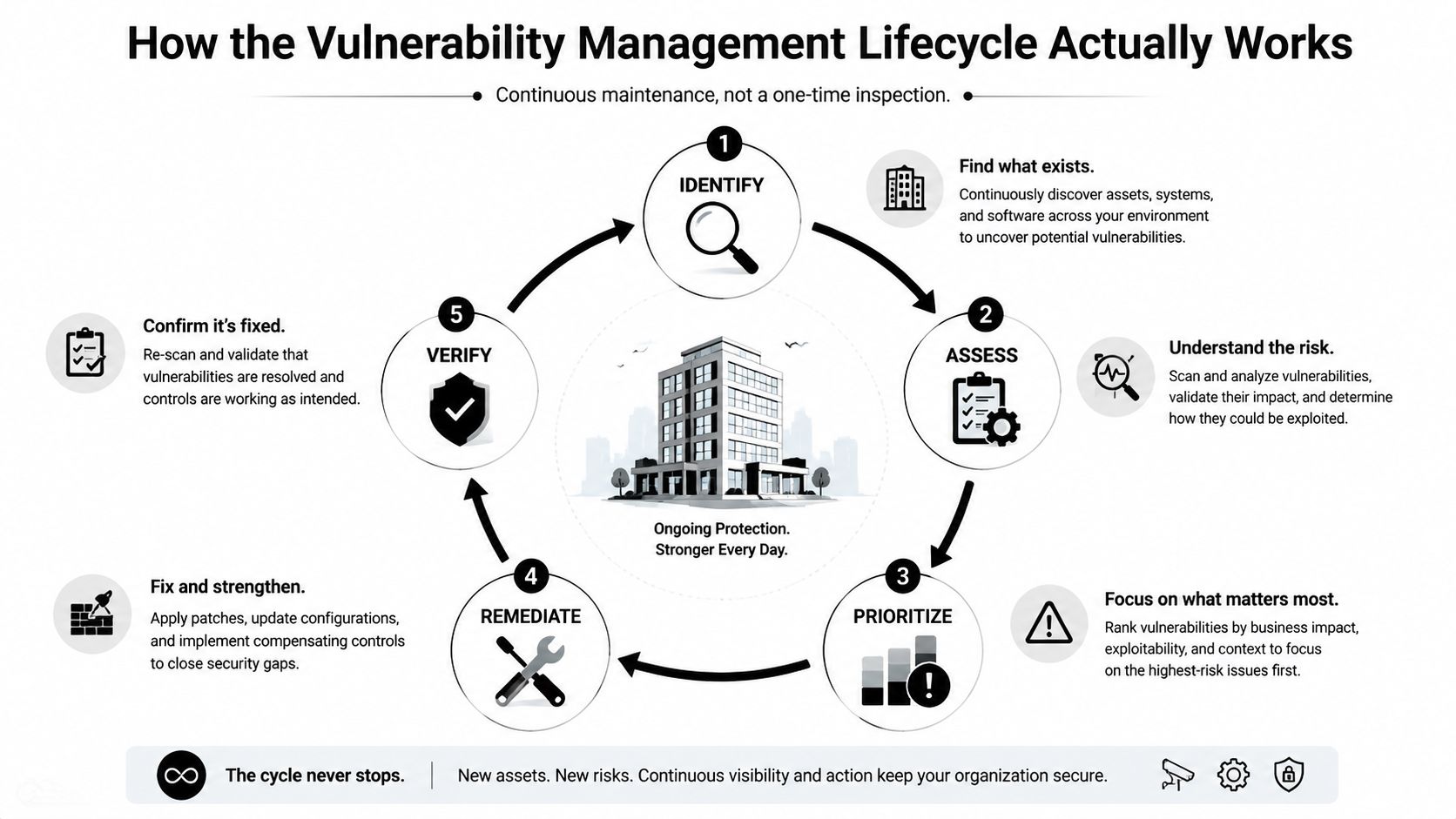
Identify every asset
The first stage is discovery. The organization records workstations, servers, network devices, cloud resources, applications, mobile devices, remote endpoints, and externally reachable services. Asset ownership and business purpose matter as much as technical details. A Frisco construction office should know which systems support project files, payroll, estimating, and field connectivity.
Assess the weaknesses
Assessment connects discovered assets with known weaknesses, configuration problems, missing updates, and exposure conditions. A scanner can identify potential issues, but the finding still needs context. Vulnerability scanning is one input into a broader program, not the program itself.
Prioritize by exposure
Prioritization determines what deserves immediate attention. Severity scores help establish a baseline, while exploit intelligence, internet reachability, asset importance, data sensitivity, and existing safeguards refine the decision. A weakness on a public-facing remote-access system usually deserves more attention than the same weakness on a segregated test device.
Remediate the condition
Remediation may involve applying a software update, changing a configuration, disabling an unnecessary service, replacing unsupported software, restricting access, or adding a compensating control. The correct action depends on the asset and the operational impact. A clinic may stage a change to avoid disrupting patient scheduling, while a construction company may coordinate updates around field operations.
Verify and repeat
Verification confirms that the weakness is gone, not merely that a ticket was closed or a patch was sent. Follow-up scanning, configuration checks, and endpoint validation help confirm the result. Lessons from failed changes, recurring findings, and unknown assets then improve the next cycle.
NIST connects patch and vulnerability management with awareness, training, configuration management, planning, and risk assessment, while the NIST Cybersecurity Framework places it within broader organizational risk management through its cybersecurity framework guidance. Skipping any stage breaks the loop. A modest, repeatable cadence is more useful than an ambitious process that the team can't sustain.
Prioritization That Matches How Attackers Really Think
Raw vulnerability counts create noise. A small business may have limited staff, a narrow maintenance window, and several compliance responsibilities, so the useful question isn't “How many findings are open?” It's “Which exposed condition could change the business's risk most right now?”
Three inputs produce a more practical answer:
- CVSS severity: A Common Vulnerability Scoring System rating provides an initial view of technical severity. It helps sort findings, but it doesn't know whether the affected system holds patient records, client trust-account information, or only test data.
- Exploit intelligence: CISA's Known Exploited Vulnerabilities Catalog and other current threat signals show whether attackers are actively using a weakness. CISA recommends remediating critical vulnerabilities on internet-accessible systems within 15 calendar days and high vulnerabilities within 30 days, according to its guidance for internet-accessible systems. Federal policy tied to the KEV Catalog uses a 14-day remediation requirement for listed items, which illustrates how exploit evidence can shorten a response window.
- Business context: Asset criticality, data sensitivity, reachability, users, dependencies, and compliance obligations determine the consequence of failure. A medium-severity issue on a server holding patient records may be more urgent than a critical issue on an isolated test server.
| Prioritization Inputs Compared | What It Tells You | Limitation on Its Own | Best Use |
|---|---|---|---|
| CVSS severity | How serious the technical weakness may be | Doesn't capture business exposure or local controls | Establishing an initial filter |
| Exploit intelligence | Whether attackers are using or discussing the weakness | Threat signals may change quickly | Accelerating action on actively exploited issues |
| Asset context | What the system supports, what data it holds, and who can reach it | Requires an accurate inventory and ownership data | Setting the final business priority |
FedRAMP RFC-0012 demonstrates this mechanics-based approach by setting a maximum of 3 days for credibly exploitable, internet-reachable vulnerabilities, 7 days for credibly exploitable vulnerabilities that aren't internet-reachable but affect very high, high, or moderate impact systems, 21 days for non-internet-reachable low-impact vulnerabilities, and 6 months for all detected vulnerabilities, as described in the FedRAMP vulnerability remediation proposal. These timelines show why reachability and exploitability can matter more than a score viewed in isolation.
For an owner evaluating cybersecurity risk management, the practical result is a shorter, more defensible queue. Leadership can fund and track work that reduces exposure instead of asking a small IT team to treat every finding as equally urgent.
Why Scanning Alone Is No Longer Enough
A scanner produces a snapshot. Vulnerability management produces a decision process.
Traditional scan-and-patch programs often sort a long list by CVSS, assign tickets, and measure activity by the number of findings or patches completed. That approach can miss how attackers combine weaknesses. A reused contractor password on a shared portal, an unpatched remote-access appliance, and a forgotten subdomain may each look less urgent than a single high-scoring flaw. Together, they can create a path into a sensitive environment.
Recent industry writing reports that 23,667 CVEs were disclosed in the first half of 2025, up 16% year over year, alongside 161 actively exploited vulnerabilities. It also reports that 42% of those exploited flaws had public proof-of-concept code, as outlined in the 2025 exposure-first vulnerability management analysis. Those figures reinforce the operational problem, but the answer isn't to ask a small team to patch everything immediately.
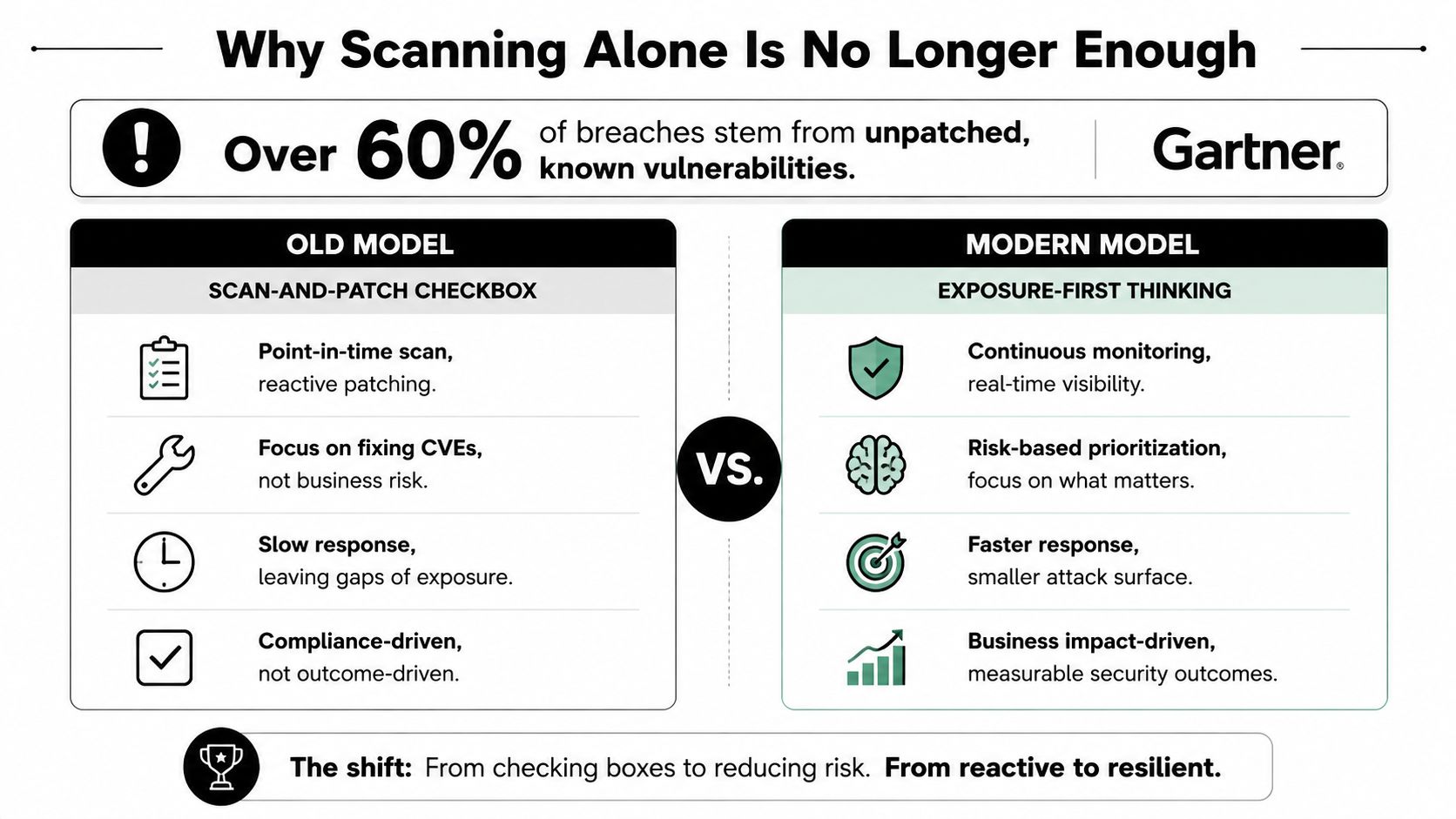
Two mindsets produce different work
| Scan-and-patch mindset | Exposure-first mindset |
|---|---|
| Starts with the scanner queue | Starts with assets, paths, and business consequences |
| Treats severity as the main ranking | Combines severity, exploitability, reachability, and asset value |
| Measures patches and closed tickets | Measures verified reduction in exposure |
| Reviews systems at fixed intervals | Maintains a repeatable loop that responds to changes |
| Assumes deployment means resolution | Confirms that the vulnerable condition is closed |
The exposure-first model asks which systems attackers can reach, which assets contain the most sensitive information, and which weaknesses can be chained together. It also accounts for controls that reduce practical exposure, such as segmentation or restricted access, without assuming those controls are working unless the organization verifies them.
Patch management remains essential, but it works better when connected to risk decisions and validation. A practical patch management process should tell the team what to patch first, how to stage the change, and how to confirm that the result holds in production.
What This Looks Like Inside a Regulated SMB
A Tuesday morning at a 40-person healthcare clinic can show the process more clearly than a policy document. An overnight scan identifies a serious weakness on an EHR integration server. The practice manager doesn't need a technical dump. The manager needs to know whether the server can be reached from outside, whether protected health information passes through it, who owns the system, and what response time applies.
The compliance lead confirms the data relationship, while the IT partner reviews the finding and checks whether the affected software and configuration match the report. The partner stages the remediation, coordinates a maintenance window, and validates the result before the clinic's staff arrive for the busiest appointments. The practice retains evidence showing the finding, decision, action, and verification.
A Fort Worth law firm can follow the same pattern before a client audit. The firm identifies systems that store matter files, confirms which users and vendors can reach them, ranks findings by exposure and client requirements, and records exceptions when a fix needs a documented alternative. A financial advisory firm preparing SOC 2 evidence can use the same records to show that findings receive owners, deadlines, remediation actions, and closure checks.
Compliance becomes an output of disciplined operations
The frameworks differ, but the operating questions remain consistent:
- Healthcare: Does the clinic know which systems handle protected health information, and can it demonstrate appropriate remediation activity for HIPAA-related controls?
- Legal: Can the firm show clients that sensitive matter data has assigned owners, documented safeguards, and a process for addressing weaknesses?
- Financial services: Can the organization produce evidence that security decisions, remediation, and exceptions are tracked under its obligations, including FTC Safeguards expectations?
- Payment environments: Can a business connect vulnerability findings and remediation evidence with PCI-DSS requirements?
A good process doesn't eliminate every finding. It gives each important finding a defensible decision and a verifiable outcome. NIST guidance describes vulnerability management as part of a broader control loop involving awareness, configuration, planning, and risk assessment, rather than an isolated scan.
That distinction matters during an audit. A spreadsheet full of unresolved findings signals uncertainty. A record showing discovery, risk reasoning, ownership, remediation, verification, and exception approval shows control.
Tools, People, and the Right Kind of Help
Technology can discover and organize findings, but technology alone doesn't decide whether a production change is safe or who accepts an exception. A strong program combines three layers: systems that collect evidence, people who make risk decisions, and expertise that keeps the process moving when internal staff have competing priorities.
A vulnerability scanner identifies known weaknesses. An exposure-management capability adds asset relationships, reachability, business context, and threat signals. Patch management handles deployment, while managed detection and monitoring can add awareness of suspicious activity that changes the urgency of a finding. The useful design connects these capabilities so a prioritized issue reaches the right owner with a deadline and later receives verification.
| Capability Layers of a Strong Vulnerability Management Program | Core Capabilities | Typical SMB Owner |
|---|---|---|
| Technology | Discovery, assessment, prioritization, remediation workflows, verification | IT administrator or managed provider |
| People | Asset ownership, change approval, exception decisions, compliance oversight | Business leader, compliance lead, and IT |
| Outside expertise | Risk interpretation, SLA design, reporting, escalation, program improvement | Managed IT partner or fractional security leader |
A 25-employee company usually can't justify a full-time vulnerability analyst, but it still needs accountable ownership. A fractional security leader or virtual chief information security officer can define priorities, establish response expectations, review exceptions, and translate technical findings for leadership. The internal team can then focus on approved operational work instead of trying to build a security program from scattered alerts.
Businesses comparing internal staffing with outside support may benefit from this IT outsourcing guide for SMBs from NineArchs LLC. The decision should be based on required coverage, response expectations, regulatory needs, and the organization's ability to maintain the process consistently.
What a DFW partner should provide
A managed IT or security partner should offer more than a monthly report. Useful evaluation questions include:
- Local response: Can the partner support DFW organizations when an on-site decision or hands-on response is necessary?
- Regulated-industry experience: Has the partner worked with healthcare, legal, financial, construction, or nonprofit environments?
- Documented timelines: Are remediation SLAs, escalation rules, and exception handling written down?
- Business translation: Can leadership understand which finding affects operations, data, or compliance?
- Verification: Does the partner confirm closure rather than assuming a deployment succeeded?
Technovation LLC offers vulnerability scanning, security audits, prioritized remediation support, and managed IT and security services for DFW businesses. Its managed IT and security services can support organizations that need outside help connecting technical controls with operational accountability.
Practical Next Steps to Strengthen Your Posture
A business doesn't need to rebuild its entire security program before taking useful action. The first month should establish visibility, ownership, and a repeatable review rhythm.
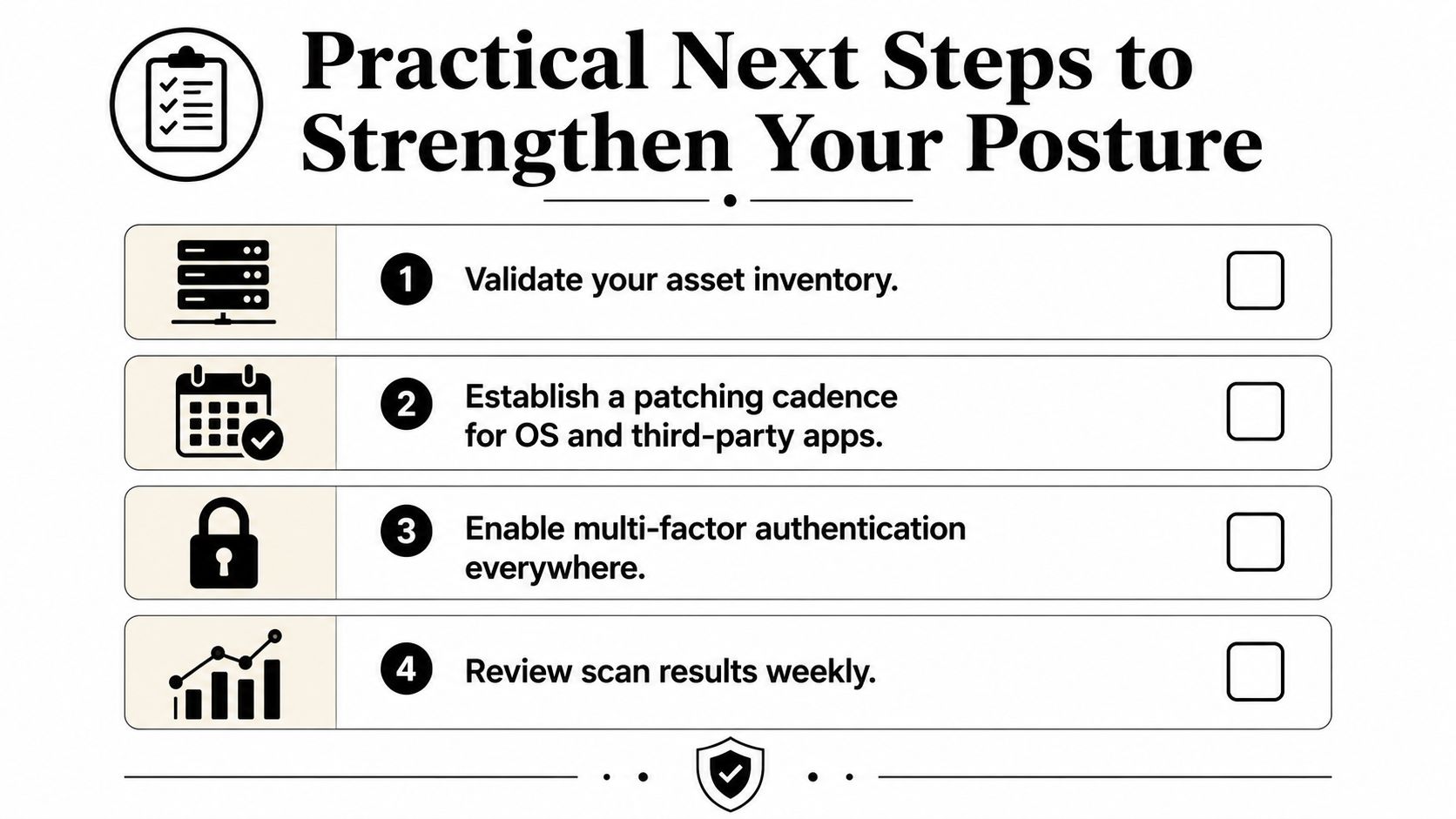
Start with the environment that actually exists
Validate the asset inventory against reality. Include remote laptops, cloud applications, network devices, servers, printers, externally reachable services, contractor access, and software that handles regulated or contract-sensitive data. Assign an owner and business purpose to each important asset.
Then establish a patching cadence for operating systems and third-party applications. Updates should move through a defined process that considers testing, maintenance windows, rollback options, and verification. A construction firm may need to coordinate around field systems, while a clinic may need to protect appointment and billing availability.
Reduce avoidable access exposure
Enable multi-factor authentication wherever the technology supports it, particularly for email, remote access, administrative accounts, cloud applications, and systems containing sensitive information. Review the external attack surface for forgotten portals, unused accounts, exposed services, and vendor connections.
Keep documentation aligned with actual operations. HIPAA, PCI-DSS, client contracts, and internal policies may require evidence of risk assessments, remediation, access controls, exceptions, and review activity. A short, accurate procedure is more useful than a lengthy policy that staff don't follow.
A practical operating rhythm can include a quarterly external scan, a monthly internal scan, and a weekly review of high-severity findings. These cadences are program design recommendations, not substitutes for risk judgment. High-risk systems or actively exploited weaknesses may require faster attention.
For organizations that haven't had an outside review, a free security audit or IT health check from a local DFW managed service provider can lower the barrier to starting. The owner should expect a clear inventory, prioritized findings, business impact, recommended actions, ownership, and an explanation of how follow-up verification will work.
Businesses also need to consider physical information handling. Guidance on how organizations can prevent data breaches with Reworx Recycling can complement technical controls by addressing equipment and records that leave the workplace.
Common Misconceptions and the Path Forward
Antivirus alone protects the business. Endpoint protection can detect and block some malicious activity, but it doesn't maintain a complete inventory, rank an exposed cloud application, or verify that a network appliance received the right update. Vulnerability management addresses weaknesses that protective software may not remove.
The cloud provider handles all patching. A provider may manage parts of the underlying service, while the customer remains responsible for accounts, configurations, applications, endpoints, integrations, and data access. The contract and shared-responsibility model need careful review.
A small business is too small to target. Attackers don't need to know the company's size before probing an exposed service, stolen credential, or outdated device. Automated activity can reach businesses that have never attracted personal attention from an attacker.
Compliance equals security. Compliance can establish useful requirements and evidence, but passing an audit doesn't prove that every asset is known or every weakness is closed. Security teams still need operational visibility between review periods.
Vulnerability management means running a scanner. Scanning is identification. The complete discipline includes assessment, prioritization, remediation, verification, reporting, and exception management. Without ownership and follow-up, a scanner can create awareness without reducing exposure.
The practical path forward is neither panic nor perfection. It's an exposure-first loop that starts with the systems the business depends on, applies defined response times, and verifies results. CISA's coordinated vulnerability disclosure process also illustrates the value of consistent collection, validation, mitigation coordination, and disclosure practices when organizations need to handle weaknesses responsibly.
For businesses that need more precise SLA design, the Government of Canada's guideline provides an example of a points-based model. It classifies scores of 40 to 50 points as Critical with action within 48 hours, 30 to 39 points as High with a 14-day window, 20 to 29 points as Medium with 30 days, and 1 to 19 points as Low with 90 days, as described in its vulnerability management guideline. A DFW SMB doesn't need to copy that model, but it can use the principle to connect risk categories with clear action and escalation.
Technovation LLC helps Dallas–Fort Worth businesses identify vulnerabilities, prioritize remediation, strengthen compliance readiness, and verify that security improvements hold across their environments. Business owners can visit Technovation LLC to request a conversation about a security audit, IT health check, or managed vulnerability program suited to their industry and available staff.