

The owner thinks the firm is fine because the core system is up, payroll ran, and no client called with a complaint. That is exactly how smaller financial firms in Dallas and Fort Worth get blindsided. The attack usually starts somewhere boring, like a vendor account, a forgotten remote access path, or a user who can still approve transactions with too much privilege. By the time anyone notices, the damage is already inside the business.
Cybersecurity for financial services is not about buying more noise. It is about protecting the pieces that keep money moving, client trust intact, and regulators off your back. For SMB banks, accounting firms, wealth managers, and payment processors, the problem is usually not a dramatic breach. It is the quiet gap between what the business assumes is controlled and what is monitored, reviewed, and recoverable.
Table of Contents
- The Hidden Reality of Financial Sector Cyber Risk
- Defining Your Protect Surface and Governance Framework
- Implementing Core Technical Controls and Zero Trust
- Mastering Detection Speed and Third-Party Vendor Risk
- Aligning Security with Compliance and Budgeting
- Building Resilience with Local Managed Expertise
The Hidden Reality of Financial Sector Cyber Risk
A DFW firm can look stable on the surface and still be one phishing click away from a real operational problem. One account manager opens a fake document, one vendor login gets reused, and suddenly someone is testing how far they can move inside the network before anyone notices. That is why the most dangerous assumption in this industry is that no obvious problem means no security problem.
The financial sector has been under pressure for a long time. The IMF's April 2024 Global Financial Stability Report says almost one-fifth of all reported cyber incidents over the past two decades affected financial firms, with banks hit most often, followed by insurers and asset managers, and it estimates about $12 billion in direct losses since 2004, including about $2.5 billion since 2020 IMF Global Financial Stability Report. That history matters because it explains why finance is treated as critical infrastructure and why resilience, incident response, and third-party controls are not extras.

A small firm doesn't need to match a global bank to be attractive. It just needs to hold useful data, connect to payment flows, or rely on a vendor that does. A practical way to challenge the comfort of “we're probably fine” is to use a board-ready security assessment template for directors and force a discussion around what is protected, who can reach it, and how fast the firm would know if access were abused.
Practical rule: If the security conversation only starts after a user complaint, the business is already operating in reaction mode.
The right mindset is simple. Security is part of business continuity, not a separate IT project. A firm that can't explain its critical systems, its access paths, and its recovery plan is not secure just because the inbox still works.
Defining Your Protect Surface and Governance Framework
Before anyone shops for new tools, the firm has to name what matters most. In financial services, the protect surface usually includes customer financial records, payment processing systems, core banking or trading applications, and the identity systems that control access to all of them. That list should be short enough to manage and specific enough to defend.
Start with the data, not the software. Catalog every place where customer PII, account data, and transaction records live, then trace where that data moves when staff upload, approve, export, or archive it. That exercise exposes the systems that deserve strict control, and it usually exposes a few that have been left out of the conversation entirely.
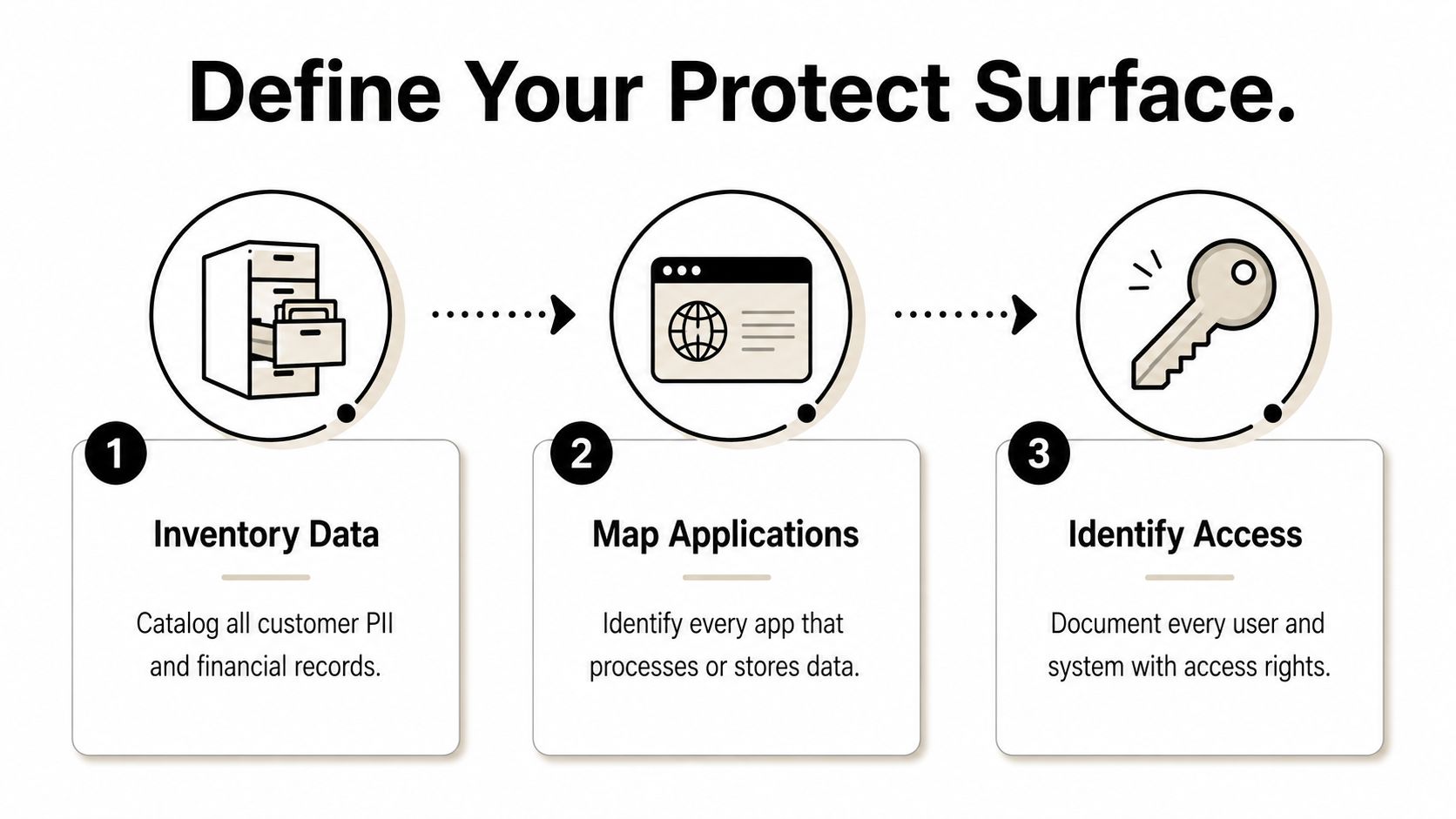
The reason this matters is governance. ENISA and PwC both emphasize continuous posture management, strong incident response, and cloud and SaaS governance, and PwC also recommends a cryptographic inventory to prepare for “harvest now, decrypt later” risk and post-quantum planning ENISA Finance Threat Landscape 2024. That means the owner, not just the technician, has to decide what is sensitive, who can approve access, and how exceptions are reviewed.
A clean governance framework should answer four questions:
- Who owns each critical system? Name a business owner, not just an IT contact.
- Who approves access changes? Make approval explicit for privileged and vendor access.
- What gets reviewed monthly? Focus on user access, logs, backups, and exceptions.
- What happens when policy is violated? If staff know nothing happens, the policy is theater.
The policy itself has to be usable. A binder full of rules that no one follows is just expensive shelf decoration. The controls that work are the ones tied to business routines, like client onboarding, payment approval, file sharing, and termination of access when someone leaves.
A well-run DFW financial firm should also use a framework to keep this from drifting. Technovation's overview of why frameworks like NIST matter beyond cybersecurity is useful because it connects security work to governance, continuity, and accountability instead of treating it like a technical side project. That is the right model for owners who need decisions they can enforce.
Implementing Core Technical Controls and Zero Trust
The fastest way to weaken a financial network is to give people broad access because it is easier. Convenience has to stop being the default. Multi-factor authentication, segmentation, endpoint protection, and encryption should all be in place, but they have to be configured around the protect surface identified above, not sprayed across the environment without a plan.
Build identity controls that assume accounts will be targeted
MFA is the baseline, not a differentiator. The stronger move is to restrict enrollment to authorized processes, verify identity carefully, and require phishing-resistant methods for sensitive roles wherever possible, especially for finance staff, admins, and remote access paths. When users can enroll devices or approve prompts without real control, attackers exploit the weakest human process, not the strongest policy statement.
Treat identity as the front door and the back office at the same time. If identity is weak, every other control has to work harder than it should.
Endpoint detection and response should cover the systems where users work, not just the obvious servers. Patch discipline, application control, and alert review matter more than branded promise language. If a laptop can run unapproved code, store stale files indefinitely, and sync sensitive data without oversight, it becomes a liability even if antivirus says it is clean.
Segment the network around business function
Network segmentation is not about building a complicated maze. It is about limiting what one compromised account can reach. A teller workstation, a payment system, a file repository, and a back-office admin portal should not sit in one flat trust zone, because flat networks let attackers move laterally with too little resistance.
A DFW financial firm should think in terms of access paths. Who needs to reach a core application, from where, and for how long? That question drives zero trust better than any product pitch. The article on what is network segmentation is a practical reminder that segmentation is a business control, not just a network diagram.
Use zero trust as a design rule, not a purchase order
ENISA's finance guidance is clear that zero trust should start with the protect surface, transaction flows, and the identities and APIs that truly need access ENISA Finance Threat Landscape 2024. That means no over-permissive access, no giant exception lists, and no pretending that one dashboard equals architecture. Zero trust fails when firms buy a label but keep legacy access habits.
Bottom line: verify each request, limit each path, and remove the access nobody can justify.
Technovation's managed approach to what is managed detection and response fits here because endpoint alerting, response discipline, and access review need human follow-through. Tools alone do not enforce architecture. People do.
Mastering Detection Speed and Third-Party Vendor Risk
The hardest truth in financial cybersecurity is that prevention can be solid and the firm can still lose because it finds out too late. The SWIF AI summary says financial firms have been reported to take an average of 233 days to detect and contain a breach, while also noting a 65% ransomware hit rate in 2024 and 52% of financial-services organizations paying ransom in one cited industry summary SWIF financial services cybersecurity statistics. That kind of delay turns a manageable incident into a business problem.
Detection speed is not a security luxury. It is the line between a suspicious login and a week of exposure in customer data, payment files, or file shares. If logs are scattered, alerts are ignored, and nobody owns response, the attacker gets time to explore the environment. That's where the loss gets expensive.
Fix the monitoring gap before it becomes a recovery gap
The monitoring stack should focus on the systems that touch money, identity, and records. Alerts need to be reviewed, triaged, and escalated by a process that tells staff what matters and what gets ignored. If the team cannot say which events trigger an immediate response, the environment is effectively self-blinding.
That is also why recovery testing matters. The Federal Reserve's 2025 report ties cyber resilience to incident coordination, operational recovery, and dependency management, because disruption can spread across connected institutions and service providers Federal Reserve cybersecurity report. A firm that only tests whether backups exist, instead of whether they can restore operations, is gambling on luck.
Treat third-party risk as an active control, not a vendor file
Third-party risk is the weak spot that SMBs keep underestimating. McKinsey found third-party management was the greatest capability weakness for 65% of respondents, which makes it the top cybersecurity gap in financial services McKinsey cyber clock insight. That lines up with the operational reality for smaller firms that rely on cloud services, fintech integrations, and outsourced support without enterprise-grade oversight.
The problem is not just onboarding diligence. It is continuous monitoring, contract enforcement, and incident coordination across a fragmented ecosystem. Annual questionnaires are too slow for a business that moves client money and stores regulated data. If a provider changes its controls, its sub-processors, or its attack surface, the financial firm needs to know.
A useful way to pressure-test that relationship is to review the dependency map, not just the contract. A practical AI Image Detector risk strategies resource can help frame the kind of questions that matter, even if the firm is not dealing with image workflows. The core idea is the same, know what the partner touches, who can reach it, and what happens when that partner fails.
Practical rule: If a vendor can disrupt client service or expose regulated data, that vendor belongs in the recovery plan, not just the procurement file.
Aligning Security with Compliance and Budgeting
Compliance should not be a separate lane from security. For a financial firm, GLBA and PCI DSS are easier to manage when the firm already knows its protect surface, access paths, and incident response routine. The controls line up cleanly when the business stops chasing checkboxes and starts mapping controls to actual operations.
| Control | GLBA | PCI DSS |
|---|---|---|
| MFA for sensitive access | Supports strong access control and reduced account abuse | Helps protect cardholder environments and privileged access |
| Network segmentation | Helps limit exposure of customer data and critical systems | Supports isolation of the cardholder data environment |
| Logging and alert review | Supports monitoring and response expectations | Supports detection and traceability in regulated environments |
| Incident response testing | Supports readiness and operational resilience | Supports response planning and validation |
| Vendor oversight | Supports third-party risk management | Supports control of connected service providers |
For a quick reference on card data requirements, a PCI DSS compliance guide can be useful when mapping card-related obligations to day-to-day controls. The point is not to chase the guide as a standalone project. The point is to tie payments, access, logging, and recovery into one operating model.
Budgeting gets easier when the firm spends against risk, not fear. PwC says financial services firms need to balance cybersecurity spend with regulatory requirements and innovation goals, while also pushing for continuous monitoring, third-party dependency mapping, and crypto planning PwC Digital Trust Insights for Financial Services. That's the budget conversation. Spend where the firm is exposed, not where the sales demo looked exciting.
Testing should be routine, not ceremonial. Penetration testing validates where the edges are weak. Tabletop exercises show whether the team can coordinate under pressure. If the incident response plan has never been exercised with staff who matter, it is not a plan, it is paperwork.
The cleanest approach is quarterly review of the highest-risk controls, followed by practical scenario testing tied to vendor failure, lost credentials, and backup restoration. That gives owners a way to verify progress without building an oversized security bureaucracy.
Building Resilience with Local Managed Expertise
A lot of SMB financial firms in DFW do not need a full in-house security operation. They need a managed model that keeps watch, tightens access, and responds fast when something looks off. That is where a local partner matters, because the firm needs someone who understands North Texas business patterns, regulatory pressure, and the reality of lean internal teams.
Technovation's co-managed IT support fits firms that already have some internal IT capability but need stronger security operations, policy follow-through, and continuity planning. The value is not in replacing the business team. It is in closing the gaps that internal staff usually cannot cover every hour of the week.
The best managed relationship is proactive. It starts with a security audit, a review of critical dependencies, and a hard look at alerting, backup integrity, vendor exposure, and access control. From there, the firm moves away from break-fix habits and toward a model where security supports service continuity instead of interrupting it.
For a financial owner, that is the outcome. Clients do not care how many tools exist. They care that their money, data, and service experience stay intact when the environment gets stressed.
Technovation LLC helps DFW financial firms tighten access, improve detection, and reduce third-party risk without building a bloated internal security team. Their team offers proactive monitoring, compliance-focused IT support, and practical risk audits that line up with the way financial businesses operate. Visit Technovation LLC to talk through a security plan that protects client trust and keeps the business running.