
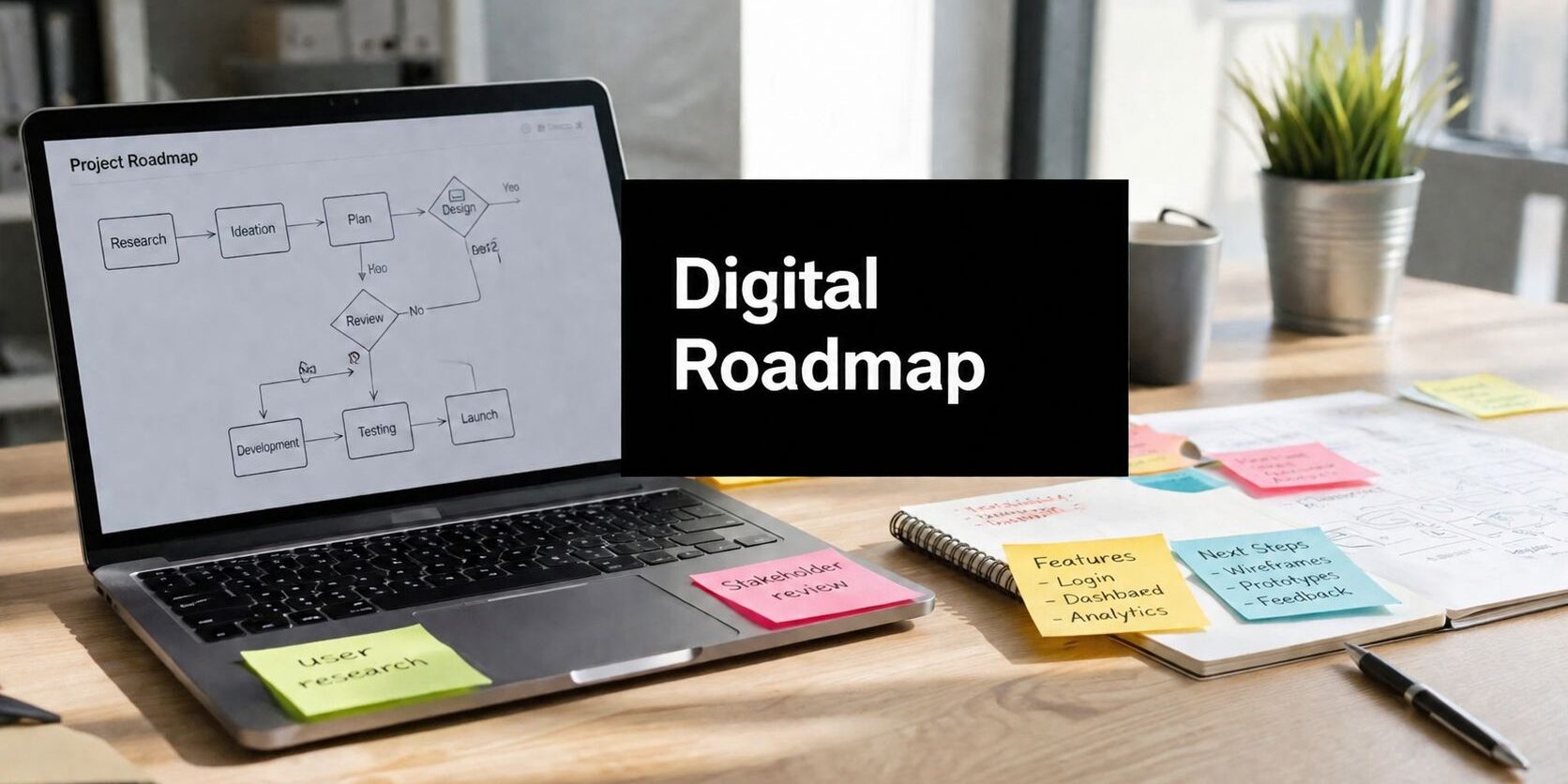
A lot of small business owners in healthcare, legal, and financial services are in the same spot right now. The team knows the business needs better systems, cleaner workflows, stronger reporting, and a practical way to use automation or AI. At the same time, nobody wants to trigger a compliance issue, disrupt staff, or create a security problem for a hybrid workforce.
That tension is exactly why a digital transformation roadmap matters. For a regulated SMB, the roadmap can't be a glossy strategy deck that treats compliance, access control, and employee adoption as cleanup work for later. It has to show what gets changed, in what order, who approves it, how risk is checked, and how the business keeps operating while the work happens.
Table of Contents
- Assess Your Foundation with a Practical Readiness Check
- Define Your North Star with Goals and Stakeholder Alignment
- Design Your Compliance-First Initiative Plan
- Fuel the Engine with Smart Budgeting and Success Metrics
- Execute with Confidence Through Change Management and Hybrid Security
- Turning Your Roadmap into Reality
Assess Your Foundation with a Practical Readiness Check
Readiness is broader than an IT audit. In a regulated business, it means understanding whether the current environment can support change without breaking operations, weakening controls, or frustrating staff into workarounds.
A good assessment works like a building inspection before a renovation. If the foundation is uneven, adding new layers only hides the problem for a while. That's why the assessment phase deserves discipline. According to AWS Executive Insights on mapping digital transformation, skipping the Assessment phase leads to misaligned initiatives and an average 40% increase in project costs due to unresolved legacy system incompatibilities.
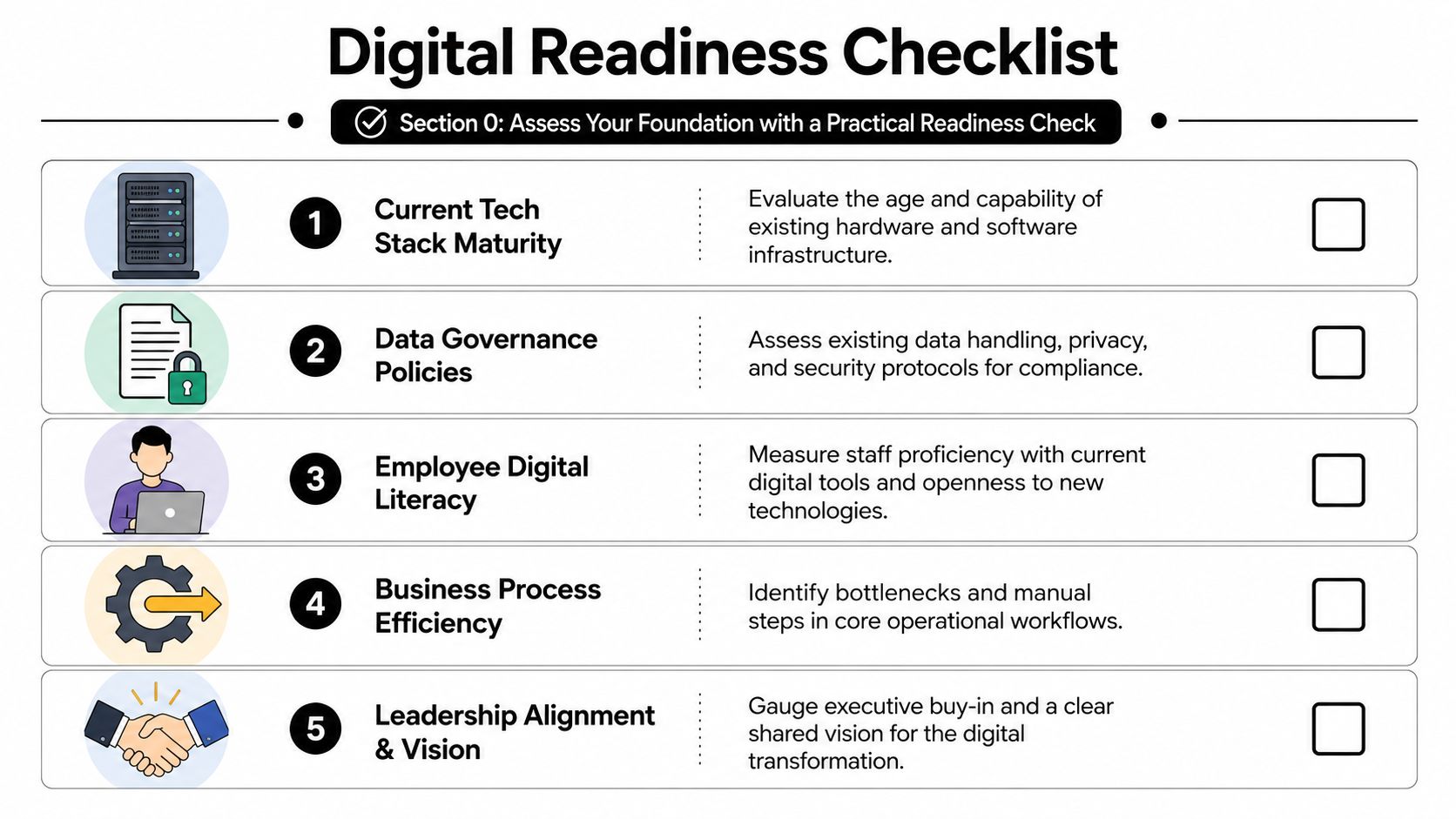
This visual gives a simple way to frame that starting point.
What readiness actually means
For a clinic, law firm, or accounting practice, readiness usually comes down to five questions:
- Can current systems support the next phase of work? Old line-of-business software, unsupported operating systems, and isolated databases create hidden friction.
- Are sensitive records governed properly? If teams can't clearly explain who can access which data, under what conditions, the roadmap already has a compliance gap.
- Where are manual processes slowing the business down? Intake, scheduling, approvals, document handling, billing, and reporting often reveal the best first opportunities.
- Will employees adopt the change? A technically sound rollout still fails if staff don't trust the process or don't understand the tools.
- Are leaders aligned on what problem gets solved first? If one department wants automation while another wants reporting and a third wants cloud migration, priorities drift fast.
For businesses dealing with aging platforms, an expert guide for engineering leaders can help frame modernization choices before the roadmap locks in the wrong assumptions.
Practical rule: Don't assess tools alone. Assess workflows, permissions, dependencies, and staff habits around those tools.
A five-part readiness check
A practical readiness review doesn't need to be bloated. It needs to be honest. This short checklist works well:
| Area | What to check | Why it matters |
|---|---|---|
| Technology | System age, support status, integration gaps | Reveals where new initiatives will hit compatibility walls |
| Data handling | Access rules, retention practices, auditability | Exposes compliance and privacy weaknesses early |
| Processes | Manual re-entry, bottlenecks, duplicate approvals | Identifies where automation can reduce drag |
| People | Digital comfort, training needs, resistance points | Prevents adoption issues from surfacing too late |
| Leadership | Shared priorities, risk tolerance, ownership | Keeps the roadmap from becoming departmental politics |
An assessment should also document known weak spots in remote access, backups, vendor dependencies, and approval workflows. Those details often look operational, but they shape the roadmap more than broad strategy language ever will.
Businesses that want a structured way to review those basics can benchmark their environment against an IT infrastructure assessment framework. The value isn't the paperwork. The value is reducing avoidable rework before money gets committed.
Define Your North Star with Goals and Stakeholder Alignment
Many digital initiatives stall for a simple reason. The business bought into technology before it agreed on the outcome.
A strong North Star isn't branding language. It's a decision filter. It tells leadership which projects matter, what trade-offs are acceptable, and what success looks like in operational terms. Without that filter, teams start optimizing for their own department instead of the business as a whole.
A vision that resolves conflict
The best goal statements are concrete enough to settle arguments. A regulated SMB doesn't need vague ambition. It needs a direction that ties service quality, control, and efficiency together.
According to Splunk's overview of digital transformation, successful digital transformations require five interconnected elements: People, Data, Insights, Action, and Results, and organizations lacking this alignment fail up to 70% of the time. That matters because many roadmaps still overfocus on software selection and underweight leadership behavior, data quality, and operational follow-through.
A useful North Star usually answers these questions:
- What business outcome matters most right now? Faster intake, fewer reporting errors, stronger audit readiness, better client response times, or reduced administrative burden.
- What must not be compromised? Privacy, evidence handling, billing integrity, segregation of duties, or document retention controls.
- What behavior has to change? More standardized data entry, fewer side-channel approvals, more secure remote access, or better use of shared workflows.
A short statement works better than a long manifesto. For example, a firm might align around a goal such as improving client service while standardizing data handling and tightening control over remote work. That kind of framing helps each department evaluate requests against the same business outcome.
Who needs to agree before anything changes
Alignment doesn't mean everyone gets everything they want. It means the right people agree on sequence, ownership, and success criteria before implementation begins.
In practice, the key stakeholders usually include:
- Owners or executives, who decide what level of risk and investment the business will accept
- Operations leaders, who know where work gets stuck
- Compliance or administrative leaders, who understand document, privacy, and reporting obligations
- Frontline managers, who can spot where a new workflow will succeed or fail
- IT leadership or external advisors, who can translate goals into realistic phases
A roadmap with weak stakeholder alignment usually becomes a collection of disconnected projects.
That's why the conversation should move beyond “What software should be purchased?” and into “What business problem is being solved first, and what has to be true for that change to stick?”
For owners thinking beyond the current quarter, a 2026 IT roadmap for enterprises can be useful reading because it highlights how planning choices affect future execution, governance, and scaling.
For SMBs that don't have internal strategic IT leadership, a virtual CIO service perspective can help create that alignment before project work starts. That step often prevents expensive decisions made in isolation.
Design Your Compliance-First Initiative Plan
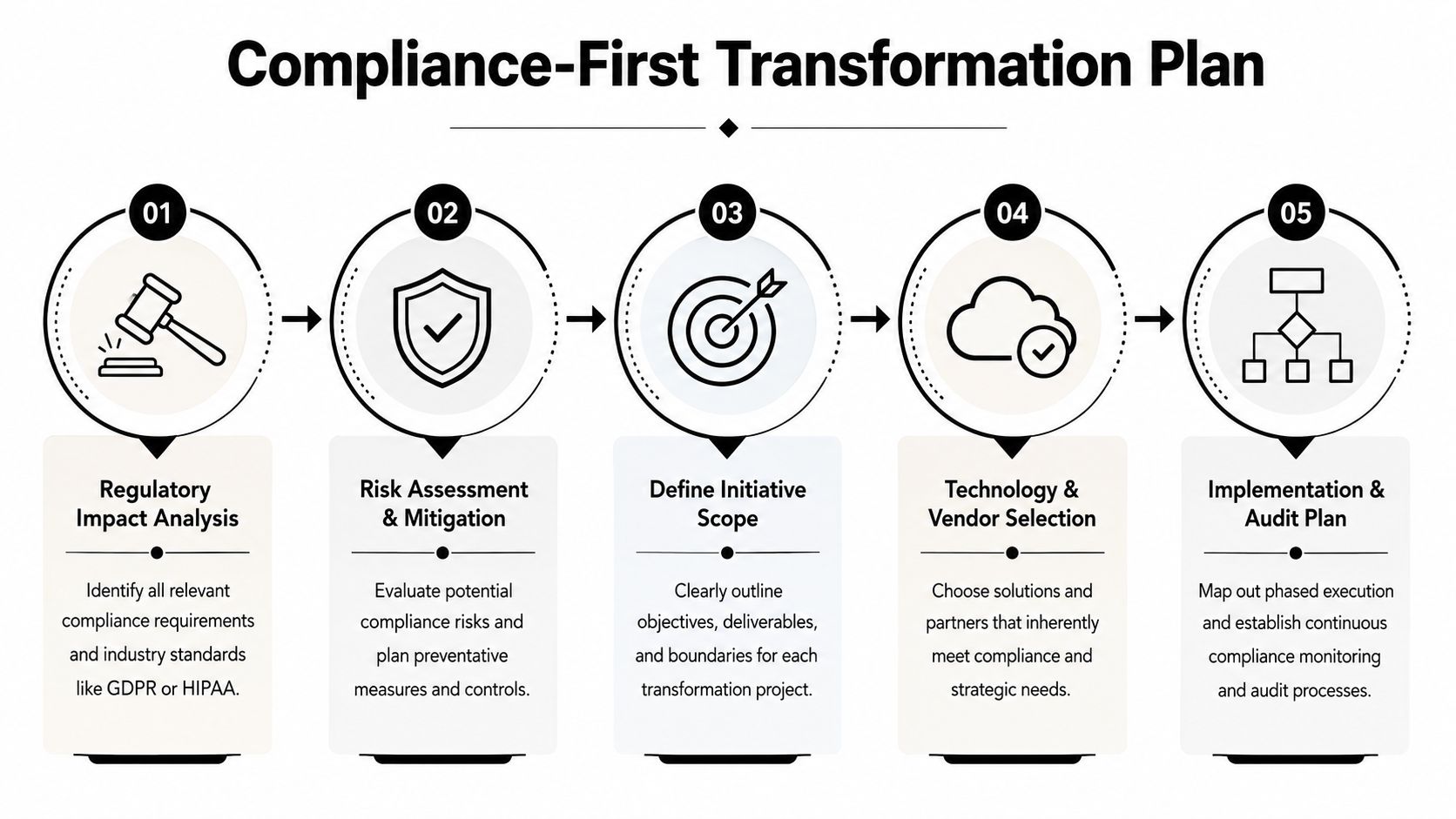
A digital transformation roadmap either becomes practical or starts becoming risky. Most SMBs don't struggle because they lack ideas. They struggle because they pile new initiatives into a timeline without embedding the approvals, policy checks, and control validation required to support them.
That's especially true in regulated industries. According to David Rogers' discussion of the DX roadmap, 68% of SMBs in regulated sectors delay transformation projects due to fear of violating HIPAA, PCI-DSS, or SEC rules. The same source notes that 42% of failed transformations in these industries stemmed from a mismatch between AI tool deployment and compliance audit cycles, not technical flaws.
That data points to a practical lesson. Compliance can't sit at the end of the project plan.
What to prioritize first
A compliance-first initiative plan should rank projects by a mix of business value, implementation effort, data sensitivity, and control impact. That changes the order of work.
For example, a low-risk workflow improvement with clear auditability may move ahead quickly. An AI-enabled document process touching protected information may need additional review even if the operational upside looks attractive.
A simple prioritization model works well:
- Start with business pain that's easy to verify. Repetitive intake steps, reporting bottlenecks, and manual approval chains often belong here.
- Separate low-risk automation from sensitive-data initiatives. Don't bundle them together just because both use new technology.
- Insert control gates inside the timeline. Vendor review, policy updates, access mapping, retention review, and testing should appear before launch, not after.
- Assign one owner for each initiative. Shared ownership usually means delayed decisions.
- Define the stop conditions. If a control test fails or a vendor can't support required safeguards, the project pauses.
A roadmap that follows this logic is much easier to govern than one that treats every item as a technology project.
A healthcare example that shows the difference
Consider a healthcare clinic that wants to adopt an AI scheduling assistant. A weak roadmap says: choose a vendor, connect calendars, train staff, go live.
A compliance-first roadmap looks different:
- Review data exposure first. What patient information will the tool process, store, or transmit?
- Map the workflow. Which employees use it, what systems it touches, and where approvals happen.
- Check privacy and security controls. That includes access boundaries, logging expectations, and retention rules.
- Time the rollout around compliance obligations. If an audit window or policy review is approaching, the launch plan should reflect that.
- Pilot with a controlled user group. Validate the workflow before broad adoption.
That sequence feels slower on paper. In practice, it usually reduces disruption because the clinic isn't backing into governance problems after staff have already changed behavior.
Compliance-first planning doesn't block innovation. It gives the business a safer order of operations.
For organizations tightening this part of the roadmap, a data security and compliance resource hub can help frame initiative sequencing around real control requirements instead of assumptions.
Fuel the Engine with Smart Budgeting and Success Metrics
A roadmap without a funding model is just a wish list. The budgeting mistake many SMBs make is treating digital transformation as a software line item when it's really a business change program with technical, operational, and human costs.
That means the budget has to cover more than licenses or subscriptions. It should account for implementation effort, process redesign, access control changes, training time, support overhead, temporary productivity dips, and the work required to retire or stabilize older systems.
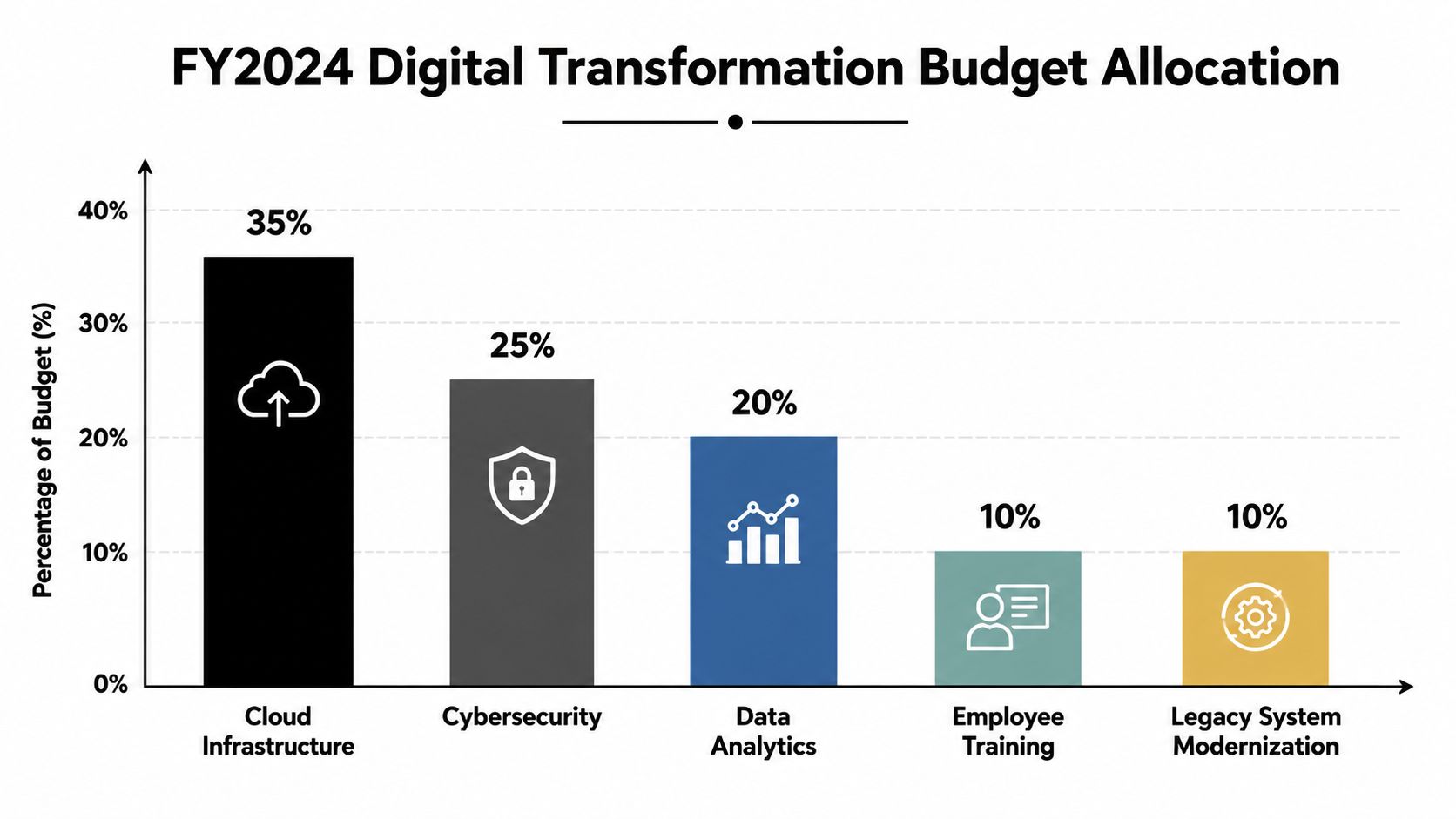
This kind of allocation thinking is easier to visualize than describe.
What a real budget includes
A practical SMB budget usually needs these categories:
- Core platform costs, such as infrastructure, application changes, and integration work
- Security and compliance controls, including logging, access management, backup, and policy-related improvements
- Training and adoption support, because staff won't absorb new workflows by memo alone
- Legacy stabilization or retirement work, which often determines whether the rest of the roadmap succeeds
- Measurement and reporting, so leadership can evaluate what's improving and what isn't
When owners review funding requests, they should ask two direct questions. First, what cost appears later if this line item is removed today? Second, what business result should improve if this spend is approved?
Those questions keep the roadmap anchored to outcomes instead of technical enthusiasm.
KPIs that prove the roadmap is working
Metrics should sit at the initiative level, not only at the program level. If the business is modernizing client intake, the KPI set should focus on intake quality, turnaround, error reduction, and staff effort. If the business is tightening hybrid access, the KPI set should focus on secure adoption, policy adherence, and support burden.
According to Kissflow's digital transformation statistics, linking Key Performance Indicators to each initiative makes progress measurable and connected to business objectives. The same source states that technology investments tied to roadmaps drove over 10% profit growth in 2023, up from 2.5% in 2022. That's the financial case for disciplined measurement. The roadmap works best when each initiative can show why it exists and how its value will be judged.
A useful KPI mix often includes:
| KPI type | Example focus |
|---|---|
| Operational | Cycle time, rework, backlog, manual steps |
| Compliance | Reporting quality, audit readiness, exception handling |
| Security | Access policy adherence, incident response workflow quality |
| Adoption | Usage consistency, training completion, workflow adherence |
| Business outcome | Client responsiveness, staff capacity, service quality |
Budgeting gets easier when each initiative has a business owner, a cost boundary, and a small set of outcome-based KPIs.
That approach also improves governance conversations. Leadership can decide whether to continue, adjust, or pause a project based on evidence instead of momentum.
Execute with Confidence Through Change Management and Hybrid Security
Execution is where roadmaps stop being theory. It's also where many businesses discover that adoption problems and remote access risks were never handled with enough rigor.
Two firms can buy similar technology and get very different outcomes. The difference usually isn't the tool. It's how the rollout was managed and whether hybrid security was treated as part of the deployment itself.
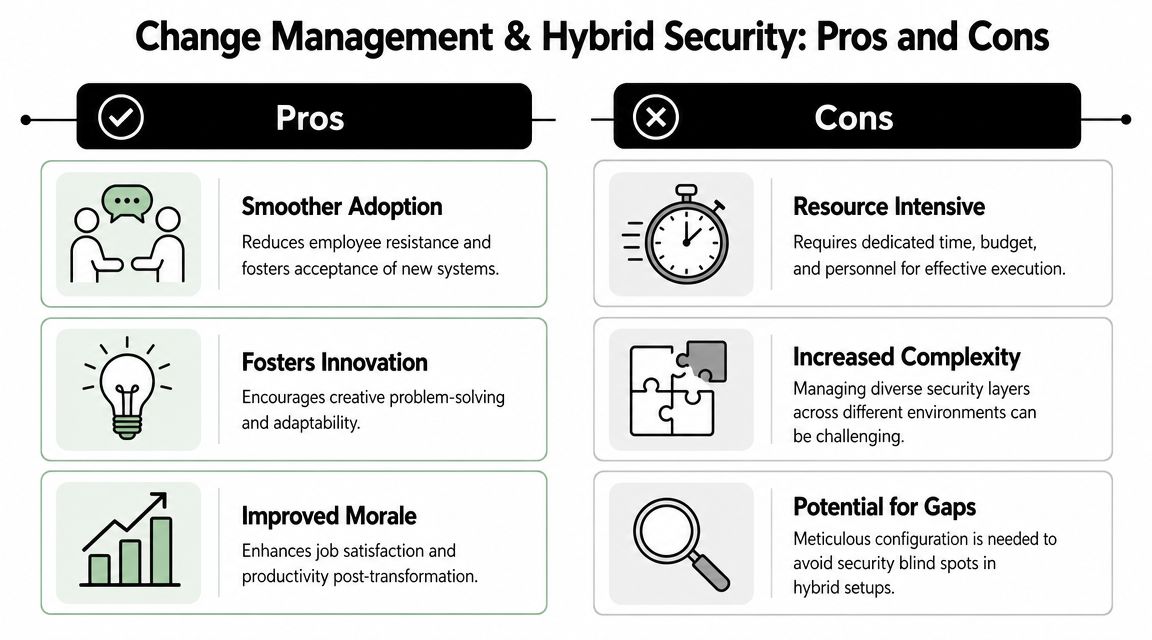
Two rollout stories with different outcomes
The first company launched a new workflow platform quickly. Leadership announced the change, sent login details, and expected teams to adapt. Managers were busy, training was brief, and exceptions were handled informally. Within weeks, staff had created side processes outside the approved workflow because they were trying to keep work moving.
The business didn't fail because the platform was unusable. It failed because nobody managed the human transition. Employees weren't shown how the new process would affect daily work, which old habits were no longer acceptable, or where to raise issues before frustration turned into workarounds.
The second company took a different path. It identified who would be most affected, ran targeted training, gave managers simple talking points, and gathered feedback during rollout. Early friction still appeared, but it was visible and fixable. Staff knew where to report process issues, and leadership reinforced the new way of working instead of tolerating exceptions indefinitely.
That's what change management does in practice. It shortens the gap between launch and stable adoption.
How hybrid security stays inside the rollout
Now add hybrid work to the picture. If employees access business systems from multiple locations, a roadmap has to include remote access design, endpoint controls, identity verification, and recovery planning as part of execution.
According to Nextiva's digital transformation roadmap article, a 2025 CISA report found that 54% of SMB cyber breaches in 2024 originated from unsecured remote access points. That's a roadmap issue, not only a security issue. When remote connectivity is treated as a side task, exposure grows while the business is expanding digital operations.
A stronger rollout includes these checkpoints:
- Before launch, confirm that remote users follow the same access standards as office-based users
- During pilot, validate endpoint controls and support workflows for offsite staff
- At broader rollout, monitor identity-related exceptions, failed access patterns, and unmanaged behavior
- After go-live, tighten any policy gaps staff exposed during real use
A business that wants to harden this layer should review how identity management services fit into access design, especially when multiple locations, contractors, or role-based permissions are involved.
Remote access is part of the business process now. It can't be secured as an afterthought.
Turning Your Roadmap into Reality
A digital transformation roadmap is most useful when it becomes a living operating guide. Not a one-time planning document. Not a stack of disconnected projects. A guide that helps the business decide what to change first, how to control risk, and when to adjust course.
That matters because digital transformation is hard to execute well. According to Mooncamp's digital transformation statistics, only 35% of companies succeed in achieving their digital transformation goals. The same source also notes that 63% of respondents saw improved performance, and that strategic tech investments drove over 10% profit growth in 2023. The message is straightforward. Success isn't common, but the upside is real for businesses that execute with discipline.
For regulated SMBs, the smart path isn't the fastest-looking one. It's the path that starts with readiness, aligns leadership around a clear destination, sequences initiatives with compliance built in, funds the work realistically, and rolls it out with attention to both employee behavior and hybrid security.
That's also why the roadmap should be revised as the business learns. A clinic may discover that intake automation should come before analytics. A law firm may realize document governance has to be cleaned up before broader collaboration changes. A financial services firm may find that access controls need attention before introducing more advanced automation. Those aren't failures. They're signs that the roadmap is doing its job.
The businesses that get this right don't chase transformation for its own sake. They use it to make service delivery cleaner, controls stronger, staff more effective, and growth more manageable.
Technovation LLC helps regulated businesses in North Texas turn roadmap ideas into controlled execution. For healthcare practices, law firms, financial firms, nonprofits, and other security-conscious SMBs, the team brings managed IT, cybersecurity, compliance support, remote access protection, and strategic planning into one practical partnership. Businesses that want a clearer view of their current risks and next steps can contact Technovation LLC for a free IT health check.