

Most business owners don't wake up thinking about switch lifecycles, backup integrity, or whether the office cabling can support the next round of wireless upgrades. They look at a simpler signal. The business appears to be working. Staff can log in, email is moving, and nothing is visibly on fire.
That's exactly why hidden infrastructure problems last so long.
A company can operate for years with slow file access, recurring Wi-Fi dead zones, undocumented cloud sprawl, aging servers, and backups nobody has tested recently. People adapt. They create workarounds. They stop reporting issues because they assume “that's just how the system is.” The result isn't a dramatic collapse. It's a slow tax on productivity, focus, and decision-making.
An IT infrastructure assessment changes that conversation. It treats technology the way a good owner treats the rest of the business, as an asset that should be inspected, measured, and aligned to future plans. It's less like a repair ticket and more like checking the foundation before adding a second floor.
Table of Contents
- Your Business Runs Fine Or Does It
- What Is an IT Infrastructure Assessment Really
- The Seven Core Components of a Thorough Assessment
- The Assessment Process From Kickoff to Roadmap
- Turning Your Assessment into a Business Action Plan
- Special Considerations for Regulated Industries
- When to Engage an MSP for Your Assessment
Your Business Runs Fine Or Does It
“Runs fine” is one of the most expensive phrases in business technology.
It usually means the visible systems are still operating. It doesn't mean the business is protected from avoidable downtime, wasteful support effort, or a costly upgrade surprise. A network can be stable enough for day-to-day work and still be one failed switch away from a bad week. Backups can exist and still fail a real recovery. Security tools can be installed and still leave major gaps in coverage.
A better way to think about infrastructure is the same way an owner thinks about a vehicle fleet. If nobody checks the engine, brakes, or tires because the cars still start, maintenance isn't being avoided. It's being delayed until the cost is larger and the disruption is worse.
Practical rule: If the business depends on technology to serve customers, process revenue, store records, or support employees, then technology needs scheduled review, not just reactive repair.
An IT infrastructure assessment gives leadership a current map of what exists, what's aging, what's underperforming, and what no longer matches the company's goals. That matters during growth, office moves, compliance preparation, mergers, hiring expansion, and cloud transitions. It also matters when none of those changes are happening, because steady operations can hide slow deterioration.
Business owners often resist assessments for understandable reasons:
- “Nothing seems broken.” Hidden inefficiency rarely announces itself clearly.
- “The team already handles IT.” Internal staff may know the environment well, but they don't always have time to step back and assess it objectively.
- “This sounds technical.” A good assessment translates technical conditions into business implications like risk, cost exposure, and planning needs.
The value isn't in producing another report that sits unread. The value is seeing the business as it actually operates today, instead of how everyone assumes it operates.
What Is an IT Infrastructure Assessment Really
An IT infrastructure assessment is often described as a review of systems, devices, and networks. That definition is accurate, but it's incomplete. A proper assessment is closer to a full property inspection before buying a building. The wiring matters. The foundation matters. The water damage behind the wall matters. The point isn't to criticize the property. It's to understand what's there before making financial commitments.
The same logic applies to business technology.
A company may rely on a mix of office hardware, cloud services, user devices, internet connectivity, backup systems, and security controls that were added over time by different people for different reasons. Without a formal review, leadership usually sees only the front end. Staff can log in, systems are available most days, and invoices still go out. What leadership doesn't always see is the technical debt underneath.
According to a widely cited infrastructure assessment benchmark, businesses waste an average of $4,072 per employee per year because of technology issues. For a 100-person organization, that could mean roughly $407,200 annually lost to avoidable downtime, slow systems, or support overhead if recurring issues aren't identified and corrected.
It's not a fault-finding exercise
That benchmark matters because it reframes the assessment. This isn't a technical scavenger hunt for minor flaws. It's a structured evaluation of hardware, software, networks, and overall performance that helps a business identify where money, time, and capacity are being lost.
A useful assessment answers questions like these:
- Where are employees losing time every week? Slow logins, unstable wireless coverage, or overloaded systems often look small in isolation and expensive in aggregate.
- Which parts of the environment are one failure away from disruption? Aging hardware, unsupported systems, and undocumented dependencies create concentration risk.
- What is the business paying for that it no longer needs? Cloud services, duplicate tools, and overbuilt capacity often stay in the budget long after the original need changed.
- Can current infrastructure support growth? A platform that works for today's staff may not support a new location, new application demands, or stricter client requirements.
The real output is clarity
The best assessments create a decision-quality map of the environment. They show what the business owns, what it depends on, how those pieces interact, and where priorities should sit.
A business owner shouldn't need to read switch logs or firewall settings to understand whether the company is exposed. The assessment should do that translation.
That's why the strongest IT infrastructure assessments don't stop at inventory. They connect technical conditions to operational outcomes. If a server is old, the issue isn't merely age. The issue is whether a failure would interrupt billing, scheduling, collaboration, or customer service. If internet connectivity is poorly designed, the issue isn't just topology. It's whether employees can keep working when a provider outage hits.
A checklist can tell a company what exists. A real assessment tells leadership what it means.
The Seven Core Components of a Thorough Assessment
A serious review doesn't look at one layer of the environment in isolation. It checks the technology stack the way an operations leader would inspect a supply chain, from the assets themselves to the policies that govern them.
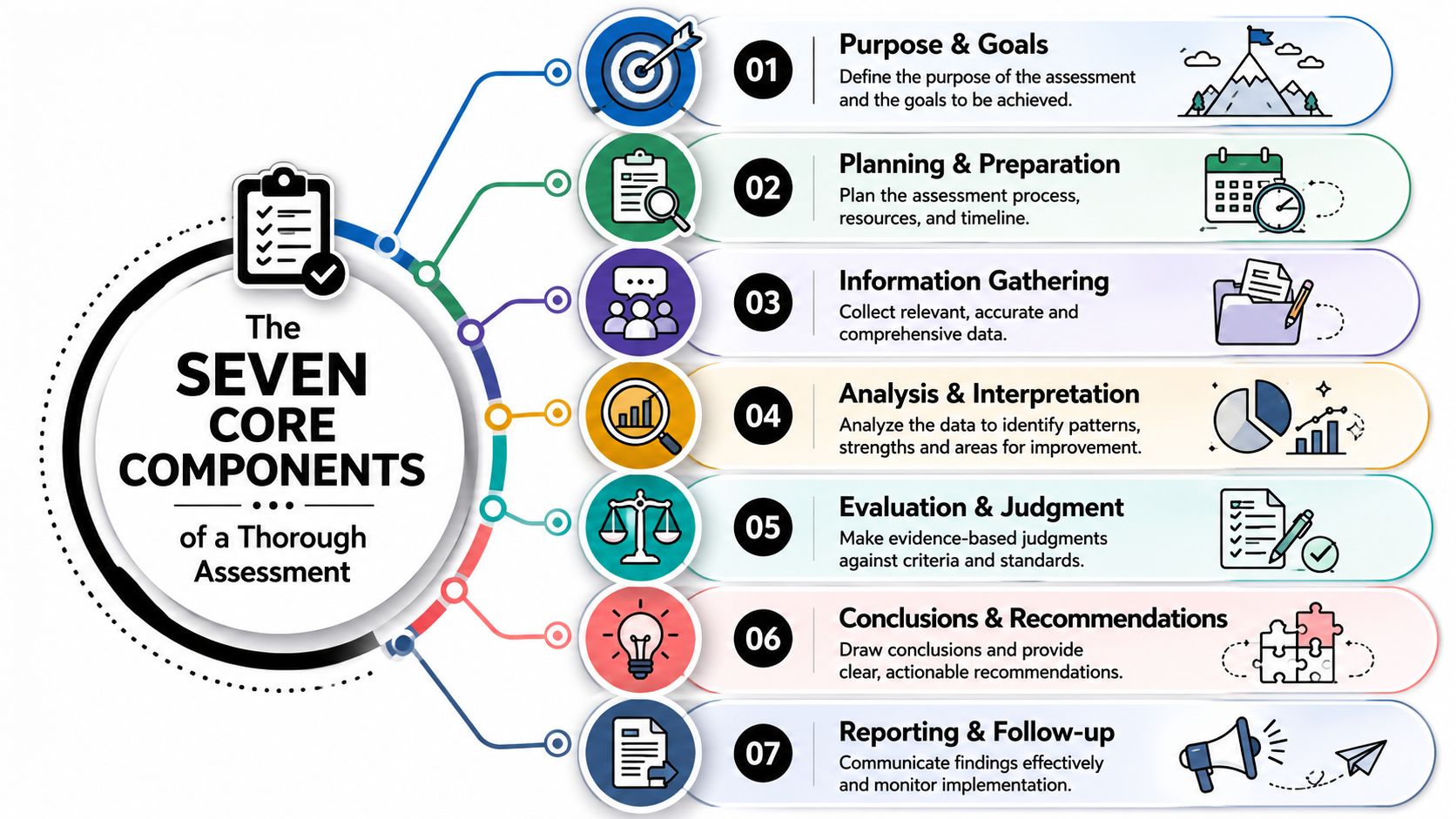
What a complete review must cover
Hardware inventory and lifecycles
Every assessment should identify what equipment is in service, where it sits, what role it plays, and whether it's still supported. Aging devices create a budgeting problem before they create a technical problem. If key systems are nearing end of support, the business needs a replacement plan instead of a rushed purchase during an outage.Network and connectivity
This is more than internet speed. The review should examine switching, wireless coverage, segmentation, redundancy, and choke points. Poor network design shows up as dropped calls, laggy applications, and staff frustration. Businesses that operate across multiple cloud environments should also understand best practices for multi-cloud because complexity grows quickly when services spread across platforms.Endpoints and mobile devices
Laptops, desktops, tablets, and phones are where users experience IT. If endpoints are unmanaged, outdated, or inconsistently configured, support effort rises and security weakens. That's one reason many firms include endpoint and network review together within broader networked IT services.Cloud services and spending
Most businesses don't have a single cloud footprint. They have a collection of file platforms, software subscriptions, hosted apps, backup repositories, and identity integrations. A good assessment identifies overlap, idle spend, access gaps, and services that nobody clearly owns.
What gets missed in weak assessments
Some assessments stay at a surface level. They inventory devices, run a scan, and produce a generic list of recommendations. That's not enough.
The remaining core areas often separate a useful assessment from a forgettable one:
| Component | What gets reviewed | Business risk if ignored |
|---|---|---|
| Security and threat posture | Access controls, endpoint protections, network exposure, account hygiene, alerting practices | Higher likelihood of disruption, unauthorized access, and expensive incident response |
| Backup and disaster recovery | Backup coverage, retention, restore practicality, dependency mapping | False confidence. Data may be backed up but not recoverable in the way the business needs |
| Compliance and policies | Documentation, control alignment, access rules, handling procedures | Audit stress, contract problems, and gaps between written policy and daily practice |
Weak assessments describe technology. Strong assessments describe consequences.
The difference matters. A business owner doesn't need a long list of device names. The owner needs to know which issues threaten continuity, which ones waste money, and which ones can wait. That's the point of assessing the full environment instead of chasing one symptom at a time.
The Assessment Process From Kickoff to Roadmap
The process feels less intimidating when it's understood as a managed project with defined phases. A solid IT infrastructure assessment isn't a single scan and a quick summary. It moves from discovery, to analysis, to reporting, with each step adding context.
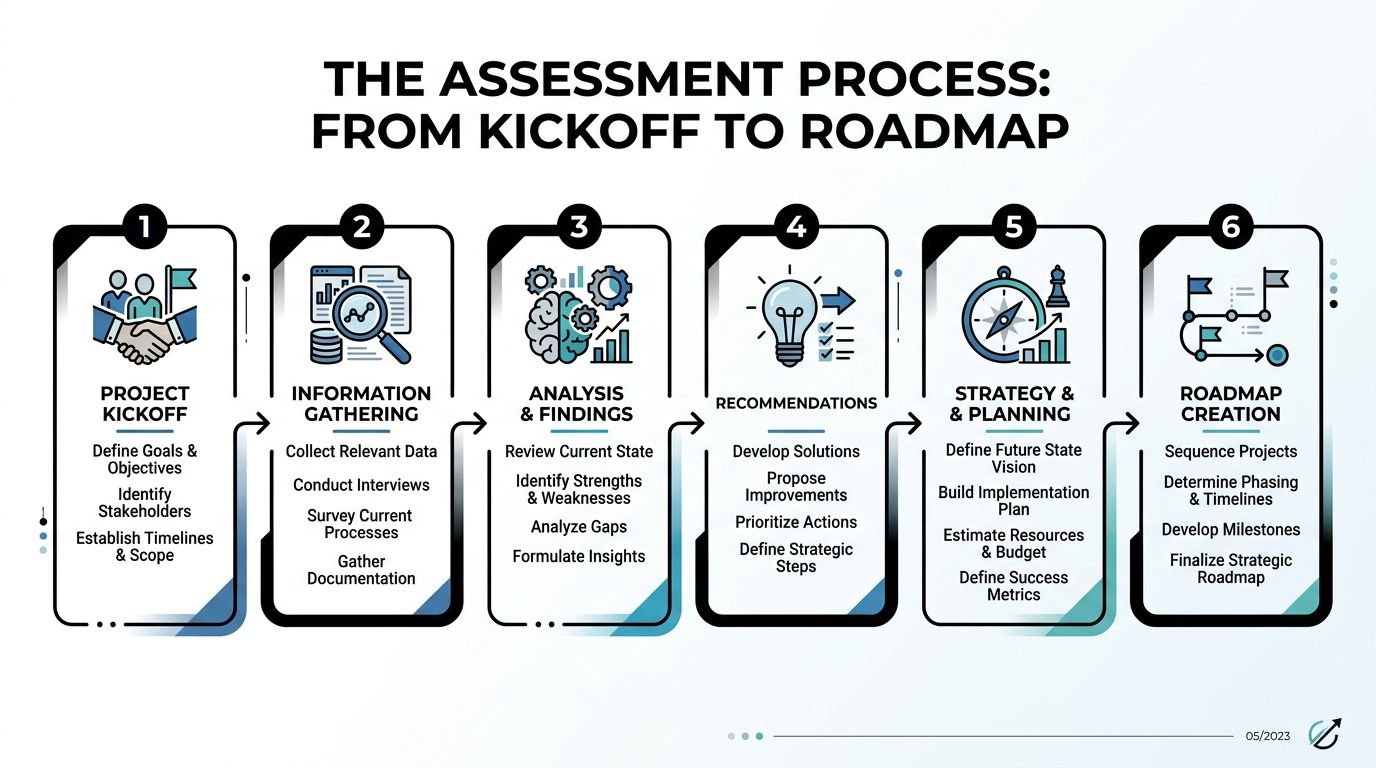
Discovery starts with evidence
Discovery should gather both technical data and operational context. That usually includes system inventories, configuration review, account and access mapping, cloud usage review, backup status, and conversations with the people who rely on the environment every day.
That human layer matters. Leadership may describe one business priority, while department managers reveal another. Finance may care about software sprawl. Operations may care about recurring slowness. Clinical or legal staff may care about access reliability and data handling. The assessment should capture all of that, because infrastructure only makes sense in relation to business use.
A rigorous process also goes deeper than software-level review. According to technical guidance on infrastructure assessment depth, documentation should include cabling diagrams, cable-test pass/fail results, PoE capacity, fiber backbone integrity, and the age/support status of every switch, server, and endpoint. That same guidance notes that flagging hardware older than five years creates a practical trigger for replacement planning.
That's an important distinction. Many firms say they assessed the network when they really reviewed only logical settings. Physical-layer validation is different. It looks for hidden fragility in the wiring and hardware foundation that supports everything above it.
Analysis and reporting should lead to decisions
Once the facts are collected, analysis should compare the current environment against business needs. That means identifying where risk is concentrated, where performance is limited, where support effort is inflated, and where technology no longer matches growth plans.
A useful reporting package usually includes:
- An environment summary that gives leadership a readable picture of the current state
- A findings register that lists issues, dependencies, and observations
- Priority ratings that separate urgent remediation from scheduled improvement
- A roadmap that sequences next steps by business impact and practicality
Good reporting doesn't overwhelm leadership with technical detail. It organizes complexity so decisions can be made confidently.
A provider can be useful in a practical way. For example, Technovation LLC performs site assessments around device configuration and operating environment as part of broader IT planning, which fits naturally into this discovery-to-roadmap model for organizations that need an external review.
The final deliverable shouldn't feel like a document dump. It should feel like a plan the business can act on.
Turning Your Assessment into a Business Action Plan
An assessment becomes valuable when leadership can use it to decide what to fix, what to defer, and what to fund. That sounds obvious, but many reports fail at this point. They describe technical conditions in detail and leave the owner to infer the business meaning.

Read findings through a business lens
A server issue, by itself, is just a server issue. The useful question is what that server supports and what happens if it fails. The same logic applies to an undocumented integration, noisy alerts, unnecessary cloud spend, or monitoring that isn't tied to service expectations.
According to guidance on making assessments executive-ready, the key value is turning the assessment into an executive decision tool by quantifying business impact, prioritizing tradeoffs, and converting findings into a board-ready roadmap tied to outcomes like downtime risk and user impact.
That guidance is especially relevant for owners who don't want a report full of technical shorthand. A better way to read the findings is through a simple matrix:
| Priority level | What it usually means | Leadership question |
|---|---|---|
| Critical | High impact and urgent exposure | What must be addressed now to reduce immediate business risk? |
| High | Serious issue, but manageable in a planned window | What should be funded in the next operating cycle? |
| Medium | Worth fixing, but not before larger risks | Can this be grouped into a broader upgrade or policy change? |
| Low | Improvement opportunity | Is this better handled during future standardization? |
A technical finding should always be translated into plain business language. “Unsupported switch firmware” becomes “higher outage and security exposure at a key office location.” “SLO mismatch” becomes “monitoring says the system is healthy even when users are experiencing delays.”
Build a phased roadmap
The best action plans don't try to fix everything at once. They separate the work into phases so the business can move without creating budget shock or operational churn.
A practical roadmap often follows this pattern:
- Stabilize now: Address issues that threaten continuity, access, or recoverability.
- Standardize next: Reduce inconsistency across devices, accounts, and configurations.
- Modernize later: Replace aging systems, redesign weak architecture, and align technology to growth plans.
For leadership teams that need help tying technical choices to budgeting and business strategy, a virtual CIO service can provide that translation layer between the report and the actual decisions.
An assessment report should answer three questions clearly: what matters now, what can wait, and what the business gains by acting.
That's when the assessment stops being an audit artifact and starts functioning as a management tool.
Special Considerations for Regulated Industries
A generic review can miss the issues that matter most in regulated environments. The infrastructure may look acceptable from a general operations standpoint and still fail the test that matters, whether that's protecting patient records, preserving confidential legal files, or controlling access to financial data.
Healthcare legal and finance need different lenses
A healthcare practice needs an assessment that maps systems, access, backup handling, and data flows to healthcare obligations. The concern isn't only uptime. It's how protected information is stored, transmitted, accessed, and recovered when something goes wrong. A clinic that wants to prepare seriously should work from a healthcare-specific framework such as this HIPAA risk assessment checklist.
A law firm has a different exposure profile. Client confidentiality, document retention, matter access, remote work controls, and secure communication channels become central. The assessment should look closely at who can access what, how data leaves the firm, and whether convenience has slowly outpaced control.
Financial firms and accounting practices face their own pressures. Sensitive records, payment-related workflows, internal approvals, and audit expectations all raise the stakes. Infrastructure choices that seem minor in another industry can become significant when they affect chain of custody, data integrity, or access logging.
Generic checklists create blind spots
The problem with one-size-fits-all assessments is simple. They produce the comfort of activity without the confidence of relevance.
A regulated business should expect an assessment to ask industry-specific questions such as:
- What data types require tighter handling?
- Which systems support regulated workflows directly?
- Where does third-party access create oversight gaps?
- Do written policies match daily employee behavior?
Compliance isn't a side layer placed on top of infrastructure. It shapes what the infrastructure must do, how it must be managed, and what evidence the business needs to retain.
That's why regulated organizations shouldn't settle for a broad technical review alone. They need a review that understands the legal, contractual, and operational context around the technology.
When to Engage an MSP for Your Assessment
Some businesses can handle routine infrastructure reviews internally. Others reach a point where outside perspective becomes the smarter choice. The signal usually isn't one dramatic event. It's a pattern: recurring issues, unclear ownership, pending compliance pressure, or a major change on the horizon.
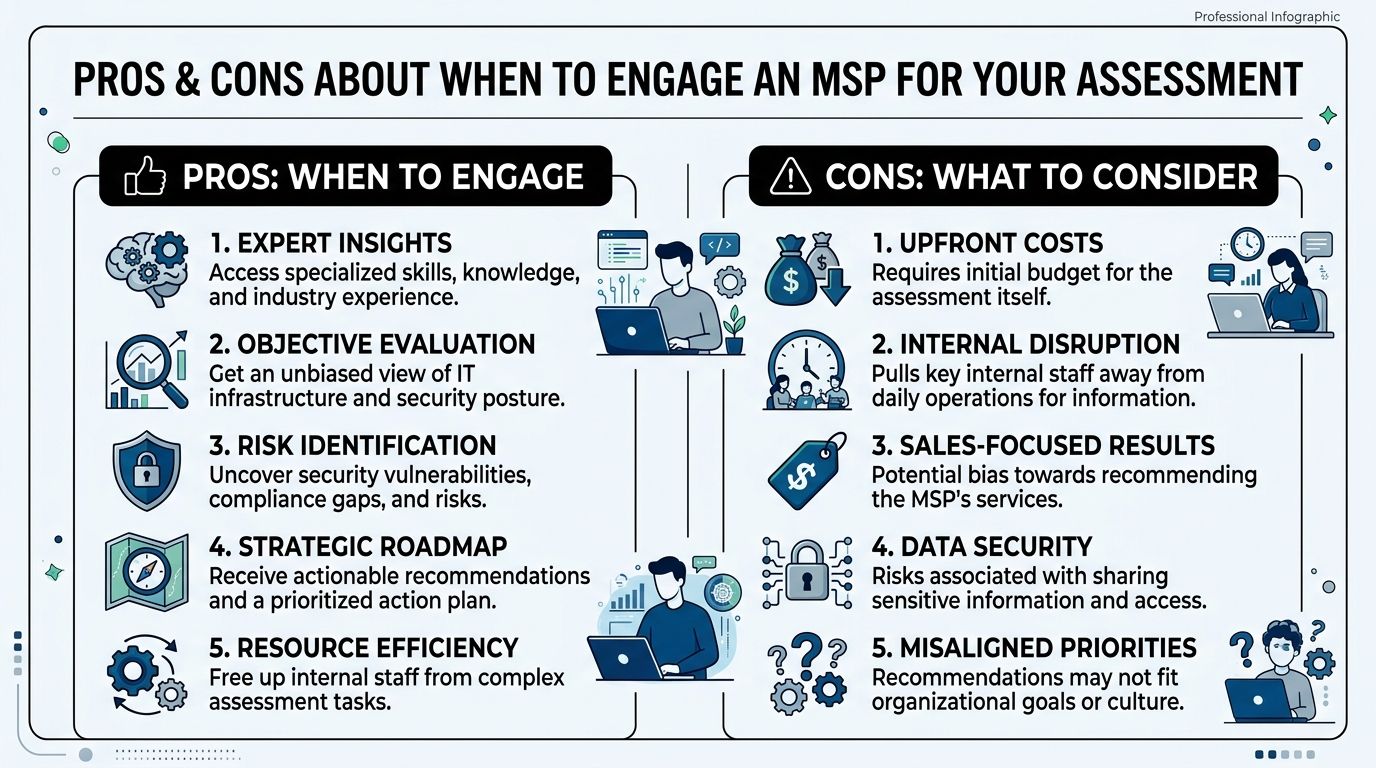
Signs an outside assessment makes sense
An MSP-led assessment is often worth considering when any of these conditions apply:
- Audit pressure is approaching: If the business needs better documentation, control mapping, or evidence preparation, outside structure helps.
- Problems keep recurring: Repeated slowness, unexplained outages, or support noise usually point to deeper design or lifecycle issues.
- The business is changing: Office relocations, mergers, cloud shifts, and hiring expansion tend to expose weaknesses in existing infrastructure.
- Internal IT is too close to the environment: Internal teams often know the systems well, but an outside review can surface assumptions, blind spots, and deferred risks.
- Leadership needs objective prioritization: Owners often need someone to separate “important someday” from “fix this quarter.”
Operational visibility also plays a role. Businesses evaluating service partners may find it helpful to understand how privacy-first analytics for MSPs can support environment insight without adding unnecessary exposure.
What the investment usually looks like
For a 50 to 200 employee business, a formal IT infrastructure assessment typically takes 2 to 4 weeks and costs $5,000 to $25,000, according to 2026 assessment guidance for SMB environments. That same guidance states that multi-site environments add 1 to 2 weeks, and regulated industries such as HIPAA, CMMC, and PCI-DSS can add 25% to 50% more time because of documentation and control mapping requirements.
Those ranges matter because they help owners evaluate the work realistically. A serious assessment is not a same-day checklist. It's a structured project. It also shouldn't be judged only as an expense. If the process identifies avoidable waste, unsupported infrastructure, recovery gaps, or compliance weaknesses before they become emergencies, the business gains planning control.
For owners deciding whether to bring in outside help, this guide on how to choose a managed service provider is a useful place to start.
The right time to engage an MSP is before the business is forced into rushed decisions. Assessment work is most valuable when leadership still has options.
Technovation LLC works with North Texas organizations that need more than a technical checklist. The firm provides cybersecurity, compliance, and business IT support for regulated and security-conscious environments, including healthcare, legal, financial, and general business operations. For companies that want an IT infrastructure assessment translated into a practical roadmap for risk reduction, budgeting, and growth, Technovation LLC is one option to consider.