
Most business owners ask the wrong question. They ask which antivirus to buy. The better question is whether the business can detect, contain, and recover from a compromised laptop before that one device turns into downtime, data exposure, or a compliance problem.
That distinction matters more in regulated SMB environments across Dallas Fort Worth. A clinic, law firm, accounting office, or construction company doesn’t just need software that blocks known malware. It needs endpoint protection that fits day-to-day operations, supports audits, and works even when the internal IT bench is thin. That’s where many “best endpoint protection for business” articles fall short. They compare features, but they ignore staffing, reporting, coverage gaps, and response discipline.
A practical buying decision starts with one truth. Endpoint protection is no longer a background utility. It’s a business control.
| Endpoint protection approach | Best fit | Main strength | Main risk if mishandled | Operational reality |
|---|---|---|---|---|
| Traditional antivirus or basic EPP | Very small environments with low complexity | Blocks common known threats | Misses deeper visibility and containment needs | Easy to buy, easy to overestimate |
| EPP plus EDR | SMBs that need prevention and investigation | Better detection, isolation, and response on endpoints | Alert volume and tuning can overwhelm staff | Strong middle ground for many regulated businesses |
| Broader XDR-aligned approach | Businesses with hybrid work, cloud apps, and higher compliance pressure | Wider visibility across security layers | Complexity rises fast without expert oversight | Best when tied to a managed operating model |
Table of Contents
- Is Your Antivirus Enough to Protect Your Business in 2026
- Understanding Your Endpoint Protection Options EPP EDR and XDR
- How to Choose the Right Endpoint Protection for Your Business
- A Comparison of Leading Endpoint Protection Platforms
- Why Your Endpoint Protection Tool Needs a Human Expert
- Endpoint Security in Action for DFW Regulated Industries
- Take the Next Step to Secure Your Business Endpoints
Is Your Antivirus Enough to Protect Your Business in 2026
For most SMBs, the honest answer is no.
Traditional antivirus still has value, but it was built for a narrower problem. It was designed to recognize known bad files and stop them. Modern attacks don’t always arrive as obvious malware. They use compromised logins, malicious scripts, living-off-the-land activity, and quiet lateral movement from one device to another. A business can have antivirus installed and still have no clear way to see what happened, what spread, and what needs to be isolated.
That gap is dangerous because the endpoint is where attackers often start. According to Palo Alto Networks’ endpoint security overview, endpoints are identified as the entry point for 72% of cyberattacks, and Verizon’s Mobile Security Index analysis cited there found that 70% of successful data breaches originate at endpoint devices. For a business owner, that means the laptop in the field, the front-desk workstation, and the remote employee’s home computer are part of the security perimeter now.
Why the old mindset fails
Many companies still think in terms of “server security” and “office network security.” That model is outdated. Staff work from home, connect from client sites, use mobile devices, and rely on cloud systems all day. The endpoint is where those activities converge.
A single unmanaged or weakly protected device can create problems that aren’t just technical:
- Operational disruption because staff lose access to files, apps, or shared systems
- Compliance exposure if regulated data sits on a compromised workstation
- Management distraction because leadership has to stop normal work and manage the incident
- Client trust damage when customers learn the business lost control of a device or account
Practical rule: If a business depends on endpoints to access client data, financial systems, patient records, or legal documents, endpoint security belongs in the same category as backup, access control, and disaster recovery.
What “enough” looks like now
Good protection now combines prevention with visibility and response. Businesses should expect behavioral detection, continuous monitoring, automated containment options, and useful reporting. They should also expect coverage across every business endpoint, not just executive laptops or a few “important” machines.
Antivirus alone isn’t the standard anymore. It’s only one layer in a broader control.
Understanding Your Endpoint Protection Options EPP EDR and XDR
Most confusion in endpoint security comes from acronyms. The concepts are simpler than the marketing.
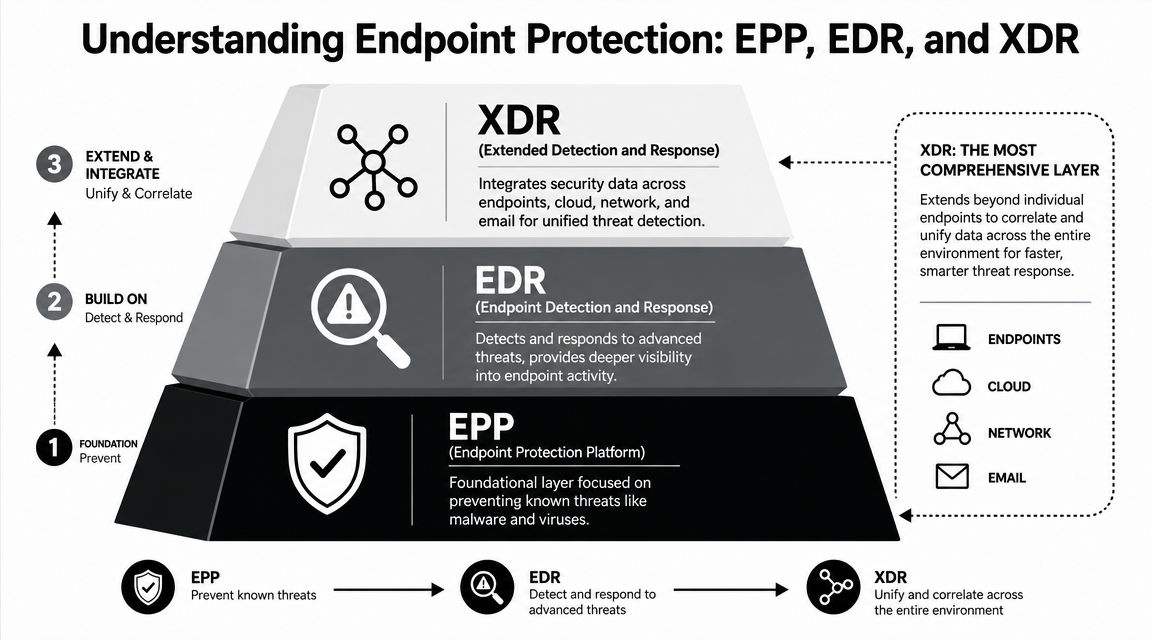
A useful way to think about the best endpoint protection for business is this. EPP locks the doors. EDR adds cameras and incident review. XDR ties the whole building together so the alarms, doors, devices, and surrounding systems can be analyzed in one place.
What EPP does well
Endpoint Protection Platform, or EPP, is the prevention layer. It focuses on stopping known threats and suspicious activity before damage spreads. That usually includes antivirus, anti-malware, policy controls, and other baseline protective functions.
For some small businesses, EPP is the first serious step beyond consumer antivirus. It’s better managed, more business-focused, and often easier to enforce across company devices. But it still leans heavily toward prevention.
That matters because prevention is necessary, not sufficient.
Where EDR changes the game
Endpoint Detection and Response, or EDR, adds visibility after something suspicious starts happening. It helps security teams investigate device behavior, trace malicious activity, and isolate compromised systems before one infected machine becomes a bigger incident.
Modern endpoint security becomes operationally useful. A regulated SMB doesn’t just need to know that something bad was blocked. It needs to know:
- Which device triggered the alert
- What user activity or process was involved
- Whether the threat spread or stayed contained
- What evidence exists for internal review or compliance follow-up
According to SentinelOne’s overview of endpoint security products, independent business-market comparisons in 2026 consistently separate products into single-agent XDR/EDR platforms and traditional antivirus or endpoint protection suites. That distinction is important because it reflects a real shift from signature-based blocking to deeper detection and response for post-exploitation activity.
Businesses that buy only for “malware blocking” often discover too late that they also needed investigation, containment, and reporting.
When XDR makes sense
Extended Detection and Response, or XDR, goes wider. It correlates security data across endpoints and other parts of the environment so teams can spot patterns that a single device view might miss.
For a DFW SMB with hybrid work, cloud applications, remote access, and multiple user types, XDR can be useful because incidents rarely stay confined to one device. An endpoint alert may connect to unusual authentication activity, suspicious email behavior, or broader environmental signals.
That said, XDR isn’t automatically the right answer for every company. If the business lacks the staff or partner support to manage it well, more data can just mean more noise. The right fit depends on operating model, not just features.
How to Choose the Right Endpoint Protection for Your Business
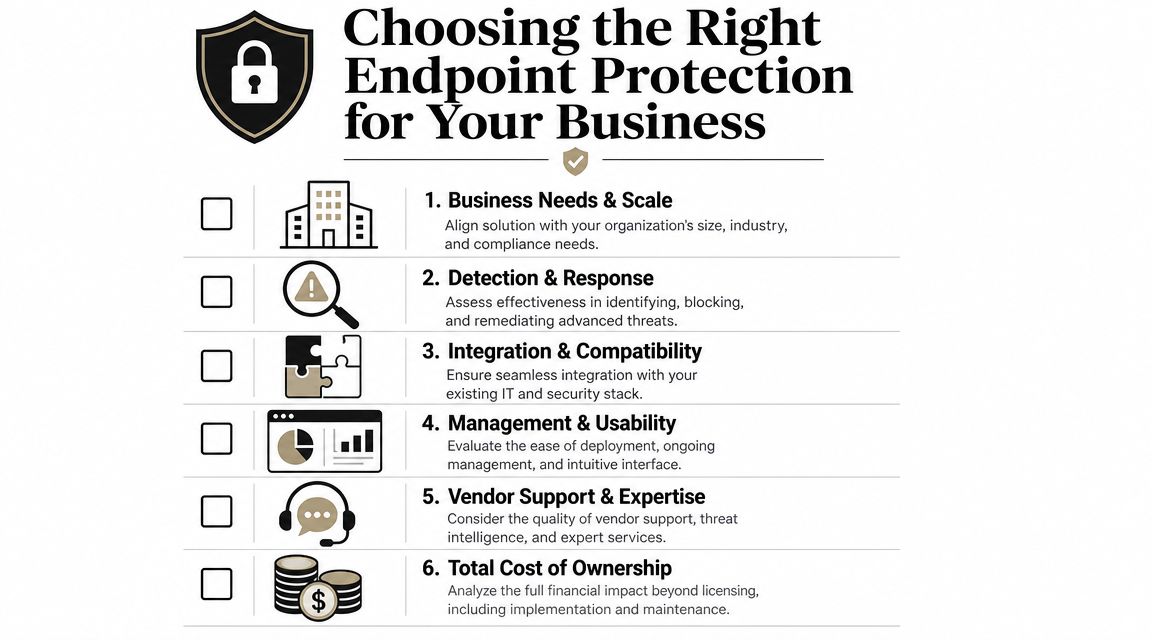
Most businesses shouldn’t choose endpoint protection by brand familiarity or feature overload. They should choose it by fit. The right platform is the one the company can deploy broadly, operate consistently, and use during a real incident without confusion.
Start with business exposure
A ten-person office handling public information has different needs than a twenty-person clinic dealing with patient records or a law firm working with confidential client files. The first filter should be operational and regulatory exposure.
Buyers should ask:
- What data sits on endpoints. Sensitive records, financial files, case notes, or project documents raise the stakes.
- How people work. Remote work, travel, field access, and BYOD increase management complexity.
- What happens if one laptop is isolated for a day. Some businesses can absorb that. Others can’t.
One of the most overlooked decisions is scope. According to SentinelOne’s business endpoint protection guidance, a key best practice is deploying protection everywhere, not only on “important” systems, to avoid coverage drift. That point is more important than many feature debates. Partial deployment creates blind spots, and attackers don’t politely choose the devices leadership already protected.
Judge management burden honestly
A platform can look excellent in a demo and still be wrong for the business.
Some tools are built for teams with internal security analysts. Others are better for lean environments that need automation, straightforward policy control, and clear response workflows. The question isn’t whether the software is powerful. The question is whether someone will maintain it, review alerts, tune exclusions, investigate suspicious behavior, and document actions.
A useful evaluation framework looks like this:
| Decision area | What to ask |
|---|---|
| Detection quality | Can the platform detect suspicious behavior, not just known bad files |
| Deployment model | Can the business roll it out to every endpoint without leaving gaps |
| Daily administration | Who handles policy changes, exceptions, alert review, and device isolation |
| User impact | Will staff experience noticeable friction or slowdown |
| Reporting | Can leadership and compliance teams get usable evidence without manual scrambling |
Operational test: If the business can’t explain who responds to an after-hours endpoint alert, it hasn’t finished choosing a solution.
Treat compliance reporting as a buying criterion
Regulated SMBs often treat reporting as an afterthought. That’s a mistake. When a compliance review, client questionnaire, or internal audit arrives, teams need evidence that endpoint controls are deployed, monitored, and enforced.
The best endpoint protection for business in regulated sectors isn’t just good at blocking threats. It also supports accountability. That means device coverage visibility, alert history, response records, policy status, and a management process someone can defend in plain English.
Price matters. So does software design. But for many DFW SMBs, operational fit and compliance fit matter more.
A Comparison of Leading Endpoint Protection Platforms
Business owners often search for a simple winner. That’s the wrong goal. There isn’t one best platform for every SMB. There are only better fits for different operating realities.
The most useful way to compare leading endpoint protection platforms is by approach, not by vendor branding. That keeps the focus where it belongs: business requirements, staffing model, and risk tolerance.
What buyers should compare first
AV-TEST’s January to February 2026 business Windows endpoint evaluation assessed 15 endpoint protection products across protection, performance, and usability, with a maximum score of 18 points. That matters because it reinforces a practical lesson. Security teams shouldn’t buy on detection claims alone. They should also look at user impact and day-to-day operability.
The table below compares the three broad profiles most SMB buyers end up considering.
| Feature | SentinelOne | CrowdStrike Falcon | Microsoft Defender for Business |
|---|---|---|---|
| Typical platform class | Single-agent EDR/XDR-style platform | Single-agent EDR/XDR-style platform | Business endpoint suite with broader Microsoft ecosystem alignment |
| Best fit | Lean teams that want strong automation and rapid containment | Security-mature environments that want deep visibility and investigation depth | SMBs already standardized on Microsoft operations and management workflows |
| Operational style | Heavier emphasis on automated response | Heavier emphasis on analyst-driven investigation and control depth | Strong fit when identity, device management, and productivity stack already align |
| Main buying question | Does the business want more autonomous containment | Does the business have enough expertise to use advanced telemetry well | Does the business want tighter integration with existing Microsoft administration |
| Potential challenge | Advanced capabilities still need disciplined tuning and review | Powerful platform can become underused without skilled oversight | Can feel limited if the business expects one tool to solve every security need |
| Good for regulated SMBs | Yes, if paired with strong operational ownership | Yes, if paired with mature incident handling | Yes, especially in standardized Microsoft-heavy environments |
Where each approach tends to fit
A more automation-forward platform often suits SMBs that need speed and don’t have time for constant manual intervention. That can work well in environments where the same small IT team handles support tickets, patching, vendor management, and security at once.
A deeper investigation-oriented platform tends to fit co-managed environments or businesses with stronger security resources. It can produce excellent visibility, but value depends on whether someone will interpret and act on that information.
An ecosystem-aligned business suite usually fits organizations that already run much of their IT through one administrative model. That can simplify policy alignment and user management, especially for companies trying to reduce tool sprawl.
No matter which route a business takes, the buying mistake is the same when it happens. Leadership buys a powerful endpoint tool and assumes the purchase itself solved the problem. It didn’t. Coverage, tuning, monitoring, response, and reporting determine whether the investment pays off.
Why Your Endpoint Protection Tool Needs a Human Expert
The software matters. The operating discipline matters more.

Many SMBs buy advanced endpoint protection and then manage it like old antivirus. They install the agent, glance at dashboards occasionally, and assume the platform will handle everything on its own. That’s not how modern endpoint security works.
A strong platform still needs tuning
According to Info-Tech’s 2026 endpoint protection enterprise rankings, top endpoint products are evaluated as enterprise-grade platforms, with scores such as 9.0 for ThreatDown EDR and 8.8 for CrowdStrike, and capability scores such as 9.3, 8.9, and 9.1 among leading entries. The lesson isn’t that a buyer should chase a leaderboard. The lesson is that these are serious platforms with serious management demands.
They need policy design. They need alert tuning. They need exclusions that don’t create blind spots. They need someone to decide when to isolate a device, when to escalate, and how to document the event.
That’s why the question isn’t “Which tool is best?” It’s “Who is driving it?”
Tools create alerts but people create outcomes
A business owner doesn’t buy endpoint protection because they want a dashboard. They buy it because they want outcomes:
- Fast containment when a workstation behaves suspiciously
- Clear decision-making when an alert appears after hours
- Less noise so staff don’t ignore real issues
- Defensible records when auditors, clients, or leadership ask what happened
Without human review, even a good platform can create two bad results. It can drown a small team in false positives, or it can sit by while no one validates whether important alerts were handled correctly.
A managed operating model solves that problem. It gives the business a defined process for monitoring, triage, escalation, and response. It also helps leadership understand what they’re paying for. They aren’t just buying software. They’re buying the ability to use it well.
For businesses weighing that model, managed detection and response services provide a useful framework for understanding how expert monitoring, investigation, and action turn endpoint tooling into an actual security function.
Software blocks some threats. People decide what the business does next, how fast it acts, and whether the incident stays small.
Endpoint Security in Action for DFW Regulated Industries
The best endpoint protection for business looks different when real work enters the picture. Regulated SMBs in DFW don’t operate in a lab. They deal with front-desk turnover, remote staff, shared files, line-of-business applications, and auditors who expect evidence.
Healthcare and legal environments
A medical practice in Fort Worth may have exam-room workstations, billing laptops, and mobile devices used by staff moving throughout the day. In that setting, endpoint protection has to do more than prevent malware. It has to support documented control, rapid isolation if something looks wrong, and reporting that helps the practice prepare for compliance conversations without scrambling.
A law firm in Dallas faces a different pattern. Attorneys and staff work across email, document repositories, remote access tools, and confidential case files. If a user opens a malicious attachment or works from an unmanaged device, the problem quickly becomes a client trust issue. The right endpoint approach gives firm leadership visibility into device coverage, suspicious behavior, and response history, not just a green check mark.
Financial firms and mixed-device teams
Accounting firms, wealth advisors, and other finance-related businesses often deal with a mix of office systems, remote access, and sensitive financial records. Endpoint security in these environments has to support policy consistency and data protection while staying usable during busy periods.
That’s especially true when the business is juggling compliance expectations from clients, carriers, or regulators. Firms that need a broader view of protecting sensitive financial information can also review data protection strategies for financial services to see how endpoint security fits into a larger control framework.
One more local reality matters. Many DFW SMBs run mixed environments with company-owned devices, occasional BYOD use, and staff who travel between office, client site, and home. That’s exactly where endpoint strategy stops being a technical checkbox and becomes an operating model decision.
Take the Next Step to Secure Your Business Endpoints
Business owners don’t need another generic security checklist. They need a clear next move.
The right endpoint protection decision starts with an honest review of current coverage, response readiness, and compliance fit. If the company can’t quickly answer which devices are protected, who reviews alerts, how suspicious endpoints get isolated, and what documentation exists for audits or client reviews, the environment needs attention.
A practical action plan
A useful path forward is straightforward:
-
Inventory every business endpoint
Include laptops, desktops, remote devices, and any system that accesses business data. -
Verify protection scope
Confirm that coverage is consistent across the environment, not limited to a handful of high-profile devices. -
Review response ownership
Identify exactly who receives alerts, who investigates them, and who has authority to contain a device. -
Test compliance usefulness
Check whether current tools produce reporting leadership can use during audits, questionnaires, or internal reviews. -
Decide on the operating model
Determine whether the business has the internal capacity to run modern endpoint security well or needs expert support.
The most expensive endpoint tool is the one a business pays for but can’t operate properly.
DFW SMBs in healthcare, legal, financial services, construction, and other security-conscious sectors usually don’t need the flashiest platform. They need one that matches their risk profile, staff capacity, and compliance obligations. That’s what separates a smart investment from a shelfware subscription.
Technovation LLC helps Dallas Fort Worth businesses turn endpoint protection into a managed, defensible security program. For organizations that need clearer coverage, stronger compliance alignment, and practical expert support, Technovation LLC offers free security audits and IT health checks that identify gaps before they become business problems.