
A Business Associate Agreement (BAA) is a HIPAA-required written contract between a covered entity and any vendor that creates, receives, maintains, or transmits protected health information on its behalf, and without it, that vendor cannot lawfully touch PHI. The agreement turns a vendor relationship into a defined compliance responsibility, not an informal promise to keep patient information safe.
A Plano dental practice may discover the problem while moving patient records into a cloud EHR. A Southlake managed service provider may find it while configuring a new client's email environment and realizing that patient intake forms sit in employee mailboxes. In both cases, the technology may be secure, but the contract relationship can still be incomplete.
Table of Contents
- What a Business Associate Agreement Really Means for Your Business
- Who Actually Needs a BAA and Who Does Not
- Key Clauses Every BAA Should Contain
- Breach Notification Timelines and What to Expect
- Real-World BAA Scenarios for DFW Healthcare and SMBs
- A Practical BAA Review Checklist Before You Sign
- Turning the BAA Into a Working Compliance Control
What a Business Associate Agreement Really Means for Your Business
A BAA is the written agreement that governs a covered entity's relationship with a business associate. HHS explains that covered entities and business associates generally must enter into contracts requiring appropriate safeguards for PHI, defining permitted uses and disclosures, preventing unauthorized redisclosure, and assigning HIPAA duties to the business associate. The HHS business associate guidance also makes clear that the obligation applies when a vendor creates, receives, maintains, or transmits PHI on behalf of a covered entity or another business associate.
That definition gives a clinic owner a practical test. The question isn't whether a vendor calls itself a technology company, consultant, receptionist service, or records company. The question is whether the vendor performs a function for the practice that involves PHI.
Practical rule: A vendor's security webpage doesn't replace a signed BAA. The contract is what defines the vendor's legal duties in the relationship.
The document matters operationally because it answers questions that become urgent during an incident. Who may access the information? Which uses are allowed? Must the vendor notify the clinic about an unauthorized disclosure? Does the vendor have to bind subcontractors to equivalent obligations? What happens to stored information after termination?
A small practice should treat the BAA as a vendor-risk decision tool, not as paperwork to file after a purchase. Before production data moves, the practice can use the agreement to compare the vendor's actual services with the data path, identify unaddressed access, and reject vague terms. A signed BAA doesn't make a weak environment compliant, but the absence of a required BAA leaves a basic contractual control missing.
A DFW owner reviewing healthcare technology can start with HIPAA compliance guidance for healthcare organizations and then build a vendor inventory. Each entry should identify the data involved, the vendor's role, the systems it can reach, whether subcontractors are involved, and where the signed BAA is stored.
Who Actually Needs a BAA and Who Does Not
The clear cases are easy. A cloud hosting provider storing patient records, an EHR platform processing clinical information, a billing or clearinghouse service handling claims, a document destruction company receiving paper charts, an e-signature platform storing intake forms, and an outsourced IT partner with access to systems containing PHI generally belong in the BAA review.
The difficult cases involve indirect or incidental access. An MSP may only manage endpoints, yet still inherit access to email accounts containing lab orders. A transcriptionist may work remotely and receive dictated encounters. An answering service may collect patient names and appointment details. A backup provider may retain legacy files even though staff rarely retrieve them.
HHS's test focuses on the vendor's function and relationship with the covered entity. A vendor that creates, receives, maintains, or transmits PHI on the entity's behalf generally requires a BAA. A janitorial crew or electrician that encounters a file randomly, without being engaged to handle PHI, is different. That access may be incidental rather than part of the service relationship.
| Vendor Relationship | BAA Required? | DFW Example |
|---|---|---|
| Cloud storage or hosting that retains PHI | Yes | A clinic stores patient records in a hosted environment |
| Outsourced billing or claims processing | Yes | A physician group sends patient and payer information for billing |
| IT support with access to PHI systems | Usually yes | An MSP administers accounts, devices, backups, or email |
| Document destruction service handling charts | Yes | A home-health agency sends patient files for destruction |
| E-signature service storing completed forms | Usually yes | A med-spa retains signed intake documents online |
| Janitorial or electrical service with random exposure | Usually no | A worker briefly sees a chart left in an office |
| Service with no PHI access | No | A contractor works only on nonclinical facilities |
A practice seeking staffing support for front-desk operations can review resources such as hire a dental receptionist while separately checking whether the proposed service will receive patient information. The staffing label doesn't decide the BAA question. The workflow does.
The common mistake is trusting a vendor's “HIPAA-ready” marketing page. A practice needs a signed agreement that covers the actual service, not a general statement about security.
Key Clauses Every BAA Should Contain
A non-lawyer should be able to open a BAA and identify the contract's working parts quickly. HHS publishes sample business associate provisions, and the agreement should connect its definitions and obligations to 45 CFR §164.504(e) rather than relying on broad language about “confidential information.”
The scope and permitted uses
The opening provisions should identify the covered entity, the business associate, the effective date, the services, and the PHI involved. The permitted-use clause should say that the vendor may use or disclose PHI only to perform the contracted services, satisfy legal duties, or follow documented instructions from the covered entity.
The agreement should also prohibit unauthorized redisclosure, sale of PHI, and marketing use unless the law and required authorization permit the activity. “Service improvement” is too broad when it could allow unrelated analytics, product development, or secondary use.
Safeguards and downstream responsibility
A usable safeguard clause should require administrative, physical, and technical safeguards aligned with the HIPAA Security Rule. That should connect to real controls such as access management, workforce procedures, secure configuration, logging, backup protection, and incident response.
Subcontractor language needs equal attention. A business associate should promise that downstream vendors handling PHI will accept equivalent restrictions and safeguards. The agreement should also identify how the primary vendor remains accountable for the chain, rather than leaving the clinic to discover unknown subcontractors after an incident.
A contract review platform such as Best AI Contract Generator may help organize draft language and review questions, but automated drafting isn't a substitute for checking whether the clauses match the actual data flow.
Patient rights, incidents, and termination
The BAA should require the business associate to help the covered entity provide access to PHI, amend records, and account for disclosures. It should require the vendor to make relevant information available for compliance obligations and to report impermissible uses, disclosures, and breaches.
The termination section should permit action for a material violation and require the vendor to return or destroy PHI when the relationship ends, subject to legally required retention. The agreement should explain what happens to backups, archives, and data held by subcontractors.
Contract warning: A BAA that is silent on subcontractor liability or gives the vendor a one-year breach clock isn't a BAA a small practice can rely on.
The agreement should also be reviewed beside the service contract. A BAA may promise narrow PHI use while the master agreement grants broad rights to analyze customer data. Any conflict needs resolution before the vendor receives production information. A data protection clause review can help connect the BAA to the broader contract language.
Breach Notification Timelines and What to Expect
The breach clause should work like a calendar, not a vague promise to notify “promptly.” HHS states that when a business associate discovers a breach of unsecured PHI, it must notify the covered entity without unreasonable delay and no later than 60 days from discovery. HHS also explains that a business associate may submit a breach report on behalf of a covered entity in some circumstances. The governing HHS breach notification guidance should be part of the practice's response planning.
“Discovery” means the point at which the business associate knows, or by exercising reasonable diligence should know, that an incident may have involved PHI. A vendor shouldn't wait until every forensic question is resolved before alerting the covered entity. The initial notice should identify what is known and what remains under investigation.
The first communication should include:
- Discovery date: When the vendor identified or reasonably suspected the event.
- Information involved: The categories of PHI and the affected systems or records.
- Current scope: What the vendor knows about affected individuals, files, accounts, or locations.
- Mitigation: Containment, credential changes, restoration, evidence preservation, and other steps already taken.
- Named contact: A person responsible for ongoing coordination with the practice.
A covered entity has its own notification responsibilities, including decisions about affected patients and HHS reporting. The BAA should support that work by requiring fast preliminary notice, continuing updates, cooperation with the risk assessment, and access to relevant evidence.
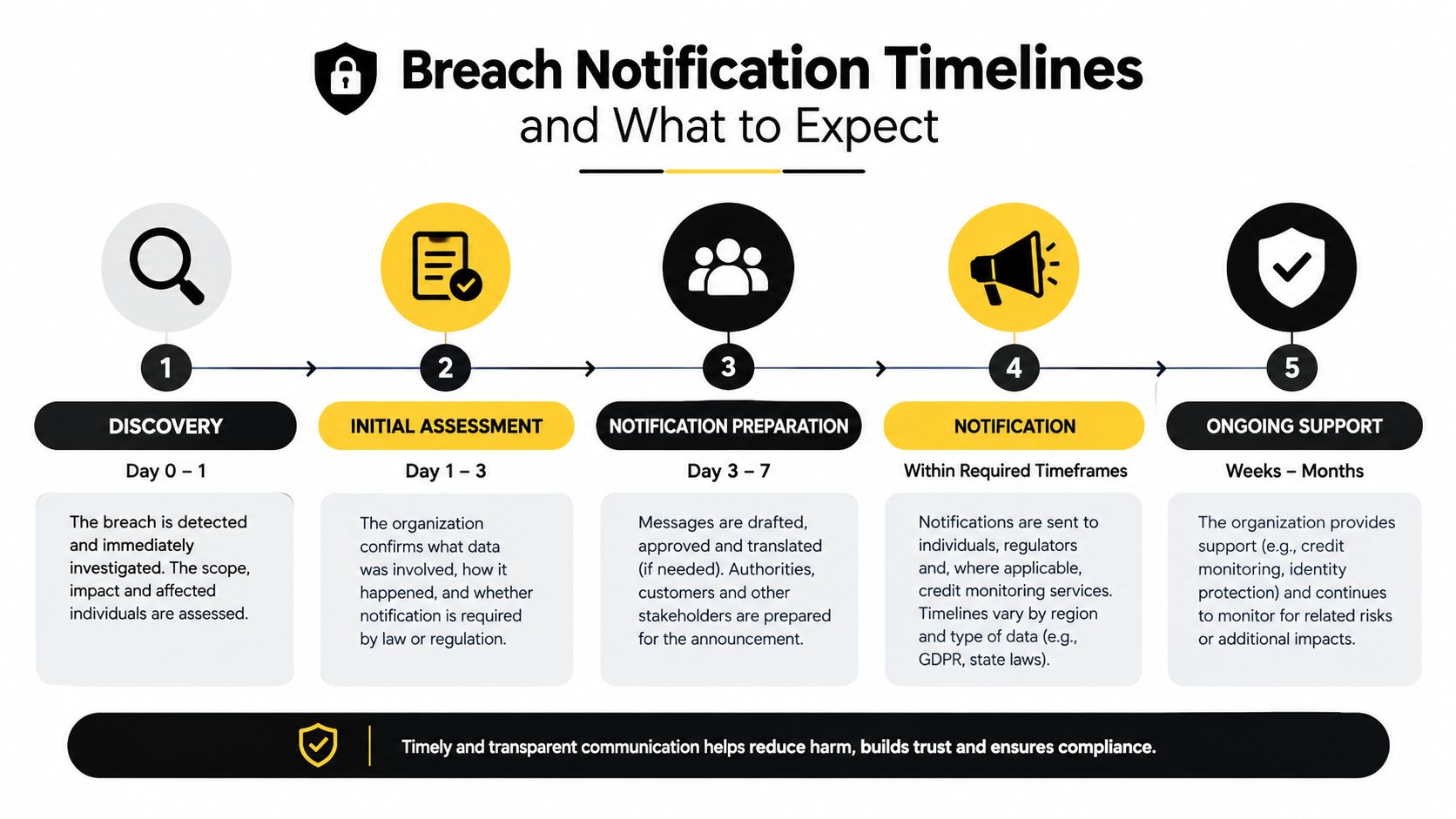
A practice should push back on clauses that let a contractor delay notice until its internal investigation is complete. The post-breach response process should name the people who receive the alert, preserve evidence, assess risk, communicate with counsel, and coordinate patient notification.
Real-World BAA Scenarios for DFW Healthcare and SMBs
North Texas practices often miss the BAA question because the vendor's service appears ordinary. The data path exposes the underlying issue.
A Plano dermatology clinic moves imaging into a cloud PACS hosted in Dallas. The hosting provider creates, receives, and maintains ePHI for the clinic, so the relationship requires a BAA before the migration. Red flags include a standard agreement that permits broad data use, excludes backups from deletion duties, or omits subcontractor obligations. The practical next step is to map production data, images, backups, support access, and retention against the proposed contract.
A Fort Worth pediatric group hires a local MSP for endpoint management. The MSP doesn't provide clinical care, but it may access usernames, devices, mailboxes, and messages containing lab orders. That access is part of the service relationship, not a random encounter. The group should require a BAA, limit administrative access, document support procedures, and confirm that remote technicians and downstream service providers are covered.
A Tarrant County home-health agency sends paper charts to a shredding vendor. The vendor handles physical PHI as part of its service, so a BAA is required. The agency should examine pickup controls, locked containers, chain-of-custody records, destruction certificates, and the vendor's retention language. “The records are destroyed quickly” isn't enough if the contract doesn't assign responsibility while the files are in transit or storage.
A Dallas med-spa uses a mainstream e-signature tool for intake forms. If the platform stores or transmits identifiable patient information, the med-spa needs a BAA or a redesigned workflow that keeps PHI outside the platform. The standard terms may reserve broad rights to retain content or change service conditions, which makes contract review more important than the convenience of the form.
| Scenario | Vendor Type | Touches PHI? | BAA Required? |
|---|---|---|---|
| Dermatology imaging migration | Cloud hosting provider | Yes | Yes |
| Pediatric group IT support | Outsourced IT partner | Yes, including indirect access | Yes |
| Home-health chart destruction | Document destruction company | Yes | Yes |
| Med-spa intake workflow | E-signature platform | Yes, if identifiable forms are stored or transmitted | Yes, unless the workflow excludes PHI |
The gray zone isn't a reason to avoid technology. It is a reason to define access accurately before signing.
A Practical BAA Review Checklist Before You Sign
A practice owner, office manager, or operations lead can make the review manageable by sorting each issue into verify, negotiate, or walk away.
| Verify | Negotiate | Walk Away |
|---|---|---|
| Legal names of both parties | Faster breach notice than the outside limit | Refusal to sign a required BAA |
| Effective date and service scope | Cure rights and response deadlines | No right to terminate for HIPAA violations |
| Permitted uses and disclosures | Audit or evidence access | Blanket indemnification favoring the vendor |
| Subcontractor flow-down | Termination for material breach | No workable breach responsibility |
| Return or destruction process | Backup and archive treatment | Contract language that permits unrestricted PHI use |
The legal name check deserves its own line. The BAA should list the clinic or business by its correct legal entity name, not a trade name copied from an email signature. The service description should also match reality. If the vendor's technicians can reach email, backups, or file shares, the contract shouldn't describe the relationship as a narrow software license.
A practice should ask whether the upstream covered entity has its own BAA with every sub-business associate in the chain. A vendor's assertion that “the infrastructure is compliant” doesn't establish that every relevant downstream relationship is documented.
The review should test more than the signature block:
- Compare the data map: List where PHI enters, moves, rests, and leaves the service.
- Check the incident path: Confirm who receives notice and what information arrives first.
- Read the deletion language: Include active systems, backups, exports, and subcontractor copies.
- Match access to duties: Limit support access and require records of administrative activity.
- Store the evidence: Keep the signed BAA with the master services agreement and vendor inventory.
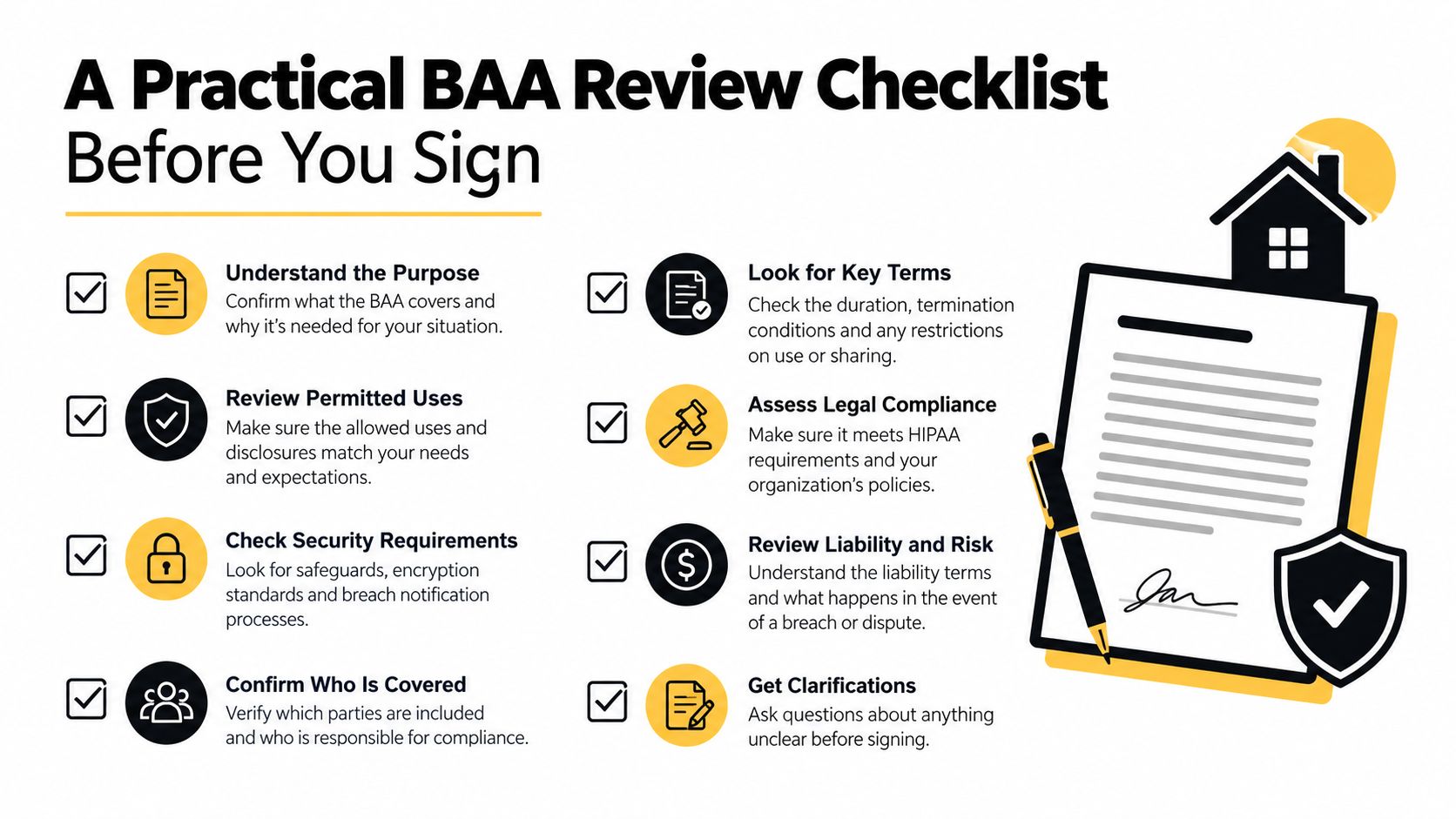
The signed copy should be reviewed annually and whenever the service scope, staff, subcontractors, systems, or data types change. A compliance audit checklist can help connect contract review with the broader risk assessment instead of treating the BAA as a one-time purchase document.
Turning the BAA Into a Working Compliance Control
A signed BAA sitting in a shared folder doesn't protect a patient record. The practice needs to connect each contractual promise to an owner, a technical setting, and evidence that someone can review.
Start with vendor onboarding. Attach the BAA to the vendor record, document the systems in scope, identify authorized contacts, and record whether subcontractors are involved. The onboarding file should also show which workforce members receive access and why.
Next, translate clauses into operating checks:
- Permitted use becomes access review. Confirm that vendor accounts and support permissions match the contracted service.
- Safeguards become evidence requests. Review relevant encryption practices, access logs, backup controls, and administrative procedures.
- Subcontractor duties become chain review. Ask the primary vendor to identify downstream parties that handle PHI and document the contractual flow-down.
- Breach duties become incident procedures. Put the vendor contact, notification route, evidence requirements, and escalation process into the incident response plan.
- Termination duties become an exit test. Confirm return or destruction, disable access, and document the result.
Annual review matters, but event-driven review matters just as much. A new service module, acquired practice, changed support arrangement, or newly introduced automation can alter the BAA's scope before the next calendar review.
For technology leaders, the HIPAA guidance for technology leaders offers useful context for connecting contractual requirements with day-to-day safeguards. A local IT and compliance partner can also review vendor agreements, configure access controls, collect evidence, and help a clinic turn legal language into tasks staff can monitor.
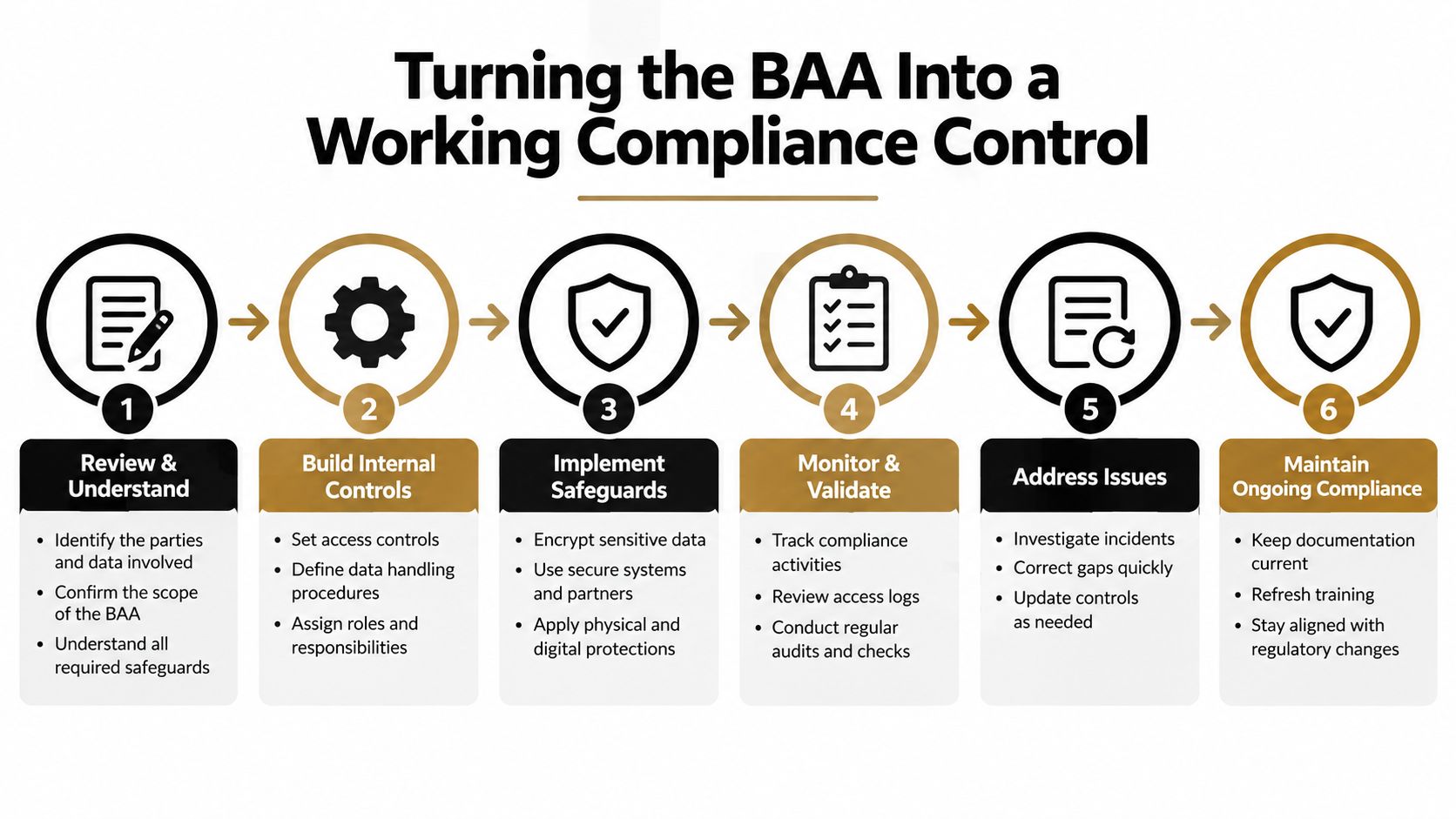
The right question isn't only whether a BAA has been signed. It is whether the practice can show which vendor has PHI, what that vendor is allowed to do, how access is controlled, how incidents are reported, and what happens when the relationship ends.
Technovation LLC helps DFW practices and regulated businesses review vendor relationships, strengthen administrative, physical, and technical safeguards, and connect BAAs to practical IT controls. Visit Technovation LLC to request a security audit or discuss a focused HIPAA compliance and vendor-risk review.