

A North Texas storm knocks out power just as a clinic needs patient records, a law firm prepares a filing, or a construction manager coordinates several crews. The servers are unavailable, staff can't reach shared files, and a backup exists somewhere. Yet nobody knows who can authorize remote work, which manual process comes first, or how long each service can remain paused.
That situation exposes the issue in business continuity vs disaster recovery. Disaster recovery may restore servers, applications, and data. Business continuity determines whether people can keep serving patients, meeting deadlines, processing payments, and coordinating projects while that restoration happens. A document that has never been tested doesn't protect an operating business. It only records an intention.

Table of Contents
- When Operations Freeze
- Defining Business Continuity and Disaster Recovery
- Measuring Resilience With RTO and RPO
- Mapping Services Beyond Technology
- The Confidence-Capability Gap in SMB Planning
- Implementing a Unified Resilience Strategy
When Operations Freeze
The first call usually goes to IT. Someone asks whether the server can be restarted, whether cloud access is working, or whether the latest backup completed. Those questions matter, but they don't answer the operational question: what can the business still deliver right now?
A clinic may have a recoverable electronic health record system but no procedure for intake when staff can't access it. A law firm may restore its document platform yet lack a clear way to identify filing deadlines, contact clients, or give attorneys secure access from another location. A construction company may recover project files while crews wait because supplier contacts, schedules, and site instructions are trapped inside systems nobody can reach.
Practical rule: A successful restore proves that technology can come back. It doesn't prove that the business can keep operating.
Business continuity planning addresses the period between disruption and normal operations. It assigns decision ownership, identifies alternate work locations, documents manual workarounds, defines communication channels, and prioritizes the services that must continue. Disaster recovery supports that work by restoring the systems those services depend on.
A business with good backups but no continuity procedures often experiences a preventable pause. Employees make separate decisions, customers receive inconsistent answers, vendors don't know where to send requests, and leaders spend critical time reconstructing responsibilities. The outage becomes longer because the organization has to invent its response while under pressure.
Technical monitoring still plays an important role. Reviewing VMM best practices can help teams improve visibility into virtual machines, identify failures sooner, and support a more reliable recovery process. Monitoring, however, is one control inside a larger program. It can't decide which client commitments take priority or supply a trained replacement for an unavailable employee.
DFW organizations need a plan that connects technical recovery to business action. That means documenting what continues, who activates it, where staff work, what vendors are essential, and which systems return in what order. Technovation's IT continuity services address that operational layer by turning recovery priorities into documented responsibilities, runbooks, and realistic tests.
Defining Business Continuity and Disaster Recovery
A company can have a polished recovery document and still be unable to serve customers during an outage. The true test is whether people know what to do, which service takes priority, and how work continues while technology is unavailable.
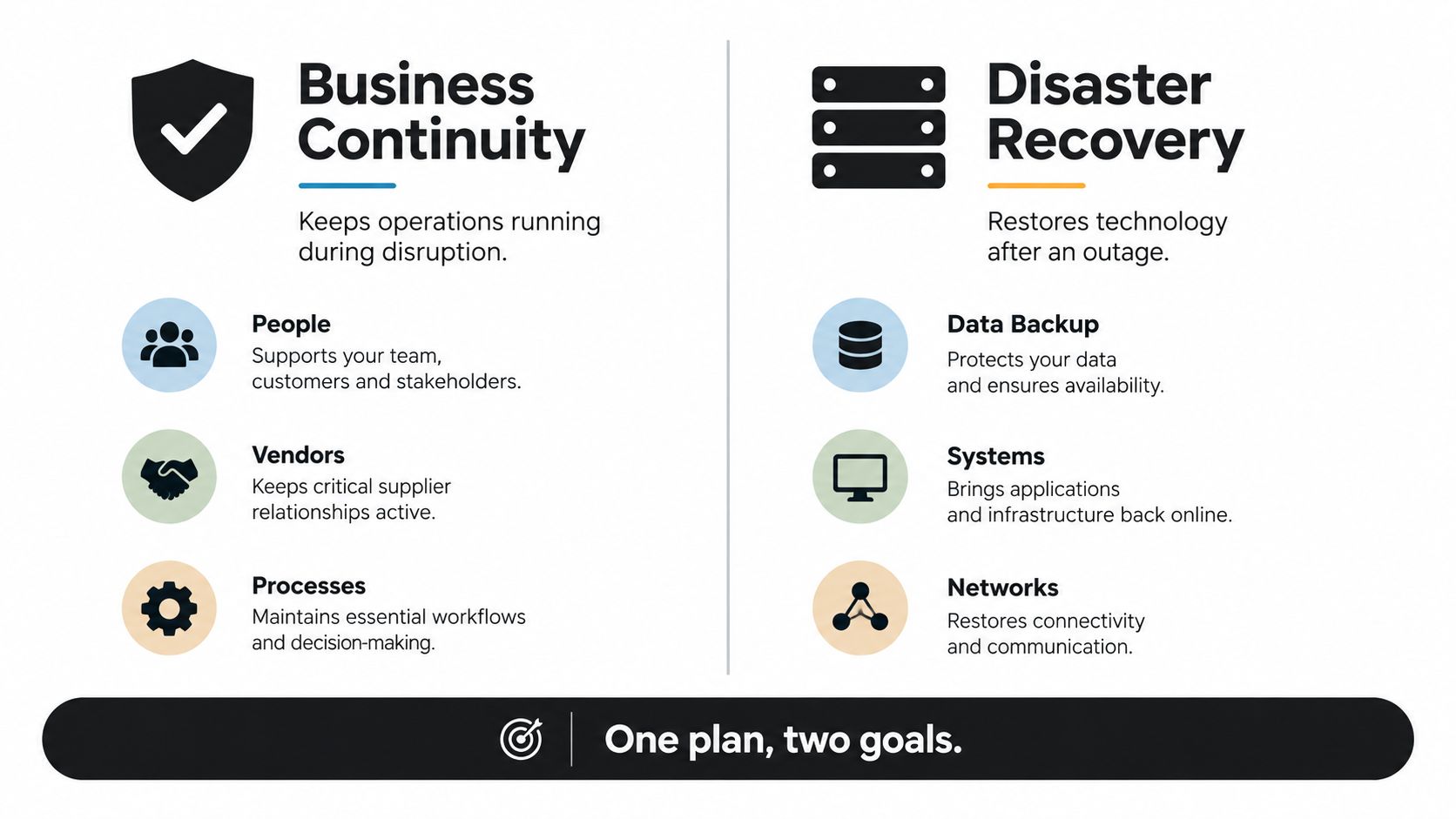
The distinction is direct:
- Business continuity keeps critical services operating during disruption.
- Disaster recovery restores technology after disruption.
Disaster recovery covers servers, applications, networks, storage, backups, alternate facilities, and restoration procedures. Its questions are technical: Which system returns first? Where will it run? How much data can be restored? Can employees reconnect securely?
Business continuity covers the operating conditions around those systems. It addresses people, processes, facilities, vendors, communications, customer commitments, compliance duties, and temporary workarounds. Its central question is practical: How does the organization continue delivering essential services when normal resources aren't available?
NIST SP 800-34 Rev. 1 makes the boundary clear. A business continuity plan provides instructions for sustaining mission and business processes during and after disruption. A disaster recovery plan documents how one or more information systems are recovered at an alternate facility after major hardware or software failure, or facility destruction. The NIST-based comparison of business continuity and disaster recovery summarizes the distinction.
The operational difference
Consider payroll. Disaster recovery may restore the payroll application and database. Business continuity defines how payroll staff access that system, verify employee information, communicate delays, and handle urgent exceptions if the usual workflow remains unavailable.
The same distinction applies to regulated work. Restoring a server does not automatically restore patient intake, legal review, financial controls, or job-site coordination. Each service depends on specific staff, approvals, facilities, suppliers, and communication methods.
| Area | Business continuity | Disaster recovery |
|---|---|---|
| Primary objective | Keep essential operations functioning | Restore systems, applications, and data |
| Scope | People, processes, facilities, vendors, communications, and technology | Infrastructure, applications, networks, storage, and data |
| Typical trigger | Facility loss, staff shortage, supplier failure, cyber incident, or technology outage | Hardware failure, data corruption, ransomware, or system outage |
| Main output | Workarounds, responsibilities, communications, and service priorities | Backup, failover, restoration, and recovery procedures |
| Success measure | Critical services continue at an acceptable level | Technology returns within defined recovery targets |
Some incidents require both disciplines at once. During ransomware, continuity leaders may shift staff to alternate workflows while recovery teams isolate affected systems and restore clean copies. During a facility outage, continuity action may begin before any server fails. Disaster recovery becomes necessary if the technology also becomes unavailable.
Technovation's disaster recovery planning approach connects technical restoration to the operational priorities outlined above. A recovery event involving irreplaceable information may also require professional data recovery from a qualified specialist. That work can retrieve information from a failed device, but it does not keep the business operating by itself. Data recovery restores information. Continuity planning keeps services running while retrieval or restoration takes place.
Measuring Resilience With RTO and RPO
Resilience becomes useful only when leaders define tolerances. “Recover quickly” means different things for a medical practice, accounting firm, legal office, and construction company. Each critical service needs a time limit, a data-loss limit, and an agreed response sequence.
Recovery time objective, or RTO, defines how long a process or system can remain unavailable before the impact becomes unacceptable. Recovery point objective, or RPO, defines the maximum tolerable data loss, measured by the gap between the last viable backup and the disruption point. The HPE guidance on business continuity objectives also identifies maximum tolerable downtime, maximum tolerable data loss, incident response time, and operational resumption time as useful measures.
| Metric | Definition | Primary use |
|---|---|---|
| RTO | Maximum acceptable time a system or process remains unavailable | Set restoration speed and recovery order |
| RPO | Maximum acceptable amount of data loss | Set backup and replication requirements |
| MTD | Maximum tolerable downtime before unacceptable business impact | Establish the outer limit for disruption |
| MTDL | Maximum tolerable data loss | Confirm how much information the business can recreate or lose |
| IRT | Incident response time | Measure how quickly the organization detects and acts |
| ORT | Operational resumption time | Measure how quickly normal service resumes after initial response |
Set targets by service, not by habit
A generic backup schedule isn't a recovery strategy. Leaders should start with the services that produce revenue, protect safety, satisfy compliance obligations, or preserve client commitments.
For a clinic, patient intake and access to essential records may outrank administrative reporting. For a law firm, deadline tracking, matter access, and secure communication may come first. For a construction business, job-site coordination, purchase approvals, and schedule access may outrank less urgent reporting functions.
Each service should answer four questions:
- What fails first if the service stops?
- How long can the service operate manually or at reduced capacity?
- How much recent data can the business recreate?
- Which system, employee, vendor, or facility must be available first?
Those answers turn business priorities into technical requirements. A system supporting a time-sensitive service may need a shorter RTO and tighter RPO than an internal archive. A system with a longer tolerance may recover later, allowing the organization to focus resources where disruption causes the greatest harm.
Measure the plan after implementation
A target isn't evidence. Actual performance must be compared with the target during recovery tests and exercises. Useful program measures include the RTO compliance rate, actual data loss against the expected RPO, backup success rate, successful recovery tests, and the gap between planned and actual recovery time, as outlined in the business continuity and disaster recovery metrics guide.
A strong test records more than whether a backup exists. It confirms whether the restored system starts, whether the right employees can access it, whether permissions remain correct, whether communications work, and whether the business process can resume. If the system meets its recovery target but employees can't perform the service, the program has exposed a continuity failure, not achieved resilience.
Mapping Services Beyond Technology
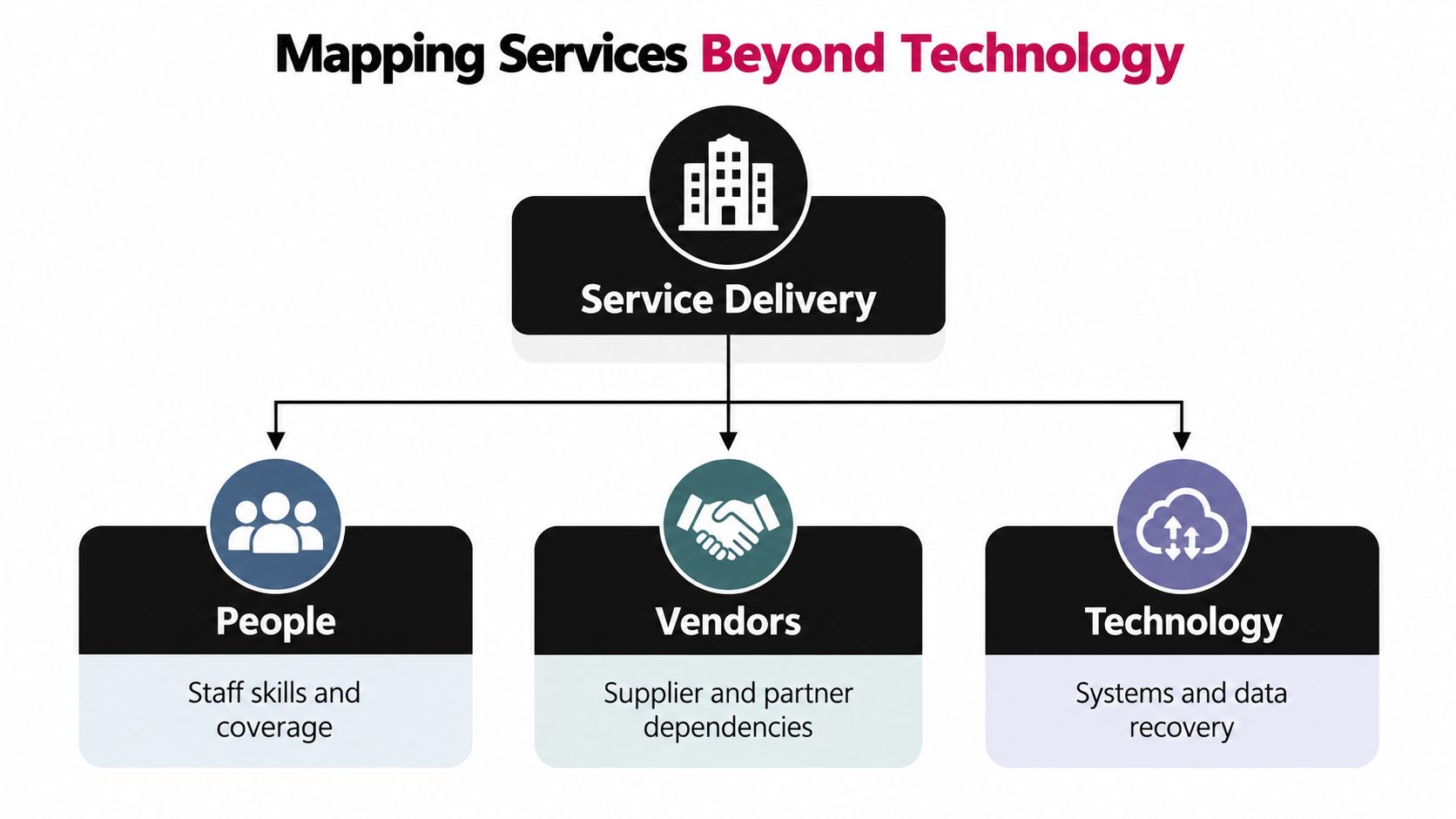
A server is rarely the service. It supports a chain that includes staff, procedures, facilities, suppliers, approvals, and customer communication. A plan that maps only the server can therefore pass a technical test while failing the business.
A legal and operations analysis describes the gap between a service mapped for technology recovery and a service mapped across the entities, people, processes, and vendors that keep it running. That distinction matters because staff availability, supplier outages, and manual workarounds often become the bottleneck. The analysis of service mapping in business continuity gives this broader view practical weight.
Start with the service
Don't begin with a list of servers. Begin with a service the organization must deliver.
A medical practice might map “patient appointment and intake.” A law firm might map “urgent matter handling.” A financial firm might map “payment approval.” A construction company might map “job-site coordination.” The service name should describe an outcome, not a piece of technology.
Then identify what the service requires:
- People: Which roles perform the work, approve exceptions, and provide specialized knowledge? Can another employee cover those responsibilities?
- Processes: Which steps must happen in order? Which steps can be performed manually, and which require a restored system?
- Facilities: Can staff work remotely, from another office, or from a temporary location? What physical equipment or records are necessary?
- Vendors: Which suppliers, carriers, payment providers, professional partners, or outsourced functions must remain available?
- Technology: Which applications, data sets, devices, networks, credentials, and integrations support the service?
Find the first broken dependency
A practical mapping exercise follows the service from request to delivery. For every step, the team should identify the dependency that would stop it first.
If a clinic can access records but has no intake staff, technology isn't the first constraint. If a law firm has attorneys available but can't reach a filing vendor or secure client communications, the vendor or communications layer is the constraint. If a construction manager can open schedules but can't reach a key supplier, the project still loses momentum.
This analysis produces better recovery priorities than an inventory of devices. It also reveals where a manual workaround is necessary. A workaround should include the responsible role, required information, approval path, storage method, and handoff back into normal systems. “Use paper temporarily” isn't a procedure unless someone has defined how paper records are controlled and reconciled later.
Make ownership visible
Every critical service needs a named decision owner and a technical recovery owner. The decision owner activates the workaround, sets priorities, and communicates with stakeholders. The technical recovery owner restores systems, validates data, and reports what is available.
Those roles should appear beside each service map, along with alternate contacts and vendor escalation details. A plan that depends on one unavailable executive or one absent administrator isn't resilient. Cross-training and documented authority matter as much as backup capacity.
The finished map should be tested with the people who perform the work. They can identify missing approvals, outdated contacts, unusable forms, and hidden dependencies that a technical review won't uncover.
The Confidence-Capability Gap in SMB Planning
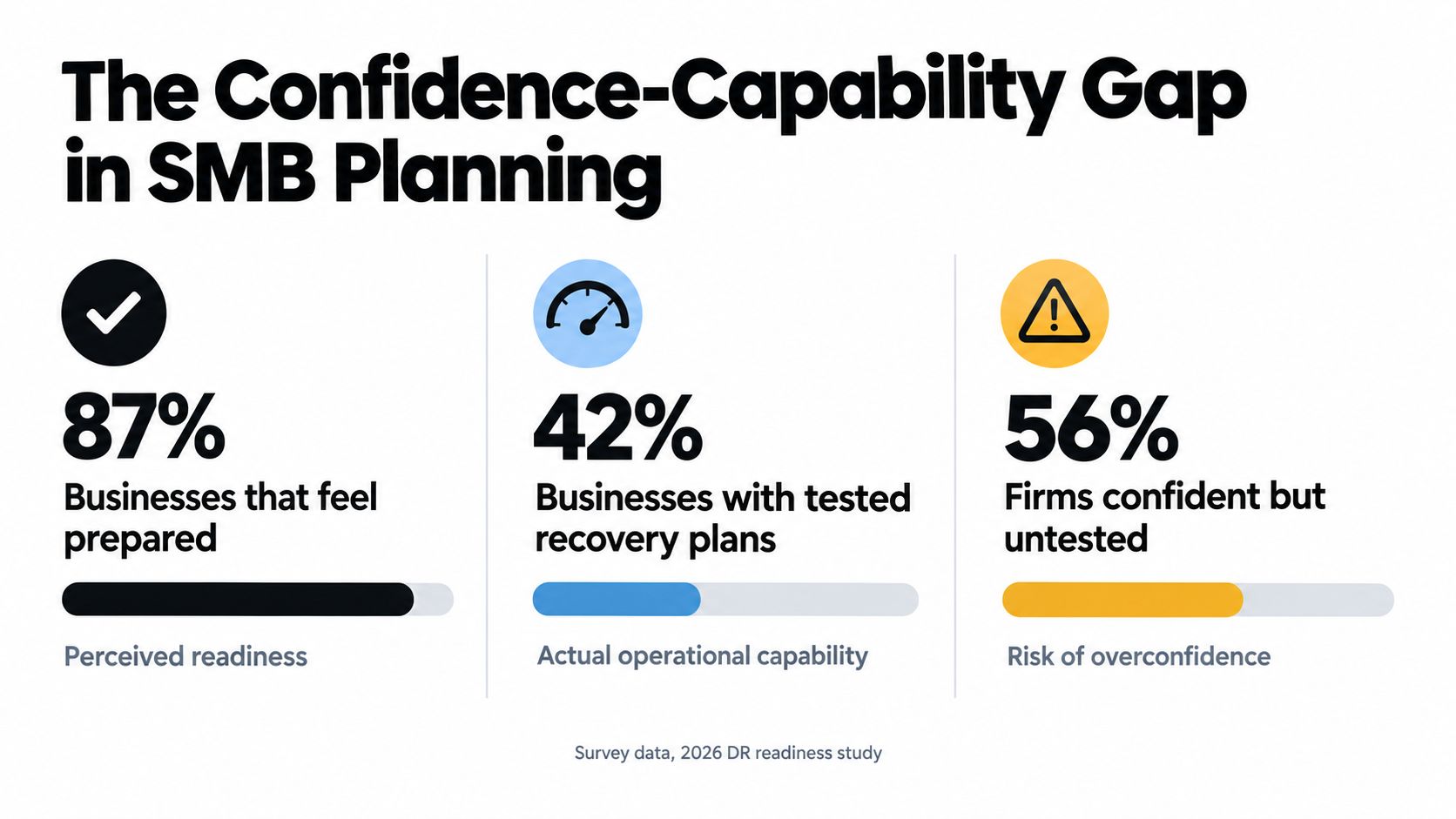
Many small and mid-sized businesses have a disaster recovery document, a backup dashboard, or a written list of emergency contacts. Those assets create confidence, but confidence isn't capability. Capability appears when the organization can perform the documented response under current conditions.
A 2026 survey of organizations with existing disaster recovery programs found that more than 75% reported having a formal DR program, while another 16% planned to implement one within a year. Yet only about half planned DR at the enterprise level in a centralized program, and just under 11% planned it in localized silos. The same survey found that about 42% had experienced a significant disaster, outage, or business disruption in the prior two years. These figures are reported in the 2026 DR preparedness survey.
The pattern is clear. Formal documentation has become common among organizations that already invest in DR, but operational readiness remains uneven. A program can exist on paper while ownership, testing, service mapping, and recovery evidence remain incomplete.
Readiness must be demonstrated
A 2026 DR preparedness study found that fewer than 40% of respondents felt very or extremely prepared for a site failure or disaster, despite more than 75% having some form of formal DR program. Only about half used a centralized program, and 15% had a dedicated DR team integrated into enterprise risk management. A separate 2026 SMB resilience index found that only 5% of clients had documented RPO and RTO targets and tested restores within the last 90 days. Those findings appear in the 2026 analysis of the confidence-capability gap.
The practical test is simple: can the team show current evidence that the plan works? Evidence includes restore results, exercise records, updated service maps, assigned owners, validated access, current vendor contacts, and documented lessons from failed tests.
A written plan that nobody rehearses may contain accurate instructions. It still doesn't tell leaders whether staff can follow them during an outage, whether remote access works after a security event, or whether restored data supports the actual business process.
Treat compliance as a management discipline
ISO 22301:2019 defines an international standard for Business Continuity Management Systems. It requires organizations to plan, establish, implement, operate, monitor, review, maintain, and continually improve a documented management system that protects against disruptive incidents, reduces their likelihood, and supports recovery. The ISO 22301 standard overview makes the central point clear: continuity is a management system, not merely an IT document.
That distinction matters for healthcare, legal, financial, construction, and nonprofit organizations that face contractual, regulatory, or client expectations. A static file may describe a response, but an operating management system assigns ownership, tracks gaps, reviews changes, and validates procedures over time.
A practical program should therefore include:
- Current service maps: Critical services, dependencies, owners, and recovery order remain aligned with how the organization operates today.
- Tested recovery objectives: RTO and RPO targets are defined by service and verified through restore exercises.
- Documented decisions: Leaders know who can activate workarounds, communicate externally, and approve exceptions.
- Improvement records: Failed tests produce assigned corrective actions, not vague observations.
- Regular review: Changes in cloud services, staffing, vendors, applications, and cyber risks trigger plan updates.
Technovation's virtual chief information officer services can provide strategic structure for organizations that lack internal capacity to maintain this governance. The value lies in turning readiness from a reassuring statement into evidence that leaders can inspect and improve.
Implementing a Unified Resilience Strategy
DFW businesses don't need separate efforts that compete for attention. They need one operating program with two connected workstreams: continuity keeps services functioning, and disaster recovery restores the technology that those services require.
The practical sequence starts with a business impact analysis. Leaders identify critical services, assign owners, define MTD, RTO, and RPO targets, map people and vendors, and rank recovery activities. The recovery plan then translates those priorities into architecture, backups, access methods, failover procedures, restoration steps, and runbooks.
The continuity side must remain active during technical recovery. It should define alternate work locations, manual procedures, communications, decision authority, and customer handling. A clinic may continue intake through a controlled temporary process. A law firm may prioritize deadline-sensitive matters. A construction company may maintain field coordination through alternate communications while project systems are restored.
Build, test, and improve
A unified program should move through a repeating cycle:
- Map services and dependencies. Start with outcomes, then identify people, processes, facilities, vendors, and technology.
- Set service-level targets. Establish the tolerable interruption and data loss for each critical function.
- Document the response. Separate immediate continuity actions from technical restoration procedures.
- Test the complete chain. Run restore exercises, tabletop scenarios, access checks, communications tests, and manual-workaround rehearsals.
- Correct the gaps. Assign owners and deadlines for every failed step or unclear responsibility.
- Review after change. Update the program when staffing, systems, facilities, vendors, or risks change.
Redundancy decisions should follow business impact rather than technical fashion. A business evaluating resilience options can use an N+1 vs 2N guide to understand how different redundancy approaches affect capacity and failure tolerance. The correct design depends on the service target, budget, dependencies, and consequences of interruption.
Technovation LLC helps organizations connect these pieces through IT continuity planning, disaster recovery design, cloud backup, remote access, runbooks, monitoring, and strategic IT planning. For healthcare, legal, financial, construction, and nonprofit organizations, the work should end with a usable operating program that identifies what must continue immediately, what can wait, and what must be restored at an alternate site.
Technovation LLC can map critical business services, set system-level RTO and RPO targets, build recovery runbooks, and test continuity procedures under realistic disruption conditions. Visit Technovation LLC to request a practical review of the gaps between the organization's documented plan and its tested ability to keep serving customers.