
A Dallas–Fort Worth business owner can go months thinking the environment is stable, then a phishing click, a misconfigured cloud app, or a failed audit exposes how much was already sitting in plain sight. That's the real value of cyber security assessment services, they turn hidden exposure into a decision leadership can act on before a breach, an insurer, or a regulator forces the issue.
This is no longer a “nice to have” IT purchase. It's a business risk conversation, especially for firms handling healthcare records, financial data, legal files, donor information, or contract-driven environments where the consequences of weak controls land on operations, cash flow, and reputation, not just the server room.
Table of Contents
- Why Cyber Security Assessment Services Matter Right Now
- The Five Core Types of Cyber Security Assessments
- How a Professional Assessment Actually Runs
- What These Services Actually Cost in 2026
- Industry-Specific Considerations for DFW Businesses
- Why a Local DFW MSP Often Beats a National Vendor
- Choosing the Right Partner and the Questions to Ask
- Your Next Step Toward a Cleaner Security Posture
Why Cyber Security Assessment Services Matter Right Now
A mid-sized accounting firm in Irving, a dental practice in Plano, or a construction company in Fort Worth often thinks the same thing right up until trouble hits, “Nothing's happened here, so we're fine.” Then the incident report shows old passwords, open access, stale accounts, and cloud settings that were wrong for months. The business didn't get unlucky, it got exposed.
That's why cyber security assessment services matter. They're independent reviews designed to find exploitable weaknesses before attackers do, then translate technical findings into business decisions leadership can use. In practice, that means the assessment isn't about producing a scary list of issues, it's about showing which weaknesses can interrupt billing, patient care, case handling, jobsite operations, or board reporting.
For regulated organizations, this sits inside risk management, not IT housekeeping. CISA says its cyber assessments run risk and vulnerability assessments across federal agencies, private organizations, and state, local, tribal, and territorial governments to identify vulnerabilities adversaries could exploit, which is a strong sign that assessment work belongs in formal security programs, not just annual cleanup cycles. See CISA's overview of cyber assessments, and note how it frames the work around exploitable weakness rather than tool counts.
A good assessment gives leadership something better than raw findings, it gives context. A board member doesn't need a dump of every open port. They need to know what could interrupt revenue, compliance, and client trust, and what should be fixed first.
Practical rule: if an assessment can't tell leadership which weaknesses matter most to the business, it's not finished yet.
Technovation's own guidance on the broader risk picture is a useful companion read for owners who need to connect cyber exposure to business continuity, and it's worth reviewing alongside a baseline assessment: Part Two, Cybersecurity Risks Business Owners Must Address in 2026.
The Five Core Types of Cyber Security Assessments
A lot of owners ask for “a security assessment” as if that's one thing. It isn't. The right buy depends on whether the company needs a broad risk picture, a technical exposure check, an adversarial test, a compliance review, or a general health check.
Start with the business question
A risk assessment asks what could hurt the organization most, and what would stop it from operating cleanly. A vulnerability scan checks for known weaknesses, like a home inspection that flags problems before a buyer moves in. A penetration test is more like hiring someone to try to get in through the weak spots. A compliance audit checks whether the organization meets a specific rule set. An IT health check looks at whether day-to-day controls are aging, missing, or badly configured.
For teams that run cloud-heavy environments, a useful companion resource is this guide on SIEM architecture for AWS, because assessment findings often spill directly into logging and monitoring design.
| Assessment Type | Primary Trigger | Key Deliverable | Typical Frequency |
|---|---|---|---|
| Risk Assessment | New service, merger, regulation, or leadership concern | Risk-ranked exposure list | Annual or after major change |
| Vulnerability Scan | Need to find known technical weaknesses | Scan findings with remediation list | Monthly, quarterly, or after major updates |
| Penetration Test | Need to validate real-world exploitability | Exploitation evidence and prioritized risk | Periodic or before high-stakes launches |
| Compliance Audit | Regulatory or contractual requirement | Control-mapping report and gaps | Scheduled to match the requirement |
| IT Health Check | General posture review or aging environment | Practical fix list for core systems | Quarterly or semiannually |
For DFW firms, the most common starting point is usually a vulnerability assessment or a broader risk assessment, because most owners need a fast answer on exposure before they spend money on deeper testing. If the business already knows it has mature controls and needs proof of breakability, then a penetration test becomes the better use of budget. Technovation's internal explainer on vulnerability assessment vs penetration testing helps separate those two choices cleanly.
A scan finds issues. A test proves whether those issues can actually be used. That difference matters when the report goes to an owner, not just a technician.
How a Professional Assessment Actually Runs
A serious engagement doesn't start with scanning. It starts with scope, because a vague scope produces a vague report and a vague report wastes money. The provider should define what's in bounds, what's excluded, how production impact will be avoided, and who gets the final findings.
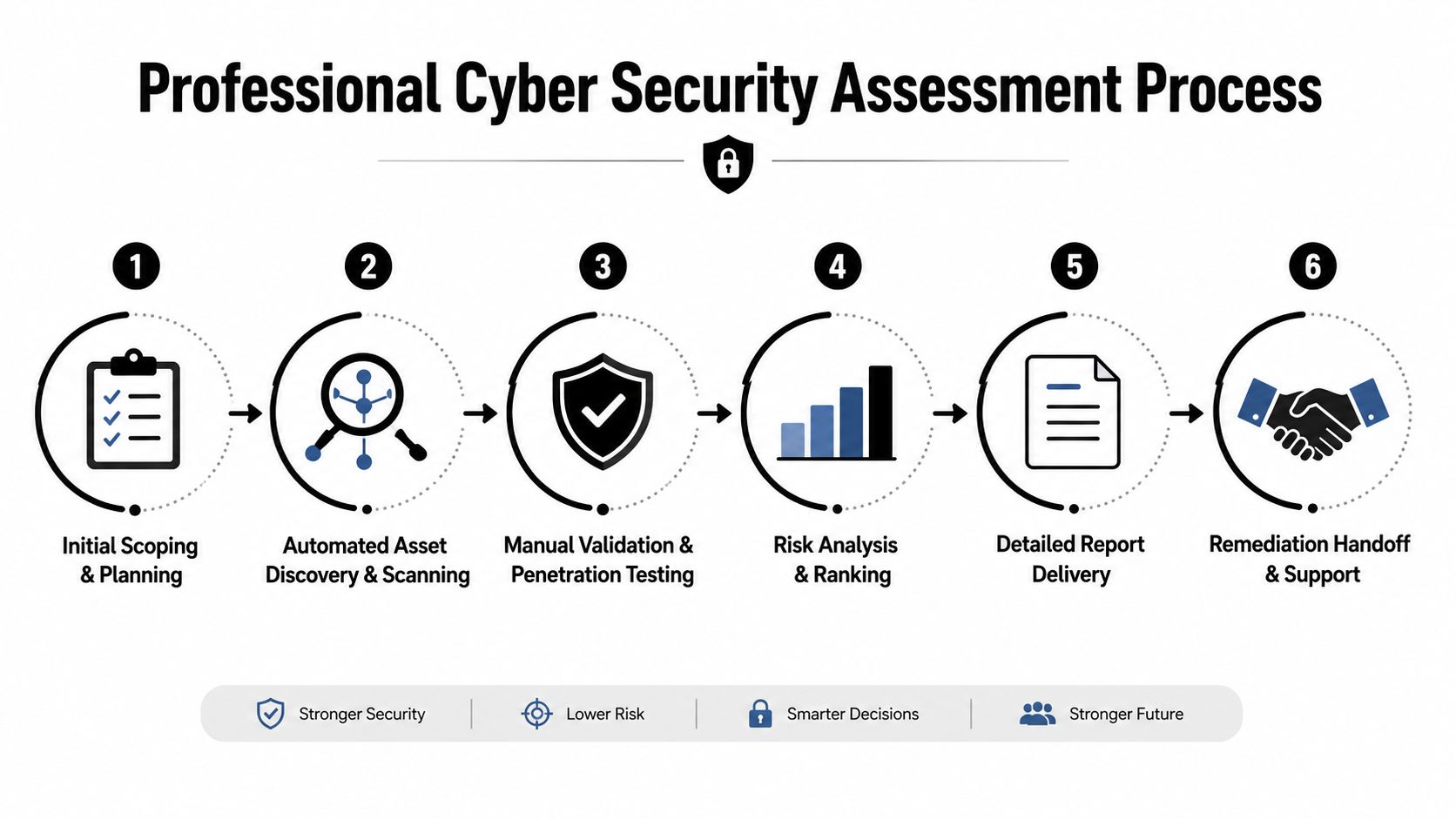
The work should move from discovery to decision
A mature process usually combines asset discovery, automated scanning, manual validation, configuration review, risk ranking, and a remediation handoff. That structure lines up well with the CISA model for risk and vulnerability assessments, which is built to find weaknesses, validate what matters, and direct attention toward the exposure an adversary could use.
A raw scanner dump doesn't help a controller, practice manager, or operations director. A business-ready report does. It should rank findings by likely impact, identify false positives, explain why a weakness matters, and pair each item with a practical fix. That's the difference between “here's a list” and “here's what to do Monday morning.”
The report also needs enough detail for both technical and nontechnical readers. Leadership needs the summary, the risk rank, and the business effect. Technical staff need the affected systems, the evidence, and the remediation sequence. If the vendor only hands over one of those layers, the process is incomplete.
For MSPs that also monitor environments, assessment data should feed into ongoing detection and response. A helpful adjacent reference on how MSPs use dark web monitoring shows why the assessment shouldn't end at a PDF, it should shape what gets watched next.
Good question for any vendor: “Will this report tell us what to fix first, or only what exists?”
Technovation's cybersecurity risk assessment template is useful for owners who want to compare a vendor's methodology against something concrete before signing a proposal.
What These Services Actually Cost in 2026
Pricing should be treated as an operating expense, not a one-time stunt buy. That's the honest view for a DFW business that runs payroll, handles customers, and has to answer to insurers or auditors. The market for these services keeps expanding, and the broader cybersecurity assessment service market has been valued at USD 4.54 billion in 2024 with a projection of USD 27.04 billion by 2032 at a 25% CAGR in one forecast, while another study places it at USD 1.91 billion in 2025 with growth to USD 2.90 billion by 2034 at 6.2% CAGR Verified Market Research Intel Market Research. That spread reflects different scopes and methods, but the direction is the same, demand is real.
What moves the quote
A flat vulnerability scan costs less than a manual test because it requires less labor. A multi-site assessment costs more than a single-office review because discovery takes longer and the report has more moving parts. After-hours testing, rush timelines, third-party coordination, and remediation retesting also push pricing up.
A quote usually does not get inflated by the right questions. It gets inflated by complexity. If the environment has cloud apps, remote staff, legacy systems, or multiple regulated workflows, the provider has to spend more time mapping the attack surface.
That's why owners should compare proposals by deliverables, not by the headline number. A lower price can be a bad deal if it excludes validation, business impact ranking, or help after the report lands.
Budgeting rule: if the assessment won't be repeated, the company is probably underbuying it.
For readers who want a deeper look at how testing effort translates to spend, this penetration testing cost analysis is a useful market lens, but the main takeaway for buyers is simpler. Price should follow scope, risk, and depth. Not the other way around.
Industry-Specific Considerations for DFW Businesses
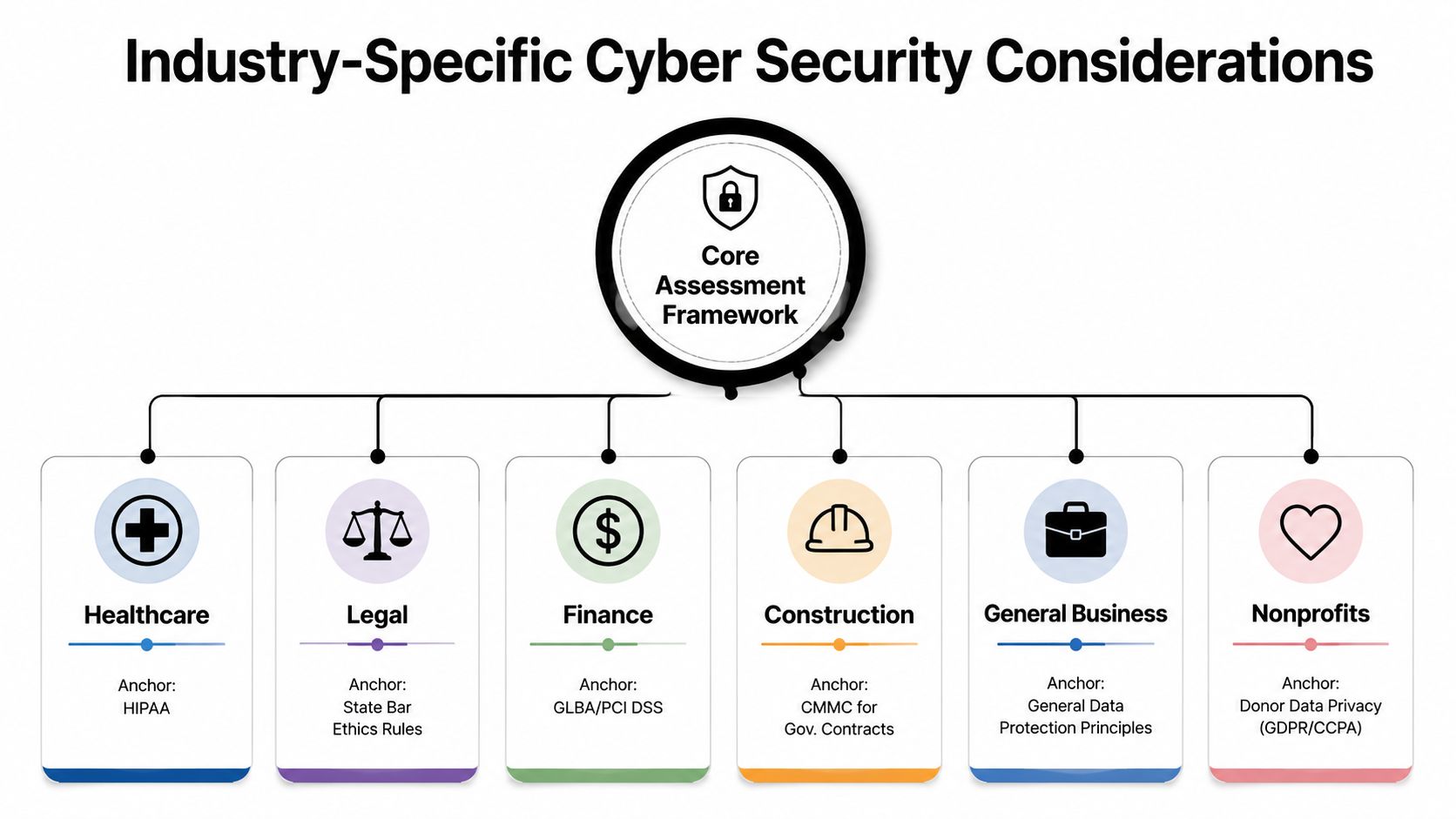
DFW isn't one market. It's a cluster of regulated businesses, contract-heavy firms, and service organizations with very different pressure points. The assessment framework is similar across them, but the scope changes fast once the industry rulebook enters the room.
Healthcare needs the deepest scope
Healthcare should be treated as the strictest environment on this list because HIPAA changes the whole engagement. The assessment has to examine where protected health information lives, who can reach it, how access is granted, and whether controls work in practice, not just on a policy page. Technovation's overview of HIPAA compliance for healthcare is the right reference point for practices that need their assessment tied to compliance readiness.
Legal firms need attention on privilege, access control, retention, and client file separation. Finance firms need their scope shaped by GLBA and, where payment data is in play, PCI expectations. Construction companies often get pulled by contract cyber requirements and government-facing security expectations, so the assessment should follow what the contract demands, not what a generic checklist says.
General businesses usually need a cleaner view of identity, email, endpoint hygiene, and backup recovery. Nonprofits need a practical review of donor data handling, volunteer access, and the privacy obligations that come with collecting personal information. In every case, the question is the same, “What would break trust, interrupt work, or create compliance pain if it failed tomorrow?”
The same control can matter for different reasons depending on the industry. The assessment has to reflect that, or the report will miss the real risk.
A good provider maps findings to the language the business already uses, clinician, partner, controller, project manager, or executive director. That keeps the report useful after the meeting ends.
Why a Local DFW MSP Often Beats a National Vendor
A national brand looks polished until the company needs a real answer fast. Then the distance shows up in the ticket queue, the handoff chain, and the person who knows the environment. A local DFW MSP can sit in the boardroom, walk the server room, and explain the risk in plain terms without making the owner wait on a call center script.

Accountability beats brand recognition
For small and mid-sized businesses, continuity matters more than logo size. The provider that knows the office layout, the EHR workflow, the billing system, or the jobsite laptop pattern can make better recommendations because they understand what breaks on Monday morning. That kind of familiarity is hard to buy from a remote vendor that only sees the environment through intake forms.
The market's expansion makes this even clearer. As demand rises, the space fills with firms offering similar-sounding assessments, which means trust becomes a deciding factor. A local partner has to earn that trust every quarter, not just during a sales pitch.
Technovation LLC fits that local model in a practical way. It brings 25 years of experience, 24/7 monitoring, free security audits, IT health checks, and compliance readiness for healthcare, legal, financial, construction, general business, and nonprofit clients across Dallas–Fort Worth. That matters because the assessment doesn't stop at finding a gap, it has to connect to what gets fixed next.
Remote delivery still has a place. But when a report surfaces a messy access issue or a misconfigured backup path, the provider that can show up often gets the work done faster and with fewer misunderstandings.
Choosing the Right Partner and the Questions to Ask
A buyer should never choose a provider just because the proposal sounds technical. The right checklist is shorter and tougher than that. It should cover certifications, methodology, reporting depth, remediation support, and contract terms.
Use the call to separate real depth from polished sales language
A good provider should explain the testing method without hiding behind jargon. The report should contain an executive summary and a technical section. Prioritized fixes should be included, not offered as an extra. The contract should spell out scope, SLA timing, data handling, and post-assessment support.
The smartest discovery questions get past marketing fast:
- What is your standard testing methodology?
- Can you show a sample report?
- What certifications do your auditors hold?
- How do you handle scoping and asset discovery?
- Do you provide post-assessment remediation guidance?
- What is your report delivery SLA?
- How do you minimize business disruption?
- Can the assessment be adjusted to our industry requirements?
- What does your pricing include, and what is extra?
- How do you protect our data during and after the engagement?
The right answer set should sound specific, not rehearsed. If the provider can't explain how findings get prioritized or what happens after delivery, leadership is buying a document, not a security outcome.
Technovation lines up well with that standard because it pairs assessment work with 24/7 monitoring, free security audits, IT health checks, and compliance-focused support across the sectors DFW owners operate in. That combination matters when the goal isn't just to check a box, but to reduce exposure in a way that fits the business.
Selection rule: if the vendor can't describe the remediation handoff in plain English, keep looking.
Your Next Step Toward a Cleaner Security Posture
A business only needs to make one decision this week. If there's never been a baseline assessment, schedule one. If the last one is older than a year, refresh it before the next audit, renewal, or incident forces the issue. That's the cleaner move, and it's usually cheaper than discovering the weak spots the hard way.
The right assessment won't solve every security problem in one shot. It will tell leadership where the actual exposure lives, what to fix first, and which risks can wait. That's the kind of clarity DFW business owners can use.
Start a conversation with Technovation LLC if a local partner, a free security audit, and a practical report would help the team get from uncertainty to action without dragging the business through unnecessary disruption.
A CTA for Technovation LLC.