

A business owner in Dallas-Fort Worth often hears the same advice from different directions. Get a vulnerability assessment. Schedule a penetration test. Tighten compliance. Reduce risk. The problem is that these terms get thrown around like they mean the same thing.
They don’t.
That confusion creates two expensive mistakes. Some companies pay for a scan and think they’ve proven they’re secure. Others buy a pen test before they’ve handled the obvious weaknesses a routine assessment would have caught first. Both choices waste money and leave risk on the table.
For regulated small and mid-sized businesses, the issue isn’t academic. A healthcare clinic, law firm, or financial services company needs to know which service supports day-to-day risk management, which one answers compliance requirements, and which one gives leadership something actionable instead of a pile of technical findings.
Table of Contents
- Are You Checking for Open Doors or Trying to Break In
- What Is a Vulnerability Assessment
- What Is a Penetration Test
- Comparing the Two Approaches Side by Side
- Which Test Does Your DFW Business Actually Need
- How to Choose Your Cybersecurity Partner
- From Understanding to Action with Technovation
Are You Checking for Open Doors or Trying to Break In
A Dallas medical practice passes its annual checklist, then gets hit with ransomware through an exposed remote access tool. A law firm discovers a client portal was reachable from the internet long before anyone noticed. A financial services office learns the hard way that “we ran a scan” does not answer the question regulators, insurers, and clients care about. Could someone get in and reach sensitive data?
That is the decision point here.
If you need a broad list of known weaknesses across your systems, you need a vulnerability assessment. If you need proof of how far an attacker could go with those weaknesses, you need a penetration test. One gives you a repair list. The other shows the business impact of leaving those repairs unfinished.

The distinction affects more than your IT budget. It affects downtime risk, cyber insurance conversations, client trust, and whether you can show a defensible security program during an audit or breach review.
For regulated SMBs in DFW, the right choice usually starts with the business outcome you need to achieve. Healthcare groups often need regular evidence that known weaknesses are being identified and addressed to support HIPAA security efforts. Law firms need to protect confidential client data and show they are using reasonable safeguards. Financial firms face pressure from clients, regulators, and partners to validate that controls work in practice, not just on paper.
A vulnerability assessment works like checking every door and window on the building and writing down which ones are open, damaged, or missing a lock. A penetration test answers a harder question. If someone tried those openings, could they reach the file room, the billing system, or the client records?
That difference drives scheduling too. Many businesses run assessments more often because they help manage ongoing exposure. Penetration tests are usually timed around compliance requirements, major infrastructure changes, new cloud deployments, or board-level concern about real attack paths.
Choose based on what decision you need to make. If you need visibility, prioritize a vulnerability assessment. If you need validation, risk proof, or compliance evidence tied to actual exploitation, pay for a penetration test. Mature security programs use both, but they use them for different reasons and at different times.
What Is a Vulnerability Assessment
A vulnerability assessment gives you a working list of weak points across your environment so you can fix them before they turn into downtime, data exposure, or audit trouble. For a small business in healthcare, legal, or finance, that matters because regulators and clients expect more than good intentions. They expect evidence that you are finding problems and addressing them on a regular schedule.
What a vulnerability assessment does
A vulnerability assessment uses automated scanning, asset discovery, and configuration review to identify known security issues across your systems. In practice, that means checking servers, laptops, firewalls, cloud assets, software versions, remote access points, and internet-facing services for problems such as missing patches, weak settings, unsupported software, and unnecessary exposure. Teams building modern vulnerability management for DevOps use this process to keep pace with constant infrastructure changes.
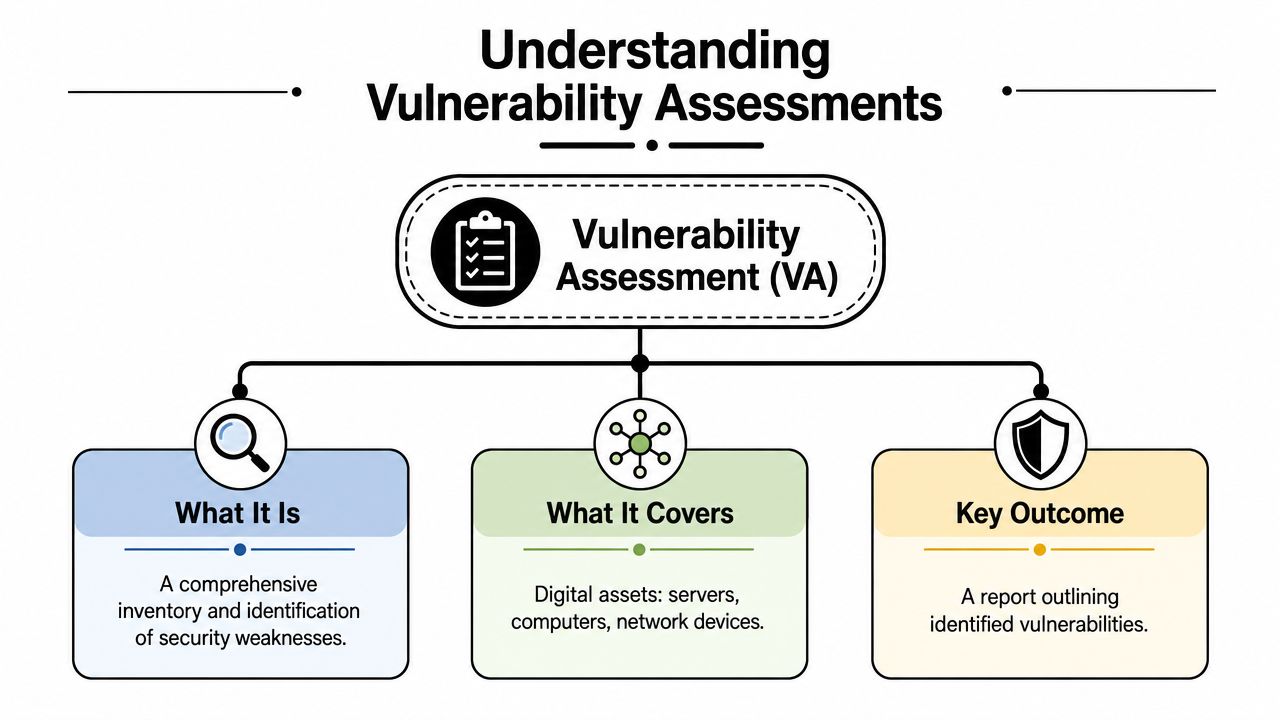
The value is coverage. You are not testing one dramatic attack path. You are checking the whole building for bad locks, broken windows, and doors that never should have been left open in the first place.
A good assessment also sorts findings by risk and business relevance. That is the difference between a useful report and a noisy spreadsheet no one acts on.
- Wide visibility: It reviews many systems and asset types across the business.
- Known issue detection: It finds documented weaknesses that attackers commonly use.
- Prioritized remediation: It helps leadership decide what to fix now, what to schedule, and what to monitor.
- Repeatable process: It fits a monthly, quarterly, or change-driven cadence.
What a business gets at the end
The final output should be simple to use. You should get a prioritized list of vulnerabilities, clear remediation guidance, affected assets, and enough context to assign work to internal IT or your security partner.
That helps regulated DFW businesses make decisions faster. A medical practice can use the report to support HIPAA security reviews and patch aging clinical systems. A law firm can spot weak remote access and poor configuration choices before client data is exposed. A financial firm can document remediation tracking for auditors, customers, insurers, and vendor due diligence requests.
Here is the rule I give owners. If you cannot point to a current, prioritized list of security weaknesses in your environment, start with a vulnerability assessment.
It will not prove how far an attacker could get. It will show you where your preventable problems are, which is exactly what many small businesses need first.
What Is a Penetration Test
A penetration test answers the question of chief concern to owners after a breach. If someone targets your business, how far can they get, what can they reach, and what would it cost you?
For a healthcare practice, that could mean access to patient records and a reportable HIPAA incident. For a law firm, it could mean exposure of privileged client files. For a financial firm, it could mean account data, failed controls, and hard questions from auditors, insurers, and customers.
A penetration test is a controlled attack carried out by ethical testers. They do not stop at listing flaws. They try to use those flaws the way a real attacker would, then document what happened, what controls failed, and what the business impact would have been.
What a penetration test is trying to prove
The point of a pen test is proof.
A scanner can tell you a server is outdated or a firewall rule is weak. A pen test shows whether that weakness can be used to get in, move between systems, reach sensitive data, or take over a critical account. That distinction matters because regulated businesses do not get fined or sued for having a messy spreadsheet. They get hit when a weakness turns into a breach.
Good testers also chain issues together. One low-level problem may look harmless on its own. Combined with weak passwords, poor network segmentation, or excessive user permissions, it can create a direct path to payroll data, legal documents, or electronic health records.
That is why the final report reads like an incident path, not a maintenance log. You should see what was tested, what access was gained, which safeguards stopped the attack, which ones failed, and what to fix first.
When a pen test is worth the cost
Penetration testing makes sense when leadership needs validation, not just visibility.
Use a pen test if any of these are true:
- You handle regulated data: Healthcare, legal, and financial firms face real consequences when an attacker reaches sensitive records.
- You need evidence for compliance or third parties: Auditors, cyber insurers, enterprise clients, and regulators often want proof that security controls were tested, not just scanned.
- You made major changes: A new cloud rollout, office move, merger, remote access change, or line-of-business app can open attack paths your last review never covered.
- You already know your common weaknesses: If your team runs routine assessments, a pen test tells you whether the remaining gaps can be used against you.
For DFW businesses in regulated fields, the decision is usually straightforward. Start with a vulnerability assessment if you lack a current prioritized list of weaknesses. Schedule a penetration test when you need to prove whether those weaknesses create a real path to business damage or a compliance failure.
Teams that want to connect routine scanning with validation can also review modern vulnerability management for DevOps.
Comparing the Two Approaches Side by Side
A DFW clinic, law firm, or advisory firm does not need more security jargon. It needs a clear answer to one question. Which test reduces business risk and helps satisfy the rules you live under?
Use this table to make that call fast.
Vulnerability Assessment vs. Penetration Test
| Criterion | Vulnerability Assessment | Penetration Test |
|---|---|---|
| Primary goal | Find known weaknesses across systems, devices, apps, and cloud services | Prove whether a real attacker could use those weaknesses to reach sensitive systems or data |
| Coverage style | Broad coverage across the environment | Focused testing against specific high-value targets and attack paths |
| Main method | Automated scanning, validation, and prioritization | Manual testing supported by tools and controlled exploitation |
| Best business outcome | A repair list your team can act on | Evidence leadership can use to judge exposure, control effectiveness, and response readiness |
| Typical output | Prioritized findings by severity, asset, and remediation need | Attack narrative showing what was accessed, how defenses performed, and where failure would hurt the business |
| Best timing | Recurring security hygiene and compliance support | Annual validation, pre-audit testing, or after major business and infrastructure changes |
Here is the plain-English difference. A vulnerability assessment tells you where the weak spots are. A penetration test tells you whether those weak spots create a real path to lost data, downtime, client harm, or a failed audit.
For regulated SMBs, that difference matters more than the technical labels. Healthcare groups need to know whether patient data can be reached. Law firms need to know whether confidential matter files and email systems can be exposed. Financial firms need to know whether controls stand up when someone actively tries to get around them.
A vulnerability assessment works like a building inspection. You get a list of doors that do not lock, windows that do not latch, and cameras that are offline. That is useful. A penetration test answers the harder business question. Could someone get into the records room, stay there, and leave with what matters?
How this plays out in healthcare, legal, and finance
A small healthcare practice may run a vulnerability assessment and find outdated software, weak settings, and exposed services. Good. Now the IT team has a prioritized fix list. But if leadership needs to know whether those issues could lead to access to electronic protected health information, only a penetration test will show the likely attack path and the business impact.
A law firm has a different exposure profile. Client trust rests on confidentiality. A broad assessment helps the firm reduce routine risk across workstations, email, remote access, and file storage. A pen test shows whether those gaps can be chained together to reach privileged documents, settlement details, or partner accounts.
Financial firms usually need both. Scanning supports routine control checks and remediation tracking. Pen testing gives decision-makers proof that the systems tied to payments, client financial data, or account access were tested under realistic conditions. That proof matters for audits, cyber insurance conversations, and board reporting.
This is why regulated businesses in North Texas should stop treating these as interchangeable line items. They serve different decisions. One supports maintenance. The other supports validation.
If your team needs both recurring visibility and proof that controls hold up under pressure, start with a provider that offers business cybersecurity solutions for regulated DFW companies and can tie testing results to remediation, compliance, and business impact.
Which Test Does Your DFW Business Actually Need
A Dallas medical practice rolls out a new patient portal. A Fort Worth law firm adds remote access for staff. A Plano financial firm connects a new vendor to its systems. In each case, the wrong test leads to the wrong answer. That wastes money, leaves compliance gaps open, and gives leadership false confidence.
For a regulated business in North Texas, the decision comes down to two things. What could disrupt the business, and what your rules or contracts expect you to prove.
The practical decision framework
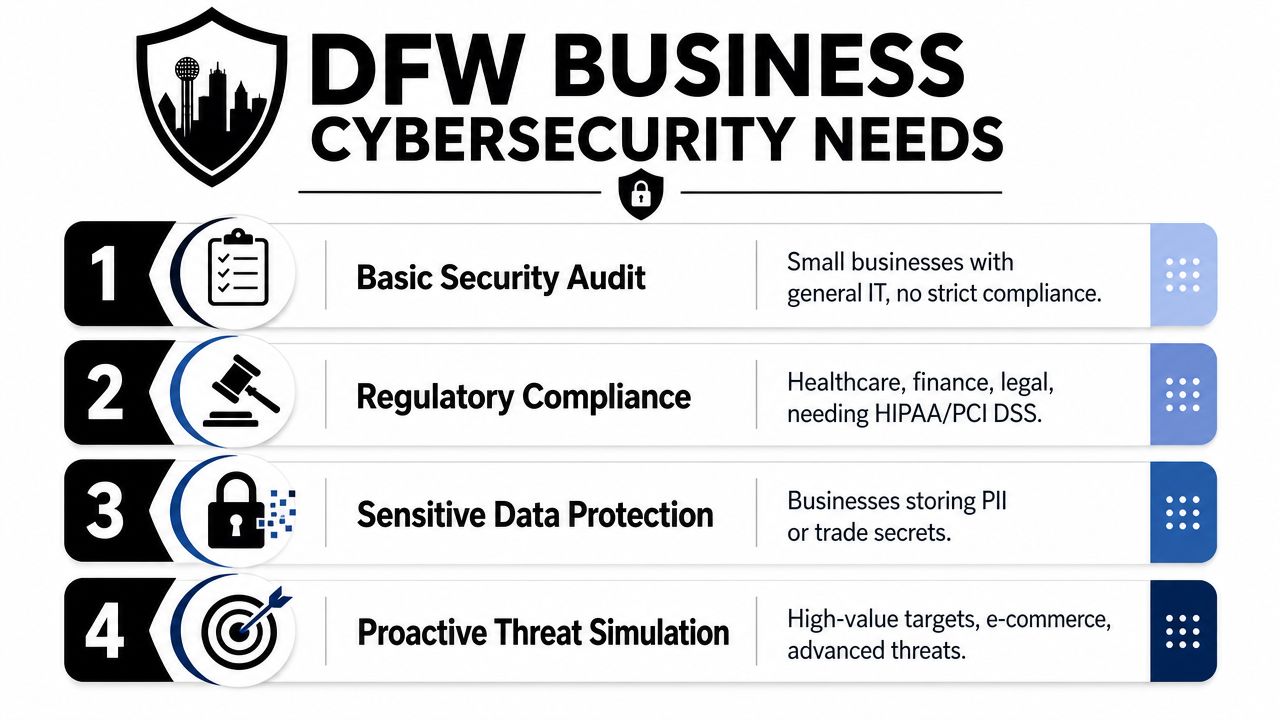
Start with the business outcome you need.
If you need a clear list of weaknesses to fix across systems, email, endpoints, cloud apps, and firewalls, start with a vulnerability assessment. If you need proof that an attacker could or could not reach sensitive data, bypass controls, or move between systems, pay for a penetration test.
Then pressure-test that decision with three questions:
- What would hurt the business most if exposed or disrupted? Patient records, trust accounts, case files, payroll data, and payment systems deserve more than a basic scan.
- What does your compliance obligation ask you to show? Some requirements focus on identifying weaknesses. Others expect testing that validates whether those weaknesses can be exploited.
- What changed in the environment? New cloud systems, remote access, mergers, office moves, vendor connections, and portal launches create new paths into the business.
For regulated SMBs, compliance language matters because it affects budget, audit readiness, and liability after an incident. A healthcare practice may need regular assessments to support its risk management process, but a penetration test becomes the smarter choice when patient data is exposed through portals, remote access, or third-party integrations. A law firm may not have the same formal framework as a hospital, yet client confidentiality creates the same business pressure. If privileged documents can be reached through a chain of smaller weaknesses, the firm still owns the fallout. A financial business or any company handling card data should assume both services belong in the plan, because routine identification and exploit validation solve different problems.
What regulated SMBs should do next
Healthcare practices should use vulnerability assessments as recurring maintenance. Then add penetration testing when the practice expands telehealth, adds external access points, or stores larger volumes of sensitive patient data. Waiting until after a breach to validate those controls is bad management.
Law firms should treat penetration testing as a business protection decision, not a luxury purchase. If attorneys and staff work remotely, share files through client portals, or rely on multiple offices, a pen test gives leadership a direct answer to the question clients care about. Can someone get in and reach confidential material?
Financial firms and payment-handling businesses should stop trying to choose one service forever. Use vulnerability assessments on a schedule. Use penetration testing at key moments, such as major system changes, compliance reviews, insurance renewals, or board-level risk reviews.
A simple model works:
- You lack current visibility. Start with a vulnerability assessment.
- You fixed the obvious weaknesses. Run a penetration test to see what still breaks.
- You operate under regulated or contractual security requirements. Map the requirement before you buy the service.
- You need help scoping the right mix. Review your environment through business cybersecurity services for DFW organizations.
Owners should also vet the provider before signing. This guide on selecting penetration testing partners is useful because it focuses on scope, reporting quality, and fit, not marketing language.
Small businesses do not need security theater. They need the right test, on the right schedule, tied to a real business risk and a clear compliance duty.
How to Choose Your Cybersecurity Partner
A Dallas medical practice passes a security review on paper, then fails the practical test when a vendor asks one simple question after an incident. Who tested your environment, what did they confirm, and who owned remediation? If your provider cannot answer that cleanly, you bought a report, not risk reduction.
That mistake hits regulated businesses harder. Healthcare groups need evidence that security work supports HIPAA safeguards. Law firms need proof they are protecting privileged client data, especially across remote access and document systems. Financial firms need testing that stands up to client due diligence, insurance scrutiny, and internal oversight. The partner matters as much as the test.
What to ask before signing anything
Start with a direct question. How will this engagement help me reduce business risk and satisfy a specific requirement?
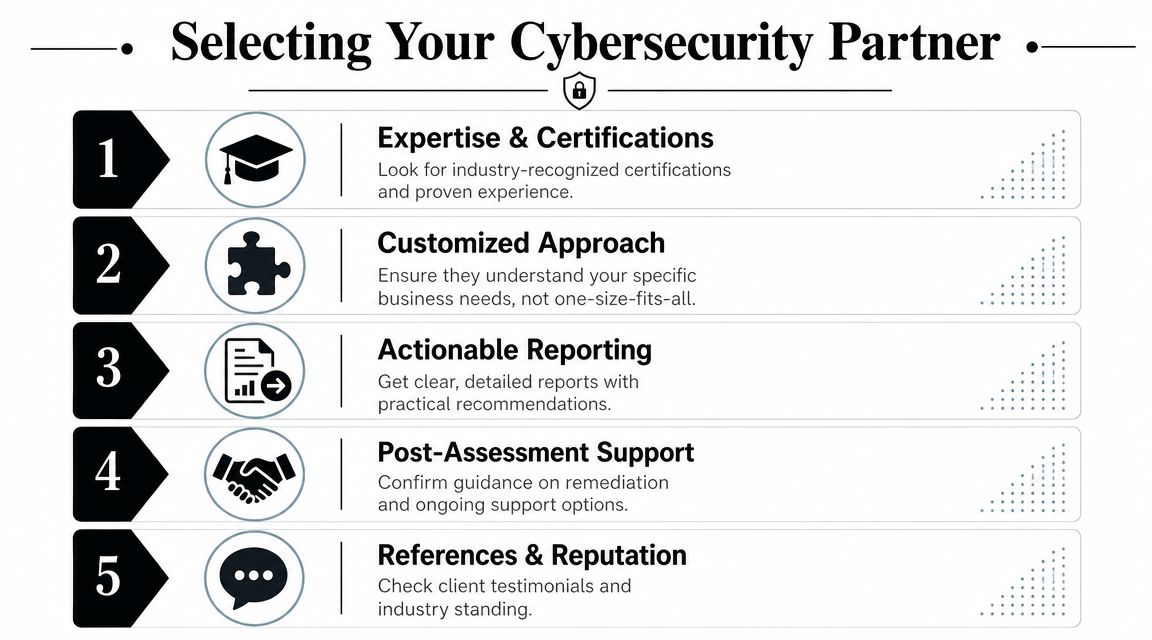
A good provider should answer in plain English. They should explain what they will test, why it matters to your business, what evidence you will get, and what your team needs to do after the report arrives. If you hear vague language, recycled templates, or a one-size-fits-all proposal for a clinic, a law office, and a wealth management firm, walk away.
Use these questions to screen them:
- Do you understand my industry obligations? A healthcare provider should know how testing supports HIPAA risk management. A legal services provider should understand confidentiality and client expectations. A financial firm should be able to map work to audit, insurance, and contractual reviews.
- Will you define the scope clearly? You need to know whether you are buying a vulnerability review, a penetration test, or a staged program that uses both.
- What will the report let me do next? The answer should include remediation priorities, ownership, and deadlines, not just a list of findings.
- Can you speak to executives and technical staff? Owners need business impact. IT needs technical proof and fix guidance. Compliance teams need traceable documentation.
- Will you help after delivery? Good firms stay involved long enough to confirm fixes, answer auditor questions, and help leadership decide what gets funded first.
For additional perspective, this guide on selecting penetration testing partners is useful because it focuses on fit, scoping, and reporting quality.
What good reporting looks like
Good reporting should settle decisions, not start arguments.
For a vulnerability assessment, expect a prioritized list of weaknesses, where they exist, how serious they are, and how to fix them. For a penetration test, expect a clear story of what the tester was able to reach, which controls failed, and what the business impact would have been if the attacker were real. If the report buries the outcome under jargon, it will not help your leadership team, your compliance reviewer, or your IT staff.
The best partners also show you how this work fits into your broader vendor strategy. Many small businesses already depend on outside IT support, which means cybersecurity testing cannot sit in a silo. If you are evaluating long-term fit, review this guidance on how to choose a managed service provider before you sign a testing agreement.
Choose the partner that can tie findings to action, compliance, and accountability. That is the provider that will save you time, reduce wasted spend, and hold up under real scrutiny.
From Understanding to Action with Technovation
The main takeaway is straightforward. A vulnerability assessment finds and prioritizes known weaknesses. A penetration test proves whether those weaknesses can be exploited in a way that creates business impact. Most regulated small businesses need both, just not for the same purpose.
The right starting point depends on current visibility, compliance obligations, and the sensitivity of the data involved. If a company doesn’t have a current picture of its weaknesses, it should begin there. If it already has scanning and remediation discipline, validation becomes the smarter next move.
For DFW businesses, local context matters. Industry pressure, client expectations, and regional responsiveness all affect how quickly security issues get addressed and how well remediation sticks.
Technovation LLC helps Dallas-Fort Worth businesses turn security testing into a practical plan instead of another confusing vendor conversation. With Technovation LLC, organizations can assess current risk, clarify whether vulnerability assessments, penetration testing, or both make sense, and align that work with compliance and business priorities. A direct conversation can save time, reduce wasted spend, and give leadership a clearer path forward.