

Is a managed service provider being evaluated as a cheaper helpdesk, or as the team that keeps revenue moving, data protected, and audits from turning into chaos?
That question exposes the biggest mistake Dallas-Fort Worth business owners make. They shop for IT support the way they shop for office supplies. Lowest monthly number wins. Then they discover the cost later, through downtime, security gaps, compliance friction, and reactive support that never fixes the root issue.
For healthcare groups, law firms, financial companies, construction businesses, and nonprofits across DFW, how to choose a managed service provider isn’t really an IT question. It’s an operating risk question. The right partner protects continuity, supports compliance, and gives leadership a plan. The wrong one creates noise, surprises, and recurring fire drills.
Table of Contents
- Beyond IT Support Finding a True Technology Partner
- First Map Your Business Needs and Compliance Risks
- The Non-Negotiable Criteria for Your MSP Shortlist
- Questions That Separate True Partners from Sales Pitches
- Common Red Flags and How to Make Your Final Decision
- Your Next Step Toward a Secure and Efficient Future
Beyond IT Support Finding a True Technology Partner
Most businesses still carry a break-fix mindset. They want someone who answers tickets, resets passwords, and shows up when something stops working.
That standard is too low.
A managed service provider touches every critical part of the business. Security. Backups. Compliance. User access. Vendor coordination. Recovery after an incident. Strategic planning. If the provider only acts like a helpdesk, leadership is outsourcing pain, not solving it.

Cheap IT usually becomes expensive IT
A business owner may look at managed services and assume in-house support is more controlled. The data says otherwise. A 2011 CompTIA study found that 96% of organizations reduced their annual IT costs by outsourcing, and 46% achieved savings of 25% or more through predictable flat-rate pricing and proactive monitoring, according to managed services statistics compiled here.
That matters because reactive environments always leak money. Staff lose time. Small issues pile up. Security work gets delayed. Maintenance gets pushed aside because nobody owns it consistently.
A better question is this: what happens to the business when technology is managed before it breaks?
Practical rule: If a provider mainly talks about how fast they fix issues, and barely talks about preventing them, that provider is still selling break-fix with better branding.
A real MSP should think like leadership
The right provider helps leadership connect IT decisions to business outcomes. That includes planning for growth, reducing operational drag, and making sure technology choices support the company instead of complicating it.
For regulated businesses in DFW, that leadership view matters even more. A medical practice doesn’t just need systems online. It needs reliable access, protected data, documented processes, and support that respects compliance obligations. A law firm needs secure document handling and continuity. A construction firm needs stable field connectivity and practical support for remote crews.
That is why strategic guidance matters as much as ticket resolution. A business that needs budgeting, planning, and risk alignment should look closely at virtual CIO service options when evaluating an MSP relationship.
The decision should change how the business operates
A true technology partner doesn’t just close tickets. That partner reduces friction across the company.
Signs of a strategic fit include:
- Clear planning: The provider can explain how IT supports hiring, expansion, security, and compliance.
- Operational discipline: Maintenance, patching, backups, and user support follow a defined process.
- Business fluency: The provider understands what downtime means for scheduling, billing, client service, and internal workflows.
- Accountability: Leadership gets visibility, not vague reassurance.
Businesses don’t need another vendor to “handle IT stuff.” They need a partner that treats resilience and growth as part of the same job.
First Map Your Business Needs and Compliance Risks
Many companies start the search backward. They talk to providers before they define what success looks like.
That guarantees a sales-led process instead of a business-led one.
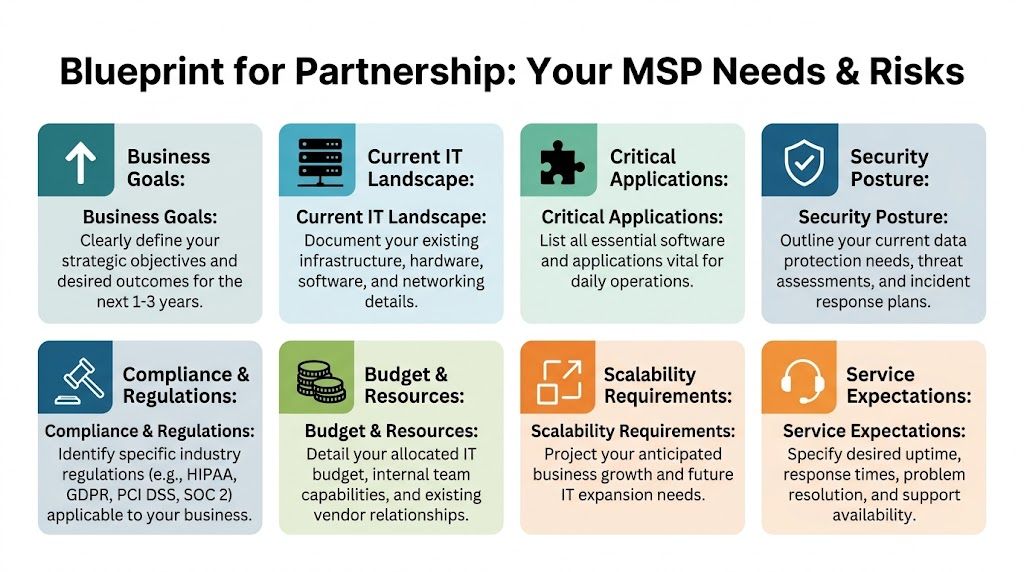
A business needs an internal needs document before it asks for proposals. Without it, every MSP sounds capable because the buyer hasn’t created a standard to judge them against.
Start with risk, not hardware
A list of laptops, servers, and software isn’t enough. That inventory matters, but it doesn’t explain exposure.
A stronger needs review starts with business consequences:
- Revenue interruption: Which systems stop work if they fail?
- Client impact: Which outages affect customers, patients, donors, or project deadlines?
- Compliance exposure: Which processes involve regulated data or records?
- Recovery pressure: Which systems must come back first after an incident?
For many DFW firms, security sits at the center of this exercise. A 2025 study found that 60% of organizations cite cybersecurity as the top challenge driving MSP partnerships, and 85% of mid-market enterprises depend on MSPs for security, according to this MSP selection analysis.
That doesn’t mean every business needs the same controls. It means every business needs clarity.
Build the needs document leadership will actually use
The document should be short, specific, and decision-oriented. One page is better than a bloated internal report nobody reads.
It should answer these questions:
-
What must the business protect?
Client records, financial data, design files, project documents, internal email, field device access, or remote endpoints. -
What rules apply?
Healthcare practices may need support around HIPAA-aligned processes. Financial firms may need tighter control over access, records, and oversight. Law firms need confidentiality and reliable document access. -
What causes the most disruption today?
Slow support, recurring outages, weak remote access, inconsistent backups, user lockouts, or poor onboarding and offboarding. -
Where is the business headed?
New office, more remote staff, cloud migration, acquisition activity, or tighter reporting requirements. -
What must the provider own?
Daily support, network oversight, endpoint protection, backup monitoring, vendor coordination, compliance support, or strategic planning.
A business that can’t describe its own risk profile will end up buying somebody else’s standard package.
Include operational expectations, not just technical requirements
At this point, many buyers get lazy. They ask whether an MSP offers support, security, and backups. Almost all of them say yes.
The useful questions are more operational:
- Support model: Who answers, how issues escalate, and what happens after hours.
- Monitoring scope: What gets watched continuously, and what only gets checked when someone complains.
- Backup reality: How backup success is confirmed and how recovery is handled.
- User experience: How quickly employees get help and whether recurring issues are tracked.
- On-site support: When a local visit is required and how that gets scheduled.
A business that needs reliable day-to-day infrastructure support should document those expectations before provider interviews begin. That makes it easier to compare candidates against actual service needs, especially for firms evaluating network support and maintenance.
A simple internal checklist works
Before any shortlist is built, leadership should confirm these points:
- Business priorities are written down: Growth, resilience, compliance, and user productivity are ranked in order.
- Critical systems are identified: The company knows what cannot go down without serious disruption.
- Risk owners are named: Someone owns operations, someone owns compliance, and someone approves budget.
- Current pain points are documented: Repeated issues are listed with examples, not vague complaints.
- Future plans are included: The provider should be evaluated against where the business is going, not just where it is today.
That document becomes the filter. Without it, the selection process becomes theater.
The Non-Negotiable Criteria for Your MSP Shortlist
Once the business knows what it needs, most providers still need to be eliminated quickly.
This is where discipline matters. A shortlist should be built on criteria that can be tested, not polished sales language. If a provider can’t show how service is delivered, measured, and improved, that provider shouldn’t survive the first round.
Local response is not a soft benefit
Plenty of MSP buyers treat local presence like a nice extra. In DFW, that’s a mistake.
A 2025 Channel Futures survey found that local MSPs in urban markets like Dallas-Fort Worth achieve a 45% faster mean time to resolution for critical incidents because of physical proximity, as reported in this discussion of MSP selection.
For a regulated business, faster resolution isn’t a convenience. It’s operational protection. When a clinic loses access, when a law office can’t reach matter files, or when a construction office has field connectivity problems, local response changes the outcome.
The shortlist should revolve around proof
The strongest MSP candidates can show what they do, how they measure it, and where the boundaries are.
A business should compare providers against a table like this:
| Criteria | What to Look For | Potential Red Flag |
|---|---|---|
| Service scope | Clear description of monitoring, support, backup, security, and strategic oversight | Vague promises like “full coverage” with no detail |
| SLA quality | Defined response commitments, escalation path, and priority definitions | “Best effort” language or unclear after-hours handling |
| Pricing model | Predictable structure with clear inclusions and exclusions | Low base fee followed by add-ons for basic work |
| Local capability | On-site support process for critical incidents in DFW | Remote-only model for every problem |
| Compliance fit | Experience supporting regulated workflows and documentation needs | Generic service package with no industry context |
| Reporting | Regular visibility into incidents, trends, and service performance | Reports that only list closed tickets |
| Proactive discipline | Evidence of maintenance, review cycles, and root-cause correction | Constant firefighting presented as responsiveness |
| Scalability | Ability to support new users, locations, and changing workflows without chaos | Contract structure that punishes change |
Pricing should be boring
That is a compliment.
A good pricing model is easy to understand and hard to manipulate. If the proposal creates confusion, the relationship will too. Buyers should want a provider whose commercial model rewards prevention, stability, and efficiency, not more incidents.
The wrong pricing structure creates bad incentives. If the provider makes more money when the environment is messy, leadership should expect a messy environment.
The monthly fee matters less than the total cost of inconsistency, surprise charges, and unresolved root causes.
SLAs should read like operating commitments
Many business owners barely read the SLA. That is where they lose their advantage.
A serious MSP should define what counts as critical, how quickly response begins, how communication works during an active issue, and what the client can expect after resolution. If the document is vague, accountability will be vague too.
Strong SLA review should include:
- Priority clarity: What qualifies as urgent versus routine.
- Escalation path: Who gets involved when the issue affects the whole business.
- After-hours process: Whether true support exists outside the standard workday.
- Communication expectations: How updates are delivered during incidents.
Industry fit has to be specific
A provider doesn’t need to serve only one vertical. But it does need to understand the workflows, constraints, and pressure points of the industries it supports.
That means asking whether the MSP understands:
- Healthcare workflows: Access reliability, user movement, and protected information handling.
- Legal operations: Document-heavy systems, confidentiality, and time-sensitive availability.
- Financial controls: Access discipline, record retention concerns, and oversight expectations.
- Construction realities: Field users, mobile devices, site connectivity, and changing project teams.
Generic IT support often sounds fine in a proposal. It falls apart in real operations. The shortlist should favor providers that can speak directly to how the business runs.
Questions That Separate True Partners from Sales Pitches
A polished presentation proves almost nothing.
The useful part of the process starts when the buyer asks questions that force the provider to reveal how it works under pressure, how it communicates, and how it thinks. That is how to choose a managed service provider without getting trapped by surface-level promises.

Ask process questions, not brochure questions
“Do you offer cybersecurity?” is a weak question.
A stronger version is, “How does the provider detect, escalate, contain, and recover from a ransomware event in a client environment?” That question forces specificity. It exposes whether the provider has a real operating model or just a category label.
Other strong questions include:
- Incident handling: What happens from first alert to final recovery when a critical security event appears?
- User support discipline: How are recurring user issues identified and fixed at the root?
- Onboarding method: How are assets, accounts, permissions, and documentation reviewed at the start of the relationship?
- Change management: How are updates, access changes, and configuration decisions approved and recorded?
Governance questions reveal maturity
One of the most overlooked parts of MSP selection is service governance. Buyers often focus on support availability and forget to ask how they will see performance, risk, and accountability over time.
That omission creates frustration later. A 2025 CompTIA report found that 42% of MSP clients report dissatisfaction due to poor transparency and metric tracking, according to this analysis of MSP selection factors.
A buyer should ask:
- What dashboards or reports are provided?
- Which service metrics are reviewed with leadership regularly?
- How are unresolved trends surfaced before they become major issues?
- How are compliance-related activities documented?
- Who owns the service review process on the provider side?
A provider that can’t explain how it reports performance usually isn’t managing performance. It’s narrating activity.
Questions that expose strategic depth
Some providers can support technology. Fewer can align it to the business.
Leadership should ask questions that test whether the MSP understands planning, not just tickets:
- How does the provider help with budgeting and prioritization?
- How does it advise on lifecycle decisions for aging hardware or risky systems?
- How does it support growth, remote work, or office expansion?
- How does it coordinate with internal staff, executives, or outside compliance advisors?
Good answers sound operational. Weak answers sound aspirational.
A short interview script for final meetings
The best buyer conversations are structured. They aren’t casual chats.
A final-stage provider should be able to answer this set cleanly:
- Describe a typical month of proactive work.
- Explain how critical incidents are communicated to leadership.
- Show a sample report used in business reviews.
- Explain what the provider needs from the client for a successful onboarding.
- Describe how recurring issues are identified and prevented.
- Explain what happens when the client grows, adds users, or changes systems.
One practical option in the DFW market is Technovation LLC, which provides managed IT, cybersecurity, compliance support, cloud backup, risk mitigation, and health checks for regulated and security-conscious organizations in North Texas. That kind of local, integrated support model is worth examining when a business wants one provider to handle both operations and strategic oversight.
Common Red Flags and How to Make Your Final Decision
A shortlist can still go wrong if leadership ignores obvious warning signs.
Most bad MSP relationships don’t fail because the provider lacked a slick proposal. They fail because the buyer accepted vagueness, tolerated pressure, or confused a low monthly number with value.
Red flags that should end the conversation
Some warning signs deserve immediate elimination.
- Unclear accountability: Nobody can say who owns strategy, support, security, or escalation.
- Rigid contracts: The provider pushes long lock-ins before trust is earned.
- Generic answers: Every question gets the same polished response, regardless of industry or risk.
- No meaningful references: The provider can’t connect prospects with similar businesses or similar operating environments.
- Thin documentation: Onboarding, reporting, and service boundaries are poorly defined.
One metric deserves special attention. A Repeat Incident Rate below 5% within 60 days is a strong target because it shows the MSP is fixing root causes, not just symptoms, based on this MSP evaluation guidance. If recurring issues keep returning, the provider is maintaining instability.
The final decision should be evidence-based
By the final stage, the business should narrow the field to a small set of serious contenders and compare them side by side.
A practical final review includes:
- Reference checks: Ask how the provider communicates under stress, not just whether the client “likes them.”
- Sample reporting review: Look for trends, accountability, and action items.
- Scope validation: Confirm what’s included, what’s excluded, and where charges may appear.
- Service walk-through: Ask the provider to explain what the first months of the relationship look like.
- Audit or health check: Use a real assessment to test the provider’s thoroughness and clarity.
Trust the provider that answers hard questions directly. Doubt the one that keeps redirecting the conversation back to price.
Gut instinct matters when it’s tied to evidence
Business owners shouldn’t ignore pattern recognition. If the provider avoids specifics, rushes commitment, or resists transparency, that behavior usually gets worse after signing.
The right MSP relationship should feel disciplined. Expectations are clear. Language is plain. Responsibilities are visible. The provider doesn’t need drama to sound valuable.
That matters in DFW, where many businesses need an MSP that can support daily operations and satisfy compliance expectations at the same time. A provider that can’t handle both shouldn’t make the final cut.
Your Next Step Toward a Secure and Efficient Future
The businesses that choose well usually approach this decision differently from the start. They don’t ask who can “handle IT.” They ask who can support continuity, accountability, and growth.
That shift changes everything.
A smart MSP evaluation starts with internal clarity. It gets sharper when leadership demands proof around local support, service levels, governance, and industry fit. It gets safer when the final decision is based on evidence instead of sales polish.
For DFW organizations in healthcare, legal, finance, construction, and nonprofit work, the stakes are bigger than support convenience. The provider will influence compliance readiness, incident response, staff productivity, and leadership confidence in every major technology decision.
That is why price should never be the primary filter. Cost matters. Hidden risk costs more.
A strong managed service relationship should produce a calmer operating environment. Fewer surprises. Better visibility. Clearer planning. More confidence that systems, users, and data are being managed with discipline.
Businesses that want a practical next step don’t need to commit to a contract first. They need a grounded view of their current environment, where the risks sit, and where operations are being held back by reactive support.
A Dallas-Fort Worth business that wants that level of clarity can start with a complimentary IT health check or security audit from Technovation LLC. It gives leadership a concrete look at current risk, support gaps, and improvement priorities before making an MSP decision.