At 2:07 a.m., a login from an unfamiliar location triggers an alert at a small medical office in Plano. The office manager is asleep, the practice owner is unreachable, and the IT contact sees the notification hours later. The business has logs, endpoint protection, and a dashboard full of events. What it doesn't have is clear ownership of the next decision.
That distinction separates cybersecurity monitoring services from simple log collection. A monitoring service should identify suspicious activity, determine whether it matters, investigate the surrounding evidence, and coordinate containment. It should also leave behind a defensible record of what happened, who acted, and when.
For Dallas-Fort Worth businesses, the right decision isn't whether to buy more alerts. It's whether a provider can own the operational gap at night, during holidays, and during the difficult hours after an incident begins. The sections below explain what these services do, how SIEM, EDR, MDR, and SOC/NOC functions differ, where they help SMBs, how they support HIPAA and PCI obligations, and what buyers should demand before signing.
Table of Contents
- A 2 A.M. Wake-Up Call and Why It Matters
- What Cybersecurity Monitoring Services Actually Do
- The Main Types of Monitoring Services Compared
- Real Benefits for SMBs and Regulated Teams
- How Monitoring Supports Compliance and Audit Readiness
- Choosing a Monitoring Partner Without Getting Burned
- Why a Local DFW Partner Changes the Equation
A 2 A.M. Wake-Up Call and Why It Matters
At 2:07 a.m., an alert reaches a DFW medical practice. It may involve a stolen password, an unusual file transfer, or a workstation contacting an unfamiliar system. The technology can flag the event, but it cannot decide whether to isolate a nurse's workstation, disable an account, or notify leadership before the first appointment.
A construction company faces the same ownership problem on a job site. A laptop connects to a corporate application after hours, authenticates repeatedly, and triggers an identity alert. The project manager may recognize the equipment, yet nobody may know whether the activity reflects normal remote work or account abuse. A ticket created at 2 a.m. is only an assignment until a person accepts responsibility.
Logs aren't ownership
Many organizations already collect endpoint events, firewall records, cloud activity, and authentication logs. Those records often sit in separate consoles, with no assigned person responsible for correlating them, escalating the event, recommending containment, or preserving evidence.
Practical rule: A monitoring contract should name the person or team responsible for investigation, escalation, containment recommendations, and evidence preservation.
The difference is time and accountability. Attackers benefit when alerts wait in a queue, especially during nights, holidays, and staff shortages. Continuous telemetry and device monitoring help analysts connect activity across systems, but collected evidence has value only when someone reviews it and acts on the findings.
A business owner does not need another dashboard tour. The owner needs direct answers:
- What happens when an alert fires?
- Who calls the office?
- Who can isolate a device or disable an account?
- Who preserves the timeline?
- Who explains the event to a regulator, insurer, or client?
Those answers should be written into the operating model, tested before an incident, and tied to the organization's authority limits. A provider that can only open a ticket is not owning the overnight gap.
Incident handling also connects to recovery planning. A business that understands RTO and RPO explained simply can set clearer limits for disruption and determine how quickly systems must return after containment. Monitoring identifies the problem. Recovery objectives guide the business decision that follows.
Technovation's incident response procedures offer a useful reference for defining responsibilities before an emergency. The test is simple: when serious activity fires at 2 a.m., can the organization investigate, contain, and prove what happened without waiting for the workday?
What Cybersecurity Monitoring Services Actually Do
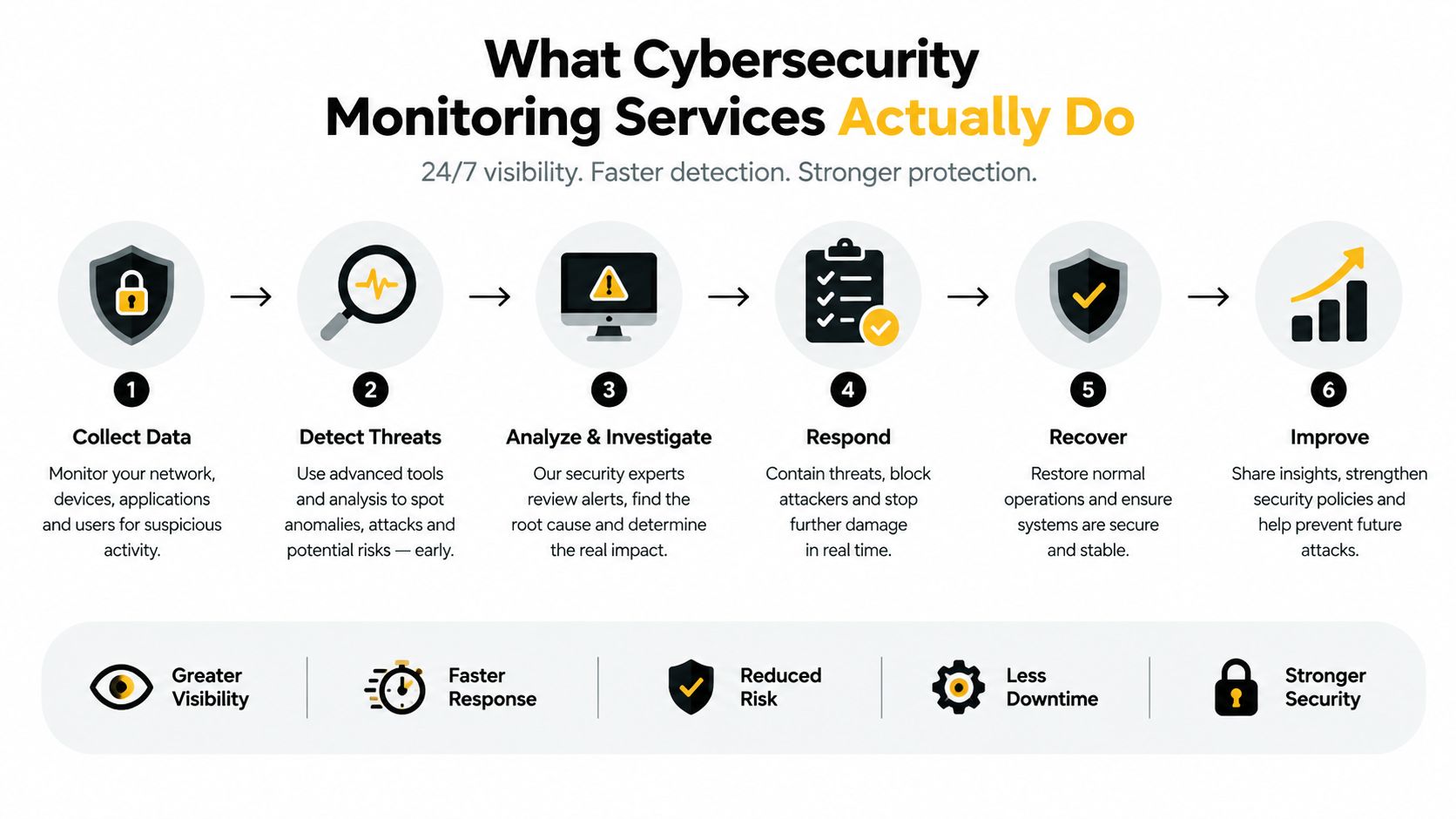
A useful analogy is a security operations team that never sleeps. It watches activity across the business, compares new behavior with established patterns, investigates anomalies, and brings in the right decision-makers when an event needs human judgment.
The work begins with telemetry. A capable platform collects activity from endpoints, identities, applications, networks, and cloud control planes. High-value events include authentication, privilege elevation, data access, and configuration changes. Those events should be normalized into a common schema so an analyst can connect a suspicious login with a new privilege assignment or an unusual file operation.
The operating layers
The service generally combines several activities:
- Collection: Agents, connectors, and cloud integrations gather security-relevant events.
- Normalization: The service organizes different event formats into a usable structure.
- Detection: Rules and behavioral models identify activity that deserves attention.
- Triage: Automated logic removes obvious benign events and prioritizes risk.
- Investigation: Analysts examine related users, devices, applications, and historical activity.
- Response: Authorized personnel recommend or execute actions such as isolating a host, disabling a user, or blocking malicious behavior.
- Improvement: The team tunes detections after reviewing what worked, what created noise, and what evidence was missing.
The platform performs much of the repetitive work. It can collect events continuously, compare behavior, enrich an alert, and trigger a predefined action. It can't reliably understand every business context, such as whether a new login reflects a legitimate physician working remotely or an attacker using a compromised account.
That's why the contract must distinguish automation from human ownership. An alert-only service may send notifications without investigating them. A managed detection and response service attaches analysts and escalation processes to the technology. A broader SOC function may coordinate monitoring, threat hunting, incident communication, and operational reporting.
Evidence is part of the deliverable
The output isn't just an alert count. It should include investigation notes, event timelines, disposition reasons, response actions, and follow-up recommendations. That record supports security decisions and can also help an organization understand reducing legal risk with data security.
The security operations center overview helps clarify why people, process, and technology must operate together. A dashboard can show that an event occurred. A mature monitoring service explains what the event means, what happened next, and which control should change so the same weakness doesn't return.
The Main Types of Monitoring Services Compared
The four labels most buyers encounter describe different parts of the operating model. They overlap, but they aren't interchangeable.
| Service Type | Primary Function | Best Fit | Human Involvement |
|---|---|---|---|
| SIEM | Centralizes, correlates, searches, and retains logs across systems | Organizations needing broad visibility, investigations, and evidence retention | Varies. Analysts are required for meaningful triage and investigation |
| EDR | Detects and responds to suspicious activity on endpoints | Businesses needing workstation and server visibility with containment capability | Can be automated, internally managed, or attached to a managed service |
| MDR | Combines detection technology with managed investigation and response | SMBs without a staffed security operations team | Continuous analyst involvement with defined escalation |
| SOC or NOC functions | Provides ongoing security operations or network operations oversight | Organizations needing broader operational coverage across security and infrastructure | Depends on scope, staffing model, and escalation design |
SIEM and EDR solve different visibility problems
A SIEM helps connect activity across identities, applications, networks, and cloud systems. It becomes valuable when an investigation requires a longer timeline or evidence from multiple sources. Its weakness is operational. A company can deploy a SIEM and still lack the people, tuning, and procedures needed to use it well.
EDR focuses more narrowly on endpoints. It can reveal process activity, suspicious execution, persistence attempts, and other behavior on workstations and servers. EDR is powerful for containment, but endpoint visibility alone won't explain every identity, cloud, or network event.
MDR adds an accountable operating layer
MDR is often the practical choice for an SMB that needs continuous detection without building a full internal security team. The value isn't the label. The value comes from the attached analysts, investigation process, response authority, and reporting discipline.
SOC and NOC functions can extend beyond alert handling. A SOC may oversee security investigations and incident response, while a NOC may monitor availability, network performance, and infrastructure health. Some businesses need both, but they should define where security responsibility ends and general IT operations begin.
Businesses comparing cybersecurity monitoring tools should start with coverage and ownership, not product features. A regulated SMB commonly combines endpoint detection, centralized event collection, identity monitoring, and managed analyst response. The correct combination depends on what systems hold sensitive data, which environments require continuous oversight, and who can act when the internal team isn't available.
Real Benefits for SMBs and Regulated Teams
At 2 a.m., a suspicious login hits a clinic, law firm, or construction company. The practical question is not whether a dashboard recorded it. It is who investigates, contains the issue, and documents what happened while the business owner and internal administrator are unavailable.
The strongest budget argument for monitoring is operational. A business can shorten the time between suspicious activity and investigation, maintain after-hours coverage without hiring a full overnight team, and produce records showing how alerts were reviewed and handled. That ownership matters more than adding another notification source.
One published SMB benchmark sets a target mean time to detect high-severity incidents at under 15 minutes and mean time to respond to critical incidents at under 30 minutes. The incident handling benchmark documents those targets, turning general promises about speed into service expectations that can be written into procedures and reviewed with a provider.
Another MDR overview cites a 2023 survey in which SMBs using managed detection and response reduced average dwell time from 78 days to under 12 days, with potential breach costs falling by roughly 60%. The figures appear in this MDR overview for SMBs. Treat them as reported survey results, not a promise for every environment. They still show why earlier investigation can reduce exposure and cost.
The business case changes by sector
| Business Type | Key Benefit | Typical Outcome |
|---|---|---|
| Medical practice | Faster investigation of identity and endpoint anomalies | Staff can contain a suspected account or device issue before it spreads across clinical workflows |
| Law firm | Documented handling of client-data alerts | The firm has clearer evidence for client security questionnaires and internal review |
| Accounting or financial office | Correlated monitoring across users, endpoints, and cloud services | Renewal and audit questions can be answered with organized records instead of manual searching |
| Construction or engineering company | Coverage for distributed users, job sites, and remote access | IT can distinguish normal field activity from suspicious access without waiting for office hours |
The trade-off is staff capacity. Without managed coverage, an administrator may spend the morning reviewing overnight alerts instead of serving employees or clients. Poor tuning creates a second problem: a flood of low-value events that obscures the few requiring action. One benchmark reports 46% of alerts as false positives, while another describes organizations receiving over 500,000 alerts with 95–98% classified as non-critical or false positives. These figures are summarized in the alert fatigue analysis.
The SANS detection and response survey analysis reports that 73% of organizations named false positives as their number one challenge, and more than 60% encountered them frequently or very frequently. Monitoring earns its keep only when analysts improve signal quality and take ownership of investigation, rather than forwarding more notifications to an already busy team.
Technovation's managed IT security services fit businesses that need monitoring connected to broader IT support, incident planning, and coverage-gap reviews. The right investment should reduce analyst workload, strengthen response readiness, and leave the owner with records that are clear enough to review without reconstructing the night from scattered alerts.
How Monitoring Supports Compliance and Audit Readiness
At 2 a.m., a suspicious login appears in a DFW clinic, law firm, or job site. The compliance question is not whether a dashboard recorded it. The question is who investigated the event, contained the risk, and can prove those actions later.
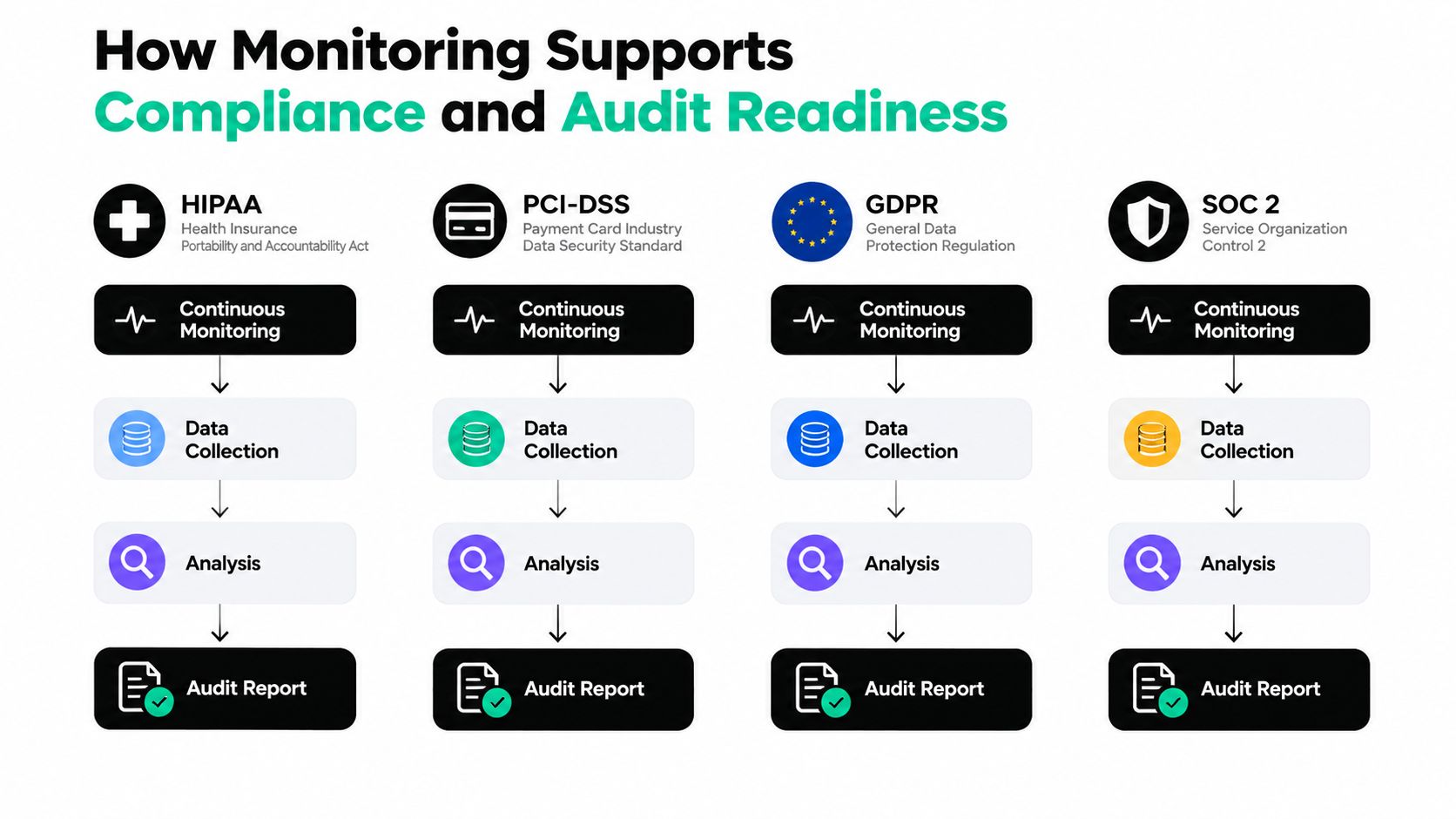
Compliance starts with defined data, retention, access, escalation, and reporting requirements. Monitoring should be configured around those requirements, not added as a generic stream of alerts.
For a healthcare practice, coverage should include unusual access to patient systems, privilege changes, and suspicious activity on clinical endpoints. HIPAA readiness also depends on workforce behavior and documented procedures, so administrators may need to browse HIPAA training requirements alongside technical controls.
PCI-DSS adds payment-system obligations. A retailer or processor needs visibility into systems that handle payment data, evidence that relevant events were reviewed, and a clear response record when a payment-related system behaves abnormally. Logging alone does not show that anyone assessed the event.
GDPR adds data protection and incident-accountability requirements for organizations handling EU personal data. Monitoring should support access reviews, investigation timelines, and records showing how the organization handled suspicious activity involving personal information.
SOC 2 readiness generally requires service organizations to show that controls operate consistently. Monitoring can support that evidence through access events, alert dispositions, change records, and documented escalation.
Logging and monitoring are different controls
Logging records that an event occurred. Monitoring shows that someone assessed it and responded appropriately. Auditors may ask for both, plus proof that records were protected from improper alteration and retained for the required period.
CERT-In directions show why operating requirements matter in a specific jurisdiction. Covered organizations must retain ICT system logs for 180 days and report covered incidents within 6 hours of noticing them. A service that only generates alerts does not complete the evidence and notification workflow.
A useful audit package should show:
- Retention: Which systems are covered, how long records remain available, and how evidence is protected.
- Access review: Who accessed sensitive systems and whether privileges changed.
- Alert disposition: Why an alert was closed, escalated, or tied to a confirmed incident.
- Incident timing: When the event was detected, investigated, contained, communicated, and resolved.
- Ownership: Which internal and external parties made each decision.
These records reduce audit preparation, insurance inquiries, and client security reviews because the business does not have to reconstruct events from scattered consoles. A clean evidence trail does not replace compliance counsel or an auditor. It gives both parties a reliable operational record and makes coverage easier to prove.
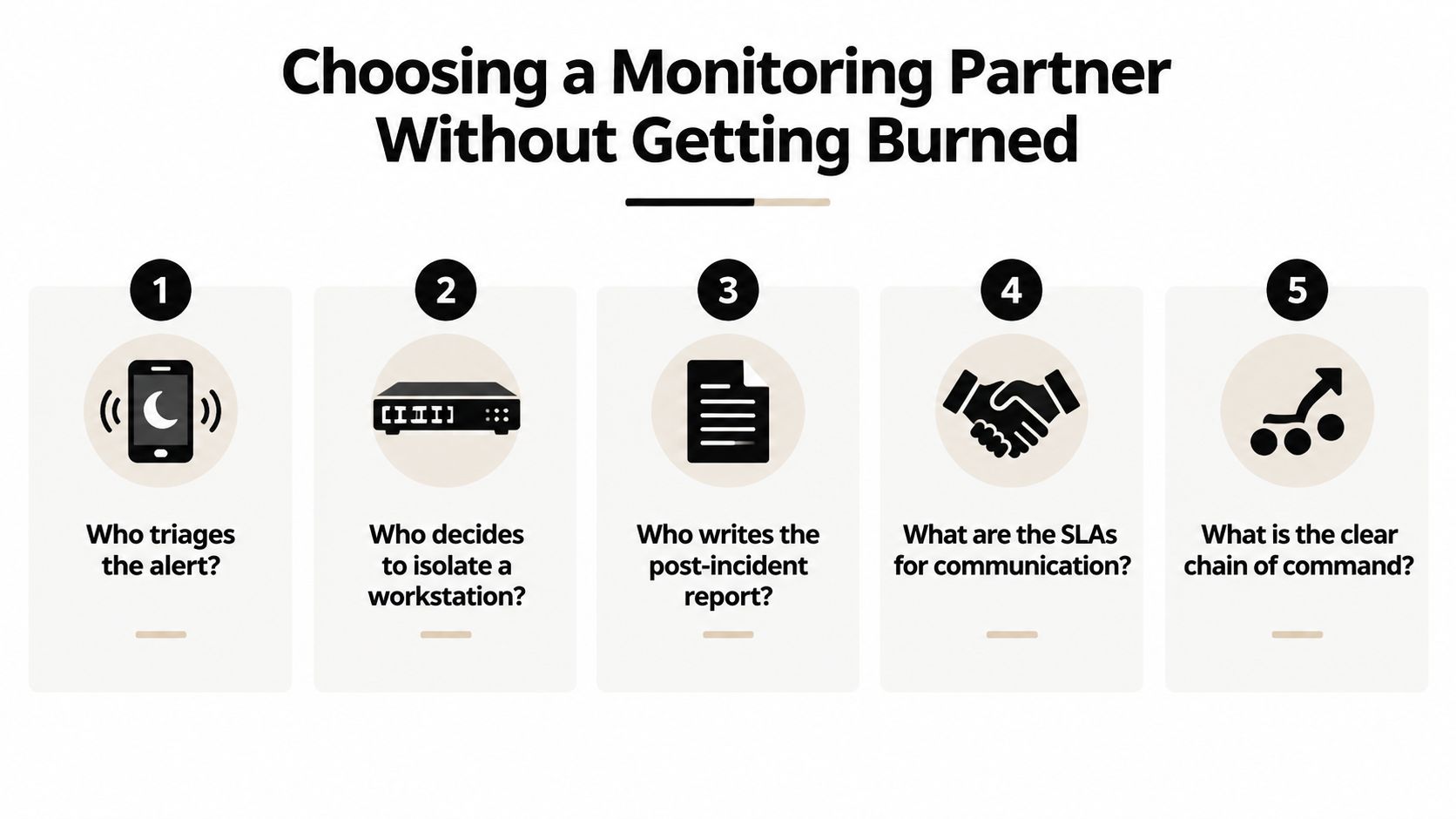
Choosing a Monitoring Partner Without Getting Burned
The usual buying checklist asks whether a provider supports endpoints, cloud systems, identity, and network devices. Those questions matter, but they don't reveal who owns the hard decisions.
Ask who triages the alert at 2 a.m. A strong answer identifies a staffed team, a defined severity model, an escalation path, and the point at which the customer is contacted. A weak answer points to a shared inbox or says the customer will receive a notification.
Ownership questions deserve direct answers
Ask who can isolate a workstation. The provider should explain whether it has authority to act, whether approval is required, and how the action is documented. If every containment step waits for an unavailable administrator, the service may provide visibility without protection.
Ask who writes the post-incident report. A mature response includes a timeline, affected systems, actions taken, remaining risk, and corrective recommendations. A red flag is a provider that closes the ticket without explaining the investigation.
Ask who is responsible if evidence is missing before an audit. The contract should describe retention, export rights, tenant separation, data residency, and the process for retrieving records. Logs locked inside a vendor platform can become a serious exit problem when a business changes providers.
Contract details can quietly change the service
Some agreements promise continuous monitoring but deliver only alert forwarding. Others rely on analysts whose location, language coverage, or working hours don't match the customer's escalation needs. Shared environments may also create unanswered questions about tenant separation and where records are stored.
Buyers should carry this checklist into every sales call:
- SOC coverage: Identify the operating hours, staffing model, and level of analyst handling.
- Escalation path: Confirm who receives critical notifications and how the provider reaches them.
- Response authority: Document which actions the provider can take without waiting for approval.
- Reporting cadence: Require investigation summaries, trend reporting, and post-incident documentation.
- Coverage proof: Ask for an example of the evidence package produced after a real incident.
- Exit terms: Confirm that logs, case notes, and timelines can be exported in a usable format.
A provider should also explain how it tunes detections for the customer's environment. The 2025 SANS reporting cited earlier found false positives remain a dominant operational challenge. A service that can't explain how it learns normal business activity, reviews alert quality, and measures analyst workload is selling volume rather than control.
Why a Local DFW Partner Changes the Equation
Geography affects response. A DFW-based team can understand the practical differences between a Plano clinic, a Fort Worth law firm, and a Midlothian job site. Those environments may use different remote-access patterns, connectivity arrangements, vendors, and business priorities, even when they share the same security technology.
Local support also matters when remote containment isn't enough. A device may need to be physically removed, a network connection may need to be checked, or staff may need help operating from a temporary location. A local partner can coordinate those activities directly instead of treating every issue as a remote ticket.
Partnership works beyond the alert
Quarterly business reviews are more useful when the provider understands the business operation behind the data. Tabletop exercises improve when the people responsible for clinical care, client confidentiality, accounting deadlines, or field production can participate in the same planning conversation.
DFW organizations also face sector-specific pressures. Healthcare practices must protect patient information, law firms manage sensitive client material, financial offices answer security questions from institutions and clients, and manufacturers may face customer-driven security reviews. A monitoring plan should reflect those realities rather than apply the same alert policy to every customer.
A local MSP should therefore be judged by more than response proximity. It should connect monitoring with incident planning, backup and recovery, compliance evidence, access reviews, and ongoing IT decisions. That relationship turns cybersecurity monitoring services from a ticket queue into an operating responsibility.
Technovation LLC provides DFW businesses with 24/7 cybersecurity monitoring across endpoint, identity, network, and cloud environments, along with managed cybersecurity support, incident response planning, and coverage-gap reviews. Businesses evaluating their current ownership model can visit Technovation LLC to request a security audit or IT health check and discuss whether co-managed or fully managed support fits their risk and staffing needs.