
How does a business owner know whether the company is secure enough if nothing visibly bad has happened yet?
That question exposes a blind spot in how many small and mid-sized firms think about IT. If staff can log in, email works, and files are accessible, security can look “fine.” But uptime and security aren't the same thing. A business can run smoothly while carrying hidden exposure in old devices, weak account controls, unmanaged vendors, or undocumented sensitive data.
That's where Cybersecurity Risk Management matters. It turns security from a vague technical concern into a business discipline. Instead of asking, “Do we have antivirus?” the better question becomes, “Which digital risks could interrupt operations, trigger compliance trouble, or hurt clients, and what should be fixed first within budget?” For DFW businesses in healthcare, legal, finance, and other regulated industries, that shift in thinking is long overdue.
Table of Contents
- Is Your Business Flying Blind to Cyber Risk
- What Cybersecurity Risk Management Really Means
- The 5 Phases of the Risk Management Lifecycle
- Meeting Compliance Demands Like HIPAA and FINRA
- Your Practical Roadmap to Getting Started
- Building Resilience Through Partnership
Is Your Business Flying Blind to Cyber Risk
A surprising number of companies still manage cyber exposure by waiting for obvious signs of trouble. If no one has reported fraud, no server has crashed, and no patient or client has complained, leadership assumes the risk is under control. That approach works right up until it doesn't.
In reality, absence of visible damage is not evidence of healthy security. It often means the business hasn't measured exposure in a way that leadership can use. Cybersecurity risk management fills that gap by connecting technical weaknesses to practical business outcomes like downtime, missed billings, client trust, audit readiness, and recovery costs.
In 2026, cyber incidents are ranked as the top global business risk, with 42% of enterprise leaders identifying them as their primary corporate concern, surpassing business interruption and economic slowdown, according to this risk management statistics summary. That matters because the issue is no longer confined to large enterprises with dedicated security teams. Smaller firms now face the same categories of attack, but usually with less internal capacity.
The real problem isn't tools, it's visibility
Most SMBs don't need more jargon. They need a clear answer to basic leadership questions:
- What data matters most: Client records, financial files, legal documents, architectural plans, HR data, or internal email.
- Where the business is exposed: Aging endpoints, weak passwords, missing access reviews, insecure remote work habits, or unmanaged third-party access.
- What happens if something fails: Lost revenue, halted service delivery, delayed payroll, reporting obligations, or reputational damage.
Practical rule: If leadership can't rank its top digital risks in plain language, the business is operating on assumptions.
That's why an assessment matters more than guesswork. A structured review gives owners and managers something far more useful than a generic “you're vulnerable” warning. It creates a list of risks, their likely business impact, and the actions worth funding first. For firms that need a starting point, a practical cybersecurity risk assessment template can help turn abstract concerns into a usable checklist.
Why this matters in DFW SMB environments
In Dallas-Fort Worth, many regulated businesses run lean. A clinic manager, office administrator, or managing partner often wears multiple hats. Security decisions get pushed down the list because operations feel more urgent. That's understandable, but it creates a pattern where risk accumulates unnoticed in systems no one is reviewing with business context.
Cybersecurity risk management changes the conversation. It asks what needs protection, what level of disruption the business can tolerate, and which controls make financial sense now instead of later. That's a much better operating model than waiting for an incident to reveal the gaps.
What Cybersecurity Risk Management Really Means
Cybersecurity risk management is often misunderstood as “locking everything down.” That's not the job. The job is making informed trade-offs so the business protects what matters most without overspending on low-value controls or underfunding critical ones.
A useful analogy is property insurance. A business doesn't remove all chance of loss. It decides what's valuable, what could go wrong, what level of protection is reasonable, and where the cost of prevention is justified. Security works the same way.

Risk is a business decision
At a practical level, risk has three moving parts. There is a threat, such as phishing, ransomware, account takeover, or data theft. There is a vulnerability, such as weak passwords, missing patches, poor permissions, or untrained staff. Then there is impact, which is what the incident costs the business in operations, compliance, or trust.
That's why buying a security product alone doesn't equal a risk strategy. A company may have decent protection on laptops but no reliable process for offboarding employees. It may back up data but never test recovery. It may encrypt devices but overlook disposal of old hardware. In that last case, operational convenience can create unnecessary exposure, which is why some organizations use services focused on guaranteed unrecoverable data destruction when retiring failed or surplus drives.
A sound plan also recognizes that not every risk gets the same treatment. Some risks should be mitigated immediately. Others can be reduced over time, transferred through insurance, or formally accepted if the cost of prevention outweighs the business value at stake. That's the heart of risk mitigation strategy planning. It's not about perfection. It's about disciplined prioritization.
What counts as impact
Non-technical owners sometimes think impact means only “how much data could be stolen.” That's too narrow. Impact usually shows up first in workflow.
Consider a few common examples:
| Situation | Business impact |
|---|---|
| Staff lose access to email and shared files | Scheduling stalls, approvals stop, customer response times slip |
| A user account is compromised | Fraud risk increases, confidential messages may be exposed |
| Sensitive records are stored in too many places | Audit preparation gets harder, retention becomes inconsistent |
| A key vendor has poor security hygiene | The business inherits operational and compliance risk indirectly |
Security spending works best when it follows business criticality, not noise. The loudest issue isn't always the most expensive one to ignore.
For SMBs, that distinction matters. It keeps attention on controls that protect continuity and compliance instead of chasing every technical alert equally. Good cybersecurity risk management is less about checking boxes and more about funding the right protections in the right order.
The 5 Phases of the Risk Management Lifecycle
Most security problems don't come from a total lack of effort. They come from fragmented effort. A company buys a few tools, reacts to isolated issues, and assumes that equals a strategy. A lifecycle approach fixes that by giving the business a repeatable operating rhythm.
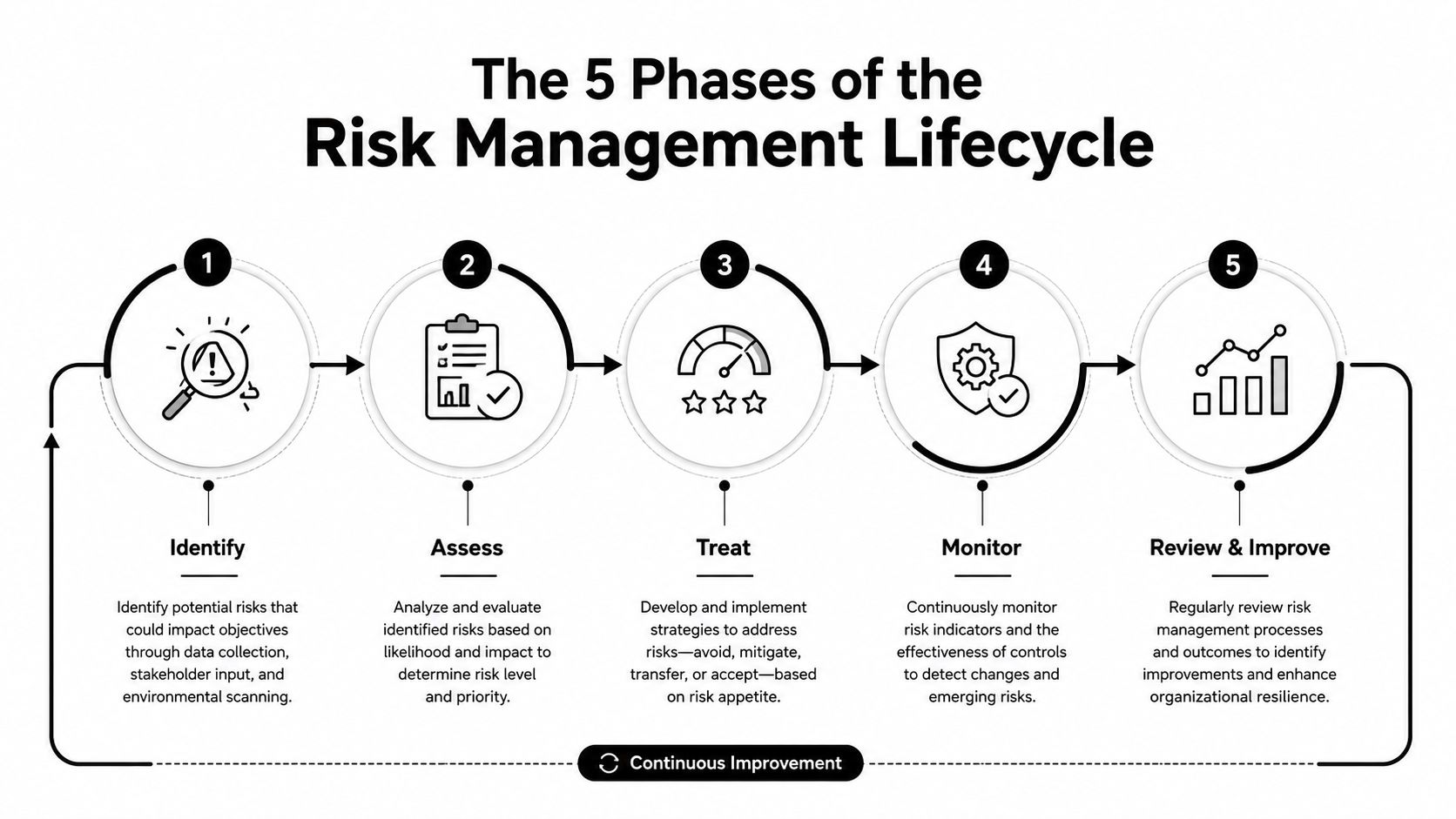
The NIST Cybersecurity Framework 2.0 overview describes a structured methodology built on six core functions: Govern, Identify, Protect, Detect, Respond, and Recover, which align with a continuous risk management lifecycle. For an SMB, that can be translated into five working phases that leadership can use.
A simple operating rhythm
Identify
Start with what the business has and what it depends on. That includes devices, cloud apps, shared drives, remote access paths, vendors, and sensitive data. If a law firm stores case files in multiple places or a clinic has patient information across several systems, leadership needs that mapped before any serious prioritization can happen.Assess
Once assets and exposures are visible, the next question is business effect. Which weaknesses are most likely to be exploited, and which ones would hurt the most if they were? Leadership then separates a nuisance from a real operational threat.Treat
Treatment means choosing a response. That might involve reducing the risk with stronger controls, accepting it, transferring part of it, or changing the business process that created it. Vulnerability identification often starts here, and routine vulnerability scanning helps turn assumptions into a prioritized remediation list.Monitor
Controls don't stay effective on their own. Systems change, users change, vendors change, and attackers adapt. Monitoring catches drift, suspicious behavior, and control failures before they become larger business events.Review
Risk decisions need a revisit. A mitigation that made sense six months ago may no longer match how the company works today. Review is where leadership validates whether the current plan still fits actual operations.
Where businesses get stuck
The lifecycle sounds straightforward, but SMBs typically hit the same stumbling points:
- They identify without ranking. A long list of issues isn't the same as a prioritized risk register.
- They assess technically but not financially. “High severity” on a scan report doesn't automatically mean “highest business priority.”
- They treat one-time issues but ignore process flaws. Resetting a password helps once. Fixing onboarding and access control prevents repeat exposure.
- They monitor alerts but not outcomes. The important question isn't whether alerts exist. It's whether the business knows who responds, how fast, and what gets escalated.
- They review only after a scare. That's too late.
For incident planning inside that lifecycle, businesses often benefit from plain-language operational guidance such as NIST incident response guidance from CMMC Shield, especially when leadership needs to understand containment, communication, and recovery responsibilities before an event occurs.
A mature process doesn't mean complicated paperwork. It means the business can answer who owns the risk, what is being done about it, and when it will be checked again.
That's the difference between scattered security activity and real cybersecurity risk management.
Meeting Compliance Demands Like HIPAA and FINRA
For regulated businesses, cybersecurity risk management is not just a smart operating model. It's part of staying in business without inviting unnecessary legal, contractual, and audit trouble.
Healthcare practices, wealth managers, accounting firms, and law offices all handle information that carries outsized consequences if exposed or mishandled. Regulators generally don't expect perfection. They do expect evidence that the organization identified risk, made reasoned decisions, assigned responsibility, and maintained controls in a way that fits its environment.
Compliance starts with documented judgment
The biggest mistake many SMBs make is treating compliance like a paperwork project. They collect policies, sign forms, and assume that's enough. It isn't. Regulators and auditors look for signs that the business has linked written controls to real operations.
That means leadership should be able to show things like:
- Asset awareness: What systems, records, and workflows fall inside the compliance boundary.
- Control decisions: Why certain protections were chosen and how they are maintained.
- Role clarity: Who approves access, who reviews incidents, who handles vendors, and who owns remediation.
- Evidence of follow-through: Logs, reviews, training records, policy updates, and risk treatment notes.
A formal program makes those answers easier to produce because it ties compliance to actual business judgment instead of disconnected documents.
Why vendor oversight belongs in the same conversation
Many firms think of compliance as an internal issue only. That's outdated. A growing share of exposure comes through outside service providers, cloud platforms, billing partners, consultants, and software vendors. If one of those relationships creates a weak link, the business still owns the consequences.
The Kudelski Security executive summary on business and cyber risk convergence notes that the convergence of business and cyber risk is driven by new regulations and third-party vulnerabilities, with directives like the EU's NIS2 imposing significant penalties for non-compliance in critical sectors, including healthcare and financial markets.
That point lands even for local SMBs that don't operate in Europe. The lesson is broader than one directive. Regulators increasingly expect organizations to understand how supplier access, hosted systems, and outsourced workflows affect security and continuity.
A business can't outsource accountability. It can outsource tasks, support, and infrastructure. The responsibility for risk stays with the organization.
For HIPAA-oriented environments, that means risk analysis and safeguards cannot stop at internal devices. For FINRA-adjacent firms, documented controls around client data, access, and incident response need to reflect how the business functions, including outside dependencies. The companies that handle compliance best don't separate “security work” from “audit work.” They run one program that supports both.
Your Practical Roadmap to Getting Started
Most SMBs don't need a giant transformation plan. They need a sequence that fits normal business constraints. That means limited staff time, competing priorities, and budgets that must show value quickly.
That's especially important because Cisco's 2026 Cybersecurity Readiness Index found that 71% of organizations are in the “Beginner” or “Formative” stages of readiness, meaning three out of every four businesses are critically underprepared for modern threats. The takeaway for SMBs isn't panic. It's that waiting for “the perfect time” usually means staying stuck in early maturity.
First 30 days
The first move is visibility.
Start with an asset inventory. List laptops, desktops, servers, cloud apps, shared storage locations, remote access methods, and any vendor that touches sensitive information. Then identify where critical data lives and which users have privileged access.
Next, perform an initial risk assessment in plain business language. Not every finding needs technical depth at this stage. Leadership mainly needs to know what could disrupt service, expose regulated information, or create avoidable audit trouble.
Useful outputs in this phase include:
- A critical asset list: Systems and data the business can't operate without.
- A top-risk shortlist: The limited set of issues most worth immediate attention.
- A responsibility map: Which employee, manager, or outside provider owns each follow-up item.
For companies that want help turning this into a working baseline, Technovation LLC provides cybersecurity, compliance, monitoring, backup, and managed IT support for North Texas organizations that need structured guidance without building an internal security department.
Days 31 to 60
The next window is for quick wins with clear payoff.
Most SMBs can materially reduce exposure by tightening identity controls, improving endpoint protection, reviewing admin rights, validating backups, and reducing unnecessary access. None of those steps are glamorous. They are effective because they close common operational gaps.
A strong middle phase usually includes:
- Account security cleanup: Enforce stronger login protections and remove stale accounts.
- Endpoint hardening: Confirm that business devices are protected, updated, and monitored consistently.
- Backup validation: Make sure data recovery is not just configured, but testable.
- Vendor review: Identify which outside relationships introduce meaningful access or data exposure.
This is also where leadership should decide what won't be addressed immediately. That may sound counterintuitive, but disciplined deferral is part of good risk management. If a lower-priority issue has limited business impact, it can be documented and scheduled instead of consuming resources needed elsewhere.
Days 61 to 90
By this point, the business should move from tactical fixes into repeatable operating habits.
That includes core policies, staff training, escalation paths, and a basic incident response process. Policies should reflect reality. If staff regularly use mobile devices, work remotely, share files with clients, or rely on contractors, those patterns need to be covered explicitly.
A practical final phase looks like this:
| Focus area | What “good enough to start” looks like |
|---|---|
| Access policy | Staff know who approves access and how removal happens |
| Security awareness | Employees receive simple guidance tied to real workflows |
| Incident handling | Leadership knows who to call, what to isolate, and how to communicate |
| Risk tracking | Open items are documented, assigned, and reviewed on a schedule |
Good roadmaps don't try to solve every problem in one quarter. They reduce the most meaningful risk first, then build operating discipline around it.
That's where many SMBs gain momentum. Once leadership has a visible list of assets, priorities, quick wins, and owners, cybersecurity risk management stops feeling abstract and starts functioning like any other business process.
Building Resilience Through Partnership
Security posture can improve quickly, but resilience takes rhythm. A one-time assessment gives a snapshot. It doesn't prove that controls will still fit the business after new hires, new software, office moves, vendor changes, or evolving threats.
That's why continuity matters more than a single project plan. Cybersecurity risk management works when someone is consistently reviewing exposure, updating priorities, and making sure yesterday's decisions still make sense for today's operations.
A snapshot is not a strategy
Quarterly reassessment guidance from Kovrr states that cybersecurity risk assessments must be reassessed on a quarterly basis, at minimum, because threats evolve and controls require continuous monitoring to remain effective.
That cadence is practical for SMBs because it matches how businesses change. Staff turnover, policy drift, software additions, and vendor changes don't wait for annual planning cycles. If leadership only reviews cyber risk once a year, too much can shift unnoticed in between.
A reliable review cycle should answer a short list of business questions:
- What changed: New systems, vendors, users, or workflows.
- What remains unresolved: Risks that were accepted, delayed, or partially mitigated.
- What needs escalation: Issues that now carry higher business impact than before.
What a steady partner changes
Most smaller organizations don't need a full internal security office. They do need consistent oversight, clear reporting, and help translating technical findings into business action. That's one reason many firms evaluate how to choose a managed service provider based on governance, responsiveness, compliance familiarity, and the ability to support ongoing risk reviews instead of one-off fixes.
The strongest partnerships usually improve three things at once. Leadership gets clearer visibility into risk. Staff get faster support and more usable guidance. The business gets a steadier process for balancing security, compliance, and budget.
Cybersecurity risk management isn't about buying fear. It's about buying clarity, control, and continuity. For a DFW business that handles sensitive data or depends on stable operations, that's a strategic decision worth making before a disruption forces it.
Technovation LLC helps North Texas businesses turn cyber risk into a manageable operating plan with security assessments, compliance-focused IT support, ongoing monitoring, and practical remediation guidance. For organizations that want a low-pressure first step, schedule a free security audit with Technovation LLC.