A lot of Dallas Fort Worth business owners are in the same spot right now. They have antivirus, backups, cyber insurance paperwork, and an IT contact they trust, but they still don't have a clear answer to one hard question. When a real security incident starts at 9:17 a.m. on a Tuesday, who does what first?
For a regulated SMB, that gap matters more than most leaders realize. A delayed decision can become a reporting problem, a client communication problem, and a business continuity problem at the same time. An incident response playbook fixes that by turning uncertainty into assigned roles, timed actions, and documented decisions that stand up to compliance scrutiny.
Generic templates rarely fit a clinic, law firm, accounting practice, nonprofit, or construction company with outside IT support. A usable playbook has to reflect real staffing, real vendors, real data flows, and the reporting obligations that apply when sensitive data is involved.
Table of Contents
- Your First Sign of Trouble and the Need for a Plan
- Laying the Foundation of Your Response Playbook
- Building Your Core Response Workflows and Checklists
- Managing Communications and Third-Party Escalations
- Activating Your Plan Through Testing and Simulation
- From Reactive Firefighting to Proactive Resilience
Your First Sign of Trouble and the Need for a Plan
It usually starts with something that doesn't look dramatic. A staff member can't open a shared file. A practice management system hangs. A controller notices unusual account lockouts. Someone assumes it's just another IT issue and waits for a callback.
In a regulated business, that waiting period creates a significant danger. The team doesn't yet know whether they're looking at a software glitch, unauthorized access, or the early stage of data exfiltration. Leadership wants answers. Employees want instructions. Clients keep calling. No one wants to shut down systems too early, but no one wants to lose evidence or let an attacker move further either.
That is exactly where a formal incident response playbook earns its value. It gives the business a trigger point, assigns authority, and tells the team what happens next without forcing everyone to improvise.
Practical rule: If the first meeting during an incident is spent deciding who is in charge, the organization is already behind.
The timing pressure is real. The first 4 hours of a cybersecurity incident are universally recognized as the critical window for containment, and without a defined playbook organizations face higher risks of prolonged downtime and regulatory penalties because detection and containment often exceed that threshold when response isn't preplanned, according to guidance on the critical first hours of incident containment.
What chaos looks like without a playbook
A small firm without a playbook tends to fall into the same pattern:
- Everyone reports upward at once: Leadership gets fragments instead of a single verified status.
- Technical staff chase symptoms: One person resets passwords while another reboots a server and a third starts deleting files that may be evidence.
- Compliance questions arrive too late: Legal, privacy, and reporting duties aren't considered until after key decisions have already been made.
- Client communication becomes reactive: Front desk staff, account managers, or partners answer questions differently because no approved message exists.
Those aren't signs of careless people. They're signs of a business asking normal employees to perform under abnormal pressure with no shared script.
What control looks like instead
A playbook changes the first hour from a scramble into a sequence. One person owns command. One person validates technical impact. One person controls communication. The team isolates what needs isolating, preserves what needs preserving, and documents the decisions that matter.
That discipline matters long after containment. A regulated SMB that has to notify counsel, regulators, carriers, or affected customers needs a record of what happened and when. Businesses that need a practical next-step reference after an incident can also review post-breach response actions for businesses to see how quickly technical and reporting work can overlap.
A playbook isn't a sign that a company expects disaster. It's a sign that leadership takes continuity, reputation, and compliance seriously enough to prepare for disruption before it arrives.
Laying the Foundation of Your Response Playbook
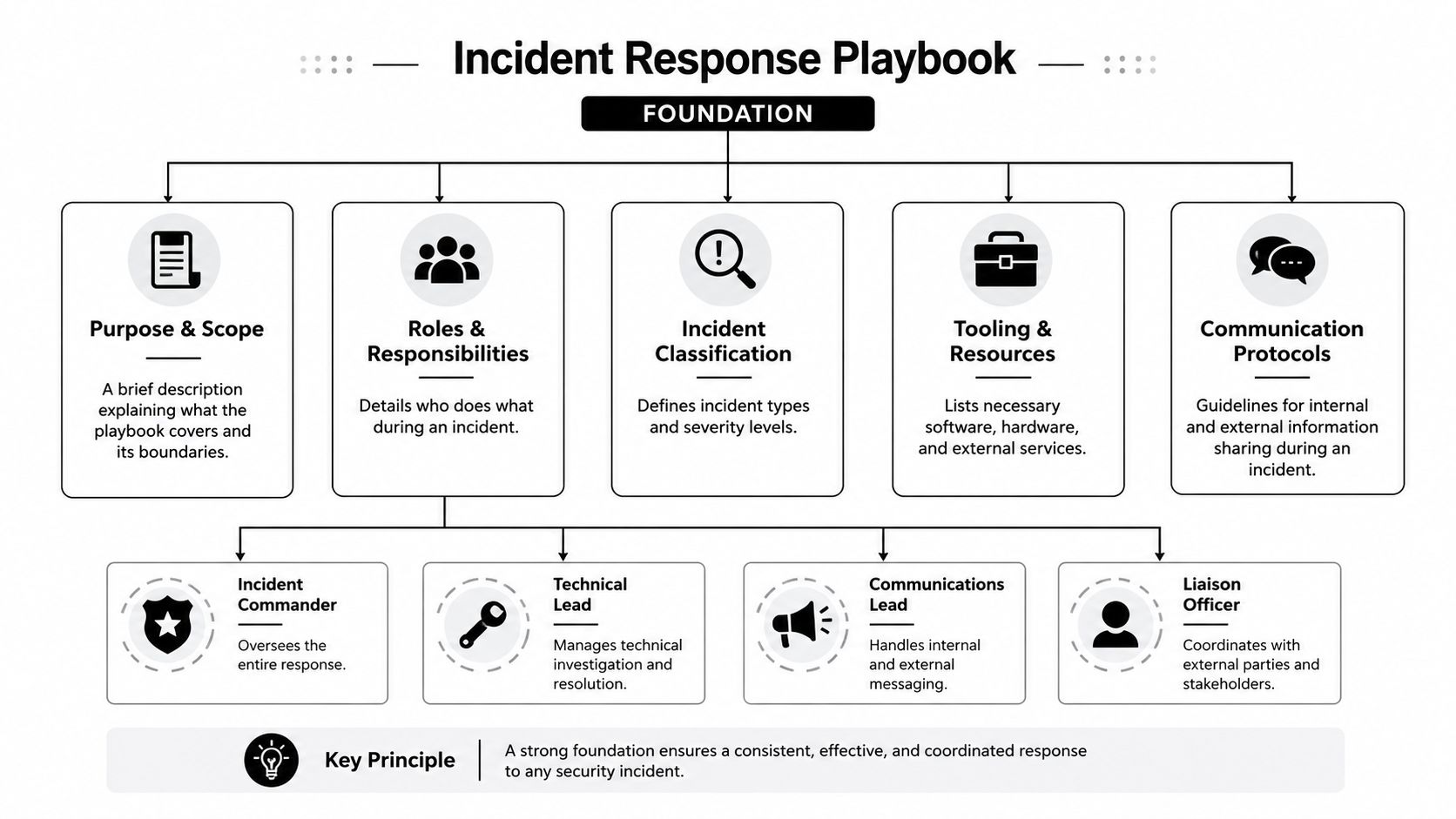
A strong playbook doesn't begin with malware steps or draft notification emails. It begins with structure. If the foundation is weak, the technical workflow won't hold when a real event forces quick judgment.
Why roles come first
For most SMBs, the biggest early mistake is assuming titles automatically define incident authority. They don't. The office manager, compliance contact, outside IT provider, and owner may all be critical during an event, but each needs a clear lane.
According to CISA, federal government playbooks require organizations to document designated coordination leads and escalation protocols. This sets a compliance benchmark that extends to regulated industries, making role definition an essential first step, as outlined in CISA's incident response playbook requirements.
At a minimum, most regulated SMBs should assign these roles:
- Incident Commander: Owns decisions, approves escalations, and keeps the response moving.
- Technical Lead: Confirms scope, directs containment, and preserves evidence.
- Communications Lead: Controls internal messaging, external notices, and stakeholder updates.
- Compliance or Legal Contact: Reviews reporting duties and records decisions tied to regulated data.
- Executive Sponsor: Removes roadblocks and approves business-impacting calls when needed.
A small company may assign more than one role to the same person. That's fine if it's deliberate. It becomes dangerous when it happens by accident.
A good playbook doesn't try to make a small team look bigger. It makes a small team act with less confusion.
For businesses that want a broader perspective on messaging discipline under pressure, insights on crisis preparedness for businesses are useful because they reinforce a point many technical teams miss. Communication must be planned before a crisis, not drafted in the middle of one.
Define assets triggers and compliance obligations
Once roles are assigned, the next task is to define what the playbook protects. A regulated SMB should identify its crown jewels in plain business language, not just technical language. That usually includes client files, protected health information, financial records, payroll data, email, cloud storage, line-of-business apps, remote access systems, and backup repositories.
A short asset inventory should answer four questions:
- What data or systems would stop operations if unavailable
- What data would create a reporting duty if exposed
- Who owns each critical system
- Which outside vendors support or host it
Many teams benefit from aligning the playbook with a formal data classification policy for regulated businesses. If data types aren't classified ahead of time, responders will waste valuable minutes debating whether an event is merely inconvenient or reportable.
The playbook also needs launch criteria. Not every help desk ticket should trigger a full response, but the team should know what does. Good triggers often include unauthorized access indicators, ransomware behavior, privilege misuse, confirmed phishing compromise, unusual outbound data transfer, or a vendor notification tied to systems the business relies on.
Finally, map those triggers to your obligations. A healthcare clinic, law office, accounting firm, or nonprofit handling sensitive records doesn't need a generic checklist. It needs workflows that tell staff when to preserve logs, when to involve counsel, when to freeze user actions, and when formal reporting timelines begin. That turns the playbook into an auditable operating document instead of a shelf document.
Building Your Core Response Workflows and Checklists
Once the foundation is set, the playbook needs working procedures. Many SMBs frequently overcomplicate the document. They build a giant manual no one can use at speed. A better approach is to create short, scenario-based play cards for the incidents most likely to affect the business.
Build plays around decisions not theory
The most practical workflow follows the core rhythm already familiar to practitioners. Detect and analyze. Contain and eradicate. Recover and review. What makes the playbook effective is not the section names. It's the quality of the decisions inside each phase.
A usable workflow tells responders:
- What must be confirmed first: Is the alert real, what systems are affected, and what business process is at risk
- What actions are allowed immediately: Isolate device, disable account, revoke access, preserve logs, pause a service
- What needs approval: Customer communication, regulatory contact, broad shutdown, forensic engagement
- What marks completion: Threat removed, systems restored, communication issued, lessons captured
For regulated SMBs, short checklists beat long prose. The people using the playbook may be stressed, interrupted, and balancing technical work with operational demands. They need a sequence they can execute, not a policy essay.
A disciplined opening sequence matters. A high-fidelity playbook mandates a strict T+0 to T+15 minute methodology: T+0 requires assigning an Incident Commander, T+5 demands confirming impact, T+10 necessitates a mitigation decision, and T+15 requires a status update. This time-boxed approach prevents "analysis paralysis", as described in this guide to time-boxed incident response actions.
Sample ransomware incident checklist
Below is a simple model for a ransomware play card. The exact actions will vary by environment, but the structure should stay clear and role-based.
| Timeframe | Incident Commander Task | Technical Lead Task | Communications Lead Task |
|---|---|---|---|
| T+0 | Declare incident, assign owners, start incident log | Review alert source, identify affected users and systems, preserve current state | Prepare internal holding statement and leadership contact list |
| T+5 | Confirm severity and business impact | Validate whether encryption behavior is active, isolate affected endpoints or shares, stop nonessential changes | Notify leadership that investigation is active and messaging is controlled |
| T+10 | Approve containment path based on verified impact | Decide on rollback, failover, isolation expansion, or hotspot containment | Draft support guidance for employees and client-facing teams |
| T+15 | Approve first status update and next review time | Document systems affected, accounts involved, and immediate evidence preserved | Send approved status update and route all external questions through one channel |
| Stabilization | Coordinate business priorities with technical progress | Check backups, remove persistence, validate clean recovery path | Prepare customer, partner, or regulator communications if required |
| Recovery | Approve service restoration order | Restore systems, verify integrity, monitor for reinfection | Update stakeholders on service status and required user actions |
| Post-incident | Lead review and assign fixes | Document root cause, control gaps, and remediation tasks | Archive all communications and reporting records |
That table is intentionally simple. A real playbook card should also identify dependencies, required approvals, and exact evidence-handling rules.
What good checklists actually prevent
The point of a checklist isn't bureaucracy. It's loss prevention. In unstructured responses, teams often reboot too early, wipe evidence, forget to notify internal stakeholders, or restore systems before they understand how the compromise occurred.
A good checklist prevents those errors by forcing sequence and ownership.
"Fast" isn't the same as "rushed." The right playbook helps a team act quickly without skipping the steps that protect recovery and compliance.
The same principle applies outside ransomware. Phishing playbooks should specify when to disable accounts and search for lateral misuse. Unauthorized access playbooks should define login review, session revocation, and file access validation. Vendor-related incidents should include handoff triggers and named contact paths.
Maintenance matters too. If systems are left unpatched, the response burden gets heavier and the containment path gets narrower. Businesses that need to tighten those upstream controls should also examine a disciplined patch management process for business environments, because response quality always depends on the state of the environment before the incident starts.
Managing Communications and Third-Party Escalations
The technical team can make all the right moves and still leave the business exposed if communication breaks down. In regulated environments, silence, inconsistency, and vague updates create their own risk.
Communication protects operations and credibility
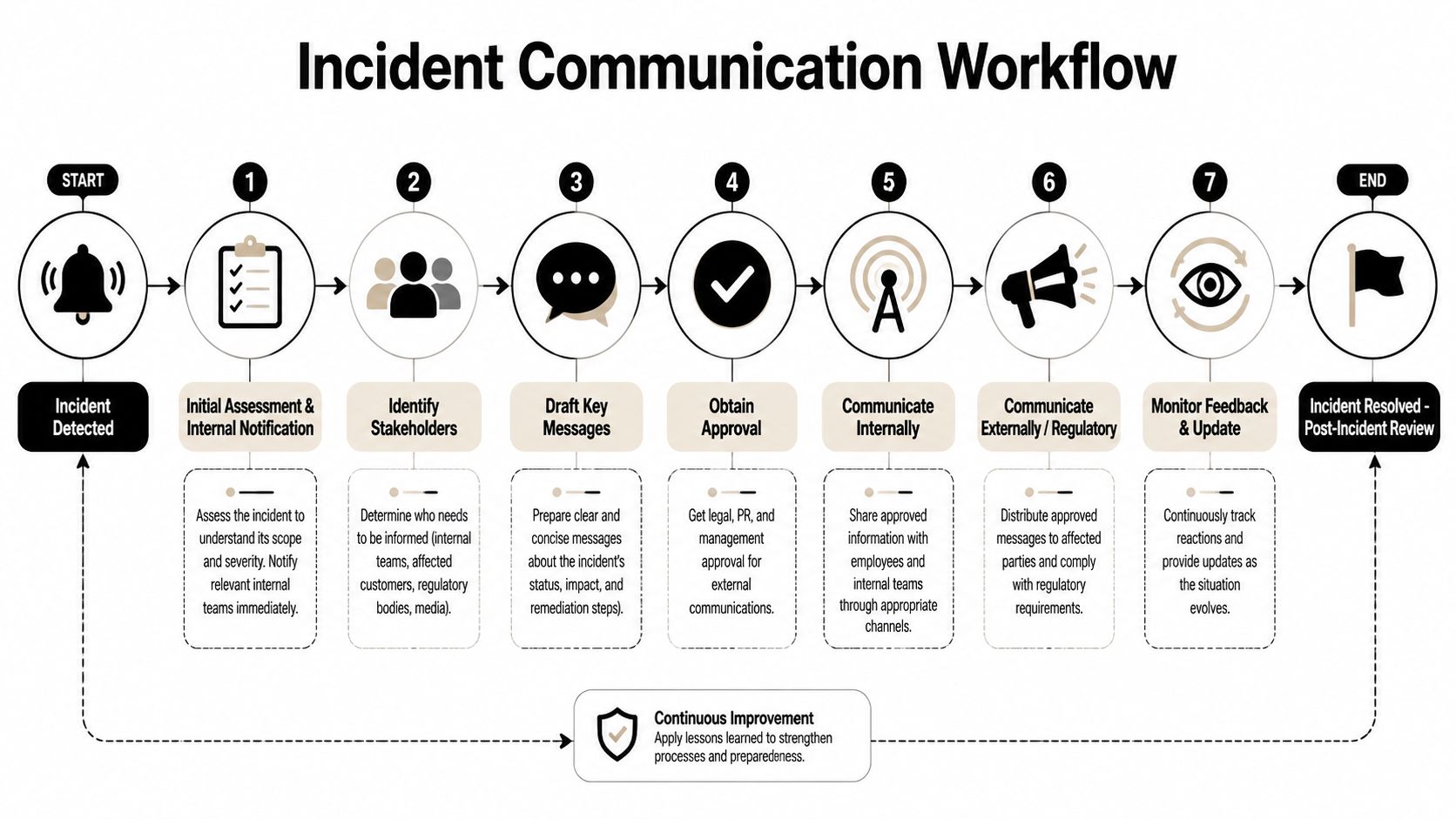
An incident response playbook should include pre-approved message templates for four groups. Leadership needs business impact and decision points. Employees need clear instructions on what to stop doing and where to send questions. Clients need accurate, limited information tied to service continuity. Regulators or counsel need documented facts and timelines.
That doesn't mean writing a dramatic breach announcement in advance. It means building controlled message formats such as:
- Leadership brief: what happened, what is confirmed, what is being done now, next update time
- Employee notice: what systems to avoid, whether passwords must change, where to report suspicious behavior
- Client service update: whether operations are affected, what support path to use, when the next update will be issued
- Formal reporting draft: date discovered, systems involved, current scope, preservation actions, designated contacts
Discipline is governance. One person owns outbound communication. Legal and compliance review what needs review. Front-line staff are told not to improvise.
Businesses dealing with cross-border obligations or complex notification exposure may also benefit from reading critical cyber law advice for businesses, because communication errors often become legal problems long before the technical work is finished.
A simple third-party escalation model
Many SMB playbooks fall short. They assume the incident starts internally and stays there. In reality, a cloud host, software vendor, outside support provider, or business partner may be the source of the disruption or compromise.
That gap has consequences. 68% of organizations report that third-party incidents take longer to contain due to missing escalation paths and unclear communication workflows, yet most playbooks focus almost exclusively on internal threats, according to guidance on third-party incident response gaps.
A practical third-party section should answer these questions immediately:
- Who calls the vendor first: name, role, and backup contact
- What evidence is shared: ticket details, timestamps, affected systems, user impact
- What authority the vendor has: observe only, advise only, or execute approved actions
- When the issue escalates internally: service outage, suspected data exposure, missed response deadlines
- How communication is logged: one incident record, not scattered emails
Operational note: If a vendor supports a critical system, the playbook should treat that vendor's incident queue as part of the business's response workflow, not as a separate universe.
A vendor management program supports this long before the incident starts. Businesses refining those handoffs should review best practices for vendor management in regulated environments, especially where hosted applications, remote access, and outside administrators are involved.
The best communication plan doesn't try to say everything. It makes sure the right people hear the right message at the right time, and that every handoff has an owner.
Activating Your Plan Through Testing and Simulation
A written playbook feels reassuring. It can also create false confidence. Plenty of businesses have a document with named roles, workflows, and reporting notes that no one has ever used in a realistic drill.

A written plan is only a starting point
The problem isn't documentation. The problem is assuming documentation equals readiness. It doesn't. Under pressure, people skip steps they thought were obvious, miss approvals they thought were assigned, and discover dependencies they never captured.
That is why expert analysis reveals that a primary reason incident response plans fail is the lack of regular, realistic simulations; organizations must conduct exercises that mimic real-world attacks to force teams to adapt under pressure, rather than relying on static documentation, as explained in this analysis of why incident response plans break down.
Testing reveals practical issues that policy reviews miss:
- Role overlap: Two people believe the other person owns a decision
- Approval delays: Legal, compliance, or leadership review paths are too slow
- Technical blind spots: Logs, backups, or access records aren't available when needed
- Communication confusion: Staff don't know where official updates come from
- Vendor friction: Support contracts and escalation contacts are incomplete or outdated
How an SMB should run its first exercise
A first tabletop exercise doesn't need a war room or a large security team. It needs a realistic scenario, the right participants, and someone willing to stop the discussion whenever the group starts hand-waving a decision.
A useful first exercise often looks like this:
- Choose one scenario with business impact. Ransomware on a file server, email account takeover for a finance employee, or suspected exposure through a hosted application are all practical.
- Use actual names and systems. Replace placeholders with real departments, real contacts, and real dependencies.
- Walk minute by minute through the opening response. Who declares the incident, who verifies impact, who can isolate a system, who approves downtime.
- Force communication decisions. Ask what leadership hears, what employees hear, and whether clients are told anything yet.
- Capture every pause. Any moment of uncertainty becomes a revision item for the playbook.
The exercise is successful when it exposes friction. If everyone agrees too quickly, the scenario probably wasn't realistic enough.
After the tabletop, the business should update the playbook immediately while the confusion points are still fresh. That may mean revising contact trees, simplifying escalation rules, or adding decision thresholds for outside counsel, insurance carriers, or key vendors.
More mature organizations add technical simulations and collaborative blue-team versus attacker-style exercises later. But the first win is simpler. Turn the playbook from a document people admire into a workflow people can execute.
From Reactive Firefighting to Proactive Resilience
The best incident response playbook changes more than incident handling. It changes how leadership thinks about risk, accountability, and operational maturity. A company stops treating security events as isolated emergencies and starts managing them as repeatable business processes.
Measure the response not just the outage
A regulated SMB needs a way to tell whether the playbook is improving performance. That requires operational metrics, not gut feel. To ensure speed and accuracy, response drills must track Mean Time to Detect (MTTD) and Mean Time to Resolution (MTTR), as these metrics are the primary indicators of response efficacy and allow organizations to quantify performance and measure improvements over time, according to guidance on evaluating incident response drills.
Those metrics are useful because they expose different weaknesses.
- MTTD rises when alerts aren't reviewed fast enough, users report too late, or ownership is unclear
- MTTR rises when containment requires too many approvals, system dependencies are poorly understood, or restoration steps are incomplete
A mature playbook review should also ask qualitative questions. Did the team preserve evidence correctly. Did leadership receive concise updates. Did employees know where to route concerns. Did third parties respond on the expected path. Those answers matter when regulators, insurers, boards, or clients want proof that the business learns from incidents instead of merely surviving them.
For business owners comparing broader service approaches and managed protection models, Wisenet Security Ltd's cyber protection offers another perspective on how organizations package resilience, monitoring, and response as an ongoing discipline rather than a one-time project.
What resilience looks like in practice
Reactive firefighting sounds like this. Call the IT person. Wait for an update. Hope the backup works. Figure out reporting later.
Proactive resilience looks different. Critical data is classified. Roles are assigned. The first actions are preauthorized. Vendor contacts are current. Communications are templated. Drills happen on a schedule. After every exercise or real event, the playbook gets revised.
That shift matters because resilience isn't built during the crisis. It's revealed during the crisis.
For a DFW healthcare clinic, law firm, accounting office, nonprofit, or growing business with sensitive data, an incident response playbook is one of the clearest signs of operational seriousness. It shows that the company can absorb disruption, document decisions, and meet obligations without turning every incident into a leadership scramble.
The question for most SMBs isn't whether they need a playbook. It's whether the one they have is specific enough to work when people are under pressure.
A practical next step is to have Technovation LLC review current response procedures, vendor handoffs, and compliance reporting gaps through a security audit. For regulated SMBs in Dallas Fort Worth, that kind of assessment can turn a generic incident document into a working playbook the business can trust when an incident hits.